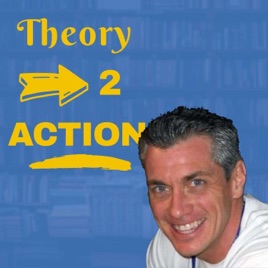
Advertise on podcast: Theory 2 Action Podcast
Rating
4.3from
This podcast has
646 episodes
Language
EnglishPublisher
David KaiserExplicit
No
Date created
2021/07/03
Latest episode
2026/10/08
Average duration
21 min.
Release period
7 days
Description
We examine and explore the great books, to extract their nuggets of wisdom helping to save you time, and ultimately to take action to FLOURISH in life. Powered by The MOJO Academy.
Unlock Theory 2 Action Podcast podcast Email contact info,
Listeners & Audience details
Email contact information
Direct podcast contact details

Listeners
Audience numbers & engagement insights

Audience details
Podcast Insights

Podcast episodes
Check latest episodes from Theory 2 Action Podcast podcast
LM#83--How Democracies Confront A Death Cult
2026/10/08
FAN MAIL--We would love YOUR feedback--Send us a Text Message
A young man murders a woman, takes her phone, and calls his parents to brag about how many Jews he killed. That single, sickening detail forces a question most people try to dodge: what do you call an ideology that doesn’t just commit murder, but celebrates it without shame?
We use Douglas Murray’s “Democracies and Death Cults: Israel and the Future of Civilization” to walk straight into that question. Murray argues October 7 was not “war” in any normal sense, but a hunt for civilians, followed by hostage taking. We break down the recorded phone call Murray cites and the three telltale signs inside it: excitement instead of remorse, parents who bless the violence, and a culture where killing is treated like a proud achievement. Along the way, we wrestle with a haunting warning from George Weidenfeld, a Jewish refugee from Nazi Austria, who believed some modern antisemitism is worse than what he saw in the 1930s.
Then we turn toward what a free society does next. Weidenfeld’s own life offers a path: he repays courage with courage, helping others escape ISIS years later. We also pull in Marco Rubio’s speech in Athens at the cradle of democracy, where he names the “cult of death,” calls the West to stop being ashamed of its history, rebuild strength, and stand together against terror networks and their sponsors. If you care about October 7, Hamas, antisemitism, Israel, Western civilization, and defending democracy with moral clarity, this one is for you.
Key Points from the Episode:
• recounting the October 7 atrocities and why plain language matters
• Douglas Murray’s definition of a death cult and what the recorded call reveals
• the three details in the call that expose pride without remorse
• George Weidenfeld’s warning about hatred worse than Nazis
• why hiding evil versus broadcasting it changes the moral stakes
• refusing silence as antisemitism spreads across the West
• Rubio’s Athens message: stop being ashamed, choose strength, stand together
• rebuilding conviction at home through truth, virtue, and gratitude
Links:
📩 5 min Book Briefs + Writings on Substack 👇
Substack https://mojoacademy.substack.com/
🤪 Every single week we publish a newsletter called Crazy versus Common Sense. The crazy versus common sense newsletter.
And friends, it's completely free!! So go sign up today. https://crazyvscommonsense.substack.com/
LM#82--The RAF Fairford Scare And What It Means For US Security
2026/09/29
FAN MAIL--We would love YOUR feedback--Send us a Text Message
Three vans. Five men. Two in the morning. And a road that points toward RAF Fairford, one of the most important bomber operating locations tied to US power projection in Europe. When British counterterrorism police make arrests that trigger evacuations and bomb disposal teams, then release the suspects on police bail, it raises a question we can’t ignore: what does a “near miss” around a strategic air base mean for American security, NATO deterrence, and the safety of our people overseas?
I walk through what we actually know versus what we don’t, because a suspicious stop is not the same as a confirmed attack, and precision matters if we want to respond wisely. Then we dig into why Fairford matters at all, from heavy bomber access to alliance signaling, and why threats don’t have to breach a gate to be deadly. Bases rely on supply lines, contractors, nearby towns, and a public that’s willing to report what looks wrong.
We also tackle the motive question without pretending certainty. We talk about Iran’s long history of proxy warfare and sponsorship of groups like Hezbollah and Hamas, the reality of rapid online radicalization, and the broader civilizational and internal cohesion pressures that can weaken an ally from within. The big takeaway is simple and unsettling: the front line is no longer a place on a map.
Key Points from the Episode:
• the known facts of the RAF Fairford arrests and what “police bail” means in the UK system
• why RAF Fairford serves as a critical US bomber launch pad for Europe and beyond
• separating suspicion from certainty while the motive remains unknown
• how Iran’s proxy strategy shapes threats even when the links are not proven
• why overseas base security depends on roads, towns, contractors, and citizen reporting
• the question of allied resilience and internal stability as part of deterrence
• “the front line is no longer a place on a map” as the core lesson
• the key questions to watch: what was in the vans, was Fairford the target, was a foreign state involved, will charges follow
Be sure to check out our show page at TeamMojoAcademy.com, where we have everything we discussed in this podcast as well as other great resources.
Read book briefs 44 and 45 on Substack.
Go back and listen to Liberty Minute 81.
Links?
📩 5 min Book Briefs + Writings on Substack 👇
Substack https://mojoacademy.substack.com/
🤪 Every single week we publish a newsletter called Crazy versus Common Sense. The crazy versus common sense newsletter.
And friends, it's completely free!! So go sign up today. https://crazyvscommonsense.substack.com/
MM#489--A History Comparison: Two Mornings That Changed America
2026/09/22
FAN MAIL--We would love YOUR feedback--Send us a Text Message
A normal morning can be the most dangerous setup in history. We look back at two dates that still define American memory December 7, 1941 and September 11, 2001 and ask why they feel so similar at first, yet lead to very different kinds of wars. Using the 9/11 Commission Report as our anchor, we trace how surprise attacks expose something deeper than gaps in weapons or intelligence: a failure of imagination, an inability to picture what an enemy might actually attempt until it’s already happening.
From Pearl Harbor’s shock to America’s industrial surge, we pull out an uncomfortable but empowering truth: the United States becomes the mightiest power on earth after it’s caught unprepared, because it chooses to rebuild and outproduce its enemies. That’s not a story about starting strong. It’s a story about refusing to stay weak, and it points to the kind of national character that still matters when the world turns.
Then we draw the line where the comparison breaks. Pearl Harbor has a nation-state behind it, something you can find on a map and force to surrender. 9/11 comes from a networked ideology, and you can defeat a country but you cannot invade an idea. That’s where Samuel Huntington’s Clash of Civilizations enters the conversation, along with the sobering reality that the War on Terror never offered a clean finish line, and that the threat adapts through proxies, online radicalization, and new theaters of conflict.
We close with three lessons worth keeping: don’t confuse eventual victory with early strength, don’t mistake a quiet decade for a solved problem, and prepare for what you haven’t imagined yet because the next Pearl Harbor may come through cyber attacks, disinformation, or a power grid.
Key Points from the Episode:
We pull lessons from the 9/11 Commission Report and Huntington’s Clash of Civilizations to ask what it means to fight a networked ideology without a clear finish line.
• the emotional and historical parallels between December 7, 1941 and September 11, 2001
• why America’s pre-1941 weakness matters more than the later victory story
• the “failure of imagination” problem and the cost of not connecting the dots
• how Pearl Harbor produces a visible enemy and a definable end state
• why the War on Terror differs when the enemy is an ideology and a network
• what Huntington predicts about civilizational conflict and why it still resonates
• how threats adapt after 2011 through proxies, online radicalization, and instability
• why cyber attacks, drones, and disinformation may define the next crisis
• three practical lessons: don’t confuse victory with early strength, don’t assume quiet means solved, prepare for the unimaginable
If this episode helped you to see the story more clearly, I'd be grateful if you left a review. Click the link if we've earned five stars from you.
Other goodness
Check us out over at substack! We are building and have built out a whole library of book briefs, just one pager's five-minute read over at the Mojo Book Academy on Substack, mojoacademy.substack.com.
Keep fighting the good fight!
If this made you think, subscribe, share it with a friend, and leave a review so more people can find the show.
LM#81--Sept 11th--25 years later: A Western Civilization Defense
2026/09/07
FAN MAIL--We would love YOUR feedback--Send us a Text Message
A Harvard professor made a prediction in the 1990s that sounded almost rude at the time: the Cold War didn’t end history, it just cleared the stage. Twenty five years after 9/11, we take that prediction seriously and ask what Samuel P. Huntington’s Clash of Civilizations gets right about identity, religion, and culture as forces that shape politics and war.
We walk through Huntington’s core ideas in plain language: what a “civilization” is, how each of us carries layered identities, and why those identities don’t disappear when markets grow or borders shift. Then we test the theory against reality. 9/11 wasn’t random violence, and it wasn’t simply a story about poverty or policy mistakes. It was a declaration from a revolutionary strain of Islamist politics, and Huntington’s historical runway helps explain how decades of grievance, power, and memory set the conditions. We also draw a bright line that matters: al Qaeda does not speak for Islam, and many of the victims of jihadism have been Muslims themselves.
From there, we turn the lens back on us. We talk about America’s mixed post 9/11 record, the limits of exporting democracy, and the evolving threats that replaced any illusion of a “peace dividend,” from cyber conflict to authoritarian rivals to mass migration used as pressure. Finally, we ask the hardest question: if culture is this durable, why is Western civilization worth defending? We make the affirmative case for rule of law, freedom of conscience, constitutional government, inherent human dignity, and ordered liberty, and we lay out what defense looks like in daily life: education, speech, borders, and strong local institutions.
Key Points from the Episode:
• marking 9/11 with grief, names, and historical memory
• defining “civilization” as the deepest cultural layer
• explaining layered identity and how it can change
• tracing Huntington’s core claim from ideology to culture
• correcting the “civilizations as monoliths” mistake
• using the framework to understand jihadism without equating it with Islam
• judging America’s post-9/11 record as mixed: strong defense, weak nation-building
• naming modern threats after Bin Laden: Iran, migration as a weapon, cyber conflict, China, Russia, Western self-doubt
• making the affirmative case for Western civilization: dignity, rule of law, freedom of conscience, ordered liberty
• outlining what defending the West looks like: free speech, real education, humane borders, strong local institutions
Links?
Huntington's 1993 Foreign Policy article
📩 5 min Book Briefs + Writings on Substack 👇
Substack https://mojoacademy.substack.com/
🤪 Every single week we publish a newsletter called Crazy versus Common Sense. The crazy versus common sense newsletter.
And friends, it's completely free!! So go sign up today. https://crazyvscommonsense.substack.com/
🎙️ Theory 2 Action podcast 👇
Website and other great resources https://www.teammojoacademy.com/
LM#80--Youtube Channel Banned
2026/09/01
FAN MAIL--We would love YOUR feedback--Send us a Text Message
Somebody flipped a switch and more than a hundred hours of work disappeared. That’s not a metaphor. Our Mojo Academy YouTube channel gets terminated with a single email citing “impersonation,” no warning, no specific video, and no clear explanation and it forces a blunt question: if a platform can erase your work instantly, what do you actually own?
We walk through what the ban feels like, why the appeal process matters, and why this is bigger than one channel. When the rules are invisible and the decision-maker is unaccountable, “platform” starts to look a lot like “landlord.” So we talk practical resilience for creators and builders: backups, diversified distribution, and why Substack and a podcast feed can protect your relationship with your audience when algorithms and policies change.
Then we zoom out to politics with Matthew Goodwin’s Suicide of a Nation, the concept of “suicidal empathy,” and the claim that Britain’s institutions have drifted from the people they exist to serve. We connect that UK warning to American concerns about borders, trust, and parties that stop listening to their voters, drawing parallels to books like Douglas Murray’s work and Todd Bensman’s Overrun.
We close by explaining what the Mojo Academy Book Brief is, why we built it, and what’s coming next with longer Academy Reviews and narrated audio. If you care about free speech, deplatforming risk, immigration debates, and staying grounded in real arguments instead of hot takes, hit play, subscribe, and share this with a friend. After you listen, leave a review and tell us: where are you building what you can’t afford to lose?
Key Points from the Episode:
• YouTube channel removal with no warning and no named violation
• Why deplatforming feels like erasure of work
• The “platform vs landlord” lesson and owning distribution
• “Suicide of a Nation” and the idea of suicidal empathy
• UK immigration, identity, and institutions drifting from the public
• Parallels to US politics, borders, and parties losing voters
• What the Mojo Academy Book Brief includes and how to use it
• Why Substack becomes the hub and what Academy Review adds
Links?
📩 5 min Book Briefs + Writings on Substack 👇
Substack https://mojoacademy.substack.com/
🤪 Every single week we publish a newsletter called Crazy versus Common Sense. The crazy versus common sense newsletter.
And friends, it's completely free!! So go sign up today. https://crazyvscommonsense.substack.com/
🎙️ Theory 2 Action podcast 👇
Website and other great resources https://www.teammojoacademy.com/
MM#488--The Five Year Anniversary of Abbey Gate And The Cost Of Hesitation
2026/08/26
FAN MAIL--We would love YOUR feedback--Send us a Text Message
A single moment at Abbey Gate still captures a whole era of American foreign policy: a Marine identifies a threat, asks for permission to act, and is told no until the danger disappears into the crowd. Hours later, the Kabul evacuation turns into a massacre that kills 13 American service members and scores of Afghan civilians. Five years on, we slow down and tell the story with the weight it deserves, because remembrance means more than silence. It means asking what decisions were made, who owned them, and why accountability never showed up afterward.
From there, we zoom out and connect three books that frame the problem in plain terms. We use Michael Mandelbaum’s “The Four Ages of American Foreign Policy” to explain how the United States became a hyperpower and still stumbled through repeated setbacks. We pull in Serhii Plokhy’s writing on the Russo-Ukrainian War to underline a pattern: ambiguity is an invitation, and hesitation is never neutral. When the free world hedges, predators don’t wait politely. We tie those ideas back to Kabul, where America had the tools to secure the evacuation but lacked the competent, decisive leadership to use them.
Then we face the present. Afghanistan under the Taliban is a closed emirate, and the crisis for women and girls is among the worst on the planet. We also dig into Iran and the administration’s next move: “Economic D-Day,” a strategy built around aggressive secondary sanctions and maritime pressure designed to squeeze Iran’s cash without launching another shooting war. The big question is enforcement, especially when most Iranian oil reportedly flows to China and the world watches whether Washington has the stomach to follow through.
Key Points from the Episode:
• Recounting the Abbey Gate timeline and the denied requests to engage a suspected bomber
• Arguing that these deaths are not inevitable but tied to incompetent, unaccountable decisions
• Explaining the “hyperpower without success” idea and why strength fails without will
• Linking Afghanistan, Georgia, and Ukraine through the lesson that ambiguity invites aggression
• Asking what Afghanistan looks like under Taliban rule and what happened to women and girls
• Debating why the US stayed after 2011 and what “finishing the job” would have required
• Assessing Iran pressure after regional strikes and the way allies hedge when costs rise
• Breaking down “Economic D-Day,” secondary sanctions, maritime blockade concepts, and the China enforcement problem
If this episode helped you to see the story more clearly, I'd be grateful if you left a review. Click the link if we've earned five stars from you.
Other goodness
LM#37---American Foreign Policy, part 3
Check us out over at substack! We are building and have built out a whole library of book briefs, just one pager's five-minute read over at the Mojo Book Academy on Substack, mojoacademy.substack.com.
Keep fighting the good fight!
CC#47--When The Shepherd Stays Silent
2026/08/22
FAN MAIL--We would love YOUR feedback--Send us a Text Message
A 94-year-old cardinal walking into a Hong Kong courtroom might be the clearest sermon you’ll hear all week. Cardinal Joseph Zen sits beside Jimmy Lai’s wife as Lai, a 78-year-old Catholic and pro-democracy publisher, is sentenced to 20 years under Hong Kong’s national security law. Then a reporter asks Pope Leo XIV about Lai, and the answer is chilling in its restraint: “I cannot comment on that.” We sit with the contrast, because it raises a hard question about what Catholic leadership looks like when a believer becomes a political prisoner.
We connect that moment to the 2018 Vatican-China agreement on bishop appointments, a secretive Vatican-China deal that, in practice, appears to give Beijing leverage while Rome keeps a veto it never uses. We talk about what secrecy prevents: accountability, clarity for ordinary Catholics, and public advocacy for the underground Catholic Church in China as crosses come down, cameras go up, and clergy face detention or “re-education.” When the Vatican’s ability to speak depends on keeping a partner happy, the people who pay first are often the ones already under pressure.
We also look backward to look forward. Rome has tried “quiet treaties” with hostile regimes before, and history shows how quickly total-control governments break promises. We compare today’s approach to earlier Vatican diplomacy, the failures of Ostpolitik, and the model of naming evil plainly, even when it comes at a cost. If you care about religious freedom, Catholic persecution, and the moral limits of diplomacy, this conversation is for you.
Key Points from the Episode:
• Jimmy Lai’s 20-year sentence and Cardinal Joseph Zen’s public witness
• Pope Leo XIV’s response and what papal silence signals
• The 2018 Vatican-China agreement and why its secrecy matters
• Beijing’s leverage over bishops and Rome’s unused veto
• The underground Catholic Church in China under surveillance and coercion
• Historical parallel with the 1933 treaty and Pope Pius XI’s 1937 warning
• Ostpolitik versus public truth-telling and John Paul II’s example
• Named bishops detained or disappeared and the question of accountability
We have everything we discussed in this podcast as well as other great ways to work.
Links?
📩 5 min Book Briefs + Writings on Substack 👇
Substack https://mojoacademy.substack.com/
🤪 Every single week we publish a newsletter called Crazy versus Common Sense. The crazy versus common sense newsletter. And friends, it's completely free. So go sign up today. https://crazyvscommonsense.substack.com/
🎙️ Theory 2 Action podcast 👇
Website and other great resources https://www.teammojoacademy.com/
LM#79--What If Liberation Was Never Inevitable
2026/08/18
FAN MAIL--We would love YOUR feedback--Send us a Text Message
Ninety hours of World War II history sounds like a stunt until you realize what it does to your perspective. I just finished Rick Atkinson’s Liberation Trilogy on Audible, spread across six years, and I can’t stop thinking about what it means to “walk” from North Africa to Sicily, up the Italian campaign, and into the final push across Western Europe. This isn’t a cheerleading tour of victory. It’s a clear-eyed account of how the United States Army starts green, makes painful mistakes, and learns the hard way what modern war demands.
We talk about why this matters now, with the 80th anniversary of VE Day approaching and firsthand memories fading fast. Atkinson wrote these books so we would never be allowed to forget, and his reporting background shows up on every page: friendly fire, vanity at the top, racism in a segregated army, and the chaos of Kasserine Pass sit right alongside courage and endurance. The big takeaway is uncomfortable and necessary: liberation was never inevitable. It was paid for, one battle and one life at a time.
We also connect Atkinson’s ground-level storytelling to Victor Davis Hanson’s The Second World Wars, which asks the colder question: why did the Allies actually win? Hanson gives us the production, fuel, airframes, and industrial capacity that made victory probable. Atkinson gives us the men who had to climb out of the landing craft and make that probability real. Along the way, we share two passages that land like a weight, including Audie Murphy’s stark line about there being “no exhilaration at being alive.”
If you want a taste before committing to the full trilogy, we point you to the free Mojo Academy book briefs.
Key Points from the Episode:
• the six-year path through An Army at Dawn, The Day of Battle, and The Guns at Last Light
• why the 80th anniversary of VE Day makes remembering urgent
• Atkinson’s credibility as a Washington Post writer and two-time Pulitzer winner
• the US Army’s early mistakes in North Africa and what Kasserine Pass reveals
• how Sicily and Italy show adaptation without a triumphalist tone
• the idea that greatness is failing, adjusting, and finishing the job
• why liberation was paid for one soldier at a time
• the contrast with Victor Davis Hanson on industrial capacity and free men
• Audie Murphy’s “no exhilaration” as sacrifice without swagger
Links?
📩 5 min Book Briefs + Writings on Substack 👇
Substack https://mojoacademy.substack.com/
🤪 Every single week we publish a newsletter called Crazy versus Common Sense. The crazy versus common sense newsletter. And friends, it's completely free. So go sign up today. https://crazyvscommonsense.substack.com/
🎙️ Theory 2 Action podcast 👇
Website and other great resources https://www.teammojoacademy.com/
LM#78--Crazy vs Common Sense
2026/08/12
FAN MAIL--We would love YOUR feedback--Send us a Text Message
Seventy percent is not a fringe. If you have ever swallowed your words while someone called basic common sense “radical,” this Liberty Minute is for you. We start with a blunt claim: you are being sold a fake 50-50 story, and it is designed to make you doubt what you already know is true.
We walk through why we created the free Crazy vs. Common Sense newsletter on Substack and what it is actually for: giving you receipts before the next awkward moment with a coworker, a cable anchor, or your kid’s teacher. Instead of hot takes, we read the political books and history books and boil them down with a clear verdict. Each issue runs through timeless lenses that outlast fads: the US Constitution, the Western tradition, and Catholic teaching as historically taught. You get what the author nails, where the argument falls short, and our plain-language “crazy or common sense” call.
Along the way, we connect the project to Thomas Paine and the American habit of saying the obvious thing out loud in print when institutions normalize dysfunction. We also dig into polling that shows broad agreement across party lines, including questions where majorities label certain policies “completely crazy,” which raises a bigger question: who benefits when normal people stay quiet?
If you want political analysis grounded in books, data, and moral clarity, subscribe, share this with a friend who feels worn down, and leave a review so more people can find it. What is one “Tuesday opinion” you have felt pressured to apologize for?
Key Points from the Episode:
The crazy versus common sense newsletter. And friends, it's completely free. So go sign up today. https://crazyvscommonsense.substack.com/ the lie that “crazy” equals mainstream why we started the newsletter after hearing the same conversations everywhere everyday examples where people self-censor common sense Scott Jennings’ framing and the Thomas Paine connection how we review one political or history book each week the three lenses we use: Constitution, Western tradition, Catholic teaching five early issues on border security, election integrity, and institutional capture the 70% polling data that shows you are not the fringe why we include fair criticism of books to earn trust a five-minute format plus optional book briefs for busy readers
Go to crazy versus commonsense.substack.com right now. We are building and have built out a whole library of book briefs, just one pager's five-minute read over at the Mojo Book Academy on Substack, mojoacademy.substack.com.
Keep fighting the good fight!
Resources for this episode:
Sign up here https://crazyvscommonsense.substack.com/
Links?
📩 5 min Book Briefs + Writings on Substack 👇
Substack https://mojoacademy.substack.com/
🤪 Every single week we publish a newsletter called Crazy versus Common Sense. The crazy versus common sense newsletter. And friends, it's completely free. So go sign up today. https://crazyvscommonsense.substack.com/
🎙️ Theory 2 Action podcast 👇
Website and other great resources https://www.teammojoacademy.com/
🎥 Youtube Channel 👇
MOJO Academy on Youtube : click here
MM#487--Voters Decide Who Gets Counted Out
2026/08/03
FAN MAIL--We would love YOUR feedback--Send us a Text Message
They told Richard Nixon his career was over. Then they told him again. He proved them wrong twice and, for a moment, he looked unstoppable.
I walk through Nixon’s political exile after 1960 and 1962, then his return to win the presidency in 1968 and dominate in 1972. The point isn’t nostalgia or hero worship. It’s a hard look at how comebacks really happen when political elites rush to declare a leader finished, but the “lunch bucket” voters still show up, still work, and still vote. Along the way, I draw a modern parallel to Donald Trump’s 2024 comeback after years of investigations, prosecutions, civil suits, and impeachment fights, and why many Americans see that era through the lens of “lawfare” and institutional trust.
To understand the country that produced Nixon’s return, we go straight to a defining source: Theodore H. White’s Pulitzer-winning The Making of a President 1960. White helped invent modern campaign journalism, writing scenes that capture Kennedy’s discipline, Nixon’s exhaustion, and the first truly television-driven presidential race where looking presidential mattered as much as sounding presidential. We also lay out the pivotal election sequence of 1960, 1964, 1968, and 1972, including how Barry Goldwater’s loss plants seeds that later power Nixon and Reagan.
Finally, we face the hinge point: Watergate. I explain why White’s series couldn’t survive Nixon’s resignation, why he turns to Breach of Faith, and where we go next with a deeper Watergate dive through Geoff Shepard’s trilogy and the argument that scandals can become tools used against future presidents.
Key Points from the Episode:
• Nixon’s two political “deaths” and the mechanics of a real comeback
• why the Trump 2024 return fuels comparisons about elites, voters and “lawfare”
• Theodore White’s The Making of a President 1960 and what it changed in political journalism
• the first TV-era presidential campaign and why “looking presidential” becomes decisive
• how 1960, 1964, 1968 and 1972 map the conservative movement’s rise from Goldwater to Nixon to Reagan
• “order” as a winning message for an exhausted country
• Watergate as the turning point that breaks White’s series and reshapes trust in institutions
• preview of the upcoming Geoff Shepard's Watergate trilogy coverage and the claim that scandal becomes a political weapon
Other goodness
America's pivotal election series:
https://www.teammojoacademy.com/mm342-pivotal-tuesdays-series-the-election-of-1968-part-1/
https://www.teammojoacademy.com/mm343-pivotal-tuesdays-series-the-election-of-1968-part-2/
We are building and have built out a whole library of book briefs, just one pager's five-minute read over at the Mojo Book Academy on Substack, mojoacademy.substack.com.
Keep fighting the good fight!
LM#77--The Fight for the Soul of America is HERE
2026/07/23
FAN MAIL--We would love YOUR feedback--Send us a Text Message
Something snapped in American life and it didn’t start yesterday. We rewind to a question so many of us have asked at kitchen tables, over beers, and at our kids’ games: what happened to our country? Then we walk back through three books that, taken together, offer one diagnosis: America is in the middle of a cultural revolution, and the battleground is institutions, education, and the stories we tell about ourselves.
We connect Kevin Slack’s “long march through the institutions” to the practical mechanisms of cultural power: schools, bureaucracy, regulatory agencies, and the quiet rewriting of norms that later becomes policy. We bring in Mark Levin’s argument about the Democratic Party’s historical arc and a modern authoritarian playbook that aims to cripple opposition without openly destroying it. And we use Chris Rufo’s work to link ideas to institutions, tracing how revolutionary academic theories become the default language of elite credentialing, even when similar experiments have failed elsewhere.
From there, we lay out the broader timeline: 1972 as a hinge point, the fading of Cold War era center left patriotism, the rise of activist incentives, the jump in organizing power in the mid 2000s, Obama era acceleration, Bernie Sanders making democratic socialism culturally “respectable,” and the Democratic Socialists of America building durable local infrastructure. We end with the most important point: this outcome is not inevitable. If you care about civic education, American history, constitutional government, and raising kids who can tell truth from propaganda, this is a roadmap for how we got here and how to fight back without despair.
Key Points from the Episode:
• Slack’s “long march through the institutions” and how cultural change precedes political change
• Levin’s historical case for a modern appetite for control and the warning signs of soft authoritarian tactics
• Rufo’s link between academic theories and real institutional power, especially in schools of education
• 1972 as the hinge point and the slow incentives driven shift inside the Democratic coalition
• The pathway from Obama to Sanders to DSA as infrastructure, money, and local wins
• Why the outcome is not inevitable and how truth, history, and classical education push back
• The fight showing up at kitchen tables, schools, workplaces, and youth sports sidelines
We are building and have built out a whole library of book briefs, just one pager's five-minute read over at the Mojo Book Academy on Substack, mojoacademy.substack.com.
Keep fighting the good fight!
Resources for this episode:
Kevin Slack, professor of politics at Hillsdale College, and his book The War on the American Republic. Listen to Part 1 here.
Mark Levin, and The Democrat Party Hates America. Listen to Part 2 here.
Christopher Rufo, and America's Cultural Revolution. Listen to Part 3 here.
Links?
📩 5 min Book Briefs + Writings on Substack 👇
Substack https://mojoacademy.substack.com/
🤪 Every single week we publish a newsletter called Crazy versus Common Sense. The crazy versus common sense newsletter. And friends, it's completely free. So go sign up today. https://crazyvscommonsense.substack.com/
🎙️ Theory 2 Action podcast 👇
Website and other great resources https://www.teammojoacademy.com/
🎥 Youtube Channel 👇
MOJO Academy on Youtube : click here
MM#486--When Is A Compromise With Power A Betrayal
2026/07/18
FAN MAIL--We would love YOUR feedback--Send us a Text Message
A signature can look like safety, right up until the day it becomes worthless ink. We take you back to 1933 Germany to watch a deal get made with Adolf Hitler and then dismantled piece by piece, revealing why legal guarantees cannot protect anyone when an authoritarian regime treats law as theater.
We set the context most people miss: German Catholics had lived through decades of hostility stretching back to Bismarck’s Kulturkampf, and the chaos of Weimar Germany made the desire for a binding national promise feel urgent. When Hitler needs the Center Party’s votes to lock in power, he offers a trade that sounds “practical” on paper: the Reichskonkordat will protect Catholic schools, parishes, and legal standing, and in return the Church steps out of politics. Then the reality hits. Youth groups disappear, priests are surveilled, and the regime’s attacks on human dignity keep escalating.
From there, we draw a clear modern parallel to the Vatican’s agreement with the Chinese Communist government over bishop appointments, renewed through 2028, and Cardinal Joseph Zen’s public warnings about the underground Church being left behind. The question underneath both stories is the same: what actually protects the vulnerable when the people in power do not believe truth is real?
We end with the turning point in 1937, when Pope Pius XI releases Mit Brennender Sorge, smuggled into Germany and read from pulpits under the Gestapo’s nose, calling Catholics to spiritual resistance and naming the poison even when politics refuses to. If you care about religious freedom, church-state relations, and the limits of diplomacy under authoritarianism, this one will stay with you.
Key Points from the Episode:
• German Catholics shaped by decades of harassment under Kulturkampf
• Weimar instability fueling a desire for national legal guarantees
• Hitler trading “protection” for the Church’s silence in politics
• The Reichskonkordat’s promises contrasted with immediate Nazi violations
• Why agreements fail when leaders reject truth and justice
• Parallels to the Vatican’s China agreement and Cardinal Joseph Zen’s warnings
• Mit Brennender Sorge as a shift from diplomacy to defiance
• The covert distribution effort and the risk taken by clergy and laity
• The persecution that followed, including imprisonment and deaths at Dachau
Be sure to check out our show page at TeamMojoAcademy.com, where we have everything we discussed in this podcast as well as other great resources.
Links
📩 Book Briefs + Writings on Substack 👇
Substack https://mojoacademy.substack.com/
🎙️ Theory 2 Action podcast 👇
Website and other great resources https://www.teammojoacademy.com/
🎥 Youtube Channel 👇
MOJO Academy on Youtube : click here
LM#76--Hong Kong's Thomas More - Jimmy Lai
2026/07/15
FAN MAIL--We would love YOUR feedback--Send us a Text Message
A 78-year-old man sits in solitary confinement in Hong Kong with a 20-year sentence hanging over him. He could have left. He could have said the words that would have set him free. Jimmy Lai refused to lie, and that single act of conscience explains why authoritarian power reacts so fiercely to one person who won’t be bought or frightened into agreement.
We trace Lai’s story from his rise as a self-made publisher and founder of Apple Daily to the convictions that made him a political prisoner, then widen the lens to a timeless pattern: rulers don’t only want silence, they want affirmation. To make the point vivid, we bring in Robert Bolt’s A Man for All Seasons and the example of Sir Thomas More, whose quiet “no” threatened a king more than any army ever could.
From there, we get personal. Tyranny’s business model depends on getting good people to say things they don’t believe, and most of the time the pressure arrives in small, ordinary moments. A boss, a crowd, or an algorithm nudges you toward the easy line instead of the true one, and repetition slowly erases your ability to resist.
You’ll leave with one clear action step for the week, a sharper understanding of why free speech and freedom of the press matter, and a reason to take courage seriously before it costs more than you think.
Key Points from the Episode:
• the weight of “20 years” for a 78-year-old man and why it reads like a life sentence
• the Thomas More parallel from A Man for All Seasons and the danger of quiet refusal
• who Jimmy Lai is, why he founded Apple Daily, and why he stayed
• why regimes punish unbought people and make examples of them
• conscience as an antidote to tyranny and the everyday pressures to comply
• a simple action step for the next moment you feel pushed to say the comfortable lie
• a warning about treating communism as abstract and a call to sober attention at home
• prayer for Jimmy Lai and others imprisoned for refusing to bow
Want to go deeper?
Watch the documentary on Jimmy Lai's story and the fall of Hong Kong: The Hong Konger — freejimmylai.comGo back and listen to where this story started — our 2022 episode: LM #21 — Two Iron Ladies: The Hong KongerAnd keep Jimmy Lai in your prayers tonight, along with every man and woman sitting in a cell right now simply for refusing to lie.
Want to leave a review? Click here, and if we earned a five-star review from you — high five and knuckle bumps — we appreciate it greatly, thank you so much!
Keep fighting the good fight.
Links?
📩 Book Briefs + Writings on Substack 👇
Substack https://mojoacademy.substack.com/
🎙️ Theory 2 Action podcast 👇
Website and other great resources https://www.teammojoacademy.com/
🎥 Youtube Channel 👇
MOJO Academy on Youtube : click here
LM#75--America 250, pt 4: the Closing Argument for America
2026/07/07
FAN MAIL--We would love YOUR feedback--Send us a Text Message
America just hit a milestone that should make all of us pause: 250 years of self-government. We’re not doing a victory lap or a doom spiral. We’re making a case. Do the principles that built the United States still hold up, and if they do, why does it feel like we’re struggling to live them?
We walk through three “nuggets” that tie the whole America 250 series together, drawing on Brett Baier’s The Case for America along with the bigger story of American history. First, liberty isn’t a one-time event. It’s something every generation has to choose, protect, and pass down, not only on battlefields but in the way we disagree with each other. Lincoln’s call for charity toward all becomes a practical standard: dissent is part of freedom, but fracture is something else, and we have to learn the difference again.
Next, we dig into the American economic miracle as a blueprint, not a fluke: freedom that rewards invention, backed by limited government, produces prosperity because ordinary people are empowered to build and try and fail and try again. Finally, we talk about providence and why acknowledging it should shape our posture with humility and gratitude, especially if we believe rights come from God rather than government.
We close with the uncomfortable diagnosis: you can’t defend what you don’t understand, and civic literacy has eroded. If we want another 250 years, we need civics education and a renewed pursuit of virtue. Listen, share with a friend, and leave a review, then tell us what should change first: how we teach civics or how we practice virtue?
Key Points from the Episode:
• liberty as a generational choice that must be defended
• dissent as evidence of freedom rather than national fracture
• the American economic miracle as a repeatable blueprint
• freedom, invention, and limited government as the core formula
• rights coming from God rather than the state
• providence as gratitude and humility rather than swagger
• civic literacy as a shared practice that has eroded
• virtue as the glue that makes self-government easier in daily life
Be sure to like and subscribe, and check out our substack where we go in depth on more of these topics.
Links
📩 Book Briefs + Writings on Substack 👇
Substack https://mojoacademy.substack.com/
🎙️ Theory 2 Action podcast 👇
Website and other great resources https://www.teammojoacademy.com/
🎥 Youtube Channel 👇
MOJO Academy on Youtube : click here
LM#74--America 250, pt 3 - Divine Providence
2026/07/05
FAN MAIL--We would love YOUR feedback--Send us a Text Message
Where do your rights come from, and what happens to a country when it gets that answer wrong? We tackle the most radical political claim baked into the American founding: unalienable rights don’t come from the state, they come from God, and government exists to protect what you already have. That single idea flips the usual power equation and draws a hard line around conscience, belief, and the limits of political authority.
We lean on Michael Medved’s book The American Miracle to explore why the founders talked about Providence and why Medved insists key moments in the Revolutionary era feel like more than coincidence. From fog and storms to the timing of alliances, we weigh “luck” against “Providence” and land on a surprising takeaway: taking American exceptionalism seriously should produce humility and gratitude, not swagger or xenophobia.
Then we connect the dots to religious liberty and why it functions as the engine of every other freedom. We talk through the First Amendment tradition, the Virginia Statute of Religious Freedom, and the core principle that God created the mind free, so no ruler has rightful authority to coerce belief or punish dissent. We also look at how free conscience fuels reform movements, from abolition to civil rights, and why Tocqueville thought America’s blend of Christianity and liberty helped explain why the system worked.
Key Points from the Episode:
• the core question of rights and their source
• the founders’ radical claim that government protects rights rather than grants them
• Michael Medved’s The American Miracle and the case for Providence over luck
• why acknowledging providence points to humility and gratitude rather than arrogance
• religious liberty as the driver of abolition and civil rights reform
• Tocqueville on Christianity and liberty in the American mind
• the Virginia Statute of Religious Freedom and the First Amendment limits on government coercion
• why state power over conscience corrupts faith and breeds hypocrisy
Be sure to check out our show page at teammojoacademy.com, where we have everything we discussed in this podcast as well as other great resources.
if you like books 📚, this is your place
Links
📩 Book Briefs + Writings on Substack 👇
Substack https://mojoacademy.substack.com/
🎙️ Theory 2 Action podcast 👇
Website and other great resources https://www.teammojoacademy.com/
🎥 Youtube Channel 👇
MOJO Academy on Youtube : click here
Podcast reviews
Read Theory 2 Action Podcast podcast reviews
Highdottle 2021/08/04
Much needed!!
Excellent stuff David! Thank you for bringing this to all of us! I’m looking forward to checking out more stuff!!
JRW614 2021/07/14
Short Nuggets of Wisdom
I’ve added these to my routine. They are short enough to fit into a busy schedule and thought provoking enough to stir my curiosity. I have added at l...
Judy Renew 2021/07/06
Awesome
These are concise nuggets of wisdom. I look forward to them coming out every time.
Podcast sponsorship advertising
Start advertising on Theory 2 Action Podcast relevant audience podcasts
You may also like to advertise on these Podcasts
4.8265052000
Morning Wire
The Daily Wire
4.518774374
American Scandal
Audible

4.689351210
Get Sleepy: Sleep meditation and stories
Slumber Studios

4.79026375
Life is Short with Justin Long
Audible
4.714114348
Bad Friends
Bobby Lee & Andrew Santino

4.7127870
10 to Life
Annie Elise
4.76754463
Criminology
Emash Digital & Mike Ferguson, Mike Morford
4.87505975
The Dr. John Delony Show
Ramsey Network

4.512595664
RedHanded
RedHanded

4.858201918
Sara Gonzales Unfiltered
Blaze Podcast Network