1579175782
What Is X?

Advertise on podcast: What Is X?

Rating
★★★★☆
4.3
from
17 reviews
This podcast has
18 episodes
Language
English
Date created
2021/07/31
Latest episode
2022/06/14
Average duration
65 min.
Release period
18 days

Description

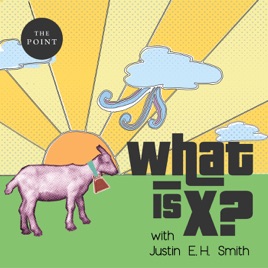
“What Is X?” has been described as “a cross between a Platonic dialogue and ‘The Price Is Right.’” It combines dialectical inquiry of the sort perfected by Socrates and his interlocutors with a distinctly ludic spirit. Here’s how it works: For each episode, host Justin E. H. Smith invites on a guest distinguished in their field (or occasionally a “regular” person who really likes to talk). Smith asks the guest to answer a question of the form “What is X?” (for example, “What is beauty?” “What is nature?” “What are dreams?”), after which the two partners in dialogue undertake a Socratic inquiry into the nature of X, in search of a definition that satisfies both of them. There are three possible outcomes: agreement, disagreement, and aporia (Greek for “dead end”), each with its own sound effect: if we arrive at agreement, a church bell will chime; disagreement is signaled by a bleating goat; if aporia is the best we can do, we will hear naught but a gust of wind. Rigorous but freewheeling, fun and serious at once, accessibly highbrow, these conversations model rational inquiry in a new way, providing answers for truth-seekers... or perhaps just more questions. /// Host: Justin E.H. Smith (justinehsmith.substack.com) /// Presented by The Point Magazine (thepointmag.com)

Unlock What Is X? podcast Email contact info,
Listeners & Audience details

Email contact information

Direct podcast contact details

Listeners

Audience numbers & engagement insights

Audience details

Podcast Insights

Social media

Check What Is X? social media presence


Podcast episodes

Check latest episodes from What Is X? podcast


What Is Authorship? | Jonathan Egid
2022/06/14
What counts as authorship? Why does it matter? Should we stop putting our names on what we write and sign off instead, as early scribes preferred to do, as nothing more than humble servants of God? In this episode, Justin E.H. Smith thinks through these questions with Jonathan Egid, writer and doctoral student in comparative literature at King’s College London. The two consider the Hatäta Walda Heywat—which, depending on who you ask, is either a seventeenth-century philosophical treatise by little-known Ethiopian philosopher Zera Yacob, or a forgery composed in the nineteenth century by the Italian monk who claimed to have discovered it. Was Zera Yacob a real person? If the monk did write the Hatäta, why would he choose to renounce his authorship, given how much work it would have taken? Smith and Egid discuss the motives behind self-effacement and self-promotion, the postmodernist idea of the death of the author, and why we keep reading Homer when we don’t know if he even existed. What does this all mean, they ask, for issues of representation and efforts to meaningfully diversify the philosophical canon?
What Are Conspiracy Theories? | Sam Kriss
2022/05/01
In this live-recorded episode of What Is X?, Justin meets up with the writer Sam Kriss at a (sometimes noisy) pub in London to chat about conspiracy theories. What makes a conspiracy theory conspiratorial? What is the relationship between conspiracy theories and philosophical skepticism?  Do we have a responsibility to correct misinformation, or should we try to embrace the right to be wrong? Over the course of this ninety-minute conversation, Justin and Sam amble through some conspiracy-theory greatest hits: the JFK assassination, 9/11 truthers’ interest in chemtrails, Jeffrey Epstein, COVID lab-leaks, "New Chronology," and the belief that all mountains were once trees—and even talk about some of their favorites. They wonder together about the relationship between the narratives spun by conspiracy theorists and those of novelists, poets and dreamers—might conspiracy theory be a kind of literature? Could the impulse behind conspiracy theories—like those of the "flat earthers" or those who believe the real sun has been replaced with an LED simulacrum—be understood not as madness or pure irrationality, but as something akin to a basic human desire for cosmological knowledge?
What Is Humor? | Luvell Anderson
2022/04/16
Longtime Point readers may remember that Justin E.H. Smith contributed to our issue 14 “What is comedy for?” symposium back in 2017. He now returns to the subject for us with this episode of “What Is X?” on humor. Joining him is Luvell Anderson, a philosophy professor at Syracuse currently at work on a book on the ethics of racial humor, from its dangers and transgressions to its progressive potential. Humor, Luvell tells Justin, is “a kind of dialogue with its culture, the cultural milieu in which it’s set.” So how, his project asks, should ethical considerations and cultural context bear on our judgments of what’s funny? What are the advantages and disadvantages of crude and less “respectable” humor, and what do we miss when we ignore their function as highly ritualized practices? What forms of communication is humor capable of that conventionally rational argument is not? To explore these questions, Justin and Luvell tackle a number of topics: the limits of satire, the tense relationship between humor and morality, and what Dave Chappelle and Hannah Gadsby have in common. Along the way, they also discuss why the Greeks thought lettuce was so funny, the tragedy of Richard Pryor, and whether a theorist of comedy needs a good sense of humor.
What Is Friendship? | S. Abbas Raza
2022/04/01
On this episode of “What Is X?” Justin E.H. Smith asks: What is friendship? His guest, S. Abbas Raza, is the founding editor of 3 Quarks Daily and has a graduate degree in philosophy from Columbia, but what qualifies him as an expert on this topic is quite simple: he is one of Justin’s oldest friends. Together, the two settle into a relaxed conversation on the nature of friendship—once a high priority for the ancient philosophers, and yet strangely neglected today—and take their own as something of a case study, probing its start in the mid-Nineties, its roots in the cultural differences between American and Pakistani conceptions of friendship, and how it has changed over time. From there they progress to timeless questions: Can you have too many friends? Is there really a distinction between the “true friend” and the “fair-weather friend”? Does the classic “Friendship ended with Mudasir” meme bear witness to a kind of relationship that simply does not exist in the U.S.? And most pressingly of all: Is friendship overrated?
What Is Consciousness? | Eric Schwitzgebel
2022/03/15
In this episode of “What Is X?” Justin E.H. Smith comes ready to be persuaded, as he tries to get a handle on one of the most difficult Xes of all: consciousness. What are the inner states we experience? Is figuring it out just a matter of neural activity, or might there be something to consciousness that science can’t fully apprehend? What is the nature of introspection, the stream of thoughts and experiences we have in the privacy of our own intellects? What are the boundaries of consciousness? Is it different from sense perception? What does it mean to “see” a red dot? From the origins of psychoanalysis to philosophy debates of the 1990s, Justin and Eric try to answer the question so poignantly captured by The Pixies: Where is my mind?
What Is Virtue? | Jennifer Frey
2022/03/02
The ancient conception of virtue is quite far removed from our own. Nowadays, we tend to think of virtue as a kind of moral righteousness, as opposed to sin. The Greeks, however, had a very different idea about virtue, or arete, as they called it. For Aristotle, virtue was a unique form of excellence, something that each person or animal or thing could aspire to. On this episode of “What Is X?” Justin E.H. Smith invites on philosophy professor Jennifer Frey to try to recover this idea of virtue and to ask whether Aristotle's definition can still work for us today. Along the way, they revisit the works of Aristotle, Augustine, Aquinas, Anscombe and Alasdair MacIntyre, and talk about everything from Madame Bovary to sea cucumbers. They ask: Does virtue ethics fit into the purview of moral philosophy, or should it stand alone? Is living a good life a matter of luck or effort? Is there one particular path to human flourishing? How should philosophy orient itself toward literature? And what is the best Coen Brothers movie?
What Is Love? | Dominic Pettman
2022/02/14
For Valentine’s Day, there was only one question “What Is X” could ask, one that thinkers through the ages, from Plato to Howard Jones, have not managed to answer: What is love? In this episode, Justin E. H. Smith is joined by New School media studies professor Dominic Pettman, the author of books such as Peak Libido and Creaturely Love, for a wide-ranging discussion of desire, romance and what it means to be completed by someone (or something) else. Starting with Plato’s Symposium, they move on to Agamben and Badiou, Leibniz and Lacan, Proust and Fourier, Spinoza and Berlant. (One lesson from this episode: philosophers might be our best aphorists of love.) With these thinkers, they’re prepared to tackle the big issues: the tension between love of hyper-singularity and love for the generic nature of humanity; whether love is work or grace; how Aristophanes predicted Sex and the City; whether you can marry the Berlin Wall, or a white-naped crane; and just how it is love is a concept we can use to describe both our romantic partners and the crucial cup of coffee we have each morning.
What Is Gender? | Robin Dembroff
2022/02/01
When it comes to gender, there are many big questions that people often get stuck on. On this episode of “What X?," Justin E. H. Smith asks Robin Dembroff, a professor of feminist and LGBTQ philosophy at Yale, to help untangle them. Justin and Robin start off by disambiguating sex and gender, with some help from the philosophical vocabulary of essence and telos. Gender, Robin argues, is the entire process of defining, classifying, and regulating people according not only to their body parts but on the basis of ideas of maleness and masculinity, and femaleness and femininity. The result: a set of norms and expectations that guide the direction of one’s life—and whose enforcement makes us miserable. If this is true, can any of these labels be salient identifications without limiting us? And if not, can we even imagine a life without gender? And a special note from the host on Season 2: “I realized over the course of Season 1 that I'm not nearly as convincing a Socrates-figure as I had imagined. But this may be another way of saying I'm a better conversationalist than I thought myself to be. I find I generally agree with people, at least during the time I'm speaking with them, while afterwards their spell begins slowly to wear off and I recall all the more enduring commitments I have that are in fact in tension with all the things I was nodding along to just a short time before. This might seem contradictory, hypocritical even, to some who position themselves in the world as polemicists or fighters for some particular cause. But everyone believes what they believe for what at least they take to be good reasons, and it's worth learning what those are. Part of that learning is the effort we undertake in conversation to put ourselves in their position, and to see what things look like when we agree with them. So, while this podcast still strives toward a determination of Agreement (marked by the sound of bells), Disagreement (goat’s bleat), or Aporia (wind), the goat has turned out to be a rare character on this show. I make no apologies for that.”
What Are Slurs? | Jason Stanley
2022/01/16
On this episode of “What Is X,” Justin invites his “old friend and sometimes adversary” Jason Stanley, the Yale philosopher and author of How Fascism Works, to investigate what might seem to be a relatively narrow question: What are slurs? You might think a slur is just a word that hurts. But to study slurs is, Jason contests, to attempt to understand why words have the communicative force they do—and why the very logic of philosophy of language falls short. In the traditional account, slurs seem to have special linguistic properties, to be uniquely expressive. But what if language is not at its core a neutral mechanism for conveying information, and the philosophy of language ignores the very aspects of language that make it so powerful and worthy of investigation? Slurs seem to be unique because they carry a history and an ideology. But so do all words—boss, professor, mother. Can slurs in fact teach us more about how language actually works than philosophy’s standard examples? To answer such questions, Justin and Jason also discuss the difference between slurs and taboos, what analytic philosophy can learn from Charles Mills, critical race theory and Judith Butler, and why the sentence “the cat is on the mat” expresses an ideological commitment.
What Is Criticism | Ryan Ruby
2022/01/01
What is the relation between criticism and crisis—is criticism in crisis?  On this episode of "What is X?," taped in July 2021, Justin invites the critic and poet Ryan Ruby on to attest to the state of criticism today. Is it even possible to play a social role as a critic today, Justin asks, given the economic structures that disadvantage serious long-form criticism? There’s more good criticism than one might expect, Ryan offers—an embarrassment of riches amid the top-ten listicles. Criticism, Ryan says, following Oscar Wilde, has become a form of art in its own right.  What can account for the paradoxical abundance of good criticism precisely at the time when there are so few incentives to writing it? Ryan and Justin discuss criticism in an age of abundance and information overload: Is everything a worthy critical object? How central is negativity—or, conversely, praise and rapture—to the critic’s arsenal? Along the way they talk about the medium of poetry, hierarchies of taste, individual subjective judgment vs. the canon, and the Filet-o-Fish.
What Is History? | D. Graham Burnett
2021/12/14
This week’s episode of “What Is X?” begins with a provocation: Does this conversation really need to be an hour long? Can’t Justin and this week’s interlocutor, D. Graham Burnett, just agree that history is what happens in the past, and let the bells of agreement ring? Naturally, they can’t, as Graham, a historian of science at Princeton and a longtime friend of Justin’s, well knows. Instead, Justin and Graham plunge into the history of defining history: if it’s not just all the events that happened in the past, what is it? Perhaps, then, it’s the process of recovering, documenting, describing and understanding those events. But is the asteroid that hit the earth 65 million years ago really in the scope of historical inquiry in the same way as the revocation of the Edict of Nantes? And if history is a kind of knowledge, as these colloquial definitions of history imply, don’t we first need to have a shared sense of what knowledge itself is before we can come to a consensus on the nature of history?
What Is Art? | Becca Rothfeld
2021/11/30
How is the aesthetic experience of art different from how we appreciate wonders of nature—a pretty flower, or a mountain vista, or a peacock's beautiful feather? In this brisk and bracing 40-minute discussion, Justin E.H. Smith is joined by critic and self-declared lover-of-art Becca Rothfeld to spar over what makes art art. They ask: Does it have to be something made by humans and for humans, or could one consider an animal or a machine an artist? Is there a stable, transhistorical definition of the term, or would what is considered “art” in one era be unrecognizable as such to those from another time? (That is: can we say that Paleolithic cave paintings are art in the same way a Basquiat painting is art?) And together they settle the matter once and for all: Are Marvel movies art?

Podcast reviews

Read What Is X? podcast reviews


4.3 out of 5
17 reviews
★☆☆☆☆
pdxjk 2021/12/05
What is…
…a philosophy podcast that is worse than this?
★☆☆☆☆
rgg123456 2021/12/01
Garbage
Just as bad as Smith’s writing, which you can tell he thinks is excellent.
★☆☆☆☆
strummermax 2021/11/08
Don’t Speak.
I have read many of the host’s Substack articles and found them well-written, thoughtful, subtly reasoned, unorthodox, and provocative. I wish I had n...
check all reviews on apple podcasts

Podcast sponsorship advertising

Start advertising on What Is X? relevant audience podcasts


What do you want to promote?