1579703800
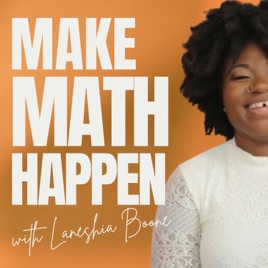
Make Math Happen

Advertise on podcast: Make Math Happen

Rating
★★★★★
5
from
12 reviews
This podcast has
51 episodes
Language
English
Explicit
No
Date created
2021/08/04
Latest episode
2026/02/01
Average duration
15 min.
Release period
8 days

Description

Make Math Happen (formerly known as PD for the SOUL) is the podcast for educators ready to move with intention and teach with impact. Hosted by math coach and equity-focused educator Laneshia Boone, each episode bridges practice and purpose to help you design instruction that centers students, builds capacity, and makes learning stick—especially for those pushed to the margins. Every week, you’ll get strategies that work in real classrooms, grounded reflections that challenge the status quo, and conversations with educators who are making bold moves in math education. From planning with purpose to using charts that anchor learning, from building strong routines to disrupting expired rules, this podcast is where meaningful math instruction comes to life. You’ll walk away with ready-to-use tools, fresh insight, and the confidence to make every lesson count. Because when we move with care, plan with clarity, and teach with courage, we make math happen.

Unlock Make Math Happen podcast Email contact info,
Listeners & Audience details

Email contact information

Direct podcast contact details

Listeners

Audience numbers & engagement insights

Audience details

Podcast Insights

Podcast episodes

Check latest episodes from Make Math Happen podcast


Connecting Math: Understanding Ratios as Relationships, Not Numbers
2026/02/01
Why ratios are about how quantities move together This episode launches our Connecting Math series by reframing ratios as relationships rather than calculations. Instead of treating ratios as fractions or procedures to memorize, we explore how ratios describe how two quantities vary together and why that way of thinking must be developed over time. Building on December’s focus on Seeing Math and January’s work around Understanding Math, this episode connects geometric reasoning and number sense to proportional thinking. We unpack the progression from counting to additive, multiplicative, and proportional reasoning, and examine why students struggle when instruction jumps too quickly to rules. You’ll hear how representations like number lines, tape diagrams, and arrays help students visualize relationships, how the Standards for Mathematical Practice reveal student thinking, and why carefully guided instruction is essential for developing mathematical reasoning. This episode sets the foundation for everything that follows in ratios, proportions, slope, and functions by focusing on the thinking students need, not just the answers they produce. Listener Reflection Questions When students in your classroom struggle with ratios, what evidence do you see about their reasoning, not just their accuracy?How often do students have opportunities to visualize and explain how two quantities change together before being asked to calculate?Which representations are you currently using to help students connect geometry, number sense, and proportional reasoning, and where might those connections be made more explicit?Send us a text Thanks for tuning in to this episode of the Make Math Happen podcast! If you enjoyed today’s conversation, subscribe on your favorite listening platform, leave a review, and share this episode with your fellow educators. You can also join the discussion and connect with me directly by clicking the link to join the Math Collective. Together, we’ll keep exploring practical strategies to transform classrooms and inspire students. Remember, new episodes drop every Sunday at 9:00 am, so mark your calendars! Until next time, keep making math happen, and I’ll catch you in the next episode. If you like math videos, let's connect: YouTube TikTok
Understanding Math: Number Sense That Transfers
2026/01/25
How strong number reasoning prepares students for ratios and algebra Throughout January, we’ve explored rational numbers, negative numbers, distance, value, fractions, decimals, and division. On the surface, it may seem like this month was about numbers. But this work didn’t begin in January. In December, we focused on seeing math—using geometry to help students notice structure, reason about space, and make sense of relationships before symbols ever appeared. Those same ideas carried forward as we shifted into number systems. When students reason about distance on a number line, compare fractions and decimals, or make sense of division, they’re drawing on the same spatial thinking developed through geometry. This episode brings those threads together. We examine how geometric reasoning supports number sense, why understanding must come before operations, and how giving students time to make sense of relationships prepares them for ratios, algebra, and beyond. You’ll hear why carefully guided instruction matters, how modeling ways of thinking differs from lecturing, and what classroom practices help students transfer understanding into new situations. If you’re looking to reduce cognitive load, strengthen coherence, and help students move from seeing relationships to reasoning with them, this episode closes the chapter on Understanding Math and sets the stage for what comes next. Send us a text Thanks for tuning in to this episode of the Make Math Happen podcast! If you enjoyed today’s conversation, subscribe on your favorite listening platform, leave a review, and share this episode with your fellow educators. You can also join the discussion and connect with me directly by clicking the link to join the Math Collective. Together, we’ll keep exploring practical strategies to transform classrooms and inspire students. Remember, new episodes drop every Sunday at 9:00 am, so mark your calendars! Until next time, keep making math happen, and I’ll catch you in the next episode. If you like math videos, let's connect: YouTube TikTok
Understanding Math: Fractions, Decimals, and Meaning
2026/01/18
Building understanding instead of teaching tricks Many students reach middle school able to perform fraction and decimal procedures without truly understanding what those numbers represent. In this episode, we slow down and reconnect fractions, decimals, and division to meaning. We explore why fractions should be understood as division first, how the number line supports flexible movement between representations, and why spatial reasoning matters when students place, compare, and reason about quantities. You’ll hear how visual models like tape diagrams, hundred grids, and aligned number lines help students see equivalence, magnitude, and relationships instead of relying on memorized steps. This episode also addresses a common instructional gap: students’ limited ability to visualize quantities. We discuss why asking students what they see when they encounter fractions and decimals matters, how number lines can be used to represent equivalent values, and how math journals can make student thinking visible and referencable for both teachers and families. If you’re looking for ways to help students build lasting understanding of fractions and decimals—and prepare them for ratios, algebra, and beyond—this episode offers concrete strategies and a clear instructional through line. Send us a text Thanks for tuning in to this episode of the Make Math Happen podcast! If you enjoyed today’s conversation, subscribe on your favorite listening platform, leave a review, and share this episode with your fellow educators. You can also join the discussion and connect with me directly by clicking the link to join the Math Collective. Together, we’ll keep exploring practical strategies to transform classrooms and inspire students. Remember, new episodes drop every Sunday at 9:00 am, so mark your calendars! Until next time, keep making math happen, and I’ll catch you in the next episode. If you like math videos, let's connect: YouTube TikTok
Understanding Math: Negative Numbers, Distance, and Value
2026/01/11
Strategies that clarify the number line for every learner Negative numbers are often taught through rules that don’t stick. In this episode, we return to meaning. We explore how students have been reasoning about space, direction, and position on the number line since the earliest grades, and why negative numbers are an extension of that work—not a new concept. By grounding integer operations in movement and distance, this episode shows how students can reason about direction, magnitude, and value without relying on memorized rules. You’ll hear classroom-tested routines that build understanding through visual models, rich conversation, and purposeful practice. We also connect this work forward into seventh-grade multiplication and division of integers and eighth-grade equations and expressions, showing how early sense-making supports long-term success. This episode is designed to help teachers slow down instruction without lowering expectations and give students the tools they need to judge reasonableness, explain their thinking, and apply integer reasoning across domains. Send us a text Thanks for tuning in to this episode of the Make Math Happen podcast! If you enjoyed today’s conversation, subscribe on your favorite listening platform, leave a review, and share this episode with your fellow educators. You can also join the discussion and connect with me directly by clicking the link to join the Math Collective. Together, we’ll keep exploring practical strategies to transform classrooms and inspire students. Remember, new episodes drop every Sunday at 9:00 am, so mark your calendars! Until next time, keep making math happen, and I’ll catch you in the next episode. If you like math videos, let's connect: YouTube TikTok
Understanding Math: Making Sense of Rational Numbers
2026/01/04
When students struggle with fractions, decimals, and integers, it’s often assumed they’re missing skills. In reality, they’re missing understanding. This episode opens our Understanding Math series by focusing on how students make sense of rational numbers as quantities that have value, direction, and position—not just symbols to manipulate. We explore how early experiences with counting, comparing, and representing numbers develop over time, why the number line is such a powerful organizer of thinking, and what students need to understand before operations make sense. You’ll hear why rushing into procedures often leads to fragile learning, how a lack of magnitude and relational understanding impacts students’ ability to judge reasonableness, and what it looks like to slow down without lowering expectations. We also share concrete ways to help students reason about value, distance, and relationships across number systems—even when your current unit lives in another domain. This episode is designed to spark meaningful PLC conversations and give you something you can use immediately in your classroom. It sets the foundation for the rest of the month and prepares students to connect quantities more confidently as we move toward ratios, proportions, and algebraic thinking. Send us a text Thanks for tuning in to this episode of the Make Math Happen podcast! If you enjoyed today’s conversation, subscribe on your favorite listening platform, leave a review, and share this episode with your fellow educators. You can also join the discussion and connect with me directly by clicking the link to join the Math Collective. Together, we’ll keep exploring practical strategies to transform classrooms and inspire students. Remember, new episodes drop every Sunday at 9:00 am, so mark your calendars! Until next time, keep making math happen, and I’ll catch you in the next episode. If you like math videos, let's connect: YouTube TikTok
Seeing Math: Similarity and Scale
2025/12/28
This episode closes our geometry focus by showing how similarity and scale serve as the bridge into ratios, proportions, and later functions. We explore what makes figures similar, how scale factor represents a preserved relationship rather than a formula, and why students need visual experiences with enlargement and reduction before working with numbers. Along the way, we address real classroom challenges, including unfinished learning, limited instructional time, and the pressure to move students forward before connections are solid. We discuss how teaching concepts in isolation often deepens gaps, and why making relationships explicit is essential for sense-making and long-term understanding. You’ll hear practical strategies for helping students reason about similarity using representations like tape diagrams, ways to anticipate common misconceptions, and ideas for re-engagement when timing or pacing doesn’t allow for a full instructional reset. We also connect these practices to research on high-impact strategies, including microteaching, reflection, and metacognition, and discuss how short video routines can activate learning both at home and in the classroom. This episode is designed to spark meaningful PLC conversations, support thoughtful sequencing, and help teachers position students for success across domains. It closes the geometry chapter and opens the door to our next focus: ratios and proportions—same story, new chapter. Send us a text Thanks for tuning in to this episode of the Make Math Happen podcast! If you enjoyed today’s conversation, subscribe on your favorite listening platform, leave a review, and share this episode with your fellow educators. You can also join the discussion and connect with me directly by clicking the link to join the Math Collective. Together, we’ll keep exploring practical strategies to transform classrooms and inspire students. Remember, new episodes drop every Sunday at 9:00 am, so mark your calendars! Until next time, keep making math happen, and I’ll catch you in the next episode. If you like math videos, let's connect: YouTube TikTok
Seeing Math: Area, Surface Area, and Volume
2025/12/21
This episode continues our Season 4 focus on making connections across mathematical domains and across grade levels. My goal over the coming months is to spark deeper conversations about instruction, sequencing, and sense-making, and to support teachers in taking these ideas back to their professional learning communities. Area, surface area, and volume are often taught as a list of formulas, but students need a much richer story. In this episode, we explore how these concepts grow from simple ideas about covering and filling space, why decomposing shapes matters, and how visual reasoning developed in earlier grades is essential for success in middle school and beyond. We connect this work to the Standards for Mathematical Practice and discuss why thoughtful sequencing is especially important for our learners. With developing prefrontal cortexes, students need us to organize learning intentionally so they can reason, make connections, and build understanding over time. You’ll walk away with concrete ways to model area, surface area, and volume using gridded space, manipulatives, household items, and simple classroom routines. Whether you’re a teacher or a family member supporting learning at home, this episode is designed to inspire deeper thinking, stronger instruction, and more meaningful conversations about how students learn mathematics. Send us a text Thanks for tuning in to this episode of the Make Math Happen podcast! If you enjoyed today’s conversation, subscribe on your favorite listening platform, leave a review, and share this episode with your fellow educators. You can also join the discussion and connect with me directly by clicking the link to join the Math Collective. Together, we’ll keep exploring practical strategies to transform classrooms and inspire students. Remember, new episodes drop every Sunday at 9:00 am, so mark your calendars! Until next time, keep making math happen, and I’ll catch you in the next episode. If you like math videos, let's connect: YouTube TikTok
Seeing Math: Angles, Lines, and Movement
2025/12/14
Helping students make sense of transformations and symmetry Geometry becomes powerful when students can see how shapes move, change, and relate. In this episode, we explore angles, lines, and the three core transformations—translations, reflections, and rotations—and what students must understand long before they ever touch coordinate rules. You’ll hear how early geometry experiences lay the groundwork for middle school expectations, why angle relationships matter more than memorized steps, and how symmetry helps students reason about structure and invariance. We also unpack common stumbling blocks that show up when transformations are taught as rules instead of relationships. Whether you’re a teacher guiding a classroom or a family supporting learning at home, this episode offers practical strategies, language shifts, and questioning techniques that help students visualize movement, predict outcomes, and build lasting understanding. These ideas don’t just support geometry—they prepare students for ratios, equations, and functions that come next. Send us a text Thanks for tuning in to this episode of the Make Math Happen podcast! If you enjoyed today’s conversation, subscribe on your favorite listening platform, leave a review, and share this episode with your fellow educators. You can also join the discussion and connect with me directly by clicking the link to join the Math Collective. Together, we’ll keep exploring practical strategies to transform classrooms and inspire students. Remember, new episodes drop every Sunday at 9:00 am, so mark your calendars! Until next time, keep making math happen, and I’ll catch you in the next episode. If you like math videos, let's connect: YouTube TikTok
Seeing Math: Why Geometry Should Start the Story
2025/12/07
Spatial reasoning is the heartbeat of middle school mathematics. In this episode, we explore how seeing patterns, shapes, movement, and structure primes students for success across every domain they’ll encounter this year. You’ll learn why geometry is far more than formulas and how it builds the visual foundation students need for ratios, functions, number lines, and equations. This episode opens the journey we’ll take all year. By the end, you’ll walk away with simple ways to strengthen visual thinking at home and in the classroom through tasks, conversations, and quick daily routines.  Send us a text Thanks for tuning in to this episode of the Make Math Happen podcast! If you enjoyed today’s conversation, subscribe on your favorite listening platform, leave a review, and share this episode with your fellow educators. You can also join the discussion and connect with me directly by clicking the link to join the Math Collective. Together, we’ll keep exploring practical strategies to transform classrooms and inspire students. Remember, new episodes drop every Sunday at 9:00 am, so mark your calendars! Until next time, keep making math happen, and I’ll catch you in the next episode. If you like math videos, let's connect: YouTube TikTok
Season Finale: Closing One Chapter, Opening Another
2025/11/23
This special episode closes out the month and reflects on the entire journey of this podcast. Four years ago, this show launched as PD for the Soul with a simple mission: to give teachers bite-sized, meaningful professional development they could listen to in the middle of real life. Whether it was on the way to work, during planning, or while cleaning the house, the goal was always the same… walk away with one idea you could use immediately. After a long break and a year that pulled me in every direction, 2025 became the year of consistency and clarity. In this episode, I look back at where we started, what we’ve explored this year, and how the podcast has grown into a space for real learning, real strategy, and real reflection. I also share the story behind my unconventional path into teaching and why it shapes everything I offer through this show. From emergency license to math coach, this journey has been fueled by research, practice, and a commitment to understanding how students learn best. Most importantly, this episode looks ahead to what’s coming next. Season 4 begins in December and will focus on building connections across middle school math. Each month will dive into a major domain so teachers and families can understand how ideas develop within a grade level and across the math story. I reflect on recent conference presentations, the feedback that pushed my thinking forward, and the vision guiding the next chapter of this podcast. If you’re ready for deeper connections, clearer understanding, and practical strategies you can use right away, Season 4 is for you. Listen in, share with a colleague, and get ready to make math happen together. Send us a text Thanks for tuning in to this episode of the Make Math Happen podcast! If you enjoyed today’s conversation, subscribe on your favorite listening platform, leave a review, and share this episode with your fellow educators. You can also join the discussion and connect with me directly by clicking the link to join the Math Collective. Together, we’ll keep exploring practical strategies to transform classrooms and inspire students. Remember, new episodes drop every Sunday at 9:00 am, so mark your calendars! Until next time, keep making math happen, and I’ll catch you in the next episode. If you like math videos, let's connect: YouTube TikTok
The Closure: Bringing the Learning Full Circle
2025/11/16
The last five minutes of class might be the most powerful. In this final episode of the instructional framework series, Laneshia breaks down the Closure portion of the lesson: the moment where big ideas get consolidated, strategies are named, and learning comes full circle. You’ll hear how teachers can use this time to: Revisit strategies and construct anchor charts that capture the day’s thinkingInvite students to reflect on their progress toward the goal, individually or with a partnerUse exit tickets to collect targeted evidence of understandingWe’ll also talk about how different curricula handle closure: some, like Open Up Resources, build in activity and lesson syntheses, while others leave teachers to create this piece themselves. Either way, skipping closure is not an option. As Brooke Powers of OUR says, “Skipping the synthesis is like skipping the end of the movie without finding out how it all came together.” Tune in to learn how intentional closure can help you form small groups, make homework meaningful, and adjust upcoming lessons with clarity and confidence. Send us a text Thanks for tuning in to this episode of the Make Math Happen podcast! If you enjoyed today’s conversation, subscribe on your favorite listening platform, leave a review, and share this episode with your fellow educators. You can also join the discussion and connect with me directly by clicking the link to join the Math Collective. Together, we’ll keep exploring practical strategies to transform classrooms and inspire students. Remember, new episodes drop every Sunday at 9:00 am, so mark your calendars! Until next time, keep making math happen, and I’ll catch you in the next episode. If you like math videos, let's connect: YouTube TikTok
The Instruct: Building Thinkers, Not Answer-Getters
2025/11/09
Last week, we broke down the Instruct phase — how to plan lessons like a chef curating a recipe, balancing tasks, facilitation, and engagement to make learning stick. This week, I’m serving up the next course: what Instruct actually sounds like in action. I’m sharing a real lesson I planned, facilitated, and reflected on using the Thinking Through a Lesson Protocol (TTLP) — a “Build a Pizza” task that pushed students to reason about relationships, not race toward answers. You’ll hear how purposeful planning and lesson study gave me the space to pause instead of rescue, to question instead of tell, and to help students uncover structure on their own. I also reflect on how these moments connect directly to the Standards for Mathematical Practice and the Effective Teaching Practices that develop confident, independent thinkers. 🎧 Listen in to learn how to: Use questioning to cultivate reasoning instead of guessing.Turn productive struggle into a tool for understanding.Plan with enough intention to respond, not react.This episode brings last week’s Instruct framework to life — a behind-the-scenes look at what it means to teach math through curiosity, connection, and care. Send us a text Thanks for tuning in to this episode of the Make Math Happen podcast! If you enjoyed today’s conversation, subscribe on your favorite listening platform, leave a review, and share this episode with your fellow educators. You can also join the discussion and connect with me directly by clicking the link to join the Math Collective. Together, we’ll keep exploring practical strategies to transform classrooms and inspire students. Remember, new episodes drop every Sunday at 9:00 am, so mark your calendars! Until next time, keep making math happen, and I’ll catch you in the next episode. If you like math videos, let's connect: YouTube TikTok
The Recipe for Instruction: Tasks, Facilitation, and Engagement That Stick
2025/11/02
Every strong math lesson has a recipe — the right balance of tasks, facilitation, and engagement that brings learning to life. In this episode, Laneshia walks you through the Instruct portion of the lesson cycle like a master chef planning a meal. You’ll learn how to: Choose and sequence tasks that align with standards and build coherence across lessons.Facilitate learning through intentional routines that get students talking, reasoning, and doing the math — not just filling in boxes.Keep engagement high with movement, discussion, and student voice.You’ll also hear strategies for classes where everyone needs acceleration — how to use conceptual connections to move the whole group forward without lowering the bar. 🎧 Listen in to learn how to: Turn “fill-in-the-box” tasks into invitations for thinking.Use routines like Notice & Wonder, Which One Doesn’t Belong, and Stronger and Clearer Each Time to build deeper reasoning.Reclaim your curriculum as a recipe for engagement, not compliance.📎 Resources Mentioned Stronger and Clearer Each Time Routine – Understanding Language, pg 9Notice & Wonder Explained – YouCubed VideoWhich One Doesn’t Belong? – Article by Juliana TapperFive Practices for Orchestrating Productive Mathematics Discussions – Smith & Stein (NCTM)Send us a text Thanks for tuning in to this episode of the Make Math Happen podcast! If you enjoyed today’s conversation, subscribe on your favorite listening platform, leave a review, and share this episode with your fellow educators. You can also join the discussion and connect with me directly by clicking the link to join the Math Collective. Together, we’ll keep exploring practical strategies to transform classrooms and inspire students. Remember, new episodes drop every Sunday at 9:00 am, so mark your calendars! Until next time, keep making math happen, and I’ll catch you in the next episode. If you like math videos, let's connect: YouTube TikTok
Pre-Teaching: Zooming Out to Zoom In
2025/10/26
Before you ever step into a lesson, your planning determines how far students can go. In this episode, Laneshia breaks down what it means to zoom out to zoom in—strategically mapping upcoming units, identifying potential roadblocks, and pre-teaching (or accelerating) just enough to keep every learner in the fast lane. You’ll hear how Suzy Pepper Rollins’ concept of acceleration aligns with research by Burns (2004), Nelson (2022), and the What Works Clearinghouse (2021)—all pointing to one truth: when we plan ahead, students don’t just catch up; they keep up. Learn how to use your calendar, intervention blocks, and bell work to make pre-teaching part of your rhythm, not an extra task. 💡 What You’ll Learn The difference between pre-teaching and acceleration—and why the mindset matters.How to identify upcoming “friction points” using your calendar and data.Simple, low-lift ways to fit acceleration into existing class time.How research validates the impact of front-loading and readiness-building.📎 Resources Mentioned 🧩 Download the Pre-Teaching / Acceleration Planner – Click here to join the math collective and get the free PDF. Use this doc map upcoming lessons, identify pre-teach opportunities, and reflect on impact. Perfect for PLCs or individual planning.📚 Research Articles Shared in This Episode:Burns (2004): Pre-Teaching Unknown Key Words with Incremental RehearsalNelson (2022): Early Mathematics Interventions and Readiness for Grade-Level WorkWhat Works Clearinghouse (2021): Assisting Students Struggling with MathematicsRollins (2014): Learning in the Fast Lane: 8 Ways to Put All Students on the Road to SuccessSend us a text Thanks for tuning in to this episode of the Make Math Happen podcast! If you enjoyed today’s conversation, subscribe on your favorite listening platform, leave a review, and share this episode with your fellow educators. You can also join the discussion and connect with me directly by clicking the link to join the Math Collective. Together, we’ll keep exploring practical strategies to transform classrooms and inspire students. Remember, new episodes drop every Sunday at 9:00 am, so mark your calendars! Until next time, keep making math happen, and I’ll catch you in the next episode. If you like math videos, let's connect: YouTube TikTok
Activate the Lesson: Setting the Stage for High Expectations
2025/10/19
Before students ever dive into a new concept, the Activate portion of your lesson determines whether they’re truly ready to think. In this episode, Laneshia models what an intentional Activate sounds like—from synthesizing a spiral warm-up to launching a new problem about dividing fractions with and without models. You’ll hear how she uses questioning, routines, and strategic sequencing to make sense-making visible and connect to the day’s learning goal. Then, she links classroom moves to the ELEOT “High Expectations” component—exploring what it means for learners to demonstrate and describe high-quality work. Learn how creating exemplars, comparing student samples, and elevating student voice build a culture where excellence is the norm, not the exception. Tune in to reflect, refine, and reimagine the way you activate learning in your math classroom. Send us a text Thanks for tuning in to this episode of the Make Math Happen podcast! If you enjoyed today’s conversation, subscribe on your favorite listening platform, leave a review, and share this episode with your fellow educators. You can also join the discussion and connect with me directly by clicking the link to join the Math Collective. Together, we’ll keep exploring practical strategies to transform classrooms and inspire students. Remember, new episodes drop every Sunday at 9:00 am, so mark your calendars! Until next time, keep making math happen, and I’ll catch you in the next episode. If you like math videos, let's connect: YouTube TikTok

Podcast reviews

Read Make Math Happen podcast reviews


5 out of 5
12 reviews
★★★★★
Elisha (18 year educator) 2025/05/11
A Must Listen for Educators Who Want to Grow with Purpose
PD for the Soul is exactly what its name promises, a breath of fresh air for passionate educators who want more than surface-level tips. Every episode...
★★★★★
LMo1913 2025/02/17
Great convos!
You and Lisa killed that podcast! I’m not an educator and it was still super interesting to me! Keep these coming!
★★★★★
A Discerning Consumer 😉🤓🙌🏾 2025/02/16
10 out of 10, Highly Recommend!
🎖️Exceptional content that everyone can benefit from - teachers, aspiring teachers, educational leaders, coaches, parents and more! The format is eas...
★★★★★
Jocilyn06 2023/07/23
Love love love
I’m always here for a great podcast and I love PD for the Soul. The content is refreshing and relatable to any career field. Laneshia is very passiona...
check all reviews on apple podcasts

Podcast sponsorship advertising

Start advertising on Make Math Happen relevant audience podcasts


What do you want to promote?