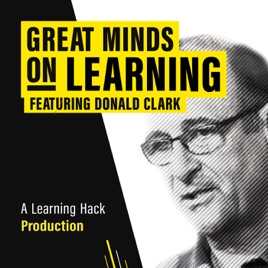
Advertise on podcast: Great Minds on Learning
Rating
5from
This podcast has
53 episodes
Language
EnglishPublisher
John HelmerExplicit
No
Date created
2021/08/24
Latest episode
2026/09/01
Average duration
75 min.
Release period
58 days
Description
Internationally respected author, blogger and learning expert, Donald Clark joins John Helmer of the Learning Hack podcast to discuss the history of thought and theorising about learning. The inspired, the enduring, the wacked-out weird and the just plain wrong, from Aristotle to the present day. © John Helmer 2021
Unlock Great Minds on Learning podcast Email contact info,
Listeners & Audience details
Email contact information
Direct podcast contact details

Listeners
Audience numbers & engagement insights

Audience details
Podcast Insights


Podcast episodes
Check latest episodes from Great Minds on Learning podcast
Learning in a Post-Literate World
2026/09/01
Schools, universities and training departments took shape in the age of mass printing initiated by Guttenberg and others in the Sixteenth Century CE. Jeff Jarvis, In The Gutenberg Parenthesis (2023), argues that this development opened a parenthesis (or bracket) which closed with the rapid spread of internet technologies in or around the year 2000. We are now in a post-text, perhaps post-literate age, which in many respects looks more like what preceded the parenthesis.
The phrase, The Gutenberg Parenthesis was coined by Lars Ole Sauerberg at the University of Southern Denmark and the idea was developed by Thomas Pettitt. It argues that the age of print — roughly 1600 to 2000 — was an interruption in the normal run of human communication.
Great Minds has been on this ground before: two episodes in May 2024 covered the invention of writing, and literacy and orality. This is a sequel, which addresses the impact on learning of low-cost publishing without gatekeepers, social media and AI. If the bracket really has closed, the consequence is not a curriculum change: it's structural.
In this episode:
What you would actually see in a medieval university Chaucer, Dante and Petrarch: authorship before print The riot of forms — broadside ballads, pamphlets, corantos, newspapers, the essay, the novel, etc. The arrival of silent reading Post-literate or post-print? The reading statistics, and the middle-class moral panic Why text-based assessment is the wrong test for a world of doing Is an LLM the most Gutenbergian object ever built? Derrida, tokens and decoders Links and resources:
Jeff Jarvis — The Gutenberg Parenthesis: The Age of Print and Its Lessons for the Age of the Internet (Bloomsbury Academic, 2023) Walter Ong — Orality and Literacy; and his doctoral work on Ramus John Amos Comenius — Orbis Sensualium Pictus (1658) Michel de Montaigne — Essais (1580) · Miguel de Cervantes — Don Quixote (1605) George Thomason — the Thomason Tracts, British Library David Goodhart — Head Hand Heart: The Struggle for Dignity and Status in the 21st Century (Allen Lane, 2020) Donald Clark — Learning Experience Design, second edition Donald Clark — AI and Productivity (Kogan Page) Previously on Great Minds on Learning: the two Scribes episodes, May 2024 — the invention of writing, and literacy and orality CONNECT WITH LEARNING HACK
LinkedIn: linkedin.com/in/johnhelmer YouTube: www.youtube.com/@JohnHelmerConsulting X: @johnhelmer Threads: @jphelmer Bluesky: @johnhelmer.bsky.social Website: learninghackpodcast.com
How Creative People Learn
2026/08/17
Nobody is born into the world already able to design a brochure, cut a dress, light a photoshoot or shred on the guitar. All of it has to be learned. The question this episode asks is how, and whether the answer has anything to teach the rest of us.
In this episode, Donald Clark and John Helmer focus on the people who make things: artists, designers, film crews, painters, musicians. Both of them have history in different parts of this territory. John has been a working musician and songwriter, and worked in advertising and arts PR. Donald sat on the board of Skillset and spent ten years as deputy chair of the Brighton Dome and Festival.
They take us on a journey, from Ruskin's drawing classes to punk's screen-printed sleeves, art schools, the golden section ... and what a skill is worth once the machine has copied the homework.
In this episode:
Introducing Creators and Learning Four Thinkers: Ruskin to Robinson Applied Arts and Design Screen and Audiovisual Arts Visual Arts and the Art School Performing Arts and the Grassroots AI and the Means of Production Summing Up Links and resources:
John Ruskin — The Elements of Drawing (1857): https://www.gutenberg.org/files/30325/30325-h/30325-h.htm Herbert Read — Education Through Art (1943) Elliot Eisner — The Arts and the Creation of Mind (Yale, 2002) Ken Robinson — "Do Schools Kill Creativity?" (TED, 2006): https://www.ted.com/talks/sir_ken_robinson_do_schools_kill_creativity Ken Robinson — All Our Futures: Creativity, Culture and Education (1999) John Carey — The Intellectuals and the Masses (1992) Bert Weedon — Play in a Day Andy Clark — on the predictive brain Tomorrow's Warriors — grassroots jazz development New Generation Jazz Brighton & Hove Music Service Donald Clark — AI and Productivity (Kogan Page): https://www.koganpage.com/hr-learning-development/ai-and-productivity-9781398623316
CONNECT WITH LEARNING HACK
LinkedIn: linkedin.com/in/johnhelmer YouTube: www.youtube.com/@JohnHelmerConsulting X: @johnhelmer Threads: @jphelmer Bluesky: @johnhelmer.bsky.social Website: learninghackpodcast.com
Sport and Learning with Donald Clark
2026/08/03
What education and workplace learning can take from sports coaching.
Modern sports coaching has abandoned the drilling of isolated techniques in favour of practice that is variable, contextual and informed by data. Opening Season 8, John Helmer and Donald Clark ask what education and workplace learning can learn from sport. From constraints-led practice and Moneyball analytics to AI tutors, coaching and performance support.
In this episode:
Practice, Constraints and Variability Deliberate Practice and Autonomy Gadgets, AI and Analytics Scenarios, Simulations and Coaching Desirable Difficulty and the AI Tutor Multimodal Learning and Performance Support Links and resources:
Donald Clark — Learning Experience Design (second edition in preparation) Donald Clark — AI and Productivity (Kogan Page): https://www.koganpage.com/hr-learning-development/ai-and-productivity-9781398623316 Nick Shackleton-Jones — How People Learn (Kogan Page) Jeff Jarvis — The Gutenberg Parenthesis Johan Huizinga — Homo Ludens (1938) — see also GMoL16, Gamification Michael Lewis — Moneyball (2003) Jabbr — boxing and combat sports analytics Jamestown Analytics — Tony Bloom's recruitment analytics company STUDI
Blog post
https://donaldclarkplanb.blogspot.com/
Website:
https://studi.ie/
Books
How to Win the Premier League: The Inside Story of Football's Data Revolution by Ian Graham
AI for Sports by Chris Brady
CONNECT WITH LEARNING HACK
LinkedIn: linkedin.com/in/johnhelmer
YouTube: www.youtube.com/@JohnHelmerConsulting
X: @johnhelmer
Threads: @jphelmer
Bluesky: @johnhelmer.bsky.social
Website: learninghackpodcast.com
GMoLS7E44 AI Learning and the Global South
2025/12/15
Recorded live at Online Educa Berlin, this episode of Great Minds on Learning explores AI and the Global South through history, hard lessons, and contemporary debate. John Helmer and Donald Clark examine early techno-utopian experiments, the ethics wars around AI, and newer perspectives rooted in language, power, and lived experience. From Negroponte and Mitra to Gebru, Arora, Manyika, and Mugane, the conversation asks who AI is really for—and who gets to decide.
Timestamps
00:57 – Intro
01:58 – Introduction to AI & the Global South
14:11 – Nicholas Negroponte
17:38 – Sugata Mitra
24:11 – Global South takes on AI
28:11 – Timnit Gebru
32:27 – Payal Arora
37:39 – James Manyika
43:12 – John Mugane
54:49 – Summing up
58:41 – Q&A
About the Show
Great Minds on Learning explores 2,500 years of learning theory—from the Greeks to the geeks. Hosted by John Helmer and Donald Clark, the podcast connects historical ideas to today's debates in education, technology, and society.
Connect
LinkedIn: https://linkedin.com/in/johnhelmer
X: @johnhelmer
Bluesky: @johnhelmer.bsky.social
Website: https://learninghackpodcast.com
Wellbeing with Donald Clark
2025/07/14
In this final episode before the summer break, Donald Clark and John Helmer explore the rise of happiness and wellbeing as central themes in psychology, education, and policy. From Seligman's Positive Psychology to Nussbaum's Capabilities Approach, they examine the thinkers who defined the science—and pseudo-science—of flourishing. Is wellbeing a universal human right, or a set of scantly-evidenced models that has somehow become an industry? And what happens when AI becomes your therapist?
⏱️ Timestamps
00:00:00 - Start 00:01:24 - Intro 00:02:25 - Introducing Wellbeing 00:09:07 - Martin Seligman (1942–) & Richard Layard (1934–) 00:21:47 - Ed Diener (1946–2021) 00:29:57 - Carol Ryff 00:41:22 - Corey Keyes 00:51:01 - Amartya Sen (1933–) & Martha Nussbaum (1947–) 00:58:37 - Lucy Foulkes 01:09:03 - Summing up
🔗 Contact
LinkedIn: linkedin.com/in/johnhelmer X: @johnhelmer Bluesky: @johnhelmer.bsky.social Website: learninghackpodcast.com
Organizational Learning with Donald Clark
2025/06/30
Learning at Scale, from Theory to Action.
This episode explores the thinkers who shaped organizational learning—how institutions learn, adapt, and evolve. From Herbert Simon's decision theory to Argyris and Schön's double-loop learning, Peter Senge's "learning organization," Japanese knowledge creation, and Finnish activity theory, we trace how learning moved beyond individuals to become a strategic force for change. A must-listen for anyone in leadership, workplace learning, or change management.
Timestamps:
00:00:00 - Start 00:01:24 - Intro 00:02:23 - Introducing Organizational Learning 00:06:29 - Herbert A. Simon (1916–2001) 00:18:38 - Chris Argyris (1923–2013) & Donald Schön (1930–1997) 00:30:14 - Peter Senge (1947–) 00:43:17 - Ikujiro Nonaka (1935–2025) & Hirotaka Takeuchi (1946–) 00:57:01 - Yrjö Engeström (1948–) 01:07:20 - Summing up
Connect:
LinkedIn: linkedin.com/in/johnhelmer X: @johnhelmer Bluesky: @johnhelmer.bsky.social Website: learninghackpodcast.com
Schoolmen with Donald Clark
2025/06/16
The surprising modernity of medieval minds.
This episode explores the medieval thinkers known as the Schoolmen—philosophers who fused logic, faith, and classical learning to shape what would become the modern university. From Anselm's ontological argument to Ockham's razor, Donald Clark and John Helmer examine the enduring legacy of scholasticism on how we teach and learn today.
Timestamp
00:01:24 - Intro 00:02:23 - Introducing The Schoolmen 00:07:27 - Anselm of Canterbury (1033–1109) 00:14:53 - Peter Abelard (1079–1142) 00:28:02 - Hugh of St Victor (1096–1141) 00:38:41 - Albertus Magnus (c. 1200–1280) 00:44:02 - Thomas Aquinas (1225–1274) 00:50:15 - Duns Scotus (1266–1308) 00:59:54 - William of Ockham (c. 1287–1347) 01:05:32 - Summing up
Connect
LinkedIn: linkedin.com/in/johnhelmer X: @johnhelmer Bluesky: @johnhelmer.bsky.social Website: learninghackpodcast.com
Critics of Higher Education with Donald Clark
2025/06/02
Who is higher education really serving? In this episode of Great Minds on Learning, John Helmer and Donald Clark examine prominent critics of higher education. Economist Bryan Caplan, linguist and activist Noam Chomsky, and tech entrepreneur Peter Thiel offer powerful critiques of the academy. Meanwhile, Harold Wilson, Jennie Lee, and Paul LeBlanc present alternative visions for more inclusive and effective systems. Is higher education broken—or just in need of reinvention?
TIMESTAMPS
· 00:00:00 - Start
· 00:01:54 - Intro
· 00:02:55 - Introducing Critics of Higher Education
· 00:07:19 - Bryan Caplan (1971–)
· 00:20:10 - Noam Chomsky (1928–)
· 00:31:41 - Peter Thiel (1967–)
· 00:44:06 - Harold Wilson (1916-1995) & Jennie Lee (1904-1988)
· 00:57:11 - Paul LeBlanc
· 01:06:15 - Summing up
Connect with us:
· LinkedIn: linkedin.com/in/johnhelmer
· X: @johnhelmer
· Bluesky: @johnhelmer.bsky.social
· Website: learninghackpodcast.com
Critical Pedagogues with Donald Clark
2025/05/19
Education's Ideological Battleground. Education is never entirely neutral. In our own time it has been increasingly seen as deeply ideological. However, whose ideology is being promoted – and does unpicking one set of biases only serve to replace it with a different, opposing set? Donald Clark and John Helmer explore the provocative ideas of influential theorists Paulo Freire, Allan Bloom, Henry Giroux, Judith Butler, Camille Paglia, and Jonathan Haidt. This episode dives into critical pedagogy's role in shaping today's contentious educational culture wars, examining how these thinkers challenged traditional perspectives, ignited fierce debates, and reshaped our understanding of education's relationship to power, politics, and identity.
Episode timestamps:
00:01:54 – GMoL intro 00:03:00 – Introducing Critical Pedagogues 00:07:37 – Paulo Freire (1921-1997) 00:18:23 – Allan Bloom (1930-1992) 00:34:06 – Henry Giroux (1943–) 00:43:21 – Judith Butler (1956–) 00:59:48 – Camille Paglia (1947–) 01:14:41 – Jonathan Haidt (1963–) 01:35:15 – Summing up
Contact:
LinkedIn: linkedin.com/in/johnhelmer X: @johnhelmer Bluesky: @johnhelmer.bsky.social Website: learninghackpodcast.com
The Blog that started it all: https://donaldclarkplanb.blogspot.com/2021/09/these-were-written-as-quick-readable.html
Contact Donald
X: @DonaldClark Blog: http://donaldclarkplanb.blogspot.com/
Early Computing with Donald Clark
2025/05/06
From Babbage to Turing: the roots of AI.
In this first episode of Season 7, Donald Clark and John Helmer trace the roots of modern computing and AI through six foundational figures—Babbage, Lovelace, Hollerith, Bush, Newman & Flowers, and Turing. Exploring their machines, insights, and visionary ideas, they uncover surprising links between early data technologies and the digital learning landscape of today. Expect Steampunk vibes, deep dives, and a speculative look at how history shaped learning innovation.
00:01:54 - Intro 00:02:58 - Donald & John catch up - Donald's new tattoo 00:05:42 - Introducing Roots of AI: Early Computing 00:13:41 - Charles Babbage (1791-1871) 00:24:14 - Ada Lovelace (1815-1852) 00:36:31 - Herman Hollerith (1860-1929) 00:50:43 - Vannevar Bush (1890 - 1974) 01:02:50 - Maxwell Newman (1897-1984) & Thomas Flowers (1905-1988) 01:10:25 - Alan Turing (1912-1954) 01:28:20 - Summing up Great Minds on Learning comes from the Learning Hack team and is produced by John Helmer. The podcast is based on a series of blog posts written by Donald Clark, who kindly collaborates on this project.
LinkedIn: linkedin.com/in/johnhelmer X: @johnhelmer Bluesky: @johnhelmer.bsky.social Website: learninghackpodcast.com
The Blog that started it all: https://donaldclarkplanb.blogspot.com/2021/09/these-were-written-as-quick-readable.html
Contact Donald
X: @DonaldClark Blog: http://donaldclarkplanb.blogspot.com/
Question Time with Donald Clark
2024/12/16
Revisiting Learning Theories: Insights and Challenges for the Future
In this special live episode of Great Minds on Learning, recorded at Online Educa Berlin 2024, Donald Clark and John Helmer tackle listener questions about learning theory's relevance, biases, and practical applications. They reflect on three years of the podcast, exploring 2,500 years of educational thought, and discuss the future of learning, including the transformative impact of AI. Engaging and insightful, this episode is a must-listen for learning professionals and enthusiasts alike.
00:00 - Start 00:59 - Introducing GMoL Question Time 08:17 - Why this podcast? 30:52 - What are the 'lessons learned'? 47:48 - What next? AI and the future of institutional learning The Blog that started it all:
https://donaldclarkplanb.blogspot.com/2021/09/these-were-written-as-quick-readable.html
Contact Donald
X: @DonaldClark LinkedIn: https://www.linkedin.com/in/donald-clark-04553022/ Blog: http://donaldclarkplanb.blogspot.com/
Contact John Helmer
X: @johnhelmer Email: [email protected] LinkedIn: https://www.linkedin.com/in/johnhelmer/ Website: https://learninghackpodcast.com/
Question Time
2024/11/21
Send in your questions for the Great Minds on Learning Q&A! Donald Clark and John Helmer will answer them at Online Educa Conference in Berlin, which will be recorded for a podcast episode to be issued before Christmas 2024. Email them in to [email protected] or reach out on social media.
Continental Theorists with Donald Clark
2024/07/15
Deconstructing Continental Philosophy's Impact on Modern Education.
At the end of the 19th Century, a split in Philosophy emerged that persists today. The Analytic tradition, led by Frege, Russell, and Wittgenstein, emphasized clarity, logical rigour, and formal methods in language analysis. By contrast, Continental theorists such as Husserl and Heidegger went to a very different place. They focused on human experience and took on broader cultural and political themes, giving us terms like existentialism, structuralism, post-structuralism, and postmodernism. In this final episode of the season, we explore the impact of Continental Theorists. What influence have these radical thinkers, whose writings often seem almost wilfully obscure, had on education and learning?
00:00:00 - Start 00:00:46 - Intro 00:01:59 - Introducing the Continental Theorists 00:09:01 - Martin Heidegger (1889-1976) 00:24:28 - Paul-Michel Foucault (1926-1984) 00:41:11 - Jean-François Lyotard (1924-1998) 00:52:42 - Jacques Derrida (1930-2004) 01:09:54 - Summing up
The Blog that started it all:
https://donaldclarkplanb.blogspot.com/2021/09/these-were-written-as-quick-readable.html Contact Donald
X: @DonaldClark LinkedIn: https://www.linkedin.com/in/donald-clark-04553022/ Blog: http://donaldclarkplanb.blogspot.com/ Contact John Helmer
X: @johnhelmer Email: [email protected] LinkedIn: https://www.linkedin.com/in/johnhelmer/ Website: https://learninghackpodcast.com/ Patreon: https://www.patreon.com/LearningHack/
Psychoanalysts with Donald Clark
2024/07/01
Learning in the post-Freudian age
At the beginning of the 20th Century, fundamental assumptions about the nature of the mind and how it learns were completely overturned by a new set of ideas. Pre-eminent among the thinkers and practitioners who spearheaded a new field of study called psychoanalysis was the Austrian neurologist, Sigmund Freud. Following his death in 1939, Freud's followers continued and developed his ideas, and psychoanalysis grew ever more influential, not just in the treatment of mental illness, but in government, business, philosophy and education. Though most of Freud's theories have since been discredited, he casts a long shadow. But what do the psychoanalysts have to say to our own time about the mind and learning?
00:00:00 - Intro 00:01:11 - Introducing the psychoanalysts 00:06:33 - Sigmund Freud (1856 – 1923) 00:25:33 - Anna Freud (1895-1982) 00:36:17 - Melanie Klein (1882-1960) 00:43:53 - Eric Erikson (1902 – 1994) 00:57:55 - John Bowlby (1907-1990) 01:05:14 - Carl Rogers (1902 - 1987) 01:10:41 - Summing Up The Blog that started it all:
https://donaldclarkplanb.blogspot.com/2021/09/these-were-written-as-quick-readable.html Contact Donald
X: @DonaldClark LinkedIn: https://www.linkedin.com/in/donald-clark-04553022/ Blog: http://donaldclarkplanb.blogspot.com/ Contact John Helmer
X: @johnhelmer LinkedIn: https://www.linkedin.com/in/johnhelmer/ Website: https://learninghackpodcast.com/ Patreon: https://www.patreon.com/LearningHack/
Connectionists with Donald Clark
2024/06/17
Is the mind flatter than we thought?
This episode was recorded in front of a live audience at the 'Performance Journey Goes Dutch' conference in Ermelo, The Netherlands, organised by Xpertise Learning. Donald and John explore a group of theorists who are giving us a new picture of how we think and learn that is distinctively different from what came before. They're the Connectionists, and they see the brain as flatter than was previously thought, constantly trying to predict what will happen next, and to improvise a response. But what are the implications for learning of this New Psychology?
00:00 - Intro 00:58 - Introducing The Connectionists 11:15 - Daniel Dennett (1942 - 2024) 19:15 - Geoffrey Hinton (1947–) 24:38 - Nick Chater (1965–) 35:17 - Karl Friston (1959–) 39:19 - Joshua Brett Tenenbaum (1972–) 43:49 - Andy Clark (1957–) 46:54 - Summing Up The Blog that started it all:
https://donaldclarkplanb.blogspot.com/2021/09/these-were-written-as-quick-readable.html Contact Donald
X: @DonaldClark LinkedIn: https://www.linkedin.com/in/donald-clark-04553022/ Blog: http://donaldclarkplanb.blogspot.com/ Contact John Helmer
X: @johnhelmer LinkedIn: https://www.linkedin.com/in/johnhelmer/ Website: https://learninghackpodcast.com/ Patreon: https://www.patreon.com/LearningHack/
Podcast sponsorship advertising
Start advertising on Great Minds on Learning relevant audience podcasts
You may also like to advertise on these Podcasts

4.512566660
RedHanded
RedHanded
4.959772000
Legal AF by MeidasTouch
MeidasTouch Network
4.7292642000
The Michael Knowles Show
The Daily Wire
4.7278152000
The Matt Walsh Show
The Daily Wire

4.922662003
First15 Devotional
First15

4.6652312197
The Charlie Kirk Show
Charlie Kirk

4.762542000
The Lawfare Podcast
The Lawfare Institute

4.819462000
Football Ramble
Stak

4.838322000
Entrepreneurs on Fire
John Lee Dumas of EOFire

4.858221914
Sara Gonzales Unfiltered
Blaze Podcast Network