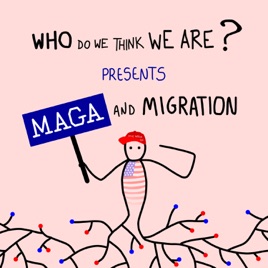
Advertise on podcast: Who do we think we are?
This podcast has
52 episodes
Language
EnglishExplicit
No
Date created
2021/09/23
Latest episode
2025/12/19
Average duration
46 min.
Release period
69 days
Description
From Brexit and the COVID-19 pandemic, to the Windrush deportation scandal citizenship and the responsibilities of the UK government to the people of Hong Kong, it seems that citizenship and migration in Britain are never far from the headlines. Who do we think we are? explores all of this and more. Join Professor Michaela Benson and her guests as they debunk taken-for-granted understandings of who is a citizen and who is a migrant in Britain today.
Unlock Who do we think we are? podcast Email contact info,
Listeners & Audience details
Email contact information
Direct podcast contact details

Listeners
Audience numbers & engagement insights

Audience details
Podcast Insights

Podcast episodes
Check latest episodes from Who do we think we are? podcast
S4 E5 The pace of change: MAGA, the US, the UK
2025/12/19
In the time of MAGA, as nightmares rapidly become reality for many living in the USA, it can be hard to keep up with the pace of change. Here, we take stock of the latest news - including the move to cap refugee numbers at a record low, the further rollback of Temporary Protected Status for many vulnerable groups, and Trump's threat to cut funding to New York City under new mayor Zohran Mamdani. We consider these developments in light of our conversations this series with Heba Gowayed, Cecilia Menjívar, Ernesto Castañeda and Rachel Humphris, and reflect on why it's important to see the present moment as both exceptional but situated in a longer history of racialised politics stretching beyond the borders of the USA alone. We also ask how MAGA rhetoric and policy is making waves beyond the USA itself - including in the UK, where not only is Reform on the rise but the Labour Party is tightening asylum laws, and academics are concerned about the state of academic freedom. Plus: how racism at the "top" filters down to shape what sociologists speak of as the "structure of feeling" - and why we need to "demigrantise" migration research, to see how discourse and policy affects all of our lives.
**Recorded November 2025**
S4 E4 Free speech for whom?
2025/12/12
What's the link between free speech, bordering, and the 'MAGA' project of Donald Trump and his backers? And how does free speech as enshrined in the US constitution, contrast with what's happening on the ground in the USA? Sociologist Heba Gowayed, author of 'Refuge', Carnegie fellow, and voice against the arrest of students protesting genocide in Palestine, joins us. She tells us what role the arrest of pro-Palestinian activists has played in the MAGA project - and how, while whiteness has long been privileged in legislation in the USA, going right back to the 1790 Naturalisation Act, we must remain alert to the extremity of now. Ours is a time, says Heba, in which we are seeing an "explicit and express commitment to mass deportation", and a spectacle of cruelty that marks a departure from before. Plus: Heba describes her current project 'The Cost of Borders' and reflects on the status of academic freedom in the USA. Academic institutions, she suggests, are "targets for authoritarians" precisely because of their potential as sites of free speech. We must defend them.
**Recorded early Oct 2025**
S4 E3 Forever Undocumented
2025/11/14
What does it actually mean to be "documented" or "undocumented" as a migrant to the USA? What's the lived reality like of existing somewhere in between the two, including under the category of "temporary protected status", or TPS, created by Congress in 1990 for people from countries deemed too unsafe to return to? UCLA sociologist and leading migration expert Cecilia Menjívar joins us to discuss her concept of "liminal legality". Elaborated in a 2006 paper following fieldwork through the 1990s with migrants from Central America, the term remains enduringly relevant in Trump's America - where the administration has moved to roll back TPS for people from countries such as Afghanistan, Venezuela and Syria. A conversation about precarity, lived experience, and policy - and a reminder that "creating a group of people whose rights are diminishing by the day" harms not only those individuals, but all of us.
**Recorded Sept 2025**
S4 E2 No place for migrants in the American Dream
2025/10/17
American Dream? Or American nightmare?
The targeting of migrants and minoritised populations under President Trump poses a serious challenge to the long-standing idea that if a person comes to the USA and works hard, they will enjoy social mobility and 'success'. Continuing our series on the role of borders and migration in the roll out of the 'MAGA' project of Trump and his backers, we're joined by Professor Ernesto Castañeda, Director of the Center for Latin American and Latino Studies and the Immigration Lab at American University, Washington, DC. We ask: who still believes in the American Dream? How long can its demolition hold, in a country built on immigration and migrant labour? And what happens - in the USA and beyond - when people start to realise that immigration is not necessarily the cause of the problems they face? A myth-busting conversation on hope, solidarity and change.
S4 E1 Raiding Sanctuary
2025/09/18
When anti-immigration raids intensified in the USA after Trump's return to the presidency, it left many wondering: how could this happen in places like LA, ostensibly a "Sanctuary City"? What, in fact, are sanctuary cities? Launching our new series on the role of borders and migration in the roll out of Donald Trump's MAGA project, Rachel Humphris, author of "Making Sanctuary Cities" joins us to explain all. She outlines the rich history of such places, with roots in both traditions of sheltering refugees but also in activist histories of non-cooperation. Rachel also describes how the term 'Sanctuary Cities' was appropriated in the so-called 'culture wars', used by the right to paint a misleading picture of urban areas as full of "undesirable" outsiders and their apparently woke defenders. Plus, we ask: what does the label 'Sanctuary City' obscure in places such as San Francisco, where many are being forced out as big tech money floods in? And how, by focusing on the history of American cities' complex and caveated relationship to the federal state, might we still hold to a future of hope and resistance?
S3 E10 Migration and the making of Global Britain
2024/03/15
What's the significance of migration for the making of 'Global Britain'? And what are the theoretical and conceptual tools that can help to unpack this question? In this episode, we turn our attention to the value of racial capitalism for understanding migration to and from the UK after Brexit. Elena Zambelli explains what we mean when we talk about 'Global Britain,' its political trajectory, and the role of coloniality within it. Ida Danewid, Lecturer in Gender and Global Political Economy at the University of Sussex joins us to offer insights into the relationship between racial capitalism, migration and borders. As she highlights, mobility controls produce the exploitable labour force necessary for capitalist accumulation and how those migrantized resist state violence. And co-hosts Nando Sigona and Michaela Benson consider what a racial capitalism lens adds to understandings of the UK's new suite of humanitarian visas, and more broadly to the role of migration in the making of Global Britain.
You can access the full transcripts for the episode, further resources and active listening questions over on our website: Who do we think we are?
S3 E9 (Not so) safe routes
2024/02/15
What are the UK Government's 'safe and legal routes'? How do these relate to 'stop the boats', the Rwanda Plan, and the curtailment of asylum as laid out in the 1951 Refugee Convention? What can we learn from listening to the Hong Kongers and Ukrainians beneficiaries of these humanitarian visas? And what if these routes are not so safe after all?
In this episode we explore the UK's safe and legal (humanitarian routes). Elena Zambelli explains what 'asylum' is, looking its history, scope and challenges to these international protections since 2015 'refugee crisis.' Fizza Qureshi, CEO of the Migrants' Rights Network, board member of Migrants at Work and of the honorary advisory committee for the Black Europeans, joins us to offer a critical overview of the UK's immigration and asylum reforms over the past decade. Asking what this tells us about migrants' rights, she highlights how these reforms impact disproportionately on brown and black migrants who try to make the UK their homes. And co-hosts Nando Sigona and Michaela Benson consider the ongoing contestations surrounding the figure of the 'refugee' as well as the asylum system as a whole. They reflect on how beneficiaries of the Hong Kong BN(O) and Ukraine visa schemes experience these humanitarian visas, and what we can learn from them about the limits of these.
You can access the full transcripts for the episode, further resources and active listening questions over on our website: Who do we think we are?
S3 E8 Fortress Britain?
2024/01/18
What's Brexit got to do with the 'small boats' crisis? What does racialised border violence in the Channel tell us about 'Global Britain'? And what can we learn about the UK's approach to its borders from the Hong Kong BN(O) and Ukrainian visas? We discuss all of this and more as we turn a lens onto Fortress Britain.
Elena Zambelli explains what we mean when we talk about migrants' irregularisation. We're joined by Arshad Isakjee and Thom Davies talk about their research on the racialised border violence enacted by Fortress Europe and why we need to turn our attention to how this relates to the EU's liberal values. And Nando and Michaela turn the lens back onto UK and its post-Brexit borders as they discuss the new suite of 'safe and legal (humanitarian) routes', and what these signal about the future of asylum within and beyond the UK.
You can access the full transcripts for each episode over on our website Who do we think we are?
S3 E7 Families at the borders
2023/11/16
What happens when borders cross families? How do families navigate these interruptions to their ability to live together? This episode considers what shifting perspective to families opens up to view in terms of thinking about the work of borders and their impact on people's everyday lives. Helena Wray, Professor of Migration Law at the University of Exeter, explains the historical development of family migration laws and what these make visible about the racialization of the nation and its political community. Elena Zambelli explains what a 'mixed-status family' is, and the many ways in which states may affect its members' everyday lives and future imaginings. And co-hosts Nando Sigona and Michaela Benson consider how the state's regulation of family migrations is linked to the reproduction of the nation state, and draw on data collected within the MIGZEN project to show the effects of Brexit on British-European families.
You can access the full transcripts for the episode, further resources and active listening questions over on our website: Who do we think we are?
S3 E6 Migrant Rights 2.0
2023/10/12
Borders around the world are becoming increasingly digitised. But who does the digitisation of borders serve? How are these technologies related to state-led projects of securitisation and surveillance? And what do digital bordering practices mean for migrants, migrant rights and advocacy?
In this episode we lift the lid on digital bordering. We debunk political rhetoric about how these make border control more efficient to consider what the increasing use of such technologies of border control makes visible about bordering as a practice and process around the world today. Elena Zambelli considers what we mean when we talk about digital borders and shows it is linked to the increasing precarity of legal status among migrants. Kuba Jablonowski, Lecturer in Sociology at the University of Bristol joins us with a case study that brings all of this to life: the digital and online only roll out of the EU Settled Status Scheme (EUSS) in the UK, how this was framed by the priorities of the Home Office, the consequences for EU nationals, including the racial discrimination produced through its implementation. And Nando and Michaela turn their attention to how those taking part on our research experienced such statuses, how this links to Hostile Environment, and the challenges that this presents for migrant rights and advocacy.
You can access the full transcripts for the episode, further resources and active listening questions over on our website: Who do we think we are?
S3 E5 Migration, diaspora, diplomacy
2023/09/14
What role do diplomacy and the power play between states play in the development of migration policy? And how can turning our attention to the significance of foreign policy within migration governance help us in understanding the post-Brexit migration regime in the UK?
In this jam-packed episode, we consider how foreign policy and geopolitics shapes migration and mobility regimes. Catherine Craven explains what we mean when we talk about migration diplomacy. Fiona Adamson, Professor of International Relations at SOAS, invites us to think about how migration and diaspora feature in inter-state relations, with a particular focus on the EU. Through the discussion of the UK's new humanitarian visas and the citizens' negotiations, Nando and Michaela reflect on the relationship between migration diplomacy and the UK's shifting position on the world stage after Brexit.
You can access the full transcripts for each episode over on our website Who do we think we are?
In this episode we cover …
Migration diplomacy and the geopolitics of migration
Hong Kong BN(O) and Ukraine Visa schemes
Brexit and the citizens' rights negotiations
Active listening questions
What does 'migration diplomacy' mean?
What actors do and can engage in migration diplomacy?
What diplomatic instruments can states use to govern international migration?
Which new visa routes and trade and mobility agreements has Britain negotiated and/or implemented since Brexit?
Find more about …
The uses of Migration Diplomacy in World Politics
Why migration deals such as the Rwanda plan are here to stay
How the UK's exit from the EU turned the Mediterranean 'refugee crisis' into a British 'border crisis'
Our podcast picks ...
Explore background debates and concepts in International Relations theory more generally at Whiskey and International Relations Theory
Hong Kong BN(O) visa scheme
NPR's Throughline on Hong Kong
Call to action
Follow the podcast on all major podcasting platforms or through our RSS Feed.
Get all the latest updates from the MIGZEN research project on Twitter and Instagram
Follow Who do we think we are? on Twitter, Instagram or Facebook.
S3 E4 A New Plan for Migration?
2023/08/10
What's changed in the UK's approach to migration since Brexit? How has this impacted on migration flows? Who is and isn't migrating to the UK ?
In A New Plan for Migration? we consider the shape and structure of the UK's regulation and governance of migration since leaving the European Union. Catherine Craven explains what we mean when we talk about Migration Regimes, and shows how this works in practice. Barrister, author and Founder of Free Movement Law Colin Yeo, shares his thoughts on what has and hasn't changed in terms of laws and policies on UK immigration since Brexit. And our presenters Michaela Benson and Nando Sigona consider the politicisation of migration, and how this is reflected in rhetoric and the framing of new legislation, policy and guidelines, and what EU citizens in the UK and British citizens in the EU have to say about it. And they ask the question is the post Brexit regime just?
You can access the full transcripts for each episode over on our website Who do we think we are?
In this episode we cover …
Migration regimes
New plan for migration
Post-Brexit borders and immigration controls
Active listening questions:
How would you define a migration regime?
What do migration regimes do for states?
In what ways has the UK's migration regime changed since Brexit, if at all?
Find out more about …
Why some migrants are deemed more deserving than others in Global Britain in Michaela and Nando's piece for Open Democracy
The injustices inherent in the UK's current immigration system from Colin's book Welcome to Britain: Fixing Our Broken Immigration System
An early call for the institution of a fair global migration regime in this article by Stephen Castles
Podcast recommendations:
Colin on the Politico podcast: Westminster Insider: Can Rishi Sunak 'Stop the boats'?
Listen to the Free Movement podcast for regular updates and commentaries on UK immigration law
Check this episode of WDWTWA Beyond the Headlines where Colin joined Michaela and Ala Sirriyeh to discuss Suella Braverman
Call to action
Follow the podcast on all major podcasting platforms or through our RSS Feed.
Get all the latest updates from the MIGZEN research project on Twitter and Instagram
Follow Who do we think we are? on Twitter, Instagram or Facebook.
S3 E3 Bye, Bye Britain
2023/07/07
Understandings of migration are invariably reduced to immigration, framed by the policy agenda of receiving states. But what about the people who leave? And why does it matter that we remember, as French-Algerian sociologist Abdelmalek Sayad stressed, that 'every immigrant is also an emigrant'?
From the role of emigration in the making of the British empire and other European colonial powers to its neglect in public and political conversations about migration today, this episode explores what is opened up when we turn the spotlight onto those leaving the sovereign territory of a nation. Elena Zambelli explains what we mean when we talk about emigration. Mukti Jain Campion, founder of the independent production company Culture Wise, reminds us of the relationship between emigration and the making of the British Empire. Nando and Michaela reflect on why we need to talk about emigration today. We look into how states engage with emigration from its role in net migration figures through to policies and concerns over brain drains. And we turn to consider who is leaving Britain today, drawing on what British citizens and EU nationals taking part in our research told us about the significance of Brexit to their emigration decisions.
You can access the full transcripts for each episode over on our website Who do we think we are?
In this episode we cover …
Emigration and colonisation
Leaving Britain today
Brexit and Brits Abroad
Active listening questions
Do you have any family members who have emigrated from their country of origin? What do you know about their reasons for leaving? What do you think understanding emigration can add to our understandings of migration? What is the relationship between British emigration and British colonialism? And how does this shape the experiences of British citizens emigrating today? What relationship does your country have with its citizens who have moved abroad?
Hear more from Michaela and Mukti about British emigrants today
Learn about The Migration Museum's Departures exhibition
Explore the Brexit testimonies of British citizens living in the EU
Our podcast picks ...
Departures – 400 Years of Emigration from Britain
BBC Radio 3 Free Thinking, Emigration
Bad Bridgets Podcast
Call to action
Follow the podcast on all major podcasting platforms or through our RSS Feed.
Get all the latest updates from the MIGZEN research project on Twitter and Instagram
Follow Who do we think we are? on Twitter, Instagram or Facebook.
S3 E2 Free Movement, limited
2023/06/02
We're talking Freedom of Movement, its role in the formation of an EU–wide imagined community, and the experiences of people who have lost their FOM rights due to Brexit. Catherine Craven explains what we mean when we talk about Freedom of Movement within the EU, its institutional underpinnings and social implications. Elspeth Guild, legal scholar and counsel, joins us to talk about the history and evolution of Free Movement rights within the EU, what Freedom of Movement does for Europeans and the meaning of EU citizenship, as well as the significance of the external EU border and the politicisation of asylum in the story of EU Free Movement. Nando and Michaela reflect on changes to who moves within Europe, how mobility within the EU relates to feelings of identity and belonging, as well as the inequalities that exist amongst EU citizens when they exercise Free Movement rights, and the impact of Brexit on those people who have lost their rights to FOM since Brexit.
You can access the full transcripts for each episode over on our website Who do we think we are?
In this episode we cover …
1 Freedom of Movement
2 EU citizenship, identity and belonging
3 What Brexit and the loss of FOM has meant for British citizens in the EU and EU citizens in the UK
Active listening questions
How would you describe Freedom of Movement? What factors might shape people's experience of moving within the EU? And relatedly, what challenges or opportunities might people face when they move within the EU? What role does migration play in creating and maintaining a 'community of Europeans'? In what ways has Brexit changed how you - your family & friends - can move to or within the EU? Find more about …
How migration and asylum relate to the "European way of life" from Elspeth's article in the European Law Journal
How British People of Colour experience Brexit in Michaela Benson and Chantelle Lewis' article in Ethnic and Racial Studies.
What Brexit means for British citizens in the EU-27 in this short animation
What place has got to do with identifying as European in this piece on Brexit, emotions and belonging by Nando Sigona and Marie Godin
And why is London the (best) place to be for Roma? Watch this short video
MIGZEN research on European belongings and political participation beyond Brexit.
Our podcast picks ...
Brexit Brits Abroad: Social mobility, free movement and the impermanance of citizenship rights
Borders & Belonging – How has Brexit changed the UK for Migrants?
Free Movement on EU Settled Status
Call to action
Follow the podcast on all major podcasting platforms or through our RSS Feed.
Get all the latest updates from the MIGZEN research project on Twitter and Instagram
Follow Who do we think we are? on Twitter, Instagram or Facebook.
Of Kings, Songs and Migrants
2023/05/05
What does Eurovision have to do with the Coronation? We're talking about what we learn about 'Global Britain' and its imagined community from looking at how migrants understand major cultural events.
Elena Zambelli explains what social scientists mean when they talk about the imagined community. Laura Clancy, sociologist of the royal family, joins us to talk about the missing voices in conversations about the future of the British monarchy. Co-hosts Nando Sigona and Michaela Benson reflect on what British citizens living abroad, EU citizens and others who have made the UK their homes told them about how they understand Britain and their place within it following Brexit. And consider what hearing from them about the monarchy, the Commonwealth Games and Eurovision makes visible about the new borders of political membership and symbolic boundaries of belonging.
You can access the full transcripts for each episode over on our website Who do we think we are?
In this episode we cover …
1 The imagined community
2 The monarchy and the myth of the British nation
3 Eurovision, the Commonwealth Games and Royal Events
Active listening questions
What imagined community, or imagined communities, do you feel that you belong to? Are there public events during which you do or could celebrate your belonging to this or these communities? Which ones? Who do you think is excluded from this imagined community and how? And what does this tell us about the symbolic boundaries of this community?
Find more about …
What EU citizens in the UK and British citizens in the EU think about the monarchy in Elena and Catherine's article in the Sociological Review Magazine
The concept of imagined community in Benedict Anderson's Imagined Communities and the critique offered by Partha Chatterjee's The Nation and its Fragments
Laura's sociology of the royal family in her book Running the family firm and the Surviving Society podcast miniseries The Global Power of the British Monarchy
Our podcast picks for this episode are:
Academic Aunties on 'Harry and Meghan'
The Allusionist on Eurovision
Coversations with IRiS on Political Demography
Call to action
Follow the podcast on all major podcasting platforms or through our RSS Feed.
Get all the latest updates from the MIGZEN research project on Twitter and Instagram
Follow Who do we think we are? on Twitter, Instagram or Facebook.
Podcast reviews
Read Who do we think we are? podcast reviews
Podcast sponsorship advertising
Start advertising on Who do we think we are? relevant audience podcasts
You may also like to advertise on these Podcasts

4.79026375
Life is Short with Justin Long
Audible

4.714114348
Bad Friends
Bobby Lee & Andrew Santino

4.7127870
10 to Life
Annie Elise

4.76754463
Criminology
Emash Digital & Mike Ferguson, Mike Morford

4.87505975
The Dr. John Delony Show
Ramsey Network

4.512595664
RedHanded
RedHanded

4.858201918
Sara Gonzales Unfiltered
Blaze Podcast Network
4.922682003
First15 Devotional
First15

4.861421104
The David Pakman Show
David Pakman

4.917101555
DarrenDaily On-Demand
Darren Hardy LLC