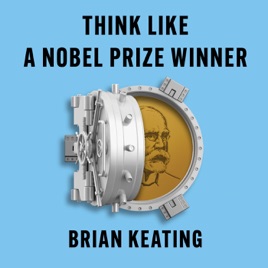
How can you unlock creativity and imagination to inspire, teach and lead? What mental models do some of the world’s brightest minds use to supercharge their creativity, and strengthen their most precious collaborations? Along the way you’ll discover that achieving greatness doesn’t require genius. Instead, dedication to a simple set of principles—habits and tools -- can boost your creativity, stoke your imagination, and unlock your full potential for out-of-this-universe success.
On this podcast you’ll discover why Nobel Prize-winning scientists credit the often-overlooked “soft skills” such as communication, motivation, and introspection as keys to their success. You’ll see why they turn to curiosity, beauty, serendipity, and joy when they need to turn fresh eyes on some of the universe’s most vexing problems...and how you can too no matter what you do!
Get the book here!
Advertise on Think Like A Nobel Prize Winner
Advertise on Think Like A Nobel Prize Winner to promote your brand to thousands of podcast listeners
Unlock Think Like A Nobel Prize Winner podcast Email contact info, Listeners & Audience details
Email contact information
Direct podcast contact details
Listeners
Audience numbers & engagement insights
Audience details
Podcast Insights
Social media
Check Think Like A Nobel Prize Winner social media presence
Check latest episodes from Think Like A Nobel Prize Winner podcast
Nobel Prize Winner Adam Riess: The Hubble Tension is Getting WORSE!
2022/05/29
Chat with Nobel Prize winner Adam Riess about his team's newest measurements of the 'most important number in cosmology' the Hubble Constant. Using the Hubble Space Telescope for what it was meant to do, Adam's team continues to make ultra-precise measurements. We'll also explore the Hubble Tension, the future of Hubble now that the James Webb Space Telescope has deployed, and other cosmic conundrums. Adam is a brilliant teacher and a wonderful raconteur. Don't miss your chance to chat with a brilliant scientist about the most important topic in cosmology today!
From the team: https://hubblesite.org/contents/news-releases/2022/news-2022-005
From CNN:
Measuring the expansion rate of the universe was one of the Hubble Space Telescope’s main goals when it was launched in 1990. Over the past 30 years, the space observatory has helped scientists discover and refine that accelerating rate – as well as uncover a mysterious wrinkle that only brand-new physics may solve.
Hubble has observed more than 40 galaxies that include pulsating stars as well as exploding stars called supernovae to measure even greater cosmic distances. Both of these phenomena help astronomers to mark astronomical distances like mile markers, which have pointed to the expansion rate.
In the quest to understand how quickly our universe expands, astronomers already made one unexpected discovery in 1998: “dark energy.” This phenomenon acts as a mysterious repulsive force that accelerates the expansion rate.
And there is another twist: an unexplained difference between the expansion rate of the local universe versus that of the distant universe right after the big bang.
Scientists don’t understand the discrepancy but acknowledge that it’s weird and could require new physics.
“You are getting the most precise measure of the expansion rate for the universe from the gold standard of telescopes and cosmic mile markers,” said Nobel Laureate Adam Riess at the Space Telescope Science Institute and a distinguished professor at the Johns Hopkins University in Baltimore, in a statement.
“This is what the Hubble Space Telescope was built to do, using the best techniques we know to do it. This is likely Hubble’s magnum opus, because it would take another 30 years of Hubble’s life to even double this sample size.”
Adam Guy Riess (born December 16, 1969) is an American astrophysicist and Bloomberg Distinguished Professor at Johns Hopkins University and the Space Telescope Science Institute. He is known for his research in using supernovae as cosmological probes. Riess shared both the 2006 Shaw Prize in Astronomy and the 2011 Nobel Prize in Physics with Saul Perlmutter and Brian P. Schmidt for providing evidence that the expansion of the universe is accelerating.
Connect with Brian:
https://twitter.com/DrBrianKeating
https://facebook.com/losingthenobelprize
https://instagram.com/DrBrianKeating
Please join my mailing list; just click here http://briankeating.com/mailing_list.php
Produced by Stuart Volkow (P.G.A) and Brian Keating
Edited by Stuart Volkow
Music:
Yeti Tears Miguel Tully - www.facebook.com/yetitears/
Theo Ryan - http://the-omusic.com/
Jocelyn Bell Burnell: Mentors, Pulsars & Prizes
2022/02/16
In 1967, Jocelyn Bell Burnell made an astounding discovery. On 28 November 1967, she detected a "bit of scruff" on her chart-recorder papers that tracked across the sky with the stars. The signal had been visible in data taken in August, but as the papers had to be checked by hand, it took her three months to find it. She established that the signal was pulsing with great regularity, at a rate of about one pulse every one and a third seconds. Temporarily dubbed "Little Green Man 1" (LGM-1) the source (now known as PSR B1919+21) was identified after several years as a rapidly rotating neutron star.
But as a young woman in science, her role was overlooked. Today's discussion is with one of the foremost astronomers of our time in a deep and revealing interview that shares a more personal side of her than ever before. In addition to describing her experimental research, we describe the surprising initial reaction to what was initially thought to be aliens, or Little Green Men.
Since then we reveal what we've learned about fascinating pulsars as well as what that may reveal about life in the universe. We also chat about her religion (Quaker) and mine (Jewish) and how her view of God has evolved. We discuss her book "A Quaker Astronomer Reflects: Can a Scientist also be Religious? ", the Multiverse and Quakers: influence of mentors like Sir Fred Hoyle, the Nobel Prize and answer audience questions.
Dame Susan Jocelyn Bell Burnell DBE FRS FRSE FRAS FInstP is an astrophysicist from Northern Ireland who was president of the Royal Astronomical Society from 2002 to 2004, president of the Institute of Physics from October 2008 until October 2010, and interim president of the Institute following the death of her successor, Marshall Stoneham, in early 2011.
In 2018, she was awarded the Special Breakthrough Prize in Fundamental Physics. Following the announcement of the award, she decided to use the £2.3 million prize money to establish the Bell Burnell Graduate Scholarship Fund, to help female, minority and refugee students become physics researchers. The fund is administered by the Institute of Physics.
Bell on God "Recognising that there was not going to be any proof of the existence of God, I decided many years ago to adopt as a ‘working hypothesis’ the assumption that there was a God, a God that I will describe below, and to see how I got on with this picture of God. Perhaps evidence would accumulate that would lead me to decide that the hypothesis was wrong, that there was no God, or that God was very different from what I had imagined."
Nobel Prizewinner Reinhard Genzel: The Monster Black Hole at the Heart of our Galaxy!
2022/01/25
#BlackHole #Singularity #AdaptiveOptics
Reinhard Genzel studied physics at Bonn Univ., and received his doctorate at the Max Planck Institute for Radioastronomy Bonn (1978), He was a Postdoctoral Fellow, Harvard-Smithsonian Center for Astrophysics (1978-1980), Cambridge, MA, was Associate Professor of Physics and Associate Research Astronomer, Space Sciences Laboratory, University of California, Berkeley (1981- 1985), Full Professor of Physics, University of California, Berkeley (1985-1986).
He is Director and Scientific Member at the Max Planck Institute for Extraterrestrial Physics (since 1986), Honorary Professor Munich Univ. (since 1988), Full Professor of Physics University of California Berkeley (since 1999).
Professor Reinhard was awarded the Nobel Prize for Physics 2020 together with Roger Penrose and Andrea Ghez "for the discovery of a supermassive compact object at the center of our galaxy."
Since nothing, not even light, can escape black holes, they can only be observed by the radiation and the movement of nearby objects. Since the 1990s, Reinhard and Andrea Ghez, with their respective research teams, have developed and refined techniques for studying the movement of stars. Observations of stars in the area around Sagittarius A* in the middle of our galaxy, the Milky Way, revealed a supermassive black hole.
https://www.mpe.mpg.de/ir/gravity
https://www.eso.org/sci/facilities/paranal/instruments/gravity/overview.html
The Best Guest I Never Had | An Elegy for Steven Weinberg
2021/12/29
This episode is sort of "fan fiction" conversation with a dead man who will cast a shadow over physics, philosophy, and theology for decades to come: Steven Weinberg, co-recipient of the 1979 Nobel Prize. Long before audiobooks and podcasts were a thing, in 1992 I took a night train from Cleveland to Buffalo to Binghamton to meet my girlfriend. To while away the hours, I brought with me Weingberg's epochal popular science book, "The First Three Minutes". A few months later, as a graduation present, I received from Lawrence Krauss, CWRU's incoming physics department chairman, "Dreams of a Final Theory".
“Weinberg” is the most mentioned name in my The INTO THE IMPOSSIBLE Podcast notebook where I keep thoughts on possible/upcoming guests. I never got to host him on my show. I did try, most recently in February 2021. For a long time, I held off, insecure in my ability to bring anything new to the table.
Weinberg was a brilliant scientist but as I show, had overly simplistic thoughts on religion and practitioners. Often he claimed science, at its best, SHOULD make religion less plausible.
Using quotes drawn from his many interviews and lectures, including one in his own voice, I bring you this slightly combative interview with a very complex individual.
For the record, Stephen Weinberg, Sheldon Glashow, and Abdus Salam shared the 1979 Nobel Prize for his work on Electroweak Symmetry Breaking or the, so-called, ‘Standard Model for particle physics’. He also made many contributions to both particle physics and cosmology. With respect to the latter, the question addressed is whether or why our universe is fine-tuned for our existence. Past guest, Lenny Susskind explained that Weinberg calculated that if the cosmological constant was just a little different, our universe would cease to exist. This paper is behind a paywall, but see a public lecture (with advanced math): https://ned.ipac.caltech.edu/level5/Weinberg/Weinberg3.html.
Weinberg believed the Anthropic Principle may be appropriated by cosmologists committed to nontheism, and refers to that Principle as a "turning point" in modern science because applying it to the string landscape "may explain how the constants of nature that we observe can take values suitable for life without being fine-tuned by a benevolent creator".
I cover some of Steven’s ‘greatest hits’ including:
"I can hope that this long sad story, this progression of priests and ministers and rabbis and ulamas and imams and bonzes and bodhisattvas, will come to an end. I hope this is something to which science can contribute … it may be the most important contribution that we can make."
"With or without religion, you would have good people doing good things and evil people doing evil things. But for good people to do evil things, that takes religion."
"In our universe we are tuned into the frequency that corresponds to physical reality. But there are an infinite number of parallel realities coexisting with us in the same room, although we cannot tune into them."
And my personal ‘favorite’:"It seems a bit unfair to my relatives to be murdered in order to provide an opportunity for free will for Germans, but even putting that aside, how does free will account for cancer? Is it an opportunity of free will for tumors?"
So, let me know what you think of this episode. Should I do more solo episodes like this, or make this my one and only 😀?
Resources:
Stephen C. Meyer “Weinberg and the Twilight of the Godless Universe”
Dan Falk: “Learning to Live in Weinberg’s ‘Pointless Universe’ “
Find more quotes from Weinberg here:
Please leave a rating and review of The INTO THE IMPOSSIBLE Podcast: Simply click here, scroll down to the ratings and leave a rating and review: 👉
Please subscribe to my YouTube Channel, just click here 👉
Please join my mailing list; just click here http://briankeating.com/mailing_list.php
Brian Schmidt:Nobel Prizewinner: Cosmic Acceleration and Collaboration
2021/12/15
Brian Schmidt, is an astronomer at the Research School of Astronomy and Astrophysics at the Australian National University, formerly known as Mount Stromlo and Siding Spring Observatories. He works in several areas of astronomy, most notably with exploding stars called supernovae. He also chases Gamma-Ray Bursts, and is heading a project to build a new Telescope that will map the Southern Sky called SkyMapper.
Brian was awarded The Nobel Prize in Physics 2011 for the discovery of the accelerating expansion of the Universe through observations of distant supernovae.
Please join my mailing list; just click here: http://briankeating.com/mailing_list.php
📺 Watch my most popular videos:📺
A New Contender is Here! https://www.youtube.com/watch?v=-6A6myur--c
Frank Wilczek https://youtu.be/3z8RqKMQHe0?sub_confirmation=1
Weinstein and Wolfram https://www.youtube.com/watch?v=OI0AZ4Y4Ip4?sub_confirmation=1
Sheldon Glashow: https://youtu.be/a0_iaWgxQtA?sub_confirmation=1
Neil deGrasse Tyson https://youtu.be/1kxgK6J4S5Y
Michio Kaku: https://youtu.be/3to9ymn-XKI
Michael Saylor: https://youtu.be/CaN_CDKqXOg?sub_confirmation=1
Sir Roger Penrose: https://youtu.be/AMuqyAvX7Wo
Jill Tarter https://youtu.be/O9K9OBd3vHk?sub_confirmation=1
Sara Seager Venus LIfe: https://youtu.be/QPsEDoOTU6k?sub_confirmation=1
Noam Chomsky: https://youtu.be/Iaz6JIxDh6Y?sub_confirmation=1
Sabine Hossenfelder: https://youtu.be/sh98cwRkzAA
Sarah Rugheimer: https://youtu.be/w5DxU-lPYK4
Stephen Wolfram: https://youtu.be/nSAemRxzmXM
Avi Loeb: https://youtu.be/N9lUceHsLRw
Jim Simons: https://youtu.be/6fr8XOtbPqM
Be my friend:
🏄♂️ Twitter: https://twitter.com/DrBrianKeating
🔔 Subscribe https://www.youtube.com/DrBrianKeating?sub_confirmation=1
📝 Join my mailing list; just click here http://briankeating.com/mailing_list.php
✍️ Detailed Blog posts here: https://briankeating.com/blog.php
🎙️ Listen on audio-only platforms: https://briankeating.com/podcast.php
A production of http://imagination.ucsd.edu/
Support the podcast: https://www.patreon.com/drbriankeating
Barry Barish Interviews Brian Keating: Part 2
2021/11/03
In February 2021 Dr. Barry Barish, co-recipient of the 2017 Nobel Prize in Physics for the LIGO experiment, interviewed me at his home in Los Angeles. The topic was his thoughts and reactions to my book, Losing the Nobel Prize (http://amzn.to/2sa5UpA). We discussed scientific leadership, academic stress, burnout, the role of mentors and managers in science and a lot about my book too.
Losing The Nobel Prize By Brian Keating
The inside story of a quest to unlock one of cosmology’s biggest mysteries, derailed by the lure of the Nobel Prize.
What would it have been like to be an eyewitness to the Big Bang? In 2014, astronomers wielding BICEP2, the most powerful cosmology telescope ever made, revealed that they’d glimpsed the spark that ignited the Big Bang. Millions around the world tuned in to the announcement broadcast live from Harvard University, immediately igniting rumors of an imminent Nobel Prize. But had these cosmologists truly read the cosmic prologue or, swept up in Nobel dreams, had they been deceived by a galactic mirage?
In Losing the Nobel Prize, cosmologist and inventor of the BICEP (Background Imaging of Cosmic Extragalactic Polarization) experiment Brian Keating tells the inside story of BICEP2’s mesmerizing discovery and the scientific drama that ensued. In an adventure story that spans the globe from Rhode Island to the South Pole, from California to Chile, Keating takes us on a personal journey of revelation and discovery, bringing to vivid life the highly competitive, take-no-prisoners, publish-or-perish world of modern science. Along the way, he provocatively argues that the Nobel Prize, instead of advancing scientific progress, may actually hamper it, encouraging speed and greed while punishing collaboration and bold innovation. In a thoughtful reappraisal of the wishes of Alfred Nobel, Keating offers practical solutions for reforming the prize, providing a vision of a scientific future in which cosmologists may, finally, be able to see all the way back to the very beginning.
Barry Barish Interviews Brian Keating: Part 1
2021/11/03
In February 2021 Dr. Barry Barish, co-recipient of the 2017 Nobel Prize in Physics for the LIGO experiment, interviewed me at his home in Los Angeles. The topic was his thoughts and reactions to my book, Losing the Nobel Prize (http://amzn.to/2sa5UpA). We discussed scientific leadership, academic stress, burnout, the role of mentors and managers in science and a lot about my book too.
Losing The Nobel Prize By Brian Keating
The inside story of a quest to unlock one of cosmology’s biggest mysteries, derailed by the lure of the Nobel Prize.
What would it have been like to be an eyewitness to the Big Bang? In 2014, astronomers wielding BICEP2, the most powerful cosmology telescope ever made, revealed that they’d glimpsed the spark that ignited the Big Bang. Millions around the world tuned in to the announcement broadcast live from Harvard University, immediately igniting rumors of an imminent Nobel Prize. But had these cosmologists truly read the cosmic prologue or, swept up in Nobel dreams, had they been deceived by a galactic mirage?
In Losing the Nobel Prize, cosmologist and inventor of the BICEP (Background Imaging of Cosmic Extragalactic Polarization) experiment Brian Keating tells the inside story of BICEP2’s mesmerizing discovery and the scientific drama that ensued. In an adventure story that spans the globe from Rhode Island to the South Pole, from California to Chile, Keating takes us on a personal journey of revelation and discovery, bringing to vivid life the highly competitive, take-no-prisoners, publish-or-perish world of modern science. Along the way, he provocatively argues that the Nobel Prize, instead of advancing scientific progress, may actually hamper it, encouraging speed and greed while punishing collaboration and bold innovation. In a thoughtful reappraisal of the wishes of Alfred Nobel, Keating offers practical solutions for reforming the prize, providing a vision of a scientific future in which cosmologists may, finally, be able to see all the way back to the very beginning.
James Altucher Interviews Brian Keating About Think Like A Nobel Prize Winner
2021/10/18
Dr. Brian Keating talks about his new book Think Like a Nobel Prize Winner. James and Brian discussed the traits of the Nobel Prize Winners, and what it means for them!
James Altucher interviews the world’s leading peak performers in every area of life. But instead of giving you the typical success story, James digs deeper to find the “Choose Yourself” story—these are the moments we relate to… when someone rises up from personal struggle to reinvent themselves.
https://jamesaltucher.com/
Available on Amazon: Think Like a Nobel Prize Winner
About Professor Brian Keating:
https://www.youtube.com/drbriankeating
Podcast in iTunes
https://simonsobservatory.org/
https://briankeating.com/
https://bkeating.physics.ucsd.edu/
https://www.linkedin.com/in/drbriankeating/
Barry Barish: The Avuncular Avatar
2021/10/06
Barry Barish is the Linde Professor of Physics, Emeritus, at Caltech and faculty member at UC Riverside. He became director of the LIGO (Laser Interferometer Gravitational-Wave Observatory) project in 1997. In 2017, he was awarded the Nobel Prize in Physics along with Rai Weiss and Kip Thorne and their teams “for decisive contributions to the LIGO detector and the observation of gravitational waves.” Before joining the LIGO experiment, he worked on the Superconducting Super Collider, the high-profile particle accelerator that was canceled by Congress in 1993. He has many other awards, is a member of the National Academy of Sciences, and served as president of the American Physical Society in 2011. Barry is a consummate scientist. He has the hands-on technical expertise, the interpersonal skills to motivate and lead, and the scientific discipline to know when to quit and went to double down.
Available on Amazon: Think Like a Nobel Prize Winner
About Professor Brian Keating:
https://www.youtube.com/drbriankeating
Podcast in iTunes
https://simonsobservatory.org/
https://briankeating.com/
https://bkeating.physics.ucsd.edu/
https://www.linkedin.com/in/drbriankeating/
Brian Keating: Author Hour Interview on Think Like A Nobel Prize Winner
2021/10/06
Brian Keating: Author Hour Interview on Think Like A Nobel Prize Winner.
Available on Amazon: Think Like a Nobel Prize Winner
About Professor Brian Keating:
https://www.youtube.com/drbriankeating
Podcast in iTunes
https://simonsobservatory.org/
https://briankeating.com/
https://bkeating.physics.ucsd.edu/
https://www.linkedin.com/in/drbriankeating/
John Mather: The Collaborator
2021/10/06
John Mather is a senior astrophysicist at NASA’s Goddard Space Flight Center and a professor of physics at the University of Maryland’s College of Computer, Mathematical, and Natural Sciences. In 2006, he and George Smoot were awarded the Nobel Prize in Physics “for their discovery of the blackbody form and anisotropy of the cosmic microwave background radiation.” The work, completed along with their teams, used the COBE satellite to all but confirm the Big Bang theory—and elevated cosmologists, individuals previously derided by “real” physicists as being “always in error, but never in doubt,” into proper practitioners of precision science.
Available on Amazon: Think Like a Nobel Prize Winner
About Professor Brian Keating:
https://www.youtube.com/drbriankeating
Podcast in iTunes
https://simonsobservatory.org/
https://briankeating.com/
https://bkeating.physics.ucsd.edu/
https://www.linkedin.com/in/drbriankeating/
Think Like A Nobel Prize Winner: An Introduction From Professor Brian Keating
2021/09/27
Available on Amazon: Think Like a Nobel Prize Winner
About Professor Brian Keating:
https://www.youtube.com/drbriankeating
Podcast in iTunes
https://simonsobservatory.org/
https://briankeating.com/
https://bkeating.physics.ucsd.edu/
https://www.linkedin.com/in/drbriankeating/
Podcast reviews
Read Think Like A Nobel Prize Winner podcast reviews
5 out of 5
21 reviews
★★★★★
emilyoundinsd 2022/03/14
Love Nobel prize wisdom
Keep it up Brian
★★★★★
yonkelllllleh 2021/11/28
Never miss an episode
I can’t get enough. love learning about physics as I don’t know as much as Brian but thanks to his guests I am learning !
★★★★★
akkkkkkfourseven 2021/11/27
Nobel prize winners are different and not so different
Love every episode especially the Nobel laureates that brian always lands. Don’t miss his main podcast Into the impossible which brought me here.
★★★★★
takkkkkway 2021/11/22
Brilliant Brian and guests
Love his interview style brings out introverted scientists from their shells
★★★★★
jackkkkkkarttakkk 2021/11/20
Love Nobel prize wisdom
Never miss an episode
★★★★★
davyjonessssssey 2021/11/20
A phenomenal mental extravaganza!
Who’s better to learn from than brilliant and personable Nobel prize winners. They share not only knowledge but also wisdom which is even more rare. T...
★★★★★
Bk613 2021/10/30
Phenomenal minds and host
Can’t get enough of this wonderful genius level stuff. More please Brian!
★★★★★
jennnnnnnyfromblock 2021/10/29
Amazing guests
I love it!
★★★★★
cmreviews 2021/10/13
Physics’s best interpersonal podcast
I’m really enjoying the testimonies from all of these scientists. Brian does a great job with letting his guests tell their stories and opinions on ve...
★★★★★
beastrafster 2021/10/10
Perfect companion to a great book!
Fascinating and inspiring to hear real interviews from Nobel prize winners! Who better to interview them than a real practicing Physics professor? D...