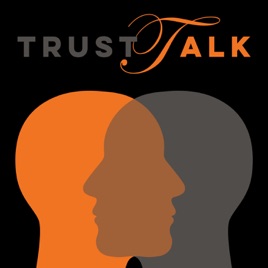
Advertise on podcast: TrustTalk - It's all about Trust
This podcast has
48 episodes
Language
EnglishPublisher
Severin de WitExplicit
No
Date created
2021/10/05
Latest episode
2022/06/28
Average duration
28 min.
Release period
16 days
Description
The TrustTalk podcast covers all aspects of trust. Trust is more relevant than ever. Trust is everywhere. Trust has many faces. We will dive in all aspects of trust in the lives of people: trust in technology, social networks, trust in politicians, trust in facts, communications and journalism, the judiciary, your partner, employer, or employee. Trust is not something that comes for free, most of the time it requires a lot of effort to gain and once gained, to keep it. Without Trust, nothing works. We are exploring trust by interviewing experts from all over the world to talk about their research, experience or thoughts about trust.
Unlock TrustTalk - It's all about Trust podcast Email contact info,
Listeners & Audience details
Email contact information
Direct podcast contact details

Listeners
Audience numbers & engagement insights

Audience details
Podcast Insights

Podcast episodes
Check latest episodes from TrustTalk - It's all about Trust podcast
Trust and Global Cooperation
2022/06/28
Our guest today is Jason Rhys Parry, Senior Content R&D at Sapienship, the global social impact company founded by Yuval Noah Harari and Itzik Yahav and headed by Naama Avital. Sapienship's mission is to focus global attention on the most important collective challenges facing the world today, through entertainment, education, and investments.
In this interview, he talks about an old mechanism for academics to build trust, the footnote, and the damaging effect hiding scientific work behind paywalls has on public access to information. Global cooperation did produce unintended positive effects on global warming as he explains the Montreal Protocol did by storing billions of tonnes of carbon stored in plants that would otherwise be in the atmosphere. He talks about the “replication crisis” in science, flawed studies, experiments that fail to replicate, the effect of too much media attention, and a lack of self-criticism and self-evaluation. And about the cost of averting climate breakdown: the “2%-More-Rule”: if humanity invests just an extra 2% of Global GDP in developing eco-friendly technologies and infrastructure every year, this would be enough to prevent catastrophic climate change.
A Trustworthy Government
2022/06/15
Our guest today is Margaret Levi, professor of Political Science and Director of the Centre for Advanced Study in the Behavioural Sciences at Stanford University. She talks about her upbringing in a middle-class Jewish suburb, how the protest marches she was going to with her mother, and the books she got from her father made her believe that you have to stand up to something that’s wrong. Her publications concentrate on trust in government, the ways in which citizens and governments interact, about institutions providing a setting in which we feel protected. She talks about the social contract between citizens and their institutional leaders and the role of accountability. The Covid pandemic has produced new insights into citizens’ behaviors. In her book “In the Interest of Others” she explains why members of organizations are willing to engage in costly actions, using the Australian transportation unions as an example. To create trust, credible and fact-based communication is essential. Asked what the challenges are for future generations of political scientists, she mentions the threat democracy is under.
Trusted Finance
2022/05/31
In today’s interview with Peter Sieradzki, former CEO of the private bank InsingerGilissen, he talks about trust built on institutional processes, the breaches of trust in corporations and banks, the role of integrity and sustainability in the banking business, and about fintech providing a great impetus in the development of new technology and new systems in banks. He reflects on cryptocurrencies and whether they can gather sufficient integrity to be seen as a trusted financial instrument and on trust challenges for banks in the foreseeable future.
Net Positive Companies Build Trust
2022/05/04
Andrew Winston, the co-author of the book “Net Positive”, talks about the challenges that lay ahead and the limited time we have to contribute to the world’s problems. A net positive company improves the well-being of everyone they impact and the lives of everyone it touches, from customers and suppliers to employees and communities, greatly increasing long-term shareholder returns in the process, taking ownership of all the social and environmental impacts its business model creates. This in turn provides opportunities for innovation, savings, and builds a more humane, connected, and purpose-driven culture. He talks about the important connection of building trust with the external world so you can get to the kinds of partnerships and collaborations that we need to solve really big problems, without that trust built up, it's going to be nearly impossible, as one cannot have a very functional partnership unless there's some level of trust. This is no utopian fantasy. Courageous leaders are already making it real and the stakes couldn't be higher. With bold vision and compelling stories, he sets out the principles and practices that will deliver the scale of change and transformation the world so desperately needs.
Trust Solutions and The New Equation
2022/04/19
Today’s guest is Wes Bricker, US Vice-Chair and US Trust Solutions Co-Leader of PwC. He served as Chief Accountant at the US Security Exchange Commission. In this interview he talks about PwC’s project “The New Equation” and the two most fundamental needs clients and organizations are grappling with today: Firstly the urgency to successfully respond to, and change, in the face of major shifts shaping the world: technological disruption, climate change, fractured geopolitics, social tension, and the continuing effects of the COVID-19 pandemic. Secondly, the need to build trust at a time when it is both more fragile and more complicated to earn.
Do We Trust Science or the Scientist?
2022/04/12
The Covid pandemic has learned us that we have to rely on science, at the same time when scientists appear in public they are often criticized and mistrusted. In this interview, Roberto Gronda (University of Pisa, Italy) explains why this is: operating as a scientist in the context of a university or laboratory renders more trust than a scientist doing consultancy where the scientist has to show more qualifications, like being media savvy. A lot of scientists work in big groups, so they need to trust each other because they do not have all the skills necessary to assess every bit of knowledge. The old idea is that there is a scientist who has enough skills to build everything from scratch, to know everything about his field of research to be completely autonomous from all the other people. That's not possible anymore. So lay people need to trust a scientist. But the relationship between laypeople and scientists is a relationship of inequality. As for what knowledge is concerned, there is no chance that laypeople can know things better than scientists in their field of research.
Food Trust
2022/03/31
In this interview with Moira Dean, Professor in consumer psychology and food security at Queens University in Belfast, Northern Ireland (UK) we talk about her research into consumer food choices, food safety, food fraud, risk perceptions, and food supply chain management and food labeling. Consumers developed different food habits during the pandemic and lockdowns. We talk about the “head, heart, and hands” or the perceptions, attitudes, and behaviors of consumers and producers along the food supply chain to explore food security challenges and create trust in food. She explores the challenges in global food integrity and how the world’s growing population will get food in a sustainable, cost-effective, and environmentally friendly way. In the interview, we cover the 2020 Deloitte survey into consumer attitudes on ethical and environmentally produced food. How can labeling products enlarge the trust of consumers? What is the role of all players in the food production chain, the farmers, food producers, and retail?
International Relations, Diplomacy & Trust
2022/02/26
This interview with Richard Ned Lebow, Professor of International Political Theory at the Department of War Studies at King’s College in London, was taken, just before Russia invaded Ukraine. We talked about trust in international relations, about the view that asking Ukraine to renounce membership of NATO is dangerous (which he does not agree with), a discussion that rendered moot with the news about Russia invading Ukraine.
Trust is an important element in diplomacy mentioning three famous examples in history. Trust in diplomacy should be distinguished from trust in nations.
He talks about the role of disinformation during World War II. Russia was not the only country using disinformation (“maskirovka”) in warfare. General Patton of the Allied Forces staged a non-existent army in Kent, including radio traffic as if it was a real army to strengthen the German belief that an allied invasion would start in the French Port of Calais.
He comments on Stanford professor Larry Diamond’s view that we see a trend of a “democratic depression”, about deterrence and realist models of International relations assuming that trust is in short supply.
How to Effectively Regain Trust?
2022/02/10
When companies or politicians break trust, it takes three equally important steps to repair trust. As a professor of management practice at Harvard Business School and co-writer of the book “The Power of Trust: How Companies Build It, Lose It, Regain It”, Sandra Sucher takes us through some examples of apologies after broken trust that were ineffective, causing tremendous harm. UBER is a very competent company, yet they are losing customers due to a lack of trust, Volkswagen had its trust failure after rigging emissions test of their diesel cars, for which the CEO apologized, but did so unconvincingly, with great consequences.
But there are examples of successful trust repair. Who remembers Japanese-based platform business Recruit Holdings, who after a scandal showed how to repair broken trust, or the PWC gaffe from 2017, where employees mixed up the winner's envelope, as a result of which La La Land was announced the Oscar winner, instead of Moonlight. Both did a remarkable job in restoring trust. In the interview, she explains what it took to restore those trust failures.
She talks about a study by Kurt Dirks who found that the NCAA basketball team won the most games due to the trust they had in their coach and about the way politicians can restore broken trust, about creating a trusted work environment for women, and the four attributes of trust repair.
Trusted B-Lab & B-Corp companies
2022/02/07
Today’s guest is entrepreneur Leen Zevenbergen. Together with Marcello Palazzi, he started the non-profit organization “B Lab”, with the idea that a different kind of economy was not only possible but necessary and that business could lead the way towards a new, stakeholder-driven model. B Lab has become known for certifying B Corporations (or “Benefit Corporations”). A “B Corp” is a company that meets high standards of social and environmental performance, accountability, sustainability, and transparency. Currently, there are over 4,000 B Corps in 75 countries. He talks about the Impact Measurement Tool of B Lab which 160,000 companies in the world are using. The country with the most B-Corps is Italy.
Trust Responsible Drug Use
2022/01/27
In this interview with Carl Hart, professor of neuroscience at Columbia University, New York, he sets out his belief that the way we think about drugs and addiction is wrong and prevents society to live up to its ideals of liberty and the pursuit of happiness. All drugs, he argues, should be fully legalized, and instead of punishing or shaming people for drug use, we should focus on helping them use drugs wisely. Do we trust the people that regulate drugs to do the right thing to keep people safe? In his view, the answer to this question is a resounding no. We don't trust those people.
Trusted Digital Identity
2022/01/13
Jacoba Sieders is among the top experts on digital identity in Europe. In this second interview with her (the first one was published on April 18, episode 17) she talks about the three phases of how digital identity developed over time, about “federated identity”, one password to log in to different organizations. In a third stage, you upload your data and by doing so establish your own digital identity in your own digital wallet. The newest innovation, is “distributed identity”, that you as a user are the center of your own digital identity and not the organizations that need to trust you. It is called self-sovereign identity (SSI) with zero-knowledge proof, the idea that your claim (e.g. that you are over 18 and can buy alcohol or are entitled to drive) is right, without sharing all your personal data. She explains the necessary “triangle” of the digital wallet, the holder, issuer, and validator of personal data and talks about the ten requirements of proper identity management, among which is privacy and the “right to be forgotten”. She explains the attempt by the EU to create a single digital market by eIDAS, or electronic IDentification, Authentication, and trust Services), an EU regulation on electronic identification and trust services for electronic transactions in the European Single Market. Can we get rid of cookies, or passwords, altogether? Finally, she speaks about medical and other very private data in 2G apps fighting the coronavirus.
Podcast reviews
Read TrustTalk - It's all about Trust podcast reviews
Podcast sponsorship advertising
Start advertising on TrustTalk - It's all about Trust relevant audience podcasts
You may also like to advertise on these Podcasts
4.4371061566
The Megyn Kelly Show
SiriusXM
4.888901269
Fearless with Jason Whitlock
Blaze Podcast Network
4.8118931000
Mind Pump: Raw Fitness Truth
Sal Di Stefano, Adam Schafer, Justin Andrews, Doug Egge
4.8102131585
Tara Brach
Tara Brach
4.541561215
Something You Should Know
Mike Carruthers | OmniCast Media

4.513841343
Strictly Anonymous Confessions
Kathy Kay
4.8292781897
Fantasy Footballers - Fantasy Football Podcast
Fantasy Football
4.62382612
Football Weekly
The Guardian

4.45387666
Two Judgey Girls
Two Judgey Girls

3.8258501152
The Viall Files
Nick Viall