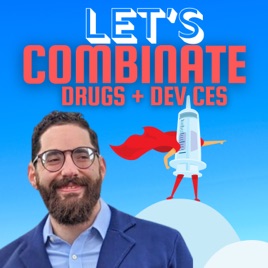
Advertise on podcast: Let's Combinate - Drugs + Devices
Rating
4.9from
This podcast has
266 episodes
Language
EnglishPublisher
Subhi SaadehExplicit
No
Date created
2021/10/07
Latest episode
2026/10/12
Average duration
20 min.
Release period
7 days
Description
Hello Combi-Nation! Our industry fee complicated sometimes. Drugs, devices, clinical trials, submissions, sterilization validation, design control, risk management, market access reimbursement, the list goes on. My name is Subhi Saadeh. I've spent over a decade in medical device, pharma, and combination product development. My goal is mastery, so this podcast is to ask questions I have to people who may have the answers. Whether you're background is Pharma, Device or both, I invite you to listen and together we can simplify by Combinating!
Unlock Let's Combinate - Drugs + Devices podcast Email contact info,
Listeners & Audience details
Email contact information
Direct podcast contact details

Listeners
Audience numbers & engagement insights

Audience details
Podcast Insights

Podcast episodes
Check latest episodes from Let's Combinate - Drugs + Devices podcast
258 - Combination Product Quality: Human Factors, CDMO Scorecards, ISO 14971 vs. ICH Q9, with Ben Locwin
2026/10/12
Combination product quality with Ben Locwin: why drug and device quality systems differ, how human factors studies are designed, what to do when a CDMO's clean audit doesn't match its performance, and how ISO 14971 risk management compares with ICH Q9.
This conversation was recorded for Ben Locwin's Life Science Shifts podcast from Reliant Life Sciences, with Subhi Saadeh as the guest. It covers where pharma and medical device thinking diverge, and what that means when one product has to satisfy both.
IN THIS EPISODE
- Why drugs and devices prove safety and effectiveness in different ways
- Drug development (clinical, nonclinical, CMC) vs. device design controls
- Why the same syringe can need new human factors work for a different user
- How human factors studies are built: patient and caregiver arms, trained and untrained users
- CGMPs for combination products: QMSR, ISO 13485, ICH, and PIC/S
- Global harmonization: IMDRF for devices, ICH for drugs, and the gap for combination products
- CDMO oversight when the supplier scorecard and the audit result don't match what you see
- ISO 14971 and ISO/TR 24971 vs. ICH Q9: initial and updated probability
- FMEA as a living document
TIMESTAMPS
0:00 Pharma vs. medical device quality: two philosophies
2:10 Drug development vs. device design controls
4:29 Why device trials rarely use placebo controls
9:52 Platform technology and delivery devices
12:10 Same device, different user: bracketing and generic platforms
14:14 Human factors studies: recruitment, study arms, formative studies
15:40 CGMPs for combination products: QMSR, ISO 13485, ICH, PIC/S
16:58 Harmonization: IMDRF and ICH
19:12 Conway's Law and organizational inertia
22:06 Staying objective as a consultant
25:10 CDMO oversight: when the scorecard doesn't match reality
30:18 Scoring bias in subjective weighting
31:14 ISO 14971 vs. ICH Q9 risk management
32:32 FMEA as a living document
RELATED VIDEOS
Pharma vs. Medical Device Quality Systems: 5 Differences
https://youtu.be/xG0htEu0ph4
Working with a Device CDMO: Common Sponsor Mistakes
https://youtu.be/d2SDwndXuCk
ICH Q9 Explained
https://youtu.be/Is67hbh71RY
Design Controls Explained for Pharma and Combination Product Teams
https://youtu.be/f7esiLpUhfM
Need help with CDMO oversight, supplier audits, or risk management on a combination product?
https://letscombinate.com/services/
ABOUT BEN LOCWIN
Ben Locwin is Vice President at Reliant Life Sciences and host of the Life Science Shifts podcast. His work spans drug therapies, vaccines, and medical devices, and he is a frequent industry speaker and commentator on pharma and medical device quality.
Reliant Life Sciences:
https://www.reliantlifesciences.com/
ABOUT SUBHI SAADEH
Subhi Saadeh is the Founder and Principal of Let's Combinate, a consultant, auditor, and trainer specializing in drug-device combination products, medical devices, and pharmaceutical quality systems. He has held quality and engineering roles at Pfizer, Gilead, and Baxter, with experience spanning quality, R&D, and commercialization and a focus on design controls, supplier quality, inspection readiness, and translating regulatory expectations into practical execution.
Subhi is an ISO 13485 Lead Auditor and an ASQ Certified Quality Auditor and Certified Quality Engineer. He has chaired the Combination Product Working Group for Rx-360, served as International Committee Chair for the Combination Products Coalition (CPC) and as a member of ASTM Committee E55, and served on AAMI's Combination Products Committee.
CONNECT WITH SUBHI
Consulting, audits, and training:
https://letscombinate.com/services/
Discuss a project:
https://calendly.com/letscombinate/quick-chat
LinkedIn:
https://www.linkedin.com/in/subhi-saadeh-1169aa21/
Email:
[email protected]
FOLLOW LET'S COMBINATE
YouTube:
https://www.youtube.com/@LetsCombinate
Spotify:
https://open.spotify.com/show/71wYadhCrfLsdYTVachpD2
#CombinationProducts #HumanFactors #RiskManagement
257 - 21 CFR Part 4 Explained: CGMP Requirements for Combination Products
2026/10/05
21 CFR Part 4 sets the CGMP requirements for combination products. If your product has a drug and a device in it, you're on the hook for both sets of regulations. In this video, I walk through Part 4 Subpart A section by section: the scope, the key definitions, which CGMPs apply, and the two ways to comply, including the streamlined approach under 4.4(b).
Updated for February 2026, when the device side moved to the QMSR and ISO 13485, plus the new medical gas provisions.
Working on your first combination product program? Watch this next: https://youtu.be/uG_Ea__-Pjc
Want a second set of eyes on your combination product quality system? Book a quick call: https://calendly.com/letscombinate/quick-chat
Sources
21 CFR Part 4 (eCFR): https://www.ecfr.gov/current/title-21/chapter-I/subchapter-A/part-4
FDA Guidance, CGMP Requirements for Combination Products: https://www.fda.gov/media/90425/download
Chapters
0:00 Intro
0:50 21 CFR Part 4 Subpart A vs. Subpart B
2:00 Full compliance vs. the streamlined approach
2:39 21 CFR 4.1: Scope (single-entity and co-packaged)
3:52 21 CFR 4.2 and 4.3: Definitions and which CGMPs apply
4:37 21 CFR 4.4: How to comply with CGMPs for combination products
5:38 Drug-based system: ISO 13485 and QMSR provisions to add
7:58 Device-based system: 21 CFR 211 provisions to add
11:24 Medical gas and 4.4(c)–(e): separate facilities
12:10 Wrap-up
About me
I'm Subhi Saadeh. I help companies make drug and device quality systems work together. I'm a consultant, auditor, and trainer focused on combination products, an ISO 13485 Lead Auditor, and an ASQ CQA and CQE. I've worked on prefilled syringes, autoinjectors, IV bags, cartridges, and vial-based systems, from clinical through commercial.
🌐 https://letscombinate.com
📅 https://calendly.com/letscombinate/quick-chat
💼 https://www.linkedin.com/in/subhi-saadeh-1169aa21
✉️ [email protected]
#CombinationProducts #21CFRPart4 #QMSR
256 - The New FDA Inspection Playbook: Where to Start with QMSR
2026/09/28
QMSR became effective on February 2, 2026. Alongside that change, FDA retired the Quality System Inspection Technique (QSIT) and began using the inspection process described in Compliance Program 7382.850.
What does that mean for industry and how should we use the new program to prepare?
In this episode of Let’s Combinate: Drugs + Devices, Subhi Saadeh introduces a four-part series on QMSR inspection readiness. We compare QSIT’s four major inspection subsystems with the new program’s six QMS areas, explore how risk informs inspection coverage, and identify where industry should start reading.
The episode also features an excerpt from Subhi’s conversation with Eric Pittman, a former FDA investigator who spent a decade as editor-in-chief of FDA’s Investigations Operations Manual.
IN THIS EPISODE
• What replaced QSIT and where to find it
• Why Part III is a useful starting point for industry
• How FDA reorganized inspection coverage into six QMS areas
• How product risks and risk management documentation help guide record selection
• What’s coming in the QMSR inspection readiness series
TIMESTAMPS
00:00 QSIT is gone: What changed with QMSR
00:50 The new FDA inspection program
01:39 The four-part inspection readiness series
02:47 Eric Pittman: Where industry should start
04:14 Will FDA publish a new QSIT guide?
05:06 Comparing the old and new inspection approaches
05:47 Four major subsystems to six QMS areas
06:57 Inspection models and record selection
07:37 Risk, controls, and inspection evidence
08:08 What’s next in the series
THE SERIES
1. QSIT to QMSR: Understanding the new inspection program
2. Inspection models, coverage, and record selection
3. The six QMS areas and how they connect
4. Inspection readiness: Preparing people, processes, and records, with lessons from early QMSR warning letters
RESOURCES
FDA Compliance Program 7382.850 — Inspection of Medical Device Manufacturers
Part III begins on page 20. Attachment A details the QMS areas, elements, and requirements.
https://www.fda.gov/media/80195/download
FDA Investigations Operations Manual — Chapter 5
https://www.fda.gov/media/166533/download
FDA QMSR Frequently Asked Questions
https://www.fda.gov/medical-devices/quality-management-system-regulation-qmsr/quality-management-system-regulation-frequently-asked-questions
ABOUT SUBHI SAADEH
Subhi Saadeh is the Founder and Principal of Let’s Combinate, a consultant, auditor, and trainer specializing in drug-device combination products, medical devices, and pharmaceutical quality systems. His experience spans quality, R&D, and commercialization, with a focus on design controls, supplier quality, inspection readiness, and translating regulatory expectations into practical execution.
Subhi is an ISO 13485 Lead Auditor and an ASQ Certified Quality Auditor and Certified Quality Engineer.
CONNECT WITH SUBHI
Consulting, audits, and training:
https://letscombinate.com
LinkedIn:
https://www.linkedin.com/in/subhi-saadeh-1169aa21/
Schedule a quick chat:
https://calendly.com/letscombinate/quick-chat
Email:
[email protected]
FOLLOW LET’S COMBINATE
YouTube:
https://www.youtube.com/@LetsCombinate
Spotify:
https://open.spotify.com/show/71wYadhCrfLsdYTVachpD2
Apple Podcasts:
https://podcasts.apple.com/us/podcast/lets-combinate-drugs-devices/id1589285792
255 - Audit Interview Techniques: How Good Auditors Get Better Evidence
2026/09/21
A huge part of the job is knowing how to interview people, understand how work is actually performed, and corroborate what you hear against records, observations, and other objective evidence.In this episode, I pulled one of the lessons from the auditing course Andy Robertson and I developed and walk through some of the fundamentals of audit interviewing: building rapport, asking open-ended questions, avoiding overly checklist-driven interviews, corroborating information, managing group interviews and translators, and handling some of the situations that make interviews difficult.If documents and records alone were enough to understand the quality of an organization, every audit could be a desktop audit. People are a huge part of what makes an audit work.Full CQA Master Class:https://cqeacademy.teachable.com/p/the-cqa-master-class-courseChapters0:00 Intro1:39 Interviewing Fundamentals3:04 Conversational vs. Checklist3:49 Building Rapport4:29 Focus on the Process5:30 Open-Ended Questions5:58 Corroborating Information6:44 Group Interviews7:29 Using Translators8:20 Interview Challenges10:29 Time Management11:16 ClosingAbout SubhiSubhi Saadeh is the Founder and Principal of Let’s Combinate, where he helps teams develop and control drug-device combination products by aligning quality systems, development, and regulatory expectations across drug and device domains. He is a consultant, auditor, trainer, and speaker with experience across pharma, biotech, medical devices, and combination products.Learn more about Let’s Combinate:https://letscombinate.com/Connect with Subhi on LinkedIn:https://www.linkedin.com/in/subhi-saadeh-1169aa21Need help?https://calendly.com/letscombinate/let-s-combinate-intro-session#Quality #Auditing #QualityAssurance #CQA #Pharma #MedicalDevices #CombinationProducts
254 - Saying No Is the Easy Part of Quality
2026/09/13
Quality has a reputation for saying no.
Sometimes that’s exactly the right call. Other times, “no” is just the easiest answer.
In this episode, Subhi breaks down four situations where Quality should absolutely stop the train, and a few where it’s worth stepping back and asking what’s really driving the no in the first place.
Subhi covers:
when there is real patient or product risk
when the evidence doesn’t support the decision
when moving forward would clearly violate requirements or SOPs
when schedule or business pressure is pushing a team to close something that isn’t actually closed
He also talks through some weaker reasons Quality says no, including:
personal preference or “this is how we’ve always done it”
uncertainty from lack of technical familiarity
applying more GMP rigor than the stage of development actually requires
If you work in quality, combination products, development, manufacturing, or technical leadership, this is a practical look at how to think about “no” in a more risk-based way.
Timestamps
00:00 Why Quality Says No
00:45 Channel Intro and Setup
02:02 No When Risk Is Real
03:06 No When Evidence Fails
05:02 No When Requirements Break
05:44 No to Schedule Pressure
07:48 Bad No From Preference
08:33 Bad No From Uncertainty
09:20 Overkill and Phase GMPs
10:08 Build Flexible Quality Culture
12:16 Wrap Up and Takeaways
Subhi Saadeh is a consultant, trainer, auditor, and the Founder and Principal of Let’s Combinate. He has spent his career across medical devices and pharmaceuticals, with experience spanning research and development, industrialization, quality systems, and combination products. Through Let’s Combinate, he helps professionals and organizations better understand and navigate the intersection of drugs, devices, quality, and regulatory requirements.
Connect with Subhi Saadeh
LinkedIn: https://www.linkedin.com/in/subhi-saadeh-1169aa21/
Website: http://letscombinate.com/
Book a quick chat: https://calendly.com/letscombinate/quick-chat
Email: [email protected]
Listen / Follow Let’s Combinate
YouTube: https://www.youtube.com/@LetsCombinate
Spotify: https://open.spotify.com/show/71wYadhCrfLsdYTVachpD2
Apple Podcasts: https://podcasts.apple.com/us/podcast/lets-combinate-drugs-devices/id1589285792
#Quality #CombinationProducts #Pharma #MedTech #RiskManagement #GMP #DesignControls #SupplierQuality #QualitySystems #LetsCombinate
253 - FDA Is Making Big Changes to Its Inspection Approach
2026/09/07
FDA is changing how it organizes and deploys its investigators but it isn’t simply returning to the old generalist model.
Eric Pittman spent more than 20 years at FDA, conducted approximately 800+ inspections, led the Bioresearch Monitoring Division West, and served for a decade as editor-in-chief of FDA’s Investigations Operations Manual.
In this episode, Eric explains how FDA investigators are trained to think, the difference between technical expertise and inspection skill, why investigators sometimes “phone home,” and what the transition from ORA to OII means for the agency’s inspection model.
We also discuss BIMO inspections, the difference between inspections and investigations, the end of QSIT, and how companies can use FDA’s Investigations Operations Manual and compliance programs to prepare more effectively.
Timestamps
00:00 Introduction00:48 FDA’s generalist and specialist inspection models03:52 What is Bioresearch Monitoring (BIMO)?05:03 What makes someone an effective FDA investigator?08:39 Technical expertise versus auditing and inspection skills11:25 What FDA investigators are actually looking for14:07 Eric’s experience conducting 800–1,000 inspections15:11 How investigators prepare, inspect, and write reports19:44 Why FDA investigators sometimes “phone home”23:35 The transition from ORA to OII28:00 What responsibilities remain within OII?30:31 FDA inspections versus investigations33:05 The IOM, QSIT, and investigator discretion38:25 How industry should use FDA compliance programs44:13 What companies waste time preparing for45:55 Where to find Eric
About Eric Pittman
Eric Pittman is Vice President of Quality Assurance and Regulatory Affairs at Project Farma. Before moving into industry, he spent more than 20 years at FDA across drugs, devices, foods, biologics, and bioresearch monitoring.
He served as Division Director for Bioresearch Monitoring West, was the U.S. delegate to the OECD Working Party on Good Laboratory Practice, and spent a decade as editor-in-chief of FDA’s Investigations Operations Manual. Eric is also an adjunct professor in Temple University’s QA/RA graduate program.
Connect with Eric
LinkedIn: https://www.linkedin.com/in/ericspittmanmba-fdaProject Farma: https://projectfarma.com
About Subhi Saadeh
Subhi Saadeh is a combination-product quality professional, consultant, and host of Let’s Combinate: Drugs + Devices. His work focuses on the intersection of pharmaceutical and medical-device requirements, including combination-product quality systems, design controls, supplier quality, manufacturing, inspection readiness, and regulatory strategy.
Through Let’s Combinate, Subhi brings together regulators, industry leaders, and technical experts to make complex drug-device topics easier to understand and apply.
Connect with Subhi
LinkedIn: https://www.linkedin.com/in/subhi-saadeh-1169aa21/YouTube: https://www.youtube.com/@LetsCombinateWebsite: https://letscombinate.com
252 - Acceptance Sampling Fundamentals: AQL, Attributes vs Variables, and Risk (OC Curves)
2026/08/31
Acceptance sampling is one of the most commonly used and commonly misunderstood tools in quality.
In this video, I break down the fundamentals of acceptance sampling: what it is, what an AQL actually means, the difference between sampling by attributes and variables, and the risk involved when we use a sample to make an accept/reject decision about an entire lot.
We’ll also introduce Operating Characteristic (OC) curves, producer risk, and consumer risk — because acceptance sampling is probability-based and every sampling plan comes with tradeoffs.
This is the first video in a series on acceptance sampling. Future videos will go deeper into attribute sampling, variable sampling, and how to select and apply sampling plans in practice.
Topics Covered:
* What acceptance sampling is
* Why acceptance sampling is probability-based
* AQL — Acceptance Quality Limit
* Why AQL does not simply mean “allowable percent defective”
* Attribute vs. variable acceptance sampling
* ISO 2859-1 / ANSI-ASQ Z1.4
* ISO 3951 / ANSI-ASQ Z1.9
* Operating Characteristic (OC) curves
* Producer risk vs. consumer risk
* How overly tight or overly loose sampling plans can create problems
Chapters
00:00 Introduction
01:30 Why Acceptance Sampling Matters
01:45 Perfect World vs. Reality
02:49 What Is Acceptance Sampling?
03:53 Attributes vs. Variables
05:21 What Is AQL?
07:05 Risk & the OC Curve
09:57 Producer & Consumer Risk
12:05 Practical Takeaway
About Subhi Saadeh
Subhi Saadeh is the Founder and Principal of Let’s Combinate, an independent media, education, and consulting company focused on drug device combination products, quality systems, and quality engineering.
Subhi is a consultant, trainer, and auditor with a background spanning R&D, industrialization, commercialization, and quality across the pharmaceutical and medical device industries.
He is also the host of Let’s Combinate: Drugs + Devices where he talks with industry leaders and breaks down complex quality, regulatory, device, pharma and combination-product topics.
**Need help with consulting, training, or auditing?**
Learn more at: [https://www.letscombinate.com](https://www.letscombinate.com)
**Connect with Subhi:**
LinkedIn: [https://www.linkedin.com/in/subhi-saadeh-1169aa21](https://www.linkedin.com/in/subhi-saadeh-1169aa21)
Email: [[email protected]](mailto:[email protected])
#AQL #AcceptanceSampling #QualityEngineering #Pharma #MedicalDevices #CombinationProducts #ISO2859 #ISO3951
251 - The Future of Drug Delivery: Orals, Injectables, Sustainability & Device Strategy
2026/08/24
In this episode, Subhi Saadeh sits down with Steven Kaufman, Founder of Combination Product Solutions, Inc. and fractional Chief Commercial Officer at Portal Instruments, to discuss where the drug delivery device market is headed and what it takes for new technologies to actually make it to patients.
Steven brings more than 21 years of experience across drug delivery and combination products, spanning strategy, business development, commercialization, consulting, and executive leadership.
The conversation explores what makes a drug delivery device commercially successful in 2026, why pharma companies can be hesitant to adopt unproven technologies, and how device companies can differentiate in an increasingly crowded market. Steven also discusses the growth of larger-volume subcutaneous delivery, the tradeoffs between reusable and disposable devices, sustainability, primary container strategy, and the changing role of sales and business development in drug delivery.
Subhi and Steven also dig into oral GLP-1s and whether oral drugs could ultimately displace injectables. Steven explains why route of administration alone does not determine the better solution — efficacy, patient adherence, cost, usability, and the overall treatment experience all matter.
The episode closes with Steven looking ahead to 2035 and explaining why he believes sustainability will be one of the major forces shaping the next generation of drug delivery devices.
Timestamps
00:00 Introduction and Steven’s Drug Delivery “Bookshelf”
02:24 From Marketing to Drug Delivery Strategy
06:10 What Makes a Device Commercially Successful in 2026?
11:11 Is the Large-Volume Injection Market Getting Crowded?
14:28 The Chicken-and-Egg Problem With New Device Technologies
19:25 CDAs, Proprietary Information and Working With New Suppliers
22:31 How Do You Sell a Drug Delivery Device in 2026?
29:17 Why Drug Delivery Is Still “Sexy”
31:20 Oral Drugs, Adherence and the Mucinex Horse Pill
33:18 Reusable Devices and Human Factors
35:22 Sustainability as a Drug Delivery Market Force
39:32 Cartridge vs. Prefilled Syringe
43:57 If You Had to Bet on One Drug Delivery Trend Through 2035
46:55 IV Drugs and the Shift Toward Subcutaneous Delivery
49:15 Steven’s Book Recommendation: Make Your Bed
51:22 Where to Find Steven
Steven Kaufman Bio
Steven Kaufman is the Founder of Combination Product Solutions, Inc. and a drug delivery and combination product executive with more than 21 years of industry experience.
His career has spanned device strategy, commercialization, business development, consulting, executive leadership, and entrepreneurship. Steven has held senior roles across the drug delivery industry and today works with device companies, biotech and pharmaceutical organizations, and investors on commercialization, technology strategy, platform evaluation, and bringing new drug delivery technologies to market.
Steven also serves as fractional Chief Commercial Officer at Portal Instruments.
Connect with Steven
Website: Combination Product Solutions
Email: [email protected]
LinkedIn: Steven Kaufman on LinkedIn
Subhi Saadeh Bio
Subhi Saadeh is a Quality Professional and host of Let’s Combinate. With a background in Quality, Manufacturing Operations, and R&D, he has worked in large medical device and pharmaceutical organizations supporting the development and launch of hardware devices, disposable devices, and combination products for vaccines, generics, and biologics.
For questions, inquiries, consulting, or episode suggestions:
Website: Let’s Combinate
LinkedIn: Subhi Saadeh on LinkedIn
Email: [email protected]
I'm Changing The Podcast
2026/08/18
After 250 straight weeks of publishing Let’s Combinate every Wednesday, I’m making a change.
Starting now, new episodes will go live Mondays at 5:00 AM CT.
To everyone who watches, listens, shares, or has been part of the journey: thank you. This podcast has been one of the most enriching things I’ve ever done.
See you Monday.
🌐 https://letscombinate.com
📅 https://calendly.com/letscombinate/let-s-combinate-intro-session
💼 https://www.linkedin.com/in/subhi-saadeh-1169aa21
About Subhi Saadeh
Subhi Saadeh is a combination product quality and compliance professional, consultant, auditor, trainer, and host of Let’s Combinate: Drugs + Devices, where he explores the intersection of pharmaceutical and medical device quality.
250 - PIC/S PI 006-4 (2026): What Changed in Qualification & Validation?
2026/08/12
PIC/S has issued its first major update to its qualification and validation recommendations in nearly 20 years. PI 006-4 replaces PI 006-3 from 2007 and brings the document much closer to how qualification and validation are approached today.
In this video, I walk through where PI 006-4 fits within the broader GMP framework, how it relates to EU Annex 15, and the sections I think are most worth paying attention to.
A few of the major themes include a much stronger emphasis on quality risk management and lifecycle thinking, more explicit expectations around statistics, sampling, variability, and process capability, a move away from treating three validation batches as a default answer, and clearer discussion of traditional validation, continuous process verification (CPV), hybrid approaches, and ongoing process verification (OPV).
The goal isn't to suggest that all of these concepts are brand new. Many have been developing across the industry for years. What is interesting is seeing how PIC/S has now pulled them together into an updated recommendation that reflects current qualification and validation thinking.
Chapters
00:00 Big Update Overview
01:02 Who PIC/S Serves
01:28 Annex 15 Relationship
02:12 Scope and Exclusions
02:39 Why Update Now
04:05 Four Key Changes
04:47 Risk and Lifecycle Shift
06:43 Statistics and Sampling
07:48 Rethinking the Three-Batch Rule
08:30 Ongoing Process Verification
09:11 Traditional, CPV and Hybrid Approaches
10:45 Key Takeaways
About Subhi
Subhi Saadeh is a quality professional, consultant, auditor, and trainer who specializes in drug-device combination products, medical devices, pharmaceutical quality systems, supplier quality, and lifecycle management. Through Let’s Combinate, he helps pharmaceutical and medical device teams bridge the gap between drug and device quality, regulatory expectations, and practical execution.
Connect With Let’s Combinate
Website:https://www.letscombinate.com
Schedule an intro call:https://calendly.com/letscombinate/let-s-combinate-intro-session
LinkedIn:https://www.linkedin.com/in/subhi-saadeh-1169aa21
Apple Podcasts:https://podcasts.apple.com/us/podcast/lets-combinate-drugs-devices/id1589285792
Spotify:https://open.spotify.com/show/71wYadhCrfLsdYTVachpD2
Documents Discussed
PIC/S PI 006-4 — Recommendations on Qualification and Validation (2026)https://picscheme.org/docview/11277
PIC/S PI 006-3 — Validation Master Plan, IQ/OQ, Non-Sterile Process Validation & Cleaning Validation (2007)https://picscheme.org/docview/3447
EMA / PIC/S Concept Paper — Revision of Annex 15: Qualification and Validation (2026)https://www.ema.europa.eu/en/documents/scientific-guideline/concept-paper-revision-guidelines-good-manufacturing-practice-medicinal-products-annex-15-qualification-validation_en.pdf
PIC/S Publications Pagehttps://picscheme.org/en/publications
249 - The Best Audit Advice Nobody Told Me
2026/08/05
Audits are not supposed to be gotchas, and they are not meant to evaluate one person’s work in isolation. A good audit looks at whether a system is suitable, effective, and adequate and where it may need to improve.
In this video, I share the lessons I learned as I moved from being audited and supporting audit rooms to conducting audits as a certified lead auditor:
1) Audit the system, not the person: The goal is to understand how the system operates, not to catch an individual making a mistake.
2) Look for patterns, not isolated errors: One typo is different from a recurring or systemic problem, unless the individual event is critical.
3) Scope the audit before you start: The objective, criteria, time, resources, and agenda need to align before the audit begins.
4) Technical expertise is not the same as audit skill: Auditing requires its own tools, tactics, strategies, interviewing skills, and qualification.
5) Lower the temperature to get better evidence: People communicate more clearly when the auditor reduces unnecessary anxiety, although assertiveness is sometimes necessary when information is being withheld.
Chapters
00:00 Audits Aren’t Gotchas
00:38 Audit the System, Not the Person
03:16 Look for Patterns, Not Isolated Mistakes
05:27 Set a Clear Audit Scope
08:21 Auditing Is Its Own Skill and Being Technical Helps
11:11 Lower the Temperature and Be a Human
About Subhi
Subhi Saadeh is a quality professional, consultant, auditor, and trainer who specializes in drug-device combination products, medical devices, pharmaceutical quality systems, supplier quality, and lifecycle management. Through Let’s Combinate, he helps pharmaceutical and medical-device teams bridge the gap between drug and device quality, regulatory expectations, and practical execution.
Learn more:
https://letscombinate.com/
[email protected]
Connect with Subhi on LinkedIn:
https://www.linkedin.com/in/subhi-saadeh-1169aa21
248 - What Is a Quality Unit? QA vs. QC Explained
2026/07/29
What is a Quality Unit and how do Quality Assurance and Quality Control fit within it?
In this episode, I explain the practical differences between the Quality Unit, QA, and QC across pharmaceutical, medical-device, and combination-product companies. We’ll look at the Quality Unit’s major responsibilities, why QA is generally system- and process-focused, why QC is generally testing- and product-focused, and why the organizational structure varies between companies.
CHAPTERS
00:00 What is a Quality Unit?
01:18 The Quality Unit as the umbrella function
01:55 Three major Quality Unit responsibilities
03:08 What functions may sit within Quality
04:08 Establishing, operating, and releasing
04:37 Quality Assurance vs. Quality Control
05:38 Common QA responsibilities
06:16 Common QC responsibilities
06:53 Why pharma and device companies look different
07:32 Drug vs. device terminology
08:06 How QC supports product release
08:26 Final QA vs. QC summary
KEY TAKEAWAYS
• The Quality Unit provides overall quality oversight.
• QA primarily focuses on systems and processes.
• QC primarily focuses on inspection, measurement, and testing.
• QC testing provides essential evidence supporting product disposition.
• Exact responsibilities and reporting structures vary by company and industry.
How are QA and QC organized at your company? Share your experience in the comments.
#QualityAssurance #QualityControl #QualityUnit #Pharma #MedicalDevices #qualitymanagement
Subhi Saadeh is a quality professional, consultant, auditor, and trainer who specializes in drug-device combination products, medical devices, pharmaceutical quality systems, supplier quality, and lifecycle management.
Through Let’s Combinate, he helps pharmaceutical and medical device teams bridge the gap between drug and device quality, regulatory expectations, and practical execution.
Learn more about Let’s Combinate:
https://www.letscombinate.com
Schedule an introductory call:
https://calendly.com/letscombinate/let-s-combinate-intro-session
Connect with Subhi on LinkedIn:
https://www.linkedin.com/in/subhi-saadeh-1169aa21
Listen to Let’s Combinate on Apple Podcasts:
https://podcasts.apple.com/us/podcast/lets-combinate-drugs-devices/id1589285792
Listen on Spotify:
https://open.spotify.com/show/71wYadhCrfLsdYTVachpD2
247 - Why Everyone in Pharma and MedTech Should Work in Quality
2026/07/22
Quality is often treated like a necessary function rather than an exciting career path. But working in quality can give professionals in pharma, biotech, and MedTech a much broader understanding of how regulated businesses actually operate.
In this video, Subhi Saadeh explains three reasons everyone in the industry should consider spending time in quality:
You learn how the business works. Quality follows the product across its lifecycle from development and suppliers through manufacturing, operations, regulatory changes, and post-market activities.
You develop judgment. Quality professionals regularly make structured, risk-based decisions in gray areas and document those decisions so they can withstand audits, inspections, and future review.
You learn to influence without owning everything. Quality is often accountable for outcomes without directly controlling every activity, which requires strong questions, clear communication, and the ability to help teams navigate competing priorities.
Even if you do not spend your entire career in quality, the experience can make you a stronger decision-maker, collaborator, and leader throughout the rest of your career.
00:00 Why Quality Matters
00:35 Why Work in Quality
01:41 Reason One: Learn How the Business Works
02:47 Reason Two: Make Defensible Decisions
05:23 Reason Three: Influence Without Authority
07:43 Key Takeaways
About Subhi
Subhi Saadeh is a consultant, trainer, auditor, and the founder and principal of Let’s Combinate. He has spent his career across medical devices and pharmaceuticals, with experience spanning research and development, industrialization, quality systems, and combination products. Through Let’s Combinate, he helps professionals and organizations better understand the intersection of drugs, devices, quality, and regulatory requirements.
246 - The 3 Ways to Structure a Quality Management System (Centralized vs. Federated vs. Decentralized)
2026/07/15
Most discussions about One QMS focus on harmonization.
But before deciding whether a single global Quality Management System is the right approach, it's worth understanding the three primary ways organizations structure a QMS.
In this episode, I compare centralized, decentralized, and federated (hybrid) Quality Management System models, including the trade-offs of each in terms of ownership, standardization, flexibility, governance, and decision-making.
We also walk through how the document hierarchy typically differs across each model—from the Quality Policy and Quality Manual to standards, SOPs, work instructions, and records—and discuss why governance often has a greater impact on success than the operating model itself.
Timestamps
00:00 Why "One QMS" Is Trending
01:33 The Three Primary QMS Models
01:50 Centralized QMS
02:01 Decentralized QMS
02:28 Federated (Hybrid) QMS
03:50 Comparing the Document Hierarchy
04:14 Centralized Document Structure
05:04 Decentralized Document Structure
05:22 Federated Standards, SOPs, and Governance
06:50 The QMS Tree: Philosophy, Governance, and Execution
08:20 Why Governance Matters More Than the Model
Subhi Saadeh is a quality professional, consultant, auditor, and trainer who specializes in drug-device combination products, medical devices, pharmaceutical quality systems, supplier quality, and lifecycle management. Through Let’s Combinate, he helps pharmaceutical and medical device teams bridge the gap between drug and device quality, regulatory expectations, and practical execution.
245 - Reducing a 14-Step Emergency Injection to a Two-Step Auto-Injector
2026/07/08
In this episode of Let’s Combinate: Drugs + Devices, Subhi Saadeh talks with Julia Anthony, founder and chief strategy officer of Solution Medical, about adrenal crisis, emergency hydrocortisone, and what it takes to build a drug-device combination product from a patient need.
Julia was born with salt-wasting congenital adrenal hyperplasia, a life-threatening form of adrenal insufficiency. Because her body cannot make cortisol, she takes cortisol replacement daily and may need an emergency hydrocortisone injection during a crisis.
The problem?
The current emergency injection can take upto 14 steps to prepare, mix, and administer.
Julia explains why the liquid and powder need to stay separate for stability, why the current process is so difficult during an emergency, and how Solution Medical is developing a proprietary dual-chamber primary container to simplify reconstitution while maintaining shelf life without refrigeration.
We also discuss how the company evolved from a device idea into a drug-led 505(b)(2) NDA program, the development of a four-step prefilled syringe and two-step auto-injector, human factors testing with both patients and injection-naive users, manufacturing challenges in aseptic processing, supplier trust, regulatory strategy, and the broader platform potential for other mix-before-inject drugs.
Chapters
00:00 Meet Julia Anthony
01:04 Living Without Cortisol
02:03 The 14-Step Injection
05:01 Building a Combination Product
07:54 From Device Concept to Pharma Company
10:06 Needles, Steps, and Testing
13:25 Patient Insights and Human Factors
16:58 Real-World Access Challenges
21:50 Why Not a Liquid Formulation?
24:15 Regulatory Pathway: 505(b)(2)
25:13 Manufacturing and Partner Trust
27:32 Rare Disease and Supplier Power
31:53 Platform Vision Beyond Adrenal Insufficiency
38:05 Reconstitution Is the Hard Part
41:12 COVID Tailwinds and Timeline
43:38 Where to Find Solution Medical
44:42 Final Thoughts on Cortisol
About Subhi
Subhi Saadeh is a consultant, trainer, and auditor focused on quality, regulatory, manufacturing, and supplier challenges for drugs, devices, and combination products.
Through Let’s Combinate, Subhi helps companies navigate the messy intersection of pharmaceutical and medical device requirements through consulting, training, audits, and practical education.
He also hosts Let’s Combinate: Drugs + Devices, where he speaks with leaders building, regulating, manufacturing, and improving combination products.
Podcast reviews
Read Let's Combinate - Drugs + Devices podcast reviews
lblake09 2023/12/29
Great content and knowledgeable guests
As a young biomedical engineer in BioPharmTech, this podcast is a good resource for pertinent topics in the medical device/pharmaceutical world. The o...
Podcast sponsorship advertising
Start advertising on Let's Combinate - Drugs + Devices relevant audience podcasts
You may also like to advertise on these Podcasts

4.6908522
You Can Heal Your Life ™
Hay House

4.41164993
Extratime
Major League Soccer

4.8815227
ArtCurious Podcast
Jennifer Dasal/ArtCurious

4.9328151393
REAL AF with Andy Frisella
Andy Frisella

49002560
20/20
ABC News
4.91363710
The Learning Leader Show With Ryan Hawk
Ryan Hawk
4.92112500
the bossbabe podcast
Natalie Ellis
4.3385661986
The Megyn Kelly Show
SiriusXM
4.947660408
The Shawn Ryan Show
Shawn Ryan

4.5185359
Who, When, Wow!
Tinkercast | Wondery