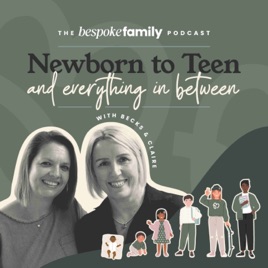
Join us (Becks and Claire) for a new episode every fortnight, for accessible, light-hearted and well researched advice and guidance on the various ways we can tackle the ups and downs of life with children (and have a bit of a giggle along the way!)
Whether you’re a parent, a teacher, TA or childcare worker, or just looking to gain a better understanding of the world through a child’s eyes, we have 25 years of childcare experience to share with you. Listen for judgement free reassurance and support to help you navigate tricky conversations, challenging behaviour, complex emotions, and the general day to day pressures of raising and working with children.
We believe that a child centred approach which recognises and respects individuality is the best way to enable families to thrive.
Subscribe for new episodes every fortnight, to help you get the best out of your time with the children in your life.
Find us online at:
www.bespokefamily.co.uk
Instagram: @bespokefamily
Search 'Bespoke Family' on Facebook
This podcast is proudly produced by Decibelle Creative
Advertise on Newborn to Teen and Everything in Between
Advertise on Newborn to Teen and Everything in Between to promote your brand to thousands of podcast listeners
Unlock Newborn to Teen and Everything in Between podcast Email contact info, Listeners & Audience details
Email contact information
Direct podcast contact details
Listeners
Audience numbers & engagement insights
Audience details
Podcast Insights
Podcast episodes
Check latest episodes from Newborn to Teen and Everything in Between podcast
Understanding Your Teenager with Tony Griffin, Author of The Teenager’s Book of Life
2026/09/30
How well do we really understand our teenagers and how can we stay connected to them as they begin to work out who they are and where they fit in the world?
This week, we’re joined by Tony Griffin, author of The Teenager’s Book of Life, a book written for teenagers rather than their parents. Tony tells us why he wanted to speak directly to young people, how his own teenage experiences shaped his work and what he has learnt from years of conversations with teenagers about the questions they really want answered.
We talk about emotions, friendships, identity, body image, education, social media, mental health and the sometimes difficult balance between supporting our teenagers and trying to control the direction they take.
In this episode, we discuss:
Why Tony chose to write a book for teenagers, rather than another book telling parents how to raise them.Tony’s own experiences as a teenager and how he came to work with young people.Teenagers and emotions, including the isolation some boys experience and the impact of social media and reduced face-to-face interaction.Helping teenagers discover who they are - and why many of us are still working that out as adults!Whether education often places too much emphasis on academic achievement and not enough on preparing young people for life.Teenage brain development, risk-taking and some of the particular challenges facing boys.The pressures teenagers experience around school, education, achievement and expectations.Tony’s observation that we can sometimes under-parent in the online world while over-parenting in the real world.The pressures of parenting, our desire to conform and the tendency to see our children as a reflection of ourselves.Practical ways to accept our teenagers for who they are - while also looking at who we are as parents.Why teenagers need to find their tribe, what happens when we worry they have found the wrong one, and why curiosity can be more helpful than control.Moving towards connection over control and having conversations about what your teenager enjoys, what they are good at and what they imagine their future might look like.Encouraging interests and ambitions while recognising the importance of commitment, practice and hard work.Body image, belonging and peer acceptance - and how Tony encourages young people to understand and challenge their inner critic, rather than focusing solely on their body. Why conversations about that critical voice in our heads need to become more normal.VENT — Tony’s practical strategy for responding when your teenager comes to you with a problem or overwhelming emotions: Validate, Empathise, Normalise and Transform.Teenage friendships, how boys and girls may navigate them differently and the reassurance that sometimes your closest friends are still out there waiting to be found.
A really interesting conversation about understanding the person behind the teenager, staying curious and connected, and supporting them as they begin to find their own way.
Find out moreTony’s book, The Teenager’s Book of Life, is available from:
Teenager’s Book of Life
From 15 October 2026 it will also be available in bookshops across the UK.
Follow Bespoke Family:
Instagram: @bespokefamily
Facebook: @bespokefamily
Read our blogs on tweens and teens:
Blogs for Tweens and Teens
For information about a Bespoke Family Parent Consultation, click here.
Explore our downloadable ‘Your Guide to…’ webinars, covering topics including preparing for and welcoming your newborn, behaviour, toilet training, sleep and more:
‘Your Guide to…’
This podcast is produced by Decibelle Creative.
Holiday mode off! Back to life (back to reality!)
2026/08/26
The school holidays can mean later nights, slower mornings, meals at different times and routines becoming a little more relaxed, which is all part of the fun!
But then suddenly… holiday mode is over and it’s back to reality!
School and nursery bring structure back into our children's days: getting up at a certain time, getting dressed, eating breakfast, leaving the house and being ready to learn, eat and sleep at particular times. After weeks away from that routine, it can take a little while for children's body clocks (and their emotions) to catch up.
In this episode, Claire and Becks talk about why the transition back into routine can sometimes be trickier than we expect and the small things we can do to make it easier.
We discuss:
Why routines help children know what to expect and can help them feel safe and secure.How being out of routine can affect sleep, eating and children's ability to recognise what their bodies need.Why suddenly going from relaxed holiday days to busy school mornings can result in resistance and challenging behaviour.The emotions sitting underneath that 'back-to-school feeling' from excitement and anticipation to worry and separation from parents.Why even little things such as new shoes, uniform or unfamiliar lunchboxes and water bottles can feel like a big change.How practising with new school or nursery belongings before the first day can help.Why it can be helpful to start gradually reintroducing your usual routine during the week before school or nursery starts.Re-setting realistic wake-up and bedtime routines.How visual timetables can help children understand what is going to happen next.And why it is important to give yourself and your child time to get back on track - it doesn't all have to fall perfectly into place on day one.
The more children know what to expect, the easier a transition can feel. A little preparation before the new term can go a long way towards helping everyone move from holiday mode back to everyday life.
Instagram: @bespokefamilyFacebook: @bespokefamily
Read our blog: That back-to-school feeling!
For information about a Bespoke Family Parent Consultation, click here.
Explore our 'Your Guide to...' downloadable webinars, covering topics including preparing for and welcoming your newborn, behaviour, toilet training, sleep and more.
Newborn to Teen and Everything in Between is produced by Decibelle Creative.
Ewen and Me: The Reality of Growing Up with a Disabled Sibling - with Ruby Peace
2026/07/29
Content note: This episode includes discussion of mental health deterioration, detention under the Mental Health Act and the impact of the COVID-19 pandemic on Ewen and his family.
In this episode, we are joined by Ruby, the creator of @ewenandme, to talk about her experience of growing up alongside her older brother, Ewen.
Ewen is 24, autistic and non-speaking, with significant support needs. To Ruby, however, he has always simply been Ewen — her big brother, her best friend and one of the most important people in her life.
Ruby explains why she started the Ewen and Me Instagram account in 2022. Born partly from frustration at the lack of understanding surrounding siblings of disabled people, the account gives Ruby a space to share both the joy and the reality of their relationship.
Ruby talks openly about growing up “in Ewen’s shadow”, sometimes feeling left out and learning from an early age to compromise and adapt around his needs. Although her parents worked hard to ensure that Ruby had her own identity and she never felt let down by them, family life inevitably required sacrifices.
We also discuss the closeness Ruby and Ewen share. Ruby can instinctively recognise when Ewen is happy and often understands him without words, but it can be much harder to know what he wants or needs. Ewen previously communicated using PECS — the Picture Exchange Communication System — but has since become increasingly reliant on prompts and more isolated within himself. Ruby describes the family’s wish for him to be able to communicate more independently.
When Ewen was ten, he began attending a residential school, returning home at weekends. He later moved into residential care. During the COVID-19 pandemic, separation from his family had a devastating effect on him. Ruby speaks movingly about the deterioration in Ewen’s mental health, his detention under the Mental Health Act and the enormous toll this period took on the whole family.
Ewen now lives in his own home with a dedicated care team, somewhere Ruby says he loves.
Ruby also reflects on what she needed from the people around her while growing up. School became a vital source of support, particularly one teacher who gave her the time, care and acknowledgement she needed. She explains how isolating life can feel for siblings and why a friend, teacher or trusted adult simply recognising what is happening can make a huge difference.
We hear about some of the things Ruby missed out on or had to leave early because Ewen needed her, from holidays with friends to nights out and even a date. Ruby explains that, in some ways, becoming an adult sibling has been harder than being Ewen’s little sister, as questions about responsibility, care and the future become more prominent.
Her experiences have also shaped her career. Ruby now works in a caring role within the community and supports Jude, the son of the creator of @storiesaboutautism, with whom she has developed a close and natural friendship. She feels that she often connects more easily with neurodivergent people than with neurotypical people.
Ruby speaks honestly about sharing the harder parts of life online and dealing with cruel comments from people who may feel uncomfortable seeing the full reality of disability and family life. Although her relationship with Ewen is beautiful and full of love, she is clear that it can also be incredibly difficult - and that both things can be true at once.
Her advice to other siblings is not to be too hard on themselves. Siblings should recognise what they are carrying, find someone they can trust and give themselves permission to talk honestly about their worries and feelings.
As Ruby says, sometimes the only way to get through something is simply to keep going - and for her, the motivation has always been Ewen.
Follow us:
Instagram: @bespokefamily
Facebook: @bespokefamily
Follow Ruby and Ewen:
Instagram: @ewenandme
Further support
Sibs is the UK charity supporting brothers and sisters of disabled children and adults. Visit: sibs.org.uk
For information about a Bespoke Family Parent Consultation, click here
Explore our downloadable Your Guide to… webinars, covering topics including preparing for and welcoming your newborn, behaviour, toilet training and sleep - click here
This podcast is produced by Decibelle Creative.
My child keeps running off!
2026/06/24
That heart-in-mouth moment when your little one suddenly bolts is something so many parents recognise. One minute they are beside you, the next they have spotted freedom, space, excitement - and they are off.
In this episode, we explore what is really going on when children run away from us, and why it often happens just as they are beginning to feel more confident and independent. From a child’s perspective, they have spent much of their early life being moved, carried, lifted and guided from place to place. Then suddenly they discover they can move themselves, and running feels exciting, powerful and freeing.
We talk about the sensory pull of movement, space and exploration, and why young children do not yet have the same sense of danger or safety that adults do. That is why our role is not just to stop them running, but to help them gradually learn how to manage freedom safely.
Claire shares practical ways to build safety awareness from an early age, including how clear and simple our explanations need to be, why role modelling matters so much, and how games like “Red Light, Green Light”, “What’s the Time Mr Wolf?” and “freeze and go” can help children practise stopping and listening in a playful way.
We also reminisce about the Tufty Club, the Green Cross Code and the old road safety campaigns many of us grew up with, and discuss why teaching road safety now sits even more firmly with parents and carers.
The episode also covers what to do when your child refuses to hold your hand, how to make boring walks more engaging, and how reins or wrist links can be used calmly and positively when needed. Claire also shares her top tip for how impactful our reaction can be in the moment, especially when we feel frightened or cross.
For families who are really struggling, we talk about how a reward chart might support this learning, and how to approach safety when you are out and about with more than two little ones. We have a blog on reward charts here
As always, this episode is about understanding children’s behaviour, setting boundaries and helping our little ones learn the skills they need to stay safe while still building confidence and independence.
Helpful reminder
Running off is not usually about being “naughty”. It is often about curiosity, excitement, impulse and a child’s developing sense of independence. With calm, clear boundaries and lots of practice, children can gradually learn how to stay safe while still enjoying the freedom to explore.
Instagram @bespokefamily
Facebook @bespokefamily
Our blog -
For information about a Bespoke Family Parent Consultation click here
‘Your Guide to...’ (our downloadable webinars including preparing for and welcoming your newborn, behaviour, toilet training, sleep and more)
This podcast is produced by Decibelle Creative
Keeping your cool when your child loses theirs!
2026/05/27
In this episode, we’re talking all about keeping your cool when your child loses theirs - much easier said than done!
We explore why staying calm in the middle of a meltdown can feel so difficult, especially when the little things have been building up, you’re already feeling stressed, or the day you had planned simply isn’t going the way you hoped.
Becks shares honestly about how her mum never kept her cool (and how Becks hasn’t always kept hers either!) We talk about the fact that no parent can stay calm 100% of the time. It’s just not possible. Sometimes people may look like they’re coping from the outside, but we never really know what is going on underneath.
We also discuss how hard it can feel when everyone seems to have an opinion, especially when your child is having a difficult moment in public, or when social media makes it look as though everyone else has it all together - calm parents, calm children, and no meltdowns in sight.
Claire talks about the importance of having a toolkit of things to try when emotions are running high, including simple strategies you can use yourself and with your children. These are the kinds of ideas you can pin on the fridge or save on your phone, so they’re easy to reach for when you need them most.
We look at how you can try to bring your child’s chaos down with your calm, rather than matching their chaos with your own and escalating things further. We also talk about recognising your own triggers, trying to understand your child’s triggers, and how different situations, including Claire’s experiences with her mum’s dementia, can bring up big feelings in us too.
There’s also an honest conversation about what happens afterwards: the guilt, the beating yourself up, and the importance of repair. Losing your cool doesn’t mean you’ve failed, but coming back together afterwards really matters.
Finally, we talk about accepting help when it’s offered. So many of us find this hard, but it really does take a village to raise a child. And if you’re the friend offering help, sometimes just doing something practical can make all the difference.
We hope this episode gives you some reassurance, some practical ideas, and a reminder that you are not alone in finding these moments hard.
Instagram @bespokefamily
Facebook @bespokefamily
For information about a Bespoke Family Parent Consultation click here
‘Your Guide to...’ — our downloadable webinars including preparing for and welcoming your newborn, behaviour, toilet training, sleep and more
This podcast is produced by Decibelle Creative
Hayfever in children 🤧: Symptoms, treatment and tips for parents
2026/04/29
In this episode, we’re talking all about hayfever in children - how it can affect them, how tricky it can be to spot, and how to help manage hayfever symptoms during pollen season.
We explore just how unpleasant hayfever can be for little ones, from feeling generally unwell and tired to dealing with a wide range of symptoms. Because younger children can’t always explain how they’re feeling, it can be difficult to know whether it’s just a cold or hayfever. We talk through the common hayfever symptoms in children, including sneezing (very common for Becks!), runny nose, coughing, itchy, watery or red eyes, headaches, earaches, tiredness, and that itchy or scratchy throat that may be described by little ones as a sore throat.
We also discuss how hayfever symptoms can vary day to day, and how different types of pollen affect children at different times of year - tree pollen in spring, grass pollen in summer (often worse during harvest time), and weed pollen in autumn.
Antihistamines can help relieve hayfever symptoms, but we touch on how they may still cause drowsiness in some children - something to be mindful of, especially when they may already be feeling run down. If your child has more severe hayfever, we highlight the importance of speaking to a GP or pharmacist for advice and support.
Claire also shares some simple, practical tips for managing hayfever in children and helping them feel more comfortable during high pollen days.
With hayfever season approaching, we hope this episode gives you helpful, realistic ways to support your child through it.
Instagram @bespokefamily
Facebook @bespokefamily
Our Hayfever blog – My child has hayfever, what can I do to help?
For information about a Bespoke Family Parent Consultation click here
‘Your Guide to...’ (our downloadable webinars including preparing for and welcoming your newborn, behaviour, toilet training, sleep and more)
This podcast is produced by Decibelle Creative
Birth trauma – My story, with Hannah
2026/03/25
Trigger warning: In this episode we talk about birth trauma and Hannah’s personal experience of this. If you don’t feel ready to listen right now, please take care of yourself and come back when the time feels right 💛
In this episode, we’re joined by Hannah, who we first met when she was a student at Norland College. Hannah shares her experience of the traumatic birth of her daughter, and why she feels so strongly about raising awareness and supporting other parents who may be going through something similar.
We talk about the importance of having someone to advocate for you during pregnancy and birth, and what can happen when that support isn’t there. Hannah reflects on her experience in hospital, the moments and interactions that have stayed with her, and how it felt to meet her daughter for the first time in NICU. She also shares the ongoing impact once they returned home, from feeling overlooked and unsupported, to navigating continued concerns and ‘red flags’ in her baby’s care.
We also explore how birth trauma doesn’t always end when you leave the hospital. Hannah opens up about the time it took to for her to realise she needed to seek support, finally doing so through her GP, the emotional toll it had on her relationships, and the difficult decision-making process when considering having another baby, including the support she received from a birth trauma therapist.
This conversation highlights how important it is that parents feel heard, supported and cared for and raises important questions about how maternity services can better support families. Hannah also shares her thoughts on the need for greater awareness of birth trauma and why she is supporting calls for maternity reform.
Hannah talked to us about a petition currently circulating around maternity reform. This is being debated on 20 April 2026 and, if you are listening before the deadline of 7 July 2026, she (and we) would urge you to sign it.
Sign the petition here
Instagram @bespokefamily
Facebook @bespokefamily
Our podcast episode (September 2025) with Trudi Webber from Make Birth Better, was all about what birth trauma is, how it can happen along with tips for looking after yourself emotionally when preparing for, during and after birth – you can listen to this episode here
For information about a Bespoke Family Parent Consultation click here
‘Your Guide to...’ (our downloadable webinars including preparing for and welcoming your newborn, behaviour, toilet training, sleep and more)
This podcast is produced by Decibelle Creative
Sickness bugs 🤢
2026/02/25
Claire wasn’t a really sicky child (Becks was!) but she has a phobia of sick so this was a great topic for her!!
We talked about:
Sickness bugs (aren’t they a gift..!) and some tips to help. Getting sick off a carpet – use shaving foam! Sick phobias and parenting – it's a real thing. Dehydration – the signs to look for. How children should be 48 hours clear before going back to nursery or school and why (and no swimming for 2 weeks). They will probably tell nursery anyway!! Foods to help with recuperation. Triggers for sickness and how they can continue (think of that drink that made you sick 😉) How sickness bugs creep up on you with no warning – you just have to go with it (but make sure you are ready with a sick bowl, kitchen roll and marigolds!)!
Always remember to seek medical advice (GP, Pharmacist or 111) if you are worried.
Instagram @bespokefamily
Facebook @bespokefamily
For information about a Bespoke Family Parent Consultation click here
‘Your Guide to...’ (our downloadable webinars including preparing for and welcoming your newborn, behaviour, toilet training, sleep and more)
This podcast is produced by Decibelle Creative
Help! My little one's sleep has gone wrong!
2026/02/11
A topic that we are contacted about quite regularly – we absolutely expect broken sleep in the first months, and then sleep is really good (whatever that means to us) then it starts to change and feels like it’s all gone wrong...
Don’t panic! - we talk about all the things that could be impacting this and the possible reasons why sleep has changed. How illness can impact on children’s sleep and how to get back to a routine that suits you with the least amount of upset. Feeling scared and how this can affect sleep (we have some blogs on how to help with this). Situations when little ones are disturbed because they are practicing things like crawling, rolling, babbling etc. How routines (daytime and bedtime) can affect sleep. Sleep associations – whatever children go to sleep with they will look for it to help settle them back off in the night when they wake up. Treating it like a puzzle and the importance of taking notes so you can see any patterns. How nothing is unfixable and everything is sortable (and we are here to help with a Bespoke Family Parent Consultation if you need it!)!
Our sleep blogs - https://www.bespokefamily.co.uk/blog/category/Sleep
Instagram @bespokefamily
Facebook @bespokefamily
For information about a Bespoke Family Parent Consultation click here
‘Your Guide to...’ (our downloadable webinars including preparing for and welcoming your newborn, behaviour, toilet training, sleep and more)
This podcast is produced by Decibelle Creative
Fussy, picky, choosy eaters
2026/01/28
When / why do children become more fussy? We spoke about the neophobic stage (which goes right back to when we were cave people!) as well as other reasons why babies and children might be choosy about food.
What happens when panic sets in and our children refuse to eat? Some tips to help children with learning about what they like and portion control. Offering alternatives? Watching our children eat “please just try it!!!”and how it feels for them. How the neophobic stage is also the ‘terrible twos’ stage. ‘Tricking’ / bribing children to get them to eat. Did Claire’s dad buy cabbage for tea! Of course he did 😉! How important it is for children to be sitting in a position where their back and feet are supported to eat comfortably and well. Sweet and savoury – puddings, how we are conditioned from childhood, building good food habits.
Our food and weaning blogs - https://www.bespokefamily.co.uk/blog/category/Food+and+weaning
Instagram @bespokefamily
Facebook @bespokefamily
For information about a Bespoke Family Parent Consultation click here
‘Your Guide to...’ (our downloadable webinars including preparing for and welcoming your newborn, behaviour, toilet training, sleep and more)
This podcast is produced by Decibelle Creative
Why doesn’t my child show much affection?
2026/01/14
We started the conversation by acknowledging that some adults don’t necessarily show much affection even though they are very caring people and children are the same.
We spoke about:
How there is nothing better than a lovely cuddle from a child and it can feel difficult when a child doesn’t necessarily want this from us. The other ways that children show affection to us. The importance of never expecting children to give hugs or show physical affection 5 Love Languages – how physical touch isn’t always the most important to fulfil children’s affection. Quality time and the importance of this to children. Being the ‘preferred parent’
Our blog - Why doesn't my child show much affection?
Instagram @bespokefamily Facebook @bespokefamily
For information about a Bespoke Family Parent Consultation click here
‘Your Guide to...’ (our downloadable webinars including preparing for and welcoming your newborn, behaviour, toilet training, sleep and more)
This podcast is produced by Decibelle Creative
When kids swear 🤬!
2025/11/26
There are swear words in this episode so please make sure that little ears aren’t listening 🙉 ...!
This episode is all about when your child, all of a sudden, says a swear word (or something they think is a swear word!) and what you can do about it. We spoke about:
How sometimes in families where there is so much swearing that the children don’t actually swear! Overuse of swear words and how much more it is heard on a day to day basis now (including in songs on the radio and as graffiti!! - Claire has a funny story about this 😬). When children take you by surprise with a swear word! When children copy us 🫣!! How children love making people laugh and how it can be confusing when we then change our reaction from laughing to saying "no don’t say that!". Ways we can react instead. What to say when children ask what a swear word means 😳. Some of Claire’s funny experiences of children swearing in nursery! When children get older and use swear words.
Instagram @bespokefamily
Read our blog on this topic here – How to handle children using swear words!
For information about a Bespoke Family Parent Consultation click here
‘Your Guide to...’ (our downloadable webinars including preparing for and welcoming your newborn, behaviour, toilet training, sleep and more)
This podcast is produced by Decibelle Creative
Looking after poorly kids 😕
2025/11/12
This episode is all about looking after children when they are feeling under the weather and the bugs that they bring home from nursery and school (how is it that we sometimes feel so much worse than they do?!).
We talked about lots of things you can do to help little ones feel better and more comfortable as well as:
The time of year that children tend to get more bugs (or whether that’s really a thing). The chickenpox vaccine and what this means for babies, children and families. Hygiene – washing hands, hand sanitiser, keeping toys clean etc. Temperatures – what is a high temperature and how do you get it down? When you shouldn’t give Ibuprofen. The medicine box / cupboard and what should be in it. Keeping hydrated. When a baby has a temperature or isn’t well. The importance of not randomly Googling! How you should always refer to the NHS or call 111 for answers / guidance. First Aid training and how helpful this can be. Tips for when children are coughing (including some old wives tales!) and the nasal aspirator (snot sucker!). Changing habits and routines and how to re-introduce them when the child is feeling better.
NHS Apps:
Handi App The HANDi app offers simple and straightforward advice, for the following conditions in children:
diarrhoea and vomitinghigh temperature‘chesty baby’ illnesses, such as bronchiolitis, asthma and croup‘chesty child’ illnesses, such as wheezing and asthmacommon newborn problemstummy painhead injuries.
The Healthier Together App
Similar to HANDi, it uses a symptom checker to guide parents on whether to treat at home, seek GP advice, or attend emergency services.
Instagram @bespokefamily
For information about a Bespoke Family Parent Consultation click here
‘Your Guide to...’ (our downloadable webinars including preparing for and welcoming your newborn, behaviour, toilet training, sleep and more)
This podcast is produced by Decibelle Creative
Creating invitations to play! With Steph Williams from Mudpies and Sprinkles
2025/10/29
Steph told us all about Mudpies and Sprinkles and how it began. It’s an outdoor play space for children (and Becks waxed lyrical about it!) - Steph’s love for watching children enjoying different elements of play really shone through.
Steph hasn’t got any formal training and learnt what worked along the way and through her own children.
We talked about:
Things you can do when you are outside (even just being at the park) All of the different areas in Mudpies and Sprinkles and why there are there (eg an old phone, a sewing machine etc!) Sparking curiosity in children and the importance of making things inviting for children to want to engage and play with Steph’s favourite areas at Mudpies and Sprinkles (and why!) Children with additional needs and how this kind of outdoor play area can help to support them How when we were younger that being outside and making mud pies was what we did! How there’s no such thing as bad weather, just bad clothes! The importance of letting children make their own play and keeping it open ended Following your child’s lead and not worrying about ‘doing it right’!
Instagram @bespokefamily / @Mudpies_and_sprinkles
Mudpies and Sprinkles website
For information about a Bespoke Family Parent Consultation click here
‘Your Guide to...’ (our downloadable webinars including preparing for and welcoming your newborn, behaviour, toilet training, sleep and more)
This podcast is produced by Decibelle Creative
Crying at Nursery (or school) drop off?
2025/10/15
Becks’s children both cried when they were dropped off at nursery so she knows exactly how this feels and Claire has lots and lots of experiences of children crying at drop off as a nursery manager.
We talked about:
How there are always going to be children who don’t like the separation moment; as Claire explains 9 times out of 10 they will be OK when you have left (but they might also cry when you pick them up). Separation anxiety – how this can coincide with the age that children start to go to nursery. Days and times of the week they are left – how these can be difficult for children to understand (especially Mondays!) Other reasons children might be unsettled on drop off and how change can have a huge impact on how settled children are. How it’s important to trust the childcare professional and what they say about how your children are. Letting your children know it’s OK to feel sad and knowing that you are building resilience. Some ideas for things you can do to help make the separation a little easier. How it is important to always say goodbye and not sneak off (but don’t drag it out!). If your child is upset all day, then this is a different thing and how you should always talk to someone at the nursery in more detail about it.
Blog – My child always cries when I drop them at nursery
For information about a Bespoke Family Parent Consultation click here
‘Your Guide to...’ (our downloadable webinars including preparing for and welcoming your newborn, behaviour, toilet training, sleep and more)
Facebook @bespokefamily
Instagram @bespokefamily
This podcast is produced by Decibelle Creative
Podcast reviews
Read Newborn to Teen and Everything in Between podcast reviews