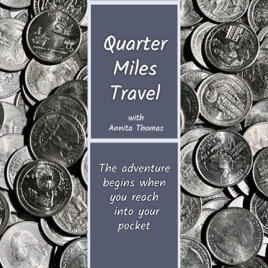
Advertise on podcast: Quarter Miles Travel With Annita
Rating
5from
This podcast has
69 episodes
Language
EnglishPublisher
Travel With Annita and FriendsExplicit
No
Date created
2021/10/26
Latest episode
2026/09/20
Average duration
35 min.
Release period
8 days
Description
The Adventure begins when you reach into your pocket. Each U.S. Mint Commemorative Quarter design tells a unique story. Each quarter is filled with pride, from hometown heroes to iconic landmarks; wildlife and nature to music and culture. Reach into your pocket and let Quarter Miles Travel take it from there, we’ll turn that quarter into an adventure.
Unlock Quarter Miles Travel With Annita podcast Email contact info,
Listeners & Audience details
Email contact information
Direct podcast contact details

Listeners
Audience numbers & engagement insights

Audience details
Podcast Insights

Podcast episodes
Check latest episodes from Quarter Miles Travel With Annita podcast
Dogs on the Road: The South’s Best Cities for Travel With Your Pup
2026/09/20
Radio segment from Mornings on Maine With Bill Maine
Dogs on the Road:
The South’s Best Cities for Travel With Your Pup
Pet travel stats, airline and national park rules, and five great Southern getaways for you and your dog
Annita and her English Lab.
By Annita Stokes Thomas
If there’s a dog riding shotgun in your car more often these days, you’re not imagining it. Americans are traveling with their pets in record numbers, and the hospitality industry is scrambling to keep up. Here’s a look at where that trend stands right now, what to know before you fly or head into a national park with your dog, and five great Southern destinations worth the trip.
Are We Really Traveling With Our Dogs?
Short answer: yes, and more every year. Multiple recent surveys peg the number of American pet owners who travel with their pets annually at right around 78 percent. More than half of dog and cat owners say they now plan their trips around their pet, not the other way around.
And it’s not just a domestic trend. A global pet-parent study out last year found that 56 percent of people worldwide now own a pet, with nearly half of those being first-time owners, a whole new generation of pet parents who don’t want to leave the dog behind. A 2025 survey of US and UK travelers found that 27 percent of pet owners who brought their pet on a big vacation last year were doing it for the very first time.
The number one reason people leave the dog at home? Fear that travel would be too stressful for the pet — that’s the top reason cited, followed by not trusting that a destination is truly pet-friendly.
How are they getting there?
Road trips still win, hands down — nearly two-thirds of pet owners, right around 64 percent, say they prefer traveling with their dog by car.
Flying is a distant second, with roughly a third of pet owners saying they’ve flown with a pet.
About 75 percent of hotels nationwide — luxury, midscale, and economy — now allow pets in some form, and the vast majority of pet parents say they’d choose a pet-friendly hotel over any other option.
RVs and camping are part of that road-trip boom too — pet owners increasingly point to hiking and fresh-air destinations as their top pick for a pet-friendly trip, right up there with beaches.
The trend line is clear: dogs are road-tripping more than ever, hotels are adapting fast, and flying — while it’s growing — comes with a lot more fine print.
A little dog in an airline pet carrier sized to fit under the seat in front of you.
Flying With Fido: What the Airlines Actually Allow
Here’s something that surprises a lot of people: as of this year, only two major U.S. airlines will still fly a dog in the cargo hold for an everyday passenger — Alaska Airlines and Hawaiian Airlines. American, Delta, United, Southwest, JetBlue, Spirit, and Frontier have all discontinued or paused their pet cargo programs for the general public. If you’ve got a bigger dog who can’t fit under an airplane seat, your options for flying with them have really narrowed.
Here’s the cabin picture, airline by airline:
Delta: small dogs, cats, and household birds only, in a ventilated carrier under the seat in front of you. No cargo option for regular travelers.
American Airlines: small cats and dogs in the cabin only, around $150 each way, first-come first-served with a limited number of pet spots per flight.
United: dogs, cats, rabbits, and household birds allowed in an approved hard- or soft-sided kennel under the seat, roughly $125 each way, advance reservation required.
Southwest: small cats and dogs only, in a carrier under the seat, about $95 each way — and no pets on international flights.
JetBlue: small dogs and cats, combined pet-and-carrier weight can’t exceed 20 pounds, about $125 each way.
One more wrinkle worth knowing: the rules changed a few years back for emotional support animals. They no longer have protected status the way a trained service dog does — airlines can now treat an ESA like any other pet, subject to the regular carrier fees. A true service dog still flies free, but it needs the Department of Transportation’s standard Service Animal Air Transportation Form, usually submitted 48 hours ahead of the flight.
Bottom line: if your dog is small enough to ride under the seat, flying is very doable, just book early, since cabin pet spots are limited per flight. If you’ve got a bigger dog, ground transportation is your best bet, which most pet-travel experts say is safer and less stressful anyway.
Expert traveler tip – always call ahead to check airline rules, regulations and fees. They change and your fur baby is looking forward to the trip too. And, always consider your pet’s temperament. Talk with your vet about the best way to ensure a pleasure flight for your pet, you and the other passengers.
National Parks and most campsites have specific rules to follow.
Can Your Dog Come to the National Park?
If your road trip includes a national park, here’s what to know before you go: most national parks allow dogs, but with real restrictions. The National Park Service uses a simple rule of thumb called B.A.R.K. — Bag your pet’s waste, Always use a leash, Respect wildlife, and Know where you can go.
Leashes are required almost everywhere dogs are allowed, and that leash can’t be longer than six feet.
In most national parks, dogs are limited to paved roads, parking lots, picnic areas, and campgrounds — they generally are not allowed on backcountry or wilderness trails, since their scent and noise can disturb wildlife.
Pet-friendly campgrounds are common inside national parks, but your dog can never be left unattended at the site, even for a quick walk to the restroom.
National forests and national recreation areas are typically much more permissive, with most trails open to leashed dogs. If the park itself is restrictive, check whether there’s a national forest right next door.
Some of the more dog-friendly national parks people point to include Acadia in Maine, Shenandoah in Virginia, Great Sand Dunes in Colorado, and Cuyahoga Valley in Ohio, which welcomes just about any domesticated animal. Always check the specific park’s website before you go — rules vary park to park, and some, like Sequoia, don’t allow dogs on any trails at all.
Expert traveler tip – Check before leaving, but also check Facebook pages to see how other National Park visitors have experienced the park with their dog. Many hikers share personal experiences both challenging and excitingly fun.
America’s Most Pet-Friendly Cities: The Study
Traveling with your fur baby is fun for the whole family.
There’s a well-known study out from WalletHub called “Most Pet-Friendly Cities,” updated again for 2026. It compares the 100 largest U.S. cities across 23 different measures, grouped into three categories: pet budget, worth 25 percent of the score and covering things like vet costs and insurance; pet health and wellness, the biggest category at 50 percent, covering vets and trainers per capita and dog-friendly dining; and outdoor pet-friendliness, worth the final 25 percent, covering parks, trails, and weather.
Top five for 2026: Scottsdale, Arizona; Tampa, Florida; Cincinnati, Ohio; Las Vegas, Nevada; and Portland, Oregon.
Also cracking the top ten: Orlando, Birmingham, Lexington-Fayette, Austin — and our own Atlanta, Georgia.
Dead last, at number 100: Honolulu, Hawaii.
Here’s the catch: this study only covers the 100 largest U.S. cities, which means Charleston, Savannah, and St. Augustine are all too small to even be measured by it — Atlanta is the only one of the five Southern cities below big enough to show up on this particular list. For the smaller, more historic towns, the rankings below come from different, more specialized studies.
Bring along your fur baby with these suggestions.
Five Of My Favorite Trips for You and Your Dog
Atlanta — The Day Trip
Atlanta ranked 9th out of the 100 largest U.S. cities in that WalletHub 2026 study — the only one of today’s five cities big enough to make that particular list. It scored well on vet access, pet businesses per capita, and walkability.
Where to walk: Piedmont Park, with its off-leash Piedmont Dog Park, and the Atlanta BeltLine, which has become the go-to spot for locals walking their dogs on weekends.
Two dog-friendly restaurants: Joy Cafe near Piedmont Park, where the chef makes food for humans and dogs alike — dogs can order burgers or grilled chicken breast off their own menu — and Hampton + Hudson in Inman Quarter, which has a big pet-friendly patio and even hosts Sunday “Doggie Mingle” hours with a signature Puppy Love Cocktail that benefits local rescues.
Two pet-friendly hotels: The Kimpton Sylvan in Buckhead, which welcomes dogs with no size limit and no pet fee at all, plus washed dog beds and treats in the room; and the Four Seasons in Midtown, which bakes a complimentary biscuit for dogs 35 pounds and under at check-in.
Athens — Game Day With the Bulldogs
Athens didn’t make the WalletHub top-100 list since it’s too small, but it did land at number 32 out of 500 cities in a separate, broader study from LawnStarter — specifically called out for its generous yard space, meaning lots of room for dogs to roam.
Dog parks: Athens has close to 20 acres of off-leash space spread across its parks. Memorial Park has a wooded, 1.5-acre off-leash dog park on a hillside, and Sandy Creek Park — a sprawling 782-acre park around Lake Chapman — has four fenced off-leash areas plus private dog parks you can rent by the hour.
Hotels: The Graduate Athens — formerly the site of an old ironworks foundry — allows two pets up to 50 pounds for a $50 fee, and Hotel Indigo downtown charges a flat $75 pet fee.
Restaurants: Mama’s Boy, the beloved Southern brunch spot, welcomes dogs on its patio — try the Georgia peach
Episode 56: The Three Fifths Compromise
2026/09/16
The Three Fifths Compromise
What it was and who benefited
COLD OPEN
[SOUND: Quill scratching on parchment. A gavel, once, distant. Silence.]
ANNITA (V.O.):
In the summer of 1787, in a locked room in Philadelphia, fifty-five men sat down to build a government. And for weeks, in that room, they talked about hundreds of thousands of human beings — argued about them, bargained over them, measured them, weighed their worth against tax revenue and political power — and not one of those human beings was ever asked what they thought. Not one of them was in the room. Not one of them had a vote, a voice, or a name that made it into the record.
They were husbands and wives. Mothers who had already buried children sold away from them. Grandfathers who remembered a homeland none of these delegates could have pointed to on a map. Blacksmiths, healers, midwives, farmers, cooks — entire lives, entire families, entire histories, reduced in that room to a single question: how much of a person should the law say they were.
The men in that room decided on three-fifths. Not because they believed it. Because it was useful.
[SOUND: Silence holds, then fades.]
This is Quarter Miles Travel. I’m Annita. On this show, I always tell you — we say their names, and we tell their stories. But today, that promise is harder to keep than it’s ever been. Because the truth is, we don’t have most of their names. History didn’t record them. The Constitution didn’t ask for them. An entire population was debated, decided, and written into law — without a single one of them ever being permitted to speak for themselves in that room.
So today, we’re not just telling you what happened in Philadelphia in 1787. We’re standing in for the hundreds of thousands of voices that should have been in that room and weren’t — and we’re telling their story anyway, exactly as fully and as honestly as we can, because somebody finally should.
SEGMENT ONE: The Number That Came Before
[SOUND: Soft, sparse instrumental bed, low — something unresolved, not comforting]
ANNITA (V.O.):
This story doesn’t start in Philadelphia in 1787. It starts four years earlier, in 1783, in a much quieter argument about money.
Under the Articles of Confederation, the fledgling national government had almost no way to fund itself. It could only ask the states for money — “requisitions” — based on the value of land within each state, a system nobody could measure fairly or enforce honestly. So Congress considered a fix: base each state’s tax burden on population instead.
And here, for the first time, the question arrived — a question this country would spend the next seventy-eight years failing to answer honestly. If a state’s population determined what it owed, did enslaved people count as part of that population?
James Madison, then a young Virginia delegate to the Confederation Congress, proposed a number: three-fifths. It wasn’t drawn from any principle about human worth. It was, by most accounts, simply a number that split the difference between two sides who couldn’t agree on anything else. That 1783 proposal came up for a vote as an amendment to the Articles — and it failed, falling two states short of the unanimous approval required.
But a number, once spoken aloud in a room full of powerful men, doesn’t simply disappear. It waits.
SEGMENT TWO: The Room Reopens the Question
ANNITA (V.O.):
Four years later, delegates from twelve states gathered in Philadelphia, in the same stifling summer heat we’ve talked about before on this show, to write an entirely new Constitution. And on June 11th, 1787, the three-fifths number walked back into the room.
It was delegate James Wilson of Pennsylvania who formally reintroduced it — proposing that enslaved people be counted at a three-fifths ratio as an amendment to the Virginia Plan, the framework then being debated for how the new government would be structured. Charles Pinckney of South Carolina seconded it.
Here’s something worth sitting with: Wilson wasn’t a slaveholder, and by most historical accounts, he wasn’t ideologically committed to protecting slavery. He appears to have simply reached for a number that had almost worked once before — a number he calculated might actually get enough votes to hold this fragile convention together. Practicality, not principle, put that fraction back on the table.
And once it was on the table, the room split — but not in the way you might expect.
SEGMENT THREE: The Argument Nobody Wants to Admit They Made
[SOUND: Music drops low, more tense]
ANNITA (V.O.):
Here is the detail that should stop you cold, and it’s the one most people never learn: the two sides of this debate did not argue from principle. They argued from advantage — and they switched sides entirely, depending on what was being counted.
When it came to representation — how many seats a state got in Congress, how many electoral votes it held — southern delegates wanted enslaved people counted as full persons. Every enslaved person counted meant more political power for the state that held them in bondage.
Northern delegates objected. Elbridge Gerry of Massachusetts asked the room a question that exposed the entire moral rot of the argument in a single sentence: why should “the blacks, who were property in the South, be in the rule of representation more than the cattle & horses of the North?” Notice what that question does. Gerry is arguing against the compromise — and even in his objection, he reaches for cattle and horses as his comparison. This was not, on either side of the room, a debate about the humanity of enslaved people. It was a debate about property, dressed in the language of political philosophy.
But then came taxation — and the exact same men flipped their positions entirely. When it came to how much a state would owe in federal taxes, southern delegates suddenly wanted enslaved people counted as little as possible, to keep their tax burden low. Northern delegates now wanted them counted fully, to raise it.
Let that sink in. The very same enslaved human being was, in the same room, in the same week, argued to be a full person when it helped the North, a full person when it helped the South, and no person at all when it helped either side avoid a cost. The only consistent principle in the entire debate was self-interest.
South Carolina’s John Rutledge said the quiet part aloud, telling the convention plainly: “Religion & Humanity had nothing to do with this question. Interest alone is the governing principle with Nations.” His fellow South Carolinian, Charles Pinckney, went further, declaring that his state would never accept Congress “meddling with the importation of negroes” — a warning that slavery, and the ongoing trade in human beings, was not up for negotiation at all.
And some southern delegates made an even starker threat. They stated outright that they would “never confederate” — that they would walk out, refuse to join this new nation entirely — unless enslaved people were counted at a ratio of at least three-fifths. The compromise, in other words, wasn’t reached through persuasion. It was reached through the threat of national collapse.
One voice in that room said something closer to the truth than almost anyone else. Gouverneur Morris of New York called slavery a “nefarious institution… the curse of heaven on the states where it prevailed.” He attacked the compromise directly, for rewarding the act of enslaving people with more political power — the more a state enslaved, the more it would be represented in the very government built on the promise of liberty.
SEGMENT FOUR: The Compromise, Written Into Law
ANNITA (V.O.):
In the end, the room settled on the same fraction it had nearly settled on four years earlier. Article One, Section Two, Clause Three of the United States Constitution: representation and taxation would be determined “by adding to the whole Number of free Persons… three fifths of all other Persons.”
They didn’t even use the word “slave.” The Constitution never does — not once, anywhere in its original text. The framers wrote around it deliberately, using euphemism to avoid stating plainly what they had just built into the nation’s founding law. Three-fifths of all other persons. A whole system of human bondage, folded into a single evasive phrase.
And it worked — not morally, but mechanically. It held the convention together. It got the South to sign on to a union it might otherwise have refused. And it embedded, permanently, into the mathematics of American democracy, the idea that enslaved human beings were worth counting, but not worth freeing.
[SOUND: Music softens into something heavier, more solemn]
SEGMENT FIVE: What It Built — The Presidency and the Power
ANNITA (V.O.):
The effect was not abstract. It was immediate, measurable, and it shaped the government for generations.
Because House seats — and therefore Electoral College votes, since electoral votes are based on congressional representation — were calculated using three-fifths of the enslaved population, southern states received significantly more political power than their actual voting population ever justified. Not one enslaved person could cast a ballot. And yet their existence, counted at sixty percent value, inflated the power of the very people who held them in chains.
The numbers tell the story bluntly. After the 1790 census, enslaved people made up roughly 39 percent of Virginia’s population, 43 percent of South Carolina’s. Constitutional scholar Akhil Amar has pointed out that after the 1800 census, Pennsylvania’s free population was actually ten percent larger than Virginia’s — and yet Virginia received twenty percent more electoral votes. Pennsylvania’s power came from free citizens who could vote. Virginia’s came, in significant pa
Destination: The History of America’s Labor Force
2026/09/05
The History of America’s Labor Force
“The Price of a Day’s Work:
Labor, Jobs, and the Fight for Fairness in America”
*Photos at the bottom
SEGMENT ONE — approx. 9:00
The History of America’s Labor Force and How Labor Day Became a Holiday
[SOUND: Show theme, warm, fades under welcome]
ANNITA:
I’m Annita with Travel With Annita, and this weekend, most of us will fire up a grill, maybe hit one last beach trip, and enjoy a day off work. Let’s talk about The History of America’s Labor Force. But Labor Day didn’t start as a cookout holiday. It started as a protest — and understanding how it became a national holiday tells you almost everything about how hard-fought every single workplace protection in this country has been.
The story actually has two men fighting for credit, and historians still argue about which one truly deserves it. Peter J. McGuire has long been called the “Father of Labor Day” — his gravestone in Pennsauken, New Jersey, is inscribed with those very words, and every year, labor leaders still gather there to honor him. McGuire’s own story is worth knowing: he was the child of Irish immigrants, and he quit school at a young age to go to work himself, long before he ever became a labor leader. He co-founded the United Brotherhood of Carpenters in 1881, and helped lead the movement that eventually became the American Federation of Labor. The AFL-CIO itself has said that McGuire “probably did more than anyone else” to convince skeptical, locally-minded union activists around the country that a national labor federation wasn’t just necessary, but actually possible.
But there’s another man in this story — Matthew Maguire, a machinist who served as secretary of the Central Labor Union in New York, and many historians now believe he actually proposed the idea first. It was Maguire who sent out the announcements and invitations for that first Labor Day gathering, and Maguire who rode in the lead carriage of the parade itself. For decades, credit for founding Labor Day actually went to Maguire — it wasn’t until 1924, forty years after the fact, that the credit was formally shifted over to McGuire instead, and the debate over who truly deserves the title has never fully settled.
That first parade happened on September 5th, 1882, in New York City. Somewhere between ten thousand and twenty-five thousand workers marched that day, sponsored by an organization called the Knights of Labor — one of the largest and most influential labor organizations of the era, open to nearly all workers regardless of skill, trade, race, or gender, at a time when that kind of inclusiveness in a labor union was genuinely radical. There was no deep historical significance to that particular date, by the way — McGuire simply said it fell about halfway between the Fourth of July and Thanksgiving, giving working families a break during that long stretch of the calendar with no holiday at all.
It took twelve more years, and something far more tragic, to turn that one parade into a national holiday. In the summer of 1894, the Pullman railroad strike erupted — and we’re going to come back to Pullman a little later in the show, because that story matters more than you might think. That strike turned violent, and federal troops were sent in to break it up. Workers died in the clashes. Congress and President Grover Cleveland, looking to make peace with an angry and grieving labor movement, rushed a bill through just days after the strike ended, and Cleveland signed Labor Day into law as a national holiday on June 28th, 1894.
Here’s a detail that doesn’t often make it into the story: Cleveland specifically chose to elevate Labor Day, held safely in September, rather than embrace May Day, the international workers’ holiday already celebrated in many countries. May Day carried socialist and radical associations in the public mind at the time, tied to earlier labor unrest, and Cleveland wanted nothing to do with that reputation. So America ended up with its own separate labor holiday, deliberately distanced from the more radical politics of the labor movements happening elsewhere in the world.
So the very holiday we use to close out summer was born, in part, out of federal troops firing on American workers, and a president trying to calm public anger without embracing the more radical wing of the movement that made the holiday necessary in the first place. When we come back, I want to take you somewhere this history rarely goes — because you cannot talk honestly about American labor without talking about Black workers, both enslaved and free.
[SOUND: Music bridge]
SEGMENT TWO — approx. 9:35
From Bondage to the Fields — Sharecropping and the Migrant Workers of Florida
ANNITA:
Welcome back to Travel With Annita.
I want to be honest with you. For the first two hundred fifty years of this nation’s story, Black labor wasn’t paid at all — it was stolen. When emancipation finally came in 1865, the promise was freedom. What actually followed, for millions, was a different kind of chain, dressed up to look like opportunity.
It’s called sharecropping. Formerly enslaved people, with no land and no money, needed to survive. White landowners — sometimes the very people who had enslaved them — needed labor but had no cash to pay wages. So a system formed: a family would work a parcel of land, and in exchange, they’d owe the landowner a share of whatever they grew, often as much as half the harvest. On paper, that sounds almost like a fair trade. In practice, it was a trap, and here’s exactly how the trap worked. Sharecropping families had no money for seed, tools, food, or clothing until harvest time — so they had to borrow against a crop they hadn’t grown yet, usually from a store owned by the very same landlord, at interest rates that could run fifty percent or higher. This is called the crop-lien system, and it functioned like a plantation commissary designed to keep a family owing more than they could ever hope to repay. By the time harvest came and the books were “settled up,” most sharecropping families ended the year owing money, not earning it — trapped for another season, then another, then another, sometimes for generations.
In Georgia alone, by 1910, over fifty percent of Black farmers were sharecroppers or wage laborers, while more than forty percent of white farmers owned their own land outright. Across the entire South, by 1880, nearly eighty percent of Black farmers were sharecroppers or tenants, not landowners. And when Black families tried to organize together — to demand fairer terms, the same way industrial workers up north were organizing into unions — the response was often violent. In Elaine, Arkansas, in 1919. In Camp Hill, Alabama, in 1931. In Lowndes County, Alabama, in 1935. Black sharecroppers who tried to unionize were attacked, and in some cases killed, simply for asking to be paid fairly for their own labor. Historians today describe this system for exactly what it was: freedom in name, but economic bondage in practice — the plantation, rebuilt with paperwork and interest rates instead of chains.
Now let’s bring this closer to home, because Florida has its own chapter of this story, and it deserves to be told just as clearly. Starting in the late 1800s, and picking up heavily in the early 1900s, thousands of Black Bahamians began migrating to South Florida — drawn by the construction of Henry Flagler’s Florida East Coast Railroad, the rapid growth of Miami, and agricultural work in citrus groves and the pineapple industry, which the Bahamas themselves had once depended on before disease and hard winters collapsed it. Between 1900 and 1920 alone, somewhere between ten and twelve thousand Bahamians made that crossing — many settling in communities like Coconut Grove, which still carries that island heritage today, in its food, its churches, and its culture. Bahamian men cleared roads and built homes and hotels; Bahamian women staffed the hotels rising up along Florida’s booming coastline. And alongside them worked Black Americans who’d migrated down from Georgia, Mississippi, and across the South — many of them refugees from the very sharecropping system we just described, following the crops from state to state: peaches in South Carolina, cabbage in North Carolina, tomatoes and strawberries right here in Florida.
There’s a literary connection here worth knowing, too. The great Florida-born author Zora Neale Hurston wrote about exactly this world of Black migrant farmworkers in the Everglades muck, laboring around towns like Belle Glade — culminating, in her most famous novel, in the catastrophic 1928 Okeechobee hurricane, which killed thousands, a large share of them Black migrant agricultural workers whose deaths were undercounted and under-mourned for decades afterward. Hurston didn’t invent that world. She documented it.
And then there’s Florida’s sugarcane industry — this piece of the story isn’t ancient history at all. From 1941 all the way into the mid-1990s, virtually every stalk of sugarcane grown in Florida was cut entirely by hand, by workers brought in mostly from Jamaica under a federal guest worker program. Cutting cane by hand, in Florida heat, with machetes, hour after hour, is some of the most physically brutal agricultural labor in this country’s history. Workers were housed in company camps around towns like Belle Glade, paid low wages, and had little real power to push back against unsafe conditions — the same basic pattern of debt and dependency that shaped sharecropping generations earlier, simply relocated to a new crop, a new labor force, a new era.
This history isn’t finished, either. Today, in places like Immokalee, Florida, Haitian and Mexican farmworkers still fight the same fundamental battle — fair wages, humane housing, and freedom from
Destination: America A Young Nation – The War Was Won — Now What?
2026/09/04
America A Young Nation –
The War Was Won — Now What?
I’m Annita with Travel With Annita, and today we’re picking up right where the story usually stops. We all know 1776. We all know Yorktown, 1781, when the war was effectively won. But here’s the question nobody asks enough: what happened the Monday morning after?
In September of 1783, the Treaty of Paris made it official. Independence, recognized by the very king who’d refused to grant it. And here’s something that surprises a lot of people — Britain didn’t just recognize a strip of coastline. They ceded territory stretching all the way west to the Mississippi River. Overnight, this brand-new country doubled, tripled in size on paper, and had almost no way to actually govern any of it.
Because here’s the thing about winning a revolution — the fighting is, in some ways, the easy part. You know who the enemy is. You know what victory looks like. Building a government from scratch, with thirteen different states that had spent the last several years being fiercely independent of each other, and even more fiercely suspicious of any government trying to tell them what to do? That was a completely different kind of battle.
The system already in place at the time was called the Articles of Confederation, adopted back in 1781, even before the war had officially ended. And it was designed to be weak. Deliberately, intentionally weak. Think about what these people had just lived through — years under a king who taxed them without asking, who quartered soldiers in their homes, who dissolved their local governments whenever it suited him. So when it came time to build something new, the instinct was: never again. Never let one government have that much power over us again.
So the Articles gave Congress almost nothing to work with. No power to levy taxes — Congress could only ask the states nicely for money, and the states, more often than not, simply didn’t pay. No power to regulate trade between states, which meant New York could tax goods coming in from New Jersey like they were a foreign country. No real national army, no national currency worth trusting, no executive branch at all to actually enforce anything Congress did manage to agree on. Congress was, in a very real sense, a room full of representatives who could debate and recommend, but couldn’t compel anyone to do anything.
For a couple of years, the country limped along like this. States printed their own money, which lost value practically as fast as it was printed. Trade between states got tangled in a mess of competing tariffs. Soldiers who had fought the entire war often went unpaid, waiting on promises from a Congress that had no actual money to give them. There’s a reason historians often call this stretch “the critical period” — because in hindsight, it’s genuinely unclear whether this experiment survives.
And then, in the fall of 1786, that fragile situation broke wide open — not in some far-off frontier, but in Massachusetts, among ordinary farmers who had, in many cases, fought in the very war that was supposed to have earned them a better life.
These were men crushed by debt. The state was demanding taxes paid in hard currency, at a moment when currency of any kind was scarce, and courts across western Massachusetts were foreclosing on farms right and left. So a former Continental Army soldier named Daniel Shays helped lead an armed uprising — farmers marching on courthouses to physically shut them down before they could hear another foreclosure case. At one point, they even attempted to seize the federal armory at Springfield, hoping to arm themselves properly.
The rebellion itself didn’t last. Massachusetts militia put it down by early 1787. But the effect on the country’s leadership was seismic. Because think about what this proved: under the Articles of Confederation, the national government had essentially no ability to respond. Massachusetts had to handle this entirely on its own. If ordinary citizens could take up arms against courts and come dangerously close to seizing a federal armory, and the national government simply had no mechanism to help — what happened next time? What happened if it wasn’t put down so easily?
Leaders like James Madison and Alexander Hamilton had already been warning for years that the Articles were too weak to survive. Shays’ Rebellion turned that warning into urgency. Even George Washington, who had largely retired from public life after the war, wrote with real alarm about what he was seeing, wondering aloud whether the revolution had been fought for nothing if the country couldn’t even govern itself in peace.
So a meeting was called. Delegates from the states would gather in Philadelphia in the summer of 1787 — officially, just to revise the Articles of Confederation. Just to patch a few things up.
That is not remotely what ended up happening. When we come back, I’ll tell you exactly how that room in Philadelphia turned a modest repair job into an entirely new country.
[SOUND: Music bridge]
SEGMENT TWO — approx. 9:35
Philadelphia and the Deal That Built a Country
ANNITA:
Welcome back to Travel With Annita.
So when we left off, delegates were heading to Philadelphia in the summer of 1787, technically just to revise the Articles of Confederation. Fifty-five delegates, representing twelve of the thirteen states — Rhode Island refused to send anyone at all, suspicious from the very start of where this was all heading. They weren’t entirely wrong to be suspicious.
Because almost as soon as the convention opened, the delegates quietly abandoned the idea of revising anything. Instead, under the guidance of men like James Madison — who did so much of the intellectual heavy lifting that he’s often called the Father of the Constitution — they began drafting something completely new. An entirely different framework for how this country would govern itself.
And immediately, they hit a wall. It’s a wall that, honestly, still shapes American politics today: how do you fairly represent both large states and small states in the same government? Virginia, the most populous state, proposed what’s called the Virginia Plan — representation in Congress based purely on population. Naturally, the larger states loved this. The smaller states, like New Jersey, saw exactly where that led — permanent political dominance by a handful of big states — and countered with the New Jersey Plan, which called for equal representation for every state, regardless of size.
For weeks, this genuinely threatened to collapse the entire convention. Neither side would budge, because neither side was wrong to worry about what they stood to lose. What finally broke the deadlock is what we now call the Great Compromise, or sometimes the Connecticut Compromise, since it was Connecticut’s delegates who proposed the fix: a two-chamber Congress. The House of Representatives, apportioned by population — a win for the big states. The Senate, with equal representation, two senators per state regardless of size — a win for the small states. It’s the exact structure Congress still has today, nearly two hundred and forty years later, and it exists because of a fight almost nobody remembers happened.
But there was another compromise made in that room, and this one doesn’t get to wear the word “great.” Southern delegates wanted enslaved people counted toward their state’s population — which would give them significantly more seats in the new House of Representatives, and more electoral votes down the line. Northern delegates objected, and not, it must be said, primarily out of moral conviction — mostly out of concern that it would hand the South outsized political power. The compromise they landed on was the Three-Fifths Compromise: each enslaved person would count as three-fifths of a person for purposes of representation and taxation.
Sit with that for a moment. Human beings, counted as three-fifths of a person — not because anyone believed that was a scientific or moral truth, but because it was a number two sides could agree on to settle a political fight. And those same human beings, whose bodies were being used to inflate a state’s political power, had no rights, no vote, no voice in any of it whatsoever.
This is the piece of our founding story that doesn’t get talked about enough on the average history tour, and I think it deserves to be said plainly: the contradiction between “all men are created equal” and a Constitution that quantified human beings for political convenience wasn’t an oversight. It was a choice, made deliberately, by delegates who understood exactly what they were doing and chose political expediency over the principle their own revolution had just been fought to defend. That contradiction didn’t get resolved in Philadelphia in 1787. It got postponed. And the bill for that postponement came due less than eighty years later, in a Civil War that very nearly tore this country apart for good.
By September of 1787, after months of debate, compromise, and genuine crisis, the delegates finished their draft. What emerged from that room is still, to this day, the oldest written national constitution in continuous use anywhere in the world.
But writing it was only half the battle. Now it had to be approved — by the very states whose delegates had just spent months arguing about it. And that fight was its own kind of drama. When we come back, I’ll tell you about the promise that finally got it across the finish line, and about the man who turned out to be surprisingly good at building a government nobody had ever seen before.
[SOUND: Music bridge]
SEGMENT THREE — approx. 9:35
The Bill of Rights and the First President
ANNITA:
Travel With Annita, glad to have you back with me.
So the Constitution was written. Now it needed ratification — appr
Following Togo’s Trail: A Travel Guide to the 1925 Serum Run
2026/08/25
Following Togo’s Trail:
A Travel Guide to the 1925 Serum Run
Nome, the Diphtheria Outbreak, the Iditarod, and Where to Find Togo Today
Every hero has a version of the story the world remembers, and a version that’s actually true. For Togo, the twelve-year-old sled dog who led his team across the most dangerous 260 miles of the 1925 race to save the children of Nome, Alaska, those two versions couldn’t be further apart. On a recent episode of Quarter Miles Travel, “The Dog They Left Out of the Story,” we traced Togo’s journey from a sickly, unwanted puppy to the true hero of the Great Race of Mercy — and uncovered why history handed his statue, his fame, and his place in the public imagination to a different dog entirely. This guide picks up where that episode left off, mapping out the real places where Togo’s story still lives today — from the frozen coastline he once crossed in the dark, to the quiet corners of three states where his memory finally caught up with what he actually did.
Why This Guide
In January of 1925, a diphtheria outbreak threatened the town of Nome, Alaska, and a relay of twenty mushers and more than a hundred sled dogs raced 674 miles across the frozen wilderness to deliver life-saving serum. Togo, the twelve-year-old lead dog of musher Leonhard Seppala, carried that serum across the longest and most dangerous stretch of the route — and for decades, watched a different dog receive most of the credit.
This guide gathers the real places where that story still lives — from the town the serum was racing to save, to the museum where Togo himself still stands watch, to the world-famous race his journey inspired. Whether you’re planning a full Alaska trip or a detour through New York City, here’s where to go to trace this remarkable piece of history for yourself.
Alaska: Where It Happened
Nome, Alaska
How to get there: Nome is not accessible by road from the rest of Alaska; visitors fly in, typically via Anchorage
This is where the story begins and ends — the isolated coastal town that a diphtheria outbreak threatened to devastate in the winter of 1925, and the town Togo, Seppala, and the rest of the relay mushers raced to save. Nome today remains a small, remote community on the Bering Sea coast, rich with Gold Rush history layered on top of this later chapter. A drive east along the Bering Sea coast follows roughly 30 miles of the historic serum run trail itself, giving visitors a genuine sense of the terrain the mushers crossed.
Carrie M. McLain Memorial Museum — Nome, Alaska
Located in Nome, this local museum holds photographs and artifacts from the original 1925 serum run, offering a direct and tangible link back to that winter. It’s the natural first stop for anyone wanting to understand the event from the perspective of the town it saved, rather than just the mushers who saved it.
Iditarod Trail Sled Dog Race Headquarters & Museum — Wasilla, Alaska
Location: Mile 2.2 Knik Road, Wasilla, AK (near the intersection with Knik-Goose Bay Road)
Website: iditarod.com/plan-your-visit — https://iditarod.com/plan-your-visit/
Hours: Generally open year-round, Monday–Friday, 9 a.m.–5 p.m., with extended daily hours (roughly 8 a.m.–5 p.m.) during the summer season (mid-May through mid-September); confirm current hours before visiting, especially in winter
Admission: Free museum entry; dog-cart rides available for a small fee (around $10/person) during summer months
This is the single most important stop on the entire trip: Togo himself, mounted and preserved, stands on permanent display here in a glass case — the actual dog, not a replica. The headquarters also houses decades of Iditarod race memorabilia, trophies, and photographs, and offers dog-cart rides in summer so visitors can get a small taste of what it feels like to be pulled by a real sled dog team. Located about 45 minutes to an hour north of Anchorage, this is an easy and essential day trip for anyone visiting the area.
Iditarod Trail Sled Dog Race
Website: iditarod.com — https://iditarod.com
The race itself is the living legacy of the 1925 serum run — a roughly 1,000-mile course from the Anchorage area to Nome, run every March by mushers and dog teams retracing much of the same historic ground Togo and Seppala once covered. The ceremonial start takes place in Anchorage, with the competitive restart currently held in Willow, about 70 miles up the Parks Highway. If your travel dates allow, visiting during the race (early March) offers a rare chance to see the modern-day version of exactly what this history was really about.
New York City: Where Togo Is Remembered in Bronze
Togo Statue — Seward Park, Manhattan
Location: Seward Park, bounded by East Broadway, Essex Street, and Canal Street, New York, NY 10002 (Lower East Side)
Tucked into a small Lower East Side park, this bronze statue of Togo has stood at the East Broadway entrance since 2001 — one of only a small handful of statues in the country dedicated to him specifically, rather than to the serum run in general. The park underwent a major renovation in recent years, and Disney partnered with NYC Parks to add an interpretive plaque alongside the statue honoring the 260 miles Togo covered to help deliver the serum. It’s a quiet, easy-to-miss corner of the city — worth deliberately seeking out rather than stumbling upon.
Balto Statue — Central Park, Manhattan
Location: Central Park, near East 67th Street, New York, NY (Doris C. Freedman Plaza area)
Worth visiting for context, even though it tells only part of the story: this statue, unveiled in December 1925, honors Balto, who led the final and shortest leg of the serum relay into Nome. It became — and remains — far more famous than any tribute to Togo, despite Togo having run the longest and most dangerous portion of the journey. Seppala himself was famously unhappy about this imbalance, writing in his own memoir that he resented the statue given to Balto, believing Togo was the dog who truly deserved it. Visiting both statues in the same trip makes for a genuinely compelling contrast — and a good conversation starter about how history remembers its heroes.
Maine: Togo’s Final Years
Poland Spring Resort & the Togo Statue — Poland Spring, Maine
After the serum run, Togo spent his retirement here, in the care of musher Elizabeth Ricker, fathering the next generation of a sled dog line before his death in 1929. In 2022, Poland Spring unveiled a bronze statue in Togo’s honor — the newest of his memorials, and a fitting tribute given that this is where he actually lived out his final, peaceful years by the fire. It’s a quieter, more personal stop than the New York statues, tied directly to the end of Togo’s story rather than its most famous chapter.
A Suggested Way to Experience This Story
If you’re able to combine stops, consider this rough arc: start in New York, comparing the Togo statue in Seward Park with the more famous Balto statue in Central Park, to understand how public memory shaped this story from the very beginning. Then travel to Alaska — Nome first, to see where the serum was actually headed and to visit the Carrie M. McLain Memorial Museum, followed by Wasilla, to stand in front of Togo himself at the Iditarod Trail Headquarters. If your schedule allows a visit in early March, the modern Iditarod race offers a living, breathing continuation of the exact history you’ve just traced. And for those who want the quieter, final chapter, a stop in Poland Spring, Maine, completes the picture — from the dog who was almost forgotten, to the dog whose name is now remembered in three states.
For more on the U.S. Mint State and Commemorative Coins visit their website USMint.Gov
2008 50 State Quarters Coin Alaska Uncirculated Reverse
Destination: Story of Alexander Hamilton and Nevis
2026/08/10
Destination:
Story of Alexander Hamilton
and Nevis
Ever wonder how travel expert Anita Thomas chooses her next destination? Well, this year she’s just flipping a coin. For eight years, Anita has been hosting her award-winning podcast, Quarter Miles Travel. And this year on Travel with Anita, she is sharing those experiences with you. This season, Anita will take you to the states commemorated on the back of a quarter, revealing hidden hotspots and don’t-miss destinations that you might not have heard about, possibly in your hometown state. The adventure begins as he reaches into her pocket. Here’s Anita Thomas.
Hello, hello, hello, and welcome aboard Travel with Anita and Friends. Now, as you know, we are the spot where we don’t just show you a destination, we take you into its history, its heroes, and the stories that make it so unforgettable. And today, we’re heading to the twin island nation of St. Kitts and Nevis, a place of quiet beaches, volcanic peaks, and one truly extraordinary claim to fame. Are you ready for this? It is the birthplace of one of America’s founding fathers, Alexander Hamilton. Now, did you know that? Well, if not, that’s what today’s show is all about. Because now you know Hamilton from the $10 bill, of course we know that. And you may know him from the history books as the main man who shaped America’s financial system as its very first Secretary of the Treasury. Or you may also know him, if you’re one of the millions who have seen it, you may know him from the stage where a hip hop and R&B musical turned his story into one of the most celebrated works of theatrical performances in a generation. So let’s get to the information, though, about Hamilton. Because if you didn’t know about him being born on Nevis, this is gonna be a great show for you to find out a lot of great American history, but also Caribbean history. Born on the island of Nevis around 1757, Hamilton’s beginnings, well, they were anything but easy. Because we may think of one of the Founding Fathers as having an easy life from birth until the end. Well, he was raised in poverty, orphaned as a teenager, and yet through sheer intellect and ambition, he rose to become one of the most influential figures in early American history. He was a key author of The Federalist Papers. Yep, that was Hamilton. He was an aide to General George Washington during the Revolutionary War. That was Hamilton. And he was the architect of the young American nation of their banking and financial system. That was definitely Hamilton. So it’s a remarkable journey, a remarkable story. And it all starts on a small Caribbean island to the center of American power. And it’s a story that in recent years found a whole new audience. Because in 2015, the musical Hamilton, well, it reimagined his life on Broadway, turning a Founding Father into a cultural phenomenon, and sending curious travelers looking for the real place where his story began. And that place is Nevis. And today we’re going to take you there. But now it won’t just be me. Joining me is someone who knows this island very, very well, and of course knows Hamilton’s connection to it better than, certainly better than I do, and almost anyone. And that would be Greg Phillip of Nevis Sun Tours. So I’d like to welcome Greg to the show for him to help us tell the story of Alexander Hamilton and Nevis Island. So Greg, thanks for joining me today. Alexander Hamilton is celebrated as one of America’s Founding Fathers. But before America knew him, he was a young boy growing up in Nevis. So tell us-
Yes… a little bit of, about what life was like on Nevis during his childhood, and how did the island, well, how do you feel the island shaped the man that he became?
So Anita, thank you very much for having me. I’m, I’m really happy to be here with you this morning, um, to talk first of all about, um, yes, Alexander Hamilton and his role, um, living here on Nevis. But in addition to that, I’m very much happy to be here to talk about Nevis in general, and also my company, Nevis Sun Tours. Um, Nevis Sun Tours, um, really we’re both a destination management company and a luxury travel enablement platform, which basically means that where it might be difficult for people to obviously find luxury when they’re traveling, we work with, um, them and, um, their travel agencies, et cetera, to ensure that they can enjoy luxury vacations here on Nevis. Now, in relation to Alexander Hamilton, um, I, I probably spend more time with Hamilton than is normal. [laughs]
And, and, and the reason, the reason I can say that is because, you know, um, for us at Nevis Sun Tours, we’ve really, um, embraced Alexander Hamilton and, and fully incorporated him into the stories that we tell about this island of Nevis. And it’s important that we do so because, you know, many people do not realize that Alexander Hamilton was born here on the island of Nevis. Mm.
Just the fact that he’s born here on the island of Nevis really says that, um, a small island in the Caribbean have had so much to do with the, number one, the existence of America, and number two, with the way America is with its financial systems, its defense systems, et cetera. Because Alexander Hamilton is the man that had so much to do with the origins of all those things. So your question I should, I should get to that about- [laughs]
Alex- [laughs] about how, how this island would have, um, shaped him. Absolutely. Um, that w- without a doubt. And, and I can say this confidently, with as much confidence as it’s possible for anyone to say anything. Alexander Hamilton, the man we know for all the things he has done, could not have ever become the man he became without the island of Nevis in his background. And, and, and that’s, that’s as, that’s as sure as we can be. And, and the reason for that is because, um, so many things happened here on this island that really shaped Alexander Hamilton. This island shaped the man Alexander Hamilton became.
Well, what was life like during his childhood on Nevis at that time? Ah. Well, [laughs] I’ll say, I’ll say this, it wasn’t easy.
00:07:03,352 –> 00:07:03,792 [speaker_1] Mm. 00:07:03,992 –> 00:07:13,892 [speaker_2] Um, and um, it, it, it begins with this, and, and y- probably for many of your listeners a little-known fact. Alexander Hamilton was born out of wedlock.
Really? His mother and father were not married. And because his mother and father were not married, I mean, back then any child that was born out of wedlock had a very difficult road ahead.
Mm-hmm. Um, a, number one, Alexander Hamilton would have been in a situation where he could not go to school with, with other children, um, at the school here, that he should have gone to in Nevis. And, and the schools back then, education was taken care of by the Anglican Church back then, and there was absolutely no way the church was gonna have a child from a sinful union-.. go to school with other good Christian children. So if you could imagine- Yeah. here is Alexander Hamilton starting life without a clear opportunity to be educated. That’s Hamilton’s life here on Nevis when starting. But surrounding him here on Nevis are so many other things. It’s, um, the, the vibrant, um, trade and commerce that really positioned Nevis as a, as a world economic power for Great Britain, in terms of what was contributed. And, and, um, all the trade and commerce I’m speaking of related to Nevis and Hamilton’s time here would have been, um, surrounding both sugar and slavery. And um, I, I’ll tell you this though, Anita, um, when, when we talk about Caribbean travel and people coming to enjoy the Caribbean, um, the slavery issue is not something that we can ever shy away from because it is so much a part of our history. What we’ve done though, um, and in the work that we do, is to make sure that when we tell those stories, that they’re told truthfully, but they’re not told, they’re not told in a way that’s going to alienate anyone.
Mm-hmm. Uh-huh. Um, they’re told in a way that is, that is honest, truthful, and of course, um, w- keeping the fact in mind that this is our history, and it’s a, it’s a history that must be told in a certain way, um, so that it is honored and it is honorable. And keeping in mind that no one today was involved in what was happening back then.
Hamilton’s early childhood on Nevis is very important to the development of the man who would then become such an important part of American history. I’ll stop here, but when we come back, I will continue my conversation with Greg in talking about Hamilton and the island of Nevis on Travel with Anita and Friends. Back in a minute. Kind of a wonder how travel expert Anita Campbell keeps her travel destinations fresh. Well, this year she’s still flipping a coin. For eight years, Anita has hosted her award-winning podcast, Quarterhouse Travel. And this year on Travel with Annita, she is sharing those experiences with you. This season, Annita will take you to the states commemorated on the back of a quarter, revealing-
[Instrumental music] We know one of our Founding Fathers, Alexander Hamilton, as the person who helped us get a treasury system set up in the United States. But what do we know about his early childhood and the conditions under which he grew up living on the island of Nevis in the Caribbean? Welcome back to Travel with Anita and Friends. I asked Greg Phillip of Nevis Sun Tours to tell us more about the conditions and times when Hamilton lived on the island, what was going on, those conditions, and how they go about presenting that history as part of their tours.
We, we definitely, with our stories, keep history in its true context. Never mind that we may have feelings, but whatever we feel today, um, are things that we have to embrace because, especially when we’re talking about
Destination: Four Georgians Who Shaped America
2026/08/10
Destination:
Four Georgians Who Shaped America
Hello, hello, hello, and welcome aboard Travel with Anita and Friends. Now, Georgia has always produced more than its share of remarkable people, men and women whose ideas, courage, and craftsmanship reach far beyond our state lines and help shape the story of our entire country. We’re going to meet four of them: an industrialist who built a town from the ground up, a woman who started a movement that still shapes girls’ lives today, and a master bridge builder who connected two states with his own hands, and a woman who broke barriers as a teacher, a nurse, and author decades ahead of her time.
Now, I’m talking about some really pretty fantastic people, some that you may know very well and others that may be new to you. Henry Ford, of course, we know him from Ford Motor Company. Juliette Gordon Low of the Girl Scouts. Horace King, who built a bridge, and Susie King Taylor, the educator who worked through the Civil War to educate people in reading and writing. Now, four Georgians, four extraordinary stories that we’ll share today. So I’m ready to really get into it now, and I’d like to start with the man that I like to say is the man who built a hill. I’m talking about Henry Ford’s Georgia legacy along the Coastal Bryan Heritage Trail. Some of us may have actually driven through Richmond Hill. It’s just a little south of Savannah in a town that is so charming you’d swear it was designed that way on purpose. And, well, it kinda was. We’re talking about Richmond Hill, Georgia, that is a place that is right off of Highway 17 or Interstate 95.
And you may not realize that you just passed through a town that is one of the most famous men in America, in American history, he- that he basically built with his own two hands. Now, Henry Ford, and that is of course the Henry Ford, the Model T Henry Ford of the Ford Company. Well, that assembly line, the man who put America on wheels, and for over 20 years, this stretch of Georgia coast was where he came to slow down. So let’s back up a little because to understand why Henry Ford ended up here, you have to understand who he really was before he even set foot in Georgia. Now, back in 1914, Ford did something that shocked the entire country. He doubled his factory workers’ pay practically overnight to $5 a day. [laughs] That doesn’t seem like much now, but at that time, that was really big money, and newspapers all over the world ran the story.
Nobody had ever seen an industrialist share that kind of money with the people actually building his products. Well, now, let’s be honest, though, because it wasn’t quite as simple as it sounds. It came with strings attached. Ford had inspectors checking up on workers and home lives, expecting them to save money, stay sober, keep things tidy. [laughs] Wow, that’s quite an involvement there, and people didn’t love that part. You can understand why. But at the heart of it, Ford believed something a lot of wealthy men of his era didn’t, that if you take care of the people around you, everybody does better. The company does better. The community does better. The individual people do better. So keep that in mind because that same instinct, that’s, that’s exactly what he brought with him to Georgia. And by the early 1920s, Henry and his wife, Clara, were spending their winters down in Fort Myers, Florida. But Florida was growing. It was growing fast, and the Fords started feeling really a little crowded. So what did Henry do? Well, what Henry always did. He asked someone he trusted.
His good friend, the naturalist John Burroughs, told him about a quiet stretch of the Georgia coast, a little place called Way Station. And Henry and Clara came to take a look, and from what history books tell us, it was Clara who really fell the hardest for that particular area. She loved the Spanish moss hanging off of those big live oak trees and the birds everywhere you looked, and that slow, easy, kind of low country charm that you get in that area. Of course, Henry saw something a little different. He saw opportunity, and before they even left Savannah, he told his secretary he… to start negotiating right away. And that was it.
By March of 1925, Henry Ford owned his first 100 acres in Way Station. Over the next several years, Ford just kept buying. Old rice plantations, overgrown farmlands, even the abandoned grounds of historic Fort McAllister. And by the time he was done, Henry Ford owned somewhere around 85,000 acres. Yep, you heard me right, 85,000. Now, that’s 120 square miles. That’s a lot of land, and for those of you who are keeping track at home, that’s actually larger than some countries. That’s pretty big. Henry Ford didn’t buy all of that land just to sit on it and enjoy the view. Way Station at that time was one of the poorest communities on the whole Georgia coast, and Ford, true to that same instinct that gave us the $5-a-day pay, decided he was going to change that. So he started a working farm, timber operations, a sawmill, and that sawmill alone put hundreds of local people to work who really had had really not that much opportunity in the past. But he ran into a problem.
Folks couldn’t get to the jobs that he was creating. The roads were just not built for it, so Ford solved that, too. He had his own sawmill start producing materials for tenant housing, designed so that the homes could go up quickly and also efficiently as, as well. Now, all told, they built over 200 houses, and Ford didn’t, he didn’t price poor families out, either. Some of the most struggling families in that area paid him just a dollar a month in rent. A dollar a month. And to keep going, a community center, a kindergarten, a medical clinic, a real medical care for people who rarely had had access to it before, churches, a bakery, a post office, and my favorite part, an honest-to-goodness industrial arts and trade school with science labs and auditorium, giving kids, um, an education that frankly a lot of the wealthier towns didn’t even have back then. He was really putting things on the map. And this wasn’t Henry’s writing checks from Detroit and calling it a day. By all accounts, he was out there walking the streets, talking to his neighbors, checking in on the schools and the sawmills himself. And Clara too. She was the one who brought in music programs and supported local artists, adding a little beauty and culture to go along with all of the Ford practicality.
So by 1936, the Fords decided to build themselves a proper home right on the banks of the Ogeechee River on the old site of the historic Richmond Plantation. And when I say a home, I mean a home. About 70,000 square feet, Greek Revival style, built out of that beautiful Savannah gray brick, sitting on 55 acres of manicured lawns and gardens, and they called it Richmond Hill. So you see? That’s why I said it’s a man who built a hill. Now here’s a sweet little twist, though, a little twist to the story. In 1941, the federal government needed land in the middle of Bryan County to build an Army training base, and what we now know as Fort Stewart. And that meant several small communities in the county had to be relocated, and a lot of those displaced families ended up resettling right here in the town that Henry Ford had spent 15 years building up. And later that same year, the town made its official way station’s name become Richmond Hill in honor of Henry and Clara Ford. Now, Henry Ford passed away in 1947, and a few years later in 1951, the Richmond family’s holdings were sold to the Union Camp Paper Company, and by the summer of 1952, Ford’s operations here officially came to a close. But the city remained the same name, Richmond Hill, as we know it today.
That grand Richmond Hill mansion was added to the National Registry of Historic Places back in 1978, and these days it’s part of a private community called the Ford Field and River Club. So it’s not open to just walk right in, but the Richmond Hill Historical Society does offer special tours throughout the year, so keep an eye out for those, ’cause you’ll definitely wanna go and check out that amazing Georgia history and American history. Now, I’ll stop here, but when I come back, I have another extraordinary Georgian here on Travel with Anita and Friends.
Now our next Georgian up here today on Travel with Anita and Friends, where we’re highlighting extraordinary Georgians who’ve made a difference in not only Georgia history, but American history. Well, this woman, she built something you can’t always see: confidence, independence, and purpose in generations of young girls who came after her. Juliette Gordon Low. She was deaf in one ear, restless in the drawing rooms of Savannah society, and absolutely determined to give girls a place to lead and not just follow. She started a movement in her own backyard that reached the entire world. Her name, again, Juliette Gordon Low.
Do you know that name? Well, you may not know her name, but you certainly know the Girl Scouts, the Girl Scouts of America. And I’m sure if you’re like me, you’ve bought some of those Girl Scout cookies, or you may know some young girls who’ve gone through the Girl Scout program. Here’s her story that I wanna share with you. Here’s Juliette Gordon Low. To understand Juliette Gordon Low, well, we need to step back to the early 1900s, because in those days, opportunities for women and girls w- were very limited. Women could not vote. Social expectations were very strict. Girls were often taught to be quiet, be polite, and be prepared for the traditional roles of life, and you know those traditional roles generally meant things that you did in your home. But Juliette Gordon Low believed girls deserved something, something very different, something more.
She believed that they should be curious, they should be adventurous
Episode 54: Horace King – The Prince of Bridge Builders
2026/08/02
Episode 54
Horace King – The Prince of Bridge Builders
“The Man Who Built the South’s Bridges”
The Story of Horace King
[SOUND: River current, low ambient water sound. A single hammer strike on wood, echoing. Then silence.]
ANNITA (V.O.)
Somewhere along the Chattahoochee River, there’s a bridge that isn’t there anymore. Most of them aren’t. Floods took some. War took others. Time took the rest.
But the man who built them? History almost took him too.
[SOUND: River fades under.]
This is Quarter Miles Travel. I’m Annita. And today, we’re going looking for Horace King.
[SOUND: Soft acoustic guitar bed, low, under narration]
ANNITA (V.O.):
Before we get to the man, I want you to understand the river.
The Chattahoochee cuts a long, winding line between Georgia and Alabama, nearly 450 miles of water that, in the early 1800s, was less a landmark than an obstacle. If you wanted to move goods, families, or an entire town’s commerce from one side to the other, you needed a way across. And building something strong enough to survive that river, its floods, its currents, its width, required real engineering skill.
In the growing antebellum South, that skill was in short supply. The man who had it in greater measure than almost anyone else in the region was, by law, someone’s property.
[SOUND: Guitar]
ANNITA (V.O.):
Horace King was born enslaved on September 8th, 1807, in Chesterfield District, South Carolina. His ancestry was African, European, and Catawba, a heritage as layered as the structures he’d spend his life constructing.
In the 1820s, contractor John Godwin purchased Horace and brought him to Alabama, to help build bridges across the Chattahoochee. Together, in 1832, they completed the first bridge to span the river and connect Georgia and Alabama at what’s now Columbus and Phenix City.
Even in bondage, Horace’s intellect was unmistakable. He mastered the Town lattice truss, a design patented just a few years earlier, using interlocking wooden planks pegged together in a diagonal pattern, strong enough to carry enormous weight with real structural grace. It was a relatively new technique even among trained engineers. Horace didn’t just learn it, he mastered it well enough to teach it, adapt it, and improve on it.
By adulthood, he wasn’t just following instructions on a job site. He was managing entire work crews. He was solving structural problems that stumped men with formal engineering educations he never had access to.
Godwin recognized what he had. He allowed Horace to travel and build alone across the region, an almost unheard-of freedom of movement for an enslaved man in the Deep South.
[SOUND: Guitar fades]
ANNITA (V.O.):
In 1846, with Godwin’s support, the Alabama legislature passed a special act approving Horace King’s manumission.
Sit with that for a moment. A state legislature, in a state built on the institution of slavery, passed a law to free one specific man, because his talent had become too significant, too visible, too undeniable to leave unrecognized.
He didn’t step into freedom uncertain of his path. He stepped into it already renowned, a craftsman actively shaping the built environment of two states, about to expand into a third.
Over the next four decades, King designed and built bridges, mills, and public buildings across Georgia, Alabama, and Mississippi. He constructed massive Town lattice truss bridges across nearly every major river between west Georgia and northeastern Mississippi, including almost every crossing of the Chattahoochee between Carroll County and Fort Gaines. In the mid-1850s, he built Moore’s Creek Bridge over the Chattahoochee, between Newnan and Carrollton. He worked on portions of the Alabama State Capitol, including intricate spiral staircases that still draw visitors’ awe today.
By some counts, across his lifetime, he built more than 100 bridges.
A story worth sitting with: for years, many of King’s structures were credited only to the contractors or firms that employed him — a common erasure for Black craftsmen of the era, one that often continued well after emancipation. Part of why we tell this story today is to put his name back where it belonged all along.
[SOUND: Music softens, holds low]
ANNITA (V.O.):
Here’s the hard truth about building things out of wood, along a river prone to flooding, in a region that would soon be torn apart by war: most of it doesn’t survive.
Most of what Horace King built is gone now. Lost to war. Lost to flood. Lost to the simple passage of modern development, as newer bridges replaced the old ones he’d built by hand.
Of the roughly hundred covered bridges he constructed, only one remains standing and still in use today, the Red Oak Creek Covered Bridge, in Meriwether County, Georgia.
Horace King died in LaGrange, Georgia, in 1885. His five children carried his work forward after him, including his son, George King, who continued building in his father’s tradition. In 2004, the Horace King Overlook was dedicated at Riverfront Park in Albany, Georgia, a permanent marker for a man whose actual bridges mostly didn’t survive to mark themselves.
[SOUND: soft music]
ANNITA (V.O.):
If you want to stand where Horace King stood, you still can.
Start in LaGrange, Georgia, at Mulberry Street Cemetery, recently restored, with accessible pathways and interpretive markers throughout the grounds. King’s family gravesite is there, marked with a dignified granite monument. And just steps away stands something remarkable: a section of an actual covered bridge, rebuilt by his son George and now permanently installed at the cemetery, after decades on display at Callaway Gardens.
It is, quite literally, a piece of what he built, still here, still standing, still telling his story to anyone who takes the time to look.
Seasonal walking tours in LaGrange often weave King’s story into a broader exploration of the town’s history, a chance to turn a quiet Georgia visit into something that connects directly back to the man himself.
[SOUND: Music swells slightly, then settles]
ANNITA (V.O.):
Horace King built the crossings that let a divided landscape become passable — river by river, county by county, state by state. He did it while enslaved. He did it after freedom. And most of what he built didn’t survive him.
But he did. His name did. And today, we made sure you heard it too.
We say his name, and we tell his story.
To visit the Mulberry Street Cemetery visit the website www.VisitLaGrange.com
Photos
Episode 53: Susie King Taylor – From Slavery to Civil War to Her Own School
2026/07/30
Episode 53:
Susie King Taylor –
From Slavery to Civil War to Her Own School
The Story She Wrote Herself
Quarter Miles Travel shares a powerful story – Susie King Taylor – From Slavery to Civil War to her own school. Born into slavery in Liberty County, Georgia, in 1848, Susie King Taylor taught herself to read in secret, at a time when it was illegal for an enslaved child to do so.
After escaping to freedom in 1862, she became the first Black woman to teach openly in a school for African American children in Georgia — and then served through the Civil War as a nurse and laundress with the 33rd United States Colored Troops, tending wounded soldiers in the field.
In 1902, she published her memoir, making her the first African American woman to write and publish an account of her own experience during the Civil War.
Her story is finally getting the recognition it deserves — right here in her home state, in Hinesville, Georgia.
And to help us tell it properly, I’m joined by the woman who has spent years bringing that story home: the founder and executive director of the Susie King Taylor Women’s Institute and Ecology Center, and curator of the Susie King Taylor Museum in Hinesville — Hermina Glass-Hill.
Hermina, welcome to the show.
Interview with Hermina
She wrote it all down. Her own memoir — one of the only firsthand accounts by a Black woman who lived the Civil War from inside a military camp, not from a distance.
And still — most people have never heard her name.
This is Quarter Miles Travel. Today, we’re tracing the coastline she once called home — the islands, the schools, the quiet places where a girl with a stolen education became a woman history almost forgot.
If you want to walk where she walked, start in Liberty County. Waterways, historic landmarks, and the Georgia coast she knew are still waiting to be explored. Plan your trip at libertycounty — that’s L-I-B-E-R-T-Y-C-O-U-N-T-Y dot org.
Go to my website, Travel With Annita dot com, for photos of the museum.
If you enjoyed this episode, subscribe to the podcast, and share it with other history buffs — and anyone who loves finding the little-known stories.
We say her name, and we tell her story.
Quarter Miles Travel and the U.S. Mint’s Georgia National Historic Site quarter highlight the beautiful Georgia coast. The marine life, shore birds, natural habitat and the space where many Blacks have called the area home for generations. Among the sweet grasses, dunes and Atlantic Ocean shores men and women like Susie King Taylor have built their lives and left a legacy.
Photos from the Susie King Taylor Museum in Hinesville, GA
Susie King Taylor’s Autobiography which you can purchase on Amazon.
Susie King Taylor’s autobiography
33rd US Colored Troops
*Affiliate link to Amazon.
Joe and The Alamo - Little Known Stories
2026/07/13
Joe and The Alamo –
Little Known Stories
The Last Man Standing Joe
the Battle of The Alamo, and the testimony that became history
There were many stories on the wagon trail. To understand what Joe did, you first have to understand what he wasn’t supposed to do at all. He wasn’t a soldier. Nobody swore him in. Nobody handed him a rank.
He was, in the eyes of the law and in the eyes of the man who owned him, property, a twenty-year-old enslaved man named Joe, body servant to a twenty-six-year-old lieutenant colonel named William Barret Travis.
Joe pressed his master’s clothes. Saddled his horse. Drove his carriage into town. That was the job. That was supposed to be the whole of his story.Here on Quarter Miles Travel – Well say his name and we tell his story.
In December of 1835, Travis was ordered to the Texas frontier, to a small town built around a crumbling Spanish mission, San Antonio de Béxar. He brought Joe with him. Not as a companion. As equipment – as property. They arrived on February 5th, 1836.
Within three weeks, everything about that place would become permanent carved into American memory for two hundred years.
The mission was called the Alamo.
On February 23rd, Mexican forces under General Antonio López de Santa Anna poured into San Antonio far faster than the Texans expected. Santa Anna raised a blood-red flag over the bell tower of San Fernando Church, a message with only one meaning: no mercy, no quarter, no surrender terms.
Travis answered with a single cannon shot. For the next thirteen days, roughly two hundred men, Travis, Jim Bowie, Davy Crockett, and the volunteers who’d gathered behind the Alamo’s crumbling walls, held out against a force that outnumbered them many times over.
And for thirteen days, Joe was there too.He didn’t get a say in whether to stay and fight or to run. He shared every hour of it anyway, the cold, the hunger, the exhaustion, the slow realization that the reinforcements everyone hoped for weren’t coming.
Historians will tell you plainly: an enslaved man’s presence during a siege like this wasn’t unusual for the era. What’s unusual, what’s remarkable is that we know what Joe experienced at all. Because almost nobody in that position ever got to speak afterward. Joe did.
Before dawn on March 6th, 1836, the assault came. By Joe’s own later account, he was asleep in the same room as Travis when the alarm went up. Travis grabbed his rifle and his sword. He shouted for Joe to follow him. They ran together to the north wall.
Travis called out to his men, one last order to stand and fight. He fired his weapon. Almost in the same instant, he was shot and fell inside the compound.
Joe watched his master go down. And then he did the only thing that gave him any chance at all, he pulled back into one of the interior buildings and kept firing from cover as the walls came apart around him.
The battle by this point wasn’t a battle in any organized sense anymore. It was hand to hand. Rifle butts, knives, bayonets. Men fighting for their own lives with whatever was in their hands. When Mexican soldiers finally broke all the way through, they moved building to building. And they called out, demanding that any Black men inside reveal themselves.
Joe stepped out. Even so, in the chaos, a soldier struck him with a pistol and drove a bayonet toward him before a Mexican officer intervened and stopped it.
He was one of only a small handful of people left alive inside those walls.The only adult male defender to survive.
Joe was taken into Béxar as a captive. He watched a formal review of the Mexican army, a display, really, meant to communicate total victory. And then he was brought before Santa Anna himself. Joe apparently spoke some Spanish. So Santa Anna questioned him directly, about the size of the Texan forces, about Sam Houston’s army, about what was left to stand between the Mexican military and the rest of Texas.
He was also asked to help identify the bodies of Travis and Bowie among the Alamo’s dead. Then, for reasons historians still debate, he was released.
Think about the position he was in. A prisoner. Interrogated by the general who’d just ordered the deaths of everyone he’d spent thirteen days beside. No protection. No guarantee that walking out of that room meant walking out alive.
And somehow, it was Joe, not a Texan officer, not a diplomat, who became one of the only living sources of truth about what had actually happened inside the Alamo.
Joe made his way to Gonzales, traveling alongside Susanna Dickinson wife of a fallen Alamo defender, and her infant daughter. Together they delivered the news to Sam Houston and the gathering Texan forces there: the Alamo had fallen. Everyone inside was dead.
It was the first confirmation Texas had. Houston, realizing Santa Anna’s army was still advancing, ordered Gonzales burned and its people evacuated east, the beginning of what Texans still call the Runaway Scrape.
Joe kept moving. He arrived at Washington-on-the-Brazos around March 20th, the exact place where, just days earlier, delegates had signed Texas’s declaration of independence. Now those same men crowded around a twenty-year-old enslaved man to hear, in his own words, how their friends had died.
A Texas official named William Fairfax Gray was in that room. He wrote in his diary that evening, describing Joe as composed, careful, and his word, modest in how he told it.
Gray’s diary entry became one of the very first written records of the battle. And it was built almost entirely on what Joe said. This is the part worth sitting with. ,,,,,,The version of the Alamo that got passed down, the one in the textbooks, the movies, the folklore, that version exists because a young enslaved man walked into a room full of powerful white men four days after his master’s death and told them the truth, carefully and clearly, while still legally considered someone’s property. Joe didn’t just witness history. Joe *authored* it.
Here’s where the story turns. Despite everything, despite being celebrated for weeks as the last man standing, despite giving Texas its founding legend in his own voice, Joe received no freedom. No pension. No formal thanks from the government he’d just helped bring into existence.
He was returned to the Travis estate. Just property again, now under a new name on a new ledger, the estate’s executor, a man named John Rice Jones.
He waited exactly one year. On April 21st, 1837, the anniversary of the battle that finally won Texas its independence, Joe escaped. Two stolen horses, an unnamed companion, and whatever nerve it takes to run twice: once from a battlefield, once from the country he’d helped build.
A reward notice ran in the newspaper for three months. Then it just…stopped. Most historians read that the way it sounds: Joe made it.
What happened after is contested, a little heartbreaking in how little of it survives. Some records suggest he reached Alabama and told the rest of the Travis family how William died. Some say he was seen in Austin, or San Antonio, decades later, an old man with an extraordinary story nobody thought to fully write down while he could still tell it.
And then, without ceremony, without a marked grave anyone has ever confirmed, Joe disappears from the record completely.
So why build an entire episode, an entire stretch of road, around one man’s testimony? Because the Alamo isn’t just a battle. It’s one of the most repeated, most mythologized stories in American history. And for generations, the person most responsible for how we know that story got reduced to a single line in the footnotes: *”Travis’s slave, Joe, also survived.” That’s not an account of a man. That’s an erasure wearing the shape of one sentence.
Understanding Joe’s role means understanding two things at once, and holding them together without letting either one cancel out the other. First, his testimony has real, lasting historical weight. Diaries, government records, and the earliest published accounts of the Alamo’s fall all trace back through what Joe told officials in those first days.
Without him, we would know dramatically less about how Travis died, how the final assault unfolded, and what those last hours inside the walls actually looked like. Second, none of that mattered enough, in 1836, to grant him his freedom. Both of those things are true. Texas history was built, in part, on the memory and the voice of a man history refused to fully credit or free.
That’s the whole of what we’re chasing out here, mile after mile. Not the version of the story that fits neatly on a monument. The whole version. The one that makes you stop the car, get out, and stand quietly on ground that’s still asking to be understood correctly.
Next time you hear someone say “Remember the Alamo” ……remember that the reason we can remember it accurately at all …..is because one young man survived long enough, and was brave enough, to say what he saw out loud.
His name was Joe.
This has been Quarter Miles Travel.
**”We say his name, and we tell his story.”**
Sketch of how the Alamo would have looked after battle
Sketch of Joe’s impression
The Alamo today
American Cowboys: The Real Story
2026/07/11
American Cowboys: The Real Story
SEGMENT ONE: THE AMERICAN COWBOY
Hello, hello and welcome aboard Travel with Annita.
I am so glad you’re riding with me today — because today we are going somewhere I have wanted to take you for a long time. We are going West. Not just geographically west, but historically west. We are going to the heart of one of the most powerful, most misunderstood, and most genuinely American stories ever told.
We are talking about the American cowboy.
Now, when I say “cowboy,” I want you to set aside for a moment everything Hollywood ever showed you. Set aside John Wayne. Set aside the rhinestone shirts and the singing cowboy. Set aside the lone white man on a white horse riding into the sunset. Because the real story — the actual, documented, fascinating history of the American cowboy — is so much bigger, so much richer, and so much more diverse than any movie ever captured. And today, we are going to tell it right.
Let’s start at the very beginning — and I mean the very beginning.
Before there was ever an American cowboy, there was a vaquero. Say that word with me — vaquero. It comes from the Spanish word vaca, meaning cow, and it described a skilled horseman who managed cattle across the open range. The vaqueros were Mexican. They were indigenous. They were mestizo — a mix of Spanish and Native ancestry — and they were doing this work in Texas, in California, in what would become the American Southwest, a full century before the famous cattle drives that most of us associate with cowboy history even began.
Think about that for a moment. A century before. When the Spanish established missions in Texas in the early 1700s, they weren’t just building churches — they were building ranching operations. By 1721, there were nearly 5,000 head of cattle in the San Antonio River Valley alone, tended by vaqueros who had developed their craft into something extraordinary. By the early 1800s, California missions were operating herds that averaged 40,000 cattle each. This was an enormous, sophisticated cattle industry — and it was entirely run by people whose names Hollywood never put on a movie poster.
And here is something important: every single tool we associate with the American cowboy came directly from the vaquero. The saddle with the raised horn for roping — Mexican. The lasso — that’s the vaquero’s reata. The chaps protecting a rider’s legs — from the Spanish chaparajos. The corral, the rodeo, the bronco, the rancho — all Spanish words, adopted wholesale by Anglo settlers who learned this craft by watching, by working alongside, and eventually by hiring the people who had been doing it for generations. By the 1870s, those tools and those techniques had become so common across Texas that everyone called them simply “American” — and the vaqueros who invented them got quietly written out of the story.
Now. The moment that changed everything — that turned the cowboy from a regional ranch worker into a genuine American icon — was the Civil War. And specifically, what happened right after it.
When Confederate Texas men left to fight, the people left behind tended those ranching operations. They were largely enslaved African Americans and vaqueros from Mexico. They kept those ranches going. And when the war ended, when emancipation came, those ranches sat in the middle of an astonishing situation: millions of longhorn cattle had roamed wild across Texas during the war years, largely unbranded and unclaimed. At the same time, the expanding railroad network was pushing north into Kansas and Missouri, and the cities of the North and East were desperately hungry for beef.
So you had cattle. You had markets. And you had a distance of five hundred miles or more between them. And the solution — the human solution — was the cowboy.
Between 1865 and roughly 1895, an estimated ten million Texas longhorns were driven north along famous routes like the Chisholm Trail, the Goodnight-Loving Trail, and the Western Trail. These cattle drives became the defining image of the American West. A trail crew typically included a trail boss, eight to twelve cowboys, a cook — who was arguably the most important person on the entire drive — and a wrangler managing the extra horses. They covered ten to fifteen miles a day. They crossed rivers with thousands of panicking cattle. They rode through lightning storms with no shelter. They worked in dust so thick you couldn’t see the rider in front of you. It was hard, physical, unglamorous work — and it built the cattle industry that fed a nation.
But here is the most important thing to understand about that era: those trail crews were not the all-white crews Hollywood showed you. They were Mexican vaqueros. They were Native American riders, particularly through Indian Territory in what is now Oklahoma — men who knew that land better than any trail boss on earth. They were formerly enslaved Black men who had learned to ride and rope and read cattle under the cruelest conditions imaginable, and who carried those skills into freedom and onto the trails. The American cowboy was, from the very beginning, a diverse workforce. A mixed crew. A collection of people from different backgrounds who shared one thing: they could do the work.
That era ended as quickly as it began. By the mid-1890s, three things had killed the long cattle drive. Railroads pushed deeper into Texas, eliminating the need to drive cattle hundreds of miles north. Barbed wire — invented in 1874 — allowed farmers to fence off the open range that cattle drives depended on. And a disease called Texas Fever, spread by longhorn cattle, caused surrounding states to close their borders to Texas herds. Within a generation, the working cowboy’s golden age was over.
But here is the remarkable thing. The cowboy didn’t disappear when the work ended. He became something even more powerful. He became a symbol.
Dime novels romanticized him. Wild West shows turned his work into spectacle. Buffalo Bill Cody took a theatrical version of cowboy life all the way to Europe — before the King and Queen of England — and made the American cowboy a global icon. And then Hollywood took over, and for the next century, the American cowboy became the single most powerful image of American identity in the world.
That image stood for something. It stood for self-reliance — the idea that one person, on horseback, in open country, could make their own way in the world. It stood for moral clarity — the hero who knew right from wrong and acted on it, no matter the cost. It stood for a relationship with the land that urban, industrial America was rapidly losing but desperately wanted to hold onto. The cowboy became the way America told itself the story of who it was: tough, independent, honest, free.
The power of that symbol has never faded. In our own time, the television series Yellowstone sent a shockwave through American popular culture by telling a contemporary cowboy story — a ranching family fighting to hold their land, their traditions, their way of life — and audiences couldn’t get enough. Western wear has surged in popularity to levels not seen since the 1980s. Searches for cowboy boots and Stetson hats increased by 67% in a single year. The cowboy is having a moment in 2026 that would have surprised no one who understood how deep this symbol runs in the American soul.
Because here is the truth: the cowboy is not just a historical figure. He is not just a fashion trend. He is the way America has always processed its own story — the frontier, the open land, the individual against the wilderness, the crew working together across difference to get the cattle to market. It is a story about work. About endurance. About people who came from vastly different places and built something together on the open range.
And we have only begun to tell it.
Because when we come back after the break, we are going to go deeper into that story — and we are going to meet the men whose names were left off the movie poster, whose faces were left out of the films, but whose hands built one quarter of the entire cattle industry that made the American West. We are going to talk about the Black cowboys. And I have a special treat for you — after a brief introduction, you are going to hear directly from historian and professor Ronald Davis, who has spent years documenting this history and giving it the recognition it has always deserved.
Stay with me. We’ll be right back.
SEGMENT TWO: THE BLACK COWBOYS
Welcome back to Travel with Annita.
Before the break, I told you that the American cowboy was always more diverse than Hollywood showed us. I told you the cattle drives were built by vaqueros, by Native American riders, and by Black cowboys who made up a full quarter of the workforce on those famous trails. Now I want to spend a few minutes with you on that last part — because the story of the Black cowboy is not a footnote to American cowboy history.
It is where American cowboy history begins.
Before the Civil War. Before emancipation. Before the Chisholm Trail was ever blazed. There were Black men on horseback in Texas, riding herd on thousands of cattle. They were enslaved. Their labor was stolen. Their expertise was not their own to claim. But the knowledge they built — the horsemanship, the roping, the cattle reading, the understanding of the open range — that belonged to them. No one could enslave a man’s skill. And those skills would shape the entire cattle economy of the American West.
In the early 1850s, with one third of Texas’s population comprising enslaved people, African Americans were the majority of cowboys in Texas. Not a notable minority. The majority. They worked alongside vaqueros from Mexico in the Gulf Coast brush country, catching and tending wild cattle, breaking horses as young as ten or eleven years old, develo
Episode 49: American Revolution Patriots In The Shadows
2026/07/03
American Revolution Patriots
In The Shadows
Photo courtesy of U.S. Mint
July 10th, 1777. Middle of the night. A small rowboat slips through British-controlled waters off the coast of Rhode Island. Forty men are packed into a handful of boats, oars wrapped in cloth to muffle the sound. Their target: a British general, asleep in a farmhouse a mile inland from his own troops.
They land. They creep to the door. And when it doesn’t open fast enough, a man named Jack Sisson puts his own head down and rams it through. No shots fired. No alarm raised. British General Richard Prescott is dragged out of bed in his nightshirt and rowed back across enemy lines as a prisoner of war.
Jack Sisson was an enslaved man from Rhode Island. And if you’ve never heard his name before; you’re not alone. Because for two hundred and fifty years, stories like his have been sitting in pension files and church records and old muster rolls, waiting for someone to go looking.
I’m Annita Thomas, and this is Patriots in the Shadows, the story of the thousands of Black soldiers, sailors, spies, and guerrilla fighters who fought in the American Revolution. On both sides. In every colony. And in almost every major battle you learned about in school, even if nobody mentioned they were there.
Let’s get into it.
Before we even get to the war itself, we have to go back five years earlier to March 5th, 1770. Boston.
A crowd is gathered outside the Custom House, taunting a group of British soldiers. Tensions have been simmering for months. And then, someone gives the order or maybe no one does, historians still argue about it, and the soldiers open fire into the crowd.
The first man to die is Crispus Attucks. A dockworker, part African, part Native American, and by most accounts, right at the front of that crowd. He becomes the first casualty of what history will call the Boston Massacre, five years before a single shot of the actual war is fired.
Fast forward to April 19th, 1775. Lexington Green. The war has officially begun. Among the colonial militia standing on that field is a man named Prince Estabrook, enslaved but permitted to serve. When the British volley hits the line, Estabrook goes down wounded. One of the very first men, of any race, hurt in the Revolutionary War.
There were other Black militiamen at Concord that same day. We don’t have most of their names. That’s going to be a theme in this episode, and it’s worth sitting with for a second. The men who are remembered are often remembered by accident: a wound, a pension claim, an officer who happened to write something down. For every Crispus Attucks, there were probably a dozen men whose entire service is just… gone.
Two months after Lexington, you get Bunker Hill, one of the bloodiest battles of the entire war. And this is where the historical record actually gets a little better, because so many officers on both sides wrote detailed accounts afterward.
At least three dozen Black soldiers fought at Bunker Hill. Three dozen. Let that sink in for a second, next time someone shows you a painting of that battle with an all-white cast.
Peter Salem, a man who’d been freed by his enslaver specifically so he could enlist, is credited with firing the shot that killed British Major John Pitcairn. This is the same officer who, weeks earlier at Lexington, had given the order to fire on the militia. Salem didn’t stop there either. he went on to fight at Saratoga and Monmouth.
Then there’s Salem Poor. Also formerly enslaved. Poor fought so effectively at Bunker Hill, he’s credited with killing a British lieutenant colonel. that fourteen American officers, after the battle, signed a joint petition to the Massachusetts legislature. Fourteen officers, vouching for one soldier. They called him, and I’m going to read this because it’s worth hearing exactly as written: “a brave and gallant soldier” who “behaved like an experienced officer.” That document still exists. It’s one of the only formal, individual battlefield commendations we have for a Black soldier in the entire war.
And there’s Barzillai Lew, six-foot-tall free Black cooper from Massachusetts, who served as a fifer and drummer. Story goes, during the actual fighting, Lew kept morale up by playing “Yankee Doodle” on his fife while the battle raged around him. He’d go on to serve at Fort Ticonderoga and was present at Saratoga when British General Burgoyne surrendered. His powder horn is still sitting in a museum in Chicago today. And here’s a fun fact, in 1943, Duke Ellington wrote a piece of music in his honor, after learning his story from his own high school teacher.
Cuff Whittemore fought so bravely that day, he was allowed to keep a sword he’d captured off a British officer. Titus Coburn, Alexander Ames, Blaney Grusha, Cato Howe, Seymour Burr, all there too. All in the fight. Most of them known to us today only because somebody, somewhere, wrote their name down on a piece of paper that survived two hundred and fifty years.
Now let’s go back to Jack Sisson – the guy who broke down a door with his own skull. Sisson served in what became known as the First Rhode Island Regiment, nicknamed, at the time, the “Black Regiment.” It was formed in 1778, when Rhode Island, desperate for troops, started allowing enslaved men to enlist in exchange for their freedom.
This regiment fought at the Battle of Rhode Island later that year, and, this is the part that gets me every time, they were part of the actual assault that took British redoubts nine and ten at Yorktown in 1781. That’s the battle that ended the war.
There’s an account from a French officer who observed them and said they were some of the most sharply dressed, precisely drilled troops he’d ever seen. And there’s a moment, May 1781, when their commander, Colonel Christopher Greene, is caught in a surprise attack. And according to one early historian, the British swords only reached him after cutting through the bodies of the Black soldiers who had surrounded him to protect him. Every single one of them died defending their commander.
That’s the unit Jack Sisson came out of. And his own operation — the Prescott capture — happened a full year before the regiment was even officially formed. He was already doing the work.
Let’s talk about espionage for a second, because this is where some of the highest-stakes stories in the whole war come from.
James Armistead, later known as James Armistead Lafayette, was enslaved in Virginia. With his enslaver’s permission, he volunteered to go behind British lines, posing as a runaway. He gained the trust of British officers, including, briefly, Benedict Arnold himself, and started feeding them false information, while secretly reporting real troop movements back to the Marquis de Lafayette.
His intelligence was critical in trapping Cornwallis at Yorktown. Lafayette personally wrote testimony afterward praising Armistead’s service, and Armistead used that document decades later to petition for his own freedom. Which tells you something pretty stark about what “freedom” actually meant after the war. Even the men who helped win it had to go argue their case with paperwork.
Saul Matthews, another enslaved Virginian, also served as a spy for the Continental Army, and he’s one of the rare cases where freedom came fast and direct. The Virginia legislature freed him by formal legislative act, specifically citing his wartime service.
Okay. Here’s where the story gets more complicated. Because not every Black soldier fought for American independence. And honestly? A lot of them had a pretty compelling reason not to.
In November 1775, Lord Dunmore, the British royal governor of Virginia, made an offer: any enslaved man owned by a Patriot who was willing to fight for the Crown would be freed. Later, in 1779, the British expanded that offer even further. And tens of thousands of enslaved people took them up on it. Historians estimate around 20,000 African Americans sided with the British over the course of the war roughly double the number who fought for the Patriots.
The most famous of them might be Colonel Tye. Born Titus Cornelius, enslaved in New Jersey, he escaped to British lines after Dunmore’s proclamation and became – by pretty much every account – the most feared Black military commander of the entire war, on either side. He led a mixed-race guerrilla unit called the Black Brigade, raiding Patriot militias across New Jersey and New York, and at his peak, he commanded around 800 men. He died in 1780 from an infected wound. But for a few years there, Colonel Tye was one of the most effective military leaders in the entire conflict, and almost nobody talks about him.
Harry Washington, and yes, that’s the same last name for a reason, was enslaved by George Washington himself, at Mount Vernon. He escaped in 1776, joined Dunmore’s forces, and served as a Black Loyalist for the rest of the war, including at the siege of Yorktown. Which means Harry Washington was standing on a battlefield, fighting against the army led by the man who used to own him.
Boston King, another Black Loyalist, actually left us something rare: a written first-hand account of his own experience. After the war, along with thousands of other Black Loyalists, he was evacuated to Nova Scotia, and later resettled in the new British colony of Sierra Leone.
The Southern colonies tell their own version of this story — and it’s shaped heavily by the fact that states like Georgia initially banned enslaved men from militia service completely.
Austin Dabney became Georgia’s most celebrated Black Patriot soldier almost by accident. He was sent to fight as a substitute for his enslaver, which, ironically, was the only legal way for an enslaved man to serve in Georgia at the time. He fought as an artilleryman and was badly wounded at the Battle of K
Destination: America 250 What are we celebrating
2026/06/27
Destination: America 250
What are we celebrating
America’s 250th: Three Events, One Story
Three Dates, One Nation, and Why the Difference Matters
Welcome to Travel with Annita. I’m so glad you’re here with me today, because we’re starting something a little different, a deep look at America’s 250th anniversary, what we’re actually celebrating, and why getting the story right matters more than you might think.
Here’s where this segment came from. Over the past while, I’ve had listeners ask me, more than once, and I mean that with real warmth and no judgment at all, whether the Revolutionary War and the Civil War were the same event. One listener asked if the Declaration of Independence was signed to end slavery. Another asked if George Washington fought against the Confederacy.
I want to be really clear about something before we go any further: there is absolutely nothing embarrassing about these questions. American history, especially when you didn’t grow up steeped in it or it’s been a while since school, can blur together. We’ve got founding fathers and generals and documents and wars all crowded into the same few centuries, and honestly, our own history hasn’t always done a great job of teaching it in a way that sticks. So today, we’re untangling it together, gently, clearly, and with the respect this story deserves.
So let’s lay out the three big events we’re going to be living with throughout this show.
First: the Declaration of Independence. Adopted July 4, 1776. This is the moment the American colonies formally declared they were no longer subjects of the British Crown, a political and philosophical announcement, made in writing, asserting that they intended to become a free and independent nation.
Second: the Revolutionary War. Now here’s the first surprise for a lot of folks, the war actually started before the Declaration, back in April 1775, at Lexington and Concord. The fighting had already been going on for over a year by the time Congress formally declared independence. The war then continued for eight more years, finally ending with the Treaty of Paris in 1783.
Third: the Civil War, and this one happened a full 78 years after the Declaration, and 80 years after the Revolution began. It started in 1861 and ended in 1865. This was Americans fighting Americans, over whether the union would survive and whether slavery would continue to exist in this country.
Now, why does the order and the spacing here matter so much? Because each of these events answers a completely different question. The Declaration answers the question: can a people declare themselves free, and define what they believe a government owes its citizens? The Revolutionary War answers the question: will that declared freedom actually be won and defended? And the Civil War answers a question the founding generation left unresolved, does “all men are created equal” actually mean what it says, for everyone, or just for some?
That’s the heart of it. The Declaration made a promise. The Revolution fought to secure the right to make good on that promise. And the Civil War, eight decades later, was the price the nation paid for not having kept that promise the first time around.
Why July 4, 1776 and Why That Date Is More Layered Than It Looks
This year, 2026, is the Semiquincentennial, the 250th anniversary, and it’s anchored specifically to the Declaration of Independence, July 4, 1776. Not the start of the war. Not the end of the war. The moment America declared, in writing, what it intended to become.
But here’s something worth knowing, because it surprises almost everyone the first time they hear it: July 4th isn’t actually the date the colonies voted for independence, and it isn’t the date most signers actually signed the document either. Congress voted to approve independence on July 2, 1776. Two days later, on July 4th, Congress formally adopted the final edited text of the Declaration, that’s the date that’s printed on the document, and that’s the date we celebrate. But the actual signing of the parchment copy by most delegates didn’t happen until August 2, 1776, nearly a full month later, and a few signatures weren’t added until early the following year.
So when we say America turns 250 on July 4, 2026, we’re really celebrating the day Congress agreed on the wording of a promise, not the vote, and not the signing. It’s a small distinction, but I think it’s a beautiful one, because it means we’re celebrating the moment the *idea itself* became official, independent of the political vote that came before it, and independent of the individual men who later put their names to it one by one over the following months.
And here’s one more date worth knowing: John Adams himself believed history would remember July 2nd, the day of the actual vote, as America’s true day of independence, not July 4th. He even refused for years to attend July 4th celebrations on principle. There’s a strange and rather wonderful postscript to that stubbornness: Adams died on July 4, 1826, exactly fifty years after the Declaration’s adoption, and so, in a twist of fate, did Thomas Jefferson, on the very same day. Two of the document’s most important architects, gone on the fiftieth anniversary of the day their words became official.
I think that’s exactly the kind of detail that makes history feel alive rather than just memorized, and it’s exactly why this anniversary is worth more than a passing mention on the calendar.
Why This Matters for All of Us? Here’s why I think this anniversary matters, for every single person who calls America home, regardless of your background, your politics, or how your own family’s story intersects with this history. America has never been a finished project. It was declared into being as an unfinished sentence, “all men are created equal”, and every generation since has had the job of trying to close the gap between those words and the lived reality of this country. Sometimes we’ve made extraordinary progress. Sometimes we’ve failed each other badly. The road to freedom in this country has been filled with real struggle, real heartbreak, and real disappointment, and it’s also, genuinely, one of the most remarkable experiments in human self-governance the world has ever seen.
Both of those things are true at the same time. And I think honoring this anniversary means holding both of them, the pride and the honest reckoning, together, without flinching from either one.
So over these next three segments, we’re going to dig into the Declaration itself, why it was needed, who wrote it, and some details you may never have heard. We’re going to look closely at the 56 men who signed it, including some real complexity around slavery that doesn’t get talked about nearly enough. And we’re going to walk through the Revolutionary War itself, the protests, the battles, and how it actually ended.
Stay with me. This is going to be a good one.
The Declaration of Independence: Why It Was Needed, and How It Came to Be
Welcome back to Travel with Annita. Let’s dig into the document itself, the Declaration of Independence. Where it came from, why the colonists felt they needed it, and some details about the people and the room where it happened that I think you’ll find genuinely fascinating.
Why Independence Felt Necessary – To understand why colonists wanted independence, you have to understand what it actually felt like to live as an American colonist in the years leading up to 1776, because this wasn’t abstract politics for ordinary people. It touched daily life directly.
After Britain’s expensive victory in the French and Indian War, Parliament looked to the colonies to help pay down the war debt. Starting with the Stamp Act of 1765, Britain began directly taxing colonists for the first time, and I mean directly touching everyday transactions. Newspapers needed a stamp. Legal documents needed a stamp. Even playing cards needed a stamp. Imagine every receipt, every deed, every contract suddenly costing more because of a tax imposed by a government three thousand miles away, in which colonists had no elected representation whatsoever. That’s where “no taxation without representation” comes from, and it wasn’t an abstract slogan, it was colonists experiencing, in their pocketbooks, day after day, a government making decisions about their lives without their consent.
Then came the Townshend Acts, taxing glass, paper, paint, and tea. British troops were sent to enforce order in cities like Boston, and having armed soldiers stationed in your town, watching your streets, created constant friction. That friction exploded into violence in March 1770, when British soldiers killed five colonists in what became known as the Boston Massacre, including a man named Crispus Attucks, who was of African and Native American descent, and who became the first person to die for the cause of American independence.
Then in December 1773, colonists boarded British ships in Boston Harbor and dumped 342 chests of tea into the water, the Boston Tea Party, protesting a tea monopoly that was undercutting local merchants. Britain’s response was the turning point: rather than treating this as an isolated incident, Parliament passed the Coercive Acts, closing Boston Harbor entirely and stripping Massachusetts of its self-governance. And here’s the key thing, this terrified colonists everywhere, not just in Massachusetts, because it proved that Parliament could punish an entire colony’s self-government over a single act of protest. If it could happen to Massachusetts, it could happen to anyone. That fear is what finally pulled the colonies together.
Drafting the Document – By 1776, the Second Continental Congress had been meeting in Philadelphia for over a year, managing a war that had already begun at Lexington an
Episode 48: Juliette Gordon Low – The Girl Scouts
2026/06/16
Photo courtesy – U.S. Mint
Episode 48:
Juliette Gordon Low –
The Girl Scouts
Juliette Gordon Low & the Girl Scouts
From 18 Girls in Savannah to a Global Movement
Hello, hello, hello—and welcome to another journey through history.
Today we’re traveling to Savannah, a beautiful Southern city known for its moss-draped oak trees, historic squares, and charming architecture.
But Savannah is also the birthplace of a movement that changed the lives of millions of girls around the world. The story begins with a determined woman named Juliette Gordon Low—known affectionately to friends and family as “Daisy.”
And now, more than a century later, her legacy is being honored on the Juliette Gordon Low Quarter, part of the American Women Quarters Program issued by the United States Mint.
She was a Woman Ahead of Her Time
To understand Juliette Gordon Low, we need to step back to the early 1900s. In those days, opportunities for women and girls were limited. Women could not vote yet. Social expectations were strict. Girls were often taught to be quiet, polite, and prepared for traditional roles.
But Juliette Gordon Low believed girls deserved something very different. She believed they should be curious, adventurous, independent, and confident.
And she believed they should learn skills that would help them make a difference in the world.
In 1911, while traveling in England, Juliette Gordon Low met a man named Robert Baden-Powell. He had founded the Boy Scouts, a movement designed to teach boys outdoor skills, leadership, and service.
The idea sparked something in Juliette Gordon Low immediately.She saw how powerful this type of program could be—but she believed girls deserved the same opportunities. So she returned home to Savannah with a bold plan.
On March 12, 1912, Juliette Gordon Low gathered 18 girls in Savannah. Those girls became the very first troop of what would become the Girl Scouts of the USA.
At the time, the organization was first called Girl Guides, modeled after a similar group in Britain. But the name soon changed to Girl Scouts.
Those first meetings focused on things that were unusual for girls at the time:
hiking
camping
first aid
leadership
community service
And perhaps most importantly—confidence. Juliette Gordon Low encouraged girls to believe they could do anything.
What started with just 18 girls in Savannah quickly began to grow. Girls across the country were drawn to the idea of adventure and service.
They learned to:
build campfires
navigate outdoors
work together in teams
serve their communities
These were skills that prepared girls not just for childhood—but for life.
The movement spread quickly. In the 1920s, Girl Scout troops began appearing beyond the United States.
Troops formed in places like:
China
Syria
Mexico
One of the earliest Native American Girl Scout troops formed on the **Onondaga Nation Reservation in New York in 1921.
Mexican American girls formed a troop in Houston in 1922.
By 1925, a troop was registered in Shanghai, showing just how quickly the movement had grown. What Juliette Gordon Low started in Savannah had become international.
When the Great Depression struck in the 1930s, Girl Scouts stepped forward to help.
Troops collected:
food
clothing
supplies for families in need
They also worked to welcome immigrants into their communities. The Girl Scouts even printed information about their organization in several languages, including:
Yiddish
Italian
Polish
This helped new immigrant families understand and join the movement.
Inclusiveness became one of the organization’s core values.
During World War II, Girl Scouts once again stepped forward to serve.
Troops across the country participated in national war efforts.
Girls collected:
scrap metal
cooking fats
clothing
They also planted Victory Gardens to help support food supplies.
Some troops even operated bicycle courier services, delivering important messages and supplies.
Girl Scouts also organized Defense Institutes, where women learned emergency skills and ways to help children remain calm during air raids.
Even Japanese American girls held in wartime internment camps in Utah and California formed Girl Scout troops—demonstrating the power of community even during difficult times.
The spirit of service continued after the war.
During the Korean War, Girl Scouts assembled “Kits for Korea,” packages filled with supplies for Korean civilians.
The organization also continued pushing for equality and inclusion.
By the early 1950s, progress toward racial integration was already happening within Girl Scouts—even in the segregated South.
In the 1960s, Girl Scouts became increasingly active in conversations about equality and social change.
The organization held Speak Out conferences across the country where girls could discuss issues of race and justice.
A national program called ACTION 70 encouraged girls to work toward overcoming prejudice and building stronger relationships among communities.
Girl Scouts were also invited guests of NASA to witness the launch activities surrounding the Apollo 12 Moon Mission.
The message was clear:
Girls could dream big—even reaching for the stars.
Juliette Gordon Low passed away in 1927, but her legacy continued to grow.
Today the Girl Scouts organization includes millions of girls worldwide.
They continue learning the same values she believed in:
leadership
courage
community service
friendship
self-reliance
And it all began with a simple gathering of 18 girls in Savannah.
The progress continued into the 1970s. In 1970, Girl Scouts elected its first African American national board president, Gloria D. Scott.
The organization also began addressing environmental issues through a national program called Eco-Action, encouraging girls to understand and protect the natural world.
And during that same decade, Girl Scouts helped Vietnamese refugee children adapt to their new lives in the United States, demonstrating the organization’s commitment to compassion and global citizenship.
By the 1980s, interest in Girl Scouting was growing rapidly.
The organization introduced the Daisy level, designed specifically for kindergarten-aged girls.
The highest award that older Girl Scouts could earn was renamed the Gold Award, recognizing exceptional leadership and service.
Girl Scouts also began distributing a program called The Contemporary Issues series, which helped teenage girls address real-world challenges including:
drug use
child abuse
teen pregnancy
It was a sign that the organization was evolving alongside the challenges young people faced.
As technology began reshaping society in the 1990s, Girl Scouts responded once again.
They introduced a Technology badge to help girls learn about computers and digital skills—long before technology education became widespread.
At the same time, the organization launched the Right to Read service project, tackling literacy challenges across the country.
Nearly four million Girl Scouts and leaders participated, helping children and families gain access to reading and education.
In the early 2000s, Girl Scouts continued focusing on the healthy development of girls.
The organization established the Girl Scout Research Institute, which studies the needs and experiences of girls and shares insights to help them succeed.
Girl Scouts also strengthened its commitment to inclusiveness.
A national conference focused on Latinas in Girl Scouting, and in 2005, Patricia Diaz Dennis became the first Hispanic woman to chair the Girl Scouts National Board.
The movement Juliette Gordon Low started was continuing to grow, adapt, and inspire.
Today, millions of girls participate in Girl Scouts around the world.
They still learn the same core values Juliette Gordon Low believed in more than a century ago:
courage
confidence
leadership
friendship
service
And it all began with a simple gathering of 18 girls in Savannah.
A Quarter That Tells a Story
Now her story is being told in a new way.
The Juliette Gordon Low quarter, released in 2025 by the United States Mint, celebrates the founder of Girl Scouts as part of the American Women Quarters Program.
Each coin in the series honors women who shaped American history.
For Juliette Gordon Low, the quarter represents more than just a person.
It represents a movement.
A movement that has helped generations of girls discover their strengths, explore the outdoors, build friendships, and serve their communities.
So the next time you find yourself in Savannah, Georgia, walk through its historic streets and imagine that small gathering in 1912.
Just 18 girls. One determined woman. And an idea that girls could change the world.
More than a century later, that idea continues to inspire millions.
And now, it’s captured on a small piece of American history—one quarter at a time.
If the story of Juliette Gordon Low inspires you, there’s one place where her legacy truly comes to life—and that’s Savannah.
Savannah is one of the most charming historic cities in America, famous for its tree-lined squares, Spanish moss draping over centuries-old oak trees, and cobblestone streets that seem to whisper stories from the past.
And right in the heart of this beautiful Southern city stands one of the most meaningful stops for Girl Scouts and history lovers alike.
This elegant 19th-century home is where Daisy was born in 1860, and today it’s a beautifully restored museum that welcomes visitors from around the world.
Inside, you’ll step back into Juliette’s world—seeing the rooms where she grew up, learning about her adventurous spirit, and discovering the early experiences that shaped the woman who would one day start a global movement for girls.
Many Girl Scouts say visiting the birthplace feels almost like a pilgrimage.
But Savannah offers much more to explore.
From that small meeting in Savannah gre
Ona Judge The Courage of Freedom
2026/06/09
Ona Judge was a woman of courage. She stood strong for her freedom from the most prestigious American family - George and Martha Washington. She escaped and remained free.
Podcast reviews
Read Quarter Miles Travel With Annita podcast reviews
Podcast sponsorship advertising
Start advertising on Quarter Miles Travel With Annita relevant audience podcasts
You may also like to advertise on these Podcasts

4.830862000
The Quote of the Day Show | Daily Motivational Talks
Sean Croxton
4.7277922000
The Matt Walsh Show
The Daily Wire

4.6619472000
The Dan Bongino Show
Cumulus Podcast Network | Dan Bongino

4.8120961000
Mind Pump: Raw Fitness Truth
Sal Di Stefano, Adam Schafer, Justin Andrews, Doug Egge

4.6253122000
The Glenn Beck Program
Mercury Radio Arts

4.7106572000
FantasyPros - Fantasy Football Podcast
iHeartPodcasts
4.890571544
Fearless with Jason Whitlock
Blaze Podcast Network
4.6137761966
The Rubin Report
Dave Rubin
4.732581927
The President's Daily Brief
The First TV

4.838292000
Entrepreneurs on Fire
John Lee Dumas of EOFire