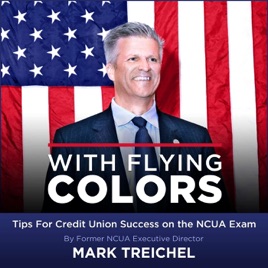
Advertise on podcast: Credit Union Exam Solutions Presents With Flying Colors
Rating
5from
This podcast has
321 episodes
Language
EnglishExplicit
No
Date created
2022/01/12
Latest episode
2026/02/10
Average duration
34 min.
Release period
6 days
Description
Tips for Credit Unions Success on the NCUA Examination. Brought to you by Mark Treichel's Credit Union Exam Solutions.
Unlock Credit Union Exam Solutions Presents With Flying Colors podcast Email contact info,
Listeners & Audience details
Email contact information
Direct podcast contact details

Listeners
Audience numbers & engagement insights

Audience details
Podcast Insights

Podcast episodes
Check latest episodes from Credit Union Exam Solutions Presents With Flying Colors podcast
Why Concentration Risk Still Trips Up Credit Unions
2026/02/10
In this special archive episode of With Flying Colors, Mark Treichel is joined by Steve Farr and Todd Miller — both former NCUA leaders — to revisit a foundational topic that continues to shape credit union supervision today: risk appetite, risk culture, and concentration risk.
While regulators often emphasize capital levels, history shows that capital alone cannot offset poor risk governance. This conversation explores why concentration risk continues to challenge institutions — even those that appear well capitalized.
Drawing on decades of regulatory experience, the team walks through the core components of a modern risk management framework and discusses how boards should think about oversight in today’s environment.
What We Cover
🔹 Risk Culture Starts at the Top
Why tone from the board and CEO matters more than policiesHow troubled institutions often trace back to cultural breakdownsThe board’s role in defining acceptable risk🔹 Risk Appetite: Limit or Goal?
What a risk appetite statement actually meansWhy limits must be measurable and monitoredThe difference between qualitative intent and quantitative control🔹 Concentration Risk in the Real World
The taxi medallion example and what it taught the industryWhy 15%+ capital ratios were not enoughHow concentration risk interacts with capital and stress scenarios🔹 The Three Lines of Defense
Frontline business unitsRisk management oversight (including the Chief Risk Officer role)Internal audit and supervisory committee functions🔹 Examiner Expectations Today
Stress testing and concentration limitsSupporting board-approved limits with dataWhat happens when limits are breachedWhy documentation and reporting matterKey Takeaways
Capital can absorb losses — but it cannot fix poor diversification.Risk appetite should reflect capital strength, strategic goals, and institutional complexity.Concentration limits are not aspirational targets — they are guardrails.Effective risk management requires culture, measurement, and accountability.Why This Still Matters
Regulatory guidance continues to evolve, but the core principles of risk governance remain unchanged. Whether you lead a $300 million credit union or a multi-billion-dollar institution, understanding how risk culture, appetite, and oversight interact is essential.
This archive episode remains highly relevant as examiners increasingly scrutinize concentration risk and enterprise risk management practices.
NCUA in Transition: What Hauptman’s Move Means with Bacino, Swann & McKechnie
2026/02/05
www.marktreichel.com
https://www.linkedin.com/in/mark-treichel/
In this episode of With Flying Colors, Mark Treichel is joined by former NCUA leaders Geoff Bacino, Alonzo Swann, and John McKechnie for a timely and candid discussion about Chairman Kyle Hauptman’s appointment to the Public Company Accounting Oversight Board (PCAOB) — and what it signals for the future of the NCUA.
While the announcement appears straightforward, the panel explains why it creates a ripple effect across the agency, including questions about leadership continuity, pending lawsuits, board vacancies, staff reductions, and the broader stability of the regulator at a critical time for credit unions.
This conversation goes beyond speculation and into how the agency actually functions when leadership is in flux — from delegation of authority to examiner operations to internal morale.
You’ll hear insider perspective on:
Why Hauptman’s “intent to remain” language mattersHow the Slaughter/Harper lawsuits could determine the shape of the future boardWhat a one-member board means in practiceWhy notation votes and lack of public discussion are becoming a concernThe real impact of a 27% staff reduction at NCUAHow agency expertise gaps are affecting morale and operationsThe upcoming interest rate ceiling decision and why it may be politically sensitiveWhy the agency may be “running itself” more than people realizeWhat happens if the Supreme Court changes how independent boards operatePredictions on who may replace Hauptman and what that means for credit unionsThe panel also discusses how political dynamics, Senate control, and White House strategy could shape the next NCUA board in ways credit unions haven’t seen before.
Despite the uncertainty, one theme is clear: the blocking and tackling of supervision continues, but major structural decisions are happening quietly beneath the surface.
This episode is essential listening for anyone trying to understand where NCUA is headed in 2026.
👥 Guests
Geoff Bacino – Former NCUA Board MemberAlonzo Swann – Former NCUA Regional DirectorJohn McKechnie – Washington, DC credit union advocate and consultant
Emergency Pod: NCUA Board Chair Kyle Hauptman Leaving for PCAOB?
2026/02/02
www.marktreichel.com
https://www.linkedin.com/in/mark-treichel/
Chairman Hauptman’s Statement on Appointment to PCAOB
ALEXANDRIA, VA (January 30, 2026) – National Credit Union Administration Chairman Kyle S. Hauptman issued the following statement after being named as a member of the Public Company Accounting Oversight Board (PCAOB).
“I am grateful to President Donald J. Trump and Chairman Paul S. Atkins for their faith in me and for the appointment to the PCAOB,” said Chairman Hauptman. “I intend to remain in my role as NCUA Chairman until my successor is appointed by President Trump and confirmed by the U.S. Senate.”
What Credit Unions Should Really Prepare for After NCUA’s 2026 Priority Letter
2026/01/27
www.marktreichel.com
https://www.linkedin.com/in/mark-treichel/
In this episode of With Flying Colors, Mark Treichel is joined by former NCUA senior leaders Todd Miller and Steve Farrar for a deep dive into NCUA’s 2026 Supervisory Priorities Letter — and what it means in the real world for credit unions heading into the next exam cycle. Deep Dive on NCUA Priority Lett…
With significant staffing reductions at the agency and a shift toward more “risk-based” supervision, the group discusses whether exam programs will truly become more tailored — or whether credit unions should expect more conservative ratings, more findings, and less dialogue.
The conversation also explores what’s emphasized, what’s missing, and how operational realities inside NCUA may shape supervision more than policy statements.
Key Topics Discussed
🏛️ NCUA Operations and Staffing
How a 27% reduction in staff could affect exam consistency and depthWhy less-experienced exam teams may lead to more conservative CAMEL ratingsConcerns about “CYA supervision” and addressing symptoms rather than root causes📊 Balance Sheet Management and Credit Risk
Why industry data does not support claims of worsening asset qualityContinued focus on credit concentrations and underwriting practicesWhat outsourcing of lending and collections may trigger in exams💧 Liquidity and Interest Rate Risk
Why interest rate risk is often overstated as a failure driverOngoing scrutiny of liquidity forecasting modelsGrowing competition for deposits from fintechs and non-banks💵 Earnings, Capital, and Rising Expenses
Why operating expenses are growing faster at credit unions than banksTechnology investments, staffing costs, and post-COVID catch-up spendingCapital planning expectations despite fewer references in the priority letter⚙️ Operational Risk, Payments, and Technology
Increasing complexity of payment platforms and third-party integrationsWhy internal audit functions matter more than everRisks created by rapid fintech adoption🕵️ Fraud Prevention and Member Protection
AI-driven fraud and voice spoofing risksWhy protecting members is now as critical as protecting institutionsReputation risk from scams and social media amplification📋 Compliance and What’s Missing
Notable reduction in consumer compliance emphasisBSA remains a regulatory constantWhat the absence of certain topics may signal about regulatory priorities🎙️ Practical Exam Strategy
Why recording exit conferences can protect credit unionsHow appeals and documentation can matter more in constrained environmentsWhy This Episode Matters
NCUA’s priority letters set expectations — but exam outcomes are often shaped by staffing, experience, and regional risk perceptions. As the agency continues to restructure, understanding how policy meets practice has never been more important.
This episode offers insider perspective on:
How exam approaches may shift in 2026Where credit unions should expect closer scrutinyWhy communication and documentation will matter more than ever
Breaking: NCUA Moves to Remove a Major Barrier to Board Service
2026/01/22
In this emergency update of With Flying Colors, Mark breaks down a newly proposed NCUA rule that could meaningfully reduce barriers to serving on a federal credit union board.
The proposal would allow federal credit unions to reimburse or directly pay reasonable dependent care costs for volunteer officials when those costs are incurred while attending board meetings or performing official duties — including, potentially, training and conferences.
This is a narrow but important change that reflects rising childcare and eldercare costs, declining volunteerism, and the increasing demands placed on credit union boards.
Mark also shares brief updates on the Central Liquidity Facility (CLF), NCUA’s regulatory simplification efforts, and what’s coming next on the podcast following recent discussions at a credit union conference cruise.
🔍 What the Proposed Rule Would Do
Applies to federal credit unions only (state charters follow state law)Allows reimbursement or direct payment of:ChildcareAdult dependent care (elder care, disabled dependents)Covers costs incurred while:Attending board meetingsPerforming official duties (which may include training and conferences)Applies only to volunteer officials, not paid executives🚫 What the Rule Does Not Do
Does not allow reimbursement for:Lost wagesPaid leaveIndirect costs of volunteeringDoes not change compensation rules under the Federal Credit Union ActDoes not require credit unions to reimburse these costs — policies remain optional and discretionaryDoes not change IRS tax treatment — consult tax professionals for reporting requirements💡 Why This Matters
Childcare costs have increased more than 200% since 1990Volunteer participation has declined significantly since pre-pandemic levelsFederal credit union boards:Must meet at least 12 times per yearCannot generally be compensatedThis proposal may help:Attract younger and working-age professionalsSupport caregivers and single parentsImprove diversity of experience and perspective on boards🧭 What NCUA Is Asking for Public Comment On
NCUA is inviting industry feedback on:
Whether reimbursement should be limited to temporary or incremental costsWhether training and conference travel should clearly qualify as official dutiesDocumentation and internal control standardsBest practices from state-chartered credit unionsCredit unions and board members are encouraged to submit comments during the open comment period.
🔜 What’s Coming Next on the Podcast
A follow-up episode with Mark’s team discussing:NCUA’s 2025 Supervisory Priorities LetterWhat it really means for exams and operationsCoverage of NCUA’s upcoming webinar on supervisory priorities (February 19)Continued “emergency update” episodes when time-sensitive issues break
Quick Take on NCUA's Exam Plans for 2026
2026/01/20
www.marktreichel.com
https://www.linkedin.com/in/mark-treichel/
In this special preview episode of With Flying Colors, Mark Treichel tees up an upcoming live, on-stage discussion from the Florida Q’s Cruise with team members Steve Farr and Todd Miller.
Just days before the cruise, NCUA released its 2026 Supervisory Priorities Letter, and as always, that letter gives us important clues about what examiners will be focused on in the year ahead — and just as importantly, what’s driving examiner behavior behind the scenes.
This episode serves as a primer for the deeper, post-cruise discussion, where we’ll incorporate real-time feedback and questions from credit union leaders attending the cruise.
🧭 Big Picture Theme: NCUA in Chaos
Before diving into technical priorities, Mark frames the conversation around what many credit unions are experiencing operationally:
Leadership instability and fewer board actionsRetirements, buyouts, and staffing lossesRevolving and often less-experienced examinersExams prioritized over approvals and strategic requestsBottom line:
Chaos upstream is driving impact downstream — and that reality shapes how exams feel, how findings are delivered, and how long approvals take.📌 What’s in the 2026 Supervisory Priorities Letter?
Mark walks through the major categories NCUA highlighted and why they matter:
🟦 Lending / Credit Risk
Delinquencies and charge-offs at decade highsFocus on underwriting, concentrations, and workoutsContinued scrutiny of commercial real estate and indirect lending🟦 Liquidity & Interest Rate Risk
Stress testing assumptions under closer reviewStructural liquidity constraints getting more attentionAlignment between balance sheet strategy and risk appetite🟦 Earnings & Capital Adequacy
Sustainability of earnings under stress scenariosCapital planning tied directly to risk profilesMore forward-looking analysis expected in exams🟦 Payment Systems (Back as a Headline Topic)
Real-time payments and complex integrationsVendor risk, data exposure, and cyber vulnerabilitiesGovernance and internal controls over payments ecosystems🟦 Fraud Prevention and Detection
Internal controls and separation of dutiesInsider abuse explicitly called outExam procedures being updated to reflect evolving fraud risks🟦 BSA / AML Compliance Risk Management
Shift away from broad consumer compliance narrativeStronger focus on risk-based AML programsPrograms must be tailored to actual institutional risk🔄 What’s Notably Different from Prior Years?
Mark also highlights important shifts compared to earlier supervisory letters:
Cybersecurity is no longer a standalone headline — now embedded in Operational Risk and PaymentsConsumer financial protection is not emphasized as a top categoryFraud and payment systems return after being absent for several yearsGovernance expectations are increasingly embedded in every risk areaThese changes align with what many credit unions are already experiencing in exams — more findings tied to process, oversight, and documentation, not just numbers.
🎤 What’s Coming After the Cruise
During the Florida Q’s Cruise, Mark, Steve, and Todd will be discussing:
What credit unions are actually seeing in recent examsWhere examiner expectations are rising fastestHow governance findings are being framedWhat boards should be asking management right nowHow to manage regulatory uncertainty proactivelyAfter the cruise, a full follow-up episode will bring those insights back to the broader audience.
🎯 Key Takeaway
The risks themselves haven’t changed dramatically — but NCUA’s capacity, processes, and delivery of supervision have.
Credit unions that adapt their governance, documentation, and strategic planning to that reality will be better positioned to manage both exam outcomes and approval delays in 2026 and beyond.
You can’t fix NCUA’s chaos — but you can manage how it impacts you.
$2.5 Billion, Egos, and Why Big Numbers Need Context
2026/01/13
www.marktreichel.com
https://www.linkedin.com/in/mark-treichel/
The clash between President Trump and Federal Reserve Chair Jerome Powell has now expanded beyond interest rates — and into a $2.5 billion building renovation at the Fed.
Some see waste. Some see politics. Most people just see a number that’s hard to comprehend.
In this episode, I take a middle-ground look at what’s really going on:
• Why large government construction projects almost always cost more than planned • Why political egos inevitably get involved • And why $2.5 billion still deserves serious public context and scrutiny
Using real-world comparisons — from stacks of dollar bills reaching into space, to thousands of apartments, to centuries of spending at $1,000 an hour — we reset the conversation around scale, transparency, and accountability, without turning it into a partisan fight.
Because when budgets get this big, math matters more than megaphones.
Key Topics Covered
Why billion-dollar numbers break our intuitionConstruction overruns: normal, but not meaninglessHow political power struggles complicate budget debatesThe opportunity cost of multi-billion-dollar projectsWhy public institutions owe the public real financial contextWho Should Listen
Credit union and bank leadersBoard membersPolicy and compliance professionalsAnyone who wants less political theater and more financial reality
Trump Demands 10% Credit Card Rates: Can He Do This?
2026/01/12
www.marktreichel.com
https://www.linkedin.com/in/mark-treichel/
President Trump has called for a one-year cap on credit card interest rates at 10%. It’s a headline-grabbing proposal — but can he actually do it, and what would it really mean for consumers, banks, and credit unions?
In this episode, Mark Treichel breaks down:
Why presidents can “call for” caps but can’t impose them unilaterallyWhy credit card rates are high in the first placeHow a 10% cap could reduce access to credit, especially for lower-income borrowersWhy rewards programs, grace periods, and credit limits could all be at riskHow credit unions would be affected differently than large banksWhy well-intended caps can push borrowers toward much worse alternatives like payday lendingBottom line: It’s good politics, but it could be very bad policy — with consequences that hit the very people it’s supposed to help.
Understanding Examiner Findings, Supplementary Facts, and DORs
2026/01/08
www.marktreichel.com
https://www.linkedin.com/in/mark-treichel/
NCUA exam reports often contain more than meets the eye.
Examiner findings, supplementary facts, and documents of resolution may look like routine supervisory language — but each serves a distinct purpose and sends a different signal to credit union boards and management.
In this episode of With Flying Colors, Mark Treichel is joined by former NCUA senior leaders Steve Farr and Todd Miller to break down how exam reports are structured, how issues escalate, and what credit unions should be paying attention to long before enforcement actions appear.
Drawing on decades of NCUA experience, the discussion explains how examiners decide where issues belong in the report, why volume matters as much as severity, and how governance and communication failures often sit at the root of repeat findings.
This is an evergreen episode for any credit union executive, board member, or compliance professional who wants to better understand what NCUA is really saying — and how to respond effectively.
In This Episode, We Discuss:
The practical differences between examiner findings, supplementary facts, and documents of resolutionWhy a long list of “minor” findings can be a major warning signHow supplementary facts are used to signal emerging risk and specialist concernsWhat elevates an issue into a document of resolutionThe SMART framework examiners are expected to use — and where it breaks downHow unresolved issues contribute to CAMEL rating pressureWhy corporate governance increasingly appears in exam reportsThe role communication plays in preventing escalationWhat boards should ask before approving a document of resolutionWho Should Listen:
Credit union board membersCEOs and executive leadership teamsCompliance, risk, and governance professionalsCredit unions preparing for an upcoming NCUA examInstitutions experiencing repeat findings or growing examiner scrutinyKey Takeaway:
NCUA exam reports are not just compliance documents — they are communication tools. Understanding how examiners signal concern helps credit unions prioritize issues, respond proportionately, and avoid unnecessary escalation.
About the Host:
Mark Treichel is a former senior NCUA executive and the founder of Credit Union Exam Solutions. With more than three decades of regulatory experience, Mark helps credit unions understand NCUA expectations and navigate examinations with confidence.
Teamwork Under Pressure: Lessons from an Olympic Gold Medalist
2025/12/30
This is a classic episode of With Flying Colors—and a rare one that steps slightly outside the credit union lane for a reason.
As teamwork becomes an increasingly critical theme heading into 2026, this conversation felt worth revisiting.
In this episode, Mark sits down with Joe Jacoby, an Olympic gold medalist and performance coach, to explore what high-performing teams really look like when conditions are uncertain and pressure is high.
While the setting is the Olympic Games, the lessons translate directly to leadership teams, boards, and organizations navigating complexity, change, and accountability.
This conversation isn’t about motivation—it’s about execution:
How trust is built before it’s neededWhy great teams communicate without noiseHow different strengths actually work together under stressAnd why teamwork isn’t soft—it’s strategicIf you lead, serve on a board, or work as part of a management team, the insights here are as relevant today as when this episode first aired.
In this episode, we discuss:
What Olympic-level teamwork looks like in real timeWhy preparation matters more than celebrationHow unspoken communication develops inside high-trust teamsThe role of diversity of thought in performanceLessons leaders can apply long after the competition ends
Credit Unions in Q3 2025: Stability Returns, Pressures Remain
2025/12/23
www.marktreichel.com
https://www.linkedin.com/in/mark-treichel/
In this quarterly roundtable episode of With Flying Colors, Mark Treichel is joined by former NCUA executives Dennis Bauer, Steve Farrar, and Todd Miller to break down the NCUA Q3 2025 Quarterly Credit Union Data Summary.
The discussion highlights a key theme: the credit union system is gradually returning to a more normal operating environment after years of rate shocks, pandemic liquidity, and balance-sheet distortion.
Key topics include improving net interest margins, rising non-interest expenses, and why ROA gains lag margin recovery. The panel examines growing pressure in auto and credit card portfolios, increased repossessions, and what delinquency trends suggest heading into 2026. They also explore liquidity stabilization, shifts in share mix, and renewed investment risk-taking as some credit unions bet on future rate cuts.
Additional insights include CAMEL rating trends, HELOC utilization growth, differences between credit union and community bank performance, and what examiner behavior may look like amid NCUA staffing constraints.
This episode is designed for credit union executives, board members, and risk leaders looking for plain-English interpretation of regulatory data—without spin or hype.
NCUA Regulation Updates: Audits, Cyber Guidance, and Corporate Rules
2025/12/16
www.marktreichel.com
https://www.linkedin.com/in/mark-treichel/
NCUA has launched a new Deregulation and Simplification Project, signaling a shift toward clearer, more flexible rules—without weakening safety and soundness.
In this episode of With Flying Colors, Mark Treichel breaks down the four proposed regulatory changes released by NCUA and explains what they mean in practice for credit unions, boards, and exam preparation.
Rather than a wholesale rewrite, this package focuses on clarity, structure, and regulatory housekeeping—especially around audits, corporate credit union governance, and cybersecurity guidance.
Key topics covered:
Updates to Supervisory Committee audit rules (Part 715)Technical and governance clarifications for corporate credit unionsWhy cybersecurity guidance is moving out of regulation and into Letters to Credit UnionsWhat’s not changing—despite the headlinesHow this project fits into broader NCUA budget and structural discussionsMark also shares perspective on why moving guidance out of the CFR matters—and what credit unions should (and shouldn’t) do next.
More regulatory developments are coming fast, including NCUA’s upcoming board meeting and budget discussions. Stay tuned.
Demographics, Deposits & the Consolidation Wave — With Dan Prezioso of Olden Lane
2025/12/09
www.marktreichel.com
https://www.linkedin.com/in/mark-treichel/
In this episode of With Flying Colors, Mark Treichel speaks with Dan Prezioso, Partner at Olden Lane, about the demographic shift reshaping credit unions and why deposit competition is entering a new era.
Dan shares data and insights from multiple national surveys, macro trends, and firsthand M&A activity, including:
Why strategic mergers are already breaking NCUA approval records in 2025The shrinking role of baby boomers as depositors, borrowers, and primary financial institution usersWhy Gen Z and millennials are saving more — but choosing Robinhood, Coinbase, and SoFi over traditional credit unionsThe alarming statistic that 37% of Gen Z credit union members are likely to switch institutions in the next 12 months“Real” deposit growth vs. nominal growth, and why rising OPEX may force additional consolidationThe engagement deficit: younger members don’t think of credit unions as their everyday financial partnerWhat credit unions can do right now to stay relevant in the next decadeDan also highlights examples of institutions that are getting it right — from fractional real estate investing to budgeting tools and crypto-enabled debit cards — and explains what boards should be asking their CEOs in 2026 strategic planning.
📩 Connect with Dan: [email protected]
🔗 Olden Lane: [email protected]
🎧 Listen now and subscribe for future episodes of With Flying Colors.
Monthly Board Meeting Packages with Todd Miller
2025/12/02
www.marktreichel.com
https://www.linkedin.com/in/mark-treichel/
Episode Summary
In this archive episode of With Flying Colors, Mark sits down with Todd Miller — longtime NCUA expert, former Director of Special Actions, and member of the CU Exam Solutions team — to break down one of the most misunderstood and under-optimized tools in credit union governance: the board package.
Boards get in trouble not because they don’t care, Todd explains, but because they are often misinformed, overwhelmed, or kept in the dark. A well-designed board package solves that — if it’s built with the right mix of clarity, consistency, and candor.
Todd explains:
What high-performing board packages includeWhy “size and complexity” shape reporting expectationsThe danger of data dumps, inconsistent formatting, and detail overloadHow to pair dashboards with strong qualitative narrativesThe one question every executive should answer in their reportsWhy peer comparisons matterHow risk appetite, strategic plans, and deviation explanations must tie togetherReal-world stories from troubled and well-run credit unionsHow to avoid examiner criticism by aligning reporting with actual riskThis episode is full of practical actions your board and leadership team can apply immediately.
Key Themes & Takeaways
1. Great Board Packages Balance Qualitative + Quantitative Reporting
Todd outlines a simple principle: Board reports should demonstrate management’s compliance with the business plan, board policies, and the credit union’s risk appetite.
transcript Board Packages Todd …
Boards need both data and narrative to understand where the credit union is, how it got there, and where it’s going.
2. Consistency Builds Board Trust
From formatting to color-coding to dashboards, consistency helps directors quickly understand risk without getting bogged down.
Inconsistent layouts or disorganized reporting create confusion and can lead to micromanagement or oversight failures.
3. Avoid the “Data Dump” Trap
Todd highlights that many troubled credit unions had mountains of data… but no clarity. Board packets that keep expanding over time—without periodic pruning—bury critical insights.
Annual reviews of what stays, what goes, and how information is summarized are essential.
4. Dashboards Are Critical — But Must Be Thoughtfully Built
Dashboards should show:
Where the CU has beenWhere it is nowWhere it’s trending nextThey must also be paired with narrative analysis to flag:
VariancesDeviations from strategic/annual plansNew risksNew opportunities5. The Biggest Blind Spot: Credit Risk Reporting
Credit risk is the No. 1 cause of failures. Todd explains how to reduce hundreds of pages into 2–3 meaningful pages with:
Risk migration visualsLTV + credit score overlaysPortfolio trendsBusiness loan concentration & large-borrower exposure6. Committees Create Risk — and Reporting Obligations
ALCO, lending, IT, risk committees… Boards need visibility but not minutiae.
Todd walks through how well-run credit unions:
Summarize committee outputElevate red flagsKeep the board focused on strategy, not operations7. Real-World Stories—The Good, The Bad, The Ugly
Todd shares examples of:
39 unprofitable branches hidden in an overly detailed packetBoards blindsided by marijuana banking risk and resulting finesA $4 million depositor walking out because the board lacked contextThese stories underscore the need for transparency, context, and prioritization.
Why This Matters
A strong board package:
Improves governanceEnhances regulator confidencePrevents surprisesSupports faster, cleaner examsKeeps boards strategicHelps management demonstrate competence and controlThis episode is a must-listen for CEOs, CFOs, lending executives, and directors looking to elevate their governance culture.
Understanding Risk Management: Culture, Appetite & Action
2025/11/20
www.marktreichel.com
https://www.linkedin.com/in/mark-treichel/
Overview In this episode, we break down the fundamentals of risk management for credit unions — what it really means, why it matters at every asset size, and how boards and executives can build a resilient framework that supports safe, sustainable growth.
blog risk appetite
What We Cover
The Three Pillars of Risk ManagementRisk Culture — how tone from the top determines effectiveness.Risk Appetite — defining how much risk is acceptable before strategy becomes unsafe.Risk Management System — the controls, processes, and oversight that put culture and appetite into action. blog risk appetite
Why Size Matters — and Doesn’tPractical guidance for smaller credit unions: clear limits, strong oversight, and effective supervisory committees.What larger credit unions need: formal risk appetite statements, risk departments, and comprehensive reporting frameworks. blog risk appetite
Common PitfallsThe “capital trap”—why even strong net worth can’t compensate for unmanaged concentration risk (e.g., taxi medallion credit unions).Siloed risk decisions.Hoping limit breaches “self-correct.” blog risk appetite
Best Practices for a Strong FrameworkAlign appetite with capital and strategy.Use clear metrics to monitor risk.Establish formal limit-breach processes.Encourage staff to raise risk concerns without hesitation.Maintain strong documentation and communication. blog risk appetite
Key Takeaway Risk management isn’t about eliminating risk — it’s about managing it in a way that protects members while enabling growth. A clear culture, aligned risk appetite, and well-designed system create the foundation for long-term success.
Podcast reviews
Read Credit Union Exam Solutions Presents With Flying Colors podcast reviews
Podcast sponsorship advertising
Start advertising on Credit Union Exam Solutions Presents With Flying Colors relevant audience podcasts
You may also like to advertise on these Podcasts
4.4371061566
The Megyn Kelly Show
SiriusXM

4.888901269
Fearless with Jason Whitlock
Blaze Podcast Network

4.8118931000
Mind Pump: Raw Fitness Truth
Sal Di Stefano, Adam Schafer, Justin Andrews, Doug Egge

4.8102131585
Tara Brach
Tara Brach

4.541561215
Something You Should Know
Mike Carruthers | OmniCast Media

4.513841343
Strictly Anonymous Confessions
Kathy Kay

4.8292781897
Fantasy Footballers - Fantasy Football Podcast
Fantasy Football

4.62382612
Football Weekly
The Guardian

4.45387666
Two Judgey Girls
Two Judgey Girls

3.8258501152
The Viall Files
Nick Viall