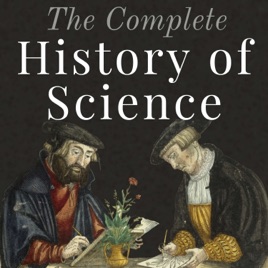
Advertise on podcast: The Complete History of Science
Rating
5from
This podcast has
45 episodes
Language
EnglishPublisher
Gethin RichardsExplicit
No
Date created
2022/01/13
Latest episode
2026/10/10
Average duration
33 min.
Release period
50 days
Description
A podcast exploring the history of science from the beginning. We will cover all of the most important scientific discoveries from Archimedes to Newton to Einstein. The aim is to give a complete overview of how science evolved and how it shaped the modern world. Support the show and keep it going: https://buymeacoffee.com/completehistoryofscience Follow me on BlueSky for updates: https://bsky.app/profile/gethinrichards.bsky.social YouTube: https://youtube.com/@thecompletehistoryofscience Music credit:Folk Round Kevin MacLeod (incompetech.com)Licensed under Creative Commons: By Attribution 3.0http://creativecommons.org/licenses/by/3.0/Photo credit: "L0015096EB" by Wellcome Library, London is licensed under CC BY 4.0. Image has been cropped.
Unlock The Complete History of Science podcast Email contact info,
Listeners & Audience details
Email contact information
Direct podcast contact details

Listeners
Audience numbers & engagement insights

Audience details
Podcast Insights

Podcast episodes
Check latest episodes from The Complete History of Science podcast
I Follow Archimedes [Galileo - Part 1]
2026/10/10
In 1583, Galileo Galilei was eighteen years old and enrolled as a medical student at the University of Pisa. On the surface, life was good. There was, however, one problem: he couldn't stand medicine. We begin with his early years, from his musician father and difficult mother to the monks who very nearly kept him for good. Nicknamed The Wrangler for arguing with his professors, Galileo slipped uninvited into a lecture on geometry and was captivated. Mathematics was poorly paid and held in low regard, but in Archimedes he had found his master. Abandoning a safe career was a gamble, and the road to a university post was not a smooth one.
Support the show
Support the show and get episodes early: https://www.patreon.com/TheCompleteHistoryofScience
Website: https://thecompletehistoryofscience.com/
Contact: [email protected]
BlueSky: https://bsky.app/profile/gethinrichards.bsky.social
Music Credit: Folk Round Kevin MacLeod (incompetech.com) Licensed under Creative Commons: By Attribution 3.0 License
Special: The History of Reproductive Science with Prof. Michael Carroll
2026/03/22
Michael, an Associate Professor in Reproductive Science, joins us for a wide-ranging dive into the history of reproductive science. From ancient Galenic theories and Leonardo da Vinci's anatomical drawings, through the gradual unravelling of how sperm and eggs work, to the breakthroughs that ultimately made IVF possible.
We trace the key milestones: sperm capacitation, early animal studies, and the pioneering work of Edwards, Steptoe, and Purdy that led to the birth of Louise Brown in 1978, and the 12 million IVF babies who have followed since.
Support the show
Support the show and get episodes early: https://www.patreon.com/TheCompleteHistoryofScience
Website: https://thecompletehistoryofscience.com/
Contact: [email protected]
BlueSky: https://bsky.app/profile/gethinrichards.bsky.social
Music Credit: Folk Round Kevin MacLeod (incompetech.com) Licensed under Creative Commons: By Attribution 3.0 License
The Harmony of Johannes Kepler [Kepler - Part 4]
2026/01/25
In 1610 reports reached Prague that Galileo had discovered new planets, and Kepler felt compelled to find out for himself what had actually been seen. Reading Starry Messenger and later observing through a borrowed telescope, he became one of Galileo’s earliest and most important defenders. Kepler not only confirmed the existence of Jupiter’s moons but also argued publicly for the reliability of telescopic observations, and went further by explaining, for the first time, how the telescope worked in theory through his optical treatise Dioptrice.
Alongside this defence of new instruments, the episode follows Kepler’s search for harmony in the structure of the cosmos, culminating in the discovery of his third law of planetary motion. It then traces his long and difficult effort to complete the Rudolphine Tables, based on Tycho Brahe’s observations. Published in 1627, the tables proved vastly more accurate than anything before them and made possible the successful prediction of planetary transits. Though Kepler did not live to see their full impact, the tables ensured that his astronomy could no longer be ignored.
Support the show
Support the show and get episodes early: https://www.patreon.com/TheCompleteHistoryofScience
Website: https://thecompletehistoryofscience.com/
Contact: [email protected]
BlueSky: https://bsky.app/profile/gethinrichards.bsky.social
Music Credit: Folk Round Kevin MacLeod (incompetech.com) Licensed under Creative Commons: By Attribution 3.0 License
Christmas Special 2025 - Q and A
2025/12/24
Merry Christmas!
Answering listener questions as well as some long standing FAQs. Enjoy!
Support the show
Support the show and get episodes early: https://www.patreon.com/TheCompleteHistoryofScience
Website: https://thecompletehistoryofscience.com/
Contact: [email protected]
BlueSky: https://bsky.app/profile/gethinrichards.bsky.social
Music Credit: Folk Round Kevin MacLeod (incompetech.com) Licensed under Creative Commons: By Attribution 3.0 License
The New Astronomy [Kepler - Part 3]
2025/11/14
After years of struggle, Johannes Kepler finally had the tools and data to wage what he called his “War with Mars.” Rejecting ancient assumptions he used Tycho Brahe’s observations to discover his first two laws of planetary motion. His New Astronomy not only redefined celestial mechanics but transformed astronomy from a geometric art into a true physical science.
Support the show
Support the show and get episodes early: https://www.patreon.com/TheCompleteHistoryofScience
Website: https://thecompletehistoryofscience.com/
Contact: [email protected]
BlueSky: https://bsky.app/profile/gethinrichards.bsky.social
Music Credit: Folk Round Kevin MacLeod (incompetech.com) Licensed under Creative Commons: By Attribution 3.0 License
Let Me Not Seem to Have Lived in Vain [Kepler - Part 2]
2025/11/10
In 1600, Johannes Kepler arrived at Tycho Brahe’s castle hoping to escape religious persecution and gain access to the most precise astronomical data in Europe. Their relationship was strained by clashing temperaments — Tycho’s secrecy and pride meeting Kepler’s impatience and ambition — yet their collaboration began to bear fruit as Kepler tackled problems of planetary motion and optical theory. Despite constant uncertainty, Kepler’s time at Benátky marked the beginning of a partnership that would reshape astronomy and set him on the path toward his greatest discoveries.
Support the show
Support the show and get episodes early: https://www.patreon.com/TheCompleteHistoryofScience
Website: https://thecompletehistoryofscience.com/
Contact: [email protected]
BlueSky: https://bsky.app/profile/gethinrichards.bsky.social
Music Credit: Folk Round Kevin MacLeod (incompetech.com) Licensed under Creative Commons: By Attribution 3.0 License
Secrets of the Universe [Kepler - Part 1]
2025/09/28
Johannes Kepler rose from a difficult childhood to become a brilliant but unconventional student, deeply influenced by his Lutheran faith, Copernican astronomy, and a belief in divine harmony within the cosmos. In Graz he developed his bold first theory, published in Mysterium Cosmographicum, which linked the orbits of the planets to the five Platonic solids and made him one of the earliest open defenders of heliocentrism. Facing religious persecution and desperate for accurate data, Kepler set out to join Tycho Brahe in Prague, convinced that Tycho’s observations were the key to uncovering the universe’s hidden order.
Support the show
Support the show and get episodes early: https://www.patreon.com/TheCompleteHistoryofScience
Website: https://thecompletehistoryofscience.com/
Contact: [email protected]
BlueSky: https://bsky.app/profile/gethinrichards.bsky.social
Music Credit: Folk Round Kevin MacLeod (incompetech.com) Licensed under Creative Commons: By Attribution 3.0 License
Tycho's World System [Tycho Brahe Part 3]
2025/06/20
Tycho Brahe’s observations of the Great Comet of 1577 and his discovery of atmospheric refraction led him to reject solid celestial spheres and reassess the structure of the cosmos. Seeking an alternative to both the Ptolemaic and Copernican systems, he developed a geo-heliocentric model in which the Sun orbited the Earth while the planets orbited the Sun, a theory he supported with years of precise measurements, including a (mistaken) parallax for Mars. Though he failed to find definitive proof, Tycho’s tireless pursuit of accuracy and his revolutionary instruments laid the groundwork for the astronomical breakthroughs that would follow.
Support the show
Support the show and get episodes early: https://www.patreon.com/TheCompleteHistoryofScience
Website: https://thecompletehistoryofscience.com/
Contact: [email protected]
BlueSky: https://bsky.app/profile/gethinrichards.bsky.social
Music Credit: Folk Round Kevin MacLeod (incompetech.com) Licensed under Creative Commons: By Attribution 3.0 License
Hven is a Place on Earth [Tycho Brahe Part 2]
2025/06/15
In 1576, Tycho Brahe was offered something no astronomer had ever received before: an island of his own. On the remote Baltic isle of Hven, Tycho set out to build the most advanced observatory in Europe. But just as construction began, a brilliant comet appeared in the night sky. For Tycho, it was more than a celestial spectacle: it was a chance to test Aristotle, challenge old ideas, and prove that careful observation could overturn centuries of dogma. This episode traces Tycho’s transformation from wandering scholar to scientific institution, as he turns a lonely island into the centre of the astronomical world.
Support the show
Support the show and get episodes early: https://www.patreon.com/TheCompleteHistoryofScience
Website: https://thecompletehistoryofscience.com/
Contact: [email protected]
BlueSky: https://bsky.app/profile/gethinrichards.bsky.social
Music Credit: Folk Round Kevin MacLeod (incompetech.com) Licensed under Creative Commons: By Attribution 3.0 License
A New Star [Tycho Brahe Part 1]
2025/06/14
13/06/25 - Episode was removed due to audio errors and reuploaded. Sorry!
In 1572, a mysterious new star appeared in the sky, defying the ancient belief that the heavens never changed. Tycho Brahe, a Danish nobleman with a passion for astronomy, set out to uncover the truth. His meticulous observations challenged established ideas and sparked debates among scholars. But Tycho’s journey wasn’t just about science, it was a struggle against family expectations, social norms, and the limits of the tools at his disposal. This episode is the first of three parts exploring how one man’s curiosity reshaped our understanding of the universe and set the stage for a new era of discovery.
Support the show
Support the show and get episodes early: https://www.patreon.com/TheCompleteHistoryofScience
Website: https://thecompletehistoryofscience.com/
Contact: [email protected]
BlueSky: https://bsky.app/profile/gethinrichards.bsky.social
Music Credit: Folk Round Kevin MacLeod (incompetech.com) Licensed under Creative Commons: By Attribution 3.0 License
The Lodestone, the Compass and the Magnetic Earth
2025/05/25
In this episode we trace the early development of magnetism and the compass—from ancient Chinese navigation to the groundbreaking insights of medieval and Renaissance Europe. The episode highlights the work of Peter Peregrinus, a 13th-century scholar whose detailed experiments with magnets laid the foundation for future magnetic science, and Robert Norman, who devised a method to reveal the mysterious “dip” of the magnetic needle. It also explores early efforts to understand magnetic declination, map its behavior, and investigate the nature of Earth’s magnetic forces. From the legends surrounding the compass’s invention to the precision of William Gilbert’s De Magnete, this episode examines how magnetism evolved from a mystical force into a measurable, mappable phenomenon—marking a crucial step on the path to modern science.
Support the show
Support the show and get episodes early: https://www.patreon.com/TheCompleteHistoryofScience
Website: https://thecompletehistoryofscience.com/
Contact: [email protected]
BlueSky: https://bsky.app/profile/gethinrichards.bsky.social
Music Credit: Folk Round Kevin MacLeod (incompetech.com) Licensed under Creative Commons: By Attribution 3.0 License
Circulation! [William Harvey Part 3]
2025/01/18
At the start of the 17th century Harvey finally put all of the pieces in place. He had discovered that blood circulates through the body with the heart acting as a pump. Realising that he was undermining a millenia of Galenism, he set out carefully, working to convince his peers of his discovery. He made many public demonstrations to support his findings, meeting both support and controversy.
Support the show
Support the show and get episodes early: https://www.patreon.com/TheCompleteHistoryofScience
Website: https://thecompletehistoryofscience.com/
Contact: [email protected]
BlueSky: https://bsky.app/profile/gethinrichards.bsky.social
Music Credit: Folk Round Kevin MacLeod (incompetech.com) Licensed under Creative Commons: By Attribution 3.0 License
Be Still My Beating Heart [William Harvey Part 2]
2025/01/11
In 1602, William Harvey joined the College of Physicians to secure his medical career, but behind the scenes, he was conducting bold anatomical research. Through dissections, vivisections, and innovative experiments on blood flow and the heart, Harvey began challenging Galen’s teachings. His relentless curiosity would soon lead to the groundbreaking discovery of blood circulation.
Support the show
Support the show and get episodes early: https://www.patreon.com/TheCompleteHistoryofScience
Website: https://thecompletehistoryofscience.com/
Contact: [email protected]
BlueSky: https://bsky.app/profile/gethinrichards.bsky.social
Music Credit: Folk Round Kevin MacLeod (incompetech.com) Licensed under Creative Commons: By Attribution 3.0 License
Aristotle My General, Fabricius My Guide [William Harvey Part 1]
2024/12/27
In late 1599, William Harvey, having completed his B.A. at Cambridge, sought further education abroad. His father, a successful businessman, funded his journey to Padua, a renowned center of medical learning.
At Padua, Harvey encountered the teachings of Aristotle, particularly the idea of understanding the "final cause" of things, which influenced his approach to medicine. He also studied under Hieronymous Fabricius, who combined Aristotelian philosophy with detailed dissections, shaping Harvey’s future medical practices.
Support the show
Support the show and get episodes early: https://www.patreon.com/TheCompleteHistoryofScience
Website: https://thecompletehistoryofscience.com/
Contact: [email protected]
BlueSky: https://bsky.app/profile/gethinrichards.bsky.social
Music Credit: Folk Round Kevin MacLeod (incompetech.com) Licensed under Creative Commons: By Attribution 3.0 License
Fallopio and Fabricius
2024/11/11
Support the show
Support the show and get episodes early: https://www.patreon.com/TheCompleteHistoryofScience
Website: https://thecompletehistoryofscience.com/
Contact: [email protected]
BlueSky: https://bsky.app/profile/gethinrichards.bsky.social
Music Credit: Folk Round Kevin MacLeod (incompetech.com) Licensed under Creative Commons: By Attribution 3.0 License
Podcast reviews
Read The Complete History of Science podcast reviews
MonsterMo 2026/03/10
Recommended
Wonderful podcast, well researched and told, even if the host does make me twitch every time he uses “phenomena” as a singular (which I assume is inte...
Cancer Scientist 2025/12/03
Great listen, well researched
Very enjoyable! The research effort to produce this is superb up to this point!! Cannot wait to see how Gethin pieces together the coming centuries of...
JE/JE 2025/11/20
Great podcast
Extremely enjoyable and informative for anyone interested in the history of science. I especially enjoy that he focuses on the broad scope of science ...
Hugo Ball 2023/12/15
Great info!
Love the info and explanations in this podcast.
It would be nice if fewer sentences started with “However.” :)
However, the episodes are smart, sound...
ProfessionalReviewerator 2023/08/17
Great Idea
A clear and interesting account of the roots and evolution of scientific principles.
Podcast sponsorship advertising
Start advertising on The Complete History of Science relevant audience podcasts
You may also like to advertise on these Podcasts

4.92002931
The Wright Report
Bryan Dean Wright

4.721741386
Motivation Daily by Motiversity
Motiversity

4.619792875
All Ears English Podcast
Lindsay McMahon and Michelle Kaplan
4.8167522000
The GaryVee Audio Experience
Gary Vaynerchuk

4.682521297
The Daily Beast Podcast
The Daily Beast, Joanna Coles

4.82762860
Dopey: On the Dark Comedy of Drug Addiction
Dave & Chris

4.629942029
Optimal Living Daily - Personal Development and Self-Improvement
Justin Malik

4.810941764
Warchant Podcasts featuring Seminole Headlines
Warchant.com

4.672722000
Timcast News
Timcast Media

4.6432741253
Verdict with Ted Cruz
Premiere Networks