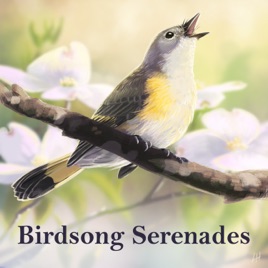
Advertise on podcast: Birdsong Serenades
Rating
3from
This podcast has
28 episodes
Language
EnglishPublisher
Rob PorterExplicit
No
Date created
2022/02/17
Latest episode
2026/04/20
Average duration
-
Release period
103 days
Description
Immerse yourself in birdsong, one species at a time. Each episode features long-form recordings focused on a single study species. Episodes will even be updated from time to time, to add even more recordings. Recordings are primarily of species present in the Great Lakes region of North America. Created, recorded, narrated by Rob Porter. Cover Art (American Redstart) by Lauren Helton: https://tinylongwing.carbonmade.com/
Unlock Birdsong Serenades podcast Email contact info,
Listeners & Audience details
Email contact information
Direct podcast contact details

Listeners
Audience numbers & engagement insights

Audience details
Podcast Insights

Podcast episodes
Check latest episodes from Birdsong Serenades podcast
Clay-colored Sparrow (Spizella pallida)
2026/04/20
It’s early morning and you’ve started the day off with a hike along a prairie scrubland — there’s few or no trees, and the small shrubs that are present reach no more than a foot off the ground.
As you hike you keep hearing this buzzy sound.
It almost sounds like an insect. Or like someone’s phone is vibrating on a table.
What you’re hearing is the Clay-colored Sparrow.
As the name suggests, this is a small brown bird with diversity of crisp earth tones, the most prominent colour being similar to that of clay.
The habitat it is mostly found in is incredibly effective at hiding this small sparrow, and the etherial sounding buzz also contributes to its inconspicuousness.
If you want to try to narrow down where this individual is, take a cue from birds of prey and bats, and move your head around a bit as it vocalizes, you might be able to use echolocation to narrow down better where that sound is coming from.
Western Meadowlark (Sturnella neglecta)
2025/08/11
Let’s say you’re taking a walk down a prairie road in early June. The land is fairly flat, there are few if any trees or shrubs taller than a couple feet.
In a field alongside you, you begin to hear this song...
It’s faint, and sounds a bit garbled and fast. You’re not quite so sure where this song is coming from, or which of the numerous prairie species this might be. Longspurs, larks, sparrows, meadowlarks — out here they can all sound rather muted and hurried in their song. Luckily, the songster decides to move from its hidden perch on a very low growing shrub to a nearby fence post, and you hear it again...
It’s a big bird. Larger than an American Robin, brown in the back, yellow in the front with a bold black bib across its chest.
I looked up some mnemonics for this species — one that came up that actually fits well is “Hey, why don’t you come to me?” Of course, this species can have plenty of variations in its song, so your mileage may vary.
One thing always stands out to me though — is just how strongly flutelike the voice of the Western Meadowlark sounds. It tends to be a much bolder song, when compared to the other songbird species it is often found alongside with. And, if you’re used to the Eastern Meadowlark, it is a much more rushed and much less contemplative of a song.
Let’s listen to the rapid warbles of the Western Meadowlark!
Eastern Wood-Pewee (Contopus virens)
2024/02/21
It’s late in the bird breeding season. Very late.. perhaps early September, somewhere in the Great Lakes region.
Many species stopped singing with any regularity weeks ago, but on a late evening hike, you’re hearing one bird singing, even after it starts getting dark.
Pee uhhh weee
The Eastern Wood-Pewee can be heard singing until the day they leave their forest breeding territory.
Of course though, this is not the only time you hear them singing. They are commonly heard alongside our previous species, the Red-eyed Vireo. Enough so that once and a while, the Red-eyed Vireo is known to mimic the song of the Eastern Wood-Pewee.
You can hear this species from twilight to dusk, though the song is much more enthusiastic in the early morning.
Red-eyed Vireo (Vireo olivaceus)
2023/12/28
Imagine that it is mid-June, and you’re hiking in a forest. You hear this one birdsong. With very few (if any) breaks between these repeated phrases.
You’re not sure, but you think there might be several of these birds.
What you can tell for certain though, is that the song has a repetitive pattern to it. And it’s coming from the canopy — the upper parts of the trees.
And, try as you might, you can’t quite see any of these birds that are singing this song.
What you’re hearing is the Red-eyed Vireo.
One of the most common ways of remembering their songs is recognizing that their song sounds like its asking, and answering, questions.
“Where are you? Here I am.”
But there’s one other trick that works.
Once again, we could (we can) use a mnemonic that focuses on rhythm and syllables instead.
Vireo? Vireo.
This trick also works for some other vireo species, such as Blue-headed, Yellow-throated, and Philadelphia Vireos who have the same rhythm but different tones and qualities to the sounds they produce.
Birdsong Serenades is Songbirding Studios production, and is recorded, engineered, narrated and created by me, Rob Porter.
Common Yellowthroat (Geothlypis trichas)
2023/12/23
The Common Yellowthroat is more heard than seen.
A typical encounter might be something like this:
You’re hiking a trail somewhere, and you hear this song.
You look over to where it came from and see a patch of cattail reeds, probably surrounding a small pond. Approaching this pond, you begin to see a small bird dart from reed to reed — perhaps sometimes even perching sideways on the reed — its feet clasping the stalk while the bird looks at you sideways.
It sings: witchataw, witchataw, witchataw. Or at least, that can be a decent analogue. We call this kind of matching with human language a mnemonic.
But a mnemonic doesn’t necessarily have to match exactly with how the bird sounds — in reality, most mnemonics are “close enough” at best.
Their job in this case is just to connect a song with a species identification.
So how about this instead: by sheer coincidence, the main phrase repeated in their song has the same number of syllables as the name “yellowthroat” itself.
Yellowthroat, yellowthroat, yellowthroat.
So if you want a mnemonic that is more of a rhythmic & syllabic match, just remember “yellowthroat, yellowthroat, yellowthroat”.
Credits
Birdsong Serenades is Songbirding Studios production, and is recorded, engineered, narrated and created by me, Rob Porter. From this point forward, you'll hear only the soundscapes.
Wood Thrush (Hylocichla mustelina)
2023/08/22
This episode will focus on the Wood Thrush. You may notice a bit of a tweak to the format of this series, it’s something new I’d like to try, and if feedback is positive I’d like to begin re-releasing episodes with the newer format. For feedback, as always you can contact me through Patreon, Discord, or email rob [at] songbirding.com.
It’s late June, and you’re on an evening hike through a deciduous forest. The birdsongs are less dense, more subdued at this time of day, and this next species’ song fits right in with that lazy late evening mood.
Peer-o-lay-dee!
The Wood Thrush has a slow, flute-like melody. It is the quintessential relaxed, chilled sounding birdsong.
And in my experience, this is a species that stands out more in the evening, not necessarily because it is more active leading up to dusk, but because it is just as active as any other time of day. Hermit Thrush and Eastern Wood-Pewee are like this as well, for example. In contrast, any given warbler or sparrow species will be likely be less active than they are in the morning.
Being a forest thrush species, these birds are more earthen in colour tones, and in the case of the Wood Thrush spend their time on the ground feeding, but also perch in the lower canopy of a forest when singing, treating the forest as their own personal auditorium as their song echoes far and wide.
They are not the only thrush to sound so calming. The Hermit Thrush could also be argued to be also a very calm, lazy sounding song.
This is where the mnemonics can come in handy, comparing the Wood Thrush’s flutelike peer-o-lay-dee vs the Hermit Thrush’s less describable flurry of notes.
Memorizing this distinction is not easy though… especially considering you’re only likely to hear these species’ songs through a quarter of the year, and that’s assuming you live somewhere that you might have regular access to both of these species. When hearing one of these two after 8 or 9 months of not hearing either, one could not be blamed for readily misidentifying these songs.
For more Hermit Thrush songs to compare with, there is previous Birdsong Serenades episode with extensive recordings to compare with. An upcoming episode will have a mix of both, so you may contrast and compare these two songful thrushes.
Credits
Birdsong Serenades is recorded, engineered, narrated and created by Rob Porter.
Ruby-crowned Kinglet (Regulus calendula)
2023/04/03
The Ruby-crowned Kinglet has a lengthy and fascinating song for such a tiny songbird.
It starts off with soft high notes, then break into a musical twittering, and concludes with a loud series of phrases.
It’s a strange song, and a loud one for such a tiny bird. Most people will only get a chance to hear this song during spring migration as most of their breeding territories are far away from heavily populated areas.
Northern Cardinal (Cardinalis cardinalis)
2023/02/15
To many in North America, the Northern Cardinal is the first birdsong of the season one will hear. If you listen often enough though, you might hear one singing at any time of the year.
The song can be a “purr deep purr deep” phrase repeated, or a “freep freep tick tick tick tick tick”. This species can vary quite a bit throughout its wide range, and both females and males are known to sing, though males do so more often.
American Robin (Turdus migratorius)
2023/01/31
The American Robin is very common songbird found across North America, and is often considered the quintessential “sign of spring” for many people.
Their song is complex, but can often be boiled down to variations upon the mnemonic “cheery, cheerio, cheer-ily”, repeated in rolling phrases.
Eastern Towhee (Pipilo erythrophthalmus)
2023/01/23
The Eastern Towhee has one of the most famous mnemonics of all of North America's songbirds.
"Drink Your Tea" describes the most common song of this species, though it has some variations to this.
Its' call, interestingly enough, can sound like its name "towhee", but some describe this call instead of "chewink".
Hooded Warbler (Setophaga citrina)
2022/12/28
The Hooded Warbler's range just barely touches into southern Ontario, and is usually associated with the extreme south -- the forests near the shore of Lake Erie.
This yellow warbler with a distinct black hood is a Carolinian Forest species, and has a couple different songs, it's primary song sounding like a-weeta-weeta-weeteeoo.
Eastern Meadowlark (Sturnella magna)
2022/10/24
The Eastern Meadowlark is a bright, loud, and cheery presence in tallgrass prairies and farmland across eastern North America, the Central Americas and parts of South America.
The male’s song generally consists of 3-5 plaintive whistles, slurred together into a single melody. Generally they sing from an exposed perch, but have been known to sometimes sing in flight.
Hermit Thrush (Catharus guttatus)
2022/09/20
The Hermit Thrush is a forest songbird with a drab brown plumage, and well-known melancholy song.
They lurk in the understories of northern forests in the summer, and the southern forests in the winter.
Their song begins with a sustained whistle, and follows with echoing tones that sound like they drift away at the end.
Chipping Sparrow (Spizella passerina)
2022/06/16
The Chipping Sparrow has what can be called in most regions a cryptic song. What is meant by this, is it can sound very similar to some other species.
Its trill is similar to Swamp Sparrow, Dark-eyed Junco, Pine Warbler, and Worm-eating Warbler.
So how can you tell it apart?
For me, this song is sharper, and more consistent in its trills, in volume, frequency, and speed.
The song of a Chipping Sparrow a tricky one to identify completely by sound, but there are some hints you can get from the environment the bird spends its time in.
Chipping Sparrows are common in urban environments — which is only also true for the Dark-eyed Junco, but only outside of breeding season when they are not singing very much.
Outside of the urban environments, you will find them in edge habitats — somewhere between two distinct habitats, such as forest and prairie. Perhaps this is why they tolerate urban environments, as they tend to have plenty of habitat edges.
House Wren (Troglodytes aedon)
2022/05/11
The House Wren is a small but powerful and frequent singer.
Both males and females will sing during breeding season. The songs are bubbly, and abruptly move from note to note. To me they can be reminiscent of a warbler song.
Podcast sponsorship advertising
Start advertising on Birdsong Serenades relevant audience podcasts
You may also like to advertise on these Podcasts

4.321868
money money money
Glen James

4.8184300
The Geekz Podcast
The
4.623659
We Know Severance
RHAP Productions

4.8237135
Re: Dracula
Bloody FM

4.7622111
Black Diamonds
SiriusXM

4.4150117
Hyperallergic
Hyperallergic

4.5194744
Pod Maverick: A Dallas Mavericks podcast
Audacy

4.8301364
POSH DJs Podcast
POSH DJs

4.9195115
Southern Bramble: a Podcast of Crooked Ways
Austin & Marshall

4.3112117
پادکست باضیا - Ba Ziya Podcast
Ali Ziya