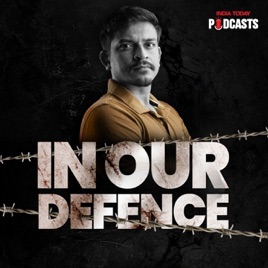
Advertise on podcast: In Our Defence
Rating
4.7from
This podcast has
196 episodes
Language
EnglishPublisher
India Today PodcastsExplicit
No
Date created
2022/04/01
Latest episode
2026/06/26
Average duration
62 min.
Release period
9 days
Description
In Our Defence is a weekly podcast that breaks down wars, weapons, and the world of military power with clarity, curiosity, and zero jargon. Hosted by journalist Dev Goswami, each episode features sharp, story-rich conversations with leading defence experts, offering distinct perspectives and nuances on how nations prepare, fight, and defend. From battlefield strategy and military tech to geopolitics, intelligence, and national security -- In Our Defence focuses on conversations that are grounded, engaging, and made for curious minds. No fluff. No noise. Just a clear line of sight into the world of conflict.
Unlock In Our Defence podcast Email contact info,
Listeners & Audience details
Email contact information
Direct podcast contact details

Listeners
Audience numbers & engagement insights

Audience details
Podcast Insights

Podcast episodes
Check latest episodes from In Our Defence podcast
India's Warship Boom Is Hiding a Bigger Problem |S3| Ep 55
2026/06/26
India appears to be in the middle of a naval shipbuilding boom. Destroyers, frigates, submarines, anti-submarine vessels and support ships are entering service with striking regularity.
But commissioning ceremonies tell us what India decided to build years ago. They do not necessarily tell us what is being ordered for the 2030s and 2040s.
In this season finale episode of In Our Defence, host Dev Goswami and national security expert Sandeep Unnithan examine how the Indian Navy became unusually capable of designing, integrating and supervising the construction of its own warships. The two decode the Navy's alphabet soup of Project 15B, Project 17A, Project 75I, Project 76 and the proposed next-generation programmes.
The two also ask whether India risks losing the continuous production rhythm required to build complex destroyers, frigates and submarines. Smaller vessels may keep shipyards occupied, but can they preserve the skills and supply chains needed for the next generation of frontline combatants?
And finally, the two get to the larger strategic argument: what kind of Navy does India actually want?
Should it focus on controlling the waters close to home, dominate key parts of the Indian Ocean, operate from Africa to Southeast Asia, or develop a more expeditionary force? Does India need a third aircraft carrier or would submarines, escorts, maritime aircraft and unmanned systems provide greater value?
Because before India decides which ships to build, it must decide what it expects its Navy to do.
Tune in!
Produced by Taniya Dutta
Sound mixed by Aman Pal
Galwan Revisited: The Night India's China Problem Became Real | In Our Defence | S3 | Ep 54
2026/06/19
Six years after the Galwan Valley clash, we revisit the night that fundamentally changed India's relationship with China.
What exactly happened on June 15, 2020? How did the Indian Army respond after losing soldiers, including a commanding officer? Why didn't the crisis spiral into a shooting war? And with the benefit of hindsight, what can we now infer about China's objectives and Xi Jinping's motivations?
In this episode, we explore:
* The events of the Galwan clash
* The command and emotional shock inside the Indian Army
* Whether Galwan permanently shifted India's military focus toward China
* China's long-term strategy along the Line of Actual Control
* Why trust between India and China remains difficult six years later
Galwan was more than a border clash. It was the moment India's China challenge stopped being theoretical.
Tune In!
Produced by Taniya Dutta
Sound mixed by Rohan Bharti
AMCA's Real Challenge Isn't Stealth. It's Management. | In Our Defence | S3 | Ep 53
2026/06/05
India's Advanced Medium Combat Aircraft, or AMCA, is usually discussed as a fifth-generation stealth fighter: low observable design, internal weapons bays, sensor fusion, advanced engines, and all the cool stuff that makes defence nerds sit up straighter.
But this episode of In Our Defence asks a slightly different question: is AMCA really about building a plane or about building the factory, institutions, and accountability structure needed to make that plane real?
The Ministry of Defence's AMCA tender lays out an ambitious plan to rope in a private-sector industrial partner in order to create a fifth-generation aerospace manufacturing ecosystem.
But then comes the big gap: who is the real project manager?
ADA owns the design. The IAF owns the requirement. Private industry will build and integrate. Certification agencies will certify. GTRE-Safran's engine effort appears, for now, to be running on a separate track. So, if X owns A and Y owns B...Who owns the delay?
In this episode of In Our Defence, host Dev Goswami and defence expert Sandeep Unnithan unpack why AMCA needs more than a good airframe. It needs the kind of mission-mode structure India built for the ATV/Arihant submarine programme - one that brings the alphabet soup of agencies together under real authority.
We also get into the quirks of India's L1 bidding culture: sensible for many contracts, but possibly dangerous when applied to complex, high-risk, must-succeed strategic programmes like a fifth-generation fighter.
Tune in!
Produced by Taniya Dutta
Pakistan's Generals and America's Forever Influence | In Our Defence | S3 | Ep
2026/05/22
Pakistan did not just become America's ally after 1947 – it slowly became a state whose military and strategic establishment learned that survival depended on staying useful to Washington.
In this episode of In Our Defence, host Dev Goswami and national security expert Sandeep Unnithan trace how Pakistan evolved into a geopolitical rentier state: trading geography, military cooperation and strategic access for money, weapons, political backing, and regime stability.
We break down:
-Why the United States backed Pakistan after independence
-How Pakistan's military became deeply tied to Washington
-Why Pakistani generals realised pleasing the US was often the key to surviving domestically
-The Cold War origins of the US-Pakistan partnership
-How this relationship pushed India closer to the Soviet Union
-What the Imran Khan cipher controversy actually revealed
-Whether the US played a role in Khan's removal
-The rise of Asim Munir and Pakistan's military establishment
-Why Pakistan may still prioritise US ties even at the cost of China
Tune in!
Produced by Taniya Dutta
Sound mixed by Aman Pal
India's Missile Week: Hypersonics, MIRVs & China Signal | S3 | Ep 51
2026/05/15
India has had a very busy missile season. In this episode of In Our Defence, host Dev Goswami and defence expert Sandeep Unnithan unpack a cluster of recent developments: the reported long-range hypersonic anti-ship missile test, DRDO and IAF’s TARA glide weapon trial, the Advanced Agni MIRV test, the long-duration scramjet combustor test, and the chatter around possible K-series submarine-launched missile activity.
But this is not just spec-sheet episode.
The episode looks at the story of how India managed to develop a rocket and missile force that is abreast with the rest of the world.
We go back to PN Haksar’s 1968 strategic thinking, Project Valiant, the IGMDP era, the shadowy Project Surya, and the modern Agni-6 question to understand how India’s missile ambitions evolved.
We also ask whether the least glamorous weapon in the news cycle -- TARA -- might actually matter the most in an age of long wars and attrition.
Hypersonics are sexy, MIRVs are apocalyptic, scramjets are manic engineering, but cheap precision at scale may be the real battlefield superpower.
Tune in!
Produced by Taniya Dutta
Sound mixed by Rohan Bharti
How Operation Sindoor Redefined Indian Warfare | In Our Defence |S3 | Ep 50
2026/05/07
One year ago, the template for India's response to state-sponsored terror changed forever. It began with a tragedy in Pahalgam -- where tourists were targeted with M4 rifles -- and ended with a 30-minute IAF rampage that shattered Pakistan's airbases.
In this episode, host Dev Goswami and national security expert Sandeep Unnithan go beyond the headlines of Operation Sindoor. They break down the "fast-moving missile" that nearly triggered a nuclear escalation, why India stayed silent about it, and the birth of Cold Start 2.0: a new era of kinetic non-contact warfare that uses Pakistan's own geography against it.
Key Takeaways:
The Geography Curse: How Pakistan's lack of physical depth (only 600-900km wide) makes every inch of its territory a target for BrahMos and S-400 systems.
Tactical Mistakes vs. Strategic Wins: Unpacking CDS Gen Anil Chauhan's comments on military losses and the evolution of India's policy: no more distinction between state and non-state actors.
The Silent Interception: The story of the ballistic missile fired at Delhi and why India's "off-ramp" diplomacy was just as lethal as its jets.
The lessons learnt: What India, Pakistan and even will have taken away from Operation Sindoor.
Produced by Taniya Dutta
Sound mixed by Suraj Singh
Unpacking India's Air Defence as Air Force Gets Another S-400 Regiment | In Our Defence | S3 | Ep 49
2026/05/01
In this episode of In Our Defence, host Dev Goswami and defence expert Sandeep Unnithan unpack one of the most complex parts of modern warfare: the art and science of shooting things out of the sky.
India is preparing to induct another S-400 regiment, the system that grabbed attention during Operation Sindoor and remains one of the most formidable long-range air-defence systems in the world. But the S-400 is only one piece of a much larger puzzle.
The episode breaks down India’s layered air-defence architecture: VSHORADS, MANPADS, Akash, MRSAM, Barak-8, S-400, ballistic missile defence, and the crucial command-and-control network that ties it all together: IACCS.
The episode also looks at what recent conflicts have shown us: from mass drone and missile attacks in West Asia to the growing challenge of cheap drones forcing expensive interceptors into action. And then, we turn to the uncomfortable but necessary question: what happens when air defence goes wrong?
This is not just about missiles. It is about sensors, software, human judgement, rules of engagement, friendly-fire risks, and the terrifying pressure of deciding what to shoot -- and what not to shoot -- in real time
Tune In!
Produced by Taniya Dutta
Sound mixed by Aman Pal
Pakistan Helped Shape Iran’s Nuclear Story. Now It’s Hosting US Peace Talks | In Our Defence | S3 | Ep 48
2026/04/24
In this episode of In Our Defence, we step away from the predictable outrage and look at the harder, more interesting question: why does Pakistan remain useful in high-stakes geopolitics despite its long record of contradictions?
Host Dev Goswami and national security expert Sandeep Unnithan unpack Pakistan's complicated ties with the United States, its uneasy relationship with Iran, its growing closeness to Saudi Arabia, and the larger truth that diplomacy is often driven less by morality and more by access, leverage, geography and utility.
They discuss the irony of how Pakistan with its history of having helped seed Iran's nuclear program is now helping broker talks that hinge on Tehran agreeing to give up its nuclear capabilities.
The two also get into the Osama bin Laden episode, the strange durability of US-Pakistan ties, and the role "middlemen" play in crises where nobody fully trusts anybody.
Tune In!
Produced by Taniya Dutta
Sound mixed by Rohan Bharti
Iran War: Will US Blockade of Hormuz Prevail? | In Our Defence | S3 | Ep 47
2026/04/17
In this episode of In Our Defence, host Dev Goswami is joined by national security expert Sandeep Unnithan to unpack one of the world’s most critical flashpoints—the Strait of Hormuz.
Why do narrow sea lanes like Hormuz matter so much to global trade and oil supply? What does a naval blockade actually look like in practice—not theory, but at sea? From ship strength and surveillance tech to geography and fleet positioning, we break down the real mechanics behind maritime chokeholds.
The episode also explores the counterplay: can a blockade be breached, and what does it take to punch through one? As tensions simmer between the US and Iran, does Washington’s naval dominance guarantee control, or is Tehran playing a deeper, asymmetric game?
They also unpack the curious case of the Rich Starry, the China-bound vessel whose strange movements through Hormuz have raised eyebrows. Additionally, a throwback to history — when India blockaded Karachi during the Indo-Pakistani War of 1971. What worked, what didn’t, and what it tells us about modern naval warfare.
Tune In!
Produced by Taniya Dutta
Sound mixed by Rohan Bharti
39 Days of War: Did the US and Israel Actually Fail to Break Iran? | In Our Defence | S3 | Ep 46
2026/04/10
After 39 days of war, Iran has agreed to a temporary ceasefire and the Strait of Hormuz is back in focus. But the big question remains: what exactly did this war achieve?
In this episode of In Our Defence, host Dev Goswami and national security expert Sandeep Unnithan unpack how the conflict escalated, why the war's goals seemed to keep shifting, and why, despite taking enormous punishment, Iran still ended up at the negotiating table without complete submission.
We get into:
How the US and Israel framed the war, and how those aims evolved
Whether Iran was defeated militarily but survived strategically
What this conflict revealed about air defence and modern missile warfare
Why this war may go down as a lesson in the limits of overwhelming force
Whether the ceasefire can actually hold
And the biggest long-term question of all: does this make Iran more likely to want the bomb?
This is not just a story about Iran, Israel, or the US. It is also a story about miscalculation, resilience, and what modern war looks like when even massive military superiority cannot produce a neat political outcome.
Tune In!
Produced by Areeb Raza
Sound mixed by Suraj Singh
Link To NY Times Article- https://www.nytimes.com/2026/0...
Vietnam to Iran: What Current Gulf Conflict Reveals About American War Strategy | S3 | 45
2026/03/26
A month into the Iran war, the battlefield story is changing rapidly. What began as high-impact US–Israel strikes has now entered an uncertain phase: drone warfare, energy and economic pressure through Hormuz, and now a sudden “pause” announced by Donald Trump. Is this the beginning of the end? Or just a tactical pause before the next round?
On the latest episode of In Our Defence, host Dev Goswami and national security expert Sandeep Unnithan break down:
- What the Iran war looks like right now
- Whether the U.S. pause is real diplomacy or strategic signalling
- Iran’s response and the risk of escalation
- Pakistan’s surprise role as a potential mediator
- Why does the United States, with the most powerful military in the world, keep getting pulled into long, inconclusive wars?
From Vietnam to Afghanistan, Iraq, Syria, and Libya, and now Iran the episode explores recurring pattern: Fast military success, followed by messy, unresolved endings.
Tune in!
Produced by Taniya Dutta
Sound mixed by Aman Pal
Iran, US-Israel, Gulf: Is Delhi Playing This Crisis Right? |S3 | 44
2026/03/20
The Gulf war has widened, energy infrastructure is under threat, and the Strait of Hormuz is once again at the centre of global anxiety. For India, this is not some faraway crisis. It is about oil, LPG, shipping, diaspora safety, relations with Iran, growing ties with Israel, and the limits of diplomacy when all your important partners are in the same conflict.
In this episode of In Our Defence, host Dev Goswami and national security expert Sandeep Unnithan unpack India's response to the Iran-Israel war so far. Did Delhi go too quiet too early? Or was that caution part of a deliberate strategy to preserve leverage, protect shipping, and keep channels open with all sides?
They discuss:
- How India-Iran ties evolved after 1979
- Why Tehran still seems willing to engage Delhi
- Whether and why India's initial response was too muted
- Whether India really has tilted toward Israel
- How different India's stand in this conflict from its historic positions
Tune in!
Produced by Taniya Dutta
Sound mixed by Rohan Bharti
2 Weeks Of Epic Fury: Who Is Winning The US-Iran War? |S3| 43
2026/03/12
Nearly two weeks into Operation Epic Fury, the war in West Asia has spilled over from the streets of Tehran to the depths of the Indian Ocean. In this episode of In Our Defence, host Dev Goswami and national security expert Sandeep Unnithan break down the most chaotic week in modern strategic history.
The two also dive into the sinking of the IRIS Dena, an Iranian frigate that was literally a guest at the Indian Navy’s MILAN 2026 exercise before being torpedoed by a US submarine off the coast of Sri Lanka. What message was the US trying to send by sinking a warship far away from the theatre of conflict?
Also on the episode: How for Iran, winning is equal to just suriving and how global players such as France and China will be looking at this conflict.
Tune in!
Produced by Taniya Dutta
Sound mixed by Rohan Bharti
Why India Can't Afford to let Tejas programme fail |S3| 42
2026/02/27
With the possible loss of a third HAL Tejas in Gujarat, the delayed response from authorities, and the controversy that has followed, renewed scrutiny is now on India’s indigenous fighter programme.
Questions are mounting: Has the IAF really lost another Tejas? Why the delay in official communication? And what does this mean for the Mark 1A rollout?
In this episode of In Our Defence, host Dev Goswami and national security expert Sandeep Unnithan discuss the controversy, the difference between Mark 1 and Mark 1A and the future of India’s indigenous fighter program.
The two discuss:
* Why the IAF hasn’t fully accepted the Mark 1A yet
* The GE 404 and 414 engine bottleneck
* Indigenous content — how Indian is Tejas really?
* The HAL–IAF dynamic and the larger structural silos
* Why fighter squadron anxiety is shaping procurement decisions
Tune in!
Produced by Taniya Dutta
Why India Wants To Buy 114 Rafale Jets & What That Means for Tejas, AMCA |S3| 41
2026/02/20
With the Defence Acquisition Council (DAC) clearing the monumental Rs 3.25 lakh crore deal for 114 Rafale jets just as French President Emmanuel Macron lands in India, the Indian Air Force is closer to getting the muscle it desperately needs. But what does this "Mother of All Deals" mean for India's indigenous fighter programs?
In this episode of In Our Defence, host Dev Goswami and national security expert Sandeep Unnithan unpack the proposed Rafale deal and break down the strategic and financial realities of buying 114 Rafales.
The two explore the 'Make in India' angle of the deal and what it means for India's private sector.
Most importantly, Dev and Sandeep ask the tough question: Will paying for 114 French jets bankrupt the homegrown Tejas Mk2 or is it a calculated move to buy time and secure our skies?
Produced by Taniya Dutta
Sound mixed by Aman Pal
Podcast reviews
Read In Our Defence podcast reviews
Saadi.s 2024/09/18
Well researched but needs better storytelling
Well researched but I think these guys need a writer and work on vocal timing.
aniljain 2023/01/13
Great India defense related podcast
Been listening to your podcast for some time now. It’s been a good mix of analysis and news about Indian Defense. Loved the last episode, about women ...
Podcast sponsorship advertising
Start advertising on In Our Defence relevant audience podcasts
You may also like to advertise on these Podcasts

4.87501973
The Dr. John Delony Show
Ramsey Network

4.512577662
RedHanded
RedHanded

4.959762000
Legal AF by MeidasTouch
MeidasTouch Network

4.7292652000
The Michael Knowles Show
The Daily Wire

4.9247711442
Unashamed with the Robertson Family
Tread Lively
4.8224751791
The Andrew Klavan Show
The Daily Wire
4.7278152000
The Matt Walsh Show
The Daily Wire

4.922662003
First15 Devotional
First15

4.838332000
Entrepreneurs on Fire
John Lee Dumas of EOFire

4.890611563
Fearless with Jason Whitlock
Blaze Podcast Network