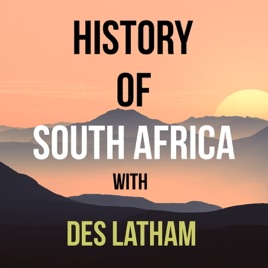
Advertise on podcast: History of South Africa podcast
Rating
5from
This podcast has
296 episodes
Language
EnglishPublisher
Desmond LathamExplicit
No
Date created
2022/05/17
Latest episode
2026/10/04
Average duration
22 min.
Release period
7 days
Description
A series that seeks to tell the story of the South Africa in some depth. Presented by experienced broadcaster/podcaster Des Latham and updated weekly, the episodes will take a listener through the various epochs that have made up the story of South Africa.
Unlock History of South Africa podcast podcast Email contact info,
Listeners & Audience details
Email contact information
Direct podcast contact details

Listeners
Audience numbers & engagement insights

Audience details
Podcast Insights

Podcast episodes
Check latest episodes from History of South Africa podcast podcast
Episode 295 - Dabulamanzi’s Murder roils northern Zululand and Dinuzulu Rebels
2026/10/04
On 27 April 1994, South Africa inaugurated a new constitutional democracy which embraced the freedom and equality of all sectors of the South African society. The Preamble of the Constitution states one of its aims was to “heal divisions of the past and establish a society based on democratic values, social justice and fundamental human rights”. This goal was to be realised by, among others, section 211 which recognised the institution, status and role of traditional leadership and entrenches indigenous African law as a source of South African law alongside the common law.
Ironically, on the very same day, 27 April, in 1889, the British Administration rejected the time-honoured institution of traditional leadership in Africa and decided finally to remove the hereditary traditional leaders from Zulu society. This is generally regarded as the final act which caused irreparable harm to Zulu solidarity and has resonated down the ages.
The British had tired of the constant warring, the tension amongst the descendants of Senzangakhona. But more importantly, they were seeking to shore up their northern marches against both the Boers and the increasingly aggressive European nations like Germany who were also seeking colonies in Africa. It has perhaps been forgotten just how active Germany was in Mozambique. German companies were buying up land in Lourenzo Marques by the late 1880s, in order to gain a foothold over south eastern Africa. Nine-tenths of the transit business along the Mozambique coast into Tanzania and even further north was in the hands of German companies, and the press in Germany were as jingoistic as any other European nation of the time.
So as we consider what was going to happen from here on in, we must keep an eye on the global effect.
When we last heard about Dinizulu was back in episode 281 where the Boers and induna’s had annointed him as King of the Zulu.
Ever since the Anglo-Zulu war of 1879, the territory had been in turmoil and from the time that Dinizulu succeeded his father Cetshwayo he was caught up in a series of conflicts which eventually destroyed him. Dinizulu fought three major contests, against Usibebu the British government sponsored chief of the Amandhlakazi, against the Transvaal Boers who were eager to make use of the Zulu civil wars to appropriate land and cattle in Zululand - eventually claiming what they called the New Republic. Dinizulu fought a third battle against the Natal colonists and government which history has described in various ways, including as a rebellion.
Episode 294 - Ndebele Envoys in England and Selous Translates
2026/09/23
The Ndebele chief said the Rudd concession document did not reflect his verbal agreements. His induna’s who’d negotiated the concession disputed the terms as well, along with missionary Charles Helms who’d translated for Lobengula.
Nevertheless, chief negotiator Charles Rudd had returned to Kimberley clutching the concession, a single page document which purported to give Rhodes’ British South Africa company sole rights to mining gold throughout Matabeleland and Mashonaland, and other adjacent territories, in exchange for one thousand Martini Henry Rifles, 100 000 rounds of ammunition, one hundred pounds, and a gunboat on the Zambezi River.
Lobengula said he’d only agreed to the rights for ten men to dig for gold at one spot rather than the general rights throughout the region to the north of the Limpopo river. Once they discovered what Rhodes was claiming, some Ndebele induna’s threatened to revolt.
At least one, Gambo, approached the Boers of the Transvaal. To the East, there was also much trouble brewing in Manicaland. That lay between Delagoa Bay and the highlands of eastern Mashonaland, where the Portuguese lay claim.
In a nutshell, like the headwaters of the Nile and the importance of the Suez Canal, the vast territories north of the Limpopo became the means through which southern Africa and the Cape could be controlled by the British Empire.
The discovery of gold on the Witwatersrand gave the Transvaal the cash to expand northwards and towards the coast and the Boers could rival the existing British dominance in the region north of the Cape. The Portuguese had ancient claims to Mozambique, stretching back almost 500 years and they posed a threat to the sea route between England and India. Then in 1887 Portugal laid claim to the a swath of land stretching coast to coast from Mozambique to Angola through the region north of the Limpopo.
In the British colonial office, Lord Salisbury of the conservative party was trying to stymie the Portuguese, and supported Cecil John Rhodes at least nominally, but only north of the Limpopo. The more grandiose all red-route touted by Rhodes of the Cape to Cairo was a pipedream, thought Salisbury.
He brushed aside the Portuguese protests based on their pre-existing treaties signed by Mashonaland chiefs stretching back to 1629, but then was warned that a Portuguese expedition had set off from the coast led by Colonel Joaquim Carlos Pavia d’Andrada heading towards Mashonaland.
Backed by the newly created Companhia de Mozambique he was joined by Manuel Antonio de Sousa - half Portuguese, half African, mixed race soldier feared by the British because he had mobilised 7000 black irregulars — local warriors.
Before they arrived in upper Manicaland, Lobengula’s two emissaries would arrive in London. Babayane and Mshete were joined by Edward Maund, Rhodes’ adversary in the concession-making business, and Natal translator, John Colenbrander.
As you heard last episode, the emissaries carried two bits of information. One was a letter for Queen Victoria, complaining of Portuguese threats to his east, the other was for the Queen’s ears only, and would be delivered verbally directly to her, face-to-face. Lobengula was going to formally renounce the Rudd concession.
Eventually, on February 6 1889, Maund, Colenbrander, Babayane and Mshete boarded the the steamship Moor, and sailed to London. The next day, a telegram arrived at Robinson’s official residence, apparently the Queen wouldn’t have enough time to meet the envoys because she was preparing for a European trip. Robinson was relieved. Perhaps all the waylaying was going to work out and he wondered, were Babayane and Mshete on a doomed mission?
Episode 293 - The Rudd Concession: Paper, Powder, and Grand Theft Zambesia
2026/09/20
We’re in Bulawayo, just over the border from the Limpopo, and very much part of South Africa’s story — the Ndebele Chief Lobengula ruled what was known generally as Matabeleland, in a territory that the British colonial office called Zambesia, which we now call, Zimbabwe.
Name changing is one of the constants of world history, let alone African or South African. Empires rise and fall, kingdoms change, political leaders come and go, languages are part of empire.
The area around the Ndebele settlement in 1888 was in the rough shape of a circle, the radius extending about 120 kilometers around the capital, known by Ndebele speakers as Gubulawayo. The circumference of the circle extended from what became known as Plumtree through Gwai, Gwelo, Selukwe, Shabani down to the Shashi River, then back to Plumtree. With that circle, Mzilikazi and then Lobengula had established some dominance over the nearby Sotho and Tswana majority.
The magnitude and frequency of Ndebele warfare reinforced their roots in a militarised Zululand - a monocratic form of government. The Ndebele immigrants into Zimbabwe could maintain their existence only if they remained obedient to their commander-in-chief. They incorporated alien captives in their midst gathered through rapid conquest rather than through the assimilation of an immigrant population. Mzilikazi had died in 1868 and his son Lobengula took power after a short sharp civil war.
Among the Ndebele, Mzilikazi represented an epic hero, similar to Moses or Hannibal - the founding father, the umdabuli wa sizwe, symbolising nationhood, loyalty and patriotism. Subjects called themselves abantu be nkosi, people of the king. Lobengula was saluted by the call, Bayete wena Nkosi, hail his majesty, and visitors knelt respectfully before him as the regent. The kings ancestral spirits were the national deities and guardians of the society itself. All property of the state including the land, natural resources, cattle, tributes of whatever sort, and the people themselves were the property of the king.
Contrary to the expanding colonial powers, Ndebele rule was through a non-monetary, pre-industrial bureaucratic administration - and this tension grew by the year in the 19th Century. Lobengula was the director and financier general, personally appointing all administrators, military officers, even regiments — as Mzilikazi had done. Ndebele weapons were manufactured in a small workshops scattered around Matabeleland, but only the king’s artisans could make shields and the all-important stabbing spears. When a warrior died, his shield and stabbing spear would usually be returned to the king - unlike the Vikings for example.
It was into this militaristic and organised kingdom that European concession seekers into Matabeleland travelled, trying to gain the all important slip of paper allowing them to mine gold. The two main rivals, the Exploring Company of Edward Maund and the British South Africa Company - BSAC of Cecil John Rhodes, left Kimberley in August 1888 heading north.
The BSAC team was comprised of Charles Rudd, Francis Robert Matabele Thompson and James Maguire sent who arrived in Bulawayo before Maund in late September. They discovered to the chagrin that Lobengula was a highly skilled negotiator who accepted their gift of one hundred gold sovereigns - worth around 100 000 dollars today then sent them back to their wagons. It had been a tiring journey no doubt, said the Ndebele king and they should rest.
Three days passed before they met once more, and Lobengula spent most of the meeting firing questions, distracting from the main objective. The three repeatedly tried to steer the conversation back to the right to mine gold, Lobengula deflected their queries, pointing out it was his respected induna’s who would negotiate mining rights.
He was clearly stalling for time.
Lobengula eventually deigned to meet Rudd who begged for a mining commission.
Episode 292 - Irish Nationalists, the Grobler Affair and Manifest Destiny
2026/09/13
If you have access to Google Maps, or preferably, an original wall map of Africa, stand back for a moment to savour the grand vista which is southern Africa. Living on the tip looking upwards creates a culture of outwardness, a mental and psychological state of eternal expansion. Despite this grandiosity, for many, it is a place of entrapment, they express sentiments of being stuck at the end of Africa, peering outwards to the continents of Europe, or America, Australasia with a sense of longing.
It is as though we are fenced in by our own preconceptions, endlessly scrolling through the timelines of the grand and glorious X Y or Z generation gallavanting through the safe woods of Croatia, swimming along the elegant isles of the Med, wondering at the delights of the Barrier Reef. Croatia, of course, is where European-based ethnic cleansing took place in 1995.
Europe is where almost 50 million died 70 years ago in a world war. America has been transfixed by a form of national socialism, Australia faces Chinese hegemony. Still, humans are a strange bunch, history a distant ship smoke on the horizon.
It is a pitiful state where middle-class South Africans appear to have become transfixed by the myth of greengrassism. Where the grass is always greener on the other side.
Our ancestors made their way into south Africa with a very different set of personal codes. From the earliest San, the Khoekhoe, then the Bantu settlers, then the European settlers, all arrived in this territory with plans and dreams. The dream may have been purely survival, or seeking treasure, for some it was purely adventure, for others, a combination of the above. But all of our ancestors had a plan which involved movement, migration, heading out to the next vista with necessities of whatever sort packed away and taken along. They were stoked by imagination, courageous, expansive.
Looking at that southern African map a few important facts leap out. There are three main corridors from the south to the centre. One lies to the East, which can be tricky as it harbours fevers, faster flowing rivers, and inhabitants stretching back millennia.
The centre is cooler in places, it is higher ground, but it also suffers from a lack of water, slow flowing larger rivers, and as you move north, geology plays tricks on you.
To the west, well, there’s a bloody great series of deserts, marching from the Karoo, Namaqualand, to the Kalahari, into the Namib, then into the Angolan plateau. Good luck using that route, even these days. Take a Land Cruiser with spare tanks, tyres and don’t forget the satellite phone.
There are a few important characters in this episode. One is Lobengula kaKhumalo, the descendant of Mzilikazi who had led his followers away from Shaka. You know his story if you’ve followed this series.
Lobengula was crowned king of Ndebele in 1868 after a short, sharp civil war, at the great place called Mhlanhlandlela. He had long been tolerant of the Boer and English hunters who showed up as his home in Matabeleland, and in 1870 had even granted Sir John Swinburne’s London and Limpopo Mining Company the right to search for gold along the Tati River — between the Shashe and Ramaquabane Rivers.
N those days, the whole of Ireland was part of the United Kingdom, but people like MacNeill were working towards Home Rule. In what can only be called a head scratcher, Rhodes fell in with the nationalists. He knew that they had 85 seats in the British parliament and were strategically important, many times when the Liberal Party and the Conservative Party were at loggerheads, it was the Irish Parliamentary Party that turned into King-makers, holding the balance of power in the House of Commons.
Episode 291 - The Miracle of South Africa’s Railways: Navvies, Gangers and Granny Mavis
2026/09/06
Welcome back to the History of South Africa podcast with me your host, Des Latham. This is episode 291, The miracle of South Africa’s railway engineering and a little bit of commentary thrown into the mix. This episode is part history, party histrionic.
Play sound - old steam train
Yes, it’s the instantly recognizable sound of a steam train which I have traveled in around the world. First trip, pre-school from Nkwalini station to Empangeni where one of the main sugar mills of Zululand could be found. My grandmother Mavis Alport was the chaperon as young Desmond and brother Gary clambered aboard the snorting beast, a visceral experience.
Exciting stuff, this steam-train business — except for the small matter of my eyes, which had been staring rapturously out of the window towards the engine, drinking in all that romance of steam trains. What everybody who has actually ridden behind a coal-fired boiler already knows, is that romance travels with shrapnel. Tiny incandescent shards of burnt coal, riding the slipstream like malevolent little embers with a grudge, aimed directly at my cornea.
Granny Mavis warned me, of course. But I was a farm boy possessed of that particular strain of confidence found only in the terminally under-informed, and so I ignored her, leaned further out, and gave the shrapnel a bigger target.
Moving goods around a country is not only about commerce, it is about strategy, and often, military strategy. The key to being able to get your soldiers and machines from A to B quickly is being able to exploit the railways. Even now, Russia and Ukraine rely on railways to move their tanks and arms. During the Second world War, when a track was blown up, often the engineers could repair the broken section within a day or two. Everything about locomotives is about speed, and always has been.
In South Africa commerce relies on aviation and trucking companies to move things around, but that’s only because our railways are somewhat shoddy and have degenerated because keeping them going requires maintenance, and that’s not something that most contemporary politicians have as a skill set.
And so the cycle turns, gloriously, predictably. Why replace a sleeper when you can convene a task team to explore the sleeper question, with international best-practice benchmarking, naturally, at a five-star conference venue?
Maintenance is a thankless art. Nobody erects a plaque to the man who tightened a bolt in 1899 and thereby prevented a derailment in 2024. As you’ll hear later, the gangers and navvies are a distant memory on our dusty veld.
The 19th century's rolling stock revolutionised South Africa, shrinking the country where trips of weeks and months turned into days and even hours.
After the line reached Kimberley in1885, and the celebrations subsided, the Cape Government was under pressure by capitalists like Cecil John Rhodes to extend it beyond the Cape and into the Orange Free State, on to the Transvaal and from Natal inland. Once established a Southern African customs union could follow as a way to maximise free trade. However, some in the Cape were not entirely sold on that idea.
The Afrikaner Bond for example was initially skittish. Bond members were mainly farmers who regarded a vast matrix of tracks across the territory as a possible increased risk as competitors from further afield could access Cape markets.
Nevertheless, the surveyor's maps had been drawn up. One ambitious plan was to extend the Midland Line—which already connected Port Alfred and Port Elizabeth to Grahamstown—even deeper into the interior. That extension was duly completed when it met the Western Line at De Aar.
And this is where there was a problem. It involved that old bugbear of trade - something called tariffs - and that other fetter of growth, nationalism. Each of these colonies and fledgling Republics collected customs duties at points of entry and if there was a free trade area, they’d lose that income.
Episode 290 - Africanders, Afrikaners and the Sprigg/Hofmeyr/Rhodes Voter Disenfranchisement of 1887-1892
2026/08/30
In 1883 Joseph Moss, regarded as the wealthiest black man in Kimberley, stood before the newly formed Africander League in the diamond mining city. Africander spelled A F R I C A N D E R. It which was not what you’d imagine, the Africander League was made up of black and coloured men before whom Moss pronounced
“We are Africans — we are not like Englishmen, who return to their own land. You are not here for a certain period to make money alone and then return to England to make yourselves great men…”
Moss looked around the room at the faces of black and brown
“…You are born here, your interest is here…”
Because South Africa was not their place of birth, most Englishmen in Kimberley did not view it as their homeland. Within a generation, however, their descendants born on South African soil would be confronted with a historic question of identity: were they British, or were they South African?
As Moss spoke he would have been aware of a similar sentiment amongst Dutch speaking South Africans, a rising Afrikaner nationalism. There were only two main differences between the Africanders and the Afrikaners
One was a matter of spelling - the black League was spelled Africander and the Dutch Bond was spelt Afrikaner.
Secondly, the black Africanders of Kimberley spoke English, while the white spoke Dutch as well the new taal of South Africa, Afrikaans.
It is one of the overriding historical facts of the last 150 years that so much resonated between these people and yet, so much was going to end up segregating them. Both of these Afrikaners regarded Africa as their homeland, yet were feited to spend their days separated because of the perceived differences based on skin colour.
IT was a surface difference and by the late 1880s, that difference was being reinforced by English politicians and millionaires in South Africa like Cecil John Rhodes.
As the diamond and gold mines developed and the ownership crystalised around a handful of men, vast changes were taking place across southern Africa, the future was swiveling about on the fulcrum of politics. Farming interests dominated local settler politics, and in the Cape more scientific farming practices advanced rapidly with the establishment of the Department of Agriculture.
There was another struggle on the go in the colony - between a progressive largely English-speaking modernising elite, and poorer, more conservative sheep farmers. From the mid-1880s onwards, Cape legislation was introduced making it compulsory to dip sheep in order to curb infection.
This gave rise to the most wide-spread popular agitation among Dutch speaking Afrikaners — agitation which threatened to split the party representing their interests, the Afrikaner Bond. It further reinforced the ethnic solidarity between Afrikaners on isolated sheep farms of the northern Cape in particular. And living next door to these farmers were the mine owners of Kimberley, led by Cecil John Rhodes.
Throughout the late 1880s, Cecil John Rhodes had maintained links with his British-based network of mine owners and financiers by sending storms of telegrams and letters, and maintained an excellent engagement with Cape politicians. By the time of gold discoveries, he had built a much closer working relationship with Afrikaners too, much to the surprise of most considering that he was an imperialist who loved Latin and Greek, and Afrikaans was not Greek to him.
In February 1887 Cecil formed Goldfields of South Africa with Charles Rudd who is another to loom large in South African history. At first Goldfields spluttered along, with most of it’s slim profits being invested into De Beers, and his new venture, the British South Africa Company.
Rhodes began to schmooze Transvaal politicians which was quite difficult seeing that he couldn’t speak Afrikaans, or Dutch, or in fact, any South African language.
Episode 289 - Black Velvet Opskop, De Beers’ Trojan Horse, an Historic Trick and a Multi-Racial Miner Protest
2026/08/23
It could be said that Cecil Rhodes quest for hegemony over the diamond industry of South Africa was quickened by rumours of significant gold discoveries in the Transvaal.
Others say not, because no-one was aware in these heady days of just how valuable the Motherlode of Main Reef was to become. First a quick note.
The easiest way to picture Kimberley in 1886–87 is not as a collection of neatly separated modern mining companies, each with its own mine. It was more like a gigantic underground chessboard, where the four great diamond mines around Kimberley—De Beers, Kimberley, Dutoitspan and Bultfontein—had originally been divided into hundreds of individual claims.
A claim was essentially a small piece of ground, and in the early days an individual digger or small partnership could own one or several of them. As the workings became deeper and more dangerous, those little claims were progressively bundled together into larger holdings and companies. By the mid-1880s, therefore, you had companies that owned groups of claims inside a particular mine, while the word "mine" referred to the entire diamond-bearing pipe or working area.
So, if you were standing in Kimberley in 1886 and somebody said, "I'm working in the Kimberley Mine," that did not necessarily mean he worked for a company called Kimberley Mine. He might have worked for Kimberley Central, or the French Company, or Standard, or one of the smaller interests that still held claims there. The mine was the physical hole in the ground; the companies were the owners of pieces of that hole.
In 1886–87 the whole industry was therefore in the middle of a gigantic transition from hundreds of little claim-holders hacking away independently at the diamond-bearing ground, toward a handful of enormous corporations controlling entire mines.
Underground mining was replacing the enormous open pits because the old workings were becoming dangerously deep; companies were sinking shafts and driving tunnels down into the pipes. At the same time, Cecil John Rhodes and Barney Barnato were consolidating ownership above ground.
By 1886 Rhodes wasn’t powerful enough to overcome other significant owners in Kimberley, although most of the other entrepreneurs believed amalgamation was good for diamonds — no-one wanted to be dominated by Rhodes — or each other. And Rhodes was seeking domination.
While the majority of those in Kimberley scrabbled and scratched, the magnates were high on the hog. They frequented the Kimberley Club, launched by 74 well-heeled citizens who pledged 100 pounds each, a double storey structure that impressed as it rose from the flat Griqualand surrounds. Evenings were full of dinners and dances, black tie and evening dress abounded, awash in the blaze of the new electric lights, the first in South Africa, which twinkled inside the homes of the rich, and splashed along the streets. Men and women mingled, thronged and thrusted, the tuxedo dressed elites sat in their plush chairs in the Kimberly club, pressing the electric bells to call waiters who slid effortlessly across the plush velvet pile and Turkish carpets.
Most evenings sitting side by side in the lounge were Cecil John Rhodes and his friend and co-shareholder Alfred Beit, sipping on their favourite tipple which was black velvet, a mixture of champaign and stout beer. Suitably fortified, they would dance, but let me hasten to add, not together, Rhodes with the plainest girl apparently while Beit, who was a short man, often sought out the tallest women. A weird vaudeville show and watched by a few sober enough to register irony. Alfred Beit was the key to what happened next because he had already drawn the attention of one of the most powerful capitalists in the world — Nathanial Natty Rothschild of Rothschild’s bank in London. Beit wrote a letter of introduction for Rhodes, who sailed off to England where he met Natty Rothschild. The first meeting didn’t start well. Rothschild was frosty.
Episode 288 - Squabbling Europeans Dissect Africa and the Sultan of Zanzibar gets Shafted
2026/08/16
In the last few episodes we have tracked the miraculous discovery of gold on the Witwatersrand — the importance of which cannot really be overstated. While diamonds placed South Africa on the map, gold was going to convert the struggling region into a financial paradise for British financiers — and therein lies the imperial rub.
However, it’s time to step back a tad to provide an historical overview for the late 1880s and it’s also time to zoom out of southern Africa to take a good hard look at global events.
For centuries before European powers drew border lines across maps of the continent, the western Indian Ocean functioned as a single economic basin. Fleets of dhow’s linked Gujarat, the Persian Gulf, the South Arabian coast, and the Swahili littoral, their journey’s dictated by the predictable rhythm of the monsoon winds which blow southwest toward Africa from November to March and reverse northeast toward Arabia and India from April to September, This was a commercial matrix of city-states fueled by the exchange of African ivory, timber, gold, and slaves for Indian textiles, Chinese porcelain, and Middle Eastern metalwork.
The Sultanate of Zanzibar was born directly out of this maritime deep history. In 1840, Sultan Seyyid Said of Oman moved his royal court from Muscat to Stone Town on the island of Zanzibar. By anchoring his authority off the East African coast, he consolidated control over the lucrative trade routes stretching deep into the African interior to the Great Lakes. The island served as a massive commercial emporium and agricultural power, built heavily on clove plantations operated by slaves while Indian merchant financiers—the banyans—backed the long-distance caravans into the mainland.
Sultan Barghash bin Said was a proud son of the legendary Seyyid Said, inheriting the throne of Stone Town in 1870 while his brother Majid was bequethed Oman itself. Sharper and more ambitious than Majid, Barghash spent his eighteen-year reign modernizing Zanzibar—building piped water systems, telegraph links, and grand stone palaces. But his survival relied on a faustian bargain.
Guided by Sir John Kirk—the British Consul-General who became his shadow advisor—Barghash aligned his dynasty entirely with London. Kirk was the single most influential British official in East Africa during the late 19th century. A Scottish physician, naturalist, and explorer, he first gained prominence as David Livingstone’s trusted second-in-command on the Zambezi Expedition between 1858 and 1864. In 1866, he was appointed to the British Agency in Zanzibar, eventually rising to become Consul-General and Political Agent. When German agent Carl Peters began seizing territory on the mainland, London chose European alliance-building with Berlin over its promises to Zanzibar.
In 1873, under direct British gunboat pressure, Barghash signed the treaty that outlawed the maritime slave trade and shut down Stone Town's notorious public slave market. It was an act of political self-mutilation; it deeply alienated his own Omani elite and rich plantation owners, but Barghash traded his domestic standing for what he believed was an ironclad guarantee of British protection over his mainland empire.
Unfortunately, that gamble proved fatal. The Foreign Office in London watched the global map with growing anxiety as rival flags sprouted across the continent. What infuriated British diplomats most was a sudden, unnatural alliance between their two greatest rivals: France and Germany. Furious over Britain’s unilateral grab of Egypt in 1882, the French teamed up with Otto von Bismarck to check British ambition.
London had tried a sly maneuver in West Africa—signing a treaty with a weak Portugal to recognize Portuguese control over the mouth of the Congo, effectively using Lisbon as a buffer to keep other powers out. But Bismarck saw right through it.
Episode 287 - "Not Worth Hell Room" — JB Robinson, Widow Oosthuizen, and the Witwatersrand Gold Grab
2026/08/09
Onwards!
Or more accurately - downwards! Because we’re continuing the saga of early gold digging around the farm Langlaagte, and the other farms like Turfontein, it is 1886, hundreds of treasure hunters have descended on the empty veld just south of the Witwatersrand Ridge.
First a quick note about Kimberley, where the mining magnates were locked in a struggle for supremacy trying to secure control over the lucrative industry. As you heard last episode, one of these, JB Robinson, had run into cash difficulties but was determined to travel to the Witwatersrand to assess for himself just how much gold could be mined in the Main Reef discovered by the two Georges.
He’d borrowed 20 000 pounds from another Kimberley magnate Alfred Beit, and along with Beit’s partner Maurice Marcus, launched the Robinson Syndicate with a total capital of 30 000 pounds. Then he leapt aboard a stagecoach for the gruelling four day trip between Kimberley and Potchefstroom where he arrived on the 22 July 1886.
When this archetype converged on the Witwatersrand in 1886, they encountered a landscape defined by absolute physical indifference. The main reef was not an easy vein of rich quartz waiting for a prospector’s spade as you’ve heard. It was a mysterious sloping and tilted sheet of ancient pyritic conglomerate, the banket, plunging deep into the earth’s crust.
On the surface, the highveld in July is icy at night, sometimes sleet blows when the antartic fronts charge up from the south, sweeping the ridge with handfulls of pain. When Robinson pitched up and set about breaking the land to fit his intent, it was a virgin of veld, clean and wide open. Within a decade the land had been utterly transformed by thousands of men forcing their way along the sloping banket, intent on finding treasure.
JB Robinson spent a few days crunching through the conglomerate and realised that this reef was like no-other. How deep it went was still unknown, but that it was extensive was obvious.
Petronella Oosthuizen, the widow, owned Portion D of LAnglaagte Farm, and her fortunes were indeed improving by the day. Robinston made a b-line straight for her house, and secured mining and water rights from the widow on July 27th 1886, paying 450 pounds with an additional option to buy the farm outright for 6000 pounds.
In September the canny investor did just that, and also negotiated mining and water rights from the owner of Langlaagte Portion B, Anna de Beer Mulder. That cost Robinson one thousand pounds.
Robinson later faced criticisms and a whispering campaign, it was rumoured that he had used his charm to seduce Petronella Oosthuizen before negotiating her land away.
Petronella was paid the equivalent of 7 million Rand for her land — not a little — but in comparison to it’s value, not a lot either.
But he didn’t stop there. Remember Robinson had a war chest of 30 000 pounds and was determined to buy up as much land as he could. He purchased fifty percent of a portion of Vogelstruisfontein Farm, the other half was owned by prospector Jan Bantjies as well as 50 percent of the Turfontein Farm — next door to Langlaagte. By snapping up the 12 000 hectares, Robinson was the first of a wave of Kimberley’s rich who would make the journey north to the Witwatersrand.
The second wave included Cecil John Rhodes. There is a bit of a myth about his involvement, that he was a late comer to the scene. That is inaccurate, if you cast your memory back to a far earlier episode, I explained how Rhodes had bought the farm Roodepoort near the gold bearing reefs more than ten years earlier — there it was a purchase based on a whim. A bit of luck you’d say.
Rhodes had been present that day in April 1886 when Kimberley shop keeper Alexander had crushed conglomerate brought to Kimberley from the Witwatersrand, he had seen the public panning demonstration that revealed a gleaming line of wealth and was impressed as was JB Robinson.
Episode 286 - German Mercenary von Brandis formally Proclaims Johannesburg
2026/08/02
Welcome back to the history of South Africa podcast with me your host, Des Latham.
This is episode 286 - Johannesburg is proclaimed but the flow of water and cash provs challenging.
We’ll start however, with the Orange Free State. Its president Johannes Brand was certainly carved from an original chunk of Boer marble — even the British empire recognized his magnificence, at least, Queen Victoria, who was knighted him.
Brand was one of the main movers behind the first attempt at uniting the Boer Republics of the Transvaal and Orange Free State but the open hostility by Paul Kruger and the Burghers of the Transvaal scuttled his plans. President Brand had been voted into office in 1872 and for the next 20 years, the Free State was characterised by relative tranquility and modest prosperity. After Britain formally annexed Basutoland and Griqualand West, the Free State experienced a few ructions, but there was little friction between the Afrikaaners and their English compatriots.
Brand was steadfast in his belief that the Republics should remain neutral when it came to Great Britain, while Paul Kruger’s Transvaal was openly hostile to London. The Free State leader was a warded the Knight Grand Cross of the Order of St Michael and St George by Queen Victoria in 1882, turning Brand into Sir Johannes Brand. That rankled the still more. Kruger wanted utter independence, whereas Brand was willing to negotiate based on what was best for the Free State.
A deeply religious man, Johannes Brand was extremely popular with the burghers of the Orange Free State, and his expression "alles zal recht komen als elkeen zijn plicht doet" (all will be well if everyone does his duty) is one of the most recognisable sayings of his presidency.
Nor were there serious difficulties with black Free Staters, mainly because in the Free State, blacks had no rights and couldn’t own land and avoided the territory. It wasn’t like the Cape, where jobs abounded.
In 1885, there were about an equal number of blacks and whites living in the Free State, with the independent Basutoland on the eastern border and territory around Thaba ‘Nchu prosperous under Basutho chief, Moroka the second. The Total population of the Free State in 1885 was 140 000 — smaller than most counties in England, which is amazing because the Free State was almost exactly the same size as the whole of England.
Free State is 129 825 square kilometers, England is 130 279 square kilos. The Free State also lay directly between the Cape, which England controlled, and the Transvaal, which it thought of as a suzereignty. The reason for all this preamble is that railways were coming to South Africa, albeit slowly. In 1885, there were only 1 318 miles of track in operation and 1 213 of those were in the Cape, 115 miles in Natal. By contrast, 5 133 miles of track had been laid in Australia, and even New Zealand had longer lines - 1 486 miles.
The new gold fields of the Witwatersrand were going to need railway lines urgently. By the end of July 1886 a crowd of 600 diggers had rushed to the district and had camped on two main farms, Turftontein and Doornfontein. Unlike the early rush to Kimberley, in this case there were no black diggers because of the discriminatory legislation prohibiting blacks from owning claims in the Transvaal. The South African Republic had passed a law in 1885 explicitly excluding blacks from buying or working their own claims or even dealing in precious stones and metals. They were practicing their race-based legislating for a much more refined version which would pop up in the 20th Century.
But there was another reason which haunts Johannesburg to this day — there was very little water particularly during winter. Millions of litres were required to wash the ore and sieve the gold, no water, no mining. Providing water was going to cost a fortune, something beyond the cash flow of small operators.
Episode 285 - The Three Georges Gold Saga and a Bottle of Mampoer Vignette
2026/07/26
Farming dominated the Zuid Afrikaanse Republiek economy in the 1880s, even after gold was discovered in the eastern Transvaal but that was about to change. Last episode we heard about the early gold finds around Rustenburg which was part of the Witwatersrand Ward back in the late 1800s.
Farms along the Ridge of White Waters had a fairly steady supply of water courtesy of the many springs that could be found along the ridge. Still, the freezing winters and the lack of wood meant the region was not in high demand despite water and fairly good soils.
By 1886 dozens of diggers began arriving on the Witwatersrand, having heard reports of the earlier finds and growing tired of the limited options available in Pilgrims Rest. Others made their way from the south, from Kimberley or the coast, trekking on foot. Two of those were the George’s I mentioned in episode 284 .. George Harrison and George Walker, who walked from the Orange Free State who had decided to chance their luck in Barberton.
If it were possible and we teleported ourselves back to this time, we would have come across hundreds of other fortune seekers tramping across the countryside, determined to strike it lucky.
George Harrison is a bit of a mystery. He was Australian, or perhaps more accurately, an Englishman who’d live in Australia and joined the gold rush there, failed to find any treasure, then read about the Eastern Transvaal Barberton and Pilgrim’s Rest discoveries and made a B-line for South Africa. We don’t know much more about Harrison’s origin story.
George Walker on the other hand had quite an extensive CV — born in Wigan in England in 1853, he made his way to Kimberley in 1879 but had little luck digging for diamonds. He joined a British cavalry contingent during the Anglo-Zulu war and fought in Zululand, after which he rode off to Pilgrim’s Rest and Kaapsehoop to dig for gold.
Coal had been discovered in large quantities in the Free State, and he first took up a job at the Witrand Coal Mine near Kroonstad, where he met Elizabeth Johanna Catharina Pretorius and the couple married in 1883. It was there that George Harrison bumped into him on his great trek from Kimberley to the eastern Transvaal gold fields and the two decided to try their luck one more time at Barberton.
George Walker left his wife Catharina and children in Potchefstroom, and joined Harrison for their trek to Barberton. They broke their journey on the Witwatersrand, deciding to earn more cash to set themselves up with a wagon, horses and other necessities before heading on to Barberton. It just so happened that the Struben brothers were looking for builders around their Confidence Mine, which as you heard last episode, was somewhat of a misnomer.
When Hendrik Potgieter and other Voortrekker reconnaissance parties arrived along the Vaal and Witwatersrand in 1836, battles followed, eventually the Ndebele were pushed out the Transvaal completely and ended up in Zimbabwe.
The two Georges would have been aware of the Potgieter saga, but blissfully unaware of the pre-history as they wondered through Langlaagte Farm. Originally 2 260 Morgan in size, It had been broken up into four portions. In common with other pastoral communities across Southern Africa, Boer custom stipulated that marriage entailed a land grant or farm subdivision for every son. The difference is most African communities relied on the King or Chief assigning land, whereas in the Boers case, it was the grandfather, or the father.
Portion A was owned by Andries Breedt, Portion B by Anna Elizabeth de Beer Mulder - her maiden name was Oosthuizen - Portion C by Gerhardus Oosthuizen, and Portion D by the widow Petronella Oosthuizen and her son, Jan Hendrick Oosthuizen. Portion D was where Harrison was working, building the widow and her son their home.
George Walker and George Harrison strolled onto Gerhardus’ Oosthuizen’s Portion C property, when they stumbled on a well weathered outcrop of rock.
Episode 284 - Australians and the Struben Brothers Hunt Gold on the Ridge of White Waters
2026/07/19
Gold sends a shiver through the spine of the adventurer, the merest hint drives men to acts of extreme bravery, or stupidity. Moderate men and women throw off their cloaks of social anonymity and travel thousands of kilometers in arduous conditions just to lay their hands on a Gramm or two of the yellow treasure.
Gold fever is a pandemic even in the modern world, although the price of gold fluctuates based on world geopolitics and economics. What is this allure? Callous investors of the modern era decry gold bugs and their passion, sneering at the pursuit of a commodity that appears to have very little going for it other than it’s scarcity.
Despite these days of blockchain, ETFs, polymarket and AI investor hullabaloo, the physical value underpinning billions is bullion.
By the 1880s, gold was more than something to lock away in a vault or fashion into a king's crown. It had become one of the world's essential industrial commodities, prized because it would not rust, tarnish or corrode, and because it could be beaten into sheets so thin they were almost transparent.
Gold leaf adorned the domes of public buildings, church altars, picture frames and the spines of expensive books. Dentists relied on it for fillings, crowns and bridges because it was soft, durable and chemically inert.
Watchmakers and instrument makers used it for precision components that had to resist corrosion, while jewellers transformed it into rings, brooches and chains for an expanding middle class.
Gold salts found their way into photography and medicine, and artisans incorporated the metal into fine porcelain, glass and luxury decorative objects. Yet these practical uses consumed only a fraction of the world's output.
The overwhelming demand for gold came from another purpose altogether: it was the metal that underpinned the global financial system. Nations minted it into sovereigns, eagles and francs, banks stored it in their vaults as the foundation of their currencies, and governments measured their economic strength by the weight of bullion they possessed. Every new reef discovered promised not merely ornaments or luxury goods, but the power to expand credit, finance empires and reshape the world economy.
Geologically speaking the Witwatersrand gold basin is a unique phenomenon, it is the most immense gold resource with the poorest grade ever discovered.
Witwatersrand makes up 1/3rd of all gold ever mined in the history of planet earth.
Standing south of Johannesburg these days and looking at the high ground, the Witwatersrand, gives you very little idea about why early settlers called this the Ridge of White Waters. It’s all developed now, there the inevitable town house development complexes, shopping malls, industrialised and urbanised land has obfuscated the look and feel of the landscape.
As the early trekkers made their way north from the Vaal River in the mid-1830s, they were struck by the beautiful vista of a broad ridge about 100 kilometers across, dotted with waterfalls in summer. To give you an idea about what this must have looked like, go visit the Walter Sisulu botanical gardens in Roodepoort to take a look at the stunning waterfall there.
The entire ridge was covered with these waterfalls, particularly spectacular after heavy rains — places like Roodepoort, Melville, Parktown, Upper Houghton, Orange Grove, Bedfordview were covered in clear running falls, long since channeled and drained, the silver cascades long gone.
The Australians have a lot to do with gold discoveries in South Africa - particularly Henry Lewis who had been lured to Southern Africa by reports of paydirt in the Eastern Transvaal - Pilgrims Rest etc. That was in 1874 and like many other diggers, he wondered about and eventually discovered alluvial gold on the farm Blaaubank near Rustenburg.
Fred Struben was the son of a Dutch naval officer who arrived in South Africa in the 1850s, and he disembarked in Cape Town with a thirst for adventure.
Episode 283 - Warren’s Great North Road Balloon and Telegraph Escapade
2026/07/12
Welcome back to the History of South Africa podcast with me your host, Des Latham. Episode 283 and it’s 1885.
And boy! Do we have a plethora of happenings to report.
This is a year before the discovery of gold in the Transvaal, and global events are full of war, innovation, ethnic carnage, economic ups and downs, world firsts, medicine, and a dose of snot and trauma.
The year 1885 opened with a strange and ironic trial by fire across England, balancing state-sanctioned progress against lawless destruction. In January, Irish rebels shattered the peace by detonating dynamite inside Westminster Hall and the Tower of London, raining literal fire and brimstone upon the ancient symbols of British authority.
Amidst this chaotic violence, a far more orderly kind of incineration took place.
That same year, the widowed painter Jeanette Pickersgill of London, a lady "well known in literary and scientific circles," became the first person to be legally cremated in England by the Cremation Society at Woking, Surrey.
It was a classic Victorian paradox: while the state scrambled to suppress the lawless Irish bombs threatening to burn the old order down, it was simultaneously finalizing the bureaucratic regulations on how its most respectable citizens could legally burn themselves to ashes.
In Southern Africa, 1885 saw two major geopolitical moves - In March the United Kingdom Established the Bechuanaland Protectorate - modern day Botswana. The second event was the incorporation of the tiny Boer republic of Stellaland into Bechuanaland.
It was all part of a grand plan partly initiated by Transvaal president Paul Kruger.
He had sailed to London in 1884 and met Secretary of State of the Colonies Lord Derby where the two struck a deal. Derby would drop the British claim to suzerainty over the Transvaal and reduce the Transvaal’s debt, and reduce the powers of the British representative in Pretoria, in exchange Kruger agreed to decrease tariffs on imported goods and to drop claims to Stellaland and Goshen, thus opening up Cecil John Rhodes’ important North Road.
The agreement promised a rare season of peace and stability for the fractured region. Yet, its true survival rested entirely on whether both sides would honor the principles they had so recently espoused.
They did not.
Or to be more accurate, Pro-Boer and Pro-Imperial activists did not. Transvaal commandos rode into Zululand and into Bechuanaland, cocking a snook at their own leadership. On the British side, all manner of colonials looked askance at the Kruger/Derby Deal. One was missionary and humanitarian, Reverend John Mackenzie, a prominent member of the London Missionary Society. He had spent most of his adult life proselytizing amongst the Tswana people at Kuruman and Shoshong.
Mackenzie was the Boer’s arch enemy, denouncing incursions from the pulpit in South Africa, then back in the UK when he was on leave in 1882 and 1883. The Road to the North worried him because of how dominant the Transvaal Boers were in this region.As King Leopold of Belgium, the French, Bismarck of Germany and others met to finalise who got what in Africa, the British Foreign Office suddenly woke up. They were concerned about the Transvaal and German South West Africa. The British Government did a volte-farce, and sent a powerful army up the North Road. Four thousand regular troops, including the famous Inniskilling Dragoons cavalry regiment from Ulster in Northern Ireland, along with three observation balloons, all headed towards Stellaland from Kimberley.
Episode 282 - The Scramble for Africa Berlin Conference of 1884/5 and Lüderitz becomes German
2026/07/05
There are many correlations and connections in this episode, so hang on tight as we toboggan down the slippery slopes of history bumping into all manner of bizarre and simultaneously heinous characters. Keeping in mind that we’re dealing with men and women of their age, nevertheless, the tale is one of intrigue, ego, treasure hunting, not to mention, madness.
Belgium by 1882 was barely half a century old, becoming independent in 1830, ruled by King Leopold the Second, who sported a spade shaped beard and a giant colonial chip on his shoulder. Because he led a respectable European country, he was a king, but how he’d become a king was a sleight of hand.
His father was a German prince, related to the British Royal family, Leopold the First. This trembling nation had been pasted together — an uneasy amalgam as Adam Hothschild writes — of French and Flemish, a version of Dutch spoken in northern Belgium. King Leopold the Second was fluent in French, German, like his father and later, English.
He never bothered to learn Flemish, spoken by more than half his people. A snob, some said, bitterly, as bitter as the division created by language and class. French was the language of the bourgeois, the educated, Flemish was working class. Even the professionals of northern Belgium spoke French instead of Flemish, the perceived language of the farm labourer and factory worker.
As a teen, Leopold the Second was a gangly youth, his head too big for his body, his clothes hanging off his spindly shoulders — a callow boy who’s mother tended to write him threatening letters about his lack of interest in studies rather than speak to him directly. He was useless in most subjects except for Geography. Leopold the Second was a Geography freak, and from the age of ten, his education was based in military lore. By fifteen he was a lieutenant of the Belgian army, 16 he was a captain, 18, a major, 19, a colonel, and a year later, at 20, a major general.
This pencil thin spindle of a boy had to apply for an audience with his father - who spoke to his son through messengers. As this alienated boy aged, he surrounded himself with men who explained how government worked, and plied him with maps.When the elder Leopold died, Leopold exclaimed :
“Petit pays, pettis gens”. — small country, ordinary people. Belgium, just for the record, is about the same geographic size as Lesotho and squeezed between France and Germany, the grand nations of Europe in the late 19th Century. Leopold was peeved by his puniness, something had to be done to rouge up the petit pays.
Recognizing growing domestic pressure and the strategic need to split British and French alliances, Bismarck plunged Germany into the colonial race. In 1884, he hosted the Berlin Conference, with a hazy goal at formalizing something about the European partition of the African continent.
The main aim of Berlin Conference was to deal with the growing pressure of European claims over West Africa, but it was much more than that. It began formally on Saturday 15th November 1884, as winter snow which had arrived early cloaked Berlin.
The plenipotentiaries had their brief - but what was Bismarck planning? Was this a free trade conference to safeguard German business in the Congo and Niger? Or was Bismarck about to wield a hefty cake slicer, to carve up the whole African continent?
Episode 281 - The Boers anoint Dinizulu King of the Zulus
2026/06/28
Cetshwayo had sought refuge in Nkandla as his arch enemy, Zibhebhu, turned his attention to the royalists living along the Zululand Coastal plain. Soon Somkhele of the Mphukunyoni and the emaNgweni people were hiding in the swamps and reed-beds of the sub-tropical bush along the Indian Ocean.
Melmoth Osborne was the resident commissioner of Zululand and a committed foe of Cetshwayo’s royal line, a supporter of Zibhebhu. As Cetshwayo waited for the civil war to die down, he came to the conclusion that it was imperative to convince Melmoth of his right to rule. It was time to come out of hiding and to seek shelter from the commissioner — which he did under Henry Francis Fynn’s junior’s escort in October 1883. Cetshwayo was placed in a small house alongside his father’s old kwaGqikazi homestead where he could contemplate how far he’d fallen.
There he remained until 8th February 1884. Had he lived longer, he would have heard that his old Nduna and councillor, Mnyamana, had escaped with his life after being poisoned.
The Zulu king was another going to be so fortunate. Shortly after he ate, at 2.30 pm on 8th February, he was overtaken by convulsions, then he collapsed and died a short while later. His family members refused permission for a post-morten, surgeon Scott declared the death had been caused by heart disease.
However, historians know the truth - Cetshwayo had most likely been poisoned - placed either in his beer, or his snuff. While it’s not known what poison was used, my research into the symptoms and passage of death points to Erythrophleum lasianthum, commonly known as the Swazi ordeal tree, is a medium to large leguminous tree native to southern Africa. It is notable for its exceptionally toxic bark and seeds, traditional cultural significance, and ecological value as a component of woodlands and forests across parts of South Africa, Eswatini and Mozambique.
All parts of the tree—especially the bark, seeds, and roots—contain powerful alkaloids and cardiac toxins. Historically, extracts from the bark were used in ordeal poison practices in parts of southern Africa, giving rise to the common name "ordeal tree." The tree has also been used in traditional medicine, but these practices carry substantial risk because the difference between a toxic and potentially therapeutic dose is extremely small.
Symptoms of poisoning can include vomiting, tremors, irregular heartbeat, seizures, respiratory failure, and death. The second option is Boophone disticha — a bulb known across southern Africa for centuries and Zulu herbalists were fully aware of its toxicity.
Every part of the plant—especially the bulb—contains powerful Amaryllidaceae alkaloids and is highly poisonous to people, livestock, and pets. Traditional healers have employed carefully prepared doses for medicinal and ceremonial purposes but like the Swazi Ordeal Tree, there is a tight margin between a traditional dose and a dangerous one. Exposure to flowers in confined spaces alone causes eye irritation or headaches, giving rise to the common name sore-eye flower.
Still, this bulb is highly sought after by modern collectors because of the bulb’s beauty. Just wash your hands after fiddling with it, folks.
A third possibility is the Acokanthera which causes death through cerebral hypoxia, and a fourth, poison beans, the species of Abrus precatorius in particular — but those can take days to kill you and Cetshwayo perished in an hour or two.
Zibhebhu was immediately blamed and he would pay eventually for his actions. But first, the king had to be buried. First he was placed in a sitting position and tied to his hut’s central post. The building was sealed with clay and mud so that no smell could emerge and Cetshwayo’s body was left there for a few weeks to putrefy. The royal attendants asked Melmoth Osborne for permission to take the body to the emaKhosini valley so he could be buried with his ancestors, but the commissioner refused.
Podcast reviews
Read History of South Africa podcast podcast reviews
OribiBoy76 2026/02/06
History I was never taught
Des Latham tells weaves a tale that is the History of South Africa which is filled with courage, treachery, deception, rebellion and our independent a...
Podcast sponsorship advertising
Start advertising on History of South Africa podcast relevant audience podcasts
You may also like to advertise on these Podcasts

4.611617506
The Bulwark Podcast
The Bulwark

4.711465388
Matt and Shane's Secret Podcast
Matt McCusker & Shane Gillis

4.82496178
Smosh Reads Reddit Stories
Smosh

4.975140746
Small Town Murder
James Pietragallo, Jimmie Whisman

4.71271593
Bulwark Takes
The Bulwark

4.8583398
Didn't I Just Feed You
Stacie Billis and Meghan Splawn

4.4503509
Warfare
History Hit

4.8296511978
Fantasy Footballers - Fantasy Football Podcast
Fantasy Football

4.712830545
True Crime All The Time
Emash Digital

4.8160001996
Watch What Crappens
Ben Mandelker & Ronnie Karam