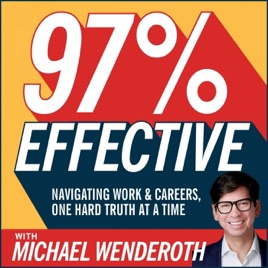
Advertise on podcast: 97% Effective
Rating
5from
This podcast has
136 episodes
Language
EnglishPublisher
Michael WenderothExplicit
No
Date created
2022/09/21
Latest episode
2026/01/28
Average duration
49 min.
Release period
15 days
Description
Learn more about Michael Wenderoth, Executive Coach: www.changwenderoth.com. 97% Effective is dedicated to helping great people get ahead at work and increase their impact – without selling their souls in the process. Season #1 focuses on Power and Influence, two widely acknowledged (but poorly understood) forces that can help you rise, lead more effectively and get big things done. Each week we have candid conversations with an academic, coach, or executive, helping you gain new insights to better navigate your work and career.
Unlock 97% Effective podcast Email contact info,
Listeners & Audience details
Email contact information
Direct podcast contact details

Listeners
Audience numbers & engagement insights

Audience details
Podcast Insights

Podcast episodes
Check latest episodes from 97% Effective podcast
EP 135 – Alexa Samaniego, Presentation Coach & Behavioral Researcher at Stanford University – You Are Performing at Work: How You’re Really Judged
2026/01/28
Learn more about Michael Wenderoth, Executive Coach: www.changwenderoth.com
“If you want the social benefits of being authentic, how you feel inside may have very little to do with it.” At work, we like to believe we’re evaluated on substance. In reality, we’re constantly being judged on how we perform— how authentic we seem, how prepared we appear, and how natural we look like in our role. In this episode of 97% Effective, host Michael Wenderoth speaks with Alexa Samaniego, Presentation Coach and Doctoral Researcher at Stanford University, about how we judge performances and performers — and why those judgments matter far more than most people realize. Drawing from behavioral research, one-on-one presentation coaching, and her background in theater and the performing arts, Alexa challenges some of the most comforting things we believe (“just be yourself,” “don’t over-rehearse,” “there’s universal best practices for presenting”) and replaces them with a more honest view of how credibility, competence, and connection are actually earned. This is not an episode about becoming fake. But it will get you thinking differently about how you show up at work if you want to better influence outcomes. You’ll leave this episode with a much more realistic understanding of how you’re really judged — and how to work with that reality, rather than against it.
SHOW NOTES
Alexa’s path from theater and the creative arts to doctoral research and presentation coachingHow her background in performance shapes the research questions she studiesWhat organizational behavior research looks like in practice: an overview of the PhD arcWhy most people under-rehearse presentations — despite clear benefits of repetitionWhy fear of “sounding fake” leads people to underperformAlexa’s two distinct definitions of authenticity: authentic to self vs. authentic to roleWhy being perceived as authentic matters more than feeling authenticSpontaneity and consistency as two key drivers of being seen as authenticHow researchers measure authenticity and test perceptions in lab and field settingsThe uncomfortable truth: social benefits depend on how you come across, not how you feelWhy we are always playing roles at work — and why separating intentions from behaviors matters“It only feels inauthentic because it’s not habitual yet”Insights from actors on how to step into a role without losing yourselfThe “outside-in” effect: how dress, voice, and physical behavior shape perceptionTradeoffs between authenticity, polish, and competence at workAlexa’s third research stream: the double-edged sword of being (and looking) preparedWhen preparation signals competence — and when it backfires as “trying too hard”Why “everything depends”: how Alexa’s coaching changed after doing her researchHow universal presentation advice can fail across gender, culture, and contextDrawing from the outside world: how Alexa’s theater background differentiates her research lensHorror films, storytelling, and what they reveal about authenticity and self-expressionAlexa’s hard truth: research is powerful, but techniques must be practiced before being used in high-stakes settings
BIO AND LINKS
Alexa Samaniego is a Presentation Coach and a doctoral researcher in Organizational Behavior (Micro) at the Stanford Graduate School of Business. Her research is inspired by her background in theatre and the performing arts, and examines how speakers and audiences judge others. Her research informs her work as a presentation coach in the Stanford Oral Communication Program and with TEDxStanford. Prior to beginning her PhD, Alexa worked as a research associate at Achievers Workforce Institute and Columbia Business School. She received her BS in Business Psychology from UC San Diego and her MS in Applied Psychology from San Diego State University. Alexa also specializes in portrait photography and creating short horror films.
Connect with Alexa
LinkedIn: https://www.linkedin.com/in/alexa-samaniego/Email: alexasam [at] stanford.eduWebsite: https://www.alexasamaniego.comStanford Profile: https://profiles.stanford.edu/alexa-samaniego
People, Ideas and Films Referenced
Erving Goffman:https://en.wikipedia.org/wiki/Erving_GoffmanYasmin Williams (double-necked guitar performance): https://www.yasminwilliamsmusic.com/media-horizonCovering, the concept (Wharton): https://tinyurl.com/353c7p8u1408, horror film: https://www.imdb.com/title/tt0450385/Erica Bailey: https://haas.berkeley.edu/faculty/erica-r-bailey/Brian Lowery: https://www.gsb.stanford.edu/faculty-research/faculty/brian-loweryBenoît Monin: https://www.gsb.stanford.edu/faculty-research/faculty/benoit-moninAlexa’s short films Too Late and 5 Weeks to Transform Your Life: https://www.alexasamaniego.com/art
More from 97% Effective
Michael’s Award-winning Book: Get Promoted: What You’re Really Missing at Work That’s Holding You Back: https://tinyurl.com/453txk74Watch this episode on YouTube: https://www.youtube.com/@97PercentEffective
Advertising Inquiries: https://redcircle.com/brands
Privacy & Opt-Out: https://redcircle.com/privacy
EP 134 – Devon McConnell, Executive Coach & Pyschotherapist: Who Has Your Back? How to Navigate Your Boss, Conflict, and Stress at Work
2026/01/14
Learn more about Michael Wenderoth, Executive Coach: www.changwenderoth.com
Who has your back at work? Do you feel like you’re constantly walking a tightrope – high up, with the spotlight on you, and no net? That’s how many people, including senior executives, describe their experience at work – and what led Devon McConnell, an executive coach and psychotherapist, to explore what drives that stress and burnout. In this episode of 97% Effective, host Michael Wenderoth speaks with Devon about her research and coaching work examining how key relationships at work – especially with our boss – shape stress, burnout, and performance. They discuss what individuals and organizations can do to better navigate conflict and pressure at work, and why stress is so often driven by relationships rather than workload. Devon explains attachment theory in clear, practical terms, shares techniques to help you manage relational conflict and regain a sense of agency, and offers a thoughtful look at how AI could improve feedback and reduce unnecessary workplace anxiety. You’ll leave this episode with a clearer understanding of what’s really driving your stress, new ways to navigate tough relationships and conflict at work —and, at a minimum, knowing that Devon and Michael will always have your back.
SHOW NOTES:
The trend Devon noticed in her executive coaching practice that led her to research stress and burnoutAttachment science: what it really says, why it matters across different spheres of life, and how it’s often oversimplifiedWhy having key figures as safe havens enables us to explore, take risks, and perform under pressureThe dependency paradox: why being able to rely on others actually increases autonomy and independenceHow attachment science helps explain why trust—especially in leaders—is so criticalWhy your personality is not fixed: how we develop attachment strategies early in life, and how new experiences can reshape themThe connection to Amy Edmondson’s work on psychological safety—and why different language (e.g., trust vs. pyschological safety) often lands better with senior executivesA leadership metaphor that resonates: the importance of being a steady pilot in turbulent conditionsHow emotional labor—not workload—is a major driver of burnout“The higher you rise, the more how you manage yourself and your relationships defines your success—and how you feel about your success”Practical tools from Devon, including:o A powerful daily question: “What conversation are you not having—and with whom?”o How to diagnose whether your boss is a primary source of your stress—and why that awareness matterso How to use the Karpman Drama Triangle to understand conflict dynamics and make small shifts to regain agencyNavigating dependency, influence, and workplace politics more effectivelyA bright spot: how AI — used thoughtfully — could improve feedback and reduce workplace stressorsWhy conflict-avoidant bosses can cause more harm than openly difficult and abusive onesDevon’s latest work developing and testing an AI-enabled 360 feedback toolHow her training in psychology and therapy has shaped her work as an executive coach
BIO AND LINKS:
Devon Forster McConnell is an executive coach and psychotherapist who works with CEOs and senior leaders on presence, influence, conflict management, and sustaining performance under pressure. She also researches, writes, and hosts the My Robot Boss podcast on the future of leadership in an AI-driven world and interventions for burnout and anxiety. Prior to coaching, Devon spent 20 years in Fortune 50 leadership roles at BlackRock and Wells Fargo Advisors. Devon is based in San Francisco, where she works with leaders and organizations globally.
Connect with Devon:
Devon on LinkedIn: https://www.linkedin.com/in/devonmcconnell/Website: https://devonmcconnell.comPodcast: My Robot Boss: https://podcasts.apple.com/us/podcast/my-robot-boss/id1831832043
Research & Frameworks Referenced:
Devon’s research presentation at the Columbia Coaching Conference (Judith E. Glaser Award finalist): https://www.youtube.com/watch?v=zOnDg1ZQ2_sAttachment theory: https://en.wikipedia.org/wiki/Attachment_theoryThe dependency paradox (randomized controlled trial): https://pubmed.ncbi.nlm.nih.gov/17279849/Psychological safety (Amy Edmondson): https://amycedmondson.com/psychological-safety/The Karpman drama triangle: https://en.wikipedia.org/wiki/Karpman_drama_triangleDr. Becky Kennedy (Good Inside): https://www.goodinside.com/about/
More from 97% Effective:
Michael’s book, Get Promoted: What You’re Really Missing at Work That’s Holding You Back:https://tinyurl.com/453txk74Watch this episode on the 97% Effective YouTube channel:https://www.youtube.com/@97PercentEffective
Advertising Inquiries: https://redcircle.com/brands
Privacy & Opt-Out: https://redcircle.com/privacy
EP 133 – Khanh-Linh Lê, Entrepreneur & Host at Forest Builders – Daring to Do: Building Impact through Courage and Power
2025/12/31
Learn more about Michael Wenderoth, Executive Coach: www.changwenderoth.com
What holds you back, but more importantly what springs you forward? In this episode of 97% Effective, host Michael Wenderoth speaks with Khanh-Linh Le, entrepreneur and host of the Forest Builders podcast. Khanh-Linh shares how she left prestigious corporate jobs in France and Vietnam to dive into the world of chocolate entrepreneurship – then later made the equally tough decision to leave that venture behind. Khanh-Linh speaks to the importance of asking what you actually want, why showing up and “daring to do” is your critical first step – and how convincing yourself, and repetition, is a key unlock to projecting confidence as an entrepreneur. You’ll leave this episode with a much deeper appreciation for the power that lies within you.
SHOW NOTES:
When Khanh-Linh’s passion awoke: “The power of the smell of chocolate to get you to feel and see things in a different way”Why do you want power?The dark side of chocolate“With time I’ll get closer”: The career shift from management consulting in France to chocolate in AsiaSerendipity and Synchronicity: The 4 AM bus ride and chance encounter with GrichaUsing coaching as an opportunity to step back and ask what you actually wantHow Khanh-Linh “dared” and took the next step“A lot of time you just need to show up”How Khanh-Linh sees power and influence as critical to entrepreneurshipCommunication insights for Entrepreneurs: Convincing yourself, repetition, projecting confidencePatience and calmness: Reflections on projecting confidence as a Vietnamese French female entrepreneurThe power of a support group: Khanh-Linh and the female entrepreurs of Saigon“Would a man censor himself?” – Khanh-Linh on how women often need to get out of their own wayMaking the choice to let goKhanh-Linh reflects on the power of podcasting to open doors, help you find inspiration – and show the world what you are intoGet started and dare to show up!
BIO AND LINKS:
Khanh-Linh Le is an entrepreneur and host of the Forest Builders Podcast. She is based in France where she supports food companies and their transition to regenerative supply chains. She previously co-founded the Cocoa Project in Vietnam and worked for McKinsey and Anheuser-Busch InBev. Khanh-Linh is from France and holds master's degrees in international management and business at HEC Paris and CEMS.
Khanh-Linh on LinkedIn: https://www.linkedin.com/in/khanhlinh-chocolate/The Forst Builders Podcast: https://open.spotify.com/show/49xSK5SlZ2xvTwLIAgSDNz?si=a4bec083e9a54305The Cocoa Project: https://www.linkedin.com/company/the-cocoa-project/The Female Entrepreneurs of Saigon: https://www.facebook.com/fesaigon/“Chocolateman: Harnessing Power to Create Sustainable Business Practices” (EP#22 with Gricha Safarian on 97% Effective): https://redcircle.com/shows/86fcd90d-083e-4af2-9bc8-6d52fb981ae1/ep/4caaa1d9-0fa2-42a4-89e1-3ef10739c889Michael’s Award-Winning book, Get Promoted: What Your Really Missing at Work That’s Holding You Back https://tinyurl.com/453txk74Watch this episode on video, the 97% Effective Youtube channel: https://www.youtube.com/@97PercentEffective
Advertising Inquiries: https://redcircle.com/brands
Privacy & Opt-Out: https://redcircle.com/privacy
EP 132 – Julia Bunyatov, Founder & Executive Coach at Sirmio Leadership – Leading Through Complexity: What Neuroscience Really Teaches Us
2025/12/17
Learn more about Michael Wenderoth, Executive Coach: www.changwenderoth.com
What does neuroscience tells us about the brain-body connection? How we can utilize that knowledge to thrive amid times of uncertainty, change and fear? In this episode of 97% Effective, Michael speaks with Julia Bunyatov, executive leadership coach and founder or Sirmio. Julie discusses her work with Wall Street executives and how she applies neuroscience insights to her coaching practice. She shares how mindfulness, curiosity and optimism are the keys to leading amid uncertainty – and to approaching the important question of how we are changing as leaders with the emergence of AI. Discussed: her latest articles, how to best eliminate the brain’s prediction errors, optimism vs toxic positivity, and what it means to thrive and “create magic.”
SHOW NOTES:
How Julia’s years on Wall Street informs her work as an executive leadership coachThe personal family experiences that led Julia to neuroscience, the science of thriving – and into coachingThe rock formation behind her company’s name, Sirmio LeadershipHow do we lead through complexity – and create outcomes that could not have been predicted beforeAddressing the soft “new age” perception of “Mindfulness, Optimism and Curiosity”Mindfulness defined: Our ability to manage our attention and focus in a desired way – and observe in a non-judgmental wayPractical ways (beyond meditation) to become more mindful so you can deepen your self-awarenessIs stress good – and if so, how much do you want?Curiosity: How it helps us engage our capacity to be creative and innovativeHow mindfulness helps us when we get triggered at workHow empathy creates more energy in the brain body system that helps usWe think our brain is reactive, but it is actually predictingThe best way to eliminate prediction error and anxiety is through experience: the example of thriving in a snowstormOne of the most important things that Coaches doOptimism vs “toxic positivity”Applying the process of mindfulness, curiosity and optimism to the emergence of AI: how do we collaborate and create something that did not exist before?AI is absolutely about creating efficiencies in the workplace, but the more important question is how are we changing as leaders?Why we need friction – and not everything should be smooth sailingHow Julia uses AI in her coaching practice and workJulia’s take on emotions: don’t suppress them, use them as a source of energy and conduit to our results
BIO AND LINKS:
Julia Bunyatov is the founder of Sirmio Leadership, which focuses on Executive Coaching & Advisory. She is a certified Executive Coach and former C-suite leader with 30 years of experience in executive leadership, board governance, and coaching. She held senior roles including COO of Global Equities Trading, COO of Global Equity Derivatives, and Americas Risk Officer at Bankers Trust, Lehman Brothers, and Barclays. Today she supports senior leaders in aligning insight with real-world leadership to drive meaningful change. In addition to other board commitments, Julia serves as Treasurer of the Columbia Coaching Conference and is a board member of the Columbia Coaching Learning Association.
Julia on LinkedIn: https://www.linkedin.com/in/julia-bunyatov-0b23001/Sirmio Leadership: https://www.sirmioleadership.comThe meaning of “Sirmio”: https://en.wikipedia.org/wiki/SirmioJulia’s article in Choice: “Thriving in Uncertainty ~ Neuroscience and applications for coaches and leader” https://choice-online.com/thriving/Julia’s article: “We Built the Machine. Now We Must Build the Mindset: How Emotion, Neuroscience, and AI Are Rewiring Leadership” https://tinyurl.com/4e7bpcm9Michael’s Award-Winning book, Get Promoted: What Your Really Missing at Work That’s Holding You Back https://tinyurl.com/453txk74Watch this episode on video, the 97% Effective Youtube channel: https://www.youtube.com/@97PercentEffective
Advertising Inquiries: https://redcircle.com/brands
Privacy & Opt-Out: https://redcircle.com/privacy
EP 131 – Mary Olson-Menzel, CEO at MVP Executive Development: Lighting the Way to Your Next Big Career Step
2025/12/03
Learn more about Michael Wenderoth, Executive Coach: www.changwenderoth.com
When it comes to taking the next big step in your career, some urge you to follow your passions – while others back a more bare-knuckled approach. But there’s a third way, says Mary Olson-Menzel, author of the bestseller “What Lights You Up.” In this episode of 97% Effective, host Michael Wenderoth and Mary talk about the key factors that lead to a fulfilling and successful career, and Mary’s 10-step pivot process that has helped thousands of her clients at MVP Executive Development. They debate passion, authenticity, networking – and discuss how to create opportunity during turbulent times. If you’re struggling with taking the next big step in your career, this episode is for you.
SHOW NOTES:
Michael was deeply skeptical about Mary and her message, so why he invited her on the showMary’s 10-step pivot program and what led her to write her book“The light is not woo-woo… it is all about what’s driving you”Mary address the critique that “following your passion is terrible advice” (Newport, Galloway, Wenderoth)The ven diagram of Ikigai that puts passion in its proper placeCore elemants that drove Mary’s career successThe role of curiosity when it comes to pivoting with purposeHow to make opportunities “fall into your lap”How to take advantage – and thrive – in chaotic timesIdentifying gaps: a practical and underused way to be helpful to others - and yourselfHow to overcome fear and stay in the driver’s seat of your careerCan sharing your passion at work lead to you being exploited (offered lower pay)?How a “personal board of directors” can help you stay on track – and not get taken advantage ofNo one has a crystal ball, which is why you need to shake the bushes: Great questions to ask, before you join a companyDealing with setbacks: Having champions, mentors – and always a Plan BMary’s take on authenticity: What it is, what it is notMary’s take on why we still get so many terrible leadersQuiet confidence: How to make sure you and your accomplishments are heard and visible, without seeming like a bombastic, self-promoting jerk?Mary and Michael discuss “threading the line”: how to embrace things that are effective, but may initially feel uncomfortableTop tips on building connection in a remote, distributed worldMary’s “Networking Power Hour”For younger professionals: Tips for networking with people 2-3 levels above youNetworking tips beyond the time consuming 1-1Success is personal and changes: How do you define it, and what lights you up?
BIO AND LINKS:
Mary Olsen-Menzel is the Founder and CEO of MVP Executive Development, and the author of the USA Today National Bestseller “What Lights You Up? Illuminate Your Path and Take the Next Big Step in Your Career.” She is a renowned expert in career and workplace success, with more than 30 years of leadership experience with global organizations across media, tech, healthcare, and sports. Mary earned her MBA from Northwestern University’s Kellogg School of Business and a Bachelor’s degree in Communications and Public Relations from Illinois State University. Mary lives in West Chester, New York, with her husband and family. She is part of Marshall Goldsmith 100 Coaches, and a regular Guest Lecturer on career development, internships, and workplace success at the NYU School of Professional Studies.
Mary on LinkedIn: https://www.linkedin.com/in/mary-olson-menzel-mvpexec/“What Lights You Up?” Mary’s bestselling book, and free workbook: www.maryolsonmenzel.comMVP Executive Development: www.mvpexec.comCal Newport’s book, So Good They Can’t Ignore You: https://calnewport.com/writing/Ikigai: https://en.wikipedia.org/wiki/IkigaiResearch at Duke: How attribution of passion may legitimize the poor treatment of workers: http://dx.doi.org/10.1037/pspi0000190Michael’s Award-Winning book, Get Promoted: What Your Really Missing at Work That’s Holding You Back https://tinyurl.com/453txk74Watch this episode on video, the 97% Effective Youtube channel: https://www.youtube.com/@97PercentEffective
Advertising Inquiries: https://redcircle.com/brands
Privacy & Opt-Out: https://redcircle.com/privacy
EP 130 – Peter Novak, Founder at Strictly Speaking Group: The Surprising Truth About Accent Bias – and How to Overcome It
2025/11/19
Learn more about Michael Wenderoth, Executive Coach: www.changwenderoth.com
Ever feel you are getting penalized at work – not getting promoted, not being listened to, not being seen as a leader – because of your accent? “Accent bias” is very real, says Peter Novak, but his prescriptions on how to overcome that bias – and elevate yourself – may surprise you. In this episode of 97% Effective, host Michael Wenderoth sits down with Peter Novak, PhD and founder of the Strictly Speaking Group. They discuss how we should think about accents – and the keys to succeeding in high stakes communications, particularly if you are a non-native English speaker. Peter challenges the usefulness of “accent reduction” training and the common advice to “not read from a script,” sharing research and cutting-edge strategies (including ones that involve AI) that have helped his clients become rising stars who embrace the power of their multilingual identities. You’ll leave this episode with the hard truths on accents and amazingly practical tips that will immediately help you ascend.
SHOW NOTES:
Peter’s interest in communication, accents and theater that drove his career and lifeInsights from Peter’s two year project translating Shakespeare’s 12th night into American Sign Language (ASL)Blunt question #1: Is “accent bias” real? Peter shares the research.What the heck does confidence in English sound like?The core of Peter’s work: How do you speak in a way that meets the expectations of what native speakers are listening for?Blunt question #2: Should I get accent reduction training? Peter’s surprising response.Brain science on what native English speakers are listening for: English as a “stress-timed language” where stressing certain words generates meaningBeyond your words and accent: understanding “prosody” or the musicality of a language to convey meaning, intention – and make your communication landPractical Tip: One of the best things you can do is to get a good microphone!“It’s not an accent, it’s an identity”The Canadian study that showed that language training that focused on “macro-linguistic factors” (variation, tone, pace) mattered more than training that focused on accentPractical Tip for fast speakers: Don’t slow down – Instead pause within the sentence around “thought clusters”How to sound confident, curious, or spontaneous: When and how to use downward, upward and sustained intonation in your communication.How to read from a text – but still sound like you are speaking off the cuffPractical Tip: Practice your speech out loud – but record it with a voice to text app – and then ask AI to generate a voice print and recommendations.Practical Tip: Scoring and the “2 1/2 inch trick” when delivering a powerful speech through virtual meetings and online video communication.Repeating words, using sustained inflection – and not being confined by the text: Peter demonstrates how to sound spontaneous when reading from a scriptPractical tip, inspired by Ginger Rogers: How to send subtle reminders at work that you are powerful and do a lot of heavy lifting.Practical tip, inspired by Laura Huang: Turn a stereotypically perceived weakness into a strengthPractical tip: Use idioms from your native language (where Peter reveals his Argentinian-accented Spanish!)Understanding how people want their communications: Ask them, ask others, use new AI toolsPractical tip for non-native speakers: Provide sign posts and structure to ensure your message landsLightning round with Peter: Who has most shaped his thinking, How communication will evolve with AI
BIO AND LINKS:
Peter Novak is the founder of Strictly Speaking Group, where he has built his reputation as a globally recognized communications coach. Since 2016, his team has coached thousands—from rising stars to Fortune 50 executives—helping global companies succeed in high-stakes communications. A top-rated LinkedIn Learning instructor, Peter’s course on clear speech for global professionals has attracted more than 250,000 learners and has been translated into six languages. He is recognized for his work with multilingual leaders and non-native English speakers, blending linguistics, cultural intelligence (CQ), and inclusive communication. Peter holds a doctorate in Dramaturgy from Yale, and is Professor Emeritus at the University of San Francisco, where he co-founded the Performing Arts & Social Justice program.
Peter on LinkedIn: https://www.linkedin.com/in/peter-novak-ssg/Strictly Speaking Group: https://www.strictlyspeakinggroup.comPeter’s LinkedIn Learning Course: https://tinyurl.com/4w98sfe6Signing Shakespeare: Peter’s translation of Twelfth Night into American Sign Language (ASL) https://tinyurl.com/5acxjmcuResearch (Lit Review) on the advantages of multilingualism: https://www.researchgate.net/publication/383948429_Literature_Review_The_Advantages_of_Multilingualism“Learners can become more intelligible or comprehensible through instruction with ‘no noticeable change in accent’ ” –controlled investigation on the effects of ESL teaching. “Evidence for a Broad Framework for Pronunciation Instruction” (Derwing, Munro & Wibe): https://onlinelibrary.wiley.com/doi/abs/10.1111/0023-8333.00047Laura Huang’s book – EDGE: Turning Adversity into Advantage https://a.co/d/1C1GXk697% Effective EP115: The Power of Being in Outsider (Prof Sven Horak): https://tinyurl.com/2y48e9jtArdjan Verdooren’s book on intercultural communication: Cultures Don’t Meet, People Do https://a.co/d/82S7j04Michael’s Award-Winning book, Get Promoted: What Your Really Missing at Work That’s Holding You Back https://tinyurl.com/453txk74Watch this episode on video, the 97% Effective Youtube channel: https://www.youtube.com/@97PercentEffective
Advertising Inquiries: https://redcircle.com/brands
Privacy & Opt-Out: https://redcircle.com/privacy
EP 129 – Nick Day, CEO at JGA Recruitment Group: AI Has Changed Job Search. Here’s How You Stand Out – and Win
2025/11/05
Learn more about Michael Wenderoth, Executive Coach: www.changwenderoth.com
There’s a huge chance you’re being passed over for top jobs – and you’re not even aware of it. How has AI changed recruiting and job search, and what does that mean for you? In this episode of 97% Effective, host Michael Wenderoth speaks with Nick Day, founder and CEO of JGA Recruitment Group, a leading global recruiter and payroll advisory based in the UK. Nick provides sharp, practical advice on how to be visible, stand out, and land your dream job in an increasingly competitive talent market, where recruiters and other job seekers are increasingly using AI. He talks about the two versions of your CV that you most need, suggests you answer problems that aren’t being advertised, and explains why visibility is the currency of credibility in today’s job market. You’ll leave this episode with a strong understanding of AI’s impact on job seekers – and a much deeper appreciation for the human touch that will get you the best results.
SHOW NOTES:
What Nick’s social post about Costa Rica this summer reveals about him – and JGA“Done Lists” and how Nick sets his intentions each dayHow fear disguises itself as wisdom: Nick’s hard truth about AI and the current job marketWhat’s the right depth and place to “jump in” learning about AIWhy great job candidates are being left in the coldTip#1: Optimize yourself for the algorithms – and produce two versions of your resume.What?! How excellent candidates with high level strategic resumes are getting rejectedTip#2: Make sure to add that personal element to your CV, because everyone’s submitting the “perfect” resumeTip#3: The 3 necessary approaches to getting your dream jobHow “easy apply” is overwhelming recruiters and ensures top candidates never get the lookTip#4: Go back to basics and cater your CV to a position – and tell a story that shows your value“Answer a problem that isn’t being advertised”Your CV/resume is the most important document you will ever writeWhy most CV/resume services are a big waste of moneyTip#5: Have an achievement section at the top of your CV – don’t wait for the recruiter to find them on page 2Michael’s highlight: How Nick’s job search tips are also best practice that help you get promoted“The important bits” that Nick says we should save for the interview (and not put on the resume)The importance of generating connectionTip#6: Treat your job as a campaign, not as a checkboxWhere Nick sees AI systems doing more harm than goodTip#7: Change your resume for the position, but also change your persona for the person that’s interviewing youHow to be creative – but not lie – in your resume, to helps you work with the algorithm, even if don’t have the exact experienceGetting over imposter syndrome to become your biggest advocateTip#8: The most underrated skill in business is storytelling“Visibility is the currency of credibility”Reaching Nick: No AI, no PA’s. Nick responds personally!
BIO AND LINKS:
Nick Day is a globally recognised HR and payroll authority with over 20 years of experience leading the sector through innovation, insight and influence. As CEO and founder of JGA Recruitment Group, Nick has built one of the most respected payroll and HR talent consultancies in the UK and abroad. Nick’s voice reaches tens of thousands of professionals through his acclaimed platforms: The Payroll Podcast, the H&R L&D Podcast, and the Mindful Paths Podcast.
Nick on LinkedIn: https://www.linkedin.com/in/nickday/?originalSubdomain=ukJGA Recruitment Group: https://jgarecruitment.comNick’s post on his daughter, in Costa Rica: https://tinyurl.com/2s3f3n7jWalk the Camino Santiago: https://en.wikipedia.org/wiki/Camino_de_Santiago“Life Moves Pretty Fast..” (The epic line, from Ferris Bueller): https://tinyurl.com/bdns8pa7Nick’s Mindful Paths Podcast: https://podcasts.apple.com/us/podcast/mindful-paths-podcast/id1682002299Done Lists: https://tinyurl.com/2s3hrdfdAs an Algorithm Blocking Your Job Search? (WSJ Podcast): https://tinyurl.com/ujy6yttnBohemiam Rhapsody Flashmob in France: https://www.youtube.com/watch?v=rfUEstWJUkAMichael on Nick’s HR L&D Podcast, “Mastering Office Politics: Power, Promotion & Playing to Win: https://www.youtube.com/watch?v=ARVsf7dFOyYMichael’s Award-Winning book, Get Promoted: What Your Really Missing at Work That’s Holding You Back https://tinyurl.com/453txk74Watch this episode on video, the 97% Effective Youtube channel: https://www.youtube.com/@97PercentEffective
Advertising Inquiries: https://redcircle.com/brands
Privacy & Opt-Out: https://redcircle.com/privacy
EP 128 – Richard Bistrong, CEO at Front-Line Anti-Bribery, LLC – Avoid the Dark Side: How to Manage Your Ethical Blind Spots
2025/10/22
Learn more about Michael Wenderoth, Executive Coach: www.changwenderoth.com
When does your influence cross the ethical line at work? What sends people to the “dark side” that causes personal pain and derails careers – and how to make sure that never happens to you? Richard Bistrong can tell you from personal experience: He went to prison for bribery. And if you think that can’t happen to you (most people don’t), or you’ve felt the pressure to cut corners to advance at work (most people do) -- then you really need this episode. Richard Bistrong, CEO of Front-Line Anti-Bribery, wants to make sure you navigate tough ethical decisions that can arise in the ambitious pursuit of your career, getting things done, or influencing others. He and host Michael Wenderoth discuss what blinded Richard and practical steps that you – and your organization – should put in place to stay out of trouble, and smartly accelerate your career.
SHOW NOTES:
Risk will sneak up on you when you think: “That would never happen to me”Why Richard was sent to prison – and what that was likeHow Richard accidentally started Front-Line Anti-Bribery LLC, to address an underserved “middle”Cheating is always a choiceThe call Richard never madeThe case of the Dutch police official: How conspiracies and bribery usually occurSunshine, chocolate and tolls vs. “commiting transnational crime”: How euphemisms and “non-terms” don’t sound so bad lead to moral fadingWhen an internal compliance officer needs to walk around with body guards – in their OWN companyAre people inherently good – or evil?If Richard could go back and make the call, how would he have done it?Not a “one and done”: Proactive outreach and what the company could have done“The voice of business”: How company’s can get over the first awkward call, by using open ended questions – and making sure those calls don’t just come from the Compliance officerTraining vs Preparation, Wall posters vs Operationalizing through Structures and Governance: What most companies missHow to identify your blind spotsAssembling “truth tellers” to manage conformity and your own confirmation bias“Ethical mistakes age like milk, not like wine”How to know when you are crossing the lineNavigating the “deep grey” when it comes to influenceRichard’s safety check: Are you becoming somebody else’s ambassador?Tips on how to assess a company’s ethics – “You can always walk out, but you don’t always have to walk in”“The lack of competing narratives” and other red flags that Richard looks forChanges in how the FCPA is being enforcedThe question Michael use to pose to his sales teamHow Richard finds foreign (non-US) countries approach business ethics differently from their US counterpartsFocus on the frozen middle in organizations
BIO AND LINKS:
Richard Bistrong is the CEO of Front-Line Anti-Bribery, a consultancy focusing on real-world anti-bribery, ethics, and compliance challenges. His expertise is in Ethics, Compliance and Ethical Decision Making Under Pressure. He hopes to share the benefits of ethical business practices by the identification of blind spots in decision making. His work has appeared in Fast Company and The Harvard Business Review. He has also been quoted in The New York Times, The Wall Street Journal, and The Financial Times. You can connect with Richard on LinkedIn and follow him on Instagram.
Richard on LinkedIn: https://www.linkedin.com/in/richardbistrong/Richard’s website: www.richardbistrong.comRichard is on Instagram at @richardbistrong (and on YouTube, X under his name; and on Facebook under Front-Line Anti-Bribery.His TED Talk: https://www.youtube.com/watch?v=PDnGVxAc7ikDorie Clark’s book Reinventing You: https://dorieclark.com/reinventingyou/Ron Carucci “How to Fix Our Trust Recesssion” (EP25 on 97% Effective): https://tinyurl.com/39cdawcpSpeak Out, Listen Up (Book by Megan Reitz and John Higgings): https://a.co/d/56zuYWxThe concept of “dangerous silence” in Amy Edmonson’s book, The Fearless Organization: https://a.co/d/08U3fDM“Why High-Performers are More Subject to Ethical Risks” (Forbes): https://tinyurl.com/5yp558vw“How to Approach Business Ethics When Global Consensus Breaks Down” (HBR article by Richard and Anna Romberg): https://hbr.org/2025/03/how-to-approach-business-ethics-as-global-consensus-breaks-downMichael’s Award-Winning book, Get Promoted: What Your Really Missing at Work That’s Holding You Back https://tinyurl.com/453txk74Watch this episode on video, 97% Effective Youtube channel: https://www.youtube.com/@97PercentEffective
Advertising Inquiries: https://redcircle.com/brands
Privacy & Opt-Out: https://redcircle.com/privacy
EP 127 – Susan Ibitz, Founder of the Human Behavior School – Face Reading: A Real Superpower — or Something Else?
2025/10/08
Learn more about Michael Wenderoth, Executive Coach: www.changwenderoth.com
** Watch to see Susan read Michael’s face, HERE: https://www.youtube.com/@97PercentEffective **
You’ll love or hate today’s guest, Susan Ibitz, who boldly says: “I’m the only person in the world who does what I do.” Dubbed “freaky” and “the top expert in her field” by the Chicago Tribune and Pyschology Today, Susan draws on physiognomy, micro-expressions, and body language – practices often accused of shaky pseudoscience -- to profile and read people. A former political influence consultant, profiler, and civilian hostage negotiator, she’s helped top law firms select high-stakes juries, coached Shark Tank’s fastest deal-closer, and advised everyone from television producers to sales reps on how to “hack” human behaviour to get results. But here’s the question: Can she really profile anyone in just 90 seconds? Is her ability a legitimate superpower … or something else? You decide. In this episode of 97% Effective, watch as she turns her methods on host Michael Wenderoth, and then listen as they discuss her background and training, the art and science of her craft, and the myths that swirl around in her field.
SHOW NOTES:
Susan profiles Michael – in 90 secondsThe breakdown: What Michael’s flat forehead, neanderthal bump eyebrows, resting face, upper eyelids, the four quadrants of his mouth, bigger ears and earlobes, hair… all say about his personalityAre facial features universal across gender, race, culture, age?A short history: how face reading got incorrectly associated with phrenology (reading the shape of the head), Mengele and the NazisStudying under Paul Ekman and the problem with microexpressionsHow face reading catapulted Susan’s careerMichael challenges Susan: What was her confidence level that she read him correctly?Top reasons why a face profiler can be wrong: Normalization, fighting the process, being too tired, and confirmation biasWhy listening to someone’s voice and tone is critical – lessons from hostage negotiationsHow Susan’s Dyslexia and Aspergers enhances her skills to read context and peopleDiagnosing vs Profiling and reading people’s tendenciesThinking in terms of percentages and propensities“Assessments are not tests”Susan is not for everyone: Are you open to change?The bad apple effectThe top things organizations don’t pay attention to: The importance of stepping away (because you can be the problem), and that people are not always in the positions they need to be (so reallocate them)A critique of “thin slicing”41 Shots and the importance of never assuming you are right 100% of the timeSusan busts 3 myths: 1) That using the number 3 means you are lying, 2) That 93% of your communication is body language, and 3) That “mirroring” will make people instantly love youThe way you say things is 30% more persuasive than anything you can do with your bodyHow to protect yourself from being persuaded – or connedCon artists play with your ego; narcissists and pyschopaths go after people who are highly intelligentWhen ego gets in the way and we become victims because we are too cockyWhen it smells, looks and tastes like poo poo, it’s _______.The guts are your first brain: you can smell fear“Always doubt”Susan on AI vs humans: her record vs Big Blue, and how AI can make you dumberHow one of Susan’s students outperformed AI to solve a murder mysteryToo many tik tok’ers, not enough plumbersLightning round: Susan’s biggest influences; Favorite Sci-fi movie; Her drink of choice
BIO AND LINKS:
Susan Ibitz is a former political influence consultant, profiler, and civilian hostage negotiator, with expertise, study and degrees in Human Behavior, Behavioral Economics, Neuroscience – with a deep nerd-like love for data. From physiognomy to micro-expression and body language, she incorporates numerous forms of studying human behavior to “hack” each person’s personality traits. She uses that skill and experience to “works on the humans that grow your business,” offering her expertise to television producers to sales trainers to the FBI, to now the general public. Past engagements have included work with the U.S. Navy, Harvard University, and the Secret Service.
Watch Susan read Michael’s face -- on the 97% Effective video channel, here: https://www.youtube.com/@97PercentEffectiveSusan Ibitz Behavior Consulting: SusanIbitz.comSusan on LinkedIn: https://www.linkedin.com/in/susan-ibitz/ENOUGH PLEASE! Susan’s article: ‘93% of communication is driven by body language’ is NOT what Mehrabian said: https://tinyurl.com/356sjkwwPaul Ekman and the study of emotions and their relation to facial expressions: https://en.wikipedia.org/wiki/Paul_EkmanReprint of profile of Susan in the Chicago Tribune: https://tinyurl.com/4aj65fbt“How to make questions to get the answers you need”: https://tinyurl.com/ywxwctfkThin-slicing, featured in Blink (Malcolm Gladwell): https://tinyurl.com/2ws268aa41 shots: https://en.wikipedia.org/wiki/American_Skin_(41_Shots)Book by Gavin De Becker - The Gift of Fear: https://a.co/d/b6jvWVmMichael’s Award-Winning book, Get Promoted: What You’re Really Missing at Work That’s Holding You Back https://tinyurl.com/453txk74
Advertising Inquiries: https://redcircle.com/brands
Privacy & Opt-Out: https://redcircle.com/privacy
EP 126 – Rich Braden & Tessa Forshaw, Authors of Innovation-ish: Stuck? How Anyone Can Create Breakthrough Solutions
2025/09/24
** Watch our engaging discussion on video, HERE: https://www.youtube.com/@97PercentEffective **
Learn more about Michael Wenderoth, Executive Coach: www.changwenderoth.com
Feeling stuck with a challenge at work, or in advancing your career? In this episode of 97% Effective, we discuss proven, effective ways to creatively solve problems, innovate – and advance. Host Michael Wenderoth interviews Rich Braden and Dr. Tessa Forshaw, authors of Innovation-ish: How Anyone Can Create Breakthrough Solutions to Real Problems in the Real World. They discuss why your mindset is more important than process, why to aim for “roof-shots” instead of moonshots, and how their book helps ordinary people overcome “innovation hesitation.” By the end of this episode, you’ll not only want to read their book – you’ll leave with a better understanding of the science of how we learn, powerful mental reframes, and practical tips to get unstuck. Rich, a design strategist and the CEO of People Rocket, and Tessa, a cognitive scientist and co-founder of the Next Level Lab at Harvard, have served as design educators for years at Stanford and Harvard, and have helped leading companies and non-profits creatively solve their most vexing challenges to unlock growth.
SHOW NOTES:
Why Rich and Tessa wrote their book – and chose the word “Innovation-ish”The problem with a “process focus” to innovation“If you’ve ever been to Costco..” (Tessa explains Mindset)How mindsets translate into “Moves”Forward movement in action: The science of why your moves need to be bite-sizedKids vs adults: How adults can tap into their vast experiences to become more creativeMichael’s observations comparing coaching to Rich and Tessa’s work“Explore before Explain” - Why and how Tessa and Rich flipped how they teachTessa on “Learning needs to be effortful”Rich explains “Innovation is not hard. But it is hard work”You’ve got moves inside that are Innovation-ish: How one student used “family system mapping” from her therapist training in powerful new waysYou’ve got insights that will help you navigate power & politics: How Michael’s clients apply their own skillsRoofshots over MoonshotsFramestorming: Are we even looking at the right problem?“Solutions are baked into the frame of the problem” – Tina SeeligTessa’s hard truth: “You can’t stop your biases, but you can set up structures and processes to counteract them”Tessa explains in plain (Aussie) English the $5 word “metacognition”: Thinking about Thinking vs RecountingWhy wore Michael wore airplane cufflinks for this interviewLightning round: Can AI replace human creativity; Biggest influence; Their “go to” technique to get themselves unstuck; Tips on how to make sure your teenage kids stay creative
BIO AND LINKS:
Dr Tessa Forshaw and Rich Braden are the authors of Innovation-ish: How Anyone Can Create Breakthrough Solutions to Real Problems in the Real World. Rich is a design strategist and CEO of People Rocket, based in Silicon Valley. Tessa Forshaw, PhD, is a cognitive scientist and co-founder of the Next Level Lab at Harvard University. Both have served as design educators for years at Stanford and Harvard, worked for leading innovation consultances including IDEO and Accenture, and in their private consulting have helped leading companies and non-profits including Coke, Airbnb and the Native American Community Clinic in Minnesota, USA. Their mission is to help everday people untap their creative potential – and become more confident, and innovation-ish.
Watch our engaging interview on video: https://www.youtube.com/@97PercentEffectiveInnovation-ish the Book: https://www.innovationish.comRich Braden on Linkedin: https://www.linkedin.com/in/richardcoxbraden/Tessa Forshaw on LinkedIn: https://www.linkedin.com/in/tessaforshaw/People Rocket: https://www.peoplerocket.com“Exploration before Explanation” explained: https://tinyurl.com/5xuwcc8p“Think Roof Shot, Not Moonshot” (an interview with Tessa in Harvard’s Graduate School of Education): https://tinyurl.com/hszp2zvaHow What Got You Here WILL GET YOU THERE (the power of “tapping your past”) - EP #83 on 97% Effective: https://tinyurl.com/2d6np2kuRich’s reference to an interview with Axel Ohrstrom on 97% EFFECTIVE (EP #91: How to Start Your Career Off Right”): https://tinyurl.com/5bweydfh“You’re not even looking at the problem” – most memorable movie moment with Brad Pitt in Moneyball [4 min watch]: https://www.youtube.com/watch?v=krZVcOMTR98The amazing Prof Tina Seelig: https://profiles.stanford.edu/tina-seeligTessa’s a-ha moment: Reading Prof. Roy Pea’s paper on distributed intelligence and designs for education: https://telearn.hal.science/hal-00190571/documentRich’s a-ha moment: BATS Improv https://www.improv.orgMichael’s a-ha moment: Reading Six Thinking Hats by Edward de Bono (and yes, he lives on!): https://a.co/d/f5qAgxIHow Constraints Move us Forward -- and stimulate creativity (Forbes): https://tinyurl.com/ywap8fzmAntoinette Portis’s delightful book for all of us (not just kids), Not a Box: https://www.antoinetteportis.com/not-a-box/Michael’s Multi-Award-Winning book, Get Promoted: What You’re Really Missing at Work That’s Holding You Back https://tinyurl.com/453txk74
Advertising Inquiries: https://redcircle.com/brands
Privacy & Opt-Out: https://redcircle.com/privacy
Best of 97% Effective - Giselle Timmerman, Founder of Positive Work: How to Create More Positive and Powerful Organizations
2025/09/10
Enjoy your summer with this “BEST OF 97% EFFECTIVE” EPISODE! Tune in this fall for new episodes and more great content.
Learn more about Michael Wenderoth, Executive Coach: www.changwenderoth.com
SHOW NOTES:
Giselle Timmerman, founder of Positive Work, was one of the first 30 people in the world to study with Professor Martin Seligman, the founder of positive psychology at the University of Pennsylvania. In this episode, Giselle shares how she applies the science to help leaders and organizations unleash the power of their teams and reach new heights.
The visual metaphor of Los CastellersPositional and personal powerHow research on subjective well-being led to Giselle’s leapCore tenets of positive psychologyHow positive psychology gets misinterpreted and misappliedThe Happiness Advantage (Department of Defense study)Audit your well-being to determine where to take action: Using Seligman’s framework on flourishing, PERMAHow much influence can we have on our own well-being at work?“I’m doing all the right things but not getting promoted” – Two areas you might really be missing.Example of trying new tactics to achieve your goalPositive manipulationExpanding how we think about our strengthsHow to manage our weaknesses (one of which may be your strength)Setting tripwires, and becoming more self-aware“The bridge of your nose”: How to find your positive blindspots“Micro-moments”Why we have so many screwed-up organizationsWhat Europeans may be more attuned to at work compared to AmericansResearch on “Positive energizers”The Power of Inquiry to be more influential: 3 underused practices
BIO AND LINKS:
Giselle Timmerman is the Founder of Positive Work. For the past 17 years, she has been partnering with clients, from founders to Fortune 500 teams, to build stronger leadership and team cultures for greater engagement and competitive performance. She holds a Bachelor's from NYU and a Master's in Applied Positive Psychology (MAPP) from the University of Pennsylvania.
Giselle on Linkedin: https://www.linkedin.com/in/giselletimmerman/?originalSubdomain=esPositive Work: https://www.positivework.com/Castell tradition: https://en.wikipedia.org/wiki/CastellEd Diener’s research: The Science of Subjective Well-BeingMichael’s HBR article: Great Leaders Embrace Office PoliticsScott Donaldson’s Meta-analysis: The Effectiveness of Positive Psychology InterventionsMIT Sloan: Department of Defense Happiness studyMartin Seligman’s framework: PERMAStudy from Emotion Journal: Awe walks promote prosocial positive emotions in older adultsStephen Covey’s theory: Emotional Bank AccountUniversity of Michigan: Center for Positive OrganizationsKim Cameron’s book: Positively Energizing LeadershipRob Cross research: What Creates Energy in Organizations?Zoe Chance’s article: The Secret To Influence: Ask The Magic QuestionMichael’s Award-winning Book, Get Promoted: https://a.co/d/2oRmqF4
Advertising Inquiries: https://redcircle.com/brands
Privacy & Opt-Out: https://redcircle.com/privacy
Best of 97% Effective - Peter Belmi, Professor at University of Virginia: Social Class & Our Beliefs – How they affect our Path to Power
2025/08/27
Enjoy your summer with this “BEST OF 97% EFFECTIVE” EPISODE! Tune in this fall for new episodes and more great content.
Learn more about Michael Wenderoth, Executive Coach: www.changwenderoth.com
SHOW NOTES:
Peter Belmi, Professor at the Darden School of Business at University of Virginia, studies power, social class and inequality. We discussed how the beliefs we hold about ourselves – many formed by our class background – can perpetuate social inequality. We look at how the world and organizations are not a fair place, but where we the power to do something about that.
SHOW NOTES
Embrace new things: Peter on Filipino food and HamiltonPeter’s research in one sentence and why he focuses on inequalityHow your social class can shape what you view as a “good person” – and how that impacts what you will and won’t do in organizationsThe conundrum: Why people from working class backgrounds may make better leaders – but often don’t get into those positionsThe reframe: how re-thinking behaviors that feel “icky” can benefit usMillion $ question: So… how should I show up at my meeting next week?Before you seek power, you need to first ask this critical question!Think about power in a different way to “keep yourself in the game”Ends vs means, and how to ensure you don’t get lost in the journeyDoes power corrupt?The value of “structured introspection” with a coachThe biggest barrier people have with power“Give yourself a shot” – agency, when you should opt outLeading with vulnerability without having it get used against you - “Being situationally appropriate” and “Powering up and powering down”Do we have a real self? Why U.S students often push back on the idea of “playing roles”How one student “created something out of nothing” to land the job she wanted (power skills in action)Personal qualities, positioning yourself strategically and relationship managementHow to Get Promoted: “Your job is to find the right people and get them excited about you.”How a controversial fashion blogger will piss you off – but can teach you about crafting a path to power (Peter’s Bryanboy case study)Meta-lesson: How being judgmental causes us to stop learning – and holds us back from building power
BIO AND SHOW LINKS:
Peter Belmi is the Scott C. Beardsley Associate Professor of Business Administration at the Darden School of Business. His scholarship on the psychology of inequality has received numerous awards, and he was named one of the "30 emerging thinkers with the potential to make lasting contributions to management theory and practice" (Thinkers50). In 2018, Peter was named by Poets & Quants as one of the "40 Best Business Professors Under 40" and received the University of Virginia's Mead-Colley Award, a distinction given to the professor who embodies the Jeffersonian vision of an ideal teacher. Peter's work is published in leading psychology and management journals, and also been featured by The New York Times, The Wall Street Journal, and across the popular press.
Email: BelmiP [at] darden.virginia.eduPeter’s profile: https://www.darden.virginia.edu/faculty-research/directory/peter-belmiPeter’s research on social class and confidence: https://pubmed.ncbi.nlm.nih.gov/31107052/Cited research: Kraus, Cote & Keltner on Social Class and Empathic Accuracy https://journals.sagepub.com/doi/abs/10.1177/0956797610387613Peter and Melissa Thomas-Hunt’s exercise “Leading with Vulnerability” http://store.darden.virginia.edu/leading-with-vulnerabilityDeb Gruenfeld: “Power up, Power down” https://www.youtube.com/watch?v=-skBaZ9o5vgPeter’s Bryanboy case study: https://papers.ssrn.com/sol3/papers.cfm?abstract_id=2974849Michael’s Award-winning Book, Get Promoted: https://a.co/d/2oRmqF4
Advertising Inquiries: https://redcircle.com/brands
Privacy & Opt-Out: https://redcircle.com/privacy
Best of 97% Effective - Chris Fenning, Award-winning Author: How to Start Conversations That Get Results
2025/08/13
Enjoy your summer with this “BEST OF 97% EFFECTIVE” EPISODE! Tune in this fall for new episodes and more great content.
Learn more about Michael Wenderoth, Executive Coach: www.changwenderoth.com
SHOW NOTES:
Chris Fenning is a highly-sought after trainer and the award winning author of The First Minute: How to Start Conversations That Get Results. We walk through before-after examples, showing how to structure your business communication for maximum impact. The hard truth is that poor communication is one of the top reasons people don't get promoted.
Concise communication matters, but what most training courses fail to doWhy Chris left a fantastic career to help people with business communicationFactoid: Chris did this feat at 17…Chris critiques -- and improves –Michael’s 15 second introWhy the first minute is key.Before vs after example: Context-Intent-Key Message framework in actionHow to build the concise communication habitDon’t bury the lede!Tips when sending emails and meeting invitesBeing Concise vs Being BluntUsing “GPS” in your first minute, with an example that boils 20 minutes into 3 linesOvercoming “the curse of knowledge”More tips on how to quickly make the framework a habitHow things differ cross-culturallyWill these techniques reverse poor first impressions you may have already created?3 ways you can tell boss they are a bad communicator … without getting in hot water
BIO AND LINKS:
Chris Fenning is on a mission to help Technical and Business teams communicate clearly and remove the pain they experience so often. His 4x award winning book, The First Minute, shows you the HOW to be concise, step by step, drawing from 20,000 conversations, decades of work leading technical and business teams across the world, and training individuals and teams from start-ups to Fortune 50 companies.
Linkedin: https://www.linkedin.com/in/chris-fenning/Chris’s Website & His Book www.chrisfenning.comChris’s Best Giveaway (Free First Minute Workbook, $30 value): https://chrisfenning.com/get-the-first-minute-workbook-free/Erin Myer’s Book, The Culture Map: https://erinmeyer.com/books/the-culture-map/Michael’s Award-winning Book, Get Promoted: https://a.co/d/2oRmqF4
Advertising Inquiries: https://redcircle.com/brands
Privacy & Opt-Out: https://redcircle.com/privacy
EP 122 - Beena Kavalam, Executive Coach: Got Gravitas? How to Grade and Grow Yours
2025/07/30
Learn more about Michael Wenderoth, Executive Coach: www.changwenderoth.com
**EPISODE best watched on the 97% Effective YouTube channel: https://www.youtube.com/@97PercentEffective **
Ever been told you need to develop your “gravitas,” and then given no explanation of what that means -- or how you improve it? In this episode of 97% Effective, host Michael Wenderoth interviews Beena Kavalam, executive coach, founder of Gravitas360 Consulting and “Indian Jersey girl.” They discuss what gravitas is, how it differs from executive presence, and offer practical techniques that will help you own the room and elevate how you are seen at work. Beena offers specific tips for women and people of color, and how to increase your gravitas in virtual environments. Start this episode by taking Beena’s “Grade your Gravitas” self-assessment, then listen (and watch!) their wide-ranging conversation – and you’ll put yourself on the path to dramatically grow your gravitas.
SHOW NOTES:
Beena’s backstory: Why she focuses on gravitas and her mission to change one million livesGrade your Gravitas with Beena’s self-assessment (link below)What is gravitas, why it’s important and Beena’s 4 C’s of gravitasHow Gravitas differs from Executive PresenceOne size does not fit all: Examples of diverse leaders with gravitasThe two biggest myths people have when it comes gravitasThinking in terms of “the gravitas gradient” and dialing it up or downGetting practical: key steps to improving your gravitasWays to shift from negative to positive self talk, but still leads you to “put in the work”Using the 4-7-8 technique to calm yourself and increase your emotional steadiness3 Practical Techniques: The “power of the pause,” bottom lining and focusing on 2-3 supporting pointsPractice! And how to talk to yourself to reinforce positive neural pathwaysSpeaking on the fly and navigating “impromptu” situations when you are put on the spotPowerful tips on building gravitas in virtual environments: Camera on, leaning in, standing up and Beena the bio major geeks out on “ventral fronting”Michael recommends you find 2-3 people you know how can assess you with Beena’s “Grade your Gravitas” toolWhat’s different for women and people of color when it comes to gravitas: “Don't shrink – be direct, but add empathy”“Indian Jersey Girl” explained
BIO AND LINKS:
Beena Kavalam is an executive coach and leadership consultant who helps high-performing leaders grow their gravitas, strengthen their executive presence, and lead with influence in today’s complex business environments. As the founder of Gravitas360 Consulting, she has coached hundreds of leaders across Fortune 500 companies, emerging startups, and mission-driven organizations. Her work focuses on helping leaders become visible, credible, and impactful — without compromising who they are.
Watch this episode on video: https://www.youtube.com/@97PercentEffectiveBeena’s “Grade your Gravitas” self-assessment: https://gravitas360consulting.kit.com/gravitasquizBeena on LinkedIn: https://www.linkedin.com/in/beenakavalam/Beena’s Youtube channel: https://www.youtube.com/c/BeenaKavalamBeena’s website: www.gravitas360.comPositive Intelligence: https://www.positiveintelligence.comWhen “positive self-talk” works – and when It doesn’t! Summary of the research by Professor Don Moore @ Haas School of Business EP#38 “How to Be Perfectly Confident” on 97% Effective: https://podcasts.apple.com/us/podcast/97-effective/id1646325886?i=1000615107188“The Power of Improv to Elevate your Communication, Clarity and Connection” EP#118 with Kesinee Yip & Kevin Weinstein on 97% Effective https://tinyurl.com/59z9f46kResearch: Why having your camera on signals engagement and increases how others see you as a leader: https://tinyurl.com/yc3k3c5mPIE: What you’re Missing (Peformance Image and Exposure explained, with examples) – EP#64 on 97% Effective: https://tinyurl.com/yvbmnewaMichael’s Award-Winning book, Get Promoted: What Your Really Missing at Work That’s Holding You Back https://tinyurl.com/453txk74
Advertising Inquiries: https://redcircle.com/brands
Privacy & Opt-Out: https://redcircle.com/privacy
EP 121 – Ed Batista, Executive Coach: How “Touchy Feely” Impacts Your Power & Influence
2025/07/16
Learn more about Michael Wenderoth, Executive Coach: www.changwenderoth.com
Ed Batista spent fifteen years as Lecturer and Leadership Coach at Stanford Business School, working in and teaching the highly popular course there, Interpersonal Dynamics – also known as “Touchy Feely.” In this episode of 97% Effective, host Michael Wenderoth talks with Ed about the influence that course had on Ed’s coaching – and how course “T-groups” are a powerful laboratory to explore influence. They discuss why needers need to build emotional regulation and how many people confuse force and power – and confuse empathy with needing to be nice. By the end of this episode, you’ll have a deeper understanding of core concepts in touchy feely – and why that doesn’t imply you need to adopt a “touchy feely” leadership style.
SHOW NOTES:
How the Stanford course Interpersonal Dynamics (aka “Touchy Feely”) has influenced EdA short history on Interpersonal dynamics (Kurt Lewin and “T-groups”)A source of power is developing close and connected relationships with peopleMagical black box, artificial setting, or great laboratory for exploring interpersonal communication, influence and power? Michael and Ed debate T-groupsThe benefit of structured reflectionEd is not advocating a “touch feely” leadership style – but he does stress the importance of emotional regulationAre you willing to understand and explore your feelings?Confusing force and powerConfusing empathy with being nice (or with not holding people accountable)The need to understand what another person is feelingMichael and Ed discuss empathy vs perspective taking – is the difference a nuance, and does that matter?EdBot (the large language model built on Ed’s blog) and Swiss watchesHow should coaches take advantage of AI tools, what differentiates human coaches?A man and his dog.. the common connection: Buster (Great Pyrenees mix) is to Ed what and Manchas (Spanish Mastin mix) is to Michael…
BIO AND LINKS:
Ed Batista has been an executive coach since 2006, working with senior leaders who are facing a challenge or would like to be more effective or fulfilled in their roles. He also spent 15 years as a Lecturer and Leadership Coach at the Stanford Graduate School of Business. Most of Ed’s clients are technology company CEOs, but he works with leaders in fields from investing to healthcare. Issues he addresses with clients include managing relationships with key employees, improving leadership team dynamics, transitioning from technical expert to leader, evolving company culture, and better self-care. Ed’s work as a coach began after a 15-year career in management, during which he took two years off to earn an MBA at Stanford and helped launch three new organizations. He writes about coaching and related issues at www.edbatista.com. Ed is married to Amy Wright, and they lived in San Francisco from 1990 to 2020, when they relocated to a farm 40 miles north of the city. In addition to his MBA, Ed earned a BA in History, magna cum laude, from Brown University.
Previous episode with Ed and Michael EP120: Power Struggles Among Nice People: https://redcircle.com/shows/86fcd90d-083e-4af2-9bc8-6d52fb981ae1Ed’s website and blog: https://www.edbatista.com/about.htmlKurt Lewin and T-groups: https://www.edbatista.com/2018/06/a-brief-history-of-t-groups.htmlProf Jeffrey Pfeffer at Stanford: https://jeffreypfeffer.comForce isn’t Power: https://www.edbatista.com/2021/03/force-isnt-power.htmlTry out EdBot: https://www.edbatista.com/2025/04/ask-me-anything-anytime-the-ed-bot-20.html8000 Coaching Sessions Reflection: https://www.edbatista.com/2024/05/8000-coaching-sessions.html9000 Hours (Evolution of a Practice): https://www.edbatista.com/2025/03/9000-coaching-sessions-the-evolution-of-a-practice.html97% Effective, Now on video, here: https://www.youtube.com/@97PercentEffectiveMichael’s Award-Winning book, Get Promoted: What Your Really Missing at Work That’s Holding You Back https://tinyurl.com/453txk74
Advertising Inquiries: https://redcircle.com/brands
Privacy & Opt-Out: https://redcircle.com/privacy
Podcast reviews
Read 97% Effective podcast reviews
Rawalamit 2022/11/03
Get furious and curious
Are you an ambitious professional who strives to get to the pinnacle of his/her career. Then, this is for you. Re-examine your relationship with power...
Podcast sponsorship advertising
Start advertising on 97% Effective relevant audience podcasts
You may also like to advertise on these Podcasts

4.4371061566
The Megyn Kelly Show
SiriusXM
4.888901269
Fearless with Jason Whitlock
Blaze Podcast Network
4.8118931000
Mind Pump: Raw Fitness Truth
Sal Di Stefano, Adam Schafer, Justin Andrews, Doug Egge
4.8102131585
Tara Brach
Tara Brach

4.541561215
Something You Should Know
Mike Carruthers | OmniCast Media

4.513841343
Strictly Anonymous Confessions
Kathy Kay

4.8292781897
Fantasy Footballers - Fantasy Football Podcast
Fantasy Football

4.62382612
Football Weekly
The Guardian

4.45387666
Two Judgey Girls
Two Judgey Girls

3.8258501152
The Viall Files
Nick Viall