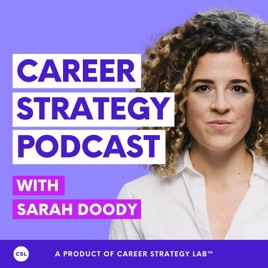
Advertise on podcast: Career Strategy Podcast with Sarah Doody | UX, Product Design, UX Research
Rating
5from
This podcast has
204 episodes
Language
EnglishPublisher
Sarah Doody from Career Strategy LabExplicit
No
Date created
2023/03/10
Latest episode
2026/10/12
Average duration
26 min.
Release period
7 days
Description
Welcome to the Career Strategy Podcast, with Sarah Doody, a UX Researcher & Product Designer with 22 years of experience who is helping UX and Product people design their careers. You’ll learn how to advance your UX or Product career including how get hired in UX, stay hired, get promoted, and build a personal brand and visibility. You’ll also hear no BS tips to optimize your UX resume and portfolio, navigate your UX job search, and prepare for UX job interviews so you can stop being invisible and be seen as an in-demand UX professional. Get ready to UX your career, ironic, right?!
Unlock Career Strategy Podcast with Sarah Doody | UX, Product Design, UX Research podcast Email contact info,
Listeners & Audience details
Email contact information
Direct podcast contact details

Listeners
Audience numbers & engagement insights

Audience details
Podcast Insights

Podcast episodes
Check latest episodes from Career Strategy Podcast with Sarah Doody | UX, Product Design, UX Research podcast
196: What a Shopify design recruiter looks for in a senior UX portfolio
2026/10/12
A senior UX portfolio gets read differently than a junior one, and most people never find out how until they're already in the rejection pile. Jared Tredly has spent around 15 years in recruitment, most recently as a design recruiter at Shopify, where he was hiring for roughly 30 open design roles at the time of this conversation. Before that, he worked agency side, where a single role could pull in 700 applicants a week.
He's blunt about what actually happens to a UX portfolio once it lands in front of someone like him. At Shopify he sees 50 to 100 new applications come in on a given day, and he says UX recruiters broadly can see anywhere from a hundred to a thousand portfolios on a busy stretch. He'll often look at the work before he even opens the resume, because for UX design roles the portfolio carries more weight than it does in almost any other hiring process. He describes reviewing one like peeling back the layers of an onion.
This episode gets into what actually earns a second look at that volume. Where seniority shows up in a case study and where it doesn't. Why he thinks ATS systems are mostly useless for screening portfolios, and what he actually uses them for instead. Why "impact" metrics carry less weight than most candidates assume, and what he listens for instead.
If you've ever wondered what happens to your application after you hit submit, or why a UX portfolio that took you weeks to build didn't get a response, this is a rare look from the other side of the desk.
Topics Discussed
✅ Why a UX design portfolio carries more weight in hiring than it does for almost any other role, and why that makes it the first thing reviewed, not the resume
✅ How many UX portfolios get looked at in a single day at a company like Shopify, and what that volume means for how quickly a decision gets made
✅ Why ATS systems are mostly unreliable for screening portfolio quality, and what they're actually useful for in the UX hiring process
✅ What causes an instant "hook" or an instant bounce in the first few seconds of a UX portfolio review
✅ Why inconsistency between a resume, UX portfolio, and LinkedIn profile raises suspicion instead of just looking sloppy
✅ What separates a senior level UX case study from a mid level one, including project complexity, recency, and evidence of influence over simple execution
✅ Why cramming a UX case study with slides or over explaining a process can actually work against a candidate
✅ Why raw impact numbers matter less than being able to explain why a UX design decision was made and what it actually changed
✅ Whether portfolio format (website, deck, or PDF) matters, and what actually causes friction for a reviewer regardless of format
Links & Resources
🔗 Connect with Jared Tredly on LinkedIn
🔗 Explore open design roles at Shopify
🎯 How I can help with your UX job search
📋 Get my UX case study template
👋 Follow me, on LinkedIn, Instagram, & YouTube
195: UX Hiring Insights: Steve Durgin, From Candidate to Hiring Manager, on Trust & Networking
2026/10/05
UX hiring decisions are less scientific than most job seekers assume. Steve Durgin found that out firsthand, first as a candidate, now as the one doing the hiring.
Steve is the founder of affinityUX, a research led innovation and product studio that helps companies find friction in their products and build experiences people actually care about, using methods like jobs to be done and outcome driven innovation.
Steve came from a background in social work and human services, went through Career Strategy Lab to make his pivot into UX, got hired, and eventually built his own agency. He's since hired six CSL alumni himself, so this conversation covers hiring from both sides of the table, not just theory.
Steve used to think hiring was a logical process based on qualifications. Now he describes it as a psychological decision to trust someone under uncertainty and time pressure.
The conversation walks through what that actually looks like in practice: why a single clear, non-cringe pitch beat out a stack of cold applications, why posting inside a community instead of a public job board changes everything about speed and quality, and what he's actually trying to learn in a 30 minute screening call that never shows up in a resume.
It closes with a practical framework for turning any conversation into more opportunities, plus a portfolio structure Steve says makes the difference between getting skimmed and getting remembered.
Topics Discussed
✅ Why hiring is more of a psychological trust decision than the logical, checklist based process Steve assumed before he started hiring himself
✅ The exact type of pitch that got a candidate a same-day response, and what made it different from every cold pitch Steve normally gets
✅ Why posting inside a community instead of a public job board can cut time to hire dramatically, and what that means for where you should be spending your energy
✅ The specific question Steve asks every candidate to surface things that never show up in a resume or portfolio
✅ A real example of a candidate whose most valuable skill only became obvious once Steve actually talked to her, not from anything on paper
✅ What Steve looks for that goes beyond hard skills, from comfort with ambiguity to the ability to connect a task back to the business outcome it serves
✅ How to structure a portfolio case study into three slides so it survives someone with almost no time to look at it
✅ Steve's three part framework for turning a single conversation into new opportunities: asking for favors, offering favors, and proactively expanding your network
Links & Resources
🔗 Join the affinityUX Contractor Pool
This 10-15 minute form allows you to join affinityUX's pool of contractors. If they land a project that seems like a great fit for you, they will reach out!
🔗 Listen to Steve's earlier interview on the Career Strategy Podcast
🔗 Connect with Steve on LinkedIn
🔗 Book: Traction by Gino Wickman
🎯 How I can help with your UX job search
📋 Get my UX case study template
👋 Follow me, on LinkedIn, Instagram, & YouTube
194: UX Hiring Insights: Marc Aquino, Senior Product Design Manager at Deel
2026/09/28
UX design burnout doesn't come from working too many hours. That's one of Marc Aquino's hot takes in this episode, and once it sits with you, it's hard to keep blaming the hours.
Marc is senior product design manager at Deel, a global HR and payroll platform helping companies hire and pay employees and contractors in over 150 countries. He's spent 15 years in the industry, seven of them building and scaling design teams across startups, scale-ups, and global companies.
His take started with a LinkedIn post responding to a Nielsen Norman Group article on psychological ownership, research originally from Lynn Van Dyne and John Pierce. Burnout builds from a cycle. You get excited about a UX project. You pour research and effort into it. Then stakeholders get involved, and it gets scoped down or reshaped until it barely resembles what you built. Repeat that for months, years, and it wears you down more than the hours ever could.
Marc talks through how he tries to protect his own team from that cycle, including a framework for pitching big ideas without getting shut down, and a line from his LinkedIn post that stuck with Sarah: the UX designers who last the longest hold the shipped thing loosely and their own judgment tightly.
Then the conversation shifts into hiring. What Marc actually wants to see when a UX project never launched. Why team metrics tell him more than individual ones ever could. What happens when a candidate claims credit for a huge revenue number all on their own. Deel gets an enormous volume of applications, and Marc is candid about how little time he actually gets to review each one.
Topics Discussed
✅ Why UX design burnout might have less to do with hours worked and more to do with losing authority over something you feel deep ownership over
✅ The repeating cycle that quietly wears UX designers down over months and years, and why fast-paced companies make it worse
✅ A framework for pitching big, ambitious ideas at work without getting shut down before you even present them
✅ Why you should include projects that never launched in your UX portfolio, and what to talk about instead of the outcome
✅ Why leading with a huge dollar figure or revenue percentage in an UX interview can backfire, and what to say instead
✅ Why team metrics tell a UX hiring manager more about a candidate than an individual one ever could
✅ What actually happens to your application in the days after you hit submit at a company receiving millions of applications a year
✅ Two team rituals that help a UX design team avoid burnout and stay aligned every month
Links & Resources
🔗 Connect with Marc on LinkedIn
🔗 Marc's LinkedIn post responding to the Nielsen Norman Group article on psychological ownership
🔗 Learn more about Deel
🔗 Kotter's Eight Steps to Change Management
🔗 Sarah's earlier episode with Steph McDonald, UX recruiter at HubSpot
🔗 10% Happier by Dan Harris
🎯 How I can help with your UX job search
📋 Get my UX case study template
👋 Follow me, on LinkedIn, Instagram, & YouTube
193: Should your UX portfolio approach change based on your role or seniority?
2026/09/21
UX portfolio approaches based on seniority or role. That question lands in Sarah Doody's inbox nearly every day. Does the approach actually need to change? This episode answers a real question from a listener targeting director level UX roles, wondering if the portfolio frameworks taught inside Career Strategy Lab only apply to individual contributors.
The process for building a strong UX portfolio doesn't change based on your job title. That's the real answer buried in a question Sarah gets constantly, usually from people convinced their situation is the exception.
This time it came from a listener targeting director level UX roles, wondering if the frameworks taught inside Career Strategy Lab only apply to individual contributors. Sarah's answer: no.
Three reasons why. A portfolio's job stays the same no matter your title or years of experience. UX recruiters and hiring managers are always answering the same core questions. The way a portfolio gets consumed doesn't change either. A role gets 500 applications in 48 hours.
Every portfolio gets skimmed and scanned, not read word for word. And what makes a portfolio good is consistent across roles too. Answer the so what behind your decisions. Not just what you did.
Gamified, operating system style portfolios are trending on LinkedIn right now. Sarah explains why they create friction instead of clarity for a recruiter trying to move fast. Then there's what-ifing. Hunting for UX portfolio advice specific to your exact job title, years of experience, or city. That search doesn't exist, and it's costing you time you don't have.
If your job title or seniority level has you wondering whether you need a different UX portfolio strategy, this episode settles it.
Topics Discussed
✅ Why the three questions UX recruiters and hiring managers are actually trying to answer never change, no matter your job title
✅ How the "jobs to be done" framework applies to your UX portfolio, and what your portfolio's actual job is
✅ What happens when a UX role gets 500 applications in 48 hours, and how that changes what your portfolio needs to survive
✅ Why talking only about what you did is the most common UX portfolio mistake, and what answering the "so what" actually looks like in a case study
✅ Why operating system style UX portfolios are trending on LinkedIn right now, and why they're probably working against you
✅ The real cost of constantly asking "what if" about your specific UX job title, years of experience, or city instead of just building your portfolio
✅ What went wrong with an early UX portfolio back in 2006, and what fixing it actually looked like
Links & Resources
🔗 Episode 155, Sarah's interview with Patrick Neeman, Director of UX and AI Experiences at Workday
🔗 Episode 173, Sarah's interview with Jeni Bible, UX Manager at Home Depot
🔗 Episode 172, Sarah's interview with Alexander Zeh, Head of Product Design at ManyChat
🔗 Episode 192, Sarah's interview with Sylvain Maretto, Director of Design at Ecosia
🔗 Episode 161, Sarah's interview with Jared Tredly, Design Recruiter at Shopify
🔗 Episode 188, UX Portfolio Myth: Your UX Portfolio Does Not Need To Be A Website (Myth 2/5)
🎯 How I can help with your UX job search
📋 Get my UX case study template
👋 Follow me, on LinkedIn, Instagram, & YouTube
192: UX Hiring Insights: Sylvain Maretto, Director of Design, on Why AI Hasn't Taken Over Hiring and What He Looks for in UX Portfolios
2026/09/14
UX hiring managers are looking for three things right now, and UX isn't specifically one of them. Not exactly reassuring if you've spent years polishing your process pages. That's the reality Sylvain Maretto lays out in this episode, and it's coming from someone actually reviewing applications, not theorizing about them.
At the time of this recording, Sylvain was the director of design at Ecosia, the search engine that funds tree planting with its profits. He's spent 15 years building and leading design teams across Berlin, Tokyo, and beyond, with stops at Omio (joined when it was 25 people), Zalando, Tour Radar, and GetYourGuide. He also helped seal the acquisition of Holoplot, the audio technology behind the sound system inside the Vegas Sphere.
He joined Sarah after leaving a comment on a LinkedIn post arguing portfolios need to be more experimental. He disagreed, and what follows is his actual answer: a triangle of AI fluency, UI craft, and business acumen. UX gets treated as a given, not a differentiator.
From there, Sylvain walks through what happens inside an applicant tracking system when 500 people apply for one role. Why the AI built into most of those tools produces noise instead of signal. What a job description is actually telling you, if you read it twice. And how to talk about results when a project got canceled before it ever shipped.
If you've ever wondered what's actually happening on the other side of your application, this is that answer.
Topics Discussed
✅ The three things Sylvain actually screens for when he opens a portfolio, and UX isn't one of them
✅ What happens to your application the second it lands in an ATS, and why you're one of 500 people applying for the same slot
✅ Why the AI built into most hiring software is, in Sylvain's own words, mostly noise
✅ The STAR framework he wants every case study to follow, and why your "action" section is probably too long
✅ What to say about a project that got canceled or never shipped, when you still need to show results
✅ How reading a job description twice instead of once changes what you should actually be highlighting
✅ Whether hiring managers expect different things by country, or if it's really just about company stage
✅ Why Sylvain thinks a narrow, specific niche beats trying to check every box on a job post
✅ The values-based signal he built into his own hiring process at Ecosia that most candidates don't see coming
Links & Resources
🔗 Connect with Sylvain on LinkedIn
🔗 Learn more about Ecosia
🔗 Sarah's book: The Product of You
🔗 Ioana Teleanu's LinkedIn post that started this conversation
🎯 How I can help with your UX job search
📋 Get my UX case study template
👋 Follow me, on LinkedIn, Instagram, & YouTube
191: UX Portfolio Myth: Your personality is not what UX recruiters want in your portfolio (Myth 5 / 5)
2026/09/07
Adding personality to your UX portfolio is one of the most repeated pieces of advice in the industry, and Sarah closes out her five part portfolio myth series by explaining why it's actually working against you. Personality and passion don't get you the interview. Proof does. That's the whole myth this episode takes apart.
Sarah argues that trying to inject personality into a portfolio usually competes with the actual content instead of supporting it. A font chosen to feel "personal" can make a case study harder to read. Extra design elements, background flourishes, or animation pull attention away from the work itself, and animation in particular can even make some viewers physically ill. A personal logo shrunk down to fit a slide often becomes illegible. None of it proves you can do the job you're applying for, which is the one thing recruiters and hiring managers are actually scanning for.
She backs this up with a line from Steph McDonald, lead recruiter at HubSpot focused on UX design roles, who compares a well edited portfolio to a fashion designer who puts on all her jewelry, then takes a few pieces off before walking out the door. The move isn't to avoid adding things you care about, it's going back afterward and cutting what isn't earning its place. Sarah's takeaway is direct, less personality, more evidence that you've done what the job description is asking for.
This episode also wraps the full five part series. Sarah runs through a fast recap of all five myths, from project count to portfolio websites to showing failed work, and asks listeners who followed along to share whether it changed how they think about their own portfolio.
Topics Discussed✅ Why personality and passion don't get you an interview, and what actually does
✅ How trying to show personality through fonts, animation, or design flourishes can work against your portfolio instead of for it
✅ Why a personal logo in your portfolio often backfires once it's shrunk down to a smaller size
✅ What Steph McDonald, lead recruiter at HubSpot focused on UX design roles, said about editing a portfolio before you hit send
✅ Why Sarah says the goal is proof over personality, and what that actually looks like in practice
✅ A full recap of all five UX portfolio myths covered across the series
✅ Where to learn more about Career Strategy Lab if your portfolio has been stuck in redesign mode for months
Links & Resources🔗 Episode 168 of the Career Strategy Podcast, Sarah's full interview with Steph McDonald
🔗 Episode 187, Myth 1 of 5, on why you don't need three to five projects in your portfolio
🔗 Episode 188, Myth 2 of 5, on why your portfolio doesn't need to be a website
🔗 Episode 189, Myth 3 of 5, on why your case studies don't need to show the full UX process
🔗 Episode 190, Myth 4 of 5, on why you can show projects that didn't launch
🎯 How I can help with your UX job search
📋 Get my UX case study template
👋 Follow me, on LinkedIn, Instagram, & YouTube
190: UX Portfolio Myth: You can't show projects that didn't launch (Myth 4 / 5)
2026/08/31
UX portfolio projects that didn't launch or didn't go as planned are exactly the kind of work recruiters and hiring managers want to see, not the kind you should hide.
This is week four of a five part series on UX portfolio myths, and this episode tackles the belief that a canceled, pivoted, or unsuccessful project doesn't belong in your portfolio.
Sarah pushes back on this directly. Smart hiring managers understand that things go wrong in real UX work all the time, and a project that didn't launch says nothing about whether you're a good researcher or designer.
In fact, she argues that a messy or canceled project is one of the best opportunities to show how you adapt, collaborate, and think under real constraints, exactly the soft skills recruiters are trying to evaluate.
She walks through common scenarios people worry about, like research getting cut entirely or not being able to run usability testing, and gives specific ways to handle each one in a portfolio.
Rather than hiding the gap, she suggests explaining what happened, what you did instead, and what you would do differently with a do-over, which turns a limitation into a chance to show your thinking.
She backs this up with a clip from her interview with Jeni Bible, a UX Manager at Home Depot and a Career Strategy Lab alum who is now hiring herself. Jeni's take is simple, projects get canceled constantly, and what she actually wants to hear is what you did, what you learned, and how you collaborated along the way.
If you've been sitting on a portfolio project you assumed was too messy or unfinished to include, this episode makes the case for why it might be exactly what you need.
Topics Discussed
✅ Why a project that didn't launch doesn't signal that you're a bad researcher or designer
✅ How to handle a portfolio project where research got cut or skipped entirely
✅ What to include if you never got to run usability testing on something you worked on
✅ The "do-over" framing Sarah recommends for showing what research or testing you would have done in hindsight
✅ What Jeni Bible, a UX Manager at Home Depot and Career Strategy Lab alum, said she actually wants to hear about canceled projects
✅ Why a canceled or pivoted project can be one of the strongest ways to show adaptability and collaboration
✅ A preview of the fifth and final myth in the series, coming next week
Links & Resources
🔗 Episode 173 of the Career Strategy Podcast, Sarah's full interview with Jeni Bible on hiring and portfolios
🔗 Episode 187, Myth 1 of 5, on why you don't need three to five projects in your portfolio
🔗 Episode 188, Myth 2 of 5, on why your portfolio doesn't need to be a website
🔗 Episode 189, Myth 3 of 5, on why your case studies don't need to show the full UX process
🎯 How I can help with your UX job search
📋 Get my UX case study template
👋 Follow me, on LinkedIn, Instagram, & YouTube
189: UX Portfolio Myth: Your case studies don't need to show the full UX process (Myth 3 / 5)
2026/08/24
UX portfolio case studies don't need to walk through every single step of your process, and trying to do that is actually working against you. This is week three of a five part series on UX portfolio myths, and this episode tackles a big one, the belief that every case study needs to show the whole end to end process for a project.
Sarah argues the opposite works better. Going deep into just one or two parts of a project beats trying to cram in everything you did, especially for projects that spanned six months, a year, or longer. Trying to show it all just skims the surface of everything and overwhelms the person reviewing it, which is the opposite of what you want.
She backs this up with a clip from her interview with Alexander Zeh, former Head of Product Design at ManyChat, who said he's specifically listening for problem solving language, phrases like "I facilitated," "I unblocked," "I synthesized," because those signal maturity in how a candidate thinks, not just what they produced.
The bulk of the episode is a screen share walkthrough where Sarah rebuilds a weak case study slide by slide, showing exactly what it looks like to go from a shallow "next, I made some wireframes" slide into one that explains the problem, the decision, the reasoning, and the impact. If your case studies currently read like a list of what you did, this episode shows you exactly what to change and why.
Topics Discussed✅ Why cramming your entire UX process into one case study actually works against you
✅ What Alexander Zeh, former Head of Product Design at ManyChat, said he's actually listening for in a portfolio walkthrough
✅ A live screen share breakdown showing the difference between a shallow case study slide and one that goes deep
✅ Why "next, I made some wireframes" is what Sarah calls a five alarm fire in a portfolio
✅ How to handle a case study for a project that spanned six months, a year, or longer without trying to cram in everything
✅ What questions your case study should actually be answering, beyond just what you did
✅ Why you might choose to highlight different parts of the same long project depending on the specific role you're applying for
Links & Resources🔗 Episode 172 of the Career Strategy Podcast, the full interview with Alexander Zeh, former Head of Product Design at ManyChat
🔗 Episode 187, Myth 1 of 5, on why you don't need three to five projects in your portfolio
🔗 Episode 188, Myth 2 of 5, on why your portfolio doesn't need to be a website
🎯 How I can help with your UX job search
📋 Get my UX case study template
👋 Follow me, on LinkedIn, Instagram, & YouTube
188: UX Portfolio Myth: Your UX portfolio does not need to be a website (Myth 2 / 5)
2026/08/17
UX portfolio websites eat up months, sometimes years, of time that could be spent applying, and Sarah argues you don't need one at all. This is week two of a five part series on UX portfolio myths, and this episode takes on one of the most repeated pieces of advice in the industry, that your portfolio has to be a website.
Sarah's counter is a portfolio presentation instead. It's free, doesn't require learning new software, takes weeks instead of months, and can be duplicated and tailored for each specific role in under an hour. She walks through a full comparison of time, cost, customization, and what she calls interview readiness, the idea that a presentation portfolio doubles as the exact thing you'll need to present in interviews anyway, so you're never scrambling to build something new once you land one.
She backs this up with two hiring manager perspectives. Patrick Neeman, Director of UX and AI Experiences at Workday, told her he prefers presentations because that's the format his own team works in day to day. Steph McDonald, a lead recruiter at HubSpot focused on hiring UX designers, said presentations are completely fine as long as the craft level is polished. Sarah also shares Marcus's story, who got hired as a Lead Product Designer at NAVA after building his portfolio as a presentation instead of a website.
If you've been stuck for months trying to wrangle a website builder instead of actually working on your portfolio content, this episode is a direct permission slip to stop, and a breakdown of exactly what to do instead.
Topics Discussed✅ Why a portfolio website can actually hurt your first impression with recruiters and hiring managers instead of helping it
✅ The alternative Sarah recommends instead of a website, and why it takes weeks instead of months to finish
✅ A full breakdown of time, cost, customization, and interview readiness for a website versus a presentation
✅ What Patrick Neeman, Director of UX and AI Experiences at Workday, said he actually prefers to see in a portfolio
✅ What Steph McDonald, a lead recruiter at HubSpot, said about presentation portfolios and craft level
✅ How Marcus got hired as a Lead Product Designer at NAVA using a portfolio presentation instead of a website
✅ Why "link to portfolio" on a job application doesn't actually mean your portfolio has to be a website
✅ The exact question to ask anyone who insists you need a portfolio website, and why most people can't answer it
Links & Resources🔗 Episode 155 of the Career Strategy Podcast, Sarah's full interview with Patrick Neeman on portfolio presentations versus websites
🔗 Episode 168 of the Career Strategy Podcast, Sarah's interview with Steph McDonald on what recruiters want to see in a portfolio
🔗 Marcus's episode, sharing how he built his portfolio presentation and got hired at NAVA
🔗 Last week's episode, Myth 1 of 5, on why you don't need three to five projects in your portfolio
🎯 How I can help with your UX job search
📋 Get my UX case study template
👋 Follow me, on LinkedIn, Instagram, & YouTube
187: UX Portfolio Myth: You don't need 3 - 5 projects in your UX portfolio (Myth 1 / 5)
2026/08/10
UX portfolio advice is full of numbers that sound official but aren't backed by anything. This episode kicks off a five part series on UX portfolio myths, starting with the most common one: that you need three to five projects before you can apply.
Sarah says the opposite is true. One strong, detailed project beats five surface level ones every time. She backs this up from an interview she did with Alexander Zeh, former Head of Product Design at ManyChat, who said he'd rather see one or two case studies that map directly to the job description than five that walk through every step of the design process without any real depth.
The episode shares two specific examples. Laura got hired as a Principal Product Designer in cybersecurity with a single, unfinished feeling project still sitting in Figma slides, and was actually found and reached out to on LinkedIn before she even applied. Leon, laid off after 11 years at the same company and an author of a book on wire-framing, got hired after focusing on just one project instead of trying to rebuild an entire portfolio from scratch.
If you've been stalling on applying because you don't have "enough" projects yet, this episode is a direct challenge to that belief, and a reason to ask where that number actually came from in the first place.
Topics Discussed✅ Why the three to five project rule is a myth with no real backing, and where it likely came from
✅ Why one detailed project beats five surface level ones, and what "confuse and lose" means for a UX portfolio
✅ What a former Head of Product Design at ManyChat said he actually wants to see in a portfolio
✅ How Laura got hired as a Principal Product Designer with one unfinished project, and was found on LinkedIn without ever applying
✅ How Leon got hired after being laid off from an 11 year role, focusing on just one project instead of rebuilding his whole portfolio
✅ Why working on your portfolio alone can make you more critical of it than recruiters and hiring managers actually are
✅ The question to ask yourself if you believe you need three to five projects, and where to trace that belief back to
✅ What Sarah says to look for in UX job descriptions instead of following a generic project count
Links & Resources🔗 Episode 172 of the Career Strategy Podcast, the full interview with Alexander Zeh, former Head of Product Design at ManyChat
🔗 Laura's episode, sharing in her own words how she got hired with one project in her portfolio
🔗 Leon's book on wireframing for UX
🎯 How I can help with your UX job search
📋 Get my UX case study template
👋 Follow me, on LinkedIn, Instagram, & YouTube
186: Why Positioning Is The Most Underrated Skill in the AI Era of UX
2026/08/03
Positioning is quietly becoming the skill that separates people who stand out in UX and product from people who get left behind, especially now that AI can build almost anything in seconds.
In this episode, Sarah makes the case for why the ability to build fast is no longer the advantage it used to be, and why knowing what's worth building, and framing it well, matters more than ever.
Sarah traces this back to a belief she used to hold herself, that good work speaks for itself. It doesn't. She shares how she avoided a required public speaking class in college, only to realize later that the real skill was never about sounding polished or the delivery.
It was about the thinking that happens before you say a single word, or type a single sentence, or design a single sales page.
She also shares a recent story from her own business, where a team she hired to build an AI tool ignored the detailed context she gave them and rushed straight into building, producing a prototype that missed the mark entirely. She ended up building it herself, faster, because she had the clarity they skipped in the process.
That story becomes the jumping off point for two ideas Sarah argues will define who stands out in UX and product going forward, knowing what's worth building, and framing the work so people actually say yes to it.
If you've ever felt invisible in a meeting, passed over for a promotion, or like your UX job search ideas keep getting ignored, this episode reframes that feeling as a positioning problem rather than a skills problem, and gives a concrete way to start fixing it this week.
Topics Discussed
✅ Why "good work speaks for itself" is a myth that's quietly keeping talented people invisible
✅ The real reason some ideas get funded, approved, or hired for in UX, and it's rarely because they were the best idea
✅ A story about hiring a team to build an AI tool, and what happened when they skipped the thinking and rushed straight to building
✅ Why knowing what's worth building is about to matter more than how fast you can build it
✅ A real example of a stakeholder update that got buried, and the exact rewrite that would have gotten a faster yes
✅ Why leading with the "so what" instead of the "what" changes how quickly people respond to your ideas
✅ How the same positioning skill applies just as much to your UX job search, your portfolio, and a promotion conversation as it does to a pitch
✅ A simple challenge to try this week on your next email, Slack message, or update
Links & Resources🔗 Future Product Days in Copenhagen, September 22 to 24, where Sarah is giving a talk and workshop on positioning
🎯 How I can help with your UX job search
📋 Get my UX case study template
👋 Follow me, on LinkedIn, Instagram, & YouTube
185: The one thing you can't DIY in your UX job search
2026/07/27
DIYing your UX job search feels productive right up until you realize you've been doing it for six months, twelve months, or longer with nothing to show for it. If you've been telling yourself you're one tip away from finally landing interviews, this episode is worth sitting with.
The core question Sarah asks is simple and a little uncomfortable: if you gave yourself three more months on your ux job search, your portfolio, or your resume, what would actually be different? Because more time doesn't automatically mean better results. More applications don't automatically mean more interviews. If you can't answer what you'd change, you're just planning to spend more hours doing the same thing that hasn't worked yet.
Sarah backs this up with research from her own program, Career Strategy Lab. After analyzing over 1,700 responses from people who didn't join, the two most common reasons were not feeling ready, or wanting to keep trying the DIY approach first. But when she surveyed people after they did join, a pattern showed up just as clearly: regret over not joining sooner, and months lost to portfolios or ux job searches that stayed stuck.
The episode also gets specific about the one thing Sarah says is genuinely hard to DIY, which isn't your resume or your portfolio. It's relationships and proximity to people who are actually hiring. She shares two real examples, Marcus and Heather, both laid off, both stuck after months of solo applying, and both hired only after they stopped going it alone.
Topics Discussed✅ Why simply giving your job search "three more months" rarely changes your outcome unless your strategy actually changes
✅ The specific question to ask yourself before committing to another few months of DIYing your portfolio or resume
✅ What over 1,700 survey responses revealed about why job seekers hesitate to get outside help, and what those same people said after they finally did
✅ The popular portfolio myth about needing three to five projects before you can apply, and why it can quietly cost you months
✅ How one person got hired with only one project in her portfolio, and was found on LinkedIn without even applying
✅ Why relationships and proximity to people hiring are the hardest thing to build alone, no matter how much networking you do on LinkedIn
✅ How a referral from someone he knew got Marcus hired as a user researcher after six months of rejections and ghosting
✅ How one person's post about her manager hiring a contractor turned into a job for someone else, which then led to five more people getting hired at that same company
✅ Why being part of a smaller, closer network can make you more visible than posting into the endless scroll of LinkedIn
Links & Resources🔗 Episode 122 of the Career Strategy Podcast, Marcus's full story in his own words
🎯 How I can help with your UX job search
📋 Get my UX case study template
👋 Follow me, on LinkedIn, Instagram, & YouTube
184: Natalie got hired for a Director level UX role (and now she's the one hiring for UX roles)
2026/07/20
Landing a Director level UX role doesn't happen by accident, and neither does becoming the person on the other side of the hiring table a few months later.
Natalie Kurz did both. She spent six months on a UX job search after a layoff, landed a Director of Experience Design and Content role at NextGen Health, and within months found herself reviewing over 600 applications for her own open positions.
Natalie spent 25 years in UX, most recently as a people manager, before being laid off last May. She joined Career Strategy Lab during that UX job search, and the shift she describes isn't really about tactics.
She stopped using the "spray and pray" method long enough to get clear on what she actually wanted in her next UX role. She let her LinkedIn profile, UX network, and a background she almost left off her resume, do some of the work for her.
What makes this episode different is that Natalie is now the one hiring for UX roles.
A few months into her new position, she's already brought on multiple UX designers, including someone from Career Strategy Lab. Natalie now experiences the exact hiring process she was on the other side of not long ago.
So this conversation moves between her UX job search story and what she now looks for as a UX hiring manager, which gives listeners a rare before-and-after view of the same process.
If you're currently employed in a UX role and feel like your resume, portfolio, or LinkedIn presence isn't ready to go if an opportunity showed up tomorrow, this episode is worth sitting with.
Topics Discussed
✅ How a recruiter found Natalie and reached out about a completely unrelated UX role, purely because of how her LinkedIn profile came across
✅ Why she eventually stopped applying to every job with "UX" in the title, and what she focused on instead
✅ How a cold, polite message to a lead UX designer on a team she wanted to join turned into a warm handoff before she ever talked to a recruiter
✅ The background she almost left off her resume entirely, and why it ended up being a key reason she got hired
✅ What it was actually like reviewing over 600 UX applications as a hiring manager, and what made a resume or portfolio stand out in the first three to five seconds
✅ The line she now tells every UX applicant about generic resume bullet points, and why it matters more than people think
✅ Why she doesn't see contract roles, career gaps, or career changes as red flags in a UX resume, even now that she's the one hiring
✅ How she uses AI to check her own UX hiring decisions for bias, rather than to write applications
✅ Why she believes she'd be far more prepared for her next UX job search than she was for her last one, and what she does now to stay that way
Links & Resources
🔗 Episode 180 with Eric - UX Hiring Insights: Eric Shumake on Healthcare UX, Specializing, & Thinking of Your Career as Gigs
🔗 Natalie Kurz on LinkedIn
🎯 How I can help with your UX job search
📋 Get my UX case study template
👋 Follow me, on LinkedIn, Instagram, & YouTube
183: 3 Things I’d Do If I Was Laid Off From a UX Role Today
2026/07/13
Just laid off from a UX role? If you’re tempted to open LinkedIn and easy-apply to every role with UX in the job title, don't do it!
In this episode of the Career Strategy Podcast, Sarah Doody breaks down what she would NOT do after a UX layoff (e.g. play the numbers game) and the 3 things she’d prioritize instead.
You’ll walk away with a clear order of operations: get specific about the UX role you want, get visible where hiring actually happens, and start showing up for the work you want to be hired for.
🎯 In this episode we discuss:
- Why easy-applying to every “UX” job backfires after a layoff
- How to get ruthlessly specific about the UX role you actually want
- Auditing past jobs and naming your “superpowers” (and why to ask others)
- Where UX recruiters and hiring managers actually hang out
- The LinkedIn order of operations: headline first, then everything else
- Why turning on Open to Work is a signal, not desperation
- What to post on LinkedIn so your profile gets found, without becoming a “thought leader”
Timestamps00:00 Intro
01:30 Why I wouldn’t play the numbers game in my UX job search
02:50 Step 1 — Get specific about the UX role you want
07:37 Step 2 — Increase your visibility
13:23 Step 3 — Post about what you want to be hired for
16:17 Putting it all together
17:44 UX Layoff checklist + final word
🎯 How I can help with your UX job search
📋 Get my UX case study template
👋 Follow me, on LinkedIn, Instagram, & YouTube
182: 6 ways you'll get hired in UX faster with Career Strategy Lab (the tour you've been asking for)
2026/07/06
This episode is a full walkthrough of how you'll get hired in UX faster with Career Strategy Lab and exactly what happens after you join. Sarah shares what genuinely helps UX people in their job search, after coaching UX and Product people since 2017 and running Career Strategy Lab since 2021.
What You’ll Learn in This Episode:
✔️ The six things that help UX and product people get hired faster
✔️ What your first 30 days inside CSL look like
✔️ Why positioning comes before your LinkedIn and resume
✔️ How the portfolio, case study, and critique process works
✔️ How monthly recruiter Q&As and the 850-alumni referral network help you get hired
Topics Discussed:
✅ The 6 things Sarah has found consistently help UX people get hired faster
✅ How the first 30 days inside Career Strategy Lab are structured and why every step is intentionally sequenced to build on the last
✅ What a Compass Statement is and why it comes before everything else in your UX job search prep
✅ How getting clear on your positioning makes fixing your resume and LinkedIn significantly faster
✅ How the weekly critique system works and why submitting imperfect work early beats waiting until everything feels ready
✅ The monthly recruiter and hiring manager Q&A sessions: who shows up, what you get to ask, and why this is one of the most underrated parts of the program
✅ How Career Strategy Lab's 850-person alumni network functions as a UX-specific job referral network and how members are actively using it to get hired
✅ The open to work area, interview debriefs, and hired recaps and why watching other people get hired in real time is some of the most useful intel you can get in a job search
🎯 How I can help with your UX job search
📋 Get my UX case study template
👋 Follow me, on LinkedIn, Instagram, & YouTube
Podcast reviews
Read Career Strategy Podcast with Sarah Doody | UX, Product Design, UX Research podcast reviews
yosoytino 2026/02/09
Clear, practical strategy that works
This is one of my favorite podcasts and in my constant listening rotation. The Career Strategy Podcast delivers sharp, actionable guidance for navigat...
FlwrPwr22 2025/03/16
Excellent!
I don’t know how this podcast only has 35 reviews b/c it is excellent! Sarah provides practical tips and powerful insights to UX designers, no matter ...
A recent graduate 2024/08/21
Super Helpful!
I recently started listening to this podcast and found it so helpful! I look forward to implementing the advice during my job search.
From the Lumi girls 2024/07/23
Useful tips
Insightful tips on how to make your application stand out!
Tianac c 2024/03/28
Great content.
Super insightful content about UX.
Kkaineg 2024/01/14
Tangible and actionable advice
As a career switcher, I love the advice and strategies to help my career journey. The podcast helps me re-think and re-work my resume, profile, and po...
SF_bluesky 2024/01/04
Lots of career (and life) takeaways
The sense of perspective and useful strategies that Sarah shares are why I look forward to each new episode. The podcast consistently provides encoura...
wsbmws 2023/11/14
Excellent
Sarah Doody provides insightful, actionable strategies to give yourself a leg up in your job search and career growth. Thank you Sarah!!
pookie123456 2023/09/26
Excellent tips for job hunting In UX
This podcast is engaging and super informative. As a career switcher, I found it was very helpful and applicable as I have many years of experience in...
Amabli 2023/09/05
Great UX Career Information
You’ll want to listen to these again and again depending on where you are in your job search or career strategy!
Podcast sponsorship advertising
Start advertising on Career Strategy Podcast with Sarah Doody | UX, Product Design, UX Research relevant audience podcasts
You may also like to advertise on these Podcasts
4.8224751791
The Andrew Klavan Show
The Daily Wire

4.858201918
Sara Gonzales Unfiltered
Blaze Podcast Network

4.942031993
Chente Ydrach
Chente Ydrach

4.7106592000
FantasyPros - Fantasy Football Podcast
iHeartPodcasts
4.7278232000
The Matt Walsh Show
The Daily Wire

4.922672003
First15 Devotional
First15
4.827601703
Earn Your Happy
Lori Harder | YAP Media

4.8104512000
Steve Deace Show
Blaze Podcast Network

4.861421104
The David Pakman Show
David Pakman

4.853532000
Men In Blazers
Men In Blazers