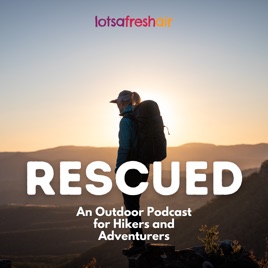
Advertise on podcast: Rescued: An Outdoor Podcast for Hikers and Adventurers
Rating
5from
This podcast has
20 episodes
Language
EnglishPublisher
Caro RyanExplicit
No
Date created
2023/04/06
Latest episode
2025/12/09
Average duration
54 min.
Release period
58 days
Description
'Rescued' is a podcast of conversations with the rescued and rescuers. It's about the lessons we learn about ourselves, the places we go to and why. It exists to help us have better adventures and experiences, manage risk and deal with the unexpected.
Unlock Rescued: An Outdoor Podcast for Hikers and Adventurers podcast Email contact info,
Listeners & Audience details
Email contact information
Direct podcast contact details

Listeners
Audience numbers & engagement insights

Audience details
Podcast Insights

Podcast episodes
Check latest episodes from Rescued: An Outdoor Podcast for Hikers and Adventurers podcast
019 // Bram's pelvis opens like a book (part 2)
2025/12/09
LISTEN to part 1 first
ENTER to win a $50 Paddy Pallin voucher + Nalgene bottle
The things we love to do in nature can lead us to explore and discover places not just close to home, but to some very remote and uncharted places around the world.
In this special double episode of Rescued, we hear from 3 friends, all highly skilled and experienced canyoners, as they find themselves in the embrace of Taiwan’s small and dedicated canyoning and rescue community, after a life-threatening fall during a multiday expedition.
If you ever needed a reminder of the value of regular, high-quality wilderness first aid training and the importance of being able to rely on the people you adventure with - this is it.
This isn't a straightforward pack n’ send case of helicopter, paramedics and hospital. Their reliance on each other, their skills and a solid sense of humour is put to the test throughout this 2 day ordeal.
Key learnings from this episode:
The importance of having the right skills, training and experience for the environments The ability to make fair self-assessments of the above Planning is key to better outcomes Research multiple contingency plans, if your exit from a canyon doesn’t work, are there alternatives you can see on satellite imagery? Plan refuge and camp spots Being able to rely completely on your adventure buddies if something goes wrong. Q: Can you say this about strangers you connect with on MeetUps or similar?) Value of research, local knowledge and connections Huge thanks to the incredible and supportive local canyoning community of Taiwan Being smart about choosing your emergency contacts and setting up a What’sApp group - briefing them all properly with plans, contingencies and giving them permission to act as your advocates if something happens The essential recert and muscle memory of quality wilderness first aid training Benefits of choosing to study Wilderness or RAFA over simple Senior First Aid Brainstorm and practice of roping and rescue problems at home and in easier environments before being confident to execute them in challenging ones Good open, inclusive and frank communication in and around a patient How humour can help with stressful situations Everyone knowing their job and getting it done How party size can change outcomes in an incident Importance of essential survival skills eg: fire making, knowing priorities for survival Stove, lighters and Nalgenes as essential canyon equipment Making sure your first aid kit is up-to-date (when was the last time you made sure you had enough panadol and ibuprofen?) Bright clothes, bothy bag, emergency blankets to draw attention Knowing how to prepare for helicopters and downwash Aussie registered PLBs activated overseas are received by AMSA in CanberraThere's a bunch of different ways you could help support the work of this pod:
Leave a review on your platform of choice Leave a donation towards the costs Visit my sponsors at Paddypallin.com.au Buy my book - "How to Navigate - the art of traditional map and compass navigation in an Australian context." Check out my Navigation Courses
018 // Bram's pelvis opens like a book in a remote Taiwan canyon
2025/11/11
The things we love to do in nature can lead us to explore and discover places not just close to home, but to some very remote and uncharted places around the world.
These activities, like bushwalking/hiking, climbing or canyoning, give us opportunities to step outside the typical tourist or visitor experience, not only opening our eyes to cultures different to our own, but on a deeper level, the chance to connect with the local outdoor community through our shared love of wild places.
In this special double episode of Rescued, we hear from 3 friends, all highly skilled and experienced canyoners, as they find themselves in the embrace of Taiwan’s small and dedicated canyoning and rescue community, after a life-threatening fall during a multiday expedition.
If you ever needed a reminder of the value of regular, high-quality wilderness first aid training and the importance of being able to rely on the people you adventure with - this is it.
This isn't a straightforward pack n’ send case of helicopter, paramedics and hospital. Their reliance on each other, their skills and a solid sense of humour is put to the test throughout this 2 day ordeal.
Key learnings from this episode:
The importance of having the right skills, training and experience for the environments The ability to make fair self-assessments of the above Planning is key to better outcomes Research multiple contingency plans, if your exit from a canyon doesn’t work, are there alternatives you can see on satellite imagery? Plan refuge and camp spots Being able to rely completely on your adventure buddies if something goes wrong. Q: Can you say this about strangers you connect with on MeetUps or similar?) Value of research, local knowledge and connections Huge thanks to the incredible and supportive local canyoning community of Taiwan Being smart about choosing your emergency contacts and setting up a What’sApp group - briefing them all properly with plans, contingencies and giving them permission to act as your advocates if something happens The essential recert and muscle memory of quality wilderness first aid training Benefits of choosing to study Wilderness or RAFA over simple Senior First Aid Brainstorm and practice of roping and rescue problems at home and in easier environments before being confident to execute them in challenging ones Good open, inclusive and frank communication in and around a patient How humour can help with stressful situations Everyone knowing their job and getting it done How party size can change outcomes in an incident Importance of essential survival skills eg: fire making, knowing priorities for survival Stove, lighters and Nalgenes as essential canyon equipment Making sure your first aid kit is up-to-date (when was the last time you made sure you had enough panadol and ibuprofen?) Bright clothes, bothy bag, emergency blankets to draw attention Knowing how to prepare for helicopters and downwash Aussie registered PLBs activated overseas are received by AMSA in CanberraThere's a bunch of different ways you could help support the work of this pod:
Leave a review on your platform of choice Leave a donation towards the costs Visit my sponsors at Paddypallin.com.au Buy my book - "How to Navigate - the art of traditional map and compass navigation in an Australian context." Check out my Navigation Courses
017 // Make good decisions with Hugh Ward - Heuristics
2025/07/23
How many decisions do you reckon you’ve made today?
It's probably the conscious ones that come to mind. Do I wear the red shirt or blue top? 1 coffee or 6.
Believe it or not, The Harvard Business Review states that adults can make around 35,000 decisions each day and many of those happen automatically and simultaneously.
When we head out into the wild places we love, or find ourselves in environments with a higher level of risk, some of these decisions (conscious or otherwise) can have some pretty intense consequences.
Today, I’m joined by Hugh Ward, co-owner of the Blue Mountains Climbing School, to learn about an easy tool that we can use every day, to help us make better decisions, smarter choices and have better adventures.
He talks us through the established acronym F.A.C.E.T.S, developed by Ian Mcammon, based upon the work of Daniel Kahneman and Amos Tsversky. It was designed to highlight common deficiencies in our decision making (Heuristic Traps) and to offer a tool to temper the choices we make in high consequence environments.
Excitingly, he then steps us through a NEW acronym, A.C.C.E.S.S. that he has developed with Climbing School co-owner and wife, Bridie Campbell, that works better with Australian outdoor environments. You can read more and DOWNLOAD their handy pocket guide here.
Resources
Article on the Climbing School blog
016 // Macca is broken in a big wall fall
2025/05/15
It was the ABC News that first alerted the outdoors community to Macca's big wall fall near Blackheath in the Blue Mountains of New South Wales. With over 30 years climbing under his belt, including many first ascents and stories, some of which are the stuff of legend, he is one of the Blue Mountains climbing community's most well-known characters.
Five years on from the accident, he joins me today with Sergeant Dal Atkinson, the team leader of Blue Mountains Police Rescue Squad, to speak about what happened and what the challenges of location, access, and weather made this one of the longest and most difficult cliff rescues in New South Wales.
https://youtu.be/IVtaK-v99jM
015 // Dr Paul Luckin is an expert on human survivablity - Part 2
2025/03/07
Dr Paul Luckin is an authority on human survivability. He’s a medical advisor to the Police Search and Rescue teams and the Australian Maritime Safety Authority (that’s AMSA), providing time-frames for human survival during Search and Rescue operations.
In part 2 of my conversation with Paul, we look deeper into demographics and practicalities of surviving in the wild. What should people do if in that situation and ask what can be done to help get these messages across.
014 // Dr Paul Luckin is an expert on human survivability
2025/02/02
Dr Paul Luckin is an anaesthetist, with a very unique background.
As an authority on human survivability he’s a medical advisor to the Police Search and Rescue teams and the Australian Maritime Safety Authority (that’s AMSA), providing time-frames for human survival during Search and Rescue operations.
He teaches the medical aspects of Search and Rescue, and is on the directing staff of the National Police Search and Rescue Managers Course.
A humble and highly trained specialist clinician and expert in search and rescue, he has served as a Captain in the Royal Australian Naval Reserve in Bougainville, East Timor, in the Resuscitation and Retrieval Team for the victims of the first Bali bombing, and in the first foreign medical team into Banda Aceh following the 2004 tsunami, and much, much more.
In 2015, he was made a Member of the Order of Australia, AM, for significant service to the
community through emergency medicine, and he joins me today…
013 // Joyce is bitten by a snake
2024/12/18
According to the World Health Organisation, roughly 1 to 2 people die from snakebite in Australia each year. The good news is this is significantly lower than the 1920’s when the Sydney Morning Herald reported about 13 people were dying each year.
Today we hear from Joyce, who bucks modern statistics which tell us that 74% of victims are male, with an average age of 46, and interestingly, with around 54% of bites happened at home.
She’s joined by her friend Frances and together, they share the story of what happened when along a spectacular, grade 5 track, over 3 hours from the nearest road, she describes what felt like a sharp stick hit her ankle.
Learnings from this episode:
First Aid Training (preferably Wilderness (WFA) or Remote First Aid (RAFA) or Remote Area First Responder is essential for you and also those you walk with or meet along the way. How to treat a snake bite - what they did. The importance of carrying more than 1 snake bandage. When calling for help in the bush in coverage, call 000. Anecdotally, Police (rather than Ambulance) may be better equipped to locate you in a remote location (ie. away from roads/tracks/etc.) The incredible benefits of walking with a group where you know the skills and capabilities, rather than strangers (support, first aid, navigation, bushcraft, tasks, team management, etc) Understand that your backpack may not travel in a rescue helicopter. Pack smart. The value of debriefing with your group after a crisis. Taking a moment to take it all in and be gentle on yourselves. Utmost importance of being prepared: packing everything you need. Learning to mitigate risks: wearing long pants, gaiters, first aid kit and training, communication methods (for in and out of coverage).Helpful Links:
My comprehensive packing lists (day hikes, overnight hikes) What's in my first aid kit? Bites and Stings app Find a club in your state! Bushwalking Australia - Emergency+ App What3Words
012 // Dr Kate is an expert in psychological trauma
2024/09/24
Dr Kate Baecher is a clinical psychologist specialising in trauma in high-risk or complex environments.
Behind all her training and experience serving with the military and working in civilian life supporting critical incidents, she is somebody deeply connected to nature, where the wild place is her happy place.
She joins me today, and shares about the time she witnessed the death of another climber while on a mountaineering holiday to Mont Blanc, on the border of France and Italy… and how that event led her to develop models for dealing with trauma and psychological first aid in remote and rugged environments.
She’ll walk us through those models and give us some really practical tools on how we can deal with traumatic incidents should we ever come across them when out on our adventures.
Episode takeaways:
The importance of having psychological first aid skills (these are different to mental health first aid) It’s normal to find ourselves in psychological distress after witnessing trauma It can affect us all in different ways (no right or wrong way) Recognise when we need to seek professional help There are some helpful (and SIMPLE) resources available (see the episode webpage) to help yourself and those around youContact Kate at: https://drkatebaecher.com/
Transcript available here.
011 // Andy needed rescue on the K2K (Kanangra to Katoomba)
2024/07/31
My guest today has a long history of working and playing in some of the most rugged and remote parts of NSW. So, with a few days up his sleeve, a bit of research and the right kind of skills and experience behind him, he set off for another steep n’ deep trip through Kanangra Boyd National Park, bound for Katoomba on the traditional K2K route.
WARNING: The K2K route is described online as a classic 3 day trip in the southern Blue Mountains. This description was written before the fires and floods since 2019. It cannot be compared with other walks of a similar length such as the Six Foot Track, which is on well-defined management and fire trails. The K2K has always been a challenging walk that pushes the Australian Walking Track Grading System of 1-5, into an unofficial 6. That was then (before the fires) and now, it's an even more punishing route.
I've written about this route before with this rescue of Chini who shared her written story.
NPWS Alert re: K2K route
Heraclitus was a Greek philosopher, born around 500 BC. Now, I’m wondering if he was a bit of a bushwalker and a lover of nature, cos he’s the one who said, “No man ever steps in the same river twice. For it's not the same river and he's not the same man.”
He’s also the one credited with saying, “the only constant is change.”
Nowhere is this more evident than in nature: The turning of the seasons, the changes this brings in life cycles of plants and animals, erosion from weather, climate change, bushfires, my greying hair, you name it.
And for those of us who love being out on (or off) the track, it’s something that feels more obvious in recent years: there’s more people, more bushfires, weather events and landslides are changing the landscapes that we love to spend time in.
Learnings from this episode:
Having a Personal Locator Beacon (PLB) as a critical part of your packing. The importance of having a 'place to go' within yourself (eg. meditation, mindfulness, faith, etc) when faced with a crisis, helping you remain calm and make wise decisions. The value of having past experience in similar terrain you expect to encounter. Just because a track is marked online or on apps, doesn't meant it exists in the landscape. Other than the official land manager apps (eg: NPWS App) data can be out of date and user reviews or descriptions extremely subjective. Apps like AllTrails, etc should be used in conjunction with other research and navigation skills. If it's been a while between longer or hard walks, consider your overall health from other factors.Helpful Links:
Episode 6 - PLBs and other satellite communication devices // My interview with Linda Berriman from AMSA (the AU govt agency responsible for rescues in Australia) Creatine Kinase (CK) testing
010 // Zuza was struck by lightning
2024/06/12
There’s something about the immense power of lightning that has fascinated cultures and people throughout the centuries.
How it behaves, how it moves through the sky and the force and damage that it can bring.
If news reports are anything to go by, it would be easy to think that being struck by lightning only happens to golfers or beach anglers.
My guest today is neither of those and shares her story of being struck by lightning while leading an outdoor activity on a school camp.
Checkout this resource from Outdoors NSW & ACT: https://www.outdoorsnswact.org/post/lightning-and-outdoor-activities-update
And here from Bushwalking Victoria's Bushwalking Manual.
Lessons for being around lightning:
Current advice based on Australian Standard Lightning protection AS 1768:2021; Clause 6.4.2. is: all outdoor activities should stop once thunder is heard, or in the event of weather tracking devices, the storm is 15 kilometres away regardless of the timing of the thunder and lightning. Understand the previous advice of the 30:30 rule and how that has changed If in a group, don't stay together - spread out Get down from high points like ridges and knolls-be low on the landscape Don't shelter in overhangs or caves Realise that 'taking shelter' means shelter from the lightning, not the rain Always check forecasts
009 // Hilary's XC ski boot was facing backwards
2024/04/22
At just under 2000m, Mt Bogong is the highest peak in Victoria. It looms over the small township of Mount Beauty, not too far from Falls Creek, and is a classic multiday trip for bushwalkers - who don’t mind over 1200 metres of vertical ascent - or in snow - for keen backcountry skiers.
Sitting within what’s called the “Bogong Remote and Natural Area” of the Alpine National Park, it’s a place of great natural beauty, whatever the season, and for the well-prepared adventurer, a place of exceptional wildness and epic tales.
In this episode, experienced outdoorsy type, Hilary, takes us along on her journey snow camping and cross-country skiing, when her skis stopped moving forward… but her body kept going.
Download the transcript here.
Episode takeaways:
Importance of wearing a helmet skiing/snowboarding Adventuring with a group verus solo The importance of knowing how to manage environmental dangers (eg. cold) during first aid emergencies, how to warm someone up and keep them warm… and having the equipment to do so. The value of thoughtful planning and communication between those doing first aid and the patient The challenge of lifting/carrying a patient Hmmmm, fruit cake The trauma/stress experienced by first aiders - being able to look after themselves too The power of the green whistle https://en.wikipedia.org/wiki/Methoxyflurane The value of leaving keys with the car Realising that AU’s Medicare doesn’t cover ambulance or helicopter rescue. It’s different in each state so you need to do the research for your situation. Why having ambulance cover is essential Understanding what ‘back to normal’ can for outdoorsy folk vs ‘normal’ folk Understanding that wellness is a process and being realistic about what that means and being kind to yourself Injuries don’t just affect our physical bodyGlossary
Chook-footing = cross-country skiing (xc) or back-country Post holing = when you step on what you think is firm snow, but sink deep up to the knee or even higher. Exhausting over distance. Yard sale = when a skier or snowboarder crashes hard and all their gear goes everywhere. Skiis, poles, backpack. It looks like a yard (Aussie = garage) sale. AAWT = Australian Alps Walking Track DIN settings = is set on your ski bindings based on your skiing ability, weight, height, boot and conditions. It is the industry-adopted scale that allows your skis to release your boot when you crash (good, causing a yard sale) versus not releasing your ski which can exert extreme pressure and wonky angles on your body (bad).
008 // Outback Mike (Atkinson) - Lessons from a Life of Adventure
2024/03/13
There is so much more to Mike Atkinson (aka Outback Mike) than what we saw of his 64 days, toughing it out in the wilds of Tassie’s west coast, on the first season of SBS’ Alone Australia (season 2 kicks off 27/3/23).
He’s been having epic expedition style adventures since his first long hike at 11 years old with his family and building towards his first solo trip, skiing from Mt Kosciusko to Canberra, aged 17.
Watching him on ALONE, I was drawn in by his problem solving and seemingly endless tinkering to build a better existence out in takayna/The Tarkine. As you’ll hear in this episode (and can read much more about in his book Modern Day Castaway), his ALONE canoe wasn’t his first.
In this ep we get to know a bit more about what drives this type of life and what it takes in the form of meticulous planning and testing, before committing to something that might cost him everything... and how he once made the decision to call for help.
BTS: If you listen carefully, you might hear aircraft in the background. Yep… if you’re going to be an Air Force pilot, you live near an airbase!
Download the transcript here.
Episode takeaways:
Why life is better with adventure How Mike approaches problem-solving and mitigating risk The value of calling for help early What a pilot sees from the air (tips for being visible) Decision-making in a crisis - how not to be ‘flappy’ The importance of satellite communication and the value of 2-way devices eg. ZOLEO, InReach, etc Choosing who will be your emergency contact When emotions can surprise you and how they could affect decision making Preparation and planning What adventurers can learn from pilots - making plans for every possible scenario, mental checklists and rehearsing them Mitigating rescue resources through smart planning The issue of sharing locations to ‘special spots’ on social media The down and UP sides of risk Why hardship is good for usLinks from this episode:
Mike’s website - outbackmike.com
Mike’s book - Modern Day Castaway
Timelapse video of Mike building his dugout canoe
Mike and his kids do the Snowies 10 Peaks Video
Thanks to sponsor Paddy Pallin
****Check out my 4 day (24-27 April) Intro to Navigation Retreat at Corinna, takayna/The Tarkine here.****
BONUS // Meet Ashley from The Sharp End Podcast
2023/12/24
What better way to wrap up 2023 and season 1 of the Rescued Podcast, than by loading you up with fresh stories and podcasts for your Aussie Summer Christmas road trip listening.
I'm delighted to introduce you to Ashley Saupe and her immense library of work on The Sharp End podcast.
Download the Transcript here
LINKS
The Sharp End - Episode 53 // The Sleeper Wave (Hawaii) - https://www.thesharpendpodcast.com/episode-53
The Sharp End - Episode 76 // Live with Arc’teryx Athlete Adam Campbell (avalanche) https://www.thesharpendpodcast.com/episode-76
The Sharp End - Episode 26 // Live with Quinn Brett (fall on El Capitan) https://www.thesharpendpodcast.com/episode-26
The Sharp End - Episode 49 // Life & Death with Charlie Sassara and Jack Tackle (rockfall and leaving to get help) https://www.thesharpendpodcast.com/episode-49
https://www.thesharpendpodcast.com/sharp-end-merchandise
007 // James is Buried Alive
2023/12/02
In what must be the most basic of human fears, James woke up to find himself buried alive.
Outside, the wind buffeted the Main Range, out past Mt Kosciusko, but all was quiet inside his cosy, white snow cave.
In this episode of Rescued, we hear from James and his mate Dylan, as they talk about their two very different experiences of this epic backcountry adventure and how escape was just the beginning.
Sincere thanks to James for sharing his very personal story.
Thanks to sponsor Paddy Pallin
Transcript and show notes TBC at https://lotsafreshair.com/category/podcast/
006 // Linda from AMSA is an expert on satellite communications
2023/09/29
We venture into wild places to get away from it all.
But when it comes to calling for help, letting someone know that we’re delayed or even just giving our loved ones peace of mind, we have to rely on satellite communication methods - because mobile phone coverage often doesn’t reach to where we want to go.
In this episode, I speak with Linda Berryman from AMSA (that’s the Australian Maritime Safety Authority) in Canberra.
We do a deep dive into Personal Locator Beacons (PLBs), along with 2-way communication devices (such as Zoleo, InReach or SPOT trackers). And yep, we also talk about the satellite capability with the iPhone 14 and some other very exciting technology that is just around the corner.
Visit the AMSA (Australian Maritime Safety Authority) website
If you accidentally activate your beacon, call: 1800 641 792
Other AMSA Contacts
Podcast reviews
Read Rescued: An Outdoor Podcast for Hikers and Adventurers podcast reviews
Jason522Shirley 2025/05/21
Great Podcast!
I’m a Search & Rescue Volunteer in the U.S. in Oregon. I’m always looking to learn more and hear real experiences. This podcast is the best when it co...
P.TwoBears 2024/07/03
Why doesn’t everyone know about this awesome podcast?
It’s literally perfect. Great production —love the narrators voice. Love the stories told.
The only thing I would change is that I would include more ...
Bee Kimura 2023/04/11
An Excellent Adventure!
Caro is a skilled interviewer and off to a great start with episode one! I am looking forward to more. I would love to hear an interview with mountain...
Podcast sponsorship advertising
Start advertising on Rescued: An Outdoor Podcast for Hikers and Adventurers relevant audience podcasts
You may also like to advertise on these Podcasts
4.21311400
TheQuartering's Podcast
thequartering

4.8111512
Hoaxed
Tortoise Media

4.6147246
10x Talk
Joe Polish of Genius Network and Dan Sullivan of Strategic Coach
4.926933
Risk of Ruin
Half Kelly Media
4.9172248
Downtime With Downstar
Downtime With Downstar
53387
Jr L's and now what
Jr L
4.5206296
Who's That Pokémon?
Brandon & Brielle

4.619973
LOVELINK
LOVELINK

4.831299
The Physio Matters Podcast
Jack Chew
58220
Life Moves (previously, Beyond the 3D)
Michael J. Russ