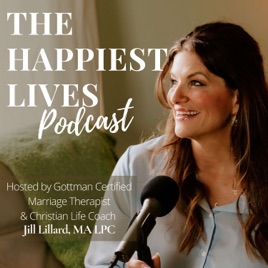
Advertise on podcast: The Happiest Lives Podcast
Rating
4.8from
This podcast has
171 episodes
Language
EnglishPublisher
Jill M. LillardExplicit
No
Date created
2023/04/09
Latest episode
2026/10/02
Average duration
22 min.
Release period
7 days
Description
The Happiest Lives was designed for Christian women who want to stop being disappointed in their relationships and feel more loved and loving. Here you will learn to think better, feel better, and love better. This podcast is hosted by Jill M. Lillard, MA LPC, a licensed counselor and Gottman Certified Couples Therapist. Jill has been helping people manage their minds, process their feelings, and have better relationships for over 25 years. For application exercises and support in applying the concepts learned on the podcasts, get your FREE podcast guide www.myhappyvault.com/podcastLearn more at www.thehappiestlives.com Discover tools at www.myhappyvault.com.Contact Jill at [email protected].
Unlock The Happiest Lives Podcast podcast Email contact info,
Listeners & Audience details
Email contact information
Direct podcast contact details

Listeners
Audience numbers & engagement insights

Audience details
Podcast Insights

Podcast episodes
Check latest episodes from The Happiest Lives Podcast podcast
E168: Who Gets to Tell Me Who I Am?
2026/10/02
Why do other people’s opinions affect me so much when I know my identity is in Christ?
You know God loves you. You know your identity is in Christ. But then your husband is frustrated, your adult child questions a decision, or someone you care about seems disappointed in you—and suddenly you’re questioning yourself.
In the first episode of the Why Don’t I Feel Secure? series, Jill explores why there can be such a gap between what we know about our identity in Christ and what we experience in our relationships. Looking at Adam and Eve’s response to shame in Genesis and our adoption in Christ in Ephesians 1, she asks a question that gets underneath our need for approval, reassurance, and understanding: Who gets to tell me who I am?
This episode will help you notice the places where you may be asking another person to answer a question God has already answered—and begin learning to live from what your Father has already said is true.
In This Episode
• Why another person’s mood, criticism, or opinion can affect your peace so quickly
• The connection between shame, hiding, and our search for approval
• What God’s question, “Who told you?” reveals about the voices we believe
• Why good things like marriage, family, and approval cannot carry the weight of our identity
• What adoption in Christ tells us about where real security comes from
• How to notice when you’re looking outward for reassurance before turning toward God
Key Takeaways
• Knowing your identity is in Christ and living from that identity are not always the same thing.
• Other people’s opinions can become verdicts when we give them authority to tell us who we are.
• Good relationships are gifts, but they cannot provide the security only God can give.
• Your emotions can reveal what feels threatened and where you may be looking for reassurance.
• Before anyone else gets a vote, your Father has already spoken over who you are in Christ.
Series Note
This is the first episode in the four-part Why Don’t I Feel Secure? series. Throughout the series, we’ll explore identity, disappointment, emotional reactivity, and what it looks like to live from a secure foundation in Christ.
Keywords
• identity in Christ
• Christian women and insecurity
• seeking approval from others
• Christian marriage and emotional security
• people pleasing and faith
• biblical identity for women
FREE: The 4 Mindset Shifts for a Happier Marriage
Ready to stop waiting for your husband to change and start focusing on how you want to show up in your marriage? Get the free mini-course + workbook and Scripture study here:
myhappyvault.com
Discover ways to work with me at www.thehappiestlives.com or www.myhappyvault.com
Questions? Email Jill directly at [email protected]
E167: The Want Match
2026/09/25
Have you ever wondered if you and your husband actually want the same thing, but you’re just going about it in completely different ways?
In this final episode of When Love Comes With a Manual, Jill introduces something she calls a want match — the idea that two people can want completely different things on the surface and still be after the exact same fruit underneath. You want him to plan the date. He wants time together without the pressure of getting it right. You want a deep conversation. He wants less tension in the house. Those aren’t opposite goals. They’re the same goal wearing two different outfits.
Jill walks through real, specific examples — date nights, spiritual connection, household overwhelm, repair after a fight — and shows what it looks like to trade a complaint for what she calls a positive invitation: a clear, honest request that opens a door instead of setting a trap. She also shares a moment from her own marriage where this didn’t go the way she expected, and what she learned from it.
If you’ve ever felt like you and your husband are speaking two different languages about the same thing, this episode will help you find the words that actually get through.
In This Episode
•Why arguing over how something should happen often means you’re missing the fact that you both want the same outcome
•The difference between a complaint and what Jill calls a “positive invitation”
•Real examples of want matches around date nights, spiritual connection, and household stress
•What to do when you’ve made a clear request and it’s still met with silence or refusal
Key Takeaways
•You may not want the same process as your husband, but you may still want the same fruit
•Complaints often have a real, honest desire buried underneath them
•A positive invitation is clearer and more effective than a hint or a test
•His response — yes, no, or something else — gives you real information, not a verdict on you
•Clarity is kinder than hinting, even when it feels riskier
Series Note: This is the final episode in the four-part series When Love Comes With a Manual, which explores the hidden expectations, scorekeeping, and unspoken demands that quietly shape our marriages — and what it looks like to move toward real connection instead.
Keywords: Christian marriage podcast, marriage communication, Christian wife, emotional connection in marriage, spiritual leadership in marriage, healthy conflict in marriage
FREE: The 4 Mindset Shifts for a Happier Marriage
Ready to stop waiting for your husband to change and start focusing on how you want to show up in your marriage? Get the free mini-course + workbook and Scripture study here:
myhappyvault.com
Discover ways to work with me at www.thehappiestlives.com or www.myhappyvault.com
Questions? Email Jill directly at [email protected]
E166: When Desire Turns Into Demand
2026/09/18
What do you do when you want something from your husband, but it starts to feel like you need it before you can be okay?
In this episode of The Happiest Lives Podcast, Jill talks about the subtle shift that happens when a good desire turns into a demand. Desire is not the problem. It is human to want closeness, help, repair, affection, spiritual connection, and emotional safety in marriage. But when we start gripping those desires so tightly that our peace depends on our husband’s response, something starts to shift inside of us.
This conversation will help you notice the difference between desire, request, demand, control, surrender, and a wise boundary. You’ll learn how to bring your desires honestly before God without shaming them, stuffing them, or using control to get them met.
In This Episode
• Why desire itself is not selfish or unspiritual
• How a good desire can turn into a demand
• The difference between a request, a demand, and a boundary
• Why “I shouldn’t have to ask” often creates resentment
• How prayer helps us bring desire to God without letting it rule us
• What it means to own what is yours without carrying what belongs to him
Key Takeaways
• Desire says, “I want this.” Demand says, “I need this from you before I can be okay.”
• A request invites. A demand grips. A boundary clarifies.
• Prayer is not pretending you don’t want anything. Prayer is bringing what you want before God with honesty and surrender.
• A boundary is not punishment. It is stewardship.
• You can want something deeply without letting it rule your peace, your tone, or the way you see your husband.
Series Note
This episode is part of the series When Love Comes With a Manual. In Episode 1, we talked about the hidden manuals we carry for how our husband should love us. In Episode 2, we talked about the hidden scorecard that forms when those manuals are not followed. This episode looks at what happens when desire becomes something we grip, demand, or try to control.
Keywords
Christian marriage, emotional health, marriage expectations, boundaries in marriage, Christian wife, relationship disappointment
FREE: The 4 Mindset Shifts for a Happier Marriage
Ready to stop waiting for your husband to change and start focusing on how you want to show up in your marriage? Get the free mini-course + workbook and Scripture study here:
myhappyvault.com
Discover ways to work with me at www.thehappiestlives.com or www.myhappyvault.com
Questions? Email Jill directly at [email protected]
E165: The Scorecard
2026/09/11
Do you keep a mental list of everything you do that your husband doesn’t?
This week we’re talking about something most of us do without even realizing it — keeping score. Not out loud. Not on paper. But silently, in the back of our minds, tracking who did what, who noticed what, and who’s carrying more.
A scorecard usually starts with something small. A load of laundry. A forgotten appointment. A toilet paper roll that never gets replaced. But small things add up, and pretty soon you’re not just annoyed about the dishes — you’re building a case. And once you’re building a case, your husband stops being your husband. He becomes a defendant.
This episode walks through why we keep score, what it actually costs us, and what it looks like to bring our real strengths to our marriage without secretly charging for them.
In This Episode
Why “keeping score” feels justified but never actually creates connectionThe sentence — “I shouldn’t have to” — that fuels resentmentWhat 1 Corinthians 13:5 actually means by love that “keeps no record of wrongs”How to tell the difference between a real strength and a hidden scorecardWhy vague expectations like “help more” set your husband up to failA simple practice for bringing resentment to God instead of stuffing it downKey Takeaways
Scorecards feel like justice, but they create distance, not resolutionThe things you’re good at can be a gift you give freely — not evidence to use laterClarity helps a marriage. Vague grading just keeps you stuckYou can be honestly hurt without letting resentment run the showSurrender isn’t pretending you don’t want more — it’s trusting God with what you do wantSeries Note This is Episode 2 of When Love Comes With a Manual, a series on the unspoken expectations we carry into marriage. If you haven’t listened to Episode 1 yet, start there.
Keywords marriage resentment, Christian marriage podcast, hidden expectations in marriage, keeping score in relationships, emotional health for wives, marriage communication
FREE: The 4 Mindset Shifts for a Happier Marriage
Ready to stop waiting for your husband to change and start focusing on how you want to show up in your marriage? Get the free mini-course + workbook and Scripture study here:
myhappyvault.com
Discover ways to work with me at www.thehappiestlives.com or www.myhappyvault.com
Questions? Email Jill directly at [email protected]
E164: When Love Comes With A Manual
2026/09/04
Why do I expect my husband to read my mind?
In this first episode of a brand-new series, Jill introduces the idea of the hidden “manual” — the unspoken rules we carry for how our husband should love us, notice us, pursue us, and make us feel secure.
These aren’t bad desires. Many of them are exactly what God designed marriage to hold.
But when a good desire never becomes an honest conversation, it quietly turns into a standard our husband is being measured against without ever knowing it.
Using the simple picture of an appliance manual, Jill walks through how easy it is to assume our spouse should just know — and how much pain gets built on that assumption. From birthday cake to spiritual leadership, this episode names the manuals so many Christian women carry and offers a different way forward: bringing desire into the light instead of leaving it buried.
In This Episode
• Why “if he cared, he would know” is one of the most common — and costly — thoughts in marriage
• The difference between a desire and a manual
• How unspoken expectations quietly become the standard we grade our husband against • Real-life examples of common marital “manuals,” including spiritual leadership
• Why writing down what you want isn’t unromantic — it’s honest
• A simple set of questions to identify your own hidden manual
Key Takeaways
• A manual is often a good desire that never became an honest conversation
• People can read your mind if you write it down and hand it to them — otherwise they’re guessing
• Disappointment often begins with an expectation, not with neglect
• The goal isn’t to want less — it’s to stop hiding what you want
• Ask: have I made it possible for him to win?
Series Note
This is Episode 1 of a four-part series, When Love Comes With a Manual. Next week: The Hidden Scorecard.
Keywords unspoken expectations in marriage, Christian marriage advice, hidden expectations, marriage communication, resentment in marriage, Christian wife podcast
FREE: The 4 Mindset Shifts for a Happier Marriage
Ready to stop waiting for your husband to change and start focusing on how you want to show up in your marriage? Get the free mini-course + workbook and Scripture study here:
myhappyvault.com
Discover ways to work with me at www.thehappiestlives.com or www.myhappyvault.com
Questions? Email Jill directly at [email protected]
E163: The Conversation
2026/08/28
Why does it feel like nothing actually gets resolved even after you've calmed down?
You've named the cycle. You've caught the flood before it swept you under. You've slowed down enough to see the story your brain was telling you. But there's still one more step nobody talks about — going back in.
This week, Jill closes out the "Why You Keep Having the Same Fight" series with The Conversation: a simple, four-question framework for coming back to a hard conversation with clarity instead of chaos.
Using Mark and Christy's story one final time, Jill walks through what it actually looks like to sit back down after a rupture — not to relitigate who was right, but to understand each other. She unpacks why "acting normal again" isn't repair, why silence lets resentment go underground, and why the goal was never a fight-free marriage in the first place. It was always this: learning how to find your way back.
In This Episode:
- The four questions that turn a conversation from circular to clear: What are we actually talking about? What are we trying to accomplish? What was happening in your model? What's underneath this?
- Why skipping straight to the "topic" keeps you stuck in the same fight
- What Mark and Christy discovered was underneath 100 different arguments about 100 different things
- Why real repair is small, specific, and frequent — not one perfect conversation
- The Gottman research on repair attempts and relationship stability
- How to have this conversation even if you're the only one showing up for it
Key Takeaways:
Repair isn't the absence of conflict — it's what you do after. And you don't need your spouse, sister, or friend to be doing this work alongside you for your half of it to matter. When you change how you move in the cycle, the whole cycle has to reorganize.
This episode closes out the four-part series "Why You Keep Having the Same Fight." If you're just joining, start with Episode 160 to hear the whole arc — from naming the cycle to flooding to the stories underneath to this: coming back to the table.
Keywords: relationship repair, marriage conflict, Gottman method, communication in marriage, emotional flooding, Christian marriage advice, recurring conflict, nervous system and relationships
FREE: The 4 Mindset Shifts for a Happier Marriage
Ready to stop waiting for your husband to change and start focusing on how you want to show up in your marriage? Get the free mini-course + workbook and Scripture study here:
myhappyvault.com
Discover ways to work with me at www.thehappiestlives.com or www.myhappyvault.com
Questions? Email Jill directly at [email protected]
E162: The Story You’re Telling
2026/08/21
Why do you keep reacting the same way in conflict — even when you’re trying not to?
Most of the time, the fight isn’t really about what it looks like on the surface. It’s about the meaning you’re making. When your husband says something that lands wrong, your brain moves fast — it takes his words and turns them into a story. About him. About you. About whether you’re loved, seen, or alone. And that story drives everything that happens next.
In this episode, Jill teaches a tool called "sitting far" — the CTFAR model — that helps you slow down and separate what actually happened from the meaning you assigned to it. You’ll learn to identify the one thought underneath your reaction, trace how it created a feeling, drove your actions, and produced a result that confirmed the story you started with. Then you’ll build a new, intentional model — one that opens the door to a different conversation entirely.
This is part three of the series Why You Keep Having the Same Fight and sits inside the regulation phase of the Flood Plan. It’s the inside work that makes going back into the hard conversation actually possible.
In This Episode
•How to use journaling to process what happened before you try to analyze it
•What the CTFAR model is and how to walk through it step by step
•Why the result of your unintentional model always loops back to prove your original thought
•How to identify one thought — not five — and examine it honestly
•Two directions for building an intentional model when you’re not ready to think generously about your spouse
•Why feeling seen by God is often the bridge between where you are and where you want to be
Key Takeaways
•The circumstance doesn’t create your feelings — your thought about the circumstance does
•You can enter the CTFAR model from the feeling, the action, or the thought — wherever you have the most clarity
•Sometimes the generous thought toward your spouse is too far to reach right now, and that’s okay
•You can have a thought that helps you feel settled in yourself before you can have a thought that opens curiosity toward him
•Regulation isn’t just calming your body — it’s also understanding the story you were telling when you flooded
Series Note
This is Episode 3 of 4 in the series Why You Keep Having the Same Fight. Start with Episode 160 if you’re new to the series.
Keywords
relationship conflict, recurring arguments in marriage, emotional flooding, thought work for women, Christian marriage help, how to stop fighting with your spouse
FREE: The 4 Mindset Shifts for a Happier Marriage
Ready to stop waiting for your husband to change and start focusing on how you want to show up in your marriage? Get the free mini-course + workbook and Scripture study here:
myhappyvault.com
Discover ways to work with me at www.thehappiestlives.com or www.myhappyvault.com
Questions? Email Jill directly at [email protected]
E161: Flooded
2026/08/14
Why do I shut down — or can’t stop talking — when things get heated?
You understood the conversation before it started. You knew what you wanted to say. And then something happened — your brain went offline, your words came out wrong, or nothing came out at all. You walked away wondering why you couldn’t just hold it together.
That’s not a character flaw. That’s flooding. And until you understand what it’s actually doing to your body, it’s almost impossible to change what happens next.
In this episode, Jill breaks down the neuroscience of emotional flooding, why productive conversation becomes nearly impossible once it hits, and why it doesn’t always look the way you think. The loud version is easy to spot. The quiet version — the one that looks like calm, like two people who just don’t fight — that one’s trickier. And just as worth paying attention to.
You’ll walk away understanding your own flooding signature and with a practical five-step Flood Plan you can use before your brain shuts down and your mouth takes over.
In This Episode
What emotional flooding is and what it does to your brain and bodyThe four flooding responses: fight, flight, freeze, and shutdownWhy the quiet version of flooding is the easiest to missHow to identify your personal flooding signatureThe five steps of the Flood PlanHow the first two steps of the FEEL method help you find and stay with emotion in real timeKey Takeaways
Flooding is physiological — once it hits, your brain literally cannot do what you’re asking it to doShutdown looks like calm but it’s still floodingA pause only works if both people trust you’re coming backThe person who calls the timeout re-initiates — within 30 minutes to 24 hoursRegulation means feeling the emotion, not replaying the argumentSeries Note This is Episode 2 of the four-part series Why You Keep Having the Same Fight. Start with Episode 160 if you haven’t already.
Keywords emotional flooding, conflict in marriage, nervous system regulation, Gottman method, communication in relationships, Christian marriage podcast
FREE: The 4 Mindset Shifts for a Happier Marriage
Ready to stop waiting for your husband to change and start focusing on how you want to show up in your marriage? Get the free mini-course + workbook and Scripture study here:
myhappyvault.com
Discover ways to work with me at www.thehappiestlives.com or www.myhappyvault.com
Questions? Email Jill directly at [email protected]
E160: Why You Keep Having The Same Fight
2026/08/07
Why do you keep having the same argument over and over — even when you promise yourself it won’t happen again?
If you’ve ever gone to bed after a fight thinking we’ve been here before, this episode is for you. The topic changes — money, parenting, connection, household responsibilities — but the emotional experience feels identical every time. That’s a cycle. And until you can see the cycle, you’ll keep trying to solve the wrong problem.
In this first episode of a four-part series, Jill Lillard breaks down what’s actually happening underneath recurring conflict — and why the topic on the table is almost never the real issue. Whether your relationship looks like constant arguments or quiet distance, this episode will help you see the pattern that’s been keeping you stuck.
In This Episode
• Why the topic is rarely the real problem in recurring conflict
• The difference between the loud cycle and the quiet cycle — and why both are keeping you stuck
• What pursue and withdraw actually looks like in everyday conversation
• The underlying questions driving most arguments before anyone says a word
• Why changing your half of the cycle is enough to shift the whole dynamic
• How to identify the dance you’re doing in your closest relationships
Key Takeaways
• Recurring conflict is about the cycle underneath, not the topic on the surface
• Both the loud version and the quiet version of conflict are cycles worth addressing
• Insight about your spouse’s half of the cycle only becomes useful when it turns inward
• You cannot change how someone else moves — but when you change how you move, the cycle has to reorganize
• Seeing the dance is the first step to interrupting it
Series Note
This is Episode 1 of the four-part series Why You Keep Having the Same Fight. Each episode builds on the last — covering emotional flooding, the Talk Table, and real repair after conflict.
Keywords
Recurring conflict in marriage, why couples have the same fight, relationship cycles, pursue and withdraw pattern, Christian marriage podcast, emotional health in relationships
FREE: The 4 Mindset Shifts for a Happier Marriage
Ready to stop waiting for your husband to change and start focusing on how you want to show up in your marriage? Get the free mini-course + workbook and Scripture study here:
myhappyvault.com
Discover ways to work with me at www.thehappiestlives.com or www.myhappyvault.com
Questions? Email Jill directly at [email protected]
BONUS: What God Is Teaching Me Right Now
2026/07/31
How do you trust God when everything in your life seems to be changing?
This episode is a little different than my usual teaching episodes. Instead of continuing a series, I wanted to invite you into my own quiet time and share what the Lord has been teaching me in real time.
As I was journaling through a season of transition and reading 2 Corinthians 8:1–15, one phrase kept coming back to me: “They gave themselves first to the Lord.” While Paul is writing about generosity, I realized God was using this passage to challenge the way I was holding onto familiar seasons, relationships, and expectations.
If you’ve ever found yourself grieving a season you loved, wondering what’s next, or learning to trust God in the unknown, I hope this conversation encourages you to loosen your grip and place yourself—and your future—back into God’s hands.
In This Episode
Why unexpected grief often accompanies healthy life transitionsWhat 2 Corinthians 8 taught me beyond financial generosityThe difference between holding on and trusting GodWhy familiar seasons can be difficult to releaseHow God often prepares us for what’s next before He reveals what’s nextOne question I’ve been asking myself during this seasonKey Takeaways
Grace changes more than what we give—it changes how we hold our lives.Surrender often comes before clarity.It’s possible to grieve a season while still trusting God with the future.God often prepares our hearts before He changes our circumstances.Every season is an invitation to give ourselves to the Lord again.Series Note
This is a special bonus episode outside of our regular monthly series—a personal reflection on what God has been teaching me during my own time in Scripture.
Keywords
Christian podcastTrusting God in transitionChristian encouragement2 Corinthians 8Letting go and trusting GodSeasons of lifeFREE: The 4 Mindset Shifts for a Happier Marriage
Ready to stop waiting for your husband to change and start focusing on how you want to show up in your marriage? Get the free mini-course + workbook and Scripture study here:
myhappyvault.com
Discover ways to work with me at www.thehappiestlives.com or www.myhappyvault.com
Questions? Email Jill directly at [email protected]
E159: Remain in the Spiral
2026/07/24
What do you do when anxiety takes over, and you can’t stop the spiral?
You know the pattern. Something happens — a shift in your body, a moment of tension in your marriage, a number in your bank account — and before you’ve had a single conscious thought, your mind is already assigning meaning, the shame is already rising, and you’re reacting from a place you didn’t choose. The spiral moves faster than your intentions do. Most of us have been trying to outrun it. This episode is about something different.
The gap between trigger and reaction is small. Most of us blow right past it. But that gap is where the Spirit lives — and learning to pause there is one of the most significant things you can practice. This isn’t a coping strategy. It’s abiding in its most raw and necessary form.
This is the final episode of the Simply Remain series, and it brings everything home. We talk about the everyday spiral and the longer dormant seasons — the empty nest, the aging parent, the chapter of life that feels unrecognizable. In all of it, the invitation is the same. Remain.
In This Episode
• Why the spiral is not evidence that something is wrong with you — it’s an invitation to abide
• The pattern behind every trigger: sensation, thought, emotion, reaction
• The gap between trigger and reaction and why that’s where God lives
• The difference between shame that drives you deeper and the Spirit that leads you gently back
• The four P’s: Panic, Pause, Pray, Praise — a practice for the hardest moments
• What pruning actually means and why the Father works through his Word, not the trial alone
Key Takeaways
• The spiral is the curriculum — your hardest moments are where abiding becomes real
• Romans 8:26 — the Spirit intercedes in your weakness. That gap is not empty
• Shame drives you deeper. The Spirit leads you back. You can tell them apart by where they take you
• Some seasons are longer than a spiral — dormant winters where the root is still doing its work underground
• The branch that holds on in winter is the branch that flourishes in spring
Series Note
This is episode four of the Simply Remain series. Start with Episode 156 for the full arc — or listen to this one wherever you are today.
Keywords
• How to stop anxiety spirals as a Christian woman
• Abiding in Christ when life feels hard
• What to do when you feel overwhelmed and anxious
• Christian women perimenopause emotional health
• Remaining in God during difficult seasons
• John 15 abiding in the vine
FREE: The 4 Mindset Shifts for a Happier Marriage
Ready to stop waiting for your husband to change and start focusing on how you want to show up in your marriage? Get the free mini-course + workbook and Scripture study here:
myhappyvault.com
Discover ways to work with me at www.thehappiestlives.com or www.myhappyvault.com
Questions? Email Jill directly at [email protected]
E158: God in the Laundry
2026/07/17
Do the ordinary tasks of my day actually matter to God?
You’re doing all of it — the meals, the laundry, the emails, the driving, the remembering. And somewhere in the middle of it a question surfaces. Does any of this actually matter? This episode is about what happens when we move through our lives productive but not present, and what abiding in the ordinary actually looks like.
Through the story of Brother Lawrence and the theology of Andrew Murray’s The True Vine, this episode reframes the mundane as the very place God is forming you. The laundry isn’t the obstacle to your spiritual life. It is your spiritual life.
In This Episode
•Why productivity without presence leaves us spiritually exhausted
•How Brother Lawrence practiced God’s presence in unglamorous ordinary work
•What Psalm 16 teaches us about security and presence in our assigned portion
•How Murray reframes pruning as God’s precision formation in everyday life
•The three questions that help you abide in the ordinary instead of just endure it
Key Takeaways
•The ordinary moments of your day are not the obstacle to your spiritual life — they are your spiritual life
•Abiding is a connection you maintain in the middle of the doing, not a feeling you chase
•The laundry is the pruning — God is actively forming you in the mundane moments
•The fruit grows while you remain connected to the vine — not when you finally finish the list
Series Note
Episode three of the Simply Remain series, which began on episode 156.
Keywords
•Abiding in God in everyday life
•Christian women and spiritual exhaustion
•Finding God in the ordinary
•Spiritual formation in daily routines
•John 15 abiding and fruit
•Andrew Murray The True Vine
FREE: The 4 Mindset Shifts for a Happier Marriage
Ready to stop waiting for your husband to change and start focusing on how you want to show up in your marriage? Get the free mini-course + workbook and Scripture study here:
myhappyvault.com
Discover ways to work with me at www.thehappiestlives.com or www.myhappyvault.com
Questions? Email Jill directly at [email protected]
E157: Stop Trying To Act Spiritual
2026/07/10
What does it mean to abide in God when your quiet time feels empty and your spiritual life feels flat?
You’ve been showing up — reading your Bible, praying, doing all the things — and something still feels off.
This episode is about what’s actually happening when that occurs. Not what you’re doing wrong. What’s actually going on. We go deep into John 15 to unpack what Jesus actually meant when he said remain in me — why the fruit that grows from genuine abiding was never meant to just feed you, and what it looks like to stay when everything in you wants to fix the flatness or conclude that God is gone.
Abiding is not a feeling you achieve. It’s a posture you return to.
In This Episode
•Why doing all the right spiritual things can still leave you feeling completely disconnected
•What John 15 actually says about dependence, pruning, joy, and friendship with God
•Why reading God’s word alone doesn’t produce transformation — and what has to be added
•How the fruit of abiding flows outward and feeds others not just yourself
•Why hormonal shifts can affect your spiritual life in ways nobody warned you about
Key Takeaways
•Chase the feeling and you end up performing. Stay in the posture and the fruit takes care of itself
•The Word has to abide in you — not just pass through you
•Grace positions you in the vine. Faith keeps you there. The fruit grows as the overflow of both
•The flatness in your quiet time might be the Father pruning — not evidence that something is wrong
•The fruit you bear isn’t yours. It’s Christ’s life flowing through a branch that stayed connected
Series Note
Episode two of the Simply Remain series. Start with episode 156 or jump in here — either works.
Resources
Song: Abide by Dwell Music
The True Vine by Andrew Murray
Keywords
•How to abide in God
•Spiritual disciplines and faith
•Feeling disconnected from God
•John 15 abiding in Christ
•Perimenopause and spiritual life
•Andrew Murray abiding in Christ
FREE: The 4 Mindset Shifts for a Happier Marriage
Ready to stop waiting for your husband to change and start focusing on how you want to show up in your marriage? Get the free mini-course + workbook and Scripture study here:
myhappyvault.com
Discover ways to work with me at www.thehappiestlives.com or www.myhappyvault.com
Questions? Email Jill directly at [email protected]
E156: Simply Remain
2026/07/03
Are you exhausted from chasing outcomes that never quite deliver the peace you’re after?
Underneath every goal is a feeling — security, love, peace, worthiness. And that feeling is already available to you through abiding in Christ, not through achieving.
In this episode Jill opens a new series called Simply Remain, anchored in John 15 and Andrew Murray’s The True Vine. She names the works of the flesh we don’t recognize because they look like diligence, introduces the idea of hard moments as portals into faith rather than detours around it, and shows what remaining actually looks like in a real moment of grief and loneliness.
In This Episode
•Why the fruit of the Spirit is not a to-do list
•How to trace any outcome back to the feeling underneath it
•The works of the flesh that look like virtue but quietly deplete you
•What remaining in Christ looks like in a real hard moment
•Why your hardest circumstances are doorways into abiding
Key Takeaways
•You’re chasing the feeling underneath the outcome — and it’s already available through abiding
•The branch has one job: to stay
•Striving and controlling are works of the flesh — they never deliver what they promise
•Your hard moments are portals, not interruptions
Series Note
Episode 1 of the Simply Remain series, based on John 15 and Andrew Murray’s The True Vine.
Keywords
•Abiding in Christ
•John 15 vine and branches
•Fruit of the Spirit
•Christian podcast for women
•Overcoming striving and perfectionism
•Spiritual growth for women
FREE: The 4 Mindset Shifts for a Happier Marriage
Ready to stop waiting for your husband to change and start focusing on how you want to show up in your marriage? Get the free mini-course + workbook and Scripture study here:
myhappyvault.com
Discover ways to work with me at www.thehappiestlives.com or www.myhappyvault.com
Questions? Email Jill directly at [email protected]
155: What Church Hurt Is Forming in You- David and Absalom
2026/06/26
How do I stop letting church hurt define me?
You’ve probably spent a lot of time thinking about what happened. Who was wrong. What should have been done differently. And honestly, you’re probably right about most of it. But here’s the question that doesn’t get asked enough: what is the experience forming in you? Not just what happened — but who are you becoming while you’re processing it?
In this final episode of the church hurt series, Jill walks through the story of Absalom from 2 Samuel 13 — a man who witnessed a serious injustice, watched it go unaddressed, and carried it in silence for two years. What happened next is one of the most sobering pictures in Scripture of what unprocessed pain can do in a person’s life. Not because he was wrong about what happened. But because being right didn’t protect him.
This episode isn’t about minimizing what was done to you or rushing to forgiveness before you’re ready. It’s about keeping your eyes on Jesus in the middle of it — doing what’s yours to do, releasing what isn’t, and trusting God with the rest.
In This Episode
•Why being right about what happened doesn’t automatically protect you from what carrying it does to you over time
•The story of Absalom, Tamar, and David from 2 Samuel 13 — and what it shows us about unprocessed pain
•The difference between processing your hurt and just circulating it
•Why stuffing it down doesn’t work — and what to do instead
•How to identify what’s actually yours to do and how to surrender the rest to the Lord
•Practical steps for moving forward without losing Jesus in the process
Key Takeaways
•Seeing something clearly doesn’t make you free of it — freedom requires bringing it to the Lord
•Silence is not neutral. What you carry without addressing will eventually move in a direction you didn’t choose
•There’s a difference between processing pain and recycling it — and one leads somewhere, the other doesn’t
•You can do what’s yours to do and trust God with the outcome, even when the outcome isn’t what you wanted
•The goal isn’t to minimize what happened — it’s to make sure your heart doesn’t become the bigger problem
Series Note:
This is episode 4 of a 4-part series on church hurt. You can start here or go back to the beginning — each episode stands on its own.
Keywords:
church hurt healing, Christian women faith, how to forgive church hurt, processing spiritual pain, church trauma recovery, emotional health faith
FREE: The 4 Mindset Shifts for a Happier Marriage
Ready to stop waiting for your husband to change and start focusing on how you want to show up in your marriage? Get the free mini-course + workbook and Scripture study here:
myhappyvault.com
Discover ways to work with me at www.thehappiestlives.com or www.myhappyvault.com
Questions? Email Jill directly at [email protected]
Podcast reviews
Read The Happiest Lives Podcast podcast reviews
L Party of 7 2026/07/12
The Real Deal
Jill is the REAL DEAL. She loves Jesus and is continually pointing others to Him. Her investment in me has literally changed my life. I cannot recomme...
byost114 2026/05/11
Faith, Wisdom, and Encouragement in Every Episode
Jill’s podcast is uplifting, encouraging, and full of meaningful Christian wisdom. Each episode offers practical insights and faith-filled conversatio...
KCity Gal 2026/04/11
Great Content!!!
Been walking with Christ for over 20 years, have led Women’s Ministry, held Bible studies, and worked in ministry full-time. Yet I LEARN MUCH from thi...
Journey2joy 2026/02/10
Helpful for me
I find this podcast helpful biblical sound advice not just follow your emotions but to live in who God has created you to be.
AspireForPeace 2025/05/26
So Helpful
I just love this podcast! I have learned so much each week! I am journaling more, and find myself able to approach everyday issues with more clarity a...
Luckyme6212 2025/05/02
Love this
Love this podcast. I’ve learned so much and been so inspired. I love how they are straight to the point and not drawn out so it doesn’t get boring. AW...
Crystal RMD 2025/04/25
Seek Godly Counsel
Biblically solid teaching from a therapist’s point of view
Peppypedro 2024/10/26
A wonderful podcast
This podcast has been such a blessing. Thank you for sharing such godly wisdom and changes I can put into action.
Haha67890 2024/10/06
Such an uplifting podcast
I love love love this podcast, she gives practical tips and teaches you how to apply them all why aligning them with the Bible. I’m only on episode 14...
CrunchyCanuck 2024/04/04
Amazing!
Everything Jill says is meeting me where I need to be met and helping me to be a better person, Christian, wife and mother. Thank you so much for maki...
Podcast sponsorship advertising
Start advertising on The Happiest Lives Podcast relevant audience podcasts
You may also like to advertise on these Podcasts

4.811241250
The Rob Carson Show
Newsmax Podcasts

4.6312821077
Wow in the World
Tinkercast

4.819462000
Football Ramble
Stak
4.6125201183
10% Happier with Dan Harris
10% Happier

4.930921696
Arseblog Arsecast, The Arsenal Podcast
arseblog.com

4.871771353
The Chalene Show | Diet, Fitness & Life Balance
Chalene Johnson

4.6619562000
The Dan Bongino Show
Cumulus Podcast Network | Dan Bongino

4.913819736
THE ED MYLETT SHOW
Ed Mylett
4.6137741977
The Rubin Report
Dave Rubin

4.933771202
Tea Time UNFILTERED With Lovelyti
Lovelyti