1682882914
This Week in Global Development

Advertise on podcast: This Week in Global Development

Rating
★★★★★
4.5
from
17 reviews
Categories
Country
United States
This podcast has
241 episodes
Language
English
Explicit
No
Date created
2023/04/17
Latest episode
2026/09/30
Average duration
32 min.
Release period
6 days

Description

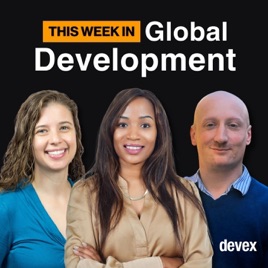
Dive into the week's most critical global development news with the This Week in Global Development podcast.  In each episode, hosts Adva Saldinger, David Ainsworth, and Rumbi Chakamba break down major headlines and invite leading experts for insightful analysis.  Get up-to-date on news regarding foreign aid, humanitarian crises, the U.N.’s Sustainable Development Goals, finance, philanthropy, climate, food systems, global health, and stay informed on the latest trends and policy changes shaping global development. Episodes are published every Friday and can also be watched on YouTube. Subscribe to our YouTube channel:  https://www.youtube.com/@devex Sign up to the Devex Newswire and our other newsletters: https://www.devex.com/account/newsletters

Unlock This Week in Global Development podcast Email contact info,
Listeners & Audience details

Email contact information

Direct podcast contact details

Listeners

Audience numbers & engagement insights

Audience details

Podcast Insights

Podcast episodes

Check latest episodes from This Week in Global Development podcast


The Power to Decide: Reclaiming Sovereignty in a Digital Era
2026/09/30
In this special edition episode of This Week in Global Development, sponsored by Public Digital, Devex's Alan Robbins sits down with Public Digital's Lauren Kahn and Mike Bracken CBE. Recorded at Devex Impact House during UNGA, they unpack the urgent need for emerging economies to transition from passive "tech-takers" to active "tech-makers" by reclaiming digital sovereignty. The conversation explores how developing nations can avoid the developmental risks of vendor lock-in, shape local digital ecosystems, and build resilient digital public infrastructure (DPI). Kahn and Bracken highlight practical steps for governments to move from traditional aid to strategic agency, leveraging open standards and investing in internal civil service capabilities to ensure critical systems can survive future crises. Dive deeper into these frameworks in Public Digital's newly released book, Digital Sovereignty: The Power to Decide: public.digital/pd-books/digital-sovereignty-the-power-to-decide
Global Progress in the AI Era: As Anthropic urges caution on AI, its ‘beneficial deployments’ work grows
2026/09/25
Anthropic co-founder and CEO Dario Amodei made headlines recently by calling for slowing the development of increasingly powerful AI models to give safety measures time to catch up. That only increased the urgency of another effort within the company, which is expanding: An initiative to help governments and nonprofits use the models available today. Elizabeth Kelly leads that effort as Anthropic’s head of “beneficial deployments,” which works with governments and nonprofits to put Claude, the company’s AI model, to use.Before joining Anthropic, she led the U.S. AI Safety Institute, which worked to evaluate risk and develop safety standards for frontier AI systems. In a live recording of the Global Progress in the AI Era podcast at Devex Impact House on the sidelines of the 81st United Nations General Assembly, she argued that her past and present roles are connected. “Safety and access are two sides of the same coin,” Kelly said. “We are not going to see any of the benefits from AI unless we really invest in safety.” Anthropic used speaking engagements this week at UNGA81 to showcase organizations working with its technology. At its own event on Tuesday, titled The Briefing, speakers included Meenakshi Ramesh, CEO of Pratham Education Foundation, Rwanda’s Minister of Information and Communications Technology and Innovation Paula Ingabire, and Rania Dagash-Kamara from the U.N.’s World Food Programme. In the podcast interview, Kelly expanded on Anthropic’s partnership with Rwanda, its first multisector government partnership in Africa, which was announced earlier this year. She also pointed to Anthropic’s work with the Coalition for Epidemic Preparedness Innovations, or CEPI, on producing situation reports during the recent Ebola response in the Democratic Republic of Congo. Other examples she cited included the International Rescue Committee’s work on child malnutrition in Nigeria and maternal care in Burkina Faso.
Live from UNGA: Navigating the new era of multilateralism
2026/09/24
This week we are closely tracking the conversations at the 81st session of the United Nations General Assembly and what they mean for the global development sector. From U.S. President Donald Trump’s speech rejecting international governance frameworks and championing national sovereignty to questions around AI regulation, we break down what the discussions at the U.N.’s headquarters in New York mean for this new era of global policy. Beyond reflecting on outgoing U.N. Secretary-General António Guterres’ legacy, we unpack the latest developments in the secretary-general race. Amid the leadership discussions, we analyze whether traditional development priorities are increasingly taking a back seat to broader geopolitical tensions and global security issues. To dig into these topics, Adva Saldinger sits down with Colum Lynch for a live recording of our weekly podcast series.
The Gates Foundation's latest AI pledge, and a look ahead to UNGA 81
2026/09/17
This week, we report on the Gates Foundation’s 2026 Goalkeepers Report, which includes a $1 billion pledge to make AI more inclusive. The funding aims to expand access across health, education, agriculture, and digital equity to directly benefit the global south. We unpack how AI can help lower-income nations tackle critical challenges while ensuring local communities remain central to the process. From the highly anticipated leadership races for the top jobs at the United Nations and World Health Organization, to a critical high-level meeting on pandemic preparedness, we discuss the major themes ahead of UNGA 81, as well as highlight the sessions we are most excited for at Devex Impact House. To dig into these topics, Rumbi Chakamba sits down with Anna Gawel and Catherine Cheney for the latest episode of our weekly podcast series. In the segment of the podcast funded by GSK/ViiV Healthcare, Devex Executive Vice President and Executive Editor Kate Warren speaks with GSK's Chief Global Health Officer, Dr. Harmony Garges. They explore how community-led models, local health worker support, and strategic partnerships are addressing last-mile delivery challenges — from integrating malaria vaccines into primary healthcare in Liberia and Sierra Leone to expanding access to HIV care globally — ensuring much-needed health innovations reach remote and underserved communities. Request to attend Devex Impact House @ UNGA here.
Special edition: The real funding gap isn't money
2026/09/15
In this special episode of the This Week in Global Development podcast, sponsored by Rippleworks, Devex Senior Editor for Special Coverage Catherine Cheney sits down with Doug Galen, CEO of Rippleworks, and Azeez Gupta, co-founder of Rocket Learning, to reimagine how philanthropy thinks about scale. As foreign aid budgets shrink, most conversations stop at the number cut. This one asks a different question: What if the real constraint isn’t how much capital is available, but what that capital is allowed to pay for? Unpacking Rocket Learning’s growth through sustained operational support, the conversation makes the case that flexible, founder-friendly capital shouldn’t be the exception in philanthropy — it should be the default.
Bypassing the traditional aid system: The big bet to end starvation
2026/09/10
This week, we discuss our in-depth story on Operation End Starvation, a new initiative aiming to remake the global malnutrition supply chain. With a focus on cost-effectiveness, the project pairs public cash for ready-to-use therapeutic foods, or RUTFs, with philanthropic dollars to fund manufacturers, transporters, and delivery partners worldwide. The initiative represents a wider shift in foreign aid — for example, it bypasses the traditional multilateral system — and critics argue it still isn't cost-effective enough and is siphoning away crucial resources from broader hunger prevention efforts. We also reflect on our key takeaways from the Africa Food Systems Forum, including the innovations driving the future of African agriculture and how the continent's agribusiness sector is responding to a changing funding landscape to become more self-reliant. To dig into these stories, and others, Adva Saldinger sits down with Tania Karas and Elissa Miolene for the latest episode of our weekly podcast series.  In the sponsored segment of the podcast, hosted in partnership with The Pfizer Foundation*, Devex Executive Vice President and Executive Editor Kate Warren speaks with Dr. Krishna Udayakumar, founding director of the Duke Global Health Innovation Center, about how AI-enabled tools are being piloted and refined alongside local communities — and what it takes for promising innovations to scale responsibly and advance equity. *Founded in 1953 by Pfizer Inc. as a charitable organization, The Pfizer Foundation is a separate legal entity from Pfizer Inc. with distinct legal restrictions.
The fight over $7.5B in expiring aid and a rejected State Department grant
2026/09/03
We recently reported that roughly $7.5 billion in international affairs funding is set to expire by the end of this month. In a letter, more than 100 U.S. lawmakers have urged the State Department to spend the money. We unpack the situation and what it means for development spending, including the $3 billion previously slated for global health programs. While some politicians are urging the State Department to spend its expiring budget, Samaritan’s Purse is turning down a $300 million federal grant. The organization’s president, Franklin Graham, maintained that the group has “always relied on God, not government, for funding.” We discuss the potential reasons behind this move, noting that in addition to not being aligned with Samaritan’s Purse’s mission, the money may have been deemed too restrictive and relatively insignificant compared to its $1.8 billion revenue in 2024. To dig into these stories, and others, Devex Business Editor David Ainsworth sits down with reporters Sara Jerving and Elissa Miolene for the latest episode of our weekly podcast series. Check out Humanitarian Frontiers, a member of the Devex Podcast Network: https://humanitarianfrontiers.buzzsprout.com/
The water sector’s funding challenge and Asia’s philanthropy push
2026/08/27
At World Water Week in Stockholm, financing took center stage ahead of the U.N. Water Conference in Abu Dhabi this December. The annual gathering saw around 2,000 participants discuss water governance, security, and the rising pressures of a global water bankruptcy. However, attracting private investment remains difficult, with water projects often seen as offering low returns and traditionally relying on public funding. This has prompted a renewed focus on the World Bank’s "Water Forward" initiative, which aims to make the sector more attractive to investors. Meanwhile, the Asian Venture Philanthropy Network conference in New Delhi, India, brought together philanthropists, impact investors, and nonprofits to discuss how the region’s own capital can be mobilized to tackle development challenges instead of relying on traditional foreign aid. While AVPN attendees looked to local philanthropy to finance areas such as mental health and cervical cancer research, the broader global health sector is facing severe funding pressures. One example is the Coalition for Epidemic Preparedness Innovations, which faces a more than $100 million funding shortfall for efforts to combat the ongoing Ebola outbreak in the Democratic Republic of Congo. To explore how these financing challenges are playing out across the development sector, Rumbi Chakamba sits down with Tania Karas and Jenny Lei Ravelo for the latest episode of our weekly podcast series. Sign up to Devex Impact House @ UNGA 81 here: https://pages.devex.com/devex-at-unga-81.html
Special edition: Rethinking the housing crisis
2026/08/25
What if housing finance could help solve today's biggest challenges? In this special episode, Habitat for Humanity’s Jacqueline Innocent reveals why housing is an upstream catalyst for health, education, and equality — and how inclusive finance can transform global housing systems.
Famine reporting goes dark in 3 crisis zones, and COP31’s critical test
2026/08/20
Afghanistan, Somalia, and Yemen, three of the world’s most hunger-prone nations, were removed from the latest reporting by the Famine Early Warning Systems Network — a U.S.-based data and monitoring system which tracks hunger levels across the globe.  The move leaves aid organizations supporting these countries in the dark, even though all three have seen an escalation in humanitarian needs. It’s part and parcel of the Trump administration’s broader posture toward the three nations, which have been virtually cut off from foreign assistance since early 2025. In Haiti, the Inter-American Development Bank is developing a $44 million agricultural program for smallholder farmers. But Haitian INGOs say that local farmers weren’t consulted about the program design, raising broader questions about the role of communities in project development. Looking ahead to COP31, the U.N. climate summit faces a critical identity test. The conference must now shift from setting targets to delivering them. But this will be hard to navigate in an era where climate finance, geopolitics, and global trust remain under intense strain. To discuss these stories and others, Adva Saldinger sits down with Elissa Miolene and Jesse Chase-Lubitz for the latest episode of our weekly podcast series.  Sign up to Devex Impact House @ UNGA 81 here: https://pages.devex.com/devex-at-unga-81.html
Inside the State Department’s historic pivot to faith-based organizations
2026/08/13
In this episode of This Week in Global Development, Business Editor David Ainsworth sits down with Senior Reporters Michael Igoe and Sara Jerving to discuss the U.S. State Department’s announcement to allocate nearly $2 billion to partnerships with faith-based and community organizations providing global health and humanitarian aid.  It is the largest funding package of its kind in over two decades, and this week’s guests discuss how the move is driven by the U.S. government's belief that faith-based groups are more cost-efficient, with the Trump administration arguing they have the potential to be more financially sustainable in the long term.  This podcast episode explores whether these faith-based partnerships include non-Christian organizations, and whether this new approach will truly maximize impact.
Special edition: Are jobs for youth development's silver bullet?
2026/08/12
In this week’s special edition episode of the This Week in Global Development podcast, sponsored by the International Youth Foundation and the Caterpillar Foundation, we examine how shifting labor markets, automation, and artificial intelligence are reshaping the job landscape, leaving millions of young people out of work even as employers face widespread skill shortages. We’re joined by Christina Sass, president and CEO of IYF, and Asha Varghese, president of the Caterpillar Foundation and head of corporate social responsibility for Caterpillar Inc., to explore why addressing this transition from education to employment is not just a youth issue, but a critical development priority. The discussion also looks at the power of long-term partnerships in creating systemic, scalable workforce solutions. Highlighting nearly two decades of collaboration through the EquipYouth initiative, and tens of thousands of young people reached, our guests share how combining technical training with essential life skills builds youth agency, resilience, and lasting economic opportunity. The conversation also delves into aligning hiring and training with evolving local and global industry needs, navigating the impacts of AI, and why long-term ecosystem investments outperform short-term grants in achieving sustainable solutions.
Tracking the real-world impacts of US foreign aid cuts
2026/07/29
This week, we discuss The Aid Report, a project supported by a media grant from the Gates Foundation to track the real-world impacts of U.S. foreign aid cuts.  Over the past couple of months, the initiative has documented more than 1,000 verified impacts across multiple countries and sectors.  We examine the major trends and surprises that emerged, discuss what lessons policymakers and donors can take away, and explore the questions that still remain unanswered. To unpack these findings, Rumbi Chakamba sits down with Kelli Rogers and Rashad Nimr for the latest episode of our weekly podcast series.  The podcast is taking a short break next week. We'll be back with a new episode the following week. Check out Perdure, a member of the Devex Podcast Network, via the link below: https://open.spotify.com/show/7CMiGygkWqhtoYfXVLuOQM?si=a07177387e314420&nd=1&dlsi=8866940a467843b4
The new era of US and European foreign assistance
2026/07/22
This week we look back at the last 18 months of U.S. foreign assistance — a period defined by the dismantling of USAID and the absorption of foreign aid strategy into the State Department. We break down the types of initiatives the Trump administration is prioritizing and where the funding is flowing. On the other side of the Atlantic, the European Union is currently in the process of negotiating the bloc’s next seven-year budget. The new financial framework could mark a turning point for European aid, formalizing a shift from development-first spending toward an approach that increasingly serves member states’ geopolitical and economic interests. To dig into these stories and others, Adva Saldinger sits down with Michael Igoe and Jesse Chase-Lubitz for the latest episode of our weekly podcast series.  Redeem your Devex Pro discount: https://www.devex.com/upgrade/payment?package_short_name=PRO&payment_page_permalink=pro-discount-fortypercent&utm_medium=link&utm_source=newswire&utm_campaign=pro_week_2026
Turning World Cup hype into impact, and governing AI for good
2026/07/16
With the FIFA World Cup entering its final week, we explore how NGOs operating in participating nations can leverage the tournament’s spotlight to advance their work. While tournament hype is notoriously fleeting, we break down how NGOs can translate a short-term spike in curiosity into sustained long-term impact. We also discuss our key takeaways from the United Nations’ Global Dialogue for AI Governance and the International Telecommunication Union’s AI for Good Summit, both of which we covered on the ground in Geneva, Switzerland. From the absence of major AI labs to how lower- and middle-income countries are demanding an equal voice in global tech regulation, we explore why the development sector must stop leaving AI’s future to technologists alone. To dig into these stories and others, David Ainsworth sits down with Catherine Cheney and Thomas Cserep for the latest episode of our weekly podcast series. In the sponsored segment of the podcast, hosted in partnership with The Pfizer Foundation, Devex Executive Vice President and Executive Editor Kate Warren speaks with Freddy Nkosi, Senior Director of Global Programs for West and Central Africa & DRC Country Director at VillageReach. They explore how locally-led supply chains and data-informed approaches are helping countries, such as the DRC and Cameroon, address last-mile challenges, supporting efforts to ensure vaccines reach remote and underserved communities when and where they are needed.

Podcast reviews

Read This Week in Global Development podcast reviews


4.5 out of 5
17 reviews
★☆☆☆☆
Buggy Sprint 2025/02/05
SATANIC VISION
This group whether they know it or not is all about satans one world government. None of them are elected, they are self appointed “doers of good” ...
check all reviews on apple podcasts

Podcast sponsorship advertising

Start advertising on This Week in Global Development relevant audience podcasts


What do you want to promote?