1704380101
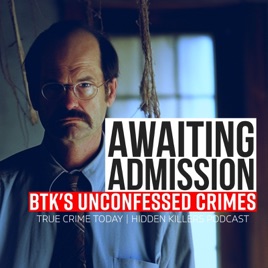
Awaiting Admission: BTK's Unconfessed Crimes | The Dennis Rader Story

Advertise on podcast: Awaiting Admission: BTK's Unconfessed Crimes | The Dennis Rader Story

Rating
★★★★☆
3.6
from
5 reviews
This podcast has
83 episodes
Language
English
Explicit
No
Date created
2023/08/25
Latest episode
2027/01/22
Average duration
12 min.
Release period
85 days

Description

In the annals of crime, few names evoke the same chilling shiver as that of the BTK Killer, Dennis Rader. Known for his sadistic modus operandi to "bind, torture, and kill," Dennis Rader was a shadowy figure of terror in Wichita, Kansas. Yet, even after his capture in 2005 and his subsequent confession to ten heinous crimes, many questions remained unanswered. "Awaiting Admission: BTK's Unconfessed Crimes" dives deep into this intricate web of uncertainty, shining a light on the shadows that still linger. Every episode of this gripping podcast peels back a layer of the complex narrative surrounding one of America’s most notorious serial killers. While Rader may be incarcerated, the quest for truth and justice remains very much alive. With an array of previously unadmitted crimes potentially linked to BTK, there's an urgency to uncover the full breadth of his dark legacy. Listeners can expect a front-row seat to candid interviews with the very detectives and experts who played pivotal roles in the hunt for the BTK Killer. Hear firsthand accounts of the manhunt, the breakthroughs, and the haunting suspicions that there may be more victims yet acknowledged. Each voice lends a unique perspective, drawing from years of experience, investigative prowess, and the personal toll such a case exacts from those in its thrall. But "Awaiting Admission" doesn’t stop at recounting past endeavors. The podcast journeys with the ongoing investigations into the crimes Rader has yet to confess to but remains the prime suspect in. With Osage County's recent revelations hinting at BTK’s potential involvement in additional crimes, including cold cases that had lain dormant for decades, the stakes have never been higher. And as investigators tread the fine line between past horrors and present-day discoveries, they inch ever closer to definitive answers. As the narrative unfolds, the podcast also offers a platform for specialists in criminology, forensic science, and psychology to weigh in. Their expertise deepens the listeners' understanding of the BTK psyche, the nature of serial killers, and the intricate dance of detective work. "Awaiting Admission: BTK's Unconfessed Crimes" is not just a true-crime podcast—it's an immersive experience. It challenges its audience to confront the unsettling realities of Rader’s reign of terror while holding onto the hope that closure may yet be found for the families of his potential victims. Join us as we navigate the murky waters of unconfessed crimes, always searching, always questioning, always seeking the truth.

Unlock Awaiting Admission: BTK's Unconfessed Crimes | The Dennis Rader Story podcast Email contact info,
Listeners & Audience details

Email contact information

Direct podcast contact details

Listeners

Audience numbers & engagement insights

Audience details

Podcast Insights

Podcast episodes

Check latest episodes from Awaiting Admission: BTK's Unconfessed Crimes | The Dennis Rader Story podcast


HOW TO LISTEN to PREMIUM PLUS AD-FREE, ADVANCE Episodes!
2027/01/22
How to Get Ad-Free, Advance Content from True Crime Today and Hidden Killers Podcasts Do you want to enjoy all the content from True Crime Today and Hidden Killers podcasts without ads and before everyone else? Here’s exactly how to do it: Subscribe to True Crime Today PREMIUM PLUS on Apple Podcasts. Choose either a monthly or yearly subscription. Make sure you select True Crime Today PREMIUM PLUS—this is the channel that gives you all the ad-free and advance content. Important: If you’re hearing ads, it means you’re not on the right channel. Double-check that you’ve subscribed to True Crime Today Premium Plus. Follow the True Crime Today PREMIUM PLUS channel on Apple Podcasts. This is a separate channel where all the ad-free and early-access episodes are uploaded. Remember: Regular episodes with ads will still be available on the main channels. To get the ad-free and advance episodes, you must subscribe and follow the True Crime Today PREMIUM PLUS channel. If you’re still getting ads, head over to the True Crime Today PREMIUM PLUS channel and ensure you’re subscribed there! Enjoy your exclusive content!
Why Did BTK Wear A 'POLICE' Rain Slicker On His City Job?
2026/06/10
In his fourteen years as the compliance officer for the city of Park City, Kansas, Dennis Rader designed a rain slicker for himself with the word POLICE printed across the back. He wore it on the job. He was not a police officer. He did not have arrest authority. His authority extended to grass height, junked vehicles, and other municipal code matters. The Park City police chief made him stop wearing the POLICE slicker. Rader's quoted response, in his own words: fine, put DOGCATCHER on it instead. In this third chapter of a five-part BTK investigation built specifically for case followers, host Tony Brueski walks through every official role Dennis Rader chose for himself and what each one actually gave him in operational terms. The ADT alarm installer position from 1974 to 1988. The Cub Scout pack leader role. The Christ Lutheran Church council seat that rose to council president. The Sedgwick County Board of Zoning Appeals seat. The Animal Control Advisory Board. The compliance officer truck with city plates and the legal authority to enter private property for code inspection without a warrant. The episode also walks through Rader's own confession description of his pre-killing reconnaissance method. He called it "trolling." Driving neighborhoods. Watching women. Mapping schedules. Picking houses. He had been doing it on his own time since the late 1960s. After 1991, the city of Park City put him on the public payroll to do exactly that, on the clock, with a badge. This is the third uncomfortable truth of the series. Dennis Rader did not need a separate hunting identity. The official roles he volunteered for gave him every legal permission and every community trust the hunting required. The costumes were not the cover. The costumes were the access. END LINKSJoin Our SubStack For AD-FREE ADVANCE EPISODES & EXTRAS!: https://hiddenkillers.substack.com/ Want to comment and watch this podcast as a video? Check out our YouTube Channel. https://www.youtube.com/channel/UC8-vxmbhTxxG10sO1izODJg?sub_confirmation=1 Instagram https://www.instagram.com/hiddenkillerspod/ Facebook https://www.facebook.com/hiddenkillerspod/ Tik-Tok https://www.tiktok.com/@hiddenkillerspod X Twitter https://x.com/TrueCrimePod DISCLAIMERThis publication contains commentary and opinion based on publicly available information. All individuals are presumed innocent until proven guilty in a court of law. Nothing published here should be taken as a statement of fact, health or legal advice.HASHTAGS#BTK #DennisRader #ComplianceOfficer #BTKCase #ParkCity #SerialKillers #ColdCase #BTKKiller #TrueCrime #HiddenKillers
Did BTK Walk Home From Killing His Own Neighbor?
2026/06/09
In April of 1985, Marine Hedge was killed in her own bedroom in Park City, Kansas. She was sixty-three years old. She lived alone. Her body was found a week later in a ditch outside town. Marine Hedge lived on Independence Street. Dennis Rader lived on Independence Street. They were neighbors. On the night Rader killed her, he walked from her front door to his own back door. He went home. He went to bed. Park City Police investigated Marine Hedge's death. They did not connect her case to BTK. BTK was understood as a Wichita killer. Marine Hedge died in Park City. Different agency. Different file. The man who had killed her would not be officially connected to her death by anybody in law enforcement until he confessed to it himself, twenty years later, in 2005. For BTK case followers, this second chapter of Tony Brueski's five-part investigation walks through every confirmed Wichita-era piece of evidence law enforcement had on Dennis Rader and could not assemble. The Bright sketch. The Otero confession letter. The Fox 911 call. The Williams sealed package. The Hedge neighbor case in Park City. The Wegerle case that was filed as a domestic and put a grieving husband under suspicion for eighteen years. The episode walks slowly through what Wichita Police had, when they had it, what the legal and jurisdictional constraints of the era looked like, and the specific moments where pieces of Dennis Rader sat in different filing cabinets that no investigator at the time was authorized or able to bring together. This is the second uncomfortable truth of the series. The chase didn't close because the cops finally caught him. The chase closed when Dennis Rader, eleven months before his arrest, accidentally handed them the last piece. END LINKSJoin Our SubStack For AD-FREE ADVANCE EPISODES & EXTRAS!: https://hiddenkillers.substack.com/ Want to comment and watch this podcast as a video? Check out our YouTube Channel. https://www.youtube.com/channel/UC8-vxmbhTxxG10sO1izODJg?sub_confirmation=1 Instagram https://www.instagram.com/hiddenkillerspod/ Facebook https://www.facebook.com/hiddenkillerspod/ Tik-Tok https://www.tiktok.com/@hiddenkillerspod X Twitter https://x.com/TrueCrimePod DISCLAIMERThis publication contains commentary and opinion based on publicly available information. All individuals are presumed innocent until proven guilty in a court of law. Nothing published here should be taken as a statement of fact, health or legal advice.HASHTAGS#BTK #DennisRader #MarineHedge #BTKCase #BTKKiller #Wichita #ParkCity #SerialKillers #ColdCase #HiddenKillers
Was BTK Possessed By 'Factor X' Or Was He Selling It?
2026/06/08
Factor X was a phrase Dennis Rader typed in a letter to a Wichita television station in February of 1978. He used it to describe what he claimed was driving him to kill. He compared the feeling to a demon. He compared himself to Jack the Ripper. He compared himself to Son of Sam. He asked the press, in writing, to call him the BTK Strangler. The press said yes. For forty-seven years, every documentary, book, and podcast about Dennis Rader has repeated his own language back to him, as if it were a forensic finding rather than a typed press release. Factor X. The Minotaur. The BTK brand. The mythology of BTK is the mythology Dennis Rader composed about Dennis Rader. In this first chapter of a new five-part investigation built specifically for BTK case followers, host Tony Brueski takes apart the language of the 1978 letter line by line. What Rader was reading at the time he wrote it. What classes he was taking at Wichita State. What books on profiling were sitting on his shelf. What cultural figures he chose to compare himself to. And the inconsistencies inside the letter that read, in retrospect, as somebody trying very hard to sound like the killer he had read about in his college textbooks. The episode also walks through how the Wichita Police Department first responded to the letter, how Chief Richard LaMunyon coined the term BTK Strangler in public for the first time, and how that branding moment turned Dennis Rader's self-marketing plan into official law enforcement terminology that has stuck for nearly half a century. If you have been studying this case for years, this episode is the version of the story you have not heard. The next four chapters go deeper. END LINKSJoin Our SubStack For AD-FREE ADVANCE EPISODES & EXTRAS!: https://hiddenkillers.substack.com/ Want to comment and watch this podcast as a video? Check out our YouTube Channel. https://www.youtube.com/channel/UC8-vxmbhTxxG10sO1izODJg?sub_confirmation=1 Instagram https://www.instagram.com/hiddenkillerspod/ Facebook https://www.facebook.com/hiddenkillerspod/ Tik-Tok https://www.tiktok.com/@hiddenkillerspod X Twitter https://x.com/TrueCrimePod DISCLAIMERThis publication contains commentary and opinion based on publicly available information. All individuals are presumed innocent until proven guilty in a court of law. Nothing published here should be taken as a statement of fact, health or legal advice.HASHTAGS#BTK #DennisRader #BTKKiller #BTKCase #FactorX #Wichita #ParkCity #SerialKillers #ColdCase #HiddenKillers
Dr. Katherine Ramsland Interview Behind The Mind Of BTK Part 5
2024/06/20
In a gripping and revealing conversation, forensic psychologist Dr. Katherine Ramsland, known for her deep-dive exploration into the mind of the notorious serial killer, Dennis Rader (the BTK Killer), spoke with Tony Brueski on the podcast "Hidden Killers". Ramsland, the author of Rader's autobiography, offered an unrivaled glimpse into the process of understanding extreme offenders, her experiences with Rader, and the effect of this journey on the field of criminology and forensic psychology.   Ramsland shared, "I've been teaching a course on extreme offenders for several decades... I had just finished a book where I looked at a dozen cases of mental health experts who had spent a lot of time with either a mass or serial killer, trying to learn as much detail about their developmental process as possible." The opportunity to work on Rader's biography, she mentioned, was one that she couldn't turn down, even though it meant navigating complex situations and trust-building exercises.   A significant part of the process was to gain the trust of both Rader and the victims' families. Ramsland explained, "I had to write a proposal that everybody agreed with and it essentially, it was to be able to use whatever [Rader] tells me to benefit law enforcement, criminology and forensic psychology." It was a sensitive negotiation that demanded empathy, understanding, and clinical detachment.   The project had a significant impact on Ramsland's career and research in criminology. Her time with Rader involved prison visits, phone conversations, detailed letters, and a study of his drawings and poetry, among other things. "It taught me things, taught him things. I think it did make a contribution... some people, I use it as a textbook in my classes," Ramsland said, affirming the value of the project to her field.   Ramsland emphasized that the process of gaining trust was intricate and multifaceted. With the victims' families, she demonstrated her clinical interest and stated her intent to avoid any glorification or excessive graphic details. Ramsland recounted, "I think when I told them my intent... and agreed to the terms, um, and that this was really for me, a professional research project. And that's what I wanted to use it for. They were on board."   On the other hand, building a relationship with Rader involved satisfying his fascination for puzzles and codes. Ramsland shared, "The first thing he wanted me to do was solve some codes... because he wanted to see if I'd play the game... I did because it was interesting... And then in the end, um, I ended up writing the code that we used for the book." Her willingness to engage in Rader's world allowed her to gain his trust and foster an understanding that eventually led to the creation of the book.  Ramsland's intensive exploration into the mind of one of the world's most infamous serial killers paints an illustrative picture of the complexities involved in understanding such individuals. This work has not only contributed significantly to the field of forensic psychology but also brought to light the mechanisms of how the minds of extreme offenders work. Her pursuit reflects a compelling blend of professional rigor, human empathy, and academic curiosity, underlining the importance of such investigations for broader societal understanding and law enforcement applications. Want to listen to ALL of our podcasts AD-FREE? Subscribe through APPLE PODCASTS, and try it for three days free: https://tinyurl.com/ycw626tjFollow Our Other Cases: https://www.truecrimetodaypod.comThe latest on Catching the Long Island Serial Killer, Awaiting Admission: BTK’s Unconfessed Crimes, Chad & Lori Daybell, The Murder of Ana Walshe, Alex Murdaugh, Bryan Kohberger, Lucy Letby, Kouri Richins, Justice for Harmony Montgomery, The Murder of Stephen Smith, The Murder of Madeline Kingsbury, and much more! Listen at https://www.truecrimetodaypod.com
Dr. Katherine Ramsland Interview Behind The Mind Of BTK Part 4
2024/06/19
In a gripping and revealing conversation, forensic psychologist Dr. Katherine Ramsland, known for her deep-dive exploration into the mind of the notorious serial killer, Dennis Rader (the BTK Killer), spoke with Tony Brueski on the podcast "Hidden Killers". Ramsland, the author of Rader's autobiography, offered an unrivaled glimpse into the process of understanding extreme offenders, her experiences with Rader, and the effect of this journey on the field of criminology and forensic psychology.   Ramsland shared, "I've been teaching a course on extreme offenders for several decades... I had just finished a book where I looked at a dozen cases of mental health experts who had spent a lot of time with either a mass or serial killer, trying to learn as much detail about their developmental process as possible." The opportunity to work on Rader's biography, she mentioned, was one that she couldn't turn down, even though it meant navigating complex situations and trust-building exercises.   A significant part of the process was to gain the trust of both Rader and the victims' families. Ramsland explained, "I had to write a proposal that everybody agreed with and it essentially, it was to be able to use whatever [Rader] tells me to benefit law enforcement, criminology and forensic psychology." It was a sensitive negotiation that demanded empathy, understanding, and clinical detachment.   The project had a significant impact on Ramsland's career and research in criminology. Her time with Rader involved prison visits, phone conversations, detailed letters, and a study of his drawings and poetry, among other things. "It taught me things, taught him things. I think it did make a contribution... some people, I use it as a textbook in my classes," Ramsland said, affirming the value of the project to her field.   Ramsland emphasized that the process of gaining trust was intricate and multifaceted. With the victims' families, she demonstrated her clinical interest and stated her intent to avoid any glorification or excessive graphic details. Ramsland recounted, "I think when I told them my intent... and agreed to the terms, um, and that this was really for me, a professional research project. And that's what I wanted to use it for. They were on board."   On the other hand, building a relationship with Rader involved satisfying his fascination for puzzles and codes. Ramsland shared, "The first thing he wanted me to do was solve some codes... because he wanted to see if I'd play the game... I did because it was interesting... And then in the end, um, I ended up writing the code that we used for the book." Her willingness to engage in Rader's world allowed her to gain his trust and foster an understanding that eventually led to the creation of the book.  Ramsland's intensive exploration into the mind of one of the world's most infamous serial killers paints an illustrative picture of the complexities involved in understanding such individuals. This work has not only contributed significantly to the field of forensic psychology but also brought to light the mechanisms of how the minds of extreme offenders work. Her pursuit reflects a compelling blend of professional rigor, human empathy, and academic curiosity, underlining the importance of such investigations for broader societal understanding and law enforcement applications. Want to listen to ALL of our podcasts AD-FREE? Subscribe through APPLE PODCASTS, and try it for three days free: https://tinyurl.com/ycw626tjFollow Our Other Cases: https://www.truecrimetodaypod.comThe latest on Catching the Long Island Serial Killer, Awaiting Admission: BTK’s Unconfessed Crimes, Chad & Lori Daybell, The Murder of Ana Walshe, Alex Murdaugh, Bryan Kohberger, Lucy Letby, Kouri Richins, Justice for Harmony Montgomery, The Murder of Stephen Smith, The Murder of Madeline Kingsbury, and much more! Listen at https://www.truecrimetodaypod.com
Dr. Katherine Ramsland Interview Behind The Mind Of BTK Part 3
2024/06/19
In a gripping and revealing conversation, forensic psychologist Dr. Katherine Ramsland, known for her deep-dive exploration into the mind of the notorious serial killer, Dennis Rader (the BTK Killer), spoke with Tony Brueski on the podcast "Hidden Killers". Ramsland, the author of Rader's autobiography, offered an unrivaled glimpse into the process of understanding extreme offenders, her experiences with Rader, and the effect of this journey on the field of criminology and forensic psychology.  Ramsland shared, "I've been teaching a course on extreme offenders for several decades... I had just finished a book where I looked at a dozen cases of mental health experts who had spent a lot of time with either a mass or serial killer, trying to learn as much detail about their developmental process as possible." The opportunity to work on Rader's biography, she mentioned, was one that she couldn't turn down, even though it meant navigating complex situations and trust-building exercises.   A significant part of the process was to gain the trust of both Rader and the victims' families. Ramsland explained, "I had to write a proposal that everybody agreed with and it essentially, it was to be able to use whatever [Rader] tells me to benefit law enforcement, criminology and forensic psychology." It was a sensitive negotiation that demanded empathy, understanding, and clinical detachment.   The project had a significant impact on Ramsland's career and research in criminology. Her time with Rader involved prison visits, phone conversations, detailed letters, and a study of his drawings and poetry, among other things. "It taught me things, taught him things. I think it did make a contribution... some people, I use it as a textbook in my classes," Ramsland said, affirming the value of the project to her field.   Ramsland emphasized that the process of gaining trust was intricate and multifaceted. With the victims' families, she demonstrated her clinical interest and stated her intent to avoid any glorification or excessive graphic details. Ramsland recounted, "I think when I told them my intent... and agreed to the terms, um, and that this was really for me, a professional research project. And that's what I wanted to use it for. They were on board."   On the other hand, building a relationship with Rader involved satisfying his fascination for puzzles and codes. Ramsland shared, "The first thing he wanted me to do was solve some codes... because he wanted to see if I'd play the game... I did because it was interesting... And then in the end, um, I ended up writing the code that we used for the book." Her willingness to engage in Rader's world allowed her to gain his trust and foster an understanding that eventually led to the creation of the book.  Ramsland's intensive exploration into the mind of one of the world's most infamous serial killers paints an illustrative picture of the complexities involved in understanding such individuals. This work has not only contributed significantly to the field of forensic psychology but also brought to light the mechanisms of how the minds of extreme offenders work. Her pursuit reflects a compelling blend of professional rigor, human empathy, and academic curiosity, underlining the importance of such investigations for broader societal understanding and law enforcement applications. Want to listen to ALL of our podcasts AD-FREE? Subscribe through APPLE PODCASTS, and try it for three days free: https://tinyurl.com/ycw626tjFollow Our Other Cases: https://www.truecrimetodaypod.comThe latest on Catching the Long Island Serial Killer, Awaiting Admission: BTK’s Unconfessed Crimes, Chad & Lori Daybell, The Murder of Ana Walshe, Alex Murdaugh, Bryan Kohberger, Lucy Letby, Kouri Richins, Justice for Harmony Montgomery, The Murder of Stephen Smith, The Murder of Madeline Kingsbury, and much more! Listen at https://www.truecrimetodaypod.com
Dr. Katherine Ramsland Interview Behind The Mind Of BTK Part 2
2024/06/18
In a captivating series of conversations on the podcast "Hidden Killers," host Tony Brueski delves into the mind of one of the most notorious serial killers alive today, Dennis Rader, the BTK Killer. The series features extensive interviews with Dr. Katherine Ramsland, the author of Rader's autobiography and a professor of forensic psychology. Brueski and Ramsland provide a fascinating insight into the psyche of a murderer, drawing from years of correspondence and interactions between Ramsland and Rader himself. Ramsland's approach to understanding Rader involved extensive communication through letters and phone calls, exploring the intricate world of a killer's mind. "Well, he has what I believe is hypergraphia. Which is excessive writing," Ramsland revealed. "He would fill pages and pages of details...but just the fact that I would have these written documents was good because then I could use those as springboards for questions back to him." Notably, Rader maintained certain degrees of respect and discipline throughout the process, which Ramsland describes as unusual amongst serial killers. "Rader was not like that. He was respectful. He appreciated what I was trying to do. He read some difficult things. I sent a couple of books that I wanted him to read and think about and comment on regarding his own case, and he made his way through them," she said. As a part of her research, Ramsland encouraged Rader to read books like "The Anatomy of Violence" by Adrian Rain, a leading forensic psychologist. Rader's narcissism often guided his interest, focusing on segments of the text that seemed relevant to his situation. Interestingly, Ramsland mentioned that Rader showed a keen interest in understanding his own actions and behavior, an aspect that isn't often observed in psychopathic individuals. "He is interested in knowing why he turned out to be this way, especially because he, you know, lost a lot was at stake. He lost his family, he lost his social standing," Ramsland commented. One aspect of their conversation brought out a rather unexpected side of Rader - his emotional response to a documentary about his crimes. Ramsland noted, "It made him cry when he watched the other people talking on it." This sparked a discussion on the depth and authenticity of Rader's emotional responses, which Ramsland explained are often superficial in psychopathic individuals. However, Ramsland does not assert these observations as definitive proof of Rader's psychopathy or ability to feel remorse. "I'm not inside his head. I can't say that he has how deep his feelings go. I can't say that about anybody I know," she says, highlighting the complexities and limitations of studying such individuals. The series "Hidden Killers" provides an unnerving yet enthralling look into the world of true crime, expertly helmed by Brueski. With Dr. Katherine Ramsland's invaluable insights into the mind of a murderer, the series invites listeners to gain a more profound understanding of the macabre world of serial killers like Dennis Rader.Want to listen to ALL of our podcasts AD-FREE? Subscribe through APPLE PODCASTS, and try it for three days free: https://tinyurl.com/ycw626tjFollow Our Other Cases: https://www.truecrimetodaypod.comThe latest on Catching the Long Island Serial Killer, Awaiting Admission: BTK’s Unconfessed Crimes, Chad & Lori Daybell, The Murder of Ana Walshe, Alex Murdaugh, Bryan Kohberger, Lucy Letby, Kouri Richins, Justice for Harmony Montgomery, The Murder of Stephen Smith, The Murder of Madeline Kingsbury, and much more! Listen at https://www.truecrimetodaypod.com
Dr. Katherine Ramsland Interview Behind The Mind Of BTK Part 1
2024/06/18
In a gripping and revealing conversation, forensic psychologist Dr. Katherine Ramsland, known for her deep-dive exploration into the mind of the notorious serial killer, Dennis Rader (the BTK Killer), spoke with Tony Brueski on the podcast "Hidden Killers". Ramsland, the author of Rader's autobiography, offered an unrivaled glimpse into the process of understanding extreme offenders, her experiences with Rader, and the effect of this journey on the field of criminology and forensic psychology.  Ramsland shared, "I've been teaching a course on extreme offenders for several decades... I had just finished a book where I looked at a dozen cases of mental health experts who had spent a lot of time with either a mass or serial killer, trying to learn as much detail about their developmental process as possible." The opportunity to work on Rader's biography, she mentioned, was one that she couldn't turn down, even though it meant navigating complex situations and trust-building exercises.  A significant part of the process was to gain the trust of both Rader and the victims' families. Ramsland explained, "I had to write a proposal that everybody agreed with and it essentially, it was to be able to use whatever [Rader] tells me to benefit law enforcement, criminology and forensic psychology." It was a sensitive negotiation that demanded empathy, understanding, and clinical detachment.  The project had a significant impact on Ramsland's career and research in criminology. Her time with Rader involved prison visits, phone conversations, detailed letters, and a study of his drawings and poetry, among other things. "It taught me things, taught him things. I think it did make a contribution... some people, I use it as a textbook in my classes," Ramsland said, affirming the value of the project to her field.  Ramsland emphasized that the process of gaining trust was intricate and multifaceted. With the victims' families, she demonstrated her clinical interest and stated her intent to avoid any glorification or excessive graphic details. Ramsland recounted, "I think when I told them my intent... and agreed to the terms, um, and that this was really for me, a professional research project. And that's what I wanted to use it for. They were on board."  On the other hand, building a relationship with Rader involved satisfying his fascination for puzzles and codes. Ramsland shared, "The first thing he wanted me to do was solve some codes... because he wanted to see if I'd play the game... I did because it was interesting... And then in the end, um, I ended up writing the code that we used for the book." Her willingness to engage in Rader's world allowed her to gain his trust and foster an understanding that eventually led to the creation of the book. Ramsland's intensive exploration into the mind of one of the world's most infamous serial killers paints an illustrative picture of the complexities involved in understanding such individuals. This work has not only contributed significantly to the field of forensic psychology but also brought to light the mechanisms of how the minds of extreme offenders work. Her pursuit reflects a compelling blend of professional rigor, human empathy, and academic curiosity, underlining the importance of such investigations for broader societal understanding and law enforcement applications.Want to listen to ALL of our podcasts AD-FREE? Subscribe through APPLE PODCASTS, and try it for three days free: https://tinyurl.com/ycw626tjFollow Our Other Cases: https://www.truecrimetodaypod.comThe latest on Catching the Long Island Serial Killer, Awaiting Admission: BTK’s Unconfessed Crimes, Chad & Lori Daybell, The Murder of Ana Walshe, Alex Murdaugh, Bryan Kohberger, Lucy Letby, Kouri Richins, Justice for Harmony Montgomery, The Murder of Stephen Smith, The Murder of Madeline Kingsbury, and much more! Listen at https://www.truecrimetodaypod.com
Dr. Katherine Ramsland on Why Some Serial Killers End Their Lives Quickly or Wait Decades
2023/11/16
Why do some serial killers choose to end their lives, and what drives the timing of this final act? This thought-provoking question underpins a fascinating discussion on the "Hidden Killers" podcast, where host Tony Brueski is joined by Dr. Katherine Ramsland, a respected professor of forensic psychology. The conversation delves deep into the mindsets of notorious serial killers, examining their motivations for suicide and the factors influencing their timing.  The dialogue begins with the case of Ted Kaczynski, the infamous Unabomber, whose decision to take his life appeared to stem more from health concerns than remorse or despair. Dr. Ramsland explores various reasons why some serial killers wait years in prison before committing suicide, while others act swiftly upon capture or sentencing. She shares the story of Harold Shipman, who delayed his suicide to ensure his wife could collect his pension, demonstrating a calculated and pragmatic approach to his death.  Another intriguing aspect discussed is the different methodologies serial killers employ to end their lives. Dr. Ramsland provides a detailed account of Israel Keyes' suicide, highlighting his meticulous planning. Keyes, known for his cunning and evasion of law enforcement, ingeniously coiled his bedsheet in a manner that would ensure death by strangulation as he lost consciousness from blood loss.  The conversation shifts to explore the concept of 'suicide by cop' or orchestrating one's own murder in prison. While Dr. Ramsland notes that this is less common among serial killers, she recounts the case of Paul John Knowles, who seemingly attempted suicide by cop during a police transport. In contrast, she points out that killers like Jeffrey Dahmer did not exhibit any desire to be killed by others, debunking some common misconceptions about serial killers' end-of-life choices.  A significant part of the discussion focuses on the psychological implications of these actions. The varying motivations for suicide among serial killers – from health issues and despair to strategic planning for the benefit of loved ones – reflect the complexity of their psychological profiles. Dr. Ramsland's insights shed light on how these individuals view their imprisonment and the inevitability of their fate, offering a glimpse into their often distorted sense of control and finality.  As the conversation concludes, Brueski thanks Dr. Ramsland for her enlightening input, emphasizing the value of her research and writings in understanding the intricate behaviors of serial killers. Her expertise provides not just academic insights but also practical knowledge that can aid in law enforcement and psychological profiling.  What does the decision to commit suicide reveal about the inner workings of a serial killer's mind, and how can this knowledge help us in understanding and potentially preventing future crimes? This episode of "Hidden Killers" with Dr. Katherine Ramsland leaves listeners pondering the depths of human psychology, especially those of the most enigmatic and dangerous individuals in society.  In a world that often struggles to comprehend the motives behind such heinous crimes, Dr. Ramsland's contributions offer a valuable perspective, deepening our understanding of the complex and often disturbing realities of the criminal mind.Want to listen to ALL of our podcasts AD-FREE? Subscribe through APPLE PODCASTS, and try it for three days free: https://tinyurl.com/ycw626tjFollow Our Other Cases: https://www.truecrimetodaypod.comThe latest on Catching the Long Island Serial Killer, Awaiting Admission: BTK’s Unconfessed Crimes, Delphi Murders: Inside the Crime, Chad & Lori Daybell, The Murder of Ana Walshe, Alex Murdaugh, Bryan Kohberger, Lucy Letby, Kouri Richins, Malevolent Mormon Mommys, Justice for Harmony Montgomery, The Murder of Stephen Smith, The Murder of Madeline Kingsbury, and much more! Listen at https://www.truecrimetodaypod.com
Dr. Katherine Ramsland on How Studying Serial Killers Has Helped Intervention Programs
2023/11/15
What can the intricate study of serial killers teach us about preventing future crimes? This thought-provoking question sets the stage for a compelling episode of the "Hidden Killers" podcast, hosted by Tony Brueski and featuring renowned forensic psychologist Dr. Katherine Ramsland.  The episode delves into the diverse psychological landscapes of serial killers, examining how understanding their mindsets can aid in identifying and possibly preventing future cases. Dr. Ramsland, known for her extensive research and writings on serial killers, including her work on the BTK killer, shares invaluable insights into the complex inner workings of these criminals.  Dr. Ramsland introduces the concept of 'script theory,' a research approach aimed at understanding the progression of a serial killer's actions - from the early triggers to the execution and aftermath of their crimes. This theory, she explains, is key to identifying common patterns and potentially intervening before crimes are committed. "It's about looking at early triggers or situations that seem to be common among them," she says, highlighting the importance of family dynamics and experiences of neglect or abuse in many serial killers' histories.  The podcast takes a fascinating turn as Dr. Ramsland recounts a conversation with an individual who identified with the tendencies of a serial killer during adolescence but never acted on them. This story underscores the potential for intervention and the need to understand the psychological processes that may lead to serial violence. "He's not the only one who's contacted me to talk about something like that," Dr. Ramsland notes, emphasizing the value of these narratives in developing preventive strategies.  Addressing the challenge of intervention, Dr. Ramsland acknowledges the difficulty but stresses that it's not impossible to predict violent tendencies. "We do have a lot of red flags in people's lives," she asserts, citing the existence of programs targeting adolescents at risk of developing into adult psychopaths. This part of the conversation is particularly eye-opening, revealing the progress made in identifying and addressing the early signs of potential serial killers.  Dr. Ramsland also dispels the myth of the 'McDonald triad' – the idea that animal cruelty, fire setting, and bedwetting are definitive predictors of a future serial killer. While these factors alone don't guarantee violent behavior, they, combined with other signs, can be red flags warranting intervention.  The discussion concludes with an exploration of parallels between serial killers and school shooters, highlighting the effectiveness of intervention programs in preventing potential school shootings. Dr. Ramsland's insights provide a glimmer of hope in the fight against such devastating crimes.  How far have we come in understanding the minds of serial killers, and what more can be done to prevent the emergence of future criminals? This episode with Dr. Katherine Ramsland not only sheds light on the intricate psychology of serial killers but also sparks crucial conversations about the potential for early intervention and the need for continued research in this challenging field.  In a world grappling with the horrors of serial violence, the insights offered by Dr. Ramsland on the "Hidden Killers" podcast are a significant step toward understanding and, ultimately, preventing these tragedies. Want to listen to ALL of our podcasts AD-FREE? Subscribe through APPLE PODCASTS, and try it for three days free: https://tinyurl.com/ycw626tjFollow Our Other Cases: https://www.truecrimetodaypod.comThe latest on Catching the Long Island Serial Killer, Awaiting Admission: BTK’s Unconfessed Crimes, Delphi Murders: Inside the Crime, Chad & Lori Daybell, The Murder of Ana Walshe, Alex Murdaugh, Bryan Kohberger, Lucy Letby, Kouri Richins, Malevolent Mormon Mommys, Justice for Harmony Montgomery, The Murder of Stephen Smith, The Murder of Madeline Kingsbury, and much more! Listen at https://www.truecrimetodaypod.com
Dr. Katherine Ramsland Talks About What We Can Learn from Serial Killers
2023/11/14
What drives a serial killer to the brink of suicide? This question serves as the centerpiece of a compelling conversation on the "Hidden Killers" podcast, hosted by Tony Brueski and featuring esteemed forensic psychologist Dr. Katherine Ramsland.  In their discussion, the duo explores the complex psychology of serial killers, particularly focusing on their propensity for suicide and the cryptic messages they leave behind. Brueski questions the value of suicide notes from killers, probing whether they offer any real insight into their psyche. Dr. Ramsland brings up the case of Israel Keyes, a serial killer who engaged in a twisted game with law enforcement, attempting to emulate Ted Bundy but ultimately falling into similar pitfalls.  Keyes, who sought a quick execution in exchange for revealing the identities of his victims, represents the convoluted thinking patterns of such criminals. "He was trying to be Ted Bundy without making Bundy's mistakes, and yet he made some mistakes that were actually similar to Bundy," Dr. Ramsland notes. This conversation sheds light on the killers' often contradictory and complex mental states.  The discussion then shifts to the distinction between mass murderers and serial killers. Dr. Ramsland points out a significant difference in their suicidal tendencies: "About 37 percent of mass murders are overtly suicidal versus 6.6 percent of serial killers." She explains that mass murderers often act on a 'coercive suicide' impulse, seeking to end their lives while inflicting harm on others, driven by a desire to make a statement or punish. This contrasts sharply with the motives of serial killers, who rarely act out of a suicidal impulse.  Addressing public misconceptions about serial killers, Dr. Ramsland emphasizes the diversity among these individuals. "We have over 5,000 serial killers documented. They're not all alike," she asserts, debunking the notion of a homogenous profile. She explains that serial killers vary widely in terms of personality, motivations, and psychological states, with only a few showing genuine remorse or turning themselves in.  The conversation dives deeper into the nature versus nurture debate surrounding serial killers. Dr. Ramsland criticizes the oversimplification of this complex issue, often propagated by fiction. She argues that each killer's journey toward violence is unique, influenced by a mix of genetic factors and life experiences. "It's a lot about perception and what they, you know, maybe entitlement in some cases," she explains.  In conclusion, the dialogue between Brueski and Dr. Ramsland not only dispels common myths about serial killers but also offers a nuanced understanding of their psychological makeup. It leaves the audience pondering: How much can we truly understand the inner workings of a serial killer's mind, and what implications does this have for preventing future crimes?  This episode of "Hidden Killers" with Tony Brueski and Dr. Katherine Ramsland offers a profound exploration into the minds of some of the most enigmatic and dangerous individuals, challenging our perceptions and inviting us to contemplate the intricate interplay of psychological factors in the realm of extreme criminal behavior. Want to listen to ALL of our podcasts AD-FREE? Subscribe through APPLE PODCASTS, and try it for three days free: https://tinyurl.com/ycw626tjFollow Our Other Cases: https://www.truecrimetodaypod.comThe latest on Catching the Long Island Serial Killer, Awaiting Admission: BTK’s Unconfessed Crimes, Delphi Murders: Inside the Crime, Chad & Lori Daybell, The Murder of Ana Walshe, Alex Murdaugh, Bryan Kohberger, Lucy Letby, Kouri Richins, Malevolent Mormon Mommys, Justice for Harmony Montgomery, The Murder of Stephen Smith, The Murder of Madeline Kingsbury, and much more! Listen at https://www.truecrimetodaypod.com
Dr. Katherine Ramsland Talks About the Connection Between Serial Killers and Suicide
2023/11/13
Can the act of suicide among serial killers be seen as a final assertion of control or an ultimate act of remorse? This intriguing question forms the crux of a riveting conversation between Tony Brueski, host of the podcast "Hidden Killers," and renowned forensic psychologist Dr. Katherine Ramsland.  In a thought-provoking exchange, Dr. Ramsland delves into the psychological complexities of serial killers who commit suicide. Contrary to popular belief, these individuals are not a monolith; they exhibit a wide array of personalities, disorders, and motivations, even in their reasons for ending their own lives.  "A lot of people think all serial killers are alike, and they're not," Dr. Ramsland explains. She emphasizes the diversity among them, challenging the stereotype of a one-dimensional, remorseless killer. The motivations for suicide among these individuals are as varied as their crimes, ranging from a last-ditch effort to avoid capture to deep-seated remorse.  Interestingly, only about 25% of these individuals leave behind notes, and even then, their motivations are rarely clear. Dr. Ramsland, also a suicideologist, underscores this point: "We're speculating, and here and there, we have some who made it very clear why they're doing this."  The conversation takes a darker turn as they discuss serial killers who chose suicide at different stages - some before being identified, some during investigations, and others while imprisoned. Dr. Ramsland cites Leonard Lake, who committed suicide upon arrest, and Jack Unterweger, an Austrian serial killer who vowed never to spend another day in prison and followed through on this promise after his conviction.  Brueski questions whether these acts are more about control than remorse. Dr. Ramsland's response is telling: "The ones who have expressed remorse are a really low percentage." This suggests that while some may experience genuine regret, many view suicide as a final exertion of control over their fates - a narcissistic suicide, as Dr. Ramsland labels it.  The conversation also explores the correlation between the methods of suicide and the killers' circumstances, noting a prevalence of shootings and hangings. Dr. Ramsland points out the practical aspects of these choices, with availability often dictating the method.  Further probing the depths of these killers' psyches, Brueski asks about the role of upbringing and mental health in their decisions to end their lives. Dr. Ramsland notes that many who committed suicide had backgrounds marked by psychiatric issues and sexual compulsion, adding complexity to their profiles.  In a striking revelation, Dr. Ramsland debunks the myth that serial killers are devoid of empathy. They can, in fact, sense others' feelings; their issue lies in their indifference to these emotions, driven by their self-centered worldviews.  The article concludes, leaving readers with a lingering question: When serial killers choose the path of suicide, are they seeking a final act of dominance over their narrative, or are they driven by a deeper, perhaps misunderstood, sense of remorse?  This conversation with Dr. Katherine Ramsland sheds light on the intricate and often misunderstood psychological landscapes of serial killers, challenging our perceptions and inviting us to ponder the complex interplay of mind, crime, and ultimate self-destruction. Want to listen to ALL of our podcasts AD-FREE? Subscribe through APPLE PODCASTS, and try it for three days free: https://tinyurl.com/ycw626tjFollow Our Other Cases: https://www.truecrimetodaypod.comThe latest on Catching the Long Island Serial Killer, Awaiting Admission: BTK’s Unconfessed Crimes, Delphi Murders: Inside the Crime, Chad & Lori Daybell, The Murder of Ana Walshe, Alex Murdaugh, Bryan Kohberger, Lucy Letby, Kouri Richins, Malevolent Mormon Mommys, Justice for Harmony Montgomery, The Murder of Stephen Smith, The Murder of Madeline Kingsbury, and much more! Listen at https://www.truecrimetodaypod.com
WEEK IN REVIEW-Will BTK Ever Confess To Additional Crimes?
2023/10/23
Welcome to the "Week In Review," where we delve into the true stories behind this week's headlines. Your host, Tony Brueski, joins hands with a rotating roster of guests, sharing their insights and analysis on a collection of intriguing, perplexing, and often chilling stories that made the news.     This is not your average news recap. With the sharp investigative lens of Tony and his guests, the show uncovers layers beneath the headlines, offering a comprehensive perspective that traditional news can often miss. From high-profile criminal trials to in-depth examinations of ongoing investigations, this podcast takes listeners on a fascinating journey through the world of true crime and current events.     Each episode navigates through multiple stories, illuminating their details with factual reporting, expert commentary, and engaging conversation. Tony and his guests discuss each case's nuances, complexities, and human elements, delivering a multi-dimensional understanding to their audience. Whether you are a dedicated follower of true crime or an everyday listener interested in the stories shaping our world, the "Week In Review" brings you the perfect balance of intrigue, information, and intelligent conversation. Expect thoughtful analysis, informed opinions, and thought-provoking discussions beyond the 24-hour news cycle.Want to listen to ALL of our podcasts AD-FREE? Subscribe through APPLE PODCASTS, and try it for three days free: https://tinyurl.com/ycw626tjFollow Our Other Cases: https://www.truecrimetodaypod.comThe latest on Catching the Long Island Serial Killer, Awaiting Admission: BTK’s Unconfessed Crimes, Chad & Lori Daybell, The Murder of Ana Walshe, Alex Murdaugh, Bryan Kohberger, Lucy Letby, Kouri Richins, Justice for Harmony Montgomery, The Murder of Stephen Smith, The Murder of Madeline Kingsbury, and much more! Listen at https://www.truecrimetodaypod.com
WEEK IN REVIEW-Will Sheriff & DA's In-Fighting Destroy New BTK Investigation?
2023/10/21
Welcome to the "Week In Review," where we delve into the true stories behind this week's headlines. Your host, Tony Brueski, joins hands with a rotating roster of guests, sharing their insights and analysis on a collection of intriguing, perplexing, and often chilling stories that made the news.     This is not your average news recap. With the sharp investigative lens of Tony and his guests, the show uncovers layers beneath the headlines, offering a comprehensive perspective that traditional news can often miss. From high-profile criminal trials to in-depth examinations of ongoing investigations, this podcast takes listeners on a fascinating journey through the world of true crime and current events.     Each episode navigates through multiple stories, illuminating their details with factual reporting, expert commentary, and engaging conversation. Tony and his guests discuss each case's nuances, complexities, and human elements, delivering a multi-dimensional understanding to their audience. Whether you are a dedicated follower of true crime or an everyday listener interested in the stories shaping our world, the "Week In Review" brings you the perfect balance of intrigue, information, and intelligent conversation. Expect thoughtful analysis, informed opinions, and thought-provoking discussions beyond the 24-hour news cycle.Want to listen to ALL of our podcasts AD-FREE? Subscribe through APPLE PODCASTS, and try it for three days free: https://tinyurl.com/ycw626tjFollow Our Other Cases: https://www.truecrimetodaypod.com The latest on Catching the Long Island Serial Killer, Awaiting Admission: BTK’s Unconfessed Crimes, Chad & Lori Daybell, The Murder of Ana Walshe, Alex Murdaugh, Bryan Kohberger, Lucy Letby, Kouri Richins, Justice for Harmony Montgomery, The Murder of Stephen Smith, The Murder of Madeline Kingsbury, and much more! Listen at https://www.truecrimetodaypod.com

Podcast reviews

Read Awaiting Admission: BTK's Unconfessed Crimes | The Dennis Rader Story podcast reviews


3.6 out of 5
5 reviews
★★★☆☆
Kramer in San Antonio 2025/01/28
BTK
I was disappointed you didn’t have more commercials. It’s not like I wanted to listen to anything important.
check all reviews on apple podcasts

Podcast sponsorship advertising

Start advertising on Awaiting Admission: BTK's Unconfessed Crimes | The Dennis Rader Story relevant audience podcasts


What do you want to promote?