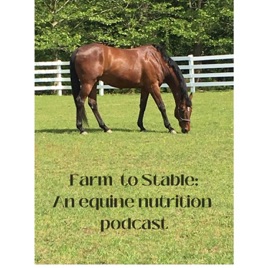
Advertise on podcast: Farm To Stable: An Equine Nutrition Podcast (TM)
Rating
5from
This podcast has
45 episodes
Language
EnglishPublisher
Dr. Nettie LiburtExplicit
No
Date created
2023/09/22
Latest episode
2025/07/14
Average duration
20 min.
Release period
14 days
Description
Welcome to Farm To Stable: An equine nutrition podcast. Here you will find practical, science-based facts from a professional PhD equine nutritionist, and some surprise guests along the way. I aim to help horse owners navigate the many questions and common concerns about feeding horses. Resources, links and other useful information will be provided based on show topics. If there are topics you'd like to hear about, contact me at [email protected]! (Music (C) Unsound Music/Randy J. Weiner)
Unlock Farm To Stable: An Equine Nutrition Podcast (TM) podcast Email contact info,
Listeners & Audience details
Email contact information
Direct podcast contact details

Listeners
Audience numbers & engagement insights

Audience details
Podcast Insights

Podcast episodes
Check latest episodes from Farm To Stable: An Equine Nutrition Podcast (TM) podcast
Staying Cool & Hydrated
2025/07/14
It's officially summer here in North America, and oh how hot it's become! Record high temperatures for the month of June have been set across the eastern half of the United States. How can you help your horse stay cool and hydrated? Should you ride or not? And what about that barn fan? Those are a few of the "hot" topics of this episode, along with how electrolytes actually work to keep a horse (and the human) hydrated. It gets a little science-y, but that's how I roll. I promise to make it fun and easy.
References and Links referenced in this episode:
Marlin, D. and Nankervis, K. 2002. Thermoregulation. In: Equine Exercise Physiology. pp.133-150. Blackwell Science. Oxford, UK.
American Association of Equine Practitioners (AAEP) on Facebook - heat index infographic: https://www.facebook.com/AAEPHorseDocs/posts/hot-tips-for-safe-summer-ridingas-you-enjoy-some-fun-in-the-sun-with-your-favori/828730918649725/
Rutgers University Fact Sheet about How to Take A Horses Temperature, Pulse and Respiration: https://esc.rutgers.edu/fact_sheet/measuring-tpr/
Does the frequency of meals affect horse behavior? We did a study on that! -With Dr.'s Sara Mastellar and Elizabeth Share of The Ohio State University
2025/07/11
Welcome special guests Dr. Sara Mastellar, Associate Professor at The Ohio State University ATI and Dr. Elizabeth Share, 4-H Program Specialist at The Ohio State University! If you've ever seen horses "guarding" hay nets or feed sources, or wondering how best to manage feeding time when horses are fed in groups, tune in for some helpful information. I was fortunate enough to be a collaborator on studies run by Dr.'s Mastellar and Share investigating the effect of meal frequency on horse behavior, and the data was presented at the recent Equine Science Society Symposium in June, 2025. These researchers were gracious enough to take some time to explain how they conducted the study and why, and the all-important results and insights gained from the research. The information learned is useful in the everyday management of horses, especially if you have more than one living in a common space. Tune in for an enjoyable conversation about how real scientific research leads to practical horse management guidelines from those who love horses!
Link to the study abstracts:
--https://doi.org/10.1016/j.jevs.2025.105462
Additional studies run concurrently by this group:
--https://doi.org/10.1093/jas/skae102.411
--https://doi.org/10.1016/j.jevs.2025.105522
--
Dr. Mastellar's Profile: https://ati.osu.edu/people/sara-l-mastellar-phd
Dr. Share's Profile: https://ansci.osu.edu/our-people/elizabeth-share-0
Link to the Equine Science Society:
Hoof Health From a (Mostly) Dietary Standpoint
2025/06/13
'Tis the season for mud...and often some concerns about hooves that come with it. Diet is a key factor in hoof health, but it can't prevent all problems. In addition to a balanced diet, genetics, environment and farrier care all play into hoof health. In this episode, the focus is on some key nutrients to support hoof health, and answer some questions about biotin (because I know you're thinking about biotin when it comes to hooves!)
We'll discuss some management issues, but for more reading on this topic, check out these fact sheets from the University of California-Davis Center for Equine Health and the University of Minnesota:
https://www.vetmed.ucdavis.edu/news/10-things-you-might-not-know-about-horse-hooves
https://extension.umn.edu/horse-health/caring-your-horses-hooves
Cover art photo credit: University of Minnesota Fact Sheet, link above.
Hay Cubes vs. Hay Pellets: Is one better than the other?
2025/05/30
I was recently asked, "What's the difference between hay pellets and hay cubes?" It made for a fun conversation (if you're a horse nutrition geek like I am) and I thought it would be a good discussion. Pellets and cubes are obviously forage alternatives that originate from hay - pellets are from ground hay and cubes are chopped and compressed. There are different reasons one may add a pellet vs. a cube to a horse's diet, if at all. What about the horse who can't even chew hay anymore? Or if you are having trouble finding good quality forage, and you'd like to improve the forage your horse is consuming? We'll touch on all of that and more in this episode, along with pros and cons. And of course, there's a little beet pulp mixed in...
Additional reading:
From the Rutgers University Equine Science Center, "Lord Nelson's Blog:"
https://esc.rutgers.edu/do-you-know-your-forage-alternatives/
Kentucky Equine Research: Hay Cubes and Pellets for Horses
https://ker.com/equinews/hay-cubes-pellets-horses/
Hay Analysis Explainer - What do all those numbers and letters mean?
2025/05/16
As a nutritionist, a hay analysis helps me create a complete, accurate picture of a horse's diet. Sometimes, it is not practical for a horse owner to acquire a hay or forage analysis. In other cases, an owner just doesn't know what to do with the information that comes back to them. In this episode, I'll explain a bit about the characteristics of good vs. poor quality hay - important if a hay analysis isn't available or practical. Then, I'll dive in to what some of those terms and values on a report actually mean. The point is to provide some context to an analysis report. Remember, it's only one part of the big picture, but having an idea of what it means can help you make good decisions about what and how to feed your horse based on their needs.
Donkeys are NOT Small Horses
2025/05/02
This one is for the long ears! Donkeys are smart, loyal and wonderful companions. Many economies in the developing world depend on donkeys for income, transportation and ensuring basic needs for their human caretakers. In other parts of the world, donkeys provide friendship to horses, humans and other donkeys, and serve as excellent guard animals.
Donkey nutrition is not the same as that for horses, and in this episode I'll discuss some of the basics for feeding donkeys. Links for more information and sources by the Donkey Sanctuary are below.
The Donkey Sanctuary Links:
Feeding Straw to Donkeys:
https://www.thedonkeysanctuary.org.uk/for-owners/owners-resources/feeding-straw-and-other-forages
Monitoring Your Donkey’s Weight:
https://www.thedonkeysanctuary.org.uk/for-owners/owners-resources/monitoring-your-donkeys-weight
General Resources for Donkey Owners:
https://www.thedonkeysanctuary.org.uk/for-owners
Post-Winter Weight Gain
2025/04/18
Recently, a friend reached out to me because her 19-year-old easy keeper is now showing ribs coming out of a very cold winter. This is a horse who is well-attended to and requires very little to keep his weight on, but as he's shedding, it seems he has lost a bit of weight. This is a relatively common occurrence, particularly as horses age, but there are some steps to take. In this episode, we'll review some weight-gain tips, along with suggestions for determining why weight loss happens in the first place. As promised, below are some helpful links for additional information.
Body Condition Scoring video with Dr. Bob Colemam of the University of Kentucky: https://www.youtube.com/watch?v=bq0ZXnSlsNQ
All About Body Condition Scoring (with pictures) from Iowa State University Extension: https://www.extension.iastate.edu/equine/body-condition-score#:~:text=Horses%20are%20scored%20on%20a,ribs%2C%20and%20behind%20the%20shoulder.
Need to buy a weight tape? Here's one place online (also check your local feed / tack store): https://a.co/d/j2wPmrK
Measuring tape long enough for horses: https://a.co/d/2IVae0e
Also, the "Healthy Horse" app is highly recommended for estimating a horse's body weight!
Weight Loss After Long Term Transport in Horses
2025/04/06
Recently, a barn mate asked me to help with her horse who had lost weight en route to a competition after a 14-hour trailer ride. Since many horses migrate for competition and other reasons, I wanted to discuss why a horse might lose weight on a long trip and what nutritional support helps support recovery. Weight loss is not the only physiological change that can occur during transport, but it is the focus of this episode. Note that any signs of distress should always be discussed with a veterinarian immediately. A nutritionist can help you get the diet on track for recovery of weight loss.
References for this episode:
Marlin & Nankervis, 2002. Transport. In: Equine Exercise Physiology. pp. 276-284. Blackwell Science. Oxford, UK.
C. L. Stull and Rodiek, A. V. 2000. Physiological responses of horses to 24 hours of transportation using a commercial van during summer conditions. Journal of Animal Science, 78(6): Pages 1458–1466, https://doi.org/10.2527/2000.7861458x
Supplements & Management for Itchy Equine Skin
2025/03/21
To celebrate the arrival of spring here in North America, we've got to talk about the coming bug season! If you haven't listened to the episode about healthy skin (Season 3, Episode 8), be sure to check that out as well, it covers the basics of healthy skin in general. This episode, we will focus on the many horses who suffer from itchy skin and allergic reactions to bug bites. There are plenty of things you can do to help reduce the irritation. Yes, there is a supplement you can feed to help as well!
One major management tip to help: STOP BATHING WITH DISH SOAP!!! It's too harsh for any horse's skin, especially those who are sensitive. Alternatives are discussed in this episode.
Listen in for advice on how to keep the bugs at bay and dietary options to help support your horse. Happy Spring!!
Research Reference:
O'Neill, et al. 2002. Flaxseed (Linum usitatissimum) supplementation associated with reduced skin test lesional area in horses with Culicoides hypersensitivity. Canadian Journal of Veterinary Research. 66: 272-277. https://pmc.ncbi.nlm.nih.gov/articles/PMC227015/
BONUS EPISODE: Basics of Breeding Herd Nutrition w/ Dr. Kris Hiney & the Tack Box Talk Podcast
2025/03/14
Check out this bonus episode of the "Farm To Stable: An Equine Nutrition Podcast" in collaboration with Dr. Kris Hiney, Extension Horses and the Tack Box Talk Podcast! As part of the Extension Horses Working Group, I'm fortunate to work with land-grant university experts from across the USA who are teachers, researchers and horse lovers from all disciplines. The purpose of university extension is to conduct research that helps the community, make that knowledge accessible and facilitate putting information to work.
Dr. Hiney invited me to be a guest recently (Feb. 2025) to talk about basic nutrition of the equine breeding herd, since foaling season is in full swing. So I'm sharing that discussion here!
Please check out Tack Box Talk for more fun, practical and interesting topics, and share this one as well. Here's a link: https://podcasts.apple.com/us/podcast/tack-box-talk/id1492355719
Happy riding!
When are low carbohydrate diets not necessarily beneficial?
2025/03/07
Carbohydrates are the main energy source used by muscles (and the brain!) for work. Horses need more time to replenish energy stores compared to a human. Can feeding a diet that is low in carbohydrates affect performance? Listen in this week to find out!
Scientific references used in preparation for this podcast are listed below.
Lacombe, V., Hinchcliff, K.W., et al. 2003. Effects of feeding meals with various soluble-carbohydrate content on muscle glycogen synthesis after exercise in horses. American Journal of Veterinary Research. 65(7).
https://doi.org/10.2460/ajvr.2004.65.916
Mesquita, V.S., Pagan, J.D., Valberg, S.J., Waldridge, B.M. and Whitehouse, C. 2014. Effect of non-structural carbohydrate, fat and fiber intake on glycogen repletion following intense exercise. Equine Veterinary Journal. 64(S46): 33. https://doi.org/10.1111/evj.12267_99
Skin Health and Equine Nutrition
2025/02/21
Cover Illustration Art Credit: Merck Veterinary Manual (link below)
Many of us are in the throes of winter and the start of shedding season. Winter dryness also contributes to dry skin. Can nutrition help? As always, nutrition is supportive of skin health. While it can't cure everything, some key nutrients can help give your horse's skin and coat a boost for overall health.
Links of Interest this week:
Merck Veterinary Manual: Structure of Skin in Horses: https://www.merckvetmanual.com/horse-owners/skin-disorders-of-horses/structure-of-the-skin-in-horses
Essential Fatty Acids and Skin Health (human focus): https://lpi.oregonstate.edu/mic/health-disease/skin-health/essential-fatty-acids
All About Vitamin E
2025/02/07
This episode talks about why Vitamin E is an important part of a horse's diet, and covers the difference between natural and synthetic Vitamin E. Discussion also includes general scenarios in which supplemental Vitamin E should be considered, what form may be appropriate and why. Vitamin E is always a popular topic, so enjoy!
The Science of Haynets - Real Benefits and Considerations
2025/01/24
Haynets are a common site in horse barns, but have you ever thought about why there are there? Are they stressful for horses? Do they have nutritional benefits? Do they really work to reduce waste? We’ll answer these questions and more in this episode, and talk about where the research came from.
Cover Art Photo: iStock, Anja Janssen
Links to research and more information:
Extension Horses Fact Sheets: 5 Benefits of Slow Feed Hay Nets - https://horses.extension.org/5-benefits-of-slow-feed-hay-nets/
Extension Horses Fact Sheets: Do hay nets impact horse health? https://horses.extension.org/do-hay-nets-impact-horse-health/
DeBoer, et al., 2024. Effect of hay nets on horse bodyweight, body condition score, hay usage, and dental health in mature adult horses. Journal of Equine Veterinary Science. Vol. 136. https://doi.org/10.1016/j.jevs.2024.105051
Glunk, E., et al., 2014. The Effect of Hay Net Design on Rate of Forage Consumption When Feeding Adult Horses. Journal of Equine Veterinary Science. Vol. 34, pp. 986-991 https://doi.org/10.1016/j.jevs.2014.05.006
Glunk, et al., 2015. The effect of a limit-fed diet and slow-feed hay nets on morphometric measurements and postprandial metabolite and hormone patterns in adult horses. Journal of Animal Science. Vol. 93, pp. 4144–4152.
https://doi.org/10.2527/jas.2015-9150
Ivester, et al., 2014. Environmental Exposures and Airway Inflammation in Young Thoroughbred Horses. Journal of Veterinary Internal Medicine. Vol. 28, pp.918-924. https://doi.org/10.1111/jvim.12333
Locke, et al., 2023. Effects of prolonged hay net feeding on equine behavior. Journal of Equine Veterinary Science. Vol. 124. https://doi.org/10.1016/j.jevs.2023.104529
Managing Changes or Additions to the Horse's Diet
2025/01/10
I recently heard from a friend who is at a barn that changed the type of feed they were providing. Sadly, they ended up with a few cases of colic. While I don't know all the details, I thought it was a good topic to discuss - when making changes to a horse's diet, how and why it needs to be done slowly and carefully. Listen in for tips and guides on how to do this and what to do if you need to add something new to the diet as well.
Podcast reviews
Read Farm To Stable: An Equine Nutrition Podcast (TM) podcast reviews
Seratom 2023/09/29
Great podcast!!!
Looking forward to more!
Puncho38 2023/09/26
A Clear and Understandable Review of Equine Nutrition!
An excellent exposition of this easily misunderstood field of equine discipline.
Podcast sponsorship advertising
Start advertising on Farm To Stable: An Equine Nutrition Podcast (TM) relevant audience podcasts
You may also like to advertise on these Podcasts
4.4371061566
The Megyn Kelly Show
SiriusXM
4.888901269
Fearless with Jason Whitlock
Blaze Podcast Network
4.8118931000
Mind Pump: Raw Fitness Truth
Sal Di Stefano, Adam Schafer, Justin Andrews, Doug Egge
4.8102131585
Tara Brach
Tara Brach

4.541561215
Something You Should Know
Mike Carruthers | OmniCast Media

4.513841343
Strictly Anonymous Confessions
Kathy Kay
4.8292781897
Fantasy Footballers - Fantasy Football Podcast
Fantasy Football

4.62382612
Football Weekly
The Guardian

4.45387666
Two Judgey Girls
Two Judgey Girls
3.8258501152
The Viall Files
Nick Viall