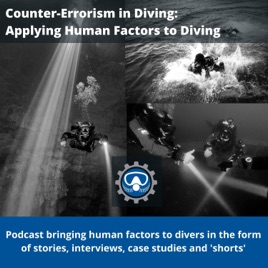
Advertise on podcast: Counter-Errorism in Diving: Applying Human Factors to Diving
Rating
5from
This podcast has
311 episodes
Language
EnglishPublisher
Gareth Lock at The Human DiverExplicit
No
Date created
2023/09/23
Latest episode
2026/10/03
Average duration
14 min.
Release period
6 days
Description
Human factors is a critical topic within the world of SCUBA diving, scientific diving, military diving, and commercial diving. This podcast is a mixture of interviews and 'shorts' which are audio versions of the weekly blog from The Human Diver. Each month we will look to have at least one interview and one case study discussion where we look at an event in detail and how human factors and non-technical skills contributed (or prevented) it from happening in the manner it did.
Unlock Counter-Errorism in Diving: Applying Human Factors to Diving podcast Email contact info,
Listeners & Audience details
Email contact information
Direct podcast contact details

Listeners
Audience numbers & engagement insights

Audience details
Podcast Insights

Podcast episodes
Check latest episodes from Counter-Errorism in Diving: Applying Human Factors to Diving podcast
SH311: 3. Don’t Wait - Learn From Everyday Work Using HOP Principles
2026/10/03
This episode explores Human and Organizational Performance (HOP), an approach to safety that starts with the idea that people will always make mistakes, so we should focus on understanding why decisions made sense at the time rather than simply blaming individuals. Drawing on a workshop from the Human Factors in Diving Conference in Vis, Croatia, we look at how HOP can be applied to diving by considering the conditions, information, equipment and pressures people were working with. Using a hypothetical case of a dive boat leaving two divers behind, we compare traditional incident investigations with a more curious approach that looks at the wider context, including workload, fatigue, schedules, group dynamics and the pressures faced by the crew. Most importantly, HOP encourages us to learn from everyday work rather than waiting for something to go wrong, asking what makes things succeed and where risks might be hiding. The episode considers how regular debriefs and humble inquiry can help teams learn, improve and build safer systems without relying on blame.
Original blog: https://www.thehumandiver.com/post/steve-smith-applying-hop-lucky-or-good
Tags: THD-English| THD-Education & Content Type| THD-HFiD-Conference
SH310: 2. More Than a Deep Dive: What a WWII Bomber Recovery Can Teach Us About Human Factors
2026/09/30
This episode explores what really makes complex technical diving successful: not just helium, decompression and equipment, but the people using them. Using the recovery of the WWII B-24 Liberator Tulsamerican off the island of Vis as a case study, we look at how communication, teamwork, workload management, clear goals and psychological safety can make the difference between a team that simply completes a dive and one that achieves its mission safely. The project brought together divers, archaeologists, historians, military agencies, local authorities and vessel crews from different backgrounds and countries, creating the kind of complex environment where human performance becomes critical. The story shows how small mistakes can quickly become team problems, why anyone should be able to speak up or call a dive, and how focusing on the wider mission can help prevent individual ambition from driving poor decisions. Ultimately, the Tulsamerican recovery demonstrates that technical diving is about far more than what we carry into the water—it is about how effectively we work together.
Original blog: https://www.thehumandiver.com/post/more-than-a-deep-dive
Tags: THD-English| THD-Education & Content Type| THD-HFiD-Conference
SH309: Change around Safety Culture is Really Hard
2026/09/23
In this episode, Gareth Lock reflects on why improving diving safety requires more than telling people to follow the rules. Drawing on his experience in aviation, diving, and safety science, he explains why incidents are often blamed on individuals while the wider system escapes scrutiny. The discussion explores how culture, reporting systems, commercial pressures, and training standards shape diver behaviour, why many divers avoid formal reporting channels, and what other high-risk industries have done to build real learning systems. Gareth also shares how The Human Diver, the LEODSI investigation framework, and new industry standards are helping shift the focus from blame and compliance to understanding context, building trust, and creating lasting improvements in diving safety.
Original blog: https://www.thehumandiver.com/post/cultural-infleunce-is-really-hard
Links: Developing competencies and capacities for resilient performance: https://www.thehumandiver.com/post/resilient-performance-model
Diving Talks: https://youtu.be/fUSD9gPZ-x0
Work as Imagined vs Work as Done: https://www.youtube.com/watch?v=vtgIwHrUWVQ&list=PLNXuyLsCTX6hHS3newpcROfJ_JiI27q3C&index=24
Standards: https://www.thehumandiver.com/post/beyond-the-floor
Gareth’s Thesis: https://youtu.be/DRXqeQvRFK0
Flavours of Human Factors: https://www.thehumandiver.com/post/four-ways-of-hf
LEODSI: https://www.thehumandiver.com/post/what-is-leodsi-petteot
Chac Mool fatalities: https://www.thehumandiver.com/post/chac-mool-triple-diving-fatality
Human Diver Conference: https://www.hf-in-diving-conference.com/
Rebreather Forum 4: https://youtu.be/nkdVHBDnCjc?t=3015
Maldives fatalities: https://www.thehumandiver.com/post/the-structure-is-normal-the-scale-is-not
Events that happen without fatalities: https://www.thehumandiver.com/post/we-know-and-we-say-nothing
Agencies using HF language: https://www.tdisdi.com/sdi-diver-news/how-serious-are-you-about-safety/
Levels of training available: https://www.thehumandiver.com/your-learning-journey
Tags: THD-English| THD-Education & Content Type
SH308: We Know, and We Say Nothing
2026/09/16
This episode explores why experienced divers still die in situations that seem predictable, using the tragic 2026 Maldives cave accident as a starting point. It looks at how outcome bias, the normalisation of deviance, nitrogen narcosis, group dynamics, and silent drift can gradually erode safety margins without divers realising it. Rather than focusing on individual mistakes, the discussion explains how everyday decisions, accepted norms, and human psychology combine to create risk over time. It also examines what divers, teams, and the wider diving community can do to recognise these patterns, challenge unsafe habits, encourage open communication, and build a culture that learns from accidents instead of simply accepting them as bad luck.
Original blog: https://www.thehumandiver.com/post/we-know-and-we-say-nothing
NotesConcept formalised by Baron, J. & Hershey, J. C., "Outcome bias in decision evaluation," Journal of Personality and Social Psychology 54 (1988), p. 569-579. PDF available: https://www.sas.upenn.edu/~baron/papers/outcomebias.pdfVaughan, D., The Challenger Launch Decision: Risky Technology, Culture, and Deviance at NASA, University of Chicago Press, 1996. Publisher page: https://press.uchicago.edu/ucp/books/book/chicago/C/bo22781921.htmlLock, G., Under Pressure: Diving Deeper with Human Factors (2019); see also The Human Diver (https://www.thehumandiver.com) and the documentary If Only… (https://www.thehumandiver.com/ifonly).First systematic experimental demonstration: Behnke, A. R., Thomson, R. M. & Motley, E. P., "The psychologic effects from breathing air at 4 atmospheres pressure," American Journal of Physiology 112(3), 1935, p. 554-558. DOI: https://doi.org/10.1152/ajplegacy.1935.112.3.554For an overview, see Nitrogen Narcosis In Diving on StatPearls (NCBI/NIH): https://www.ncbi.nlm.nih.gov/books/NBK470304/; and Clark, J. E., Moving in extreme environments: inert gas narcosis and underwater activities, Extreme Physiology & Medicine 3 (2014), which establishes that narcosis directly contributes to up to 6% of diving deaths — free full text: https://www.ncbi.nlm.nih.gov/pmc/articles/PMC4337274/Hamilton, K., Laliberté, M. F. & Fowler, B., "Dissociation of the behavioral and subjective components of nitrogen narcosis and diver adaptation," Undersea & Hyperbaric Medicine 22(1), March 1995, p. 41-49 (PMID 7742709): https://pubmed.ncbi.nlm.nih.gov/7742709/
BibliographyDecision biases, normalisation of deviance, human factors
Baron, J. & Hershey, J. C., "Outcome bias in decision evaluation," Journal of Personality and Social Psychology 54 (1988), p. 569-579. PDF: https://www.sas.upenn.edu/~baron/papers/outcomebias.pdfVaughan, D., The Challenger Launch Decision: Risky Technology, Culture, and Deviance at NASA, University of Chicago Press, 1996. Publisher page: https://press.uchicago.edu/ucp/books/book/chicago/C/bo22781921.htmlLock, G., Under Pressure: Diving Deeper with Human Factors, 2019. The Human Diver: https://www.thehumandiver.com. Documentary If Only…: https://www.thehumandiver.com/ifonly
Physiology of narcosis
Behnke, A. R., Thomson, R. M. & Motley, E. P., "The psychologic effects from breathing air at 4 atmospheres pressure," American Journal of Physiology 112(3), 1935, p. 554-558. First systematic experimental demonstration of the narcotic effects of compressed air at depth. DOI: https://doi.org/10.1152/ajplegacy.1935.112.3.554Kirkland, P. J., Mathew, D., Modi, P. & Cooper, J. S., Nitrogen Narcosis In Diving, StatPearls (NCBI/NIH), last updated 2023: https://www.ncbi.nlm.nih.gov/books/NBK470304/Clark, J. E., "Moving in extreme environments: inert gas narcosis and underwater activities," Extreme Physiology & Medicine 3 (2014). Free full text via PMC: https://www.ncbi.nlm.nih.gov/pmc/articles/PMC4337274/Hamilton, K., Laliberté, M. F. & Fowler, B., "Dissociation of the behavioral and subjective components of nitrogen narcosis and diver adaptation," Undersea & Hyperbaric Medicine 22(1), March 1995, p. 41-49. PMID 7742709: https://pubmed.ncbi.nlm.nih.gov/7742709/
Diving accident research
Divers Alert Network, Annual Diving Reports (long series, 1988 to 2021). Full collection consultable online: https://www.ncbi.nlm.nih.gov/books/NBK481542/Exley, S., Basic Cave Diving: A Blueprint for Survival, National Speleological Society — Cave Diving Section, Branford (FL), 1979. Official NSS-CDS PDF: https://nsscds.org/wp-content/uploads/2018/05/Blueprint-for-Survival.pdfBuzzacott, P., Zeigler, E., Denoble, P. & Vann, R., "American Cave Diving Fatalities 1969-2007," International Journal of Aquatic Research and Education 3(2), 2009, p. 162-177. Free full text: https://scholarworks.bgsu.edu/ijare/vol3/iss2/7/Potts, L., Buzzacott, P. & Denoble, P. J., "Thirty years of American cave diving fatalities," Diving and Hyperbaric Medicine 46(3), September 2016, p. 150-154. PMID 27723015: https://pubmed.ncbi.nlm.nih.gov/27723015/
Tags: THD-English|a href="https://www.thehumandiver.com/blog/category/learning-JC-incidents"...
SH307: 1. The 2026 HF in Diving Conference - What Did You Miss?
2026/09/09
This episode explores how a restorative just culture can help the diving community respond to incidents in a way that promotes learning rather than blame. Instead of focusing only on who broke the rules, it looks at who was harmed, what they need, and how trust can be rebuilt while addressing the wider conditions that contributed to the event. The discussion covers the impact on everyone involved, the role of accountability, compassion, and forgiveness, and why repairing systems is more effective than simply punishing individuals. It also introduces Professor Sidney Dekker's Restorative Just Culture Checklist as a practical tool for turning difficult events into opportunities for meaningful learning and safer diving.
Original blog: https://www.thehumandiver.com/post/2026-hfid-conference-what-did-you-miss
Tags: THD-English| THD-Education & Content Type| THD-HFiD-Conference
SH306: Restorative Just Culture: Repairing Trust After an Event
2026/09/02
This episode explores the difference between a retributive approach to diving incidents, which focuses on blame and punishment, and a restorative just culture, which focuses on learning, repair, and preventing future harm. It explains how incidents affect not only those directly involved but also instructors, organisations, and the wider diving community, and argues that real accountability means understanding what happened, supporting everyone affected, rebuilding trust, and fixing the conditions that allowed the event to occur. The discussion also introduces Professor Sidney Dekker's Restorative Just Culture Checklist as a practical tool for helping individuals and organisations move from blame to meaningful learning and lasting improvement.
Original blog: https://www.thehumandiver.com/post/restorative-just-culture
Links: The PDF checklist: https://drive.google.com/file/d/1Vkg0o4Fc8XWsAul-mkXNqD5lwokQ0ntP/view?usp=sharing
Tags: THD-English| THD-Education & Content Type
SH305: Cause Reason. Excuse. Three Words Doing Three Very Different Things.
2026/08/26
This episode explores an important distinction that is often missed when discussing diving incidents: the difference between a cause, a reason, and an excuse. A cause explains what contributed to an event, a reason explains why a person's actions made sense to them at the time, and an excuse uses those reasons to avoid accountability. Understanding these differences helps us learn from accidents without simply assigning blame or letting people off the hook. The discussion shows why complex incidents usually have many interacting causes, why understanding local decision-making is essential for improving safety, and how separating learning from punishment leads to better conversations, stronger investigations, and safer diving for everyone.
Original blog: https://www.thehumandiver.com/post/cause-reason-excuse
Links: Accountability blog: https://www.thehumandiver.com/post/we-want-accountability
RaDonda Vaught case: https://www.thehumandiver.com/post/the-structure-is-normal-the-scale-is-not
Stop rules blog: https://www.thehumandiver.com/post/why-investigations-stop-where-they-stop
Richard Cook’s diagram: https://www.thehumandiver.com/post/joining-dots-is-easy-if-you-know-the-outcome
More about the RaDonda Vaught case: https://humanfactors101.com/2022/05/08/is-human-error-a-crime/
The eight question review: https://www.thehumandiver.com/post/eight-questions-about-maldives-accident
“Learning” the same lessons: https://www.thehumandiver.com/post/why-does-nothing-change
Tags: THD-English| THD-Learning, Incidents & Just Culture
SH304: Why Investigations Stop Where They Stop
2026/08/19
This episode explores why accident investigations often stop long before they uncover the full picture. Drawing on research from safety science, it argues that the “cause” of an incident is not simply discovered—it is shaped by who is investigating, what they are able to change, and what explanations their community accepts. In diving, investigations often focus on the actions of individual divers or instructors because these are the easiest problems to address, while deeper issues such as organisational culture, commercial pressures, and industry practices are left unexplored. The episode examines how different people can interpret the same event in very different ways, why every investigation helps shape the community’s understanding of safety, and why asking “Why did the investigation stop here?” can lead to far richer learning than simply accepting the reported cause.
Original blog: https://www.thehumandiver.com/post/why-investigations-stop-where-they-stop
Links: The most complete data on diving fatalities from 2008: https://pubmed.ncbi.nlm.nih.gov/19175195/
Blog exploring the purposes of running an investigation: https://www.thehumandiver.com/post/what-is-the-purpose-of-an-investigation
LFEO program: https://www.thehumandiver.com/lfeo
HFiD conference: https://www.hf-in-diving-conference.com/
What you look for is what you find: https://doi-org.ludwig.lub.lu.se/10.1016/j.ssci.2009.01.004
What you find is what you fix: https://doi-org.ludwig.lub.lu.se/10.1016/j.aap.2010.07.003
Blog about agency/organisation standards: https://www.thehumandiver.com/post/beyond-the-floor
Speaking truth to power: https://www.thehumandiver.com/post/when-im-fine-isnt-true
Structural conditions that produce decisions: https://www.thehumandiver.com/post/the-structure-is-normal-the-scale-is-not
Other references:
Blazsin, H. & Guldenmund, F. (2015). The social construction of safety: Comparing three realities. Safety Science, 71, 16–27.
Lundberg, J., Rollenhagen, C. & Hollnagel, E. (2009). What-You-Look-For-Is-What-You-Find — The consequences of underlying accident models in eight accident investigation manuals. Safety Science, 47(10), 1297–1311.
Lundberg, J., Rollenhagen, C. & Hollnagel, E. (2010). What you find is not always what you fix — How other aspects than causes of accidents decide recommendations for remedial actions. Accident Analysis and Prevention, 42, 2132–2139.
Rasmussen, J. (1990). Human error and the problem of causality in analysis of accidents. Philosophical Transactions of the Royal Society of London B, 327, 449–462.
Rochlin, G. I. (1999). Safe operation as a social construct. Ergonomics, 42(11), 1549–1560.
Shreeves, K., Buzzacott, P., Hornsby, A., & Caney, M. (2018). Violations of safe diving practices among 122 diver fatalities. Int. Marit. Health, 69(2), 94–98. https://doi.org/10.5603/imh.2018.0014
van der Schaaf, T. W., Lucas, D. A. & Hale, A. R. (1991). Near miss reporting as a safety tool. Butterworth-Heinemann.
Tags: THD-English| THD-Learning, Incidents & Just Culture
SH303: The Structure of This Diving Tragedy Was Not Abnormal. The Scale Was.
2026/08/12
This episode explores why diving accidents are so often explained by individual mistakes instead of the wider conditions that made those mistakes possible. Using the case of a fatal medication error in healthcare alongside the recent Maldives cave diving tragedy, it examines how hindsight, blame, and our natural tendency to focus on people rather than systems can prevent meaningful learning. The discussion highlights how unsafe practices can become normal when they repeatedly appear to work, and why serious accidents often reveal long-standing weaknesses that existed long before the final event. Rather than asking "Who is at fault?", the episode argues that the better question is "What conditions made these decisions seem reasonable at the time?"—because understanding those conditions offers the best chance of preventing similar tragedies in the future.
Original blog: https://www.thehumandiver.com/post/the-structure-is-normal-the-scale-is-not
Links: Martin Anderson’s write-up: https://humanfactors101.com/2022/05/08/is-human-error-a-crime/
Andrzej Gornicki’s Eight Question Review: https://www.thehumandiver.com/post/eight-questions-about-maldives-accident
Gareth’s blog about accountability: https://www.thehumandiver.com/post/we-want-accountability
Assumptions and worn paths: https://www.thehumandiver.com/post/why-rules-get-broken
Consensus is because people don’t want to disagree: https://www.thehumandiver.com/post/beyond-the-floor
Conditions produce outcomes: https://www.thehumandiver.com/post/what-conditions
Useful illegality in action: https://www.thehumandiver.com/post/why-rules-get-broken
Tags: THD-English| THD-Learning, Incidents & Just Culture
SH302: Why Rules Get Broken. Does It Matter Who Is Breaking Them?
2026/08/05
This episode explores why rule-breaking in diving is often more complicated than simply “breaking the rules.” It looks at the difference between shortcuts that organisations quietly depend on to keep operating and personal shortcuts taken for convenience or ego. Through real-world examples, the discussion explains how hindsight can unfairly turn system-wide problems into individual blame after an incident occurs. The episode also examines why teams often stay silent when they notice problems, how social pressure affects decision-making, and why genuine learning requires understanding the reality of how diving actually works rather than relying on simple explanations. Ultimately, it challenges divers, instructors, and leaders to recognise the difference between necessary adaptations and risky personal shortcuts before something goes wrong.
Original blog: https://www.thehumandiver.com/post/why-rules-get-broken
Links: Blog about how conditions shape actions: https://www.thehumandiver.com/post/what-conditions
Master thesis about storytelling to learn: https://www.thehumandiver.com/post/msc-part-1-the-problem-space
Guide to speaking truth to power: https://www.thehumandiver.com/resources
Tags: THD-English| THD-Learning, Incidents & Just Culture
SH301: Eight Questions About the Maldives Dive Accident
2026/08/01
This episode examines the deaths of five Italian divers in the Maldives and a Maldivian military diver who later died during the recovery operation, using the tragedy to explore how Just Culture approaches accidents in high-risk environments. Rather than rushing to blame individuals, the discussion walks through the Eight-Question Review framework, which looks first at the wider system: authority, procedures, training, resources, organisational culture, operational norms, and the pressures influencing decisions. The episode highlights how experienced scientific divers can still face hidden competence gaps when moving into technical cave environments, how commercial and research pressures can shape risk-taking, and how safety rules may drift away from everyday practice over time. It also explores the dangers of hindsight bias and why meaningful investigations must focus on understanding how decisions made sense to those involved at the time, not simply judging outcomes after the fact. The central message is that accidents rarely come from one bad decision alone, but from interacting conditions within a wider system—and that real learning only happens when we are willing to ask difficult questions before assigning blame.
Original blog: https://www.thehumandiver.com/post/eight-questions-about-maldives-accident
Links: Blog about the Chac Mool deaths: https://www.thehumandiver.com/post/chac-mool-triple-diving-fatality
Further reading on The Human Diver:
Change your Language, Change the World
They Lost Situation Awareness
The Eight-Question Review — LFEO course
Tags: THD-English| THD-Learning, Incidents & Just Culture
SH300: "We want accountability."
2026/07/29
This episode reflects on the tragic deaths of five Italian divers in the Maldives and a Maldivian military diver who died while trying to recover them, using the event to explore what real accountability should look like after a diving accident. Rather than rushing to blame or making assumptions based on limited information, the discussion challenges the diving community to resist quick judgement and focus instead on understanding the conditions, decisions, and systems that may have shaped the outcome. It examines the difference between backward-looking accountability, which seeks someone to blame, and forward-looking accountability, which asks better questions about training, equipment, oversight, environmental conditions, and the support given to those involved in both the original dive and the recovery effort. At a time when facts are still emerging, the episode argues that meaningful learning begins with humility, patience, and a commitment to understanding what really happened—because only then can the diving community improve and better protect those who dive and those asked to rescue others.
Original blog: https://www.thehumandiver.com/post/we-want-accountability
Tags: THD-English| THD-Learning, Incidents & Just Culture
SH299: When we ask 'What conditions made this more likely?' perspectives (should) change
2026/07/25
This episode challenges the instinct to explain diving accidents by focusing only on individual mistakes or broken rules. Instead, it explores how social, cultural, organisational, and environmental conditions shape the decisions divers make, even when those decisions seem irrational in hindsight. Using recent diving incidents as examples, the discussion highlights how behaviour that appears risky often made sense to those involved at the time, influenced by pressures such as authority, identity, time, and the expectation to “get the job done.” The episode introduces the PETTEOT framework—Person(s), Environment, Tasks, Tools and Technology, External Influences, Organisation, and Time—as a way to better understand how different parts of the diving system interact to create both success and failure. By moving beyond blame and examining the wider system, divers, instructors, and leaders can uncover the hidden conditions that shape performance and learn where meaningful improvements can be made, helping the community become better than yesterday.
Original blog: https://www.thehumandiver.com/post/what-conditions
Links: Blog about LEODSI and PETTEOT: https://www.thehumandiver.com/post/what-is-leodsi-petteot
Tags: THD-English| THD-Learning, Incidents & Just Culture
SH298: Beyond the Floor: Why Meeting the Standard Isn't the Same as Being Safe
2026/07/22
This episode challenges the common belief that following diving standards automatically makes diving safe. It explores how industry standards, while important, can create an illusion of safety when compliance becomes the main goal rather than improving real-world performance. The discussion examines how many diving standards are written and assessed by the same organisations they are meant to guide, creating a closed system that can protect institutions legally while limiting opportunities for deeper learning and improvement. It also looks at why accident investigations often focus on individual mistakes rather than questioning whether the procedures, training, or standards themselves are fit for purpose. Drawing on research from aviation, healthcare, and other high-risk industries, the episode argues that safer diving requires more than rule-following—it needs independent oversight, greater transparency, and a willingness to learn from outside safety science. True progress comes not from assuming yesterday’s standards are enough, but from building systems that can recognise their own limits and continually improve.
Original blog: https://www.thehumandiver.com/post/beyond-the-floor
Links: Diving Talks: 'Compliance provides an illusion for safety in diving
InDepth article: https://indepthmag.com/compliance-provides-an-illusion-of-safety-in-diving/
Suggested further readingAmalberti, R. (2001) The paradoxes of almost totally safe transportation systems. Safety Science, 37(2–3), pp. 109–126. https://www.sciencedirect.com/science/article/pii/S092575350000045X
Carpenter, D. and Moss, D. (eds.), Preventing Regulatory Capture (Cambridge University Press, 2014). https://www.cambridge.org/core/books/preventing-regulatory-capture/
Dekker, S., The Safety Anarchist (Routledge, 2018) and Compliance Capitalism (Routledge, 2022). https://www.amazon.co.uk/Safety-Anarchist-innovation-bureaucracy-compliance-ebook/dp/B0FCCZCTG5
Dixon-Woods, M., Yeung, K., & Bosk, C. L. (2011). Why is UK medicine no longer a self-regulating profession? The role of scandals involving “bad apple” doctors. Social Science & Medicine, 73(10), 1452–1459. https://doi.org/10.1016/j.socscimed.2011.08.031
Hopkins, A., Failure to Learn: The BP Texas City Refinery Disaster (CCH Australia, 2008). https://www.amazon.co.uk/Failure-Learn-Texas-Refinery-Disaster/dp/1921322446
Lundberg, J., Rollenhagen, C., and Hollnagel, E., What-You-Look-For-Is-What-You-Find: The consequences of underlying accident models in eight accident investigation manuals, Safety Science 47(10), 2009. https://www-sciencedirect-com.ludwig.lub.lu.se/science/article/pii/S0925753509000137
Meyer, J. and Rowan, B., Institutionalized Organizations: Formal Structure as Myth and Ceremony, American Journal of Sociology 83(2), 1977. https://www.jstor.org/stable/pdf/2778293.pdf
Rae, A., Provan, D., Weber, D., and Dekker, S., Safety Clutter: The Accumulation and Persistence of 'Safety' Work That Does Not Contribute to Operational Safety, Policy and Practice in Health and Safety 16(2), 2018. https://doi.10.1080/14773996.2018.1491147
Thompson, D., Moral Responsibility of Public Officials: The Problem of Many Hands, American Political Science Review 74(4), 1980.
Tags: THD-English| THD-Operations & Procedures
SH297: CRM, ISO 8804, and Scientific Diving: Opportunities and Existing Materials
2026/07/18
This episode explores the growing recognition that safe and effective scientific diving depends on more than technical skill, equipment, and certification. Prompted by new research into applying Crew Resource Management (CRM) to scientific diver training, it examines why communication, leadership, teamwork, and decision-making are essential in complex underwater operations where divers must manage both life support and scientific tasks under pressure. Drawing on lessons from aviation, healthcare, and other high-risk industries, the discussion highlights key challenges such as cognitive overload, distributed situational awareness, and authority gradients that can prevent divers from speaking up or adapting effectively when conditions change. It also reviews the existing research, training tools, and practical frameworks already available to support this shift, while recognising that long-term improvement depends on treating diving safety as an ongoing process of learning rather than a box-ticking exercise. The message is clear: true safety is built through the conditions teams create, the culture they sustain, and how they respond when concerns are raised—always striving to be better than yesterday.
Original blog: https://www.thehumandiver.com/post/CRM-and-Scientific-Diving
Links: Original LinkedIn post: https://www.linkedin.com/posts/raymond-arce-528304355_cd37166-scientificdiving-divertraining-share-7460336156979888128-ASrc/?utm_source=social_share_send&utm_medium=member_desktop_web&rcm=ACoAAAELqPcBwf1_VKIPpplosn5XZ02d6xlOzRs
9th Annual European Conference on Scientific Diving: https://ecsd9azores.com/
Resilient Performance Model blog: https://www.thehumandiver.com/post/resilient-performance-model
Outcomes are a Function of…..: https://youtu.be/nkdVHBDnCjc?t=2293
Looking at CRM relevant failures: https://www.thehumandiver.com/post/what-is-leodsi-petteot
Guide to Diving Crew Resource Management: https://www.thehumandiver.com/commercial-occupational-diving
Moving beyond the position that compliance means safety: https://indepthmag.com/compliance-provides-an-illusion-of-safety-in-diving/
ReferencesCaramanna, G., & Strickland, B. (2023). Risk Management for Diving Operations: How to enhance the safety and proficiency of diving teams. Self-published. ISBN: 979-8988399612.
CSA Group (2026). CSA Z275.2: Occupational Health and Safety Code for Diving Operations. Toronto: CSA Group.
Edmondson, A. (1999). Psychological safety and learning behavior in work teams. Administrative Science Quarterly, 44(2), 350–383.
Endsley, M. R. (1995). Toward a theory of situation awareness in dynamic systems. Human Factors, 37(1), 32–64.
Flin, R., & Maran, N. (2004). Identifying and training non-technical skills for teams in acute medicine. Quality and Safety in Health Care, 13(suppl 1), i80–i84.
Flin, R., O'Connor, P., & Crichton, M. (2008). Safety at the Sharp End: A Guide to Non-Technical Skills. Farnham: Ashgate.
Health and Safety Executive (2011). Research Report RR871: Assessment of Manual Operations and Emergency Procedures for Closed Circuit Rebreathers. London: HSE Books.
International Association of Oil and Gas Producers (2018). Report 503: Introducing Behavioural Markers of Non-Technical Skills in Oil and Gas Operations. London: IOGP.
Lock, G. (2019). Under Pressure: Diving Deeper with Human Factors. Milton Keynes: Human in the System Consulting.
Lock, G. (2023). Human factors and rebreather diving. In: Pollock NW, ed. Rebreather Forum 4. Proceedings of the April 20-22, 2023 workshop. Valletta, Malta; 2024. p. 57–69.
O'Brien, E., & Caramanna, G. (2017). Human factors in scientific diving: an experimental approach. In Proceedings of the AAUS Diving for Science Symposium 2017. Thunder Bay National Marine Sanctuary: American Academy of Underwater Sciences.
Piispanen, W., Lundell, R., Tuominen, L., & Räisänen-Sokolowski, A. (2021). Assessment of alertness and cognitive performance of closed circuit rebreather divers with the Critical Flicker Fusion Frequency Test in Arctic diving conditions. Frontiers in Physiology, 12, 722915.
Reader, T. W., & O'Connor, P. (2014). The Deepwater Horizon explosion: non-technical skills, safety culture, and system complexity. Journal of Risk Research, 17(3), 405–424.
Reitz, M., Nilsson, V., Day, E. and Higgins, J. (2019). Speaking truth to power at work. Hult Research.
Sinek, S. (2019). The Infinite Game. New York: Portfolio/Penguin.
Stanton, N. A., Stewart, R., Harris, D., Houghton, R. J., Baber, C., McMaster, R., Salmon, P., Hoyle, G., Walker, G., Young, M. S., Linsell, M., Dymott, R., & Green, D. (2006). Distributed situation awareness in dynamic systems: theoretical development and application of an ergonomics methodology. Ergonomics, 49(12–13), 1288–1311.
Sweller, J. (1988). Cognitive load during problem solving: effects on learning. Cognitive Science, 12(2), 257–285.
Yule, S., Flin, R., Paterson-Brown, S., & Maran, N. (2006). Development of a rating system for surgeons' non-technical skills. Medical Education, 40(11), 1098–1104.
Tags: THD-English| THD-CRM, Leadership & Teamwork
Podcast reviews
Read Counter-Errorism in Diving: Applying Human Factors to Diving podcast reviews
The Divers 2026/06/14
Essential information for all divers
I began viewing my scuba diving, and life in general, through a different lens after reading Under Pressure. I then took the Essentials online course ...
Lookn4sharks 2024/07/25
Needs to be incorporated into scuba diving training
Gareth’s book “Under Pressure” is a must read for all scuba divers. He debriefs accidents in a nonjudgemental describing patterns of thinking that co...
Ron & Heidi SCUBA 2023/10/14
Most important podcast for the diving industry
Gareth has truly created the most important dive safety content for the industry. His concepts are designed to create critical thinking skills and app...
Docvfr 2023/10/01
Long Form Conversations
Truly stoked to see that Gareth has “finally” gotten into the podcast game as a host.
As a guest on our podcast, he spoke as if he had been preparin...
mysigp226 2023/10/01
Life changing - literally
Gareth is bringing the human back to diving and ushering in a much needed culture shift in the community. What I have learned in Human Factors has fun...
Podcast sponsorship advertising
Start advertising on Counter-Errorism in Diving: Applying Human Factors to Diving relevant audience podcasts
You may also like to advertise on these Podcasts
4.824761865
Deck The Hallmark
Bramble Jam Podcast Network

4.8104492000
Steve Deace Show
Blaze Podcast Network

4.75881745
Ruthless Podcast
Josh Holmes, Comfortably Smug, Michael Duncan and John Ashbrook
4.7368461279
Louder with Crowder
Louder with Crowder

4.723141951
Timeless Wisdom with Dennis Prager
Salem Podcast Network

4.662822000
The Dr. Laura Podcast
Dr. Laura Schlessinger & SiriusXM
4.815421000
The Todd Herman Show
Radio America
4.715161997
Thrivetime Show | Business School without the BS
Clay Clark

4.723612000
Everything Everywhere Daily
Gary Arndt
4.746761042
Tom Bilyeu's Impact Theory
Impact Theory