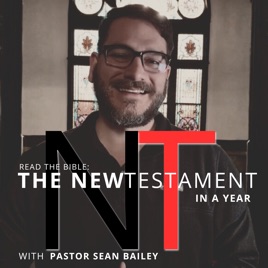
Advertise on podcast: Read the Bible: The New Testament in a Year
Rating
4.5from
This podcast has
250 episodes
Language
EnglishPublisher
Sean BaileyExplicit
No
Date created
2024/01/01
Latest episode
2026/10/02
Average duration
19 min.
Release period
2 days
Description
Looking for a simple and meaningful way to read the Bible every day? Join Pastor Sean Bailey as he leads you through the New Testament in a year, one chapter at a time. Each short daily episode includes the New Testament read aloud and clearly explained, helping you understand Scripture and apply it to everyday life, no matter where you are in your faith journey. Before each chapter, you will hear a few key look fors to help you know what to listen for as the Scripture is read. After the reading, each episode includes three clear takeaways designed to help you apply God’s Word to your life in practical and meaningful ways. This daily Bible reading podcast follows a 260 episode plan that aligns with the weekdays of the year, making it easy to build a consistent habit of reading the Bible. Whether you are driving to work, taking a walk, or spending quiet time with God, each episode offers biblical truth, encouragement, and practical insight to help you grow in your relationship with Jesus. You do not need a seminary degree or hours of free time. If you want to read the Bible, understand the New Testament, and develop a daily rhythm of Scripture and prayer, this podcast is for you.
Unlock Read the Bible: The New Testament in a Year podcast Email contact info,
Listeners & Audience details
Email contact information
Direct podcast contact details

Listeners
Audience numbers & engagement insights

Audience details
Podcast Insights

Podcast episodes
Check latest episodes from Read the Bible: The New Testament in a Year podcast
1 John 3. Day 196 - Read the Bible: The New Testament in a Year
2026/10/02
1 John 3. Day 196 - Read the Bible: The New Testament in a Year
Episode Notes:
Today's Scripture: 1 John 3 (CSB)
Podcast Homepage: The New Testament in a Year
Bible Reading Plan: Navigators Bible Reading Plan
Contact Sean: [email protected]
Follow NTIY on Facebook: facebook.com/newtestamentinayear
In Today's Episode
Children of God. A Life Transformed by Christ. Love That Moves Beyond Words.
"See what great love the Father has given us that we should be called God's children—and we are!" — 1 John 3:1
First John 3 opens with a remarkable reminder of our identity in Christ. We are not merely forgiven sinners. We are children of God! And when Christ appears, we will be like Him because we will see Him as He is. That future hope should shape the way we live today. John explains that those who have been born of God cannot remain comfortable in a settled pattern of sin. He is not suggesting that believers never stumble, but that genuine faith produces a changed direction. Jesus came to take away our sins and destroy the works of the devil. Grace does not simply change our standing before God. It changes the way we live.
John then brings everything back to love. He points to the cross as the ultimate definition of love: "He laid down his life for us." If Christ loved us sacrificially, our love for others must become more than words. John challenges believers to respond when they see a brother or sister in need rather than closing their hearts. Love is not merely something we feel or say. It is something we do. First John 3 reminds us that our identity as God's children should be visible in both holiness and love. We do not love others to become children of God. We love because we are His children, and His love is transforming us from the inside out.
1 John 2. Day 195 - Read the Bible: The New Testament in a Year
2026/10/01
1 John 2. Day 195 - Read the Bible: The New Testament in a Year
Episode Notes:
Today's Scripture: 1 John 2 (CSB)
Podcast Homepage: The New Testament in a Year
Bible Reading Plan: Navigators Bible Reading Plan
Contact Sean: [email protected]
Follow NTIY on Facebook: facebook.com/newtestamentinayear
In Today's Episode
Jesus Our Advocate. Walking as Jesus Walked. Abiding in the Truth.
"The one who says he remains in him should walk just as he walked." — 1 John 2:6
First John 2 begins with one of the most comforting truths in Scripture. John tells believers that he is writing so they will not sin, but he immediately reminds us what happens when we do: "We have an advocate with the Father—Jesus Christ the righteous one." Jesus does not abandon us when we stumble. He stands as our righteous advocate, and His sacrifice is the basis of our forgiveness. Grace is never permission to continue in sin, but it is the assurance that our hope rests in Christ rather than our ability to live perfectly. John then makes it clear that genuinely knowing Jesus should produce a growing desire to obey Him. We cannot separate loving Christ from following Christ.
John continues by bringing that obedience into our relationships. The command to love one another is not new, yet it takes on new depth through the life and example of Jesus. Anyone who claims to walk in the light while hating a brother or sister is still walking in darkness. Our love for God must become visible in how we treat people. John also warns us not to love the world or the things in it. He is not telling us to stop loving people or enjoying God's creation. He is warning against a worldly system built around sinful desires, pride, and values that compete with devotion to the Father. The world and its desires are passing away, but the one who does the will of God remains forever.
The chapter closes with a warning about false teachers who deny the truth about Jesus. John calls believers to remain in what they heard from the beginning rather than chasing every new spiritual claim. The truth of the gospel does not need to be improved upon. We have been given the Son, and in Him we have fellowship with the Father and the promise of eternal life. First John 2 challenges us to examine both our beliefs and our lives. Are we walking as Jesus walked? Are we loving as He loved? Are we remaining in the truth He revealed? The Christian life is not about simply knowing the right answers. It is about knowing Christ, remaining in Him, and allowing His truth and love to shape the way we live every day.
1 John 1. Day 194 - Read the Bible: The New Testament in a Year
2026/09/30
1 John 1. Day 194 - Read the Bible: The New Testament in a Year
Episode Notes:
Today's Scripture: 1 John 1 (CSB) Podcast Homepage: The New Testament in a Year Bible Reading Plan: Navigators Bible Reading Plan Contact Sean: [email protected] Follow NTIY on Facebook: facebook.com/newtestamentinayear
In Today's Episode
The Word of Life. Walking in the Light. The Faithfulness of God's Forgiveness.
"If we confess our sins, he is faithful and righteous to forgive us our sins and to cleanse us from all unrighteousness." — 1 John 1:9
First John opens with a beautiful reminder that Christianity is rooted in a real person, not simply a collection of religious ideas. John writes about Jesus as the Word of life, the One he had heard, seen with his own eyes, and touched with his own hands. The eternal Son of God had entered human history, and John was an eyewitness. He shares this testimony so that others might experience fellowship with the Father and His Son, Jesus Christ. At the heart of the Christian faith is an invitation into a real relationship with the living God, and John says that this fellowship brings complete joy.
John then introduces one of the central themes of his letter: "God is light, and there is absolutely no darkness in him." Because God is perfectly holy, those who belong to Him cannot claim fellowship with Him while deliberately walking in darkness. Walking in the light does not mean we never struggle with sin. It means we are no longer trying to hide from God or pretend that our sin does not matter. We bring our lives into His light, allow His truth to expose what needs to change, and continue depending on the cleansing blood of Jesus Christ. Genuine fellowship with God changes the way we live and the way we relate to one another.
The chapter closes with one of the most encouraging promises in Scripture. John says that claiming to be without sin is self-deception, but confessing our sin opens the way to forgiveness and cleansing. We do not have to cover up what Christ came to forgive. God's faithfulness and righteousness are the foundation of His promise, and the sacrifice of Jesus is what makes that forgiveness possible. First John 1 reminds us that the Christian life is not about pretending to be perfect. It is about living honestly before a holy and gracious God. Stop hiding what Jesus already died to forgive. Walk in the light, confess what needs to be confessed, and rest in the faithful mercy of the God who cleanses us from all unrighteousness.
Titus 3. Day 193 - Read the Bible: The New Testament in a Year
2026/09/29
Titus 3. Day 193 - Read the Bible: The New Testament in a Year
Episode Notes:
Today's Scripture: Titus 3 (CSB) Podcast Homepage: The New Testament in a Year Bible Reading Plan: Navigators Bible Reading Plan Contact Sean: [email protected] Follow NTIY on Facebook: facebook.com/newtestamentinayear
In Today's Episode
Living as People of Grace. Saved by Mercy, Not Works. Devoted to What Is Good.
"He saved us—not by works of righteousness that we had done, but according to his mercy." — Titus 3:5
Titus 3 brings Paul's letter to a close by showing us how the gospel should shape the way we live in the world. Paul reminds believers to respect governing authorities, be ready for every good work, avoid slander and unnecessary quarrels, and show gentleness toward everyone. Then he reminds us why humility matters: we were not always who we are today. Before Christ, we too were foolish, disobedient, deceived, and enslaved by sinful desires. That memory should keep us from looking down on others. We are not people who made ourselves better. We are people who have been rescued by grace.
At the heart of the chapter is one of the clearest explanations of salvation in Scripture. "But when the kindness of God our Savior and his love for mankind appeared, he saved us." Paul makes it unmistakably clear that salvation is not something we achieve through righteous works. It is something God gives according to His mercy. Through the washing of regeneration and renewal by the Holy Spirit, God gives us new life, pouring out His Spirit through Jesus Christ our Savior. We are justified by His grace and made heirs with the hope of eternal life. The Christian life begins not with what we have done for God, but with what God has done for us in Christ.
Paul then brings everything back to good works. Those who have believed God should be careful to devote themselves to doing what is good. That is not a contradiction. Good works are not the cause of our salvation; they are the fruit of it. Paul also warns against foolish controversies and divisive arguments that distract from the mission of the church. Titus 3 leaves us with a beautiful picture of what grace produces: humble people, renewed hearts, peaceful relationships, and lives devoted to serving others. We are not saved because we are good. We do good because God, in His mercy, has saved us. Let that truth keep you humble, grateful, and ready to reflect the kindness of Christ wherever He places you.
Titus 2. Day 192 - Read the Bible: The New Testament in a Year
2026/09/28
Titus 2. Day 192 - Read the Bible: The New Testament in a Year
Episode Notes:
Today's Scripture: Titus 2 (CSB) Podcast Homepage: The New Testament in a Year Bible Reading Plan: Navigators Bible Reading Plan Contact Sean: [email protected] Follow NTIY on Facebook: facebook.com/newtestamentinayear
In Today's Episode
Sound Doctrine That Shapes Our Lives. Grace That Trains Us. Living in Hope of Christ's Return.
"For the grace of God has appeared, bringing salvation for all people, instructing us to deny godlessness and worldly lusts and to live in a sensible, righteous, and godly way in the present age." — Titus 2:11–12
Titus 2 shows us that what we believe should shape the way we live. Paul instructs Titus to teach sound doctrine, then immediately explains what that looks like in everyday relationships. Older men and women are called to model maturity and faithfulness. Younger believers are to grow in self-control, integrity, and good works. Even in difficult circumstances, Christians are called to live in ways that honor God and make the gospel attractive to others. Sound doctrine is not simply information we agree with on Sunday. It should be visible in our attitudes, relationships, decisions, and conduct throughout the week.
Then Paul brings everything back to the foundation of the Christian life: the grace of God. Grace does more than forgive our sins. It teaches us to turn away from ungodliness and live differently. That is an important distinction. We do not pursue holiness to earn salvation. We pursue holiness because God's grace has already come to us through Jesus Christ. The same Savior who gave Himself to redeem us is also working to purify us as a people who belong to Him and are eager to do what is good. Grace does not leave us where it found us. It changes what we love, what we pursue, and how we live.
Paul closes this section by pointing us toward "the blessed hope," the appearing of our great God and Savior, Jesus Christ. We live between two great moments: Christ has already appeared to bring salvation, and He will appear again in glory. That future hope should shape our present lives. Titus 2 reminds us that following Jesus is not about merely avoiding what is wrong. It is about becoming people who reflect His goodness while we wait for His return. We have been saved by grace, we are being trained by grace, and we are living in hope of seeing the One who gave Himself for us.
Titus 1. Day 191 - Read the Bible: The New Testament in a Year
2026/09/25
Titus 1. Day 191 - Read the Bible: The New Testament in a Year
Episode Notes:
Today's Scripture: Titus 1 (CSB)
Podcast Homepage: The New Testament in a Year
Bible Reading Plan: Navigators Bible Reading Plan
Contact Sean: ([email protected])
Follow NTIY on Facebook: facebook.com/newtestamentinayear
In Today's Episode
Setting Things in Order. Character Before Leadership. Holding Firm to Sound Doctrine.
"Holding to the faithful message as taught, so that he will be able both to encourage with sound teaching and to refute those who contradict it." — Titus 1:9
Titus opens with Paul writing to one of his trusted ministry partners, a man he had left on the island of Crete to "set right what was left undone." The churches needed structure, mature leadership, and protection from false teaching. Paul begins by describing the kind of people Titus should appoint as elders. Once again, Scripture puts character before charisma. A church leader must be above reproach, faithful at home, self-controlled, hospitable, disciplined, and devoted to what is good. Leadership in the church is not simply about having ability. It is about having a life that supports the message being taught.
Paul also makes it clear that elders must hold firmly to the trustworthy Word. They need to be able to encourage believers with sound doctrine and confront teaching that contradicts the gospel. Crete had plenty of voices spreading confusion, empty talk, and deception. Some were even using religion for personal gain. Paul tells Titus not to ignore it. Truth matters because false teaching eventually produces false living. Healthy doctrine should produce healthy disciples, and leaders have a responsibility to protect the church from ideas that pull people away from Christ.
The chapter ends with one of Paul's strongest warnings. Some people "claim to know God, but they deny him by their works." That is the danger of a faith that exists only in words. Titus 1 reminds us that what we believe should eventually become visible in how we live. Sound doctrine is not merely information to memorize. It shapes our character, our relationships, and our obedience. Hold tightly to the truth, choose character over image, and make sure the life you live supports the faith you say you believe.
2 Timothy 4. Day 190 - Read the Bible: The New Testament in a Year
2026/09/24
2 Timothy 4. Day 190 - Read the Bible: The New Testament in a Year
Episode Notes:
Today's Scripture: 2 Timothy 4 (CSB)
Podcast Homepage: The New Testament in a Year
Bible Reading Plan: Navigators Bible Reading Plan
Contact Sean: ([email protected])
Follow NTIY on Facebook: facebook.com/newtestamentinayear
In Today's Episode
Preach the Word. Finish the Race. The Lord Stood with Me.
"I have fought the good fight, I have finished the race, I have kept the faith." — 2 Timothy 4:7
Second Timothy 4 feels like Paul's final charge to someone he loves deeply. He tells Timothy to "preach the word" and to be ready whether the moment feels convenient or not. Paul knows a time will come when people will not tolerate sound teaching but will surround themselves with voices that simply tell them what they want to hear. Timothy's calling is not to adjust the truth to fit the audience. He is to remain clear-minded, endure hardship, do the work of an evangelist, and fulfill the ministry God has given him. Faithfulness is not measured by how popular the message becomes. It is measured by whether we remain true to Christ and His Word.
Paul then speaks with the perspective of a man who knows his earthly life is nearing its end. "The time for my departure is close." Yet there is no panic in his words. He can look back and say, "I have fought the good fight, I have finished the race, I have kept the faith." Paul is not claiming perfection. He is celebrating perseverance. Through suffering, opposition, imprisonment, and disappointment, he kept following Jesus. Now he looks forward to the crown of righteousness the Lord will award, not only to him, but to all who have loved Christ's appearing. The goal of the Christian life is not simply to start well. It is to remain faithful all the way to the finish.
The final verses are deeply personal. Paul names people who abandoned him, people who helped him, and even practical needs like bringing his cloak and scrolls. But through all the disappointment, one truth stands above everything else: "The Lord stood with me and strengthened me." People may leave. Circumstances may change. Seasons may become lonely. But Jesus remains faithful. Second Timothy ends with a challenge worth carrying with us: Preach the Word. Endure hardship. Keep the faith. Finish the race. And when the road becomes difficult, remember that the same Lord who stood with Paul will remain faithful to His people to the very end.
2 Timothy 3. Day 189 - Read the Bible: The New Testament in a Year
2026/09/23
2 Timothy 3. Day 189 - Read the Bible: The New Testament in a Year
Episode Notes:
Today's Scripture: 2 Timothy 3 (CSB)
Podcast Homepage: The New Testament in a Year
Bible Reading Plan: Navigators Bible Reading Plan
Contact Sean: ([email protected])
Follow NTIY on Facebook: facebook.com/newtestamentinayear
In Today's Episode
Difficult Days. A Faith Worth Following. Scripture That Equips Us.
"All Scripture is inspired by God and is profitable for teaching, for rebuking, for correcting, for training in righteousness." — 2 Timothy 3:16
Second Timothy 3 begins with Paul warning Timothy that "difficult times will come." He describes people who are self-centered, lovers of money, proud, ungrateful, unholy, unforgiving, reckless, and lovers of pleasure rather than lovers of God. What makes the warning especially serious is that some will maintain an outward appearance of godliness while denying its power. Paul is showing Timothy that the greatest danger is not always open rejection of God. Sometimes it is religion on the outside without genuine transformation on the inside. A life can look spiritual and still be centered on self.
Paul then points Timothy back to the example he has already seen. Timothy knows Paul's teaching, conduct, purpose, faith, patience, love, endurance, and even the persecutions he suffered. Paul is not simply asking Timothy to believe a set of ideas. He is reminding him of a faith that had been lived out in front of him. Timothy had also known the sacred Scriptures from childhood. In a confusing world filled with false teachers and shifting values, Paul tells him to continue in what he has learned and firmly believed. Faithfulness is often less about finding something new and more about refusing to abandon what God has already made clear.
The chapter ends with one of the Bible's strongest statements about Scripture itself. All Scripture is inspired by God and is useful for teaching us what is true, confronting what is wrong, correcting our direction, and training us to live righteously. God's Word does not merely inform us. It forms us. Its purpose is to make the servant of God "complete, equipped for every good work." Second Timothy 3 reminds us that when the culture becomes confusing and voices compete for our attention, we do not need to panic or chase every new idea. Stay rooted in the truth. Keep following faithful examples. Open God's Word and let it teach you, correct you, and shape you into the person God has called you to become.
2 Timothy 2. Day 188 - Read the Bible: The New Testament in a Year
2026/09/22
2 Timothy 2. Day 188 - Read the Bible: The New Testament in a Year
Episode Notes:
Today's Scripture: 2 Timothy 2 (CSB)
Podcast Homepage: The New Testament in a Year
Bible Reading Plan: Navigators Bible Reading Plan
Contact Sean: ([email protected])
Follow NTIY on Facebook: facebook.com/newtestamentinayear
In Today's Episode
Endure Hardship. Handle God's Word Faithfully. Become Useful to the Master.
"Be diligent to present yourself to God as one approved, a worker who doesn't need to be ashamed, correctly teaching the word of truth." — 2 Timothy 2:15
Second Timothy 2 opens with Paul telling Timothy to "be strengthened by the grace that is in Christ Jesus." That is important because everything Paul asks Timothy to do next will require more than natural ability. He tells him to pass the gospel on to faithful people who will teach others, to endure hardship like a good soldier, to compete with discipline like an athlete, and to work patiently like a farmer. Each picture points to the same truth: faithfulness requires endurance. The Christian life is not built on quick results or easy circumstances. We keep going because Jesus Christ has risen from the dead, and Paul reminds Timothy that even when the messenger suffers, "the word of God is not bound."
Paul then turns to the responsibility of handling Scripture carefully. Timothy is to avoid pointless arguments that ruin those who listen and instead become a worker who "correctly teaches the word of truth." The truth of God is too important to treat carelessly. Paul warns about false teaching that spreads like gangrene, yet he also gives Timothy confidence that God's foundation remains firm. In a world filled with competing voices, speculation, and spiritual confusion, believers need more than opinions. We need to know God's Word, understand it faithfully, and allow it to shape both what we believe and how we live.
The chapter closes with a picture of becoming a vessel useful to the Master. Paul tells Timothy to flee youthful passions and pursue righteousness, faith, love, and peace alongside those who call on the Lord with a pure heart. He also warns him not to become quarrelsome. "The Lord's servant must not quarrel, but must be gentle to everyone, able to teach, and patient." Truth and gentleness belong together. Second Timothy 2 reminds us that Christian maturity is not just knowing the right things. It is becoming the kind of person God can use. Stay faithful when the road is hard. Handle the Word carefully. Run from what pulls you away from Christ. And pursue a life that is clean, steady, gentle, and ready for whatever the Master asks of you.
2 Timothy 1. Day 187 - Read the Bible: The New Testament in a Year
2026/09/21
2 Timothy 1. Day 187 - Read the Bible: The New Testament in a Year
Episode Notes:
Today's Scripture: 2 Timothy 1 (CSB)
Podcast Homepage: The New Testament in a Year
Bible Reading Plan: Navigators Bible Reading Plan
Contact Sean: ([email protected])
Follow NTIY on Facebook: facebook.com/newtestamentinayear
In Today's Episode
Fan the Flame. Do Not Be Ashamed of the Gospel. Guard What Has Been Entrusted to You.
"For God has not given us a spirit of fear, but one of power, love, and sound judgment." — 2 Timothy 1:7
Second Timothy opens on a deeply personal note. Paul is writing from prison near the end of his life, and Timothy is carrying the weight of ministry in a difficult season. Paul reminds him of the sincere faith that first lived in his grandmother Lois and his mother Eunice, and then he gives Timothy a direct challenge: "rekindle the gift of God that is in you." Timothy did not need a new calling. He needed fresh courage to live faithfully in the calling he already had. Fear can make us shrink back, hesitate, or silence what God has placed in us, but Paul reminds Timothy that fear does not define the life God has given him.
Paul then tells Timothy not to be ashamed of the testimony about the Lord or of Paul, His prisoner. Instead, he is to share in suffering for the gospel by the power of God. Paul is not promising Timothy an easier road. He is reminding him why the hard road is worth walking. God saved us and called us according to His own purpose and grace, revealed through Christ Jesus, who "abolished death and brought life and immortality to light through the gospel." That is why Paul can suffer without shame. His confidence is not in his circumstances. It is in the One he knows and trusts.
The chapter closes with another charge: guard the good deposit entrusted to you through the Holy Spirit. Timothy had received the truth of the gospel, and now he was responsible to protect it, live it, and pass it on faithfully. Paul even points to Onesiphorus as an example of someone who was not ashamed of him and repeatedly encouraged him. Second Timothy 1 reminds us that faithfulness requires courage. Fan the flame. Refuse to let fear silence your witness. Hold tightly to the gospel. And remember that our confidence is not found in ourselves, but in the God who is able to guard what has been entrusted to Him.
1 Timothy 6. Day 186 - Read the Bible: The New Testament in a Year
2026/09/18
1 Timothy 6. Day 186 - Read the Bible: The New Testament in a Year
Episode Notes:
Today's Scripture: 1 Timothy 6 (CSB)
Podcast Homepage: The New Testament in a Year
Bible Reading Plan: Navigators Bible Reading Plan
Contact Sean: ([email protected])
Follow NTIY on Facebook: facebook.com/newtestamentinayear
In Today's Episode
Godliness with Contentment. Fighting the Good Fight. Holding Wealth with Open Hands.
"But godliness with contentment is great gain." — 1 Timothy 6:6
First Timothy 6 brings Paul's letter to a strong close by confronting the way we think about money, success, and what really matters. Some false teachers were treating godliness as a way to make money, and Paul pushes back hard against that mindset. He reminds Timothy that "we brought nothing into the world, and we can take nothing out." Contentment does not come from finally having enough possessions, income, recognition, or comfort. It grows from learning that Christ Himself is enough. Paul is not saying money is evil. He says the love of money is a root of all kinds of evil because it can quietly become the thing we trust, chase, and build our lives around.
Paul then turns directly to Timothy and tells him to pursue a different kind of life: righteousness, godliness, faith, love, endurance, and gentleness. He tells him to "fight the good fight of the faith" and take hold of eternal life. Following Jesus is not passive. There are desires to resist, truths to hold onto, and choices to make every day about what will shape our hearts. Paul points Timothy toward the example of Jesus, who faithfully testified before Pontius Pilate, and reminds him that everything is ultimately moving toward the return of Christ. That eternal perspective changes what deserves our attention right now.
Paul closes with a word specifically for those who have wealth. They are not to become arrogant or place their hope in uncertain riches, but in God, who richly provides what we need. Instead, they are to be rich in good works, generous, and willing to share. The issue is not simply how much we possess, but where our hope is placed and how tightly we hold what God has entrusted to us. First Timothy 6 leaves us with a powerful challenge: pursue Christ harder than you pursue comfort. Hold your possessions with open hands. Fight for what matters eternally. Real wealth is not found in having more. It is found in knowing Christ, becoming more like Him, and using what He has given us for His glory.
1 Timothy 5. Day 185 - Read the Bible: The New Testament in a Year
2026/09/17
1 Timothy 5. Day 185 - Read the Bible: The New Testament in a Year
Episode Notes:
Today's Scripture: 1 Timothy 5 (CSB)
Podcast Homepage: The New Testament in a Year
Bible Reading Plan: Navigators Bible Reading Plan
Contact Sean: ([email protected])
Follow NTIY on Facebook: facebook.com/newtestamentinayear
In Today's Episode
Treating the Church Like Family. Caring for Those in Need. Honoring Faithful Leadership.
"But if anyone does not provide for his own family, especially for his own household, he has denied the faith and is worse than an unbeliever." — 1 Timothy 5:8
First Timothy 5 is incredibly practical. Paul begins by telling Timothy how to relate to different people in the church. Older men are to be treated like fathers, younger men like brothers, older women like mothers, and younger women like sisters with complete purity. The picture is simple but powerful: the church should function like a family. Christian relationships are not meant to be cold, transactional, or built around status. We are called to treat one another with dignity, respect, purity, and genuine care.
Paul then spends significant time talking about widows and the responsibility of caring for people who are truly in need. But he also makes it clear that families have a responsibility to care for their own relatives whenever possible. The church should step in where there is genuine need, but believers should not neglect the responsibilities God has already placed in front of them. Faith is not only expressed in what we say during worship. It is seen in how we care for aging parents, vulnerable family members, and people who cannot care for themselves. Godliness shows up in the way we take responsibility for people.
The chapter closes with instructions about church leaders. Elders who lead well are to be honored, especially those who labor in preaching and teaching. At the same time, accusations against leaders should not be accepted carelessly, and sin should not be ignored simply because someone holds a position of influence. Paul calls Timothy to wisdom, fairness, and patience. First Timothy 5 reminds us that healthy churches are built through healthy relationships. We honor one another, care for those in need, take responsibility for our families, and hold leaders to a high standard without rushing to judgment. The way we treat people is one of the clearest places where our faith becomes visible.
1 Timothy 4. Day 184 - Read the Bible: The New Testament in a Year
2026/09/16
1 Timothy 4. Day 184 - Read the Bible: The New Testament in a Year
Episode Notes:
Today's Scripture: 1 Timothy 4 (CSB)
Podcast Homepage: The New Testament in a Year
Bible Reading Plan: Navigators Bible Reading Plan
Contact Sean: ([email protected])
Follow NTIY on Facebook: facebook.com/newtestamentinayear
In Today's Episode
Guarding Against False Teaching. Training for Godliness. Setting an Example in Faith.
"Train yourself in godliness." — 1 Timothy 4:7
First Timothy 4 begins with a serious warning. Paul tells Timothy that some will depart from the faith by giving attention to deceptive spirits and false teaching. These teachers were promoting a distorted kind of spirituality that treated things God created as though they were inherently unclean. Paul responds by reminding Timothy that what God has created is good and should be received with thanksgiving when it is received according to His Word. The danger of false teaching is not always that it sounds obviously evil. Sometimes it sounds religious, disciplined, or spiritual while quietly moving people away from the truth of the gospel.
Paul then gives Timothy one of the most practical pictures of spiritual growth in the New Testament: "Train yourself in godliness." Physical training has value, but godliness has value for both this life and the life to come. Spiritual maturity does not usually happen accidentally. Just as an athlete develops through consistent practice, followers of Jesus grow through habits of prayer, Scripture, obedience, worship, and dependence on the Holy Spirit. We cannot earn God's grace through discipline, but grace should produce a life that is intentionally being shaped by Christ.
Paul also tells Timothy not to let anyone despise his youth but instead to become an example "in speech, in conduct, in love, in faith, and in purity." Influence in the kingdom of God is not ultimately determined by age, position, or title. It grows from a life worth following. Timothy is told to devote himself to Scripture, teaching, and the gift God has given him, while carefully watching both his life and his doctrine. First Timothy 4 reminds us that what we believe and how we live cannot be separated. Guard the truth, train your heart toward godliness, and live in such a way that people can see what following Jesus looks like.
1 Timothy 3. Day 183 - Read the Bible: The New Testament in a Year
2026/09/15
1 Timothy 3. Day 183 - Read the Bible: The New Testament in a Year
Episode Notes:
Today's Scripture: 1 Timothy 3 (CSB)
Podcast Homepage: The New Testament in a Year
Bible Reading Plan: Navigators Bible Reading Plan
Contact Sean: ([email protected])
Follow NTIY on Facebook: facebook.com/newtestamentinayear
In Today's Episode
Character Before Position. Servant Leadership. The Church as God's Household.
"I have written so that you will know how people ought to conduct themselves in God's household, which is the church of the living God, the pillar and foundation of the truth." — 1 Timothy 3:15
First Timothy 3 turns Paul's attention to leadership in the church, and what stands out immediately is how much emphasis he places on character. Overseers are to be above reproach, self-controlled, respectable, hospitable, faithful in marriage, able to teach, and able to lead their own households well. Paul is not looking first for charisma, popularity, or impressive credentials. He is looking for a life that can be trusted. Spiritual leadership is not mainly about having a title. It is about becoming the kind of person whose private life supports the message they proclaim publicly.
Paul gives similar instructions for deacons. They are to be worthy of respect, sincere, faithful, and tested. Once again, the focus is not on status but on faithfulness. The church needs people who can serve without making everything about themselves. This chapter reminds us that gifting matters, but character matters more. Ability may open a door, but integrity determines whether someone can faithfully carry the responsibility God has given them.
Paul then explains why all of this matters. The church is "the household of God," "the church of the living God," and "the pillar and foundation of the truth." That is a high calling. The church does not exist merely as an organization or weekly event. It belongs to God and has been entrusted with displaying and defending the truth of the gospel. Paul closes with a beautiful confession centered on Christ, reminding us that Jesus is ultimately the foundation of everything the church is and does. First Timothy 3 challenges us to ask a simple but important question: Does my character match the faith I profess? God is not only concerned with what we do for Him. He is shaping who we are becoming as we follow Christ.
1 Timothy 2. Day 182 - Read the Bible: The New Testament in a Year
2026/09/14
1 Timothy 2. Day 182 - Read the Bible: The New Testament in a Year
Episode Notes:
Today's Scripture: 1 Timothy 2 (CSB)
Podcast Homepage: The New Testament in a Year
Bible Reading Plan: Navigators Bible Reading Plan
Contact Sean: ([email protected])
Follow NTIY on Facebook: facebook.com/newtestamentinayear
In Today's Episode
Praying for All People. One Mediator Between God and Humanity. God's Order for His Church.
"For there is one God and one mediator between God and humanity, the man Christ Jesus." — 1 Timothy 2:5
First Timothy 2 begins with Paul urging believers to make prayer a priority. He calls for petitions, prayers, intercessions, and thanksgivings to be offered for everyone, including kings and those in authority. The goal is not political comfort or influence. Paul wants believers to be able to live peaceful, godly lives so that the gospel can continue to move forward. His reason is clear: God desires people to be saved and to come to the knowledge of the truth. Prayer should widen our hearts beyond our own needs and remind us that God cares deeply about people we may never meet and even people we may not naturally want to pray for.
At the center of the chapter is one of the clearest summaries of the gospel in the New Testament. There is one God and one mediator between God and humanity, Christ Jesus, who gave Himself as a ransom for all. Jesus is not one option among many paths to God. He is the One who bridges the gap sin created between a holy God and sinful humanity. That truth gives urgency to prayer, evangelism, and the mission of the church. We do not merely offer people better habits or religious advice. We point them to the only Savior who can reconcile them to God.
Paul then gives instructions for how men and women should conduct themselves in the gathered church. These verses require careful reading because they touch issues of worship, modesty, teaching, and authority. Paul is not teaching that women are less valuable or less spiritual. Men and women share equal worth before God, while Paul also describes an order for the church that he grounds in creation itself. The larger point is that worship is not supposed to revolve around self-promotion, status, appearance, or personal preference. The church belongs to God, and His people are called to reflect His character and follow His Word. First Timothy 2 reminds us to pray broadly, proclaim Christ clearly, and order our lives around the truth that Jesus alone is the mediator who brings sinners home to God.
Podcast reviews
Read Read the Bible: The New Testament in a Year podcast reviews
mommomfl 2026/04/01
Great pod, doesn’t keep up
I try to do some sort of Bible reading in a year each year as a resolution and chose this one for 2026. I take like it, but the episodes are NOT poste...
TreeingWalkerCoonhoundz 2026/02/05
Practical and encouraging
Hearing Sean read the NT passage for the day and provide simple, yet profound, insight strengthens my personal relationship with Jesus without feeling...
ivy lois 2026/01/08
H
I heard about this and have been really looking forward to following this every morning but apparently it’s not read every day.
Lisa GoldK 2026/01/04
Great intro
I started this podcast this year after hearing some episodes last year. I love the approach and the style. Very educational and inspiring.
Rich223722 2025/10/15
Daily Encouragement
This format makes learning the entire New Testament attainable. I look forward to this every morning.
ahampton 2025/02/13
New Testament in a Year is exactly what I was looking for
So grateful for finding this. Short reading each day. I also really enjoy the tips on what to listen for before the reading and the breakdown of the r...
bashKnow01 2024/01/28
10 minutes a day with God
Go chapter by chapter with ease. It’s reading, study, and devotion all in one. It’s wonderful and not overwhelming and a great way to start your day. ...
Podcast sponsorship advertising
Start advertising on Read the Bible: The New Testament in a Year relevant audience podcasts
You may also like to advertise on these Podcasts

4.9247491432
Unashamed with the Robertson Family
Tread Lively

4.897041427
The Graham Allen Show
Graham Allen

4.6652312197
The Charlie Kirk Show
Charlie Kirk

4.7292602000
The Michael Knowles Show
The Daily Wire

4.830862000
The Quote of the Day Show | Daily Motivational Talks
Sean Croxton

4.6619472000
The Dan Bongino Show
Cumulus Podcast Network | Dan Bongino

4.8120961000
Mind Pump: Raw Fitness Truth
Sal Di Stefano, Adam Schafer, Justin Andrews, Doug Egge

4.6253122000
The Glenn Beck Program
Mercury Radio Arts

4.7106572000
FantasyPros - Fantasy Football Podcast
iHeartPodcasts

4.890571544
Fearless with Jason Whitlock
Blaze Podcast Network