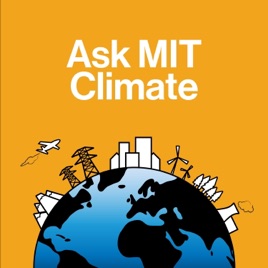
Advertise on podcast: Ask MIT Climate
Rating
5from
This podcast has
85 episodes
Language
EnglishPublisher
MIT Climate ProjectExplicit
No
Date created
2024/03/15
Latest episode
2026/10/08
Average duration
14 min.
Release period
25 days
Description
Get smart quickly on climate change. This award-winning MIT podcast breaks down the science, technologies, and policies behind climate change, how it’s impacting us, and what our society can do about it. Each quick episode gives you the what, why, and how on climate change — from real scientists — to help us all make informed decisions for our future.
Unlock Ask MIT Climate podcast Email contact info,
Listeners & Audience details
Email contact information
Direct podcast contact details

Listeners
Audience numbers & engagement insights

Audience details
Podcast Insights

Podcast episodes
Check latest episodes from Ask MIT Climate podcast
Data centers and the race to power AI (part 2)
2026/10/08
In the first half of our two-parter on data centers and the U.S. energy system, we dug into the challenges that these huge, concentrated electricity users pose for communities and power grids. In this second installment, Prof. Costa Samaras of Carnegie Mellon University and Dr. Vijay Gadepally of MIT return to talk through some of the options on the table for responding to these challenges. And we explore how our choices fit into the bigger picture of tackling climate change, as data centers’ growing electricity needs meet those of electric vehicles, heat pumps and clean manufacturing.
For a deeper dive and additional resources related to this episode, visit: https://climate.mit.edu/podcasts/e11-data-centers-and-race-power-ai-part-2.
For more episodes of Ask MIT Climate, check out askmitclimate.org. Plus, find us on Instagram, TikTok, and YouTube for outtakes, bonus content, and more climate knowledge from MIT. As always, we love hearing from our listeners; email us at [email protected].
Data centers and the race to power AI (part 1)
2026/10/08
At the heart of the explosion in artificial intelligence, there are data centers. Companies are pouring money into these facilities to train and run AI models—and with this massive buildout comes a remarkable appetite for electricity. In the first installment of our two-parter on data centers and the U.S. energy system, Prof. Costa Samaras of Carnegie Mellon University and Dr. Vijay Gadepally of MIT walk us through some of the challenges posed by this surging electricity demand. And they discuss why our response to this moment matters for power grids and people right now, and for the long-term work of tackling climate change.
For a deeper dive and additional resources related to this episode, visit: https://climate.mit.edu/podcasts/e10-data-centers-and-race-power-ai-part-1.
For more episodes of Ask MIT Climate, check out askmitclimate.org. Plus, find us on Instagram, TikTok, and YouTube for outtakes, bonus content, and more climate knowledge from MIT. As always, we love hearing from our listeners; email us at [email protected].
Dry spells and downpours
2026/07/02
How can climate change cause both more intense droughts and more severe floods? With help from Prof. Mathew Barlow, we dive into the water cycle on a warming planet, and learn how the basic physics of water moving through the atmosphere can explain a lot of the strange weather we need to prepare for as the world heats up.
For a deeper dive and additional resources related to this episode, visit: https://climate.mit.edu/podcasts/e9-dry-spells-and-downpours
For more episodes of Ask MIT Climate, check out askmitclimate.org. Plus, find us on Instagram, TikTok, and YouTube for outtakes, bonus content, and more climate knowledge from MIT. As always, we love hearing from our listeners; email us at [email protected].
To the ice sheets with a polar scientist
2026/06/11
In our previous episode, we spoke with Dr. Sarah Das, a Scientist Emeritus at Woods Hole Oceanographic Institution, about how climate change is affecting the big polar ice sheets of Antarctica and Greenland. She’s been traveling to the poles for her research since the nineties, and this week, she’s taking us behind the scenes: into the world of glacier science, “boomerang flights,” and ice as far as the eye can see.
A video version of this episode is available on our YouTube channel. For a deeper dive and additional resources, visit: https://climate.mit.edu/podcasts/bonus-ice-sheets-polar-scientist.
For more episodes of Ask MIT Climate, check out askmitclimate.org. Plus, find us on Instagram, TikTok, and YouTube for outtakes, bonus content, and more climate knowledge from MIT. As always, we love hearing from our listeners; email us at [email protected].
Polar ice in a warming world
2026/05/28
The frozen parts of our planet—from sprawling polar ice sheets and floating sea ice to mountain glaciers and frigid soils—face profound risks from climate change. Already, a warmer world has transformed these landscapes, with consequences that span the globe. Dr. Sarah Das, a Scientist Emeritus at Woods Hole Oceanographic Institution, joins to discuss her decades-long career studying the Antarctic and Greenland ice sheets and help us understand how changes to the polar regions affect people now and in the future.
We thank WHOI for providing audio recorded during supraglacial lake research in Greenland. (Credit: Chris Linder, ©Woods Hole Oceanographic Institution).
For a deeper dive and additional resources related to this episode, visit: https://climate.mit.edu/podcasts/e8-polar-ice-warming-world.
For more episodes of Ask MIT Climate, check out askmitclimate.org. Plus, find us on Instagram, TikTok, and YouTube for outtakes, bonus content, and more climate knowledge from MIT. As always, we love hearing from our listeners; email us at [email protected].
A hard look at steel
2026/05/14
From cars and ships to bridges and skyscrapers, steel forms the landscape of modern life. At the same time, steelmaking is one of the world’s biggest industrial sources of climate-warming carbon dioxide. Antoine Allanore, a professor of metallurgy at MIT, explains how CO2 became so entrenched in the chemistry of steelmaking—and the creative ways scientists and engineers are trying to get it out.
We gratefully acknowledge Katie Daehn, postdoctoral associate, and Matthew Michalek, Ph.D. student and research assistant, of the Allanore Group for additional assistance and participation in this episode.
For a deeper dive and additional resources related to this episode, visit: https://climate.mit.edu/podcasts/e7-hard-look-steel
For more episodes of Ask MIT Climate, check out askmitclimate.org. Plus, find us on Instagram, TikTok, and YouTube for outtakes, bonus content, and more climate knowledge from MIT. As always, we love hearing from our listeners; email us at [email protected].
An economist’s guide to climate change
2026/04/30
Solutions to climate change, like building clean energy, come with a price tag. But unchecked warming also brings serious costs. As we make investments to rein in our climate pollution, how should we weigh costs and benefits? Dr. Jennifer Morris of MIT joins the show to explain how economists have tried to pin down the dollar costs of a warming planet, and why a clear answer has proved elusive. Together, we’ll ask how the tools of economics can help us plan for a better, more prosperous future, even in the face of uncertainty.
For a deeper dive and additional resources related to this episode, visit: https://climate.mit.edu/podcasts/e6-economists-guide-climate-change
For more episodes of Ask MIT Climate, check out askmitclimate.org. Plus, find us on Instagram, TikTok, and YouTube for outtakes, bonus content, and more climate knowledge from MIT. As always, we love hearing from our listeners; email us at [email protected].
Re-air and update: Carbon pricing
2026/04/09
What exactly is a carbon price, and how does it work? To prepare for a new episode about climate economics, we’re re-airing this season one episode in which MIT professor Christopher Knittel explains economists’ favorite tool for addressing climate change. Professor Knittel also returns for a special update on big developments in the world of carbon pricing, from Canada, China, and the European Union.
For a deeper dive and additional resources related to this episode, visit: https://climate.mit.edu/podcasts/re-air-and-update-carbon-pricing
For more episodes of Ask MIT Climate, check out askmitclimate.org. Plus, find us on Instagram, TikTok, and YouTube for outtakes, bonus content, and more climate knowledge from MIT. As always, we love hearing from our listeners; email us at [email protected].
The (micro)grid of the future
2026/03/26
Solar panels, batteries, microgrids, and other emerging energy technologies are making it easier than ever before for a community to produce some or all of its own power. Prof. David Hsu lays out the policies and technologies challenging the traditional, centralized model of the electric grid, including in places that lack reliable access to electricity. As the world strives to make energy cleaner, cheaper, and more accessible, what can local models offer that a big utility can’t—and the other way round?
For a deeper dive and additional resources related to this episode, visit: https://climate.mit.edu/podcasts/e5-microgrid-future
For more episodes of Ask MIT Climate, check out askmitclimate.org. Plus, find us on Instagram, TikTok, and YouTube for outtakes, bonus content, and more climate knowledge from MIT. As always, we love hearing from our listeners; email us at [email protected].
The reshuffling of life on Earth
2026/03/12
Climate change is putting pressure not only on humans, but also on our fellow species. How can plants, animals, and other living things survive as their habitats are transformed? In this episode, we explore one way: moving. Dr. Toni Lyn Morelli and Dr. Alexej Sirén help us understand how climate change is shaking up the map of where species live—and what that means for all of us who share this planet.
For a deeper dive and additional resources related to this episode, visit: https://climate.mit.edu/podcasts/e4-reshuffling-life-earth.
For more episodes of Ask MIT Climate, check out askmitclimate.org. Plus, find us on Instagram, TikTok, and YouTube for outtakes, bonus content, and more climate knowledge from MIT. As always, we love hearing from our listeners; email us at [email protected].
Taking Earth’s temperature
2026/02/26
The past three years have been the three hottest humanity has ever measured. But who does the measuring, and how? Dr. Samantha Burgess, of the European Union’s Copernicus Climate Change Service, joins the show to explain how we know the temperature of the Earth, and how a global community of scientists works together to keep tabs on the health of our planet.
For show notes and more resources, visit https://climate.mit.edu/podcasts/e3-taking-earths-temperature
Credits
Aaron Krol, Writer and Executive Producer
Madison Goldberg, Host and Associate Producer
Dave Lishansky, Editor and Producer
Michelle Harris, Fact-checker
Music by Blue Dot Sessions
License: CC-BY-NC-SA. View the license terms at https://creativecommons.org/licenses/by-nc-sa/4.0/
The nuclear price tag
2026/02/12
Nuclear power offers huge amounts of round-the-clock energy free of climate-warming pollution. In the United States, it’s also become very expensive to build. As government support grows to bring more nuclear power to the U.S., Prof. Jacopo Buongiorno of MIT joins us to break down how nuclear got so costly and what we can learn from countries with more active nuclear industries.
For a deeper dive and additional resources related to this episode, visit: https://climate.mit.edu/podcasts/e2-nuclear-price-tag
For more episodes of Ask MIT Climate, check out askmitclimate.org. Plus, find us on Instagram, TikTok, and YouTube for outtakes, bonus content, and more climate knowledge from MIT. As always, we love hearing from our listeners; email us at [email protected].
Marshes, mangroves, meadows
2026/01/29
Salt marshes humming with insects and birds. Mangrove forests with tangled, arching roots. Seagrass meadows that blanket the ocean floor. The world’s coastal saltwater wetlands provide shelter for wildlife, purify water, and protect seaside infrastructure. And as Dr. Julie Simpson of MIT tells us, they also have a climate superpower: drawing down and locking away extraordinary amounts of planet-warming carbon dioxide.
We gratefully acknowledge Professor Heidi Nepf; Ph.D. student Ernie Lee; and undergraduate student Joyce Yambasu of MIT for additional assistance and participation in this episode. Thanks as well to the Waquoit Bay National Estuarine Research Reserve and research coordinator Megan Tyrrell.
For a deeper dive and additional resources related to this episode, visit: https://climate.mit.edu/podcasts/e1-marshes-mangroves-meadows.
For more episodes of Ask MIT Climate, check out askmitclimate.org. Plus, find us on Instagram, TikTok, and YouTube for outtakes, bonus content, and more climate knowledge from MIT. As always, we love hearing from our listeners; email us at [email protected].
New season, new name!
2026/01/22
The eighth season of MIT’s climate change podcast starts next week, and we’ve got some news! TILclimate is now Ask MIT Climate. It’s part of an effort to bring all of our climate change resources under one umbrella and reach learners in as many ways as we can.
We’re also diving into video! Find us on Instagram, TikTok, and YouTube @askmitclimate for outtakes, bonus content, and more climate knowledge from MIT. And we love hearing from our listeners; email us at [email protected].
.
Update: Where we've been and where we're going
2025/11/04
We’re dropping into your feed to share the news that our founding host, Laur Hesse Fisher, is departing MIT and TILclimate. In this episode, Laur sits down with new host Madison Goldberg to talk about the philosophies that have shaped TILclimate over seven seasons and take listeners behind the scenes of the show. They also discuss what’s in store for season eight—because TILclimate isn’t going anywhere.
Check out an extended video version of this conversation: https://www.youtube.com/watch?v=kB544MVZ9bg
For a deeper dive and additional resources related to this episode, visit: https://climate.mit.edu/podcasts/update-where-weve-been-and-where-were-going
For more episodes of TILclimate by the MIT Climate Project, visit tilclimate.mit.edu.
Credits
Laur Hesse Fisher, Founding Host and Senior Editor
Madison Goldberg, Incoming Host and Associate Producer
Aaron Krol, Writer and Executive Producer
David Lishansky, Editor and Producer
Danielle Simpson, Editor
Music by Blue Dot Sessions
Artwork by Aaron Krol
Special thanks to Brett Paci of MIT OpenCourseWare and to the folks at Giro Studio for their help producing this episode.
Podcast sponsorship advertising
Start advertising on Ask MIT Climate relevant audience podcasts
You may also like to advertise on these Podcasts

4.92001923
The Wright Report
Bryan Dean Wright

4.672732000
Timcast News
Timcast Media
4.6221662000
Mark Levin Podcast
Cumulus Podcast Network

4.6432771245
Verdict with Ted Cruz
Premiere Networks

4.619772871
All Ears English Podcast
Lindsay McMahon and Michelle Kaplan

4.814621637
The Big Honker Podcast
Andy Shaver & Jeff Stanfield

4.813262012
The Jeff Cameron Show ~ Warchant.com
Jeff Cameron Show

4.834901999
Conservative Review with Daniel Horowitz
Blaze Podcast Network

4.662832000
The Dr. Laura Podcast
Dr. Laura Schlessinger & SiriusXM

4.98401800
The Adam Mockler Show
MeidasTouch Network