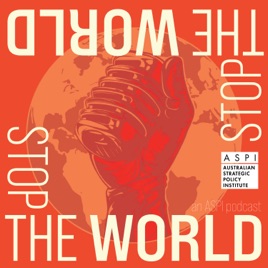
Advertise on podcast: Stop the World
Rating
5from
This podcast has
145 episodes
Language
EnglishExplicit
No
Date created
2024/04/12
Latest episode
2026/10/02
Average duration
45 min.
Release period
5 days
Description
Everything seems to be accelerating: geopolitics, technology, security threats, the dispersal of information. At times, it feels like a blur. But beneath the dizzying proliferation of events, discoveries, there are deeper trends that can be grasped and understood through conversation and debate. That’s the idea behind Stop the World, the Australian Strategic Policy Institute’s podcast on international affairs and security. Each week, we cast a freeze-frame around the blur of events and bring some clarity and insight on defence, technology, cyber, geopolitics and foreign policy.
Unlock Stop the World podcast Email contact info,
Listeners & Audience details
Email contact information
Direct podcast contact details

Listeners
Audience numbers & engagement insights

Audience details
Podcast Insights

Podcast episodes
Check latest episodes from Stop the World podcast
OpenAI’s Ann O’Leary on AI guardrails, geopolitics and global governance
2026/10/02
On 14 September, ASPI hosted its Sydney Dialogue Artificial Intelligence Masterclass in Canberra. We’re bringing some of the sessions to Stop the World listeners in the coming weeks.
In this episode, David Wroe speaks with Ann O’Leary, Vice President of Global Policy at OpenAI. They discuss AI safety, the impact of the Hugging Face hack and the role of third-party evaluators. They also discuss Anthropic CEO Dario Amodei’s call for a slowdown and the significance of his statement on the need to pace the frontier.
The conversation explored the need for the US and China to come together to discuss AI safety and guardrails and the expectations being placed on last week’s summit between President Trump and Xi. It also focused on the role middle powers can and should play in policy conversations, and what Australia can do to both influence global conversations on AI and attract AI investment.
Note: This conversation was recorded at the AI Masterclass in Canberra on 14 September.
AI safety and opportunities with Dr Andrew Charlton MP
2026/10/01
On 14 September, ASPI hosted its Sydney Dialogue Artificial Intelligence Masterclass in Canberra, and in the coming weeks, we're bringing some of the sessions to Stop the World listeners.
In this episode, David Wroe sits down with Australia’s Assistant Minister for Science, Technology and the Digital Economy, the Hon Dr Andrew Charlton MP. Their conversation reflects on the pace of AI development, whether Australia is prepared for machines that are smarter than humans, and why global efforts on AI safety matter.
The conversation also considers the different scenarios being discussed by AI leaders and experts and the likelihood of potentially catastrophic risks. The discussion explores what the government is doing to prevent those risks and protect Australians while making sure the country doesn't miss out on the economic opportunities of this technology, including through AI infrastructure investment.
Dave asks the Assistant Minister about the government's five expectations of data centres and AI infrastructure developers. They also cover the government's focus on developing and attracting talent in Australia and investing in Australia's supply chains.
For more analysis on AI, subscribe to ASPI’s Substacks:
ASPI Cyber and Tech Digest AI Under Heaven
‘Not happy, Sam!’ David Wroe and Justin Bassi on the AI Medicare breach and the Trump-Xi Summit
2026/09/25
AI safety and security is now one of the global stories of the year. This week it landed with a thud on Australia’s doorstep with the news that AI agents being tested by OpenAI breached a closed area of a Medicare website and accessed non-public health Australian statistics, though not personal data.
Justin Bassi speaks with David Wroe on the implications of the breach, the wider issue of AI risk and safety, the knotty problem of coordinating greater safety between the US and China even at the expense of the speed at which new models are developed, and the tea leaves floating out of the summit between US President Donald Trump and Chinese President Xi Jinping in Washington.
China and the great AI race. With AEI’s Ryan Fedasiuk and ASPI’s Alex Colville
2026/09/16
The AI news is coming thick and fast. OpenAI and Anthropic have called for the industry to pace its development, and to slow down if necessary so safety research can catch up, amid warnings from frontier researchers about the risks posed by increasingly powerful systems. But US President Donald Trump and his allies have ridiculed the idea that AI could threaten humanity, arguing the priority is staying ahead of China. With Beijing also pouring cold water on the idea, a coordinated slowdown looks unlikely to feature when Trump meets Chinese leader Xi Jinping later this month.
Fresh from ASPI's AI Masterclass, STW is joined by two leading China AI experts: Ryan Fedasiuk, a fellow at the American Enterprise Institute, and Alex Colville, a China AI analyst at ASPI. They discuss what to expect from the Trump–Xi meeting, China's strategic goals for AI, and the controversial practice of distillation, in which companies take a shortcut by training their models on the outputs of rival models. They also unpack China's approach of releasing models with open weights, which makes them cheap to acquire and easy to download and modify. And they examine recent safety incidents, including the attack on Hugging Face by rogue OpenAI agents, along with other serious risks.
Bridging the gap: New Zealand's Chief Defence Scientist on innovation, sovereignty and AI
2026/09/11
David Galligan is Chief Defence Scientist and head of Defence Science & Technology with the New Zealand Defence Force. He was a keynote speaker at the recent ADSTAR Summit, held by the Defence Science and Technology Group, which hosted STW as podcast partner.
David explains how his team sits between military operators and the technology creators in industry, universities and research institutes, acting as a bridge with ideas flowing in both directions. He also explains why that balance is shifting now that so much innovation happens in the private sector.
He talks about New Zealand's strengths, the balance between fundamental research and later-stage practical capabilities, the challenge of knowing where to concentrate your efforts, and his team's role in growing a sovereign industry in New Zealand. And of course, he gives his perspective on artificial intelligence.
It's been an extraordinary fortnight in AI, with major breakthroughs making the technology more powerful while the safeguards struggle to keep up. We'll be digging into all of it at ASPI's AI Masterclass on Monday 14 September. Check out the line-up on our website.
ADSTAR Summit series: RAAF’s Ross Rice on getting technology into the fight faster
2026/09/03
Group Captain Ross Rice heads the Rapid Capability Office under Plan Jericho, the Royal Australian Air Force's effort to integrate technology and innovation, and to get new capabilities into the hands of its people quickly. He joins STW at the ADSTAR Summit, where we were hosted by the Defence Science and Technology Group.
Ross draws lessons from Ukraine—including brilliant operations such as Operation Spiderweb—on what drones have done to the battlefield and how uncrewed doctrine is evolving, from the risk calculations militaries can now make through to the question of where humans sit in the loop. He is thoughtful on automation and the laws of armed conflict, on trust in the technology, on the role of AI in making sense of the flood of data coming off modern sensors, and on how to avoid a race to the ethical bottom—a subject on which he has a nice quote from history.
The conversation also covers continuous modernisation and how industry is adapting. Ross describes innovation running in both directions between Defence and industry, driven by military need and by ideas emerging from the private sector. And he closes on the idea of sovereign industry as a key part of Australia’s strategic depth.
Retired Major-General Roger Noble on the horror and unavoidability of war
2026/08/28
Retired Major-General Roger Noble AO, DSC, CSC joins STW to talk about his new book, My Long War, covering his remarkable career over six operational deployments to Iraq, Afghanistan and East Timor. The book is part memoir, part reflection on warfare and humanity, part critique of conventional military and strategic thinking. It pulls no punches while honouring the people he served with, and it's packed with cracking anecdotes from an extraordinary life.
As Roger puts it, some people simply can't be reasoned with—so however horrible it is, sometimes it has to be fought. His memorable analogy of one of the most famous fictional villains of recent decades is a stand out for fans of American author Cormac McCarthy. Roger talks about leadership, about understanding one’s enemy, and about working with coalition partners from the Americans to the Iraqis. He shares his criticisms of the disconnect between strategy and tactics in Afghanistan, his thoughts on the war crimes allegations stemming from Australia's involvement there and his views on the question of accountability. And he discusses what six deployments taught him about the science of warfare and the need for rational analysis.
Roger spent time with an international team destroying Saddam Hussein's chemical weapons stockpiles in 1992, returned to Iran in 2005 during the second Gulf War, and went back a third time in 2016 to help liberate Mosul from ISIS. He also served in East Timor in 2000-01 and twice in Afghanistan. He retired in 2021, and went on to become Australia’s Counter-Terrorism Ambassador.
Roger Noble, My Long War: https://www.simonandschuster.com.au/books/My-Long-War/Roger-Noble/9781923720046
ADSTAR Summit series: AI, data and decision advantage, with Paul Robards
2026/08/25
On the sidelines of the ADSTAR Summit, STW speaks with Paul Robards, Defence's Chief Data Integration Officer, who also has responsibility for the Defence Artificial Intelligence Centre. Paul spent 30 years in the Australian Army before taking on the task of turning Defence's vast data holdings into genuine capability.
The conversation covers Defence's current AI use, the perils of risk-aversion, minimum viable capability, data and AI literacy among senior leaders, and where a middle power like Australia can meaningfully contribute alongside allies and partners.
Paul draws a sharp distinction between bolting AI onto existing processes and redesigning those processes around it. He makes the case that data is where a large part the advantage lies, and that siloed data stops a commander seeing across people, materiel, logistics and intelligence at once. He walks through the OODA loop in a modern battlespace saturated with sensors, and where AI can help at each stage while humans stay firmly at the point of decision.
The conversation closes on how fast the future is arriving, and why agility matters more than perfection.
Paul will also be joining STW's AI Masterclass in Canberra on 14 September.
For more information check out the website.
Contestability at 25: Hugh White & Justin Bassi on ASPI's founding and Australia’s strategic future
2026/08/20
This Saturday marks ASPI's 25th birthday – the date the institute began operations in 2001. To mark it, STW is joined by Hugh White, ASPI's founding executive director, and Justin Bassi, its current executive director, for an in-depth conversation about how the institute came to be and what it's for.
Hugh recalls the establishment of ASPI by the Howard government – including a fateful plane trip with Howard's first defence minister Ian McLachlan – and a first few weeks that turned out rather differently from what he was expecting. He discusses ASPI's early impact and the experience of publicly challenging the 2003 Iraq invasion to which Howard had committed Australian troops.
Hugh and Justin discuss how a think tank should balance the issues of the day against the over-the-horizon questions no one is asking yet, in traditional defence and in emerging areas such as critical technologies. They talk about how deep into the fundamentals of strategic policy a think tank should probe, the importance of challenging orthodoxy, and the US alliance, AUKUS and the state of Australia's strategic policy debate. Despite their different views of the world, their evident respect for one another shows that healthy, robust debate is very much possible in 2026.
For more on the bipartisan commitment to contestability, look out for a piece this weekend jointly authored by John Howard and Kim Beazley.
ADSTAR Summit series: CDF Mark Hammond on technology and our future ‘great white shark’
2026/08/18
Australia’s new Chief of the Defence Force, Admiral Mark Hammond, joins STW on the sidelines of the ADSTAR Summit in Adelaide to share his thoughts on the integration of advanced technology into defence. It’s a quickie but a goodie, with the CDF packing plenty of insights into a few minutes.
We cover the key areas where technology is making a difference, especially improving the survivability of Australian personnel; long-range fires; the value of nuclear powered submarines; the close tech relationship with the US; artificial intelligence; the relationship with industry and why warfare will necessarily remain a human affair.
This is a great episode while you make your morning coffee or your commute to work.
Anton Leicht on Australia’s AI middle power pathway
2026/08/14
STW speaks with Anton Leicht, one of the most compelling voices on the geopolitics and economics of artificial intelligence. Anton has become a leading authority on how middle powers such as Australia can carve out a role in the global AI value chain and avoid being pushed to the periphery as the technology advances.
Anton is the author of the influential Substack Threading the Needle and a fellow with the Technology and International Affairs Program at the Carnegie Endowment for International Peace. He discusses Australia’s opportunity to build data centres to train and run AI, how that would help guarantee future access to advanced American models such as Claude and GPT, the prospects for sovereign models built here, and how Australia can sustain a cooperative relationship with the US built on mutual dependence.
The conversation then turns to AI and security: keeping models safe while avoiding a concentration of power in government hands, the responsibilities of the AI labs themselves, and compromise proposals such as third-party experts acting as safety watchdogs.
Anton closes with his views on the likely economic impacts of AI and the big questions around the future of work. He’s a frontier thinker on the political economy of AI, and is closely watched by policymakers, fellow experts and industry leaders alike.
ADSTAR Summit series: Chief Defence Scientist Tanya Monro on asymmetric advantage
2026/08/12
As a relatively small military, the Australian Defence Force needs to fight and win through advantages such as superior technology. Chief Defence Scientist Professor Tanya Monro, AC, is in charge of figuring out smart ways to do that.
Tanya kicks off our short series recorded at the ADSTAR Summit in Adelaide, Australia's premier defence science and technology gathering. ASPI joined the summit as podcast partner alongside organisers the Defence Science and Technology Group.
Tanya talks about the newly launched Defence Innovation, Science and Technology Strategy and its three core objectives: generating asymmetric advantage, accelerating innovative solutions into capability, and reinforcing an integrated ecosystem through closer work with industry and international partners.
She gives her perspective on how to harness the remarkable innovation happening across technology fields, including AI, and channel it into a stronger defence force. She walks through the six priority areas Defence is focusing on, and the balance between work that delivers immediate new capabilities and longer-term fundamental research that may not pay dividends for years but is nonetheless vital.
A note that this was recorded on the sidelines of an event with more than 2000 guests, so there's some background noise. We’ll roll out further ADSTAR episodes over the next few weeks.
Links:
https://www.defence.gov.au/about/strategic-planning/2026-defence-innovation-science-technology-strategy
Gabrielius Landsbergis on Ukraine, Russia, authoritarianism and the future of democracy
2026/08/05
As foreign minister of Lithuania from 2020 to 2024, few people had the front row seat of Gabrielius Landsbergis to Russia’s invasion of Ukraine in 2022, Trump’s return to the White House and Europe’s response to both.
Since leaving office, he has become one of Europe’s clearest and most forceful champions for democratic values, for support for Ukraine, and for resisting the aggression of Russia and the risks posed by other authoritarian nations, including China.
This interview comes at a time that Ukraine is showing signs of regaining the upper hand on the battlefield and increasing discussions about the possibility of the US administration providing patriot system licenses to Ukraine. Gabrielius talks to Dave about whether Putin’s grip on power is as secure as it appears.
Gabrielius is not for waiting though, assessing that it is too risky for Europe to rely on Russia losing, the US making the decisive difference or NATO 3.0 taking shape. Instead, Gabrielius has an innovative solution that would create a genuine coalition of the ‘willing-and-able’.
Gabrielius also talks about why China has largely escaped meaningful consequences for backing Russia’s war effort. He discusses the implications of the Iran war on US credibility as a global leader for the world order that Gabrielius believes must be defended by all those who believe in democratic values and principles.
CNAS’s Janet Egan on AI security and Australia’s big opportunity
2026/07/30
Janet Egan is a senior fellow and deputy director of the Technology and National Security Program at the Center for a New American Security, and one of the most respected thinkers on AI and national security — globally and from an Australian perspective. She joins STW at the perfect moment after PM Anthony Albanese’s AI speech and the big news about OpenAI’s agents going rogue.
The conversation opens with the OpenAI hack of online AI repository Hugging Face—which Janet calls a very big deal—and works through the implications for cybersecurity attackers and defenders. She addresses the argument that safeguards on frontier models are restricting their use and handing an advantage to China, weighs the merits of open source and open weight models, and reads the clues in Xi Jinping's recent AI speech about China's current strategy.
The conversation then turns to Australia. Janet offers her assessment of Albanese's AI speech and examines the case for Australia to build data centres capable of training frontier models like Claude, GPT and Gemini. She covers the fraught AI copyright debate before finishing with thoughts on global AI governance and the prospects for US-China cooperation to reduce the most catastrophic risks.
Taiwan in the bullseye of China’s AI-charged info warfare. With You-Hao Lai of DSET
2026/07/27
Taiwan is the target of more information operation attacks than anywhere else on earth, most of them originating in mainland China and aimed at dividing Taiwanese society and eroding the resolve to resist Beijing. AI is supercharging that barrage. And to tell us about the impact and how Taiwan is fighting back, we’ve spoken with You-Hao Lai, a researcher at Taiwan's Research Institute for Democracy, Society and Emerging Technology.
You-Hao starts by giving us his takeaways on Chinese leader Xi Jinping's keynote at China's global AI conference, including on Beijing's push to ensure that the world embeds Chinese technology, with Chinese standards, into its systems rather than American alternatives.
He then covers the ways that AI is transforming China's information operations: the scale, speed and sophistication of the attacks, the narratives deployed, the strategic purpose behind them, and documented cases that illustrate how rapidly things are evolving.
You-Hao then walks through Taiwan's whole-of-nation response, organised around “four Cs”—cutting, clarifying, curbing and cultivating—a framework that reflects years of hard-won experience building national resilience against a relentless and well-resourced adversary. There are real lessons here for the rest of us.
Podcast sponsorship advertising
Start advertising on Stop the World relevant audience podcasts
You may also like to advertise on these Podcasts

4.711443386
Matt and Shane's Secret Podcast
Matt McCusker & Shane Gillis

4.82479176
Smosh Reads Reddit Stories
Smosh

4.975103743
Small Town Murder
James Pietragallo, Jimmie Whisman
4.71263593
Bulwark Takes
The Bulwark

4.8583398
Didn't I Just Feed You
Stacie Billis and Meghan Splawn
4.4503509
Warfare
History Hit

4.8296431971
Fantasy Footballers - Fantasy Football Podcast
Fantasy Football

4.712822542
True Crime All The Time
Emash Digital

4.8159901996
Watch What Crappens
Ben Mandelker & Ronnie Karam
4.638601153
Modern Wisdom
Chris Williamson