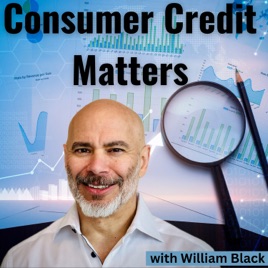
Advertise on podcast: Consumer Credit Matters
Rating
5from
This podcast has
29 episodes
Language
EnglishPublisher
William BlackExplicit
No
Date created
2024/04/23
Latest episode
2026/09/08
Average duration
47 min.
Release period
37 days
Description
Welcome to the Consumer Credit Matters podcast, where we discuss and analyze the world of consumer credit, credit risk and finance!
Unlock Consumer Credit Matters podcast Email contact info,
Listeners & Audience details
Email contact information
Direct podcast contact details

Listeners
Audience numbers & engagement insights

Audience details
Podcast Insights

Podcast episodes
Check latest episodes from Consumer Credit Matters podcast
40 Years in ABS with John Costa: Monolines, Timeshare, Extendable ABCP & Bank Charters
2026/09/08
John Costa spent 40 years in consumer credit and securitization — from E.F. Hutton and the first timeshare ABS deal to building Merrick Bank at CardWorks. He walks through the innovations that worked, the one that didn't survive 2008, and the bank-charter decision every fintech faces today.
John recently retired as Senior Vice President of CardWorks, the consumer credit originator and servicer behind Merrick Bank. He started at E.F. Hutton's Hutton Indemnity during the birth of the monoline financial guaranty business, and was on the ground floor of timeshare securitization and extendable asset-backed commercial paper.
In this episode:
– The first timeshare securitization, and why the rating agencies almost refused to take the meeting
– How timeshare ABS performed through the financial crisis
– Points programs, brand strength, and the illiquidity that still defines timeshare
– Asset-backed commercial paper at $1.2 trillion, and how extendable ABCP tried to separate liquidity risk from credit risk
– Why market psychology beat the analytics in 2008
– CardWorks' decision to form Merrick Bank rather than rent a charter, and why it still matters for fintechs
– Merrick's expansion into merchant acquiring, RV lending, GreenSky, and the Ally credit card acquisition
– Whether fintech lenders have really been tested by a credit cycle
– John's novel, Sex, Lies and Securitization
Consumer Credit Matters is an independent research, newsletter, and podcast platform for structured finance and consumer credit professionals, hosted by William Black, former Managing Director for consumer ABS ratings at Moody's.
Subscribe to CCM Weekly:https://www.consumercreditmatters.com/subscribe
John's novel: https://www.amazon.ca/stores/John-Costa/author/B00TOZZJS0?ref=ap_rdr&shoppingPortalEnabled=true
Carvana's New-Car Gambit ft. Charlie O'Shea
2026/06/12
Carvana built its brand by killing the dealership. Now it's buying them.
Host William Black sits down with Charlie O'Shea (President, O'Shea Advisors and the analyst who first called Carvana the "Amazon of auto retail") to unpack Carvana's push into franchised Chrysler, Dodge, Jeep, and Ram stores, and what it means for the company's credit and securitization profile.
In this episode:
The CDJR acquisitions and how the anti-dealership disruptor became a top national Chrysler-Dodge-Jeep-Ram dealer.The Casa Grande, Arizona pilot that went from roughly 30 to 50 units a month to about 350, per Stellantis figures reported by the Wall Street Journal. Incumbent pushback from StellantisThe CarMax precedent: it ran its own franchised playbook starting in the mid-1990s and spent two decades walking away from it. Carvana's warrant tied to Bezos-backed EV startup Slate Auto, and what the dealership rail could mean for EV distribution. And the ABS read-through: how the move could reshape the CRVNA collateral profile.
A practitioner's look at whether Carvana is re-treading a path the market already abandoned, or building something genuinely different this time.
Consumer Credit Matters is a research, newsletter, and podcast platform for structured finance and consumer credit professionals.
Newsletter and research: https://www.consumercreditmatters.com/
Watch on YouTube: https://youtu.be/fntGvXJ4cVg
When Retailers Can't Move the Goods
2026/05/19
There's an operational layer underneath consumer credit that most analysts never see: what actually happens to retail inventory when it doesn't sell, when a retailer goes bankrupt, or when a brand orders too much for the wrong season. Someone has to move those goods, and how efficiently they get moved determines recovery values in bankruptcy, margin protection for healthy brands, and signals about where retailers are headed next.
In this episode of Consumer Credit Matters, Will Black sits down with Alex Hennick, founder of AD Hennick & Associates, a Toronto-based firm that operates globally across the inventory business, from bidding on distressed assets in retail bankruptcies to clearing excess inventory for successful brands without damaging their pricing or channel relationships. Alex shares a case study of liquidating a 50,000 square foot Toronto barbecue store in a single week, walks through the mechanics of brand protection in inventory management, and offers a candid view from the front lines on tariffs, the COVID over-ordering hangover, and the structural decline of mall retail.
Will and Alex cover how retail inventory liquidation actually works, including the bid process, the time pressure of standing leases, and what drives recoveries. They go inside the quieter but larger business of inventory management for healthy brands, where channel restrictions and brand protection often matter more than price, and where some manufacturers would rather destroy product than sell it into the wrong market. Alex shares what he is seeing on the front lines right now: tariffs compressing margins overnight, consumers trading down to discount and secondary channels, the COVID-era over-ordering hangover still working through the system, and the structural decline of mall retail, with Eddie Bauer, Off Fifth, and Beyond the Rack as case studies.
Alex Hennick is the founder of AD Hennick & Associates, which he launched 17 years ago. From a Toronto base, the firm operates globally on both sides of the inventory business, bidding on distressed assets from bankrupt retailers and manufacturers, and partnering with successful brands on excess inventory, canceled orders, and close-dated product. With proprietary warehousing, an 80,000-person buyer network, and auction infrastructure, AD Hennick clears goods quickly while protecting brand value and channel relationships.
For institutional investors in consumer ABS, retail credit, and trade finance, this is a side of the ecosystem you rarely hear from directly, and a leading indicator of what eventually shows up in recovery rates, charge-off curves, and retailer bankruptcies.
Consumer Credit Matters is hosted by Will Black, founder of Black Analytics LLC and a 25+ year veteran of consumer structured finance. CCM brings institutional-quality analysis and practitioner perspectives to the consumer credit and structured finance community.
Subscribe to the Consumer Credit Matters LinkedIn newsletter for written analysis and episode recaps: https://www.linkedin.com/newsletters/consumer-credit-matters-7034965118010413056/
Consumer ABS: Built, Broken, Rebuilt — with Bonnie Seideman
2026/04/30
Bonnie Seideman has spent thirty years inside the machinery of consumer credit — from subprime auto in 1990s Dallas to running capital markets at Capital One, Santander, GE Capital, and Synchrony.
In this episode of Consumer Credit Matters, Bonnie walks through how the modern consumer ABS market got built, what she saw before the Great Financial Crisis broke it, and what actually got fixed afterward. Topics include FICO-era credit modeling, monoline wraps, gain-on-sale accounting, the originate-to-distribute model, the cocktail-party tells that flagged the GFC, CDOs and synthetic structures, and the post-crisis rebuild — TALF, risk retention, disclosure, and skin in the game.
In the final segment, Bonnie shares something personal: an ALS diagnosis, and how she's channeling her energy now into raising awareness and funding research.
If you originate, fund, or invest in consumer loans, this is a conversation about the plumbing of your business — told by someone who helped build it.
CHAPTERS
00:00 — Intro: 30 Years in Consumer ABS with Bonnie Seideman
01:40 — How Modern Securitization Got Built: Subprime Auto and FICO
05:29 — Monoline Wraps and Scaling Capital One's ABS Program
10:53 — Gain-on-Sale Accounting and the Originate-to-Distribute Era
16:14 — Front Row at the GFC: Home Equity, CDOs, and the Signals Bonnie Saw
29:09 — After Lehman: TALF, Risk Retention, and Skin in the Game
34:35 — Inside the Capital Markets Seat: Translator Across Origination, Servicing, and Finance
37:59 — A Personal Turn: Bonnie's ALS Diagnosis
SUPPORT BONNIE'S ALS FUNDRAISING
Bonnie was diagnosed with ALS and is raising funds and awareness for ALS research.
Donate directly to her ALS Association page: https://web.alsa.org/goto/bonnieseideman
Organizations advancing ALS research, advocacy, and patient support:
ALS Association — https://www.als.org
I AM ALS — https://www.iamals.org
Team Gleason — https://www.teamgleason.org
Target ALS — https://www.targetals.org
Les Turner ALS Foundation — https://www.lesturnerals.org
Bitcoin Meets Structured Finance: Breaking Down Ledn's BBB- Rated ABS | E26
2026/04/15
The First Investment-Grade Bitcoin-Backed ABS — How Ledn Did ItIn February 2026, launched a groundbreaking $200 million Bitcoin-collateralized loan ABS, rated BBB- by S&P Global — the first investment-grade rating ever assigned to a Bitcoin-backed securitization. Then, during pricing, Bitcoin dropped nearly 30%. The structural safeguards held.In this episode of Consumer Credit Matters, host William Black speaks with Adam Reeds, CEO and co-founder of Ledn, about how the deal came together, how it performed under real stress, and what it means for the future of digital asset capital markets.Topics covered:• How Bitcoin-backed lending works and why HODLers borrow instead of sell• LTV triggers, margin mechanics, and automatic liquidation at 80% LTV• Bitcoin market structure, price oracles, and liquidity risk• Lessons from past "crypto winters"• How Fidelity (custodian), Zaria (backup servicer), and S&P came together to make the deal possible• The live 30% Bitcoin price drop during pricing — and why the WSJ misread it• Revolving structure, legal final maturity, and interest coverage in an ABS wrapper• Global borrower geography, country concentration limits, and how Bitcoin flips traditional credit analysis• The addressable market: $3B today, potential path to $300BChapters:0:00 Bitcoin-Backed ABS: The First Investment-Grade Deal1:40 Ledn's Origin Story: From Renewable Energy to Bitcoin Lending4:50 Why Bitcoin Holders Borrow Instead of Sell — and How the Loans Work11:28 Bitcoin Market Structure, Crypto Winters, and the Road to ABS16:11 Building the Credit Stack: Fidelity, S&P, and Backup Servicing21:58 How S&P Rated a Bitcoin ABS BBB-: Price Oracles and Eight Years of Data23:37 Live Stress Test: 30% Bitcoin Drop During Pricing27:14 The WSJ Got It Wrong: Why Liquidations Were a Feature, Not a Bug29:30 Deal Mechanics: Revolving Structure, Legal Final, and Interest Coverage35:25 Global Borrowers, Jurisdiction Risk, and the $300B OpportunityGuest: Adam Reeds, CEO & Co-Founder, LednHost: William Black, Founder, Black Analytics | Former Moody's Managing DirectorConsumer Credit Matters is a podcast for structured finance and consumer credit professionals.#Bitcoin #AssetBackedSecurities #StructuredFinance #ABS #Securitization #CryptoFinance #Ledn #ConsumerCredit #FixedIncome #DigitalAssets
How JD Power Tracks Auto Inventory
2026/03/07
Brian Terr, who heads JD Power's Inventory Data Sales unit, joins Consumer Credit Matters to unpack how dealer inventory data intersects with auto finance, floorplan lending, and collateral accuracy.
In this episode, we explore why tracking what is actually on a vehicle matters so much, how “power booking” can distort LTV assumptions, and how lenders can use near-real-time inventory data to better understand risk.
Key topics in this episode:
• Brian Terr’s path from Edmunds to Inventory Command Center to JD Power
• Why inventory tracking matters from OEM to floorplan to retail financing
• How collateral errors can affect loan to value assumptions
• What “power booking” means in practice
• How lenders use near-real-time inventory data to monitor in-stock versus sold vehicles
• Why proprietary build data and Monroney label information can improve accuracy
Chapters:
00:00 Brian Terr (JD Power): inventory data, floorplan risk, and auto finance
04:09 Why inventory tracking matters (OEM → floorplan → retail financing)
06:32 “Power booking” explained: when LTV collateral value is wrong
09:55 How lenders use near-real-time dealer inventory data (in-stock vs sold)
16:13 AI limits, proprietary vehicle build data (Monroney), and the CDK outage story
About the show:
Consumer Credit Matters explores the trends, risks, and structural issues shaping consumer lending and specialty finance.
Subscribe for more conversations on auto finance, ABS, underwriting, and consumer credit.
#ConsumerCreditMatters #AutoFinance #JDPower #FloorplanLending #AssetBackedSecurities #ConsumerCredit
Collections 2026: An Insider's View
2026/02/11
Collections is often discussed from the consumer angle. In this episode, Will Black goes inside the collector side of the business with John Bedard (Bedard Law Group), who advises debt collectors, debt buyers, and creditors on compliance, regulation, and litigation risk.
We cover what “reg-lite” can mean in practice, how state and local requirements continue to shape day-to-day collections strategy, and why navigating federal, state, and even municipal rules is a core operating competency in 2026.
We also dig into:
How serious operators build and maintain compliance management systems
What AI changes in collections, including the idea of software as the “near-perfect collector” when trained to stay inside jurisdiction-by-jurisdiction guardrails
Credit reporting and medical debt, including the state-level push to restrict reporting and the legal uncertainty that follows
#consumercredit #collections #compliance
VantageScore Challenges FICO
2026/01/22
Mortgage credit scoring is entering a new competitive phase—raising practical questions for originators, aggregators, guarantors, and RMBS investors about calibration, comparability, and workflow adoption.
In this episode, VantageScore leaders, Rikard Bandebo and Tony Hutchinson, break down what’s changing, why it matters, and what to watch next—including the push toward cash-flow and open-banking data.
What we cover:
• Why mortgage scoring is changing—and what “FICO classic” really means
• Trended data and newer risk signals: what improves, what doesn’t
• Adoption friction: workflow inertia across the mortgage ecosystem• Investor questions: disclosure, comparability, and spread implications
• The next frontier: open banking / cash-flow data and “VantageScore 4 Plus”
Listen and subscribe
Big-Box Holiday Outlook
2025/11/29
Retailers are navigating a complicated environment marked by structural shifts, uneven consumer strength, and lingering pandemic-era distortions. In this episode, retail expert Charlie O’Shea, known for his clear-eyed analysis, returns to break down why some big-box operators continue to outperform—and why Target’s Q3 numbers require a more nuanced read than the headlines suggest.
What we cover:• How years of strategic investment created today’s retail “haves and have-nots”• The role of store-based fulfillment and the rise of buy-online-pickup-in-store• Why Target’s Q3 results are misunderstood—and what the underlying data shows• The changing profile of today’s consumer and the impact of inflation, SNAP, and credit• A realistic holiday spending outlook based on Q3 earnings and consumer behavior
Topics:consumer credit, abs, securitization, retail, big-box, Target, Walmart, consumer spending, credit risk, store cards, Charlie O’Shea
#consumercredit #abs #securitization #lending #capitalmarkets #retail #bigbox #consumertrends #creditrisk
Inside Crypto Lending: Risk, Servicing, and Securitization with Emily Barron of Zaria | E21
2025/11/18
Crypto-backed lending is re-emerging as a serious funding channel — but only if lenders can meet institutional standards around collateral control, servicing, and risk management. In this episode, Emily Barron, CEO and co-founder of Zaria, breaks down the operational and capital-markets infrastructure needed to bring crypto margin loans into warehouse lending and securitization.
What we cover:• How crypto-backed lending works today (LTVs, liquidation mechanics, stablecoins)• Why collateral segregation and custody infrastructure matter for institutional credit• How to structure servicing, backup servicing, and key agent functions in digital asset lending• Lessons from crypto winter, rehypothecation failures, and margin controls• What it will take for banks, ABS investors, and regulators to support crypto-secured loans
E20 The Tricolor Collapse: Vervent's Inside View as Successor Servicer
2025/10/28
In this episode of Consumer Credit Matters, host William Black talks with David Johnson (CEO) and Derek Gamble (CLO) of Vervent, the firm that stepped in as successor servicer following the Tricolor Auto bankruptcy.
They share what it takes for a backup servicer to become the front line in a lender collapse—managing data integrity, cash flow disruption, and investor communication—while highlighting what the case reveals about risk oversight in subprime auto ABS.
Topics include:
Vervent’s rapid mobilization as successor servicer
Coordination with trustees and warehouse lenders
How double-pledging and weak data controls can cripple a platform
What Tricolor’s failure signals for subprime auto
Listen, subscribe, and read more at https://www.consumercreditmatters.com
E19 After Tricolor: How Technology Could Close the Double-Pledging Gap
2025/10/18
Summary:In this episode of Consumer Credit Matters, William Black sits down with Sid Siddhartha (CEO, Intain) to discuss how AI and blockchain could help prevent issues like the alleged double-pledging at Tricolor Auto. They explore what went wrong, how real-time data could change collateral monitoring, and whether this moment could finally push the securitization industry toward modernization.
Chapters:
Chapters:Intro• The Tricolor Shock • Lagging Data, Late Warnings• The Double-Pledging Problem• The Road to Adoption• Conclusion and Final Thoughts
Takeaways:
The Tricolor bankruptcy reveals major vulnerabilities in consumer credit.
Double-pledging poses serious risk across warehouse and ABS financing.
AI can enable real-time collateral performance monitoring.
Blockchain offers immutable, auditable records to prevent duplication.
Lenders and trustees are beginning to pilot these solutions with FIS.
Regulatory shifts may accelerate technology adoption.
Sound Bites:
“We need early warning signals.”“Double pledging is a big issue.”“The technology is here and now.”
About the show:Consumer Credit Matters is hosted by William Black, a structured-finance analyst and founder of Black Analytics LLC. The podcast features insights and interviews with industry leaders across consumer credit, securitization, and fintech innovation.
#Tricolor #AutoFinance #Blockchain #AI #Securitization #ConsumerCredit #Fintech #StructuredFinance #ABS #WilliamBlack #ConsumerCreditMatters #Intain #SidSiddhartha
E18 Driving Into Default: Tricolor and the Subprime Auto Fallout
2025/10/11
In this episode of the Consumer Credit Matters podcast, host William Black and guest Rod Dubitsky (aka The People's Economist) discuss the recent Chapter 7 bankruptcy filing of Tricolor, a subprime auto lender. They explore the unique business model of Tricolor, the implications of fraud allegations, and the role of securitization and warehouse lending in the company's downfall. The conversation also touches on the broader implications for the subprime auto lending market and the economic pressures facing borrowers.
Chapters
00:00 Introduction to TriColor's Collapse
09:28 Straight to Chapter 7 Bankruptcy
12:24 Tricolor's Business Model
18:15 The Role of Securitization
31:40 The ABS ratings
44:29 Economic Headwinds or Immigration Policy?
57:22 The Role of the Backup Servicer
01:03:08 Social Bonds and ESG Considerations
01:08:08 Idiosyncratic vs. Systemic
Legalese Meets AI: Augmenting Decision-Making Across Structured Finance
2025/05/28
In this episode of the Consumer Credit Matters podcast, host William Black interviews Peter Jasko, CEO and co-founder of Semeris, a company focused on enhancing the efficiency of reading and analyzing legal documents in the securitization market. They discuss the role of technology, particularly AI, in transforming document analysis, the challenges of accessing legal documents, and the expansion of Semeris into new asset classes. The conversation also touches on the competitive landscape, the evolution of legal documentation, and the future of private credit.
Chapters
00:00 Punching Through the Noise: Welcome to Semeris
04:45 Meet the Founder: Peter Jasko on the Origins of Semeris
10:16 Case Study: CLO Documentation Review Process
13:39 The AI Leap: Beyond NLP Frustrations
16:51 Analyst Augmentation and Operational Efficiency
18:25 How Semeris Stands Apart
23:15 Beyond CLOs: Semeris Goes Multi-Asset
41:17 Build or Buy?: Competing in the Legal AI Race
50:18 Complexity in Legal Documentation and Its Implications
56:53 What's in a Name: The Story Behind "Semeris"
E16 Backup Servicing: The Unsung Hero of Consumer Credit Finance
2025/04/15
In the structured finance world, there’s a quiet hero most folks overlook: the Backup Servicer. Until... they’re needed.In the latest episode of the Consumer Credit Matters Podcast, I sit down with Louis Geibel and Juliellen DeLuca from Vervent, one of the industry’s leading backup servicers. We go deep on a role that rarely makes headlines but becomes absolutely critical when the primary servicer falters. Think bankruptcies, fraud, or just plain old mismanagement.With cracks forming in several consumer asset classes—subprime auto, unsecured personal loans, even credit cards—this isn’t a theoretical exercise. Backup servicers are being called into action with increasing frequency.What actually happens after the default trigger is pulled? Who’s really prepared to step in and keep the payments flowing to bondholders? And what makes some “BUS” providers better than others?
Podcast sponsorship advertising
Start advertising on Consumer Credit Matters relevant audience podcasts
You may also like to advertise on these Podcasts
4.861371088
The David Pakman Show
David Pakman
4.8258691482
Relatable with Allie Beth Stuckey
Blaze Podcast Network

4.858221907
Sara Gonzales Unfiltered
Blaze Podcast Network

4.824771857
Deck The Hallmark
Bramble Jam Podcast Network
4.922301819
The Ten Minute Bible Hour Podcast
Matt Whitman

4.916161609
The Kristian Harloff Show
Kristian Harloff
4.917101543
DarrenDaily On-Demand
Darren Hardy LLC

4.549032000
The Daily Stoic
Daily Stoic | Backyard Ventures
4.737121980
The Eric Metaxas Show
Metaxas Media

4.682401276
The Daily Beast Podcast
The Daily Beast, Joanna Coles