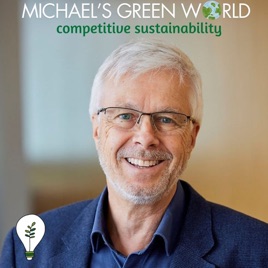
Hi, I’m Michael.
After years as an engineer and corporate manager, I founded my own consulting firm focused on sustainability solutions. Since retiring, I’ve been tackling puzzles that align seemingly conflicting interests and discovering win-win strategies with my clients. I also support a project dedicated to ocean ecology. My wife Karin and my son Alex were the first to suggest a podcast for me. As a natural optimist and father of two wonderful kids, I tend to resist gloomy predictions about our future. We probably live in the best world we ever had, with the promise of making a meaningful life accessible for a growing part of the world population, but it is imperative to keep this spirit alive. Therefore, I’ve created an antidote to scepticism: ‘Michael’s Green World.’
Advertise on Michael's Green World
Advertise on Michael's Green World to promote your brand to thousands of podcast listeners
Unlock Michael's Green World podcast Email contact info, Listeners & Audience details
Email contact information
Direct podcast contact details
Listeners
Audience numbers & engagement insights
Audience details
Podcast Insights
Podcast episodes
Check latest episodes from Michael's Green World podcast
#24P - The Ocean Race: Do Percurso de Regata a uma Força em Defesa do Oceano (dobragem com ElevenLabs)
2026/07/18
A The Ocean Race começou como uma das aventuras mais exigentes da vela internacional. Hoje, é também uma plataforma global ao serviço de mudanças positivas para o oceano.
Michael Herzog conversa com Lucy Hunt, Ocean Impact Director da The Ocean Race, sobre a forma como o desporto de alta competição pode aproximar as pessoas da ciência oceânica, da educação, das políticas públicas e da ação local.
Lucy explica como os veleiros de competição recolhem dados importantes sobre o oceano e o clima, como os programas educativos promovem a literacia do oceano, por que razão as cidades anfitriãs e as ONG locais são essenciais e como a The Ocean Race procura avaliar se o seu impacto se mantém a longo prazo.
Uma conversa sobre aventura desportiva, propósito e responsabilidade, cultura organizacional, ação comunitária — e sobre como o desporto pode oferecer uma razão credível para ter esperança.
#24F – The Ocean Race : du parcours de régate à une force pour l’océan (doublage avec ElevenLabs)
2026/07/18
The Ocean Race a commencé comme l’une des aventures les plus exigeantes de la voile internationale. Aujourd’hui, c’est aussi une plateforme mondiale au service d’un changement positif pour l’océan.
Michael Herzog s’entretient avec Lucy Hunt, Ocean Impact Director de The Ocean Race, sur la manière dont le sport de haut niveau peut relier le public aux sciences océaniques, à l’éducation, aux politiques publiques et à l’action locale.
Lucy explique comment les voiliers de course recueillent d’importantes données sur l’océan et le climat, comment les programmes éducatifs développent la culture océanique, pourquoi les villes hôtes et les ONG locales jouent un rôle essentiel, et comment The Ocean Race cherche à déterminer si son impact s’inscrit dans la durée.
Une conversation sur l’aventure sportive, le sens et la responsabilité, la culture organisationnelle, l’action communautaire — et sur la manière dont le sport peut offrir une raison crédible d’espérer.
#24B - The Ocean Race: Vom Regattakurs zur Kraft für den Ozean (Dubbing mit ElevenLabs)
2026/07/18
The Ocean Race begann als eines der härtesten Abenteuer des internationalen Segelsports. Heute ist es zugleich eine globale Plattform für positive Veränderungen für den Ozean.
Michael Herzog spricht mit Lucy Hunt, Ocean Impact Director bei The Ocean Race, darüber, wie Spitzensport Menschen mit Meereswissenschaft, Bildung, Politik und lokalem Handeln verbinden kann.
Lucy erklärt, wie die Regattayachten wichtige Ozean- und Klimadaten sammeln, wie Bildungsprogramme Ocean Literacy fördern, warum Gastgeberstädte und lokale NGOs entscheidend sind und wie The Ocean Race untersucht, ob seine Wirkung langfristig bestehen bleibt.
Ein Gespräch über sportliches Abenteuer, Sinn und Verantwortung, Organisationskultur, gemeinschaftsbasiertes Handeln – und darüber, warum Sport einen glaubwürdigen Grund zur Hoffnung geben kann.
#24A - The Ocean Race: From Racetrack to Force for the Ocean
2026/07/18
The Ocean Race began as one of the toughest adventures in international sailing. Today, it is also a global platform for positive change for the ocean.
Michael Herzog speaks with Lucy Hunt, Ocean Impact Director at The Ocean Race, about how elite sport can connect people with ocean science, education, policy and local action.
Lucy explains how racing yachts collect essential ocean data, how learning programmes build ocean literacy, why host cities and local NGOs are crucial, and how The Ocean Race examines whether its impact lasts.
A conversation about sporting adventure, purpose, organisational culture, community-based action — and why sport can offer a credible reason for hope.
#23ES – Buceadores cazan redes fantasma (AI dubbed via ElevenLabs)
2026/05/14
En este episodio de Michael’s Green World, Michael Herzog conversa con Sabine Kerkau, buceadora técnica de pecios y presidenta de la Baltic Sea Nature & Heritage Protection Association e.V., sobre peligrosas operaciones de recuperación de redes fantasma en el mar Báltico.
Hablamos de pecios, mala visibilidad, frío, profundidad, riesgo, trabajo en equipo, cooperación con pescadores y de lo que ocurre con las redes después de ser recuperadas.
Para Redes Fantasma, este episodio ofrece una mirada importante al final de la cadena: la recuperación sigue siendo necesaria, pero la prevención, la localización y la rápida recuperación de artes de pesca perdidas deben empezar mucho antes.
#23F – Des plongeurs traquent les filets fantômes (dubbed by Artificial Intelligence)
2026/05/12
Dans cet épisode de Michael’s Green World, Michael Herzog s’entretient avec Sabine Kerkau, plongeuse technique spécialisée dans les épaves et présidente de la Baltic Sea Nature & Heritage Protection Association e.V., au sujet des dangereuses opérations de récupération de filets fantômes en mer Baltique.
Nous parlons des épaves, de la mauvaise visibilité, du froid, de la profondeur, des risques, du travail d’équipe, de la coopération avec les pêcheurs et de ce qui arrive aux filets après leur récupération.
Pour Redes Fantasma, cet épisode apporte un regard important sur la fin de la chaîne : la récupération reste nécessaire, mais la prévention, la localisation et la récupération rapide des engins de pêche perdus doivent intervenir plus tôt.
#23P – Mergulhadores Caçam Redes Fantasma (dubbed via A.I. elevenlabs)
2026/05/12
Neste episódio de Michael’s Green World, Michael Herzog conversa com Sabine Kerkau, mergulhadora técnica de naufrágios e presidente da Baltic Sea Nature & Heritage Protection Association e.V., sobre perigosas operações de recuperação de redes fantasma no Mar Báltico.
Falamos sobre naufrágios, pouca visibilidade, frio, profundidade, risco, trabalho em equipa, cooperação com pescadores e sobre o que acontece às redes depois de serem recuperadas.
Para a Redes Fantasma, este episódio oferece um olhar importante sobre o fim da cadeia: a recuperação continua a ser necessária, mas a prevenção, a localização e a recolha rápida de artes de pesca perdidas devem começar mais cedo.
In this episode of Michael’s Green World, Michael Herzog speaks with Sabine Kerkau, technical wreck diver and President of the Baltic Sea Nature & Heritage Protection Association e.V., about dangerous ghost-net recovery operations in the Baltic Sea.
We talk about wrecks, poor visibility, cold water, depth, risk, teamwork, cooperation with fishers, and the question of what happens to the nets after they have been recovered.
For Redes Fantasma, this episode offers an important look at the end of the chain: recovery remains necessary, but prevention, location technology and faster retrieval of lost fishing gear must start earlier.
#23B – Taucher jagen Geisternetze
2026/05/10
In dieser Episode von Michael’s Green World spricht Michael Herzog mit Sabine Kerkau, technischer Wracktaucherin und Präsidentin der Baltic Sea Nature & Heritage Protection Association e.V., über gefährliche Geisternetz-Bergungen in der Ostsee.
Es geht um Wracks, schlechte Sicht, Kälte, Tiefe, Risiko, Teamarbeit, die Zusammenarbeit mit Fischern und die Frage, was nach der Bergung mit den Netzen geschieht.
Für Redes Fantasma ist die Episode ein wichtiger Blick auf das Ende der Kette: Bergung bleibt notwendig, aber Prävention, Ortung und schnelle Rückholung verlorener Netze müssen früher ansetzen.
#22A Who Keeps the Power Grid Stable? (AI dubbed via elevenlabs)
2026/04/13
How does a power grid stay stable when thousands of producers feed electricity into it at the same time?
A conversation with Tobias Andrist, CEO of EBL.
Recorded at EBL headquarters in Liestal.
#22B Wer hält das Stromnetz stabil?
2026/04/12
Wie bleibt ein Stromnetz stabil, wenn tausende Produzenten gleichzeitig einspeisen?
Ein Gespräch mit Tobias Andrist, CEO der EBL.
Aufgenommen am Hauptsitz in Liestal.
#21B - Kein Green Premium – Wie Innovation Nachhaltigkeit marktfähig macht (Teil 2) {KI gedubbt}
2026/02/17
{TEIL 2}
Ein Gespräch mit den IMD-Professoren Fréderic Dalsace und Goutam Challagalla über „No Green Premium“ und den Wandel von Nachhaltigkeit als Right to Play hin zu Innovation als Right to Win. Mit realen Unternehmensbeispielen und Einblicken in ihr im Harvard Business Review vorgestelltes Buch Clean Winners, das während der WEF-Woche 2026 in Davos lanciert wurde.
Teil 1 beleuchtete die Compliance-getriebenen Vorteile. Teil 2 steht für Sustainability 2.0.
Die zentrale Idee von Clean Winners ist: Nachhaltigkeit wird erst dann zum Wettbewerbsvorteil, wenn sie Innovation antreibt, die Ressourcenallokation steuert und neuen Kundennutzen schafft. Solange sie primär als Reporting- und Compliance-Aufgabe verstanden wird, bleibt sie ein notwendiger Kostenfaktor – aber kein Differenzierungsmerkmal.
Die meisten Unternehmen beginnen beim „Right to Play“: Reporting, Risikoreduktion und Reputation. Der nächste Schritt ist Effizienz – Energie sparen, Materialien reduzieren, Prozesse optimieren. Der eigentliche strategische Hebel entsteht jedoch erst, wenn Nachhaltigkeit zur Wachstumsplattform wird. In dem Moment, in dem Unternehmen verstehen, wie sich die Bedürfnisse ihrer Kunden verändern, und darauf mit neuen Lösungen und Geschäftsmodellen reagieren.
Damit verschiebt sich auch die zentrale Managementfrage. Nicht mehr: „Wie werden wir compliant?“ Sondern: „Wo investieren wir unsere knappen Ressourcen so, dass durch Nachhaltigkeit zukünftiges Wachstum entsteht?“ Die grösste Chance liegt nahe beim Kunden – im Verständnis dafür, wie sich dessen Prozesse verändern und welche neuen Fähigkeiten und Lösungen künftig gebraucht werden.
Deshalb gilt das Prinzip: beim Kunden beginnen, nicht beim Fussabdruck. Intern zu messen und zu optimieren ist notwendig – Differenzierung entsteht aber erst, wenn man den Kunden hilft, ihre eigene Transformation erfolgreich zu gestalten.
Für Unternehmen im CSRD-Kontext ist die Konsequenz klar: Nachhaltigkeit schafft nur dann echten Wert, wenn sie in die Kernprozesse integriert wird – in Strategie, Innovation, Marketing und Vertrieb, Einkauf, Produktion und Lieferung, das After-Market-Geschäft und die Kapitalallokation. Wird sie als paralleler Reporting-Strang geführt, bleibt sie Compliance. Wird sie integriert, wird sie zum Treiber von Innovation, Wachstum und Resilienz.
Die eigentliche Gefahr besteht darin, Nachhaltigkeit vollständig in einer Compliance-Logik zu verbrauchen. Das erzeugt viel Aktivität und viele Daten, aber wenig strategische Wirkung. Die Führungsaufgabe besteht darin, die regulatorischen Anforderungen zu erfüllen und gleichzeitig genügend Ressourcen und Fokus zu sichern, um Nachhaltigkeit in zukünftige Wertschöpfung zu übersetzen.
#21A - No Green Premium – Sustainability Needs Innovation to Win Customers (Part 2)
2026/02/17
{PART 2}
A conversation with IMD professors Frédéric Dalsace and Goutam Challagalla on “no green premium” and the shift from sustainability compliance as a right to play toward innovation as a right to win. Real-world business cases and insights from their HBR-published book Clean Winners, launched in Davos during 2026 World Economic Forum week.
Part 1 focussed on compliance related benefits, Part 2 talks about Sustainability 2.0.
The central idea behind Clean Winners is that sustainability becomes a competitive advantage only when it drives innovation, guides resource allocation, and creates new value for the customer. As long as it is treated mainly as a compliance and reporting exercise, it remains a cost of doing business — necessary, but not differentiating.
Most companies begin with “right to play”: reporting, risk reduction, and reputation. The next step is efficiency — saving energy, reducing materials, improving processes. But real strategic impact starts when sustainability becomes a growth platform. That is the moment when companies understand how customer needs are changing and develop new solutions and business models in response.
This shifts the key management question. It is no longer “How do we become compliant?” but “Where do we invest our scarce resources so that sustainability creates future growth?” The real opportunity is close to the customer: understanding how their processes are transforming and what new capabilities they will need.
That is why the principle is to start from the customer, not from the footprint. Measuring and optimising internally is essential, but differentiation comes from helping customers succeed in their own transformation.
For companies working with CSRD, the implication is clear. Sustainability creates value only when it is embedded in the core processes of the business — in strategy, innovation, marketing and sales, purchasing, manufacturing and delivery, the after-market, and capital allocation. If it is managed as a parallel reporting stream, it stays compliance. If it is integrated, it becomes a driver of innovation, growth, and resilience.
The real risk is to consume sustainability in a purely compliance logic. That generates a lot of activity, but little strategic effect. The leadership challenge is to meet the regulatory requirements while preserving the resources and the focus needed to turn sustainability into future value creation.
#20B - Kein Green Premium – Wie Innovation Nachhaltigkeit marktfähig macht (Teil 1) {KI gedubbt}
2026/02/11
Ein Gespräch mit den IMD-Professoren Frédéric Dalsace und Goutam Challagalla über „no green premium“ und den Wandel von Nachhaltigkeits-Compliance als 'right to play' hin zu Innovation als 'right to win'. Praxisnahe Business-Beispiele und Einblicke aus ihrem im Harvard Business Review veröffentlichten Buch Clean Winners, das während der World-Economic-Forum-Woche in Davos vorgestellt wurde.
Die deutsche Version dieses englischen Podcast wurde mittels Dubbing auf ElevenLabs durchgeführt und nach bearbeitet.
#20A - No Green Premium – Sustainability Needs Innovation to Win Customers (Part 1)
2026/02/09
A conversation with IMD professors Frédéric Dalsace and Goutam Challagalla on “no green premium” and the shift from sustainability compliance as a right to play toward innovation as a right to win. Real-world business cases and insights from their HBR-published book Clean Winners, launched in Davos during 2026 World Economic Forum week.