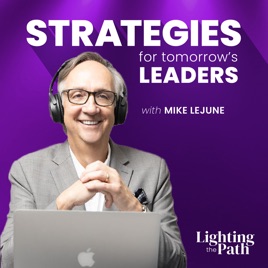
Advertise on podcast: Strategies for Tomorrow's Leaders
This podcast has
107 episodes
Language
EnglishPublisher
Mike LeJeuneExplicit
No
Date created
2024/07/03
Latest episode
2026/01/15
Average duration
24 min.
Release period
13 days
Description
The show for leaders who care about having an engaged, purpose driven workforce. Gallop surveys show that in today's economy 75% of the workforce feels disengaged. Learn from Interviews with industry leaders who understand the importance of how engaged employees impact culture, drive productivity and ignite their teams.
Unlock Strategies for Tomorrow's Leaders podcast Email contact info,
Listeners & Audience details
Email contact information
Direct podcast contact details

Listeners
Audience numbers & engagement insights

Audience details
Podcast Insights

Podcast episodes
Check latest episodes from Strategies for Tomorrow's Leaders podcast
Part II: Why Most Leaders Don't Have a Focus Problem — They Have a Time Problem
2026/01/15
Turning Vision Into Action: A Better Way to Execute Part 2 shifts from insight to application. Dan breaks down how leaders can translate long-term vision into focused, repeatable execution — without burning out or losing adaptability.
Summary Dan walks through the structure and mindset of the 12-Week Year, explaining how shorter planning cycles, weekly scorekeeping, and fewer priorities help leaders move faster and smarter. Mike connects the framework to leadership behaviors, strategic thinking, and real-world performance in uncertain environments.
Key Discussion Points Why shrinking timeframes increases energy and focus
How weekly feedback loops improve performance
The danger of treating plans as to-do lists
Why strategic thinking requires protected time
Highlights The 12-Week Year as a leadership mindset
Why five priorities outperform ten
How weekly reviews replace annual frustration
Intensity paired with recovery sustains performance
Key Takeaways Strategy lives in execution, not intention
Shorter cycles create faster learning
Planning is leadership work, not admin work
Focused systems outperform motivated chaos
Suggested Next Steps Define 3–5 priorities for your next 12 weeks
Schedule a weekly 10–15 minute review
Protect time for thinking, not just doing
Connect with Dan Mintz on LinkedIn:
https://www.linkedin.com/in/dan-mintz/
Part I: Why Most Leaders Don't Have a Focus Problem — They Have a Time Problem
2026/01/15
Why Leaders Feel Busy — But Still Fall Behind
In Part 1, Mike and Dan explore why capable, driven leaders still struggle to execute — especially in a world defined by speed, uncertainty, and constant change. This episode reframes productivity as a leadership challenge, not a time-management problem.
Summary Dan shares his experience as a CEO who felt stuck on a treadmill — planning, reacting, and falling short despite deep expertise. Together, they unpack why annual and quarterly planning fail to create urgency, how uncertainty amplifies execution gaps, and why feedback is now one of the most critical leadership tools.
Key Discussion Points Why knowledge and effort aren't enough
The illusion of progress created by long planning cycles
How uncertainty affects focus and confidence
Why feedback is tied directly to engagement and retention
Highlights "Busy" doesn't mean effective
Annual thinking delays accountability
Uncertainty demands clarity, not paralysis
Feedback helps people understand their value
Key Takeaways Execution breaks down when timelines are too long
Leaders need shorter cycles to stay grounded
Feedback is no longer optional — it's foundational
Focus creates confidence in uncertain environments
Suggested Next Steps Identify where your plans lose momentum
Reflect on how often you receive or give feedback
Ask: What would change if progress was reviewed weekly instead of yearly?
Connect with Dan Mintz on LinkedIn:
https://www.linkedin.com/in/dan-mintz/
How Leaders Can Rewire Fear, Uncertainty, and Limiting Beliefs
2025/12/18
What happens when fear, uncertainty, and limiting beliefs start driving leadership decisions?
In this episode of Strategies for Tomorrow's Leaders, we explore how leaders can rewire fear, shift their thinking, and lead themselves more effectively — especially in times of change.
This conversation looks beneath strategy and tactics and focuses on the inner work that shapes how leaders show up. We talk about fear and curiosity, how language rewires the brain, why labels quietly limit growth, and what it really means to lead from awareness instead of reaction.
Rather than pushing motivation or quick fixes, this episode offers grounded insights and practical reflections leaders can apply immediately — at work and in life.
If you're navigating uncertainty, pressure, or self-doubt, this episode will help you slow down, ask better questions, and make decisions from clarity instead of fear.
What You'll Learn in This Episode
Why fear doesn't exist in the present moment — and why that matters for leaders How curiosity helps leaders overcome fear and uncertainty The hidden cost of labels and limiting beliefs in leadership Why the words leaders use shape how they think and decide How self-awareness strengthens leadership confidence and choice About the Guest
Martine Cohen is a transformational life strategist, leadership coach, and award-winning author of No More Layers. Her work focuses on self-leadership, awareness, and helping leaders reclaim personal power from the inside out.
Why This Episode Matters
Leadership isn't just about having answers — it's about understanding what's driving your decisions. This episode helps leaders step out of fear-based patterns and into intentional, values-driven leadership.
Connect with Martine Cohen:
LinkedIn: https://www.linkedin.com/in/martinecohennml/
Email: [email protected]
Building a Business in Uncertain Times: KPIs, Mindset, and Follow-Through
2025/11/24
In a world where the word most leaders use is "uncertain," what does it really take to build something that lasts?
In this episode, Mike talks with Sarah Englade, Founder and CEO of Monarch Talent Solutions, about launching and growing a recruiting firm in 2020—when companies were laying people off, not hiring. Sarah shares how a COVID layoff pushed her to bet on herself, why KPIs and processes are non-negotiable, and how she built a relationship-first recruiting brand in a noisy, skeptical market.
They dig into the mindset shifts that separate entrepreneurs who keep going from those who quietly quit, the role of belief when the numbers aren't there yet, and how time blocking keeps you out of "tension-relieving" activity and focused on what truly moves the ball.
If you're leading a business, a team, or your own career through uncertainty, this conversation gives you practical handles—not theories—you can put to work this week.
Highlights
How a COVID layoff became the catalyst for Sarah to launch Monarch Talent Solutions
The difference between working in KPI-driven environments vs. "no metrics, total chaos"
Why Sarah "lives for KPIs and processes" and how they actually protect culture and standards
The candidate and client follow-through processes that turn transactions into long-term relationships
Building a credible brand without "infomercial" content or constant self-promotion
Using market intel and real conversations to position yourself as a trusted guide
The biggest early hurdle: mindset, not circumstance
How time blocking keeps you out of the swirl and focused on goal-achieving work
Starting each day with the task you least want to do — and why that moves the needle most
Next Steps for Listeners
Audit your KPIs:
Ask yourself, "What are the 3–5 activities that actually drive results for my team or business?" Turn those into visible, trackable KPIs.
Design one follow-through process:
Choose either candidates, clients, or customers and map a simple sequence:
How often will you touch them? Through which channels? What value will you bring each time?
Time block your week:
Take Sarah's playbook and dedicate specific days or blocks to different priorities (e.g., candidates early in the week, business development later).
Start tomorrow with the hard thing:
Before you end your day, write down the one task you're resisting — and commit to tackling it first thing.
Connect with Sarah:
Reach out to Sarah Englade on LinkedIn (https://www.linkedin.com/in/sarah-englade/) or email her at [email protected] if you want to go deeper on recruiting, branding, or building a relationship-first search firm.
Stay in the conversation:
Follow Strategies for Tomorrow's Leaders and share this episode with another entrepreneur or leader who's navigating uncertainty right now
Part II: From Compliance to Commitment - Leading Through Culture, Not Control
2025/11/11
Making Belief Practical—From Hiring to Customer Experience
Introduction:
In Part 2, we get into the how. Matt walks through what belief looks like in action—from hiring people who align with your culture, to defining values in ways people can actually use, to building customer experiences that transform relationships. This is packed with real stories from Apple, Nordstrom, and other brands that got it right, plus Matt's CADET framework that changes how you think about every interaction.
Summary:
We tackle the practical side of building belief-driven cultures. Matt shares how to hire for cultural fit and belief (not just skills), and walks through his experience scaling Apple retail from 10,000 to 25,000 employees without losing their DNA. We dig into why values are meaningless without tangible definitions, the power of storytelling in creating shared understanding, and the CADET framework for customer experience. Matt also explains why incentives must align with desired behaviors, using real examples of what happens when they don't.
Key Highlights:
Apple hired for people who loved the brand and wanted to serve, not for product expertise—then trained them Values need tangible definitions: what does "kindness" look like, sound like, feel like in your specific organization? The CADET framework: Connect, Assess, Deliver, Exceed, Transform—and why you can't skip steps Incentives and behaviors must align, or your culture breaks down (the e-commerce returns example) Key Takeaways:
Hire for belief, train for skill. Look for alignment with your mission and values first, then build competence. Define your values in observable terms. Don't just say "kindness"—describe what it looks like in action and what it doesn't look like. Use storytelling to build culture. Get your team to share transformational experiences, then identify the common threads. Deliver flawlessly before trying to exceed. Master the basics (stated needs) before attempting to wow people with extras. Remove barriers to desired behaviors. If you want certain actions, make sure your incentive structure supports them, not fights them. Next Steps for Listeners:
Pick one of your company values. Can you describe it in specific, observable terms? If not, gather your team and define it together using stories. Review your last few hires. Did you prioritize skills or cultural alignment? What would change if belief came first? Walk through a customer or employee experience using CADET. Where are you trying to "exceed" before you've "delivered"? Connect with Matt on LinkedIn.
The Power of the Pause
2025/11/06
Title: What Happens When Love Enters the Boardroom (Part 2)
Guest: Kelly Hall — Author of Love Works: Transforming the Workplace with Purpose and Authenticity
Intro If Part 1 asked us to bring our whole selves to work, Part 2 asks: How?
Kelly Hall returns to share how she learned to lead from love — through crisis, coaching, and experience. A former finance executive turned leadership expert, Kelly discovered that love and high performance aren't opposites — they're fuel for each other.
Together, she and Mike explore the tools that turn emotion into insight, chaos into clarity, and leadership into a relationship worth following.
What This Part Covers Emotional intelligence and the "second thought" that defines mature leadership.
Why pausing for clarity leads to better decisions than rushing for control.
The shift from "commander" to "coach" — and what that means in real life.
How consent-based decision-making builds trust and buy-in.
The science of love as energy — and why caring deeply drives performance.
Highlights "Your first thought isn't a choice — but your second one is."
"Sometimes the most productive thing you can do is pause."
"Love is power, not weakness."
"When leaders go last, people start to think for themselves."
"Replace delegation with enrollment — don't assign work, invite ownership."
Takeaways Lead last. Listen first.
Create clarity by slowing down before speeding up.
Turn reaction into reflection — pause before you decide.
Empower others to make decisions, not just execute them.
Redefine ego: use it to serve your people, not control them.
Next Step for Listeners In your next meeting, go last. Let the room breathe. Listen without fixing — and notice what shifts when you trust the process more than the plan.
Connect with Kelly Hall.
The Word We're Afraid to Use at Work
2025/11/06
Title: What Happens When Love Enters the Boardroom (Part 1)
Guest: Kelly Hall — Author of Love Works: Transforming the Workplace with Purpose and Authenticity
Intro What happens when a business leader says the word "love" in a boardroom?
Kelly Hall found out firsthand.
After two decades leading global teams in industries where performance ruled, Kelly began exploring what happens when we let emotion — empathy, compassion, and yes, love — belong at work.
In Part 1, Kelly and Mike unpack the tension between results and humanity: why we've been trained to separate who we are from what we do, and how reconnecting the two builds teams that trust, engage, and stay.
What This Part Covers Why "love" still feels taboo in corporate culture — and why that's changing.
Kelly's story of being told to remove the word "love" from a presentation to investors.
The danger of leaving parts of ourselves at the office door.
Mike's moment of authenticity: going from "Michael" to "Mike."
Redefining psychological safety and what it really looks like in action.
Highlights "It's scary to bring your emotions to work — and that's a tragedy."
"The best leaders put their hand on your back, not their thumb on your head."
"Safety doesn't mean comfort. It means you can stretch without fear."
"When leaders show up as their whole selves, it gives everyone else permission to do the same."
Takeaways Real leadership is relational, not positional.
Love is just another word for deep respect and care.
Authenticity isn't a soft skill — it's a performance advantage.
Create spaces where people can make mistakes and still belong.
Growth happens when people feel safe enough to stretch.
Next Step for Listeners Ask yourself: Do people on my team feel safe to tell me the truth — even when it's uncomfortable? This week, lead one conversation from curiosity, not control.
Connect with Kelly Hall.
Part I: From Compliance to Commitment - Leading Through Culture, Not Control
2025/10/22
The Foundation of Belief-Driven Leadership
Introduction: What is culture, really? In this conversation, Matt Marcotte—who's led teams at Apple, Salesforce, and Bergdorf Goodman—helps us move past the buzzwords. We talk about why belief is the difference between teams that comply and teams that commit, why uncertainty makes this more critical than ever, and how leaders can stop trying to be the hero and start creating environments where people bring their best.
Summary: Matt introduces his new book Built on Belief and explains why he pivoted from frameworks to focus on the real competitive advantage: belief. We explore how belief transforms into commitment versus compliance, why leaders feel pressure to have all the answers (and why that's wrong), and the importance of clarity around what your organization actually believes. Matt shares the "heart, head, hands" framework and explains why people feel first, think second, then act—and how leaders need to work with that reality, not against it.
Key Highlights:
Culture comes down to two things: how people act and what they believe Belief is the "magic elixir" for fighting uncertainty in today's business environment The myth of the hero leader: your success is predicated on your people's success, not on having all the answers The "heart, head, hands" framework: humans are wired to feel first, then make sense of it intellectually, then act Key Takeaways:
Start by defining what you believe. Most organizations focus on the "how" and "what" but skip the foundational "why." Commitment is born from conflict. People need agency, voice, and the ability to challenge ideas to truly buy in. Redefine what control means. Great leaders are conductors orchestrating the whole, not soloists playing every instrument. Lead with emotion, not intellect. "I have a dream" beats "I have a plan" every time when building commitment. Put people in choice. Be clear about your mission so people can authentically opt in—or out. Next Steps for Listeners:
Ask yourself: When's the last time I thought about what my organization actually believes? Identify one person on your team and practice looking at a challenge through their eyes. Think about your last big initiative—did you lead with vision (emotion) or plan (intellect)? How did people respond? Connect with Matt on LinkedIn.
Leading with Trust, Resilience, and Presence
2025/09/11
Intro
In this episode of Strategies for Tomorrow's Leaders, I sit down with Jean Marie Callahan for a candid conversation about what it really takes to lead in uncertain times. From mindset shifts to practical tools, this episode covers the habits and practices leaders need to build trust, resilience, and engagement.
Summary
We start with the personal side of leadership—resilience, authenticity, and presence—before moving into practical strategies leaders can use right away. Jean Marie shares how her own experiences shaped her perspective and why presence matters more than polish. We then dig into trust, communication, and feedback: what works, what doesn't, and how leaders can create environments where people feel steady even when circumstances aren't.
Highlights
Resilience as adapting forward, not bouncing back
Why presence and authenticity create stronger trust than "having all the answers"
How personal stories shape leadership style
Listening as a leadership superpower
Consistency between words and actions as the foundation of trust
Framing feedback as support rather than criticism
Balancing empathy with accountability in real-world leadership
Key Takeaways & Next Steps
Show up with honesty, not false certainty
Practice being present and listening fully
Build trust by aligning your actions with your words
Use feedback as a way to grow people, not tear them down
Apply these practices daily to foster resilient, engaged teams
Connect with Jean on LinkedIn:
linkedin.com/in/jeancallahan-latinamericaexecutivesearch
Part I: From Compliance to Commitment: How Leaders Win Hearts and Results
2025/08/19
Intro:
In Part 1, we get practical about leading with purpose, setting a clear North Star, and turning teams from "doers" into owners. We also unpack "draft-on impact"—the ripple effects leaders must see before they ship.
Summary:
We talk about scaling with engagement (head + heart), why great leaders set outcomes—not tasks—and how asking "why" repeatedly sharpens strategy. We explore echo chambers as an unintended consequence of product choices, and why pace without participation kills buy-in. Finally, we land on trust and psychological safety as the foundation for everything else.
Highlights & Key Takeaways:
Outcome > Orders: Point people to a North Star; let tactics live close to the work.
Draft-On Impact: Model second-order effects (e.g., polarization, FOMO) before launch.
Speed with Care: Going fast is useless if it blocks information flow and buy-in.
Trust = Safety: Engagement and commitment grow when people feel safe and seen.
Next Steps:
Ask your team: What's our North Star this quarter?
Map two "draft-on impacts" for your top initiative and how you'll mitigate them.
List one place speed is harming buy-in—and what you'll slow down to explain.
Connect with Michael Cerda:
https://www.linkedin.com/in/michaelcerda/
Part II: From Compliance to Commitment: How Leaders Win Hearts and Results
2025/08/19
Intro:
In Part 2, we move from principles to practice—how mission guided product choices (like co-viewing), how to tell your people's stories, and how to balance transparency with judgment so you don't create "us vs. them."
Summary:
We cover building for community (e.g., co-watching during lockdowns), using story to connect head and heart, and showing up in outages to refocus teams on the customer. We also tackle transparency: share enough signal to empower people, but curate it so it builds unity, not silos. We end on a core message: building stretches you—it's how you learn who you are as a leader.
Highlights & Key Takeaways:
Mission Guides Features: When the mission is clear, smart features follow.
Tell Stories That Reflect Your Users: Don't just tell; collect and echo their stories.
Show Up in the Mess: Presence in crises rallies commitment.
Transparency + Judgment: Share what people need to act; avoid "us vs. them."
Build to Discover Yourself: You learn who you are by building under real stakes.
Next Steps:
Define one feature your mission demands this quarter.
Capture three customer or employee stories you can retell internally.
Audit a recent "transparent" update: did it inform action—or fuel factions
Connect with Michael Cerda:
https://www.linkedin.com/in/michaelcerda/
Part II: From Change to Transformation: Coaching That Lasts
2025/08/14
Intro:
In this second half, the conversation turns to real-world coaching challenges, building resilience in uncertain times, and making difficult conversations productive.
Summary:
Mike and Dave tackle why leaders avoid tough conversations, how to reframe them as two-way dialogues, and why consistent investment in people drives performance. They share strategies for bridging the gap between "can't" and "potential" and for creating trust when times are uncertain.
Highlights:
The three questions to ask before replacing a team member.
Why leaders sometimes fail their people before people fail their leaders.
Turning limiting beliefs into growth opportunities.
How clarity and trust cut through uncertainty.
"Care and candid" as a formula for transformation.
Key Takeaways:
Invest in people before deciding they can't succeed.
Resilience grows from clarity, trust, and consistent communication.
Avoidance kills relationships faster than conflict—lean into the hard talks.
Next Steps:
Identify one conversation you've been avoiding. Reframe it as a two-way exchange, prepare open-ended questions, and create space for real dialogue.
Connect with Dave Reynolds on LinkedIn:
linkedin.com/in/dave-reynolds-99a71047/
Part I: From Change to Transformation: Coaching That Lasts
2025/08/14
Intro:
This episode explores why transformation—not just change—should be every leader's goal, and why coaching is the bridge to get there. You'll hear how intentional coaching builds resilience, fuels growth, and unlocks the hidden potential in your team.
Summary:
Mike and Dave dig into the difference between change and transformation, the roots of Dave's "radical growth" approach, and why leaders today must master both storytelling and coaching. They break down why questioning is more powerful than directing, how to prepare for a coaching conversation, and the 80/20 principle for listening vs. talking.
Highlights:
Why transformation is lasting, while change can be temporary.
How the radical growth concept came from a seed's first breakthrough.
The 80/20 rule for coaching conversations.
Questions as the "keys to unopened doors" in problem solving.
Why leaders should speak less so their teams think more.
Key Takeaways:
Transformation happens below the surface before it shows.
Leaders who ask better questions get deeper buy-in.
Coaching isn't about having all the answers—it's about guiding discovery.
Next Steps:
Reflect on one area where your team needs transformation, not just change. Ask three open-ended questions this week to help them discover their own answers.
Connect with Dave Reynolds on LinkedIn:
linkedin.com/in/dave-reynolds-99a71047/
Part II: The Hidden Cost of Treating Symptoms Instead of Root Causes
2025/07/24
Introduction:
How do you dig deeper with your team to create real engagement? In part two, Shannon Nutter shares advanced strategies for innovation, avoiding the whack-a-mole trap of constant firefighting, and the critical skill of asking better questions as a leader-facilitator.
Summary:
This episode dives into the practical side of leadership development. Shannon explains why leaders should function as facilitators rather than directors, how to balance innovation with results, and the importance of slowing down to truly know your people. She shares personal stories about recognizing when team members need human connection over business conversations.
Highlights:
Why successful innovation requires a 70% failure rate (like baseball batting averages) The whack-a-mole syndrome that keeps teams busy but not productive How great leaders facilitate rather than dictate solutions The power of asking "What are we missing here?" and "How could that work?" When to pause business conversations for human moments Key Takeaways:
Innovation means creating customer value in new ways, not just building new features Experimentation should include budget for learning, not just success metrics Leaders are facilitators who pull knowledge from the room rather than pushing their own Knowing your people deeply means understanding their motivations, frustrations, and insecurities Sometimes the most important conversation isn't about work at all Next Steps:
Start one project as an experiment with defined learning goals, not just success metrics Practice facilitating meetings by asking questions instead of giving answers Create space in your schedule for unplanned human moments with team members Connect with Shannon on LinkedIn:
https://www.linkedin.com/in/shannon-nutter/
Part I: The Hidden Cost of Treating Symptoms Instead of Root Causes
2025/07/24
Introduction:
What does culture really mean beyond the buzzwords and ping pong tables? In this episode, we explore the real foundations of engaged teams with Shannon Nutter, former C-suite leader who led global operations. We'll uncover why 79% of employees are disengaged and what leaders can do to create environments where people actually want to contribute their best work.
Summary:
Shannon breaks down the difference between surface-level culture initiatives and the deep work of creating psychological safety. She shares practical insights on balancing efficiency with effectiveness, the power of clarity in leadership, and why treating symptoms instead of root causes keeps teams stuck in endless cycles of firefighting.
Highlights:
Why engagement scores are at a devastating 21% despite all the "collegial culture" talk The T-bar concept: balancing human needs with business results How to create psychological safety where teams can fail, debate, and challenge ideas The difference between compliance (capturing minds) and commitment (capturing hearts) Real examples of when technology should step back and humans should step forward Key Takeaways:
Culture isn't benefits or perks - it's how work gets done AND how it makes people feel Leaders must create focus, alignment, clarity, accountability, and psychological safety Ask yourself: "When was the last time someone disagreed with me publicly?" Efficiency without effectiveness is just busy work that doesn't solve real problems Next Steps:
Evaluate your team's psychological safety by tracking when people last disagreed with you Review your current processes - are you solving problems or just making things faster? Schedule one-on-ones focused on understanding what motivates each team member Connect with Shannon on LinkedIn:
https://www.linkedin.com/in/shannon-nutter/
Podcast reviews
Read Strategies for Tomorrow's Leaders podcast reviews
Podcast sponsorship advertising
Start advertising on Strategies for Tomorrow's Leaders relevant audience podcasts
You may also like to advertise on these Podcasts
4.713122000
The NewsWorthy
Erica Mandy

4.95351222
The Potters Cast
Paul Blais
4.42301000
Journey to Truth Podcast CLASSICS
Journey to Truth Podcast

4.41851062
UBS On-Air: Market Moves
Client Strategy Office
4.5361516
Thoughtful Money with Adam Taggart
Adam Taggart | Thoughtful Money

4.8479692
Our Paranormal Afterlife : Finding Proof of Life After Death
Simon Bown

4.998317
On The Continent - A European Football Podcast
Stak

4.72141347
This Week in Virology
Vincent Racaniello

4.8313376
Everything Electric Podcast
The Fully Charged Show

4.359230
رختکن بازندهها
[email protected]