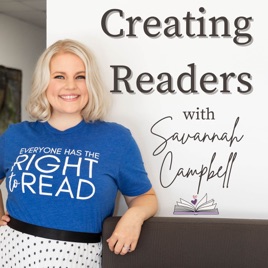
Advertise on podcast: Creating Readers with Savannah Campbell
Rating
4.9from
This podcast has
31 episodes
Language
EnglishPublisher
Savannah CampbellExplicit
No
Date created
2024/08/26
Latest episode
2026/05/28
Average duration
26 min.
Release period
28 days
Description
Join Savannah Campbell, a certified reading specialist and passionate advocate for the Science of Reading, as she shares her journey from traditional teaching methods to transformative, evidence-based practices. Savannah brings you the latest research, practical strategies, and actionable insights to help educators refine their craft and empower their students to become confident, lifelong readers. Whether you’re a seasoned teacher or new to the field, ”Creating Readers” is your go-to resource for making meaningful progress in literacy education—without the overwhelm. Grab a seat, and let’s create readers together!
Unlock Creating Readers with Savannah Campbell podcast Email contact info,
Listeners & Audience details
Email contact information
Direct podcast contact details

Listeners
Audience numbers & engagement insights

Audience details
Podcast Insights

Podcast episodes
Check latest episodes from Creating Readers with Savannah Campbell podcast
#30 Stop Following Textbooks With Fidelity!
2026/05/28
Textbook adoption committees seem to be in every district right now. States are passing legislation. Publishing companies are "coming to the rescue." And teachers are being told to follow programs with fidelity.
But what happens when the program itself is overloaded, inconsistent, or simply not aligned with how children actually learn to read?
In this episode, I’m diving into one of my biggest frustrations in literacy education: the idea that good teaching means reading directly from a script. We’ll talk about why textbooks should be treated as tools rather than sacred documents and why teacher expertise still matters more than any boxed curriculum.
✨ In this episode, we discuss:
• Why many core reading programs prioritize compliance over learning
• The problem with “activating background knowledge” when students don’t actually have it
• Why all vocabulary words should NOT be taught the same way
• What it really means to adapt a curriculum responsibly
• Why fidelity should never come at the expense of student learning
At the end of the day, programs can provide structure, but they cannot replace thoughtful, knowledgeable teachers who know their students best.
If this episode resonates with you, share it with a teacher, coach, administrator, or district leader who needs the reminder that professional judgment still matters.
Links Mentioned:
Blog post on Building Background Knowledge
My new book on teaching vocabulary!*
*As an Amazon affiliate, I may earn a small commission on any products purchased through my link, at no additional cost to you!
#29 When Do We Stop Using Decodables? (And What Comes Next)
2026/05/13
Last week, we talked all about what decodables are with Brooke Vitali.
This week, we’re tackling the question everyone is quietly wondering…When do we actually stop using them?
In this episode, I walk you through how to think about decodables as a tool (not the goal), what signals students are ready to move on, and what instruction should look like after decodables.
Spoiler: it’s not going back to leveled texts.
🔑 Key Takeaways
🔧 Decodables are a tool—nothing more, nothing less They exist to give students practice with phonics skills that have already been explicitly taught.
🎯 They are NOT the end goal The goal is not to get good at reading decodables: the goal is to read and understand any text.
🧠 Word recognition and comprehension develop separately (at first): Decodables support word recognition. Authentic text builds language comprehension. Both matter.
🔄 We don’t move on based on “levels”: Guided reading levels are not grounded in research and shouldn’t drive instructional decisions.
📚 The real signal: multisyllabic words: When students can decode and encode multisyllabic words, that’s your cue to begin transitioning away from decodables.
🌍 What comes next: authentic text + knowledge building: Shift to thematic text sets that build vocabulary and background knowledge—not leveled systems.
If you’ve ever found yourself trying to understand when to move away from decodables and what’s next, this episode is for you!
Links Mentioned:
Blog on Decoding Multisyllabic Words
Link to Dry Erase Notecards*
*As an Amazon affiliate, I may earn a small commission, at no charge to you, on any items purchased through my link.
#28 Decodables Done Right: Story, Scope, and What Actually Matters with Brooke Vitale
2026/04/29
In this episode, I’m joined by Brooke Vitale, founder of Charge Mommy Books and a former editor at major publishing houses like Penguin and Disney. Brooke has published over 100 books and brings a unique perspective to the world of decodables, blending strong storytelling with research-aligned phonics practices.
We dig into what decodables are actually for, how they should (and shouldn’t) be used, and what it really takes to create texts that both support decoding and feel like real stories.
🔑 Key Takeaways
📖 Decodables are a tool, not the curriculum: Their job is to provide practice with taught phonics skills, not replace explicit instruction.
🔤 Phonics control matters, but so does story: A decodable should still have have a story that makes sense. If it’s just words on a page, we’re missing the point.
🧠 Comprehension still belongs in decodables: Even simple tasks, like matching a sentence to a picture, require meaning-making and should be part of the experience.
⚠️ Biggest (non-mistake) mistake--not reading the book first: You can’t anticipate student breakdowns if you don’t know what’s coming.
✍️ Writing decodables is harder than it looks Brooke shares her process, starting with word lists, building a story, then revising for phonics control.
🔗 Connect with Brooke
Website: https://www.chargemommybooks.com
Instagram & Facebook: @chargemommybooks
Available on Amazon*
*As an Amazon affiliate, I may earn a small commission on any purchase made through my link, at no additional cost to you.
#27 From Data to Instruction with Rachel Beiswanger
2026/02/25
🎙️ Assessments Aren’t the Enemy
In this episode, I’m joined by my real-life best friend and literacy expert, Rachel Beiswanger (@_readingrachel_), to talk about what assessments are actually for , and how to use them without overtesting or overwhelming teachers.
If you’ve ever thought, Okay… I have the data. Now what? , then this conversation is for you.
In this episode, we discuss:
The difference between universal screeners, diagnostics, progress monitoring, and classroom-based assessments
Why ORF passages are intentionally not decodable (and why that matters)
Common assessment mistakes schools are making
How to use screening data to identify instructional pattern, not just struggling students
The first practical step to take after you administer a universal screener
If assessments aren't your favorite, let me introduce you to Rachel. She has the knack for making testing interesting and for helping all of us use data to inform our instruction.
Resources Mentioned:
Rachel's Upcoming Webinar (You do NOT want to miss this!)
CUBED Comprehension Assessment
Rachel's Blog
#26 The 3 Great Spelling Rules (and How to Make Them FINALLY Stick)
2026/02/11
Spelling multisyllabic words is not about being “naturally good” at spelling. It is about understanding what happens to base words when we add suffixes and giving students enough meaningful practice to internalize those patterns. In this episode, Savannah walks through the Three Great Spelling Rules and shares practical ways to help those rules actually stick through daily spelling and reading routines.
In This Episode, You’ll Learn:
What the Three Great Spelling Rules are and why they matter for multisyllabic spelling
The CVC doubling rule and when to double the final consonant
The silent E (magic E) rule and how vowel and consonant suffixes change the base
The Y rule for spelling, including a simple chant to help students remember it
How to use daily multisyllabic dictation to reinforce spelling patterns over time
How morphology word chains help students practice suffixes, prefixes, spelling rules, grammar, and meaning all at once
A simple reading review routine using word lists or PowerPoints to help students explain spelling changes they see in print
The Three Great Spelling Rules only work when students see them again and again in meaningful ways. With daily dictation, morphology-based practice, and intentional reading review, students can move beyond guessing and toward real spelling confidence. This short, practical episode is designed to give you strategies you can start using right away.
Resources Mentioned:
Morphology Dictation Lists
Morphology Review PowerPoints
The Megabook of Vocabulary* (affiliate link)
Blog Post on The 3 Great Spelling rules
#25 What 50 Years of Research Reveal About Comprehension Instruction (and Textbooks)
2026/01/28
What does decades of research actually say about how comprehension is taught in classrooms, and how much help do textbooks really provide?
In this episode, Savannah takes a deep dive into 50 years of comprehension research, beginning with Dolores Durkin’s landmark studies in the late 1970s and extending through large-scale analyses published as recently as 2023. Together, these studies paint a consistent and sobering picture: while comprehension is the stated goal of reading instruction, explicit comprehension teaching has historically been rare, heavily outweighed by assessment, worksheets, and questioning.
Savannah walks you through:
What classroom observations reveal about real comprehension instruction
What teacher manuals actually prioritize inside core reading programs
Whether teachers follow textbook guidance—and why many don’t
How newer studies show progress, but still reveal major gaps
Why “following a textbook with fidelity” is not the solution
This episode is especially relevant for educators working under mandated programs who feel the tension between what research says works and what materials require them to do. Savannah argues that teacher knowledge, not textbook fidelity, is the true lever for improving comprehension outcomes.
Resources Discussed:
Blog Post Discussing the Comprehension Studies
Studies Discussed:
Norwegian Study (Mentioned but Not Discussed): Bogaerds-Hazenberg, S. T., Evers-Vermeul, J., & van den Bergh, H. (2022). What textbooks offer and what teachers teach: An analysis of the Dutch reading comprehension curriculum. Reading & Writing, 35(7), 1497–1523
Capin, Philip, et al. “Reading Comprehension Instruction: Evaluating Our Progress Since Durkin’s Seminal Study.” Scientific Studies of Reading, 23 Oct. 2024, https://doi.org/10.1080/10888438.2024.2418582.
Dewitz, P., & Jones, J. (2013). Using basal readers: From dutiful fidelity to intelligent decision making. The Reading Teacher, 66(5), 391-400.
Durkin, Dolores. "What classroom observations reveal about reading comprehension instruction." Reading research quarterly (1978): 481-533.
Durkin, D. (1981). Reading comprehension instruction in five basal reader series. Reading Research Quarterly, 515-544.
Durkin, D. (1984). Is there a match between what elementary teachers do and what basal reader manuals recommend?. The Reading Teacher, 37(8), 734-744.
Reutzel, D. R., Child, A., Jones, C. D., & Clark, S. K. (2014). Explicit instruction in core reading programs. The Elementary School Journal, 114(3), 406-430.
#24 Strengthening Research and Note-Taking Skills with Katie Walker
2026/01/15
🎙️ Teaching Research Is Not “Off You Go”
Research doesn’t magically happen just because students are handed a topic and a Chromebook. In this episode of Creating Readers, Savannah Campbell is joined by Katie Walker (@katie_walker_resources) to unpack why research must be explicitly taught, carefully scaffolded, and thoughtfully supported in upper elementary classrooms.
In this episode of Creating Readers, Savannah and Katie discuss:
Why research is a taught process, not an independent free-for-all
How to help students select meaningful topics and develop strong research questions
The role of background knowledge in making research “stick”
Why note-taking skills deserve explicit instruction and ongoing practice
How graphic organizers can support organization and comprehension
The importance of scaffolding and regular check-ins during research projects
How research fits best when embedded into larger units of study
Practical ways AI can support (not replace) the research process
If research feels chaotic or overwhelming in your classroom, this episode is your reminder that it doesn’t have to be. With clear structure, intentional scaffolds, and ongoing support, students can learn to research with confidence and purpose.
Resources Mentioned:
Follow Katie on Social Media
FREE Research Planning Template
All of Katie's amazing freebies!
The Writing Revolution*
*Affiliate link
#23 Morphology: More Than Word Study
2025/12/23
Morphology is often taught as a weekly prefix or suffix list, but when it’s treated that way, we miss its real power. In this episode, Savannah explains why morphology isn’t just about spelling or quizzes and how it can become one of the most effective word-learning strategies we give students.
In this episode of Creating Readers, Savannah discusses:
Why morphology is often misunderstood and underutilized in classrooms
How English works as a morphophonemic language, preserving meaning over sound
How morphology supports vocabulary growth and helps students tackle unfamiliar words
A step-by-step look at how Savannah explicitly teaches morphology, including daily review, spelling, reading, and word work
Morphology is more than a checklist of prefixes and suffixes. When taught intentionally, it connects decoding, spelling, vocabulary, and comprehension in powerful ways. If you’re ready to move beyond word lists and start using morphology as a true meaning-making tool, this episode will give you a clear place to start.
Resources Mentioned:
FREE Morpheme Deck
Dictation Lists
Fluency Grids
Morphology Interactive Notebook
#22 All Teachers are Reading Teachers: Tips for Improving Comprehension in Content-Area Classrooms
2025/12/10
Many teachers hear the phrase “all teachers are reading teachers” and instantly panic. Don’t worry, this episode isn’t about turning math class into phonics or adding more to your already full plate. Instead, Savannah breaks down what the phrase actually means and how every content-area classroom is already positioned to boost comprehension in meaningful, doable ways.
In this episode, you’ll learn:
✨ Three Pillars for Content-Area Comprehension
Why background knowledge matters more than most people realize and how science, social studies, and even resource classes naturally build it.
How to teach vocabulary (Tier 2 + Tier 3) in ways that make words stick without overwhelming your lessons.
Simple writing routines that strengthen understanding and help students show what they truly know.
If you teach reading, this episode will help you think differently about content texts. If you teach content, it will help you make your instruction even more powerful—without adding extra work.
#21 The ONE Writing Strategy You Should Use TODAY
2025/11/26
In this week’s episode of Creating Readers, Savannah breaks down one of her favorite high-impact writing strategies from The Writing Revolution called Because, But, So. This simple routine helps students write stronger complex sentences, strengthens their understanding of content, and makes knowledge from texts stick. Savannah also looks honestly at why traditional writing workshop falls short, and how structured, explicit writing practice can transform both reading comprehension and writing skills.
In this week’s episode, Savannah shares:
Why the science of literacy community talks more about reading than writing, and why that needs to change
The purpose of the Because, But, So strategy and how it strengthens writing about reading
How each conjunction (because, but, so) pushes thinking in a different direction
Why the strategy only works when students have a strong grasp of content
The biggest mistakes teachers make when introducing this strategy
Practical teaching tips, modeling ideas, and example responses from fiction and nonfiction texts
Let this quick, actionable episode inspire one of those “I can use this TODAY” moments in your classroom.
Resources Mentioned:
The Writing Revolution*
The Writing Rope
*As an Amazon affiliate, I may earn a small commission on any purchase made through my link, at no additional cost to you.
#20 Explicit Instruction with Melissa Gill
2025/11/13
In this episode, Savannah sits down with Melissa Gill, Director of Teaching & Learning at the Wabash Valley Education Center (WVEC) in West Lafayette, Indiana, to demystify explicit instruction. They bust common myths (no, it’s not a 45-minute lecture), unpack what “I do, we do, you do” actually looks like in practice, and dig into the essential roles of modeling, monitoring, and immediate feedback. You’ll hear concrete ways explicit instruction shows up differently in phonics versus comprehension, why vocabulary deserves center stage, and how to start small. If you’ve ever been told not to be the “sage on the stage,” this conversation reframes explicit instruction as clear, kind, and student-centered teaching.
🎙️In this week's podcast episode, they discuss:
📌Myths about explicit instruction (promise it is not boring),
📌What explicit instruction actually is (You know they're gonna share Anita Archer),
📌How explicit instruction looks different for phonics vs. comprehension, and
📌Tips for getting started
Resources Mentioned:
Wabash Valley Education Center
Explicit Instruction Website
Anita Archer's Explicit Instruction (Sorry, no longer free on Kindle!)*
*As an Amazon afilliate, I may make a small commission on purchase bought through my link, at no additional cost to you.
#19 Improving Comprehension with ANY Text (Yes, Even if You Must Use a Basal)
2025/10/29
After an extended break (and finishing her first book with Scholastic!), Savannah is back on Creating Readers with one of her most practical and passionate topics yet-improving comprehension no matter what text or curriculum you’re using.
In this episode, Savannah shares five tips that teachers can implement right away, even if you’re required to use a basal or “fidelity” curriculum. Learn how to:
Actively build background knowledge to support comprehension
Create thematic text sets that deepen understanding
Teach pronoun referents to strengthen cohesion skills
Use writing to help students write meaningfully about reading
Provide explicit vocabulary instruction that actually sticks
If you’ve ever felt boxed in by a mandated program or wanted to make your existing materials work harder for your students, this episode will help you teach comprehension with confidence and creativity.
Resources Mentioned:
Free Vocabulary Planning Template (Once you click, on the right-hand side click the "Use Template" button and it will automatically make you your own copy to use!)
The Knowledge Gap by Natalie Wexler*
The Megabook of Vocabulary by Tim Rasinski, Melissa Cheesman Smith, and ME!
The Vocabulary Book by Michael Graves
*This post contains affiliate links, which means I may earn a small commission at no extra cost to you.
#18: Making Intervention Work with Shannon Moore
2025/07/16
Join host Savannah Campbell as she sits down with Shannon Moore, a certified reading specialist and owner of Moore Literacy Leaps. In this episode, they discuss practical strategies for implementing reading interventions, even with limited resources. Shannon shares her journey from classroom teacher to literacy coach and offers insights into data-driven instruction, small group management, and the importance of authentic reading experiences.
Key Points:
The importance of data analysis in planning interventions
Myths about intervention: time consumption and teacher roles
Low-prep, high-impact literacy tools and activities
Managing small group instruction and intervention time
Success stories of meaningful interventions without formal programs
Resources Mentioned:
Ultra Fine Expo Markers: I promise you'll never go back to any other one! (affiliate)
Two-sided chips for phonemic awareness/phonics practice.
Connect with Shannon:
Instagram: @MoreLiteracyLeaps
Website: www.mooreliteracyleaps.com
Upcoming Workshop: "Reading Interventions Unlocked"
#ReadingIntervention #LiteracyCoaching #EducationPodcast
#17 Flexible Grouping Within Core Instruction
2025/05/21
Have you ever wondered what Tier 1 differentiation looks like? If so, this episode is for you.
In this episode, Savannah Campbell discusses the concept of flexible grouping in reading with guests Samantha Smusz and Sarah Robinson. They explore the differences between flexible grouping and traditional intervention methods, the reasons behind their shift to flexible grouping, and the logistics of implementing this strategy in the classroom. The conversation highlights the successes and challenges faced by educators in adopting this new approach, as well as practical advice for those looking to implement flexible grouping in their own teaching practices.
Key Takeaways
Flexible grouping allows for targeted instruction within core curriculum.
Intervention focuses on catching up, while flexible grouping reinforces grade-level skills.
Data-driven decisions are crucial for effective flexible grouping.
It's important to expose all students to grade-level material, regardless of their current skill level.
Teachers should start small and gradually implement changes to avoid overwhelm.
Collaboration and communication among staff are key to successful implementation.
About Samantha:
Samantha Smusz is a reading specialist in Roanoke City Public Schools with 14 years of experience—11 as a classroom teacher and 3 in her current role. Over the course of her career, she has had the privilege of working with diverse student populations, customizing instruction to meet the unique needs of each learner. She is just as passionate about helping students build strong reading skills as she is about supporting her colleagues in best practices for literacy instruction. She lives in Botetourt County with her husband and two children. She enjoys spending time with her family and learning to crochet.
Samantha's E-Mail: [email protected]
About Sarah:
Sarah Robinson has been an elementary school teacher for 10 years. She started her teaching career with Teach for America in Atlanta, Georgia. She taught in Fulton County Public Schools before moving to Virginia and teaching in Fairfax County. Her husband's work moved them to Austin, Texas, where Sarah taught at IDEA Public Schools. After many moves, Sarah and her husband settled in Roanoke, Virginia where she teaches for Roanoke City Public Schools. She has taught Pre-K, Kindergarten, 1st Grade, and 5th Grade. She is passionate about early literacy and the power it has to change the trajectory of a student's life!
First Follower Video
#16 Beyond Round Robin Reading: Strategies to Boost Reading Engagement
2025/05/01
In this episode of Creating Readers, Savannah Campbell discusses effective alternatives to traditional round robin reading methods. She emphasizes the importance of student engagement in reading and presents various strategies such as echo reading, choral reading, cloze reading, and cloze drop reading. Savannah also highlights the significance of who is doing the reading and the need for accountability in student reading practices. The episode concludes with a call to action for educators to implement evidence-based practices to enhance literacy education.
Key Takeaways
Engaged students are the ones doing the most work.
Round robin reading can lead to emotional trauma for students.
Echo reading provides high support for students.
Choral reading helps students engage with the text.
Close reading focuses on comprehension at the sentence level.
Closed drop reading encourages active participation.
Students who read more tend to become better readers.
Accountability is key in ensuring students are reading.
Annotation codes can enhance student engagement during reading.
Implementing evidence-based practices can change lives.
Resources Mentioned:
2X4 Stickers for Reading Comprehension Questions
Notice and Note
(Please note, as an Amazon Affiliate I may make a small commission on any items purchased with my link, at no additional cost to you.)
Join my e-mail list to get the Science of Reading delivered to your inbox each week!
Podcast reviews
Read Creating Readers with Savannah Campbell podcast reviews
DuckDuckGogogo 2026/06/24
A Teacher's Teacher
I've followed Savannah for a long time. My favorite thing about her podcast is that you can tell she hasn't lost her connection with the classroom. Sh...
MrsLNB 2025/12/22
A trusted source!
Savannah does the work on sifting through the latest research and practices surrounding the science of reading so you don’t have to! Love listening to...
VA_All_Day 2025/12/22
Great listen for anyone involved with literacy!
Savannah is such a wealth of knowledge. She does a great job of breaking concepts down so they’re understandable, as well as connecting ideas to prac...
Literacy Loving Teacher 2025/12/22
A great find!
I enjoy listening to Savannah’s podcast episodes and I’m glad to have stumbled upon her on instagram!
SmilesGalore7 2025/04/17
Elementary Teacher in GA
Savannah- thank you for the work you are doing and sharing with others!!! I love how your podcast gets right to the POINT! As a busy mom and teacher, ...
MSullivan-Literacy in COLOR 2024/11/18
Helpful AND Practical!
I’ve always adore Savannah’s IG feed and was over the moon when she announced she’s starting a podcast! She brings her same unique flair in a listenin...
aedunn1 2024/09/04
Excellent Resource!
I stumbled upon Savannah’s blog in 2020 through a google search and have been a dedicated fan ever since. She is very knowledgeable and does deep rese...
MathinCharlestonSC 2024/09/04
Fresh and new!
I love the honesty and journey that Savanna brings to teaching. This is a fab podcast for anyone who is on the journey into SOR. Congrats on this podc...
sbbstudio 2024/08/26
Excellent and Very Educational Podcast
I am so excited to learn and listen to the amazing Savannah!! She is an amazing teacher and human being! And I had the pleasure to work with her and s...
Podcast sponsorship advertising
Start advertising on Creating Readers with Savannah Campbell relevant audience podcasts
You may also like to advertise on these Podcasts
4.9553772187
The MeidasTouch Podcast
MeidasTouch Network

4.639655
Only Murders in the Building Podcast
Straw Hut Media
4.7828512
The Home Service Expert Podcast
Tommy Mello: $200 Million Founder|Forbes, Inc., Entrepreneur Columnist
4.443321344
Something You Should Know
Mike Carruthers | OmniCast Media
4.7906254
Everything is Fine
Jennifer Romolini and Kim France

4.610742564
Serialously with Annie Elise
Annie Elise & Audioboom Studios
4.41171483
The Outlier Health Podcast
Matt Frazier, Matt Tullman, Isabelle Caputo, and Doug Hay
4.8219787
Imperfect Action
Steph Taylor
4.727388583
This Past Weekend w/ Theo Von
Theo Von
4.712974372
The Tim Dillon Show
The Tim Dillon Show