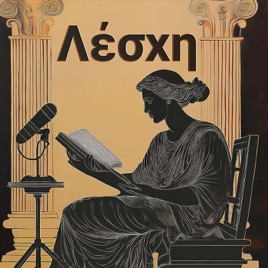
Advertise on podcast: Lesche: Ancient Greece, New Ideas
Rating
4.7from
This podcast has
40 episodes
Language
EnglishPublisher
Johanna HaninkExplicit
No
Date created
2024/08/28
Latest episode
2026/02/11
Average duration
56 min.
Release period
16 days
Description
In Greek antiquity a lesche (λέσχη) was a spot to hang out and chat. Here Brown University professor Johanna Hanink hosts conversations with fellow Hellenists about their latest work in the field.
Unlock Lesche: Ancient Greece, New Ideas podcast Email contact info,
Listeners & Audience details
Email contact information
Direct podcast contact details

Listeners
Audience numbers & engagement insights

Audience details
Podcast Insights

Podcast episodes
Check latest episodes from Lesche: Ancient Greece, New Ideas podcast
Reappraising the Choruses of Greek Tragedy
2026/02/11
Rosa Andújar joins me in the Lesche to discuss her new book, Playing the Chorus in Greek Tragedy (Cambridge, 2025).
Tragedies mentioned
Aeschylus
Agamemnon (chorus fragmentation)Seven Against Thebes (use of semi-choruses)Suppliant Women ("choral swarm" with multiple groups)Sophocles
Oedipus Rex (actor-chorus interaction)Euripides
Phaethon ( "augmentation" and secondary choruses)Trojan Women (chorus entering in fragmented small groups)Hippolytus ( subsidiary chorus appears before the main chorus)Orestes (unusual choral divisions)Suppliant Women (exceptional choral activity)Other ancient texts
Aristotle, Poetics (mentioned for lack of interest in the chorus)Aristophanes, Birds (for having a 'differentiated' chorus)Plutarch, On Listening (de Audiendo) 45e-f (Euripides training a chorus; a chorus member bursts out laughing)Antiphon 6 (On the Chorus Boy: I don't mention it by name, but this is the speech regarding the death of a choreute by performance enhancing drugs)Modern works
Azoulay, Vincent and Paulin Ismard. 2020. Athènes 403: une histoire chorale. Paris / 2025. Athenes 403 BC: A Democracy in Crisis, trans. Lorna Coing. Cambridge.Carlson, Marvin. 2003. The Haunted Stage: The Theatre as Memory Machine. Ann Arbor.Diggle, James. 1970. Euripides: Phaethon. Cambridge.duBois, Page. 2022. Democratic Swarms: Ancient Comedy and the Politics of the People. Chicago. Hegel, Phenomenology of Spirit (on choral powerlessness/inertness)Halliwell, Stephen. 1998. Aristotle's Poetics. Bristol/Chicago.Jackson, Lucy. 2019. The Chorus of Drama in the Fourth Century BCE. Cambridge.Sansone, David. 2016. "The Size of the Tragic Chorus," Phoenix 70: 233-54.Uhlig, Anna. 2019. Theatrical Reenactment in Pindar and Aeschylus. 2019.About our guest
Rosa Andújar is Associate Professor of Classics and Ancient Studies at Barnard College, Columbia University. She has published widely on Greek drama in its fifth-century Athenian context as well as on its modern global reception, particularly across the Americas. She is the author of Playing the Chorus in Greek Tragedy (Cambridge, 2025) and the editor of The Greek Trilogy of Luis Alfaro (Methuen Drama, 2020), which won the 2020 London Hellenic Prize.
________________________________
Thanks for joining us in the Lesche!
Podcast art: Daniel Blanco
Theme music: "The Song of Seikilos," recomposed by Eftychia Christodoulou using Sibelius
This podcast is made possible with the generous support of Brown University’s Department of Classical Studies and the John Nicholas Brown Center for Advanced Study.
Instagram: @leschepodcast
Email: [email protected]
Suggest a book using this form
The "Enchanted World" of Late Antiquity
2026/01/28
Michael Satlow joins me in the Lesche to discuss his new book An Enchanted World: The Shared Religious Landscape of Late Antiquity, which will be published on February 3 by Princeton University Press.
Resources
"Lived Religion Project" at the University of Erfurt's Max Weber Institute
If you're new to Late Antiquity, the foundational work is Peter Brown's 1971 The World of Late Antiquity: AD 150-750. It's been reissued in various editions, including a 2024 illustrated one from Thames & Hudson (relatively affordable!).
I mention Philogelos joke 203 in the episode introduction.
About our guest
Michael Satlow is Professor of Judaic Studies and Religious Studies at Brown University. A historian of religion in antiquity, his work explores how Jews, Christians, and others experienced the sacred in everyday life. His new book, An Enchanted World, draws on inscriptions and material culture to reveal a shared religious landscape in Late Antiquity, one filled with gods, angels, demons, and divine presence.
________________________________
Thanks for joining us in the Lesche!
Podcast art: Daniel Blanco
Theme music: "The Song of Seikilos," recomposed by Eftychia Christodoulou using Sibelius
This podcast is made possible with the generous support of Brown University’s Department of Classical Studies and the John Nicholas Brown Center for Advanced Study.
Instagram: @leschepodcast
Email: [email protected]
Suggest a book using this form
The Influence of Plato's Timaeus: Beauty & Creation
2026/01/14
Piero Boitani joins me in the Lesche to discuss his new book Timaeus in Paradise: Metaphors and Beauty from Plato to Dante and Beyond (Princeton University Press 2025).
Ancient texts
Hebrew Bible, GenesisPlato: Timaeus, Phaedrus, Symposium, ApologyAristotle: Nicomachaean EthicsLucretius, De Rerum NaturaOvid, MetamorphosesPhilo of Alexandria, On the Creation (de Opificio mundi: treatise on the Genesis creation narrative)New Testament: Acts of the ApostlesPseudo-Longinus, On the SublimeCalcidius, Latin translation of much of Timaeus (4th century CE)Pseudo-Dionysius the Areopagite, mystical treatises (c. 500 CE)Later sites of reception & influence
In Literature and Philosophy
Johannes Scotus Eriugena (John "the Scot"), translation of Pseudo-Dionysius the Areopagite (9th century)Thomas Aquinas, Commentary on the Divine Names (1260s)Dante, Paradiso (early 1300s)Marsilio Ficino's work on Plato and Timaeus (15th century)Johannes Kepler (1571-1630), scientific treatisesAlfred North Whitehad, Process and Reality (1929)Ezra Pound, Cantos (1915-1959)In Visual Art and Architecture
Raphael, "School of Athens" (1509-11, Apostolic Palace, Vatican) and Chigi Chapel (1510s, Santa Maria del Popolo, Rome)Michelangelo, Sistine Chapel (1508-1512)Botticelli, "Birth of Venus" (mid-1480s)Crypt of San Magno in Anagni (11th century)Sculptures of Chartres Cathedral (12th century)About our guest
Piero Boitani is Professor Emeritus of Comparative Literature at the University of Rome “Sapienza.” A Fellow of the British Academy, the Medieval Academy of America, the Accademia dei Lincei, and the Italian National Institute of Astrophysics, in 2016 he received the Balzan Prize for Comparative Literature. He is chairman of the Fondazione Lorenzo Valla and general editor of its series of Greek and Latin Writers.
His most recent books include Il grande racconto dei classici (Bologna, Il Mulino, 2024); «Reconnaître est un Dieu». L’anagnorisis dans la littérature occidentale (Paris, Garnier, 2025); Timaeus in Paradise: Metaphors and Beauty from Plato to Dante and Beyond (Princeton University Press 2025). A new book, The Five Elements-I cinque elementi, with a preface by Stephen Greenblatt, will be published by Mondadori, in the Lo Specchio series, in February 2026.
________________________________
Thanks for joining us in the Lesche!
Podcast art: Daniel Blanco
Theme music: "The Song of Seikilos," recomposed by Eftychia Christodoulou using Sibelius
This podcast is made possible with the generous support of Brown University’s Department of Classical Studies and the John Nicholas Brown Center for Advanced Study.
Instagram: @leschepodcast
Email: [email protected]
Suggest a book using this form
The Life (and Times) of Diogenes 'the Cynic'
2025/12/31
Inger Kuin joins me in the Lesche to discuss her new book Diogenes: The Rebellious Life and Revolutionary Philosophy of the Original Cynic (Basic Books 2025).
Ancient sources
Aristotle, Politics 1.3-7 (on 'natural' slavery)Diogenes Laertius, 2.6, Life of DiogenesPlutarch, Life of Alexander 14 (on the 'get out of my sun' episode)Xenophon, Anabasis 5-6 (on Sinope, Diogenes' birthplace)Other Diogenes testimonia from a variety of sourcesFor an accessible English-language collection of testimonia for Diogenes, see Robert Dobbin's The Cynic Philosophers, from Diogenes to Julian (Penguin Classics, 2012).
About our guest
Inger Kuin is a researcher, writer, and teacher focused on the intellectual history of ancient Greece and Rome. She is Associate Professor of Classics General Faculty at the University of Virginia. Originally from The Netherlands, she splits her time between Charlottesville (VA) and Rotterdam, and publishes both in English and in Dutch.
________________________________
Thanks for joining us in the Lesche!
Podcast art: Daniel Blanco
Theme music: "The Song of Seikilos," recomposed by Eftychia Christodoulou using Sibelius
This podcast is made possible with the generous support of Brown University’s Department of Classical Studies and the John Nicholas Brown Center for Advanced Study.
Instagram: @leschepodcast
Email: [email protected]
Suggest a book using this form
Enchantment Technologies of Ancient Greek Religion
2025/12/17
Tatiana Bur joins me in the Lesche to discuss her new book Technologies of the Marvellous in Ancient Greek Religion (Cambridge University Press 2025).
Ancient texts
Homer, Iliad 18 (on Hephaestus and his self-moving tripods) Many Athenian tragedies and comedies that made use of the μηχανή or κράδη (in comedy)Aristotle, Poetics (on the theatrical ‘crane’/μηχανή) The Aristotelian/Peripatetic work Mechanical Questions (Μηχανικά)Philo of Byzantium, Μηχανική Σύνταξη Works on mechanics by Hero of Alexandria Polybios, History 12.13, on the mechanical snail in the procession at Athens Philostratus, Lives of the Sophists 2.5, on Herodes Atticus’ mechanical Panathenaic shipAthenaeus, Deipnosophistai 196a-203c, on the πομπή of Ptolemy PhiladelphusModern bibliography
Eric Csapo's work on ancient theaterAlfred Gell’s work on art agency, particularly "technologies of enchantment"Susan Harvey, 2006. Scenting Salvation: Ancient Christianity and the Olfactory Imagination. Berkeley, Ca. Verity Platt, 2011. Facing the Gods: Epiphany in Graeco-Roman Art, Literature, and Religion. Cambridge.Hans-Jörg Rheinberger, 1997. Toward a History of Epistemic Things: Synthesizing Proteins in the Test Tube. Stanford, CA.________________________________
Thanks for joining us in the Lesche!
Podcast art: Daniel Blanco
Theme music: "The Song of Seikilos," recomposed by Eftychia Christodoulou using Sibelius
This podcast is made possible with the generous support of Brown University’s Department of Classical Studies and the John Nicholas Brown Center for Advanced Study.
Instagram: @leschepodcast
Email: [email protected]
Suggest a book using this form
Book Reviewing in Classics, with Clifford Ando (BMCR) and Mary Beard (the TLS)
2025/12/03
Mary Beard, Classics editor at the Times Literary Supplement, and Clifford Ando, senior editor of the Bryn Mawr Classical Review, join me in the Lesche to discuss the state of Classics reviewing today.
How do the TLS and BMCR assign appropriate reviewers? What makes for a good review? What's the line between critique and nastiness? Why are reviews these days so often lacking in susbtantive criticism? What do editors wish review authors knew or would consider before writing a review? Some bibliography
Clifford Ando, "BMCR: A view under the hood." Bryn Mawr Classical Review 2022.11.26. (Read all the papers from the 30th anniversary celebration of BMCR here. Several deal with book reviewing.)Mary Beard, Confronting the Classics: Traditions, Adventures, and Innovations. Liveright 2013. (See especially the Afterword, "Reviewing Classics".)Daniel Mendelsohn, "A Critic's Manifesto," The New Yorker, August 28, 2012.About our guests
Clifford Ando teaches Classics and History at the University of Chicago. His work focuses on the histories of law, religion, and government in the ancient world. He is the author, editor, and translator of some 20 books, and he has served as an editor, associate editor, or senior editor of Bryn Mawr Classical Review for not quite twenty years.
Mary Beard is professor emerita of classics at the University of Cambridge, a fellow of Newnham College, and professor of Ancient Literature at the Royal Academy. She is also the classics editor of the Times Literary Supplement, a fellow of the British Academy, and an international member of the American Academy of Arts and Sciences. She is the author of more than twenty books on the ancient world. Her latest book, Talking Classics: The Shock of the Old, is due out in spring 2026 with Profile Books (UK) and the University of Chicago Press (USA).
________________________________
Thanks for joining us in the Lesche!
Podcast art: Daniel Blanco
Theme music: "The Song of Seikilos," recomposed by Eftychia Christodoulou using Sibelius
This podcast is made possible with the generous support of Brown University’s Department of Classical Studies and the John Nicholas Brown Center for Advanced Study.
Instagram: @leschepodcast
Email: [email protected]
Suggest a book using this form
The Ancient Shore
2025/11/19
Harvard University historian Paul Kosmin joins me in the Lesche to discuss his recent book The Ancient Shore (Harvard University Press 2024), winner of the American Historical Association's 2025 Prize in History Prior to CE 1000.
Works mentioned
Agatharchides of Cnidus, On the Erythraean Sea (2nd C. BC)Philip de Loutherbourg, "Shipwreck" (painting, 1793).Demuth, Bathsheba. 2019. Floating Coast: An Environmental History of the Bering Strait. W. W. Norton.Dening, Gregory Moore. 1980. Islands and Beaches: Discourse on a Silent Land, Marquesas, 1774–1880. Honolulu: University of Hawaii Press.About our guest
Paul Kosmin completed his undergraduate degree at Oxford and earned a PhD in Ancient History from Harvard University in 2012. He was appointed an Assistant Professor in Harvard's Classics Department in 2012, was tenured in 2019, and in 2020 became the Philip J. King Professor of Ancient History, where he currently serves as Interim Chair. His research focuses on the political and cultural history of the ancient Greek world, concentrating on the globalizing and colonial Hellenistic period, and now includes an environmentally-oriented turn.
________________________________
Thanks for joining us in the Lesche!
Podcast art: Daniel Blanco
Theme music: "The Song of Seikilos," recomposed by Eftychia Christodoulou using Sibelius
This podcast is made possible with the generous support of Brown University’s Department of Classical Studies and the John Nicholas Brown Center for Advanced Study.
Instagram: @leschepodcast
Email: [email protected]
Suggest a book using this form
The Life of Demosthenes
2025/11/05
James Romm joins me in the Lesche to discuss his new biography Demosthenes: Democracy's Defender. The book is a part of Yale University Press's Ancient Lives series, of which James is also the editor.
James's author website
Ancient texts mentioned
Demosthenes, speechesAeschines, speechesAbout our guest
James Romm is an author, reviewer, and the James H. Ottaway Jr. Professor of Classics at Bard College in Annandale, NY. He specializes in ancient Greek and Roman culture and civilization. His reviews and essays have appeared in the New Yorker, the Wall Street Journal, the London Review of Books, the Daily Beast, and other venues. He has held the Guggenheim Fellowship (1999-2000), the Birkelund Fellowship at the Dorothy and Lewis B. Cullman Center for Writers and Scholars at the New York Public Library (2010-11), and a Biography Fellowship at the Leon Levy Center of the City University of New York (2014-15).
________________________________
Thanks for joining us in the Lesche!
Podcast art: Daniel Blanco
Theme music: "The Song of Seikilos," recomposed by Eftychia Christodoulou using Sibelius
This podcast is made possible with the generous support of Brown University’s Department of Classical Studies and the John Nicholas Brown Center for Advanced Study.
Instagram: @leschepodcast
Email: [email protected]
Suggest a book using this form
"Bilingual" Ionic Column Capitals
2025/10/22
Sam Holzman joins me in the Lesche to discuss "bilingual" Ionic column capitals (i.e., column capitals that combined an archaic convex style of relief carving with a more modern concave style). These are the subject of his book Retrospective Columns: Ionic Capitals and Perceptions of the Past in Greek Architecture, which just came out with Princeton University Press.
Ancient source
Vitruvius, de Architectura, esp. Books 3 & 4.Modern works
Architectural drawings in James Stuart and Nicholas Revett's Antiquities of Athens and Julien-David Le Roy's Les Ruines des plus beaux monuments de la Grèce.Alzinger, Wilhelm. 1967. "Alt-Ephesos: Topographie und Architektur." Das Altertum 13.1: 20-44.Hanink, Johanna. Lycurgan Athens and the Making of Classical Tragedy. Cambridge 2014.Rudwick, Martin J. S. 1976. "The Emergence of a Visual Language for Geological Science 1760—1840," History of Science 14.3: 149-95.Schmidt-Dounas, Barbara. 2005. "Frühe Peripteraltempel in Nordgriechenland." Mitteilungen des Deutschen Archäologischen Instituts, Athenische Abteilung 120: 107-41.About our guest
Sam Holzman is an assistant professor in the Department of Art & Archaeology and the Seeger Center for Hellenic Studies at Princeton University. He received his BA from Brown, where his senior thesis advisor in Classics was none other than Professor Hanink! He also received an MPhil from Cambridge and PhD from UPenn. He has excavated in Greece and Turkey and now leads the architectural research team of American Excavations Samothrace.
________________________________
Thanks for joining us in the Lesche!
Podcast art: Daniel Blanco
Theme music: "The Song of Seikilos," recomposed by Eftychia Christodoulou using Sibelius
This podcast is made possible with the generous support of Brown University’s Department of Classical Studies and the John Nicholas Brown Center for Advanced Study.
Instagram: @leschepodcast
Email: [email protected]
Suggest a book using this form
Classicism and Other Phobias, with Dan-el Padilla Peralta
2025/10/08
Dan-el Padilla Peralta joins me in the Lesche to discuss the critique of classicism that he articulates in his recent book Classicism and Other Phobias (PUP 2025).
Works mentioned (select)
Adeshei Carter, Jacoby. “Racing the Canon.” In The Routledge Companion to Philosophy of Race, edited by Paul C. Taylor, Linda Martín Alcoff, and Luvell Anderson, 163–174. New York: Routledge, 2017.Baldwin, James. “Stranger in the Village.” Harper’s Magazine, October 1953.Du Bois, W. E. B. Darkwater: Voices from Within the Veil. New York: Harcourt, Brace and Howe, 1920.Eccleston, Sasha-Mae, and Dan-el Padilla Peralta. “Racing the Classics: Ethos and Praxis.” American Journal of Philology 144, no. 2 (2023): 199–218.de la Vega, Garcilaso. Royal Commentaries of the Incas and General History of Peru. Translated by Harold V. Livermore. Austin: University of Texas Press, 1966.Guevara, Ernesto “Che.” The Congo Diary: Episodes of the Revolutionary War in the Congo. Edited by Mary-Alice Waters. Melbourne: Ocean Press, 1999.Hobbes, Thomas. Leviathan. Edited by Richard Tuck. Cambridge: Cambridge University Press, 1996.Locke, John. Two Treatises of Government. Edited by Peter Laslett. Cambridge: Cambridge University Press, 1988.Morrison, Toni. “Unspeakable Things Unspoken: The Afro-American Presence in American Literature.” The Tanner Lectures on Human Values. Delivered at the University of Michigan, October 7, 1988.Proctor, Hannah. Burnout: A Guide to the Psychopolitical Condition. London: Pluto Press, 2024.Shia, Moon-Ho Jung. Archive of Tongues: An Intimate History of Brownness. Durham, NC: Duke University Press, 2021.Umachandran, Mathura, and Marchella Ward, eds. Critical Ancient World Studies: The Case for Forgetting Classics. London: Routledge, 2023.Wynter, Sylvia. Black Metamorphosis: New Natives in a New World. Manuscript, 1970s. Edited version published in Katherine McKittrick, ed., Sylvia Wynter: On Being Human as Praxis. Durham, NC: Duke University Press, 2015.Young-Bruehl, Elisabeth. Why Arendt Matters. New Haven, CT: Yale University Press, 2006.About our guest
Dan-el Padilla Peralta is professor of Classics, and associated faculty in African American Studies and affiliated faculty in the Programs of Latino Studies and Latin American Studies and the University Center for Human Values, at Princeton University. He is the author of Undocumented: A Dominican Boy’s Odyssey from a Homeless Shelter to the Ivy League (Penguin 2015); Divine Institutions: Religions and Community in the Middle Roman Republic (Princeton 2020); and Classicism and Other Phobias (Princeton 2025).
________________________________
Thanks for joining us in the Lesche!
Podcast art: Daniel Blanco
Theme music: "The Song of Seikilos," recomposed by Eftychia Christodoulou using Sibelius
This podcast is made possible with the generous support of Brown University’s Department of Classical Studies and the John Nicholas Brown Center for Advanced Study.
Instagram: @leschepodcast
Email: [email protected]
Suggest a book using this form
The Art of Hellenistic Queenship
2025/09/24
Patricia (Tricia) Kim joins me in the Lesche to discuss the art of Hellenistic queenship -- i.e., art that depicted Hellenistic queens, art patronized by Hellenistic queens, and art that spoke to the construction of queenship across the Hellenistic world.
Egypt Museum on the "Arsinoe-Aphrodite" statue
Franck Goddio write-up of the statue
Lesche episode 18 is a conversation about Isis Worship in the Greek East (including Egypt) with Lindsey Mazurek.
Ancient passage
Pliny, Natural History 34.148 (on Timochares' idea for a floating statue of Arsinoe II)
Works mentioned
Historical work by Sheila L. Ager, Elizabeth Carney, Sabine Müller, et al. on Hellenistic queenship.Najmabadi, Afsaneh (2006) "Beyond the Americas: Are Gender and Sexuality Useful Categories of Analysis?" Journal of Women's History 18: 11-21.Parmenter, Christopher Stedman (2024) Racialized Commodities: Long-Distance Trade, Mobility, and the Making of Race in Ancient Greece, C. 700-300 BCE. Oxford.Seaman, Kristen (2020) Rhetoric and Innovation in Hellenistic Art. Cambridge.Smith, R.R.R. (1989) Hellenistic Royal Portraits. Oxford.Stewart, Andrew (1993) Faces of Power: Alexander's Image and Hellenistic Politics. University of California.Waywell, Geoffrey B. (1978) The Free-Standing Sculptures of the Mausoleum at Halicarnassus in the British Museum. London.About our guest
Patricia Kim is assistant professor at New York University and author of The Art of Queenship in the Hellenistic World (Cambridge University Press, 2025)—the first book-length study on the visual and material cultures of queenship from the 4th-2nd centuries B.C.E, across the eastern Mediterranean and western Asia. She is guest-curator of a forthcoming exhibition on ancient queenship at the Cincinnati Art Museum and the Getty Villa (2027).
________________________________
Thanks for joining us in the Lesche!
Podcast art: Daniel Blanco
Theme music: "The Song of Seikilos," recomposed by Eftychia Christodoulou using Sibelius
This podcast is made possible with the generous support of Brown University’s Department of Classical Studies and the John Nicholas Brown Center for Advanced Study.
Instagram: @leschepodcast
Email: [email protected]
Suggest a book using this form
Why Classicists Should Care about Byzantium, with Anthony Kaldellis
2025/09/10
Anthony Kaldellis joins me in the Lesche to discuss an in-progress edited volume about the transmission of classical texts in the East Roman Empire (aka Byzantium), and why, more generally, classicists should be better informed about the Greek Middle Ages, aka the Byzantine Millennium.
Anthony is the host of a wonderful podcast called Byzantium and Friends, which was (and still is) a major inspiration for Lesche.
Ancient texts mentioned
Photius, BibliothecaEustathius of Thessalonica's commentaries on the Iliad and the OdysseySome bibliography
Anthony has written a huge amount. During this episode we mention in particular:his "minigraph" Byzantium Unbound (Arc Humanities 2019)his groundbreaking article "The Byzantine Role in the Making of the Corpus of Classical Greek Historiography: A Preliminary Investigation," in the 2012 issue of the Journal of Hellenic Studies (vol. 132).Baukje van den Berg, Homer the Rhetorician: Eustathios of Thessalonike on the Composition of the Iliad. (Oxford 2022).Elizabeth Jeffreys, "We need to talk about Byzantium: or, Byzantium, its reception of the classical world as discussed in current scholarship, and should classicists pay attention?" Classical Receptions Journal 6 (2014) 158-74.Filippomaria Pontani, "Scholarship in the Byzantine Empire (529-1453)," in F. Montanari, ed., History of Ancient Greek Scholarship: From the Beginnings to the End of the Byzantine Age (Brill 2020).Listen to Anthony's "Byzantium and Friends" podcast episdoe, in which he and Pontani discuss the article, here.L.D. Reynolds and N.G. Wilson, Scribes and Scholars: A Guide to the Transmission of Greek and Latin Literature. 4th edn. Oxford 2013.About our guest
Anthony Kaldellis is a professor of Classics at the University of Chicago. He has published many books and articles on the history, culture, and literature of Byzantium, ranging from the fourth to the fifteenth centuries. His most recent book is a comprehensive history of the eastern Roman empire: The New Roman Empire: A History of Byzantium (Oxford, 2023). He is also the host of the academic podcast “Byzantium & Friends.”
________________________________
Thanks for joining us in the Lesche!
Podcast art: Daniel Blanco
Theme music: "The Song of Seikilos," recomposed by Eftychia Christodoulou using Sibelius
This podcast is made possible with the generous support of Brown University’s Department of Classical Studies and the John Nicholas Brown Center for Advanced Study.
Instagram: @leschepodcast
Email: [email protected]
Suggest a book using this form
SPECIAL: Literary Sources for the Roman House
2025/08/12
Marden Fitzpatrick Nichols joins me in the Lesche to discuss her new book How to Make a Home: An Ancient Guide to Style and Comfort, a curated collection of passages (by Cicero, Juvenal, Ovid, Pliny, Vitruvius, and others) that relate to the design, decor, and ideology of the ancient Roman house and home. The book is part of Princeton University Press's "Ancient Wisdom for Modern Readers" series.
Preview the book's Table of Contents here.
Read Yung In Chae's 2020 article (in the Princeton Alumni Weekly) about the "Ancient Wisdom for Modern Readers" series.
Ancient authors (selection)
Bibaculus fragments 1 and 2Cicero, Epistulae ad familiares and de OfficiisJuvenal Satires 3; 8Ovid, Metamorphoses 8 (Baucis and Philemon scene)Pliny the Younger, epistles. Marden also mentions Christopher Whitton's 2013 "Green and Yellow," Pliny the Younger: Epistles Books II (Cambridge).Velleius Paterculus, History of Rome 2.13-14Vitruvius, de Architectura (various passages)Also mentioned
Studies of the Roman house by scholars including Catherine Edwards, Elaine Gazda, Hérica Valladares, and Andrew Wallace-HadrillJosiah Osgood's books in PUP's "Ancient Wisdom for Modern Readers" seriesAbout our guest
Marden Nichols is Provost’s Distinguished Associate Professor and Chair of the Classics Department at Georgetown University. She is a scholar of ancient Roman literature, art, and architecture, whose work situates Vitruvius’ De architectura within the literary, cultural, and intellectual contexts of the ancient world. She is the author of Author and Audience in Vitruvius’ “De architectura” (Cambridge University Press, 2017) and translator of How to Make a Home: An Ancient Guide to Style and Comfort, a collection of ancient Roman writings about home design and decoration that has just appeared from Princeton University Press.
________________________________
Thanks for joining us in the Lesche!
Podcast art: Daniel Blanco
Theme music: "The Song of Seikilos," recomposed by Eftychia Christodoulou using Sibelius
This podcast is made possible with the generous support of Brown University’s Department of Classical Studies and the John Nicholas Brown Center for Advanced Study.
Instagram: @leschepodcast
Email: [email protected]
Suggest a book using this form
Homer's Bronze Age Women
2025/07/23
Emily Hauser joins me in the Lesche to discuss the lives of the real Bronze Age women remembered in Homeric epic, the subject of her new book Penelope's Bones: A New History of Homer's World through the Women Written Out Of It (UK title: Mythica). We also discuss the popularity of feminist retellings of Greek myth, and why (it's good) they're not going anywhere anytime soon.
This is the last regular episode of Lesche's first season. We'll be back with a second season on September 10.
Ancient texts
Homer, Iliad and OdysseyAlso mentioned
Beard, Mary, Women & Power: A Manifesto (Norton/Liveright 2017).Cline, Eric, 1177 B.C.: The Year Civilization Collapsed (Princeton 2014/revised edn. 2021) and After 1177 B.C.: The Survival of Civilizations (Princeton 2024).Emily Hauser's own Golden Apple Trilogy (Penguin Random House): For the Most Beautiful (2016); For the Winner (2017); For The Immortal (2018).Haynes, Natalie, No Friend to This House (Pan Macmillan forthcoming 2025).Hewlett, Rosie, Medea (Random House 2024).About our guest
Dr Emily Hauser is Senior Lecturer in Classics and Ancient History at the University of Exeter and the Times bestselling author of Mythica: A New History of Homer's World through the Women Written Out Of It (Penelope's Bones in the US). She also wrote a trilogy of novels reworking the women of Greek myth, including For the Most Beautiful (published in 2016). She has a PhD in Classics from Yale and was Junior Fellow at Harvard before returning to the UK.
________________________________
Thanks for joining us in the Lesche!
Podcast art: Daniel Blanco
Theme music: "The Song of Seikilos," recomposed by Eftychia Christodoulou using Sibelius
This podcast is made possible with the generous support of Brown University’s Department of Classical Studies and the John Nicholas Brown Center for Advanced Study.
Instagram: @leschepodcast
Email: [email protected]
Suggest a book using this form
Symbola (Monetiform Tokens)
2025/07/09
Clare Rowan and M.E. (Mairi) Gkikaki join me in the Lesche to discuss the use of monetiform tokens in Greek (and a bit of Roman) antiquity. Clare was the PI on the ERC-funded project "Token Communities of the Ancient Mediterranean." Mairi was a postdoctoral researcher on the project, and her edited volume Tokens in Classical Athens and Beyond was published (open-access) with Liverpool University Press in 2023.
See here for the project's Database of Token Types.
Ancient texts (selection)
Aristophanes, Ekklesiazousai (Assemblywomen)Aristotle, Athenaion PoliteiaHerodotus 6.86 (story of Glaucus)IG I3 34, the "Cleinias Decree"IG II3 4 76 (mention of tribal token distribution at line 79)Philochorus (Atthidographer)Plato, Symposium (Aristophanes' speech)Also mentioned (selection)
Kroll, J.H. and Mitchel, F.W. 1980, "Clay Tokens Stamped with the Names of Athenian Military Commanders," Hesperia 49, pp. 86–96. Lang, M. 1959, "Allotment by Tokens," Historia: Zeitschrift für Alte Geschichte 8, pp. 80–89. Lang, M. and M. Crosby. 1964, The Athenian Agora X. Weights, Measures and Tokens. ASCSA/Princeton.M.I. Rostovtzeff's work on tokensSvoronos, I.N. 1900, "Κατάλογος των Μολύβδινων Συμβόλων του Εθνικού Νομισματικού Μουσείου," Journal International d 'Archéologie Numismatique 3, pp. 322-343.See further work by Svoronos on tokens (εἰσιτήρια) in the Journal International d’Archéologie Numismatique. About our guests
Clare Rowan is an Associate Professor in the department of Classics and Ancient History at the University of Warwick. She specialises in ancient numismatics, in particular ancient tokens, iconography and small change. She was the principal investigator on the European Union Research Council-funded project "Token Communities of the Ancient Mediterranean" (2016-2021).
M.E. Gkikaki is an honorary research fellow at the Department of Classics and Ancient History, University of Warwick, where she has been a Marie Skłodowska-Curie Research Fellow (2018–21) and a team member of the ERC-funded project "Token Communities of the Ancient Mediterranean" (2016–18). She is editor of the volume Tokens in Classical Athens and Beyond (Liverpool University Press 2023). Her monograph Symbola: Athenian Tokens from Classical to Roman Times will soon be appearing with Liverpool University Press.
________________________________
Thanks for joining us in the Lesche!
Podcast art: Daniel Blanco
Theme music: "The Song of Seikilos," recomposed by Eftychia Christodoulou using Sibelius
This podcast is made possible with the generous support of Brown University’s Department of Classical Studies and the John Nicholas Brown Center for Advanced Study.
Instagram: @leschepodcast
Email: [email protected]
Suggest a book using this form
Podcast reviews
Read Lesche: Ancient Greece, New Ideas podcast reviews
Epaul22 2025/11/05
For academics and entusiasts!
I love this podcast. As a Classical Studies major many years removed from my degree program, this podcast brings the academic classical world to thos...
Burleith20007 2025/03/12
Learning about the ancient world
This is more or less a specialist podcast — but one that I as a non-academic appreciate, and think anyone interested in the classics or ancient world...
TmBerton 2025/07/30
Ugh…
Is it really what «classists» do for living?
The last episode of the first season «Penelope’s bones» is really about nothing, almost anti-science.
- ...
57*South 2025/01/08
Super interesting for the uninformed listener
I have tried other classics podcasts because I have an interest in the area, though no real knowledge, and often they are difficult to understand. The...
Sarah E Bond 2024/12/13
Informative But Fun
If you want to meet some of the top scholars studying antiquity, this is a great podcast. Plus I am loving the new The Return episode. Really helps me...
Podcast sponsorship advertising
Start advertising on Lesche: Ancient Greece, New Ideas relevant audience podcasts
You may also like to advertise on these Podcasts

4.950161
NFL First Read
NFL, Fantasy Points, Fantasy Football, Brett Whitefield, Joe Marino

4.111850
I’ve Got a Beatles Podcast!
I’ve Got A Beatles Podcast

420667
Most Terrifying Places in America
Travel Channel

4.61301646
Dead Rabbit Radio The Daily Paranormal Podcast
Jason Carpenter

4.514565552
The Vanished Podcast
Audible

4.8211962
The Auto Detailing Podcast
Jimbo Balaam interviews guest like Barry Meguiar, Jason Rose, Yvan Lacroix,

4.9255217
The Pistons Pulse
The Pistons Pulse

4.563721455
Alison Rosen Is Your New Best Friend
Alison Rosen

4.813802000
Daily Tech News Show
Tom Merritt

4.82585500
God Awful Movies
Puzzle in a Thunderstorm, LLC