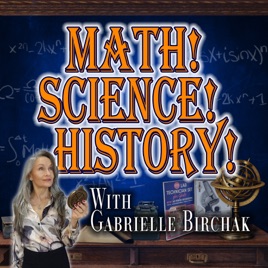
Advertise on podcast: Math! Science! History!
This podcast has
236 episodes
Language
EnglishPublisher
Gabrielle BirchakExplicit
No
Date created
2024/09/24
Latest episode
2026/09/30
Average duration
16 min.
Release period
6 days
Description
Math! Science! History! is about the history of people, theories, and discoveries that have moved our scientific progress forward and spurred us on to unimaginable discoveries. Join Gabrielle Birchak for a little math, a little science, and a little history. All in a little bit of time.
Unlock Math! Science! History! podcast Email contact info,
Listeners & Audience details
Email contact information
Direct podcast contact details

Listeners
Audience numbers & engagement insights

Audience details
Podcast Insights

Podcast episodes
Check latest episodes from Math! Science! History! podcast
The Library of Alexandria: What Really Happened?
2026/09/30
After nearly seven years and more than 200 episodes, this is where I say goodbye to Math! Science! History!. The podcast began with my book Hypatia: The Sum of Her Life and grew into something far beyond what I imagined. Thank you for listening, for following me through all of these stories, and for giving me the opportunity to explore the history behind mathematics, science, and the people and ideas that changed our understanding of the world. The podcast may be ending, but the archive, the research, and the stories will remain here for you to explore.
And perhaps it's fitting that our final story is about the Library of Alexandria. The Library didn't survive as an institution, but its ideas survived because people copied them, studied them, translated them, and passed them on. I hope Math! Science! History! can do something similar. As I move into whatever comes next, I'll leave you with the original meaning of carpe diem: to pluck the day, to savor what is ripe and ready, and then use that harvest to plant the seeds for the next season. Thank you for seven incredible years. Carpe diem, my friends.
3 Things You'll Learn
1. The Library of Alexandria was not necessarily destroyed by Caesar.
Caesar's fire in 48 BCE certainly destroyed books, but the ancient evidence does not establish that it destroyed the entire Library. Alexandria's scholarly institutions and collections continued afterward.
2. The Library disappeared through a much longer and more complicated process.
The Royal Library, Mouseion, Serapeum, and other collections existed in different forms and at different times. Political instability, changing patronage, violence, destruction, and institutional decline all played roles in the gradual disappearance of Alexandria's great scholarly institutions.
3. Knowledge can survive even when institutions disappear.
The books of Alexandria did not remain together as one intact collection, but ideas survived through copying, translation, and transmission. Centuries later, scholars working across the Byzantine, Syriac, Persian, and Islamic worlds helped preserve and transmit Greek knowledge into Arabic and beyond.
🔗 Explore more on our website: mathsciencehistory.com
📚 To buy my book Hypatia: The Sum of Her Life on Amazon, visit https://a.co/d/g3OuP9h
🌍 Let's Connect!
Bluesky: https://bsky.app/profile/mathsciencehistory.bsky.social
Instagram: https://www.instagram.com/math.science.history
LinkedIn: https://www.linkedin.com/company/math-science-history/
YouTube: Math! Science! History! - YouTube
🎧 Enjoying the Podcast?
☕ Support the Show: Coffee!! PayPal
Leave a review! It helps more people discover the show!
Share this episode with friends & fellow history buffs!
Subscribe on your favorite podcast platform
Check out our merch: https://www.mathsciencehistory.com/the-store
Music: All music is public domain and has no Copyright and no rights reserved.
Selections from The Little Prince by Lloyd Rodgers
Until next time, carpe diem!
Presenting: Before The Moment with Nile Rodgers
2026/09/30
Introducing Miguel: Finding His Voice Again from Before The Moment with Nile Rodgers.
Follow the show: Before The Moment with Nile Rodgers
R&B sensation Miguel needs no introduction - he’s a multi-disciplinary artist, known for hits like “Sure Thing” and Grammy winner, “Adorn”.
Miguel’s musings on romance and intimacy flow seamlessly through his work, brought to life with lyrical mastery and a style that always keeps you guessing. And that’s because Miguel has never let one genre define him. Raised between Black and Latin cultures, Miguel learned to move comfortably between influences, helping him bridge musical genres that continue to surprise audiences. His latest release CAOS, arrived after an 8 year break. Inside every song, you can hear an artist still experimenting, still pushing, and still reinventing himself.
See omnystudio.com/listener for privacy information.
DISCLAIMER: Please note, this is an independent podcast episode not affiliated with, endorsed by, or produced in conjunction with the host podcast feed or any of its media entities. The views and opinions expressed in this episode are solely those of the creators and guests. For any concerns, please reach out to [email protected].
Descartes' Secret Notebook: The Hidden Math Behind Topology
2026/09/24
René Descartes is famous for Cogito, ergo sum and his revolutionary approach to philosophy and mathematics. But he also left behind a mysterious 16-page manuscript written in code.
In this episode, we uncover the story of Descartes' hidden notebook, the waterlogged manuscripts that nearly disappeared, and Gottfried Wilhelm Leibniz's dramatic attempt to decipher the coded pages.
At the center of the mystery is a mathematical relationship involving the vertices, edges, and faces of three-dimensional shapes. Today expressed as V − E + F = 2, this relationship became associated with Leonhard Euler and is closely connected to the development of topology.
We'll explore why this mathematics mattered in the seventeenth century, why Descartes may have feared revealing his ideas, and how the mathematics of shapes and connectivity eventually became relevant to our modern digital world.
3 Things You'll Learn
1. Why Descartes wrote in code
The story behind Cogitata Privata, Descartes' "I proceed masked" philosophy, and the secret manuscript that disappeared after Leibniz examined it.
2. How V − E + F = 2 works
Using cubes and pyramids, we'll see how vertices, edges, and faces combine to produce a remarkably consistent mathematical relationship.
3. Why this old mathematics still matters
The episode connects the history of polyhedra to topology and modern applications such as 3D computer graphics and digital modeling.
Sources
Amir D. Aczel, Descartes's Secret Notebook: A True Tale of Mathematics, Mysticism, and the Quest to Understand the Universe
David S. Richeson, Euler's Gem: The Polyhedron Formula and the Birth of Topology
Peter J. Federico, Descartes on Polyhedra: A Study of the "De solidorum elementis"
Matthew L. Jones, The Good Life in the Scientific Revolution
Frances A. Yates, The Rosicrucian Enlightenment
Johannes Kepler, The Harmony of the World
René Descartes, Discourse on the Method
Full source list appears in the episode transcript at https://www.MathScienceHistory.com
📚 To buy my book Hypatia: The Sum of Her Life on Amazon, visit https://a.co/d/g3OuP9h
🌍 Let's Connect!
Bluesky: https://bsky.app/profile/mathsciencehistory.bsky.social
Instagram: https://www.instagram.com/math.science.history
LinkedIn: Gabrielle Birchak | LinkedIn
YouTube: Math! Science! History! - YouTube
🎧 Enjoying the Podcast?
☕ Support the Show: Coffee!! https://www.paypal.com/ncp/payment/PR7F7ST49GDNA
Leave a review! It helps more people discover the show!
Share this episode with friends & fellow history buffs!
Subscribe on your favorite podcast platform
Check out our merch: https://www.mathsciencehistory.com/the-store
Music: All music is public domain and has no Copyright and no rights reserved. Selections from The Little Prince by Lloyd Rodgers - From Page to Practice by Brian Teoh - all other music is public domain from Pixabay
Until next time, carpe diem!!
SCIENCE NEWS TUESDAY: A New Species is Discovered
2026/09/22
Scientists have officially identified a new wild cat species in Bolivia and a new snake species from New Guinea—and one of them is named after Guns N' Roses guitarist Slash. But these discoveries are about much more than a cute cat and a rock-star snake.
In this episode of How Did We Get Here? Science News Tuesday, we look at how scientists identify new species, why some animals can remain hidden in plain sight for centuries, and how modern genetics and genomics are changing our understanding of the tree of life.
From Carl Linnaeus and the origins of scientific classification to DNA analysis and museum specimens, we explore how scientists went from naming what they could see to uncovering evolutionary relationships that aren't visible to the naked eye.
And there's a bigger question: How many species are still out there waiting to be recognized—and could some disappear before we even know they exist?
Three Things You'll Learn
1. How a "new" species can hide in plain sight.
2. Why a snake was named after Slash, and how Slash rocks out for animals!
3. How DNA changed the way we classify life
4. Why discovering species matters for conservation
Welcome to the jungle: newly-discovered snake named after Slash from Guns N' Roses - Field Museum
https://www.scientificamerican.com/article/see-the-first-new-species-of-cat-discovered-in-more-than-a-century-its-adorable
🔗 Explore more on our website: mathsciencehistory.com
📚 To buy my book Hypatia: The Sum of Her Life on Amazon, visit https://a.co/d/g3OuP9h
🌍 Let's Connect!
YouTube: Math! Science! History! - YouTube
Instagram: https://www.instagram.com/math.science.history
LinkedIn: https://www.linkedin.com/company/math-science-history/
🎧 Enjoying the Podcast?
☕ Support the Show: Coffee!! PayPal
Leave a review! It helps more people discover the show!
Share this episode with friends & fellow history buffs!
Subscribe on your favorite podcast platform
Check out our merch: https://www.mathsciencehistory.com/the-store
Music: All music is public domain and has no Copyright and no rights reserved.
Selections from The Black Book by Lloyd Rodgers
Until next time, carpe diem!
GH Hardy, Ramanujan, The Search For Proof And The Discovery Of Truth
2026/09/10
GH Hardy was a character. He had qualities that were odd, yet endearing. He was a rigorous mathematician. Yet, when he received a letter from Srinivasa Ramanujan, he changed. He learned a new way of equating mathematics, and developed a deep and loving respect for an individual who was never formally educated in math.
This is the story of a man who had the ability to see genius in another person, even when that person couldn't see it in themselves.
🔗 Explore more on our website: mathsciencehistory.com
📚 To buy my book Hypatia: The Sum of Her Life on Amazon, visit https://a.co/d/g3OuP9h
🌍 Let's Connect!
YouTube: Math! Science! History! - YouTube
Bluesky: https://bsky.app/profile/mathsciencehistory.bsky.social
Instagram: https://www.instagram.com/math.science.history
Facebook: https://www.facebook.com/mathsciencehistory
LinkedIn: https://www.linkedin.com/company/math-science-history/
🎧 Enjoying the Podcast?
☕ Support the Show: Coffee!! PayPal
Leave a review! It helps more people discover the show!
Share this episode with friends & fellow history buffs!
Subscribe on your favorite podcast platform
Check out our merch: https://www.mathsciencehistory.com/the-store
Music: All music is public domain and has no Copyright and no rights reserved.
Selections from The Little Prince by Lloyd Rodgers
Wondrous Waters from Pixabay
Nature Documentary by James Carter from Pixabay
Until next time, carpe diem!
REPOST The Resilience of Subrahmanyan Chandrasekhar
2026/09/03
In this episode of Math, Science, History, host Gabrielle Birchak does a repost about Subrahmanyan Chandrasekhar, a 19-year-old prodigy whose curiosity during a two-week sea voyage in 1930 led to a groundbreaking discovery. While sailing from India to England, Chandrasekhar, armed only with a notebook and the vast expanse of the ocean, began questioning the fate of stars after they exhausted their fuel.
Explore more on our website: mathsciencehistory.com
To buy my book Hypatia: The Sum of Her Life on Amazon, visit https://a.co/d/g3OuP9h
Enjoying the Podcast?
If you love Math, Science, History, here's how you can help:
Leave a review – It helps more people discover the show!
Share this episode with friends & fellow history buffs!
Subscribe on your favorite podcast platform
☕ Support the Show! We are sponsored by Coffee!! https://shorturl.at/bHIsc
Checking out our merch: https://www.mathsciencehistory.com/the-store
Music: All music is public domain and has no Copyright and no rights reserved.
On Matters of Consequence from The Little Prince by Lloyd Rodgers
Until next time, carpe diem!
REPOST: When Women Gather
2026/08/27
What happens when women gather?
Throughout the eighteenth century, women across Europe began creating intellectual communities where they could discuss science, mathematics, philosophy, politics, literature, and medicine. During the Enlightenment, these gatherings helped women challenge the idea that intellectual discovery belonged exclusively to men.
Women such as Laura Bassi, Maria Gaetana Agnesi, Émilie du Châtelet, Catharine Macaulay, Caroline Herschel, and many others built on one another's work and created a path for future generations of women in science.
And that path matters far beyond science. When women gather, exchange knowledge, encourage one another, and make room for the next woman, they can change science, politics, education, and society.
Resources
• Read the original "When Women Gather" article
• Download my list of eighteenth-century women in science
• Laura Bassi, University of Bologna
• Émilie du Châtelet's translation of Newton's Principia, Bibliothèque nationale de France
• A Vindication of the Rights of Woman, Library of Congress
• Caroline Herschel, Royal Astronomical Society
🔗 Explore more on our website: mathsciencehistory.com
📚 To buy my book Hypatia: The Sum of Her Life on Amazon, visit https://a.co/d/g3OuP9h
🌍 Let's Connect!
Bluesky: https://bsky.app/profile/mathsciencehistory.bsky.social
YouTube: Math! Science! History! - YouTube
Instagram: https://www.Instagram.com/GabrielleBirchak
🎧 Enjoying the Podcast?
☕ Support the Show: Coffee!! PayPal
Leave a review! It helps more people discover the show!
Share this episode with friends & fellow history buffs!
Subscribe on your favorite podcast platform
Check out our merch: https://www.mathsciencehistory.com/the-store
Music: All music is public domain and has no Copyright and no rights reserved.
Selections from The Little Prince by Lloyd Rodgers
Until 2027, carpe diem!
FLASHCARDS! Three Lessons from a Tobacco Engineer on Curiosity and Identity
2026/08/21
Your job is what you do, not who you are - and that distinction could change your life. Gabrielle Birchak spotlights the astonishing story of Paul Tannery, a daytime engineer in the French tobacco administration whose after-hours curiosity helped reshape the history of mathematics and science.If you've ever felt like your work has started to define your entire identity, this episode offers a powerful reset. Gabrielle makes the case for building a second life around curiosity, hobby, and learning - not as a luxury, but as a source of well-being, purpose, and even legacy.You'll discover:
· Why meaningful interests outside work are linked to lower stress and higher life satisfaction
· How hobbies and non-work activities can strengthen mental health across cultures
· Why curiosity matters even when it never becomes "productive"
· The surprising power of sharing what you learn with other people
· A simple 20-minute weekly practice to become more than your job title
Gabrielle connects Tannery's life to modern research, including findings on psychological detachment from work and global studies on hobby engagement and mental well-being. The result is a short episode with a big message: the things you pursue for joy may end up shaping your life more than the work that pays the bills. Perfect for anyone feeling stuck in their role, hungry for a fuller identity, or looking for permission to follow their curiosity again. If you need a reminder that learning for its own sake still matters, this one will leave you thinking differently about your time, your talents, and your future.
Notable Quotes · "Your job is what you do, but it does not have to be who you are."
· "Curiosity is not a distraction from life. It is one of the things that makes life richer."
· "Knowledge grows when it is shared."
🔗 Explore more on our website: mathsciencehistory.com
📚 To buy my book Hypatia: The Sum of Her Life on Amazon, visit https://a.co/d/g3OuP9h
🎧 Enjoying the Podcast? 🔗 Explore more on our website: mathsciencehistory.com
☕ Support the Show: Coffee!! PayPal
Subscribe on your favorite podcast platform
Check out our merch: https://www.mathsciencehistory.com/the-store
Music: All music is public domain and has no Copyright and no rights reserved.
Selection is from The Little Prince by Lloyd Rodgers
Subscribe on your favorite podcast platform
Leave a review! It helps more people discover the show!
Share this episode with friends & fellow history buffs!
Until next time, carpe diem!
Paul Tannery: The Tobacco Engineer Who Changed the History of Math
2026/08/18
Paul Tannery didn't begin his career intending to become one of the most influential historians of mathematics. He trained as an engineer at the École Polytechnique and spent much of his professional life working in France's state tobacco administration. But after work, Tannery pursued a very different passion: ancient mathematics, astronomy, philosophy, and the history of science.
What began as an intellectual interest became a lifetime of scholarship.
3 TAKEAWAYS: 1. How Paul Tannery transformed a personal passion into groundbreaking scholarship
2. Why Tannery believed historical claims needed evidence, not repetition
3. Why your "side interest" may matter more than you realize
RESOURCES:
Paul Tannery — MacTutor History of Mathematics Archive
René Taton, "Paul Tannery (1843–1904)
Palatine Library - Complesso Monumentale della Pilotta
🔗 Explore more on our website: mathsciencehistory.com
📚 To buy my book Hypatia: The Sum of Her Life on Amazon, visit https://a.co/d/g3OuP9h
🎧 Enjoying the Podcast?
☕ Support the Show: Coffee!! PayPal
Leave a review! It helps more people discover the show!
Share this episode with friends & fellow history buffs!
Subscribe on your favorite podcast platform
Check out our merch: https://www.mathsciencehistory.com/the-store
Music: All music is public domain and has no Copyright and no rights reserved.
Selections from The Little Prince by Lloyd Rodgers
Waiting for You by Pawel Feszczuk – from Free Music Archive – CC 4.0
Train by Sergey Cheremisinov -from Free Music Archive – CC 4.0
Serene Sonnet by Oleskii Holubiev from Pixabay – CC 0.0
Until next time, carpe diem!
MOMENTUM! Solve Your Relationship Equations
2026/08/10
In this episode of Momentum Monday, I cover how the ancient mathematician Diophantus, who revolutionized problem-solving by focusing on relationships between numbers, can inspire us to rethink our own relationships. Instead of fixating on fixing others, I challenge you to observe, question, and experiment with your connections, just like solving an equation. Whether it's a coworker, family member, or friend, I share how curiosity, pattern recognition, and small changes can shift the momentum in your favor. Plus, I reference research from Albert Bandura, Daniel Kahneman, and B.F. Skinner to ground these ideas in psychology.
🔗 Sources & Further Reading:
Diophantus and the Birth of Algebra Albert Bandura's Social Learning Theory Daniel Kahneman's Thinking, Fast and Slow B.F. Skinner Science and Human Behavior
3 Things You'll Learn
How to observe relationships like a mathematician, identify patterns, not just problems. Why questioning your assumptions (e.g., "Are they ignoring me or overwhelmed?") prevents misunderstandings. How to experiment with small changes to shift the dynamic in any relationship.
🔗 Explore more on our website: mathsciencehistory.com
📚 To buy my book Hypatia: The Sum of Her Life on Amazon, visit https://a.co/d/g3OuP9h
🎧 Enjoying the Podcast? 🔗 Explore more on our website: mathsciencehistory.com
☕ Support the Show: Coffee!! PayPal
Leave a review! It helps more people discover the show!
Share this episode with friends & fellow history buffs!
Subscribe on your favorite podcast platform
Check out our merch: https://www.mathsciencehistory.com/the-store
Music: All music is Public Domain Mark 1.0 Universal and has no Copyright and no rights reserved.
Selections from Violin Machine: A Deconstruction of the Bach Concerto by Lloyd Rodgers
Until next time, carpe diem!
Diophantus, AI, and the Lost Art of Thinking
2026/08/05
AI may verify proofs, but it can't replace curiosity. In this episode, I travel back nearly 1,800 years to meet Diophantus of Alexandria and explore how his approach to mathematics still shapes modern problem-solving, from Fermat's Last Theorem to today's AI-assisted research. Along the way, we discover why the real value of mathematics isn't finding answers. it's learning how to think.
🌐 Website: https://www.MathScienceHistory.com
☕Support the show: https://paypal.com/ncp/payment/PR7F7ST49GDNA
• Discover why Diophantus is considered one of history's most influential mathematicians.
• Learn how his work inspired Fermat's Last Theorem centuries later.
• Explore whether AI is changing mathematics. or simply giving mathematicians better tools.
Follow the show, subscribe wherever you listen, and leave a review to help others discover Math! Science! History!
Music: All music is public domain and has no Copyright and no rights reserved.
Selections from The Little Prince by Lloyd Rodgers
Valorium – by It's Trigi – No Copyright and no rights reserved
Documentary Background – by MiroMax Music – No Copyright and no rights reserved
Blackbook 7/1/01 from On The Sensations of Tone – by Lloyd Rodgers – No Copyright and no rights reserved
Galliard á3 in g by Orlando Gibbons - recorded, mixed, and mastered by Dr. Phillip W. Serna - licensed under the Creative Commons Attribution-Share Alike 4.0 International license
Cute loop [c major] [93bpm] by deadrobotmusic -- https://freesound.org/s/555708/ -- License: Creative Commons 0
Subscribe on your favorite podcast platform
Leave a review! It helps more people discover the show!
Share this episode with friends & fellow history buffs!
Until next time, carpe diem!
- Gabrielle
REPOST: From Ancient Greece to AI: Can Mathematics Really Be Patented?
2026/07/29
Can mathematics be patented? In this episode, I explore one of the most fascinating questions in mathematics, intellectual property, and computer science by tracing the history of patents from the ancient world to today's software and AI algorithms. Along the way, we'll discover why mathematical ideas themselves remain unpatentable while the innovative ways we apply them can change technology, and the future.
🌐 Website: https://www.MathScienceHistory.com
☕Support the show: https://paypal.com/ncp/payment/PR7F7ST49GDNA
You'll learn:
• Why mathematics itself cannot be patented but mathematical applications sometimes can.
• How ancient patent and copyright ideas evolved into modern intellectual property law.
• How the MP3, Fourier Series, FFT, and the Alice v. CLS Bank case shaped today's software patents.
Follow the show, subscribe on your favorite podcast platform, and leave a review to help more people discover Math! Science! History!
Music: All music is public domain and has no Copyright and no rights reserved.
Selections from The Little Prince by Lloyd Rodgers
Subscribe on your favorite podcast platform! Leave a review! It helps more people discover the show! Share this episode with friends & fellow history buffs!
Until next time, carpe diem!
FLASHCARDS! Think Like John Dalton: 3 Scientific Habits You Already Use
2026/07/24
You don't have to be a famous chemist to think like one. This week, I share three "flashcards" inspired by John Dalton that reveal how you're already using the same habits of observation, organization, and intellectual curiosity that have fueled scientific discovery for centuries.
🌐 Website: https://www.MathScienceHistory.com
☕Support the show: https://paypal.com/ncp/payment/PR7F7ST49GDNA
You'll learn:
• Why noticing everyday patterns is the first step of scientific thinking.
• How organizing information is one of the most powerful skills of mathematicians and scientists.
• Why changing your mind when new evidence appears is a sign of wisdom—not weakness.
Follow the podcast, subscribe on your favorite platform, and leave a review to help more people discover Math, Science, and History.
Flashcard Music: Gift of the Stars from The Little Prince by Lloyd Rodgers. All music is public domain and has no Copyright and no rights reserved.
Subscribe on your favorite podcast platform
Leave a review! It helps more people discover the show!
Share this episode with friends & fellow history buffs!
Until next time, carpe diem!
MOMENTUM! 3 Success Lessons from John Dalton That Will Change Your Week
2026/07/13
Success doesn't begin with talent, it begins with the habits you practice when no one is watching. This week, I share three powerful life lessons from chemist John Dalton that can help you build momentum, overcome obstacles, and develop the kind of character that earns lasting respect.
🌐 Website: https://www.MathScienceHistory.com
☕Support the show: https://paypal.com/ncp/payment/PR7F7ST49GDNA
You'll learn:
• How to move forward even when opportunities seem out of reach.
• Why consistent daily habits create extraordinary results over time.
• How humility and genuine relationships build a legacy that lasts.
Follow the podcast, subscribe on your favorite platform, and leave a review to help more people discover Math, Science, and History.
Momentum Music: All music is Public Domain Mark 1.0 Universal and has no Copyright and no rights reserved.
Selections from Violin Machine: A Deconstruction of the Bach Concerto by Lloyd Rodgers
Subscribe on your favorite podcast platform
Leave a review! It helps more people discover the show!
Share this episode with friends & fellow history buffs!
Until next time, carpe diem!
REPOST: How John Dalton's Atomic Theory Changed Science Forever
2026/07/08
I'm revisiting one of my first episodes: the story of John Dalton, the self-taught Quaker schoolteacher who never attended university yet gave modern atomic theory its first real momentum. Barred from English universities for his faith, Dalton turned stubborn curiosity into world-changing science, mapping colorblindness before anyone understood it and sketching the first table of elements in a notebook. This is how one weaver's son carried science from a Cumberland village to the Large Hadron Collider.
You'll learn:
• How a Quaker weaver's son barred from university built the foundation of atomic theory
• The stockings mix-up that led Dalton to discover, and later name, colorblindness
• Why his five-element notebook sketch from 1803 still echoes inside the Large Hadron Collider
🌐 Website: https://www.MathScienceHistory.com
☕Support the show: https://paypal.com/ncp/payment/PR7F7ST49GDNA
Follow or subscribe so you never miss an episode. Please leave a review, it helps more curious minds find the show!
Music & Closing Credits Music: All music is public domain and has no Copyright and no rights reserved.
Selections from The Little Prince by Lloyd Rodgers
Subscribe on your favorite podcast platform
Leave a review! It helps more people discover the show!
Share this episode with friends & fellow history buffs!
Until next time, carpe diem!
- Gabrielle
Podcast reviews
Read Math! Science! History! podcast reviews
Podcast sponsorship advertising
Start advertising on Math! Science! History! relevant audience podcasts
You may also like to advertise on these Podcasts

4.8258761487
Relatable with Allie Beth Stuckey
Blaze Podcast Network
4.922321827
The Ten Minute Bible Hour Podcast
Matt Whitman

4.735991302
The Bonfire with Big Jay Oakerson and Robert Kelly
SiriusXM

4.827591699
Earn Your Happy
Lori Harder | YAP Media
4.7278132000
The Matt Walsh Show
The Daily Wire

4.816561992
Juicebox Podcast: Type 1 Diabetes
Scott Benner

4.838292000
Entrepreneurs on Fire
John Lee Dumas of EOFire
4.732641943
The President's Daily Brief
The First TV
4.6221642000
Mark Levin Podcast
Cumulus Podcast Network
4.92001922
The Wright Report
Bryan Dean Wright