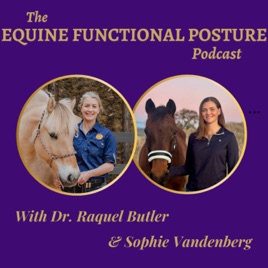
Advertise on podcast: The Equine Functional Posture Podcast
Rating
5from
This podcast has
106 episodes
Language
EnglishExplicit
No
Date created
2024/09/30
Latest episode
2026/09/27
Average duration
48 min.
Release period
7 days
Description
This podcast is created by Dr. Raquel Butler from Integrated Veterinary Therapeutics and Sophie Vandenberg from Equine Posturelate. Dr. Raquel is a Biomechanical Medicine Veterinarian and Educator. Sophie is an Equine Science graduate and has studied Equine Osteopathy. This podcast is your ultimate source for insights into the influences of functional posture on biomechanics, health and overall well-being of horses . Tune in each week as we discuss practical tips, delve into expert interviews and explore the latest research in the impact of static and dynamic posture on your horse journey. To Learn more about Dr Raquel visit: Facebook: https://www.facebook.com/IntegratedVetherapeutics Website: https://integratedvettherapeutics.mykajabi.com/about To learn more about Sophie Vandenberg: Facebook: https://www.facebook.com/profile.php?id=100091267906532 Join our community of proactive horse people exploring the world of equine functional posture - our next course begins November 2024!! To view the course visit: https://integratedvettherapeutics.mykajabi.com/store Have any questions? Email us at: [email protected]
Unlock The Equine Functional Posture Podcast podcast Email contact info,
Listeners & Audience details
Email contact information
Direct podcast contact details

Listeners
Audience numbers & engagement insights

Audience details
Podcast Insights

Podcast episodes
Check latest episodes from The Equine Functional Posture Podcast podcast
Episode 105 - Post Colic Surgery Rehabilitation
2026/09/27
Episode 105 - Post Colic Surgery Rehabilitation
Returning to performance after colic surgery does not necessarily mean that a horse's core function has fully recovered.
In this episode, Dr. Raquel Butler and Sophie Vandenberg discuss rehabilitation following colic surgery, including how abdominal surgery can affect core strength, posture, breathing and movement. They outline a staged approach that begins with wound management and gut health, then progresses through stability, functional activation, strength and a carefully assessed return to riding.
We discuss:
Why return to performance is not a complete measure of recovery
How scar tissue and internal adhesions may influence comfort and function
Early priorities including wound management, circulation, gut health, hoof balance and breathing
How feeding posture can support balance and gentle abdominal activity
The difference between true core activation and abdominal bracing as exercises progress
What to assess before returning a horse to riding or normal paddock activity
To learn more about Dr Raquel Butler visit:
Facebook: Integrated Veterinary Therapeutics
Website: https://www.integratedvettherapeutics.com.au
To learn more about Sophie Vandenberg:
Facebook: Equine Posturelate - Sophie Vandenberg
Have any questions or topics you'd love us to cover?
Email us at: [email protected]
Episode 104 - Equine Functional Posture Clinic: Insights and Breakthroughs
2026/09/20
Sometimes the most powerful change comes from doing less, waiting longer and observing more carefully.
This episode is a reflective discussion about a recent two-day equine posture clinic hosted by Dr Raquel involving five very different horses. Differing levels of balance, stability, communication and mental engagement shaped each horse's response, and we explain why the same exercise may need to look completely different for each individual horse.
We discuss:
Why doing less and allowing time to process can create meaningful change
How balance and stability can influence focus, behaviour and willingness
Why the handler's body position, softness and intention affect the horse's movement
How exercises, poles, aids and rewards can be adapted to the individual horse
What five contrasting horses revealed about lameness, forelimb instability, posture, bracing and mental disengagement
Why stopping, refusing or looking away can be considered valuable communication rather than disobedience
To learn more about Dr Raquel Butler visit:
Facebook: Integrated Veterinary Therapeutics
Website: https://www.integratedvettherapeutics.com.au
To learn more about Sophie Vandenberg:
Facebook: Equine Functional Therapy
Have any questions or topics you'd love us to cover?
Email us at: [email protected]
Episode 103 - Guest: Sharon May Davis - Grading ECVM (Equine Complex Vertebral Malformation
2026/09/14
Episode 103 - Guest: Sharon May Davis - Grading ECVM (Equine Complex Vertebral Malformation
ECVM is more than simply identifying an anatomical variation in the lower cervical spine.
In this episode, Dr. Raquel Butler and Sophie Vandenberg are joined by Dr. Sharon May-Davis PhD to explore the history, research and grading of Equine Complex Vertebral Malformation (ECVM), and what different presentations may mean for the individual horse.
We discuss:
How ECVM was first identified and how the research has developed
How the C6 grading system works and why Grade 4 horses may require further support and investigation
The difference between unilateral and bilateral ECVM presentations clinically
How changes to the longus colli may influence cervical stability, posture and movement
Early signs to observe including tripping, toe dragging, hypersensitivity and unusual behaviour
Why early investigation, appropriate management and responsible breeding decisions matter
To learn more about Dr Raquel Butler visit:
Facebook: Integrated Veterinary Therapeutics
Website: https://www.integratedvettherapeutics.com.au
To learn more about Sophie Vandenberg:
Facebook: Equine Posturelate – Sophie Vandenberg
Have any questions or topics you’d love us to cover?
Email us at: [email protected]
Episode 102: Equine Pain Part 2- Understanding Pain: More Than Just Tissue Damage
2026/09/06
Pain management in horses is rarely about finding one single treatment.
In this episode, we explore how pain can be managed more holistically, why different types of pain may respond differently to treatment, and how movement, environment and daily management can all influence comfort and recovery.
We discuss:
Why pain management needs to be individualised to the horse
Why a “bute trial” cannot always rule pain in or out
The role of movement, rehabilitation and functional posture in reducing discomfort
How environment, nutrition, sleep and recovery can influence pain
Why behaviour can be an important form of communication
How small, positive changes can support comfort, confidence and quality of life
To learn more about Dr Raquel Butler visit:
Facebook: Integrated Veterinary Therapeutics
Website: https://www.integratedvettherapeutics.com.au
To learn more about Sophie Vandenberg:
Facebook: Equine Posturelate – Sophie Vandenberg
Have any questions or topics you’d love us to cover?
Email us at: [email protected]
Episode 101: Equine Pain Part 1- Understanding Pain: More Than Just Tissue Damage
2026/08/30
Pain in horses is not simply a direct measure of tissue damage.
In this episode, we explore what pain actually is, how the nervous system contributes to the pain experience, and why persistent pain can become much more complex than simply finding an injured structure.
We discuss:
Acute pain versus persistent or chronic pain
Why pain can continue after tissues have healed
How previous experiences can influence future pain responses
Central sensitisation and an increasingly sensitive nervous system
The biological, psychological, social, environmental and lifestyle factors that can influence pain
How pain may appear through changes in behaviour, posture, movement and facial expression
To learn more about Dr Raquel Butler visit:
Facebook: Integrated Veterinary TherapeuticsWebsite: https://www.integratedvettherapeutics.com.au
To learn more about Sophie Vandenberg:
Facebook: Equine Posturelate – Sophie Vandenberg
Have any questions or topics you’d love us to cover?
Email us at: [email protected]
Episode 100: Degenerative Suspensory Ligament Desmitis... Or Something Else?
2026/08/23
A dropped fetlock is often associated with Degenerative Suspensory Ligament Desmitis (DSLD), but does a sinking fetlock always indicate this degenerative disease?
Today we explore the current research around DSLD, discuss where the evidence is strong, where it remains uncertain, and why whole-body posture and loading may be an important part of the picture.
We discuss
Suspensory ligament, pelvic and spinal function influences on distal limb loading
Diagnostic limitations, training surfaces, hoof balance and inflammation
Practical ways to support a horse who has sinking fetlocks
A key question throughout the episode: are we sometimes diagnosing a degenerative ligament disorder when we are actually seeing the consequences of chronic postural dysfunction and inappropriate loading?
To learn more about Dr Raquel Butler visit:
Facebook: Integrated Veterinary TherapeuticsWebsite: https://www.integratedvettherapeutics.com.au
To learn more about Sophie Vandenberg:
Facebook: Equine Posturelate – Sophie Vandenberg
Have any questions or topics you’d love us to cover?
Email us at: [email protected]
Episode 99: Growth Plates: More than just an age - Part 2: Loading vs Overloading
2026/08/16
When should we start riding a young horse?
There are strong opinions at both ends of the spectrum: start them young so the body adapts to load, or wait until the growth plates have closed before riding. In Part 2 of our growth plate series, we look at why the answer is much more individual than simply choosing an age.
We discuss the difference between loading and overloading, and why skeletal maturity alone doesn’t necessarily mean a horse is physically prepared to carry a rider.
In this episode we explore:
How young horses can be conditioned before they are ridden
Straight lines, proprioceptive exercises, transitions and varied surfaces
Building core strength, joint stability and body awareness
Recognising fatigue and changes in posture under load
Why recovery time matters as bone adapts to exercise
The importance of hoof care, saddle fit, bodywork and the horse’s environment
Exercises and loading patterns to be cautious with during growth
To learn more about Dr Raquel Butler visit:
Facebook: Integrated Veterinary TherapeuticsWebsite: https://www.integratedvettherapeutics.com.au
To learn more about Sophie Vandenberg:
Facebook: Equine Posturelate – Sophie Vandenberg
Have any questions or topics you’d love us to cover?
Email us at: [email protected]
Episode 98: Growth Plates: More Than Just an Age – Part 1: Understanding the Growing Horse
2026/08/09
Growth plates are central to skeletal development, but there is much more to them than simply knowing when they “close”.
Today we are explaining what growth plates are, how bones grow, and the factors that influence healthy development.
We discuss:
When different parts of the equine skeleton mature
What “open” and “closed” growth plates really mean
Nutrition, growth rate and developmental orthopaedic diseases
The importance of hoof balance, appropriate loading and posture
How bone continues to remodel after growth plates close
In Part 2, we’ll apply this information specifically to starting and training horses.
To learn more about Dr Raquel Butler visit:
Facebook: Integrated Veterinary TherapeuticsWebsite: https://www.integratedvettherapeutics.com.au
To learn more about Sophie Vandenberg:
Facebook: Equine Posturelate – Sophie Vandenberg
Have any questions or topics you’d love us to cover?
Email us at: [email protected]
Episode 97: Transitioning horses to barefoot - GUEST Annette Kaitinis
2026/08/02
Transitioning a horse from metal shoes to barefoot can be incredibly rewarding, but it is rarely as simple as removing the shoes and hoping for the best.
Guest Annette Kaitinis, co-founder of Scoot Boot, joins us to discuss what makes for a successful transition, and how she believes nearly all horses can have a comfortable booted or barefoot lifestyle with enough patience and a well-planned management approach.
Together, they discuss:
Where to begin when considering a barefoot transition
Why the condition of the hoof can influence how long the process takes
The importance of working with a qualified barefoot professional
How nutrition, movement, terrain and trimming cycles affect hoof health
Why some horses require boots or additional cushioning throughout the transition
Common hoof boot fitting mistakes and how fit can change during a trimming cycle
How hoof comfort can influence stride length, posture and tension throughout the body
Whether hoof boots can provide suitable long-term protection
How Scoot Boot’s sizing app and fitting support can help owners select the right boot
This conversation is a practical reminder that successful barefoot management is not about leaving a horse unprotected. It is about providing the trimming, nutrition, movement, environment and protection the individual horse needs to remain comfortable and functional.
To learn more about Dr Raquel Butler visit:
Facebook: Integrated Veterinary TherapeuticsWebsite: https://www.integratedvettherapeutics.com.au
To learn more about Sophie Vandenberg:
Facebook: Equine Posturelate – Sophie Vandenberg
Have any questions or topics you’d love us to cover?
Email us at: [email protected]
Episode 96: ECVM Guest & Horse Owner Kate Schreiber
2026/07/26
Bronson was a striking and successful performance horse, but behind his appearance and achievements was a long history of unusual behaviour, sensory changes, recurring injuries and physical challenges that escalated over 10 years. In this episode, we speak with Bronson’s dedicated owner, Kate Schreiber, about his Grade 4 ECVM diagnosis and recent dissection. Kate shares Bronson's story and his legacy of ECVM awareness and advocacy for horses everywhere.
We discuss:
Aggression, bolting and difficulty interacting within a herd
Persistent ulcers that remained despite extensive management
Unusual reactions to grooming, needles, hosing, rugging
The rehab, farriery and management strategies that appeared to support him
The difficulty Kate faced when pursuing an ECVM diagnosis
Knowing when to keep encouraging a horse and when it is time to stop
Bronson’s story is also an important reminder: you know your horse’s normal, their quirks and the small changes that others may not see. Those observations matter, and your advocacy makes a difference for your horse.
To learn more about Dr Raquel Butler visit:
Facebook: Integrated Veterinary TherapeuticsWebsite: https://www.integratedvettherapeutics.com.au
To learn more about Sophie Vandenberg:
Facebook: Equine Posturelate – Sophie Vandenberg
Have any questions or topics you’d love us to cover?
Email us at: [email protected]
Episode 95: ECVM: What does it mean for our horses?
2026/07/19
ECVM: What does it mean for our horses?
Equine Complex Vertebral Malformation, or ECVM, is a congenital variation in the vertebrae at the base of the horse’s neck. While some affected horses may show few obvious signs, others can experience changes in stability, limb awareness, movement and behaviour that have serious implications for both horse and rider safety - this often correlates to whether the malformation is on one side of the neck, both sides of the neck or other structres such as the first rib are also malformed.
In this interview style episode, Sophie asks Dr Raquel Butler to explain:
What ECVM is and how it can affect the surrounding muscles, nerves and blood vessels
How ECVM is currently diagnosed and why specific radiographic views are needed
Subtle signs such as stumbling, unusual limb placement, asymmetrical movement and unexplained paddock accidents
More advanced signs, including unpredictable behaviour, loss of body awareness and sudden episodes of flight
What a diagnosis may mean for riding, training, competition, breeding and long-term management
How postural strength, proprioception and careful observation may help support affected horses
This is a complex and sometimes confronting subject, but awareness gives owners, riders and professionals a better chance of recognising when something does not feel right, investigating further and making informed decisions for both the horse and the people around them.
To learn more about Dr Raquel Butler visit:
Facebook: Integrated Veterinary TherapeuticsWebsite: https://www.integratedvettherapeutics.com.au
To learn more about Sophie Vandenberg:
Facebook: Equine Posturelate – Sophie Vandenberg
Have any questions or topics you’d love us to cover?
Email us at: [email protected]
Episode 94: Assessing Postural Muscles: Controlled or Compensating?
2026/07/12
Assessing Postural Muscles: Controlled or Compensating?
Today we’re talking about how to recognise whether your horse is developing true postural control through the spine. Deep spinal muscles can be difficult to assess directly, but we can begin to understand how well they are functioning by observing our horse's movement.
In this episode, we explore:
Why postural control is often the limiting factor in all kinds of training
How balance and stability show up in small everyday movements
What limb placement and weight shifting can tell us
How you can watch and understand spinal control in deceleration and upward transitions
How watching paddock postures can reveal whether training is improving everyday function
Signs of spinal muscle fatigue; including brace and reduced co-orination
Why functional spinal motion needs to come before more advanced exercises
To learn more about Dr Raquel Butler visit:
Facebook: Integrated Veterinary TherapeuticsWebsite: https://www.integratedvettherapeutics.com.au
To learn more about Sophie Vandenberg:
Facebook: Equine Posturelate – Sophie Vandenberg
Have any questions or topics you’d love us to cover?
Email us at: [email protected]
Episode 93: The Nuchal Ligament
2026/07/05
The Nuchal Ligament - Could you describe it's function?
Today we’re unpacking the nuchal ligament: what it does, how it works, and why it is often misunderstood for it's role in body mechanics. We also share insights from dissections about where issues can occur and how ribcage position is paramount!
The nuchal ligament is a passive recoil support system that helps reduce the effort required to move and support the head and neck -which can be up to 90kg combined weight! But it does not actively lift the horse’s neck or back. That job still belongs to the muscles, thoracic sling, abdominals and deeper stabilising systems.
In this episode, we explore:
The anatomy and function of the nuchal ligament
Why it acts as an energy-saving recoil system, not a “head holder”
Signs the nuchal ligament system may be under strain or dysfunctional
What we see clinically and in dissections
How better posture, bodywork, saddle fit, feeding positions and training choices can support healthier function
To learn more about Dr Raquel Butler visit:
Facebook: Integrated Veterinary TherapeuticsWebsite: https://www.integratedvettherapeutics.com.au
To learn more about Sophie Vandenberg:
Facebook: Equine Posturelate – Sophie Vandenberg
Have any questions or topics you’d love us to cover?
Email us at: [email protected]
Episode 92: Un-Bridled Conversations- Horse Wellbeing and Biomechanics
2026/06/28
Un-Bridled Conversations- Horse Wellbeing and Biomechanics
In this episode, we explore bridleless and bitless riding as more than just an impressive training goal. We discuss what changes when the horse is no longer connected through the mouth, and how this can reveal important information about posture, balance, expression and comfort.
We reflect on recent bridleless competition footage, the positive reception it received, and what it showed us about collection, jumping technique, stride regularity and self-carriage without relying on the bit.
In this episode, we unpack:
Why bitless and bridleless riding deserve a place as valid riding and competition options
What a horse’s expression can tell us about comfort, pressure and conflict
How the head, neck and mouth can influence stride length, rhythm and hind-end function
Why bridleless riding still needs thoughtful, peaceful training foundations
How removing the bridle can reveal a horse’s true neutral posture
Anatomical considerations when using neck ropes or bridle-less aids.
To learn more about Dr Raquel Butler visit:
Facebook: Integrated Veterinary TherapeuticsWebsite: https://www.integratedvettherapeutics.com.au
To learn more about Sophie Vandenberg:
Facebook: Equine Posturelate – Sophie Vandenberg
Have any questions or topics you’d love us to cover?
Email us at: [email protected]
Episode 91: Who's responsibility is your horse's posture?
2026/06/21
Master the essential, proven, science-based tools to understand posture, movement and behaviour from the inside out - so you can create real, lasting change without overwhelm, pressure or confusion.
Enrol now and transform how you support your horse’s body, balance and wellbeing: Equine Functional Posture Course
WHO's responsibility is your horse's posture?
Your horse’s posture is not something that can be fully outsourced. While your vet, bodyworker, trainer, hoof care provider and saddle fitter all play important roles, the daily observations and small consistent inputs from the owner are often what create lasting change.
In this episode, we unpack:
Why the horse owner’s role is irreplaceable in postural change
How behaviour, posture and movement are forms of communication
What parts of your horse’s progress cannot be outsourced
Why bodywork creates opportunity, but the owner helps maintain change
How daily exercises, warm-ups and observations support the “positive posture bank”
How the Equine Functional Posture Course helps owners recognise, support and advocate for their horse
To learn more about Dr Raquel Butler visit:
Facebook: Integrated Veterinary TherapeuticsWebsite: https://www.integratedvettherapeutics.com.au
To learn more about Sophie Vandenberg:
Facebook: Equine Posturelate – Sophie Vandenberg
Have any questions or topics you’d love us to cover?
Email us at: [email protected]
Podcast reviews
Read The Equine Functional Posture Podcast podcast reviews
Skolarolly 2026/07/29
Highly informative
I discovered this podcast a couple months ago and absolutely love the educational content. I am Equine Bodyworker and all of the topics are relevant t...
Podcast sponsorship advertising
Start advertising on The Equine Functional Posture Podcast relevant audience podcasts
You may also like to advertise on these Podcasts

4.959721991
Legal AF by MeidasTouch
MeidasTouch Network
4.942001993
Chente Ydrach
Chente Ydrach
4.9247491432
Unashamed with the Robertson Family
Tread Lively
4.897041427
The Graham Allen Show
Graham Allen
4.6652312197
The Charlie Kirk Show
Charlie Kirk
4.7292602000
The Michael Knowles Show
The Daily Wire
4.830862000
The Quote of the Day Show | Daily Motivational Talks
Sean Croxton
4.6619472000
The Dan Bongino Show
Cumulus Podcast Network | Dan Bongino
4.8120961000
Mind Pump: Raw Fitness Truth
Sal Di Stefano, Adam Schafer, Justin Andrews, Doug Egge
4.6253122000
The Glenn Beck Program
Mercury Radio Arts