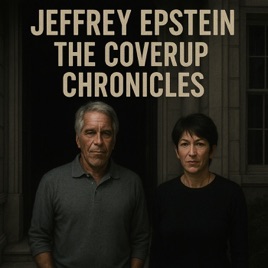
Advertise on podcast: Jeffrey Epstein: The Coverup Chronicles
Rating
3.5from
This podcast has
1000 episodes
Language
EnglishPublisher
Bobby CapucciExplicit
Yes
Date created
2025/03/08
Latest episode
2026/10/05
Average duration
41 min.
Release period
1 days
Description
Jeffrey Epstein: The Coverup Chronicles is a podcast dedicated to examining not just who Epstein was and what he did, but how so many people and institutions worked—then and now—to keep it all hidden. This series cuts past the headlines and digs into the documentation: court filings, deposition transcripts, plea deals, sealed exhibits, and the bureaucratic paper trail that still tells the real story. Our focus isn’t on speculation or recycled outrage. It’s on facts—and the deliberate efforts to keep those facts out of public view. Each episode will feature in-depth analysis of newly surfaced records and underreported legal developments, alongside expert commentary that connects them to the broader machinery of power that shielded Epstein for decades. We’ll revisit the timeline from his first arrests through his 2008 plea deal, and into the re-investigations that followed his 2019 death in federal custody. And we won’t stop there—we’ll look closely at the current state of affairs: the closed probes, the lingering co-conspirators, the civil suits, and the glaring gaps in accountability. What makes The Coverup Chronicles different is that we’re not here to sensationalize the story—we’re here to document the ongoing concealment of it. This isn’t just about reliving Epstein’s crimes. It’s about following the networks that enabled them, protected him, and continue to obscure the truth. If you want an honest look at what’s still being hidden—by whom, and why—this is the podcast that pulls those threads. And I should know—I’ve spent over six years uncovering every dark corner of this case. My name is Bobby Capucci, and I’ve dedicated those same six years exposing the truth about Epstein and the powerful figures who enabled him. From on-the-ground investigations at Epstein’s Zorro Ranch, where I spoke with insiders, to national appearances on Tucker Carlson, I’ve followed this story farther than most are willing to go. Who helped Epstein build his empire? Who protected him? And who is still pulling the strings? The answers lie in the shadows of Jeffrey Epstein's criminal empire. . This is the truth they don’t want you to hear. And I’m here to make sure you do.
Unlock Jeffrey Epstein: The Coverup Chronicles podcast Email contact info,
Listeners & Audience details
Email contact information
Direct podcast contact details

Listeners
Audience numbers & engagement insights

Audience details
Podcast Insights

Podcast episodes
Check latest episodes from Jeffrey Epstein: The Coverup Chronicles podcast
Dr. Michael Freeman Challenges the Forensic Record in Jeffrey Epstein’s Death
2026/10/05
A forensic-medicine professor who reviewed Jeffrey Epstein’s autopsy records was preparing to present findings that could challenge the official conclusion that Epstein died by suicide in his Manhattan jail cell in August 2019. Michael Freeman, editor-in-chief of the Journal of Forensic and Legal Medicine, examined autopsy materials obtained from Epstein’s brother, Mark Epstein, and conducted what he described as a biomechanical analysis of the ligature pattern. Freeman said the case contained unusual features for a suicide investigation, including the absence of photographs of Epstein’s body at the death scene and the fact that the ligature itself was not preserved or examined. He also reviewed images that he said showed injuries that were not accounted for by the medical examiner, though he had not yet publicly disclosed his ultimate conclusion.
Mark Epstein said Freeman’s work reinforced his long-standing belief that his brother’s death deserved a deeper investigation and argued that a more detailed scientific review at the time could have produced a different conclusion. Freeman was expected to present his findings at University College London in November 2026 and later publish the research alongside the autopsy files. He stressed that Epstein’s death could only be explained as either suicide or homicide and said his presentation would weigh the evidence supporting both possibilities. The development added another layer to the years of questions surrounding Epstein’s death, particularly because of the documented failures at the jail and the continuing disputes over the forensic evidence.
to contact me:
[email protected]
Mega Edition: My Interviews With Maria Farmer (10/5/26)
2026/10/05
Maria Farmer is an American visual artist who rose to public attention not for her artwork initially, but for being among the first whistleblowers to alert authorities about Jeffrey Epstein and Ghislaine Maxwell. In 1996, while working for Epstein and Maxwell in New York, she was allegedly sexually assaulted by both. She went on to submit what is recognized as the first criminal complaint to the New York City Police Department and the FBI—a warning that would unfortunately go unheeded for years.
Over the years Farmer has reemerged as a powerful advocate for survivors of Epstein’s exploitation. She filed an affidavit in federal court in 2019 supporting Virginia Giuffre’s defamation lawsuit, and in 2025, she sued the federal government for failing to act on her decades-old report. She has also publicly recounted a disturbing 1995 encounter with Donald Trump in Epstein’s Manhattan office, which she urged investigators to include in their probe of Epstein’s social circle.
In this episode, we’re going back to April of 2022 for a conversation that’s as raw and revealing now as it was then—my interview with Maria Farmer. At the time, Maria was one of the only survivors publicly speaking out against the full machinery that protected Jeffrey Epstein and Ghislaine Maxwell. She didn’t just name names—she challenged institutions, exposed failures, and pulled the curtain back on a cover-up that reached into finance, intelligence, and politics. This interview captures Maria at her most unfiltered, recounting her experiences, her warnings to the FBI that were ignored, and her insight into how deep the rot really goes.
to contact me:
[email protected]
Mega Edition: Alan Dershowitz And The Many Epstein Related Lawsuits (10/4/26)
2026/10/05
Alan Dershowitz’s Epstein-related litigation largely grew out of Virginia Giuffre’s allegation that Jeffrey Epstein had trafficked her to him for sex, an accusation Dershowitz consistently denied. The first major legal battle came in 2015, after Giuffre’s attorneys Bradley Edwards and Paul Cassell included allegations against Dershowitz in court filings. Edwards and Cassell sued Dershowitz for defamation after he publicly accused them of misconduct and dishonesty, and Dershowitz responded with his own counterclaims accusing the two lawyers of defaming him through the allegations and their public statements. That litigation was settled in 2016. The fight exploded again in 2019 when Giuffre sued Dershowitz for defamation after he repeatedly called her a liar; Dershowitz countersued, alleging that Giuffre’s accusations were false and defamatory and claiming that her lawyers, particularly David Boies and his firm, had pushed a fabricated narrative against him. The litigation ultimately became intertwined with a separate defamation fight involving Boies, who sued Dershowitz over accusations Dershowitz had made about his conduct.
Dershowitz also took his fight directly to the media. In 2021, he filed a federal defamation lawsuit against Netflix and the producers of Jeffrey Epstein: Filthy Rich, arguing that the documentary prominently repeated Giuffre’s allegations while failing to present evidence he said disproved them and violating assurances that his side of the story would be fairly included. The Netflix litigation was dismissed with prejudice in March 2022 after both sides agreed to drop their claims. Later that year, the much larger Giuffre-Dershowitz legal war also ended: in November 2022 the parties dismissed their claims with prejudice, with no monetary payment, and Giuffre issued a statement saying she recognized that she “may have made a mistake” in identifying Dershowitz. Taken together, Dershowitz used counterclaims and affirmative defamation litigation against Giuffre, her lawyers and the producers who broadcast her allegations as part of a years-long legal campaign to challenge the Epstein-related accusations against him, but none of those cases produced a trial verdict adjudicating whether the underlying sexual-abuse allegation was true or false.
to contact me:
[email protected]
Mega Edition: Ghislaine Maxwell And The Propaganda Surrounding Her Bail Attempt (10/5/26)
2026/10/05
Ghislaine Maxwell’s camp mounted an aggressive public-relations push around her bail efforts, portraying her less as a defendant facing serious federal charges and more as a woman being crushed by public hysteria, media coverage and the fallout from Jeffrey Epstein’s crimes. Her lawyers repeatedly emphasized that Maxwell was “not Jeffrey Epstein,” argued that she had been unfairly turned into a stand-in for him after his death, and highlighted her age, health, jail conditions and supposed inability to properly prepare for trial. Supporters and defense filings stressed that she had family ties, people willing to vouch for her, and no intention of fleeing, while character letters and sympathetic descriptions of her personal circumstances helped reinforce the image of someone being punished before trial rather than a wealthy defendant accused of helping Epstein recruit and groom underage girls.
That narrative was paired with an enormous proposed bail package intended to make Maxwell appear almost incapable of escaping. Her team pointed to tens of millions of dollars in pledged assets, home confinement, electronic monitoring, private security, surrendered passports and extraordinary personal guarantees as proof that the government’s concerns were exaggerated. But the court continued to focus on the factors the defense messaging could not erase: Maxwell’s substantial wealth, multiple citizenships, international connections, history of living abroad and the severe sentence she faced if convicted. The propaganda surrounding the bail push attempted to recast the dispute as one about fairness, media prejudice and excessive detention, but the judges repeatedly treated it as a straightforward flight-risk question and concluded that even one of the most elaborate bail packages imaginable was not enough to guarantee that Maxwell would remain in the United States and appear for trial.
to contact me:
[email protected]
Ghislaine Maxwell And The Civil Case That Was Stopped Due To Her Indictment
2026/10/05
A federal magistrate judge temporarily spared Ghislaine Maxwell from having to sit for a deposition or answer written questions in a civil lawsuit brought by Annie Farmer, who alleged that Maxwell sexually assaulted her when she was 16 at Jeffrey Epstein’s New Mexico ranch. Maxwell’s lawyers sought the delay by pointing to the ongoing federal investigation into Epstein’s alleged co-conspirators and the possibility that Farmer’s claims could instead be resolved through the compensation program being established by Epstein’s estate. Magistrate Judge Debra Freeman agreed to pause Maxwell’s discovery obligations for the time being, but made clear the reprieve was temporary, saying she did not want the matter to drag on indefinitely and ordering the parties to update the court on the status of the criminal investigation and claims process. Farmer’s attorney, Sigrid McCawley, opposed the delay, arguing that preventing her from questioning Maxwell effectively hamstrung Farmer’s ability to build her civil case.
The ruling came during a period when Maxwell had largely disappeared from public view and her whereabouts were unknown. Her attorney, Laura Menninger, continued to deny Farmer’s allegations and argued that Maxwell was being financially drained by the mounting litigation, claiming she was not a multimillionaire and had to pay for her own defense. At the same time, Maxwell had sued Epstein’s estate seeking reimbursement for legal expenses and personal security costs, contending that Epstein had promised to financially support her. The broader fight was also tangled up with negotiations over Epstein’s roughly $634 million estate and its proposed victims’ compensation program, which had been delayed by objections from the U.S. Virgin Islands attorney general over protections for victims and broad releases that could shield other alleged abusers.
to contact me:
[email protected]
Jeffrey Epstein IPO Club
2026/10/05
Jeffrey Epstein’s investment activity extended well beyond conventional stocks, hedge funds and private equity, and newly released records have shown that he repeatedly sought access to companies before or around the time they went public. Epstein used his network of financiers, executives and investment managers to gain exposure to private companies, secondary shares and pre-IPO opportunities that were generally unavailable to ordinary investors. One documented example was his roughly $1 million investment through a special-purpose vehicle connected to Honeycomb shortly before Spotify’s 2018 direct listing, after Epstein had previously passed on an earlier opportunity to invest in the company. Records also show that he was regularly pitched shares in major private technology companies, including SpaceX, while his broader financial files reveal a pattern of trying to position himself inside potentially lucrative deals before the wider market had access.
That activity fit a much older pattern in Epstein’s financial career. During his years at Bear Stearns, he worked with speculative securities and “new issues,” the Wall Street term frequently used for newly issued stocks and offerings, and later invested hundreds of millions of dollars through Bear Stearns and other financial vehicles. By the time of his death, his estate listed nearly $195 million in hedge-fund and private-equity investments alone, demonstrating how heavily his fortune remained tied to investments outside ordinary public-market trading. The significance of Epstein’s IPO and pre-IPO activity was not simply that he bought promising companies early; it was that his extraordinary network routinely put him in a position to hear about private investment opportunities, corporate transactions and startups before they became broadly available, an advantage that has drawn increasing scrutiny as investigators and reporters reconstruct how Epstein actually accumulated and managed his wealth.
to contact me:
[email protected]
DOJ Moves to End Katie Phang’s Epstein Files Lawsuit (Part 4) (10/4/26)
2026/10/04
This is Document 52-1 in Phang v. Blanche, filed October 1, 2026, and it is the DOJ’s Memorandum in Support of its Motion for Judgment on the Pleadings. In plain terms, Todd Blanche and the Justice Department are asking Judge Emmet Sullivan to end Katie Phang’s case without further factual development because, in their view, her claims fail as a matter of law. The DOJ’s core argument is that the Epstein Files Transparency Act does not give private citizens a right to sue to enforce it. The government says Congress deliberately created reporting and oversight mechanisms involving Congress and the Federal Register, but did not create a private cause of action. It also argues that Phang lacks Article III standing because her alleged injury is no different from that of any other member of the public who wants the government to comply with the law. Her status as a journalist, and her argument that withheld or redacted Epstein material harms her reporting and professional interests, is dismissed by DOJ as too speculative to establish a concrete and particularized injury. The filing further contends that the Administrative Procedure Act cannot be used as a workaround because FOIA already provides an adequate judicial remedy for people seeking government records.
The DOJ also attacks Phang’s claims on the merits. It argues that courts may compel only agency actions that are specifically and unequivocally required by law, and says the EFTA does not require the precise actions Phang is demanding. The Department defends its redactions, saying the statute expressly permits withholding victim-identifying information and that the Privacy Act independently requires protection of certain personal information. It rejects Phang’s position that the newer Epstein statute displaced those privacy protections, arguing the two laws must be read together. The government also says the EFTA contains no specific requirement that DOJ translate, review and produce foreign-language documents, and maintains that doing so would require immense resources and falls outside any clear statutory command. Taken together, the filing is a broad attempt to knock out the case at the threshold: no private right of action, no standing, no enforceable APA claim, no unlawful redactions, no mandatory obligation to produce foreign-language material, and no viable ultra vires or Declaratory Judgment Act claim. DOJ is asking Sullivan to enter judgment for Blanche and effectively terminate Phang’s lawsuit on the pleadings.
to contact me:
[email protected]
DOJ Moves to End Katie Phang’s Epstein Files Lawsuit (Part 3) (10/4/26)
2026/10/04
This is Document 52-1 in Phang v. Blanche, filed October 1, 2026, and it is the DOJ’s Memorandum in Support of its Motion for Judgment on the Pleadings. In plain terms, Todd Blanche and the Justice Department are asking Judge Emmet Sullivan to end Katie Phang’s case without further factual development because, in their view, her claims fail as a matter of law. The DOJ’s core argument is that the Epstein Files Transparency Act does not give private citizens a right to sue to enforce it. The government says Congress deliberately created reporting and oversight mechanisms involving Congress and the Federal Register, but did not create a private cause of action. It also argues that Phang lacks Article III standing because her alleged injury is no different from that of any other member of the public who wants the government to comply with the law. Her status as a journalist, and her argument that withheld or redacted Epstein material harms her reporting and professional interests, is dismissed by DOJ as too speculative to establish a concrete and particularized injury. The filing further contends that the Administrative Procedure Act cannot be used as a workaround because FOIA already provides an adequate judicial remedy for people seeking government records.
The DOJ also attacks Phang’s claims on the merits. It argues that courts may compel only agency actions that are specifically and unequivocally required by law, and says the EFTA does not require the precise actions Phang is demanding. The Department defends its redactions, saying the statute expressly permits withholding victim-identifying information and that the Privacy Act independently requires protection of certain personal information. It rejects Phang’s position that the newer Epstein statute displaced those privacy protections, arguing the two laws must be read together. The government also says the EFTA contains no specific requirement that DOJ translate, review and produce foreign-language documents, and maintains that doing so would require immense resources and falls outside any clear statutory command. Taken together, the filing is a broad attempt to knock out the case at the threshold: no private right of action, no standing, no enforceable APA claim, no unlawful redactions, no mandatory obligation to produce foreign-language material, and no viable ultra vires or Declaratory Judgment Act claim. DOJ is asking Sullivan to enter judgment for Blanche and effectively terminate Phang’s lawsuit on the pleadings.
to contact me:
[email protected]
DOJ Moves to End Katie Phang’s Epstein Files Lawsuit (Part 2) (10/4/26)
2026/10/04
This is Document 52-1 in Phang v. Blanche, filed October 1, 2026, and it is the DOJ’s Memorandum in Support of its Motion for Judgment on the Pleadings. In plain terms, Todd Blanche and the Justice Department are asking Judge Emmet Sullivan to end Katie Phang’s case without further factual development because, in their view, her claims fail as a matter of law. The DOJ’s core argument is that the Epstein Files Transparency Act does not give private citizens a right to sue to enforce it. The government says Congress deliberately created reporting and oversight mechanisms involving Congress and the Federal Register, but did not create a private cause of action. It also argues that Phang lacks Article III standing because her alleged injury is no different from that of any other member of the public who wants the government to comply with the law. Her status as a journalist, and her argument that withheld or redacted Epstein material harms her reporting and professional interests, is dismissed by DOJ as too speculative to establish a concrete and particularized injury. The filing further contends that the Administrative Procedure Act cannot be used as a workaround because FOIA already provides an adequate judicial remedy for people seeking government records.
The DOJ also attacks Phang’s claims on the merits. It argues that courts may compel only agency actions that are specifically and unequivocally required by law, and says the EFTA does not require the precise actions Phang is demanding. The Department defends its redactions, saying the statute expressly permits withholding victim-identifying information and that the Privacy Act independently requires protection of certain personal information. It rejects Phang’s position that the newer Epstein statute displaced those privacy protections, arguing the two laws must be read together. The government also says the EFTA contains no specific requirement that DOJ translate, review and produce foreign-language documents, and maintains that doing so would require immense resources and falls outside any clear statutory command. Taken together, the filing is a broad attempt to knock out the case at the threshold: no private right of action, no standing, no enforceable APA claim, no unlawful redactions, no mandatory obligation to produce foreign-language material, and no viable ultra vires or Declaratory Judgment Act claim. DOJ is asking Sullivan to enter judgment for Blanche and effectively terminate Phang’s lawsuit on the pleadings.
to contact me:
[email protected]
DOJ Moves to End Katie Phang’s Epstein Files Lawsuit (Part 1) (10/4/26)
2026/10/04
This is Document 52-1 in Phang v. Blanche, filed October 1, 2026, and it is the DOJ’s Memorandum in Support of its Motion for Judgment on the Pleadings. In plain terms, Todd Blanche and the Justice Department are asking Judge Emmet Sullivan to end Katie Phang’s case without further factual development because, in their view, her claims fail as a matter of law. The DOJ’s core argument is that the Epstein Files Transparency Act does not give private citizens a right to sue to enforce it. The government says Congress deliberately created reporting and oversight mechanisms involving Congress and the Federal Register, but did not create a private cause of action. It also argues that Phang lacks Article III standing because her alleged injury is no different from that of any other member of the public who wants the government to comply with the law. Her status as a journalist, and her argument that withheld or redacted Epstein material harms her reporting and professional interests, is dismissed by DOJ as too speculative to establish a concrete and particularized injury. The filing further contends that the Administrative Procedure Act cannot be used as a workaround because FOIA already provides an adequate judicial remedy for people seeking government records.
The DOJ also attacks Phang’s claims on the merits. It argues that courts may compel only agency actions that are specifically and unequivocally required by law, and says the EFTA does not require the precise actions Phang is demanding. The Department defends its redactions, saying the statute expressly permits withholding victim-identifying information and that the Privacy Act independently requires protection of certain personal information. It rejects Phang’s position that the newer Epstein statute displaced those privacy protections, arguing the two laws must be read together. The government also says the EFTA contains no specific requirement that DOJ translate, review and produce foreign-language documents, and maintains that doing so would require immense resources and falls outside any clear statutory command. Taken together, the filing is a broad attempt to knock out the case at the threshold: no private right of action, no standing, no enforceable APA claim, no unlawful redactions, no mandatory obligation to produce foreign-language material, and no viable ultra vires or Declaratory Judgment Act claim. DOJ is asking Sullivan to enter judgment for Blanche and effectively terminate Phang’s lawsuit on the pleadings.
to contact me:
[email protected]
Mega Edition: Ghislaine Maxwell And Christmas Eve Judicial Smack Down (10/4/26)
2026/10/04
On Christmas Eve 2020, Ghislaine Maxwell suffered another major setback in her effort to get out of jail when Judge Alison Nathan denied her renewed bail application. Maxwell’s lawyers had presented an extraordinary package worth roughly $28.5 million when all pledged assets and guarantees were counted, coupled with home confinement, electronic monitoring, private security, surrender of passports and other restrictions designed to convince the court that she would remain in the United States and appear for trial. The timing added another layer of drama to a bail fight that had already become one of the most closely watched parts of the case, but the size of the package did not change the central question before the court: whether Maxwell could be trusted not to flee.
Judge Nathan concluded that she could not. The court remained focused on Maxwell’s substantial financial resources, international ties, multiple citizenships, history of moving between countries and the serious prison exposure she faced if convicted. Those factors outweighed the defense’s argument that the proposed conditions were restrictive enough to eliminate the danger of flight. So, on December 24, 2020, while Maxwell’s attorneys were pushing an increasingly elaborate argument that money, monitoring and personal guarantees should be enough, the court again determined that the risk was simply too great. Maxwell remained locked up at the Metropolitan Detention Center in Brooklyn, with the Christmas Eve ruling making clear that even one of the largest and most restrictive bail proposals imaginable was not enough to overcome the judge’s concerns that she might disappear before trial.
to contact me:
[email protected]
Mega Edition: Ghislaine Maxwell Was A Risk To Flee The Country According To The Court (10/4/26)
2026/10/04
Ghislaine Maxwell’s proposed bail package was enormous by almost any measure. Her lawyers offered roughly $22.5 million in assets, including property and financial guarantees backed by Maxwell, her husband, family members and friends, while also proposing home confinement, electronic monitoring, restrictions on travel, surrender of passports and round-the-clock private security. At various points, the defense also floated extraordinary concessions involving her British and French citizenship in an effort to convince the court that she had effectively put everything on the line. The package was designed to show that fleeing would come at a devastating financial and personal cost, and Maxwell’s attorneys repeatedly argued that the combination of money, monitoring and third-party guarantees made escape unrealistic.
The court was not persuaded because the issue was never simply how much money Maxwell was willing to pledge. Prosecutors argued that she had extraordinary financial resources, international connections, multiple citizenships, experience living abroad and the ability to move between countries, all of which made her a uniquely serious flight risk. Judge Alison Nathan agreed, concluding that even a multimillion-dollar bail package and unusually restrictive conditions could not adequately guarantee Maxwell’s appearance in court. The sheer size of the proposal actually underscored the problem: this was a defendant with access to wealth and international mobility on a scale far beyond the ordinary criminal case, and the court ultimately determined that no amount of money or privately funded security could sufficiently neutralize that risk.
to contact me:
[email protected]
Mega Edition: Doug Band And His Epstein Related Congressional Transcript (Part 8-11) (10/4/26)
2026/10/04
Doug Band told the House Oversight Committee that his personal contact with Jeffrey Epstein was limited, infrequent and largely incidental to his work as Bill Clinton’s longtime aide. He said he barely knew Epstein, did not recall receiving gifts from him and had no knowledge of Epstein’s abuse or other criminal conduct while they were acquainted. Band nevertheless described Epstein and Clinton as appearing to be friends, pointing to the time they spent together, Epstein’s aircraft and his potential value as a supporter of Clinton’s post-presidential work. He acknowledged accompanying Clinton on trips aboard Epstein’s plane and visiting Epstein’s Manhattan townhouse, but said he did not remember witnessing private conversations between the two men or seeing anything improper.
Band described a more substantial relationship with Ghislaine Maxwell, admitting that they developed a friendship through Clinton’s orbit while firmly denying that it was ever romantic or physical. He said he began hearing troubling reports about Maxwell around 2011 and responded by removing her from Clinton’s contact lists and attempting to cut her out of the former president’s world. Much of the questioning focused on emails suggesting social familiarity, dinners, travel arrangements, birthday plans and flirtatious language, but Band repeatedly said he could not remember the communications or the events being discussed. His testimony therefore presented Epstein as a peripheral acquaintance and Maxwell as a former friend, while leaving lawmakers with numerous instances in which documentary records appeared more detailed than Band’s recollection.
to contact me:
[email protected]
source:
Band-Final-Transcript-7.16.26.pdf
Mega Edition: Doug Band And His Epstein Related Congressional Transcript (Part 5-7) (10/4/26)
2026/10/04
Doug Band told the House Oversight Committee that his personal contact with Jeffrey Epstein was limited, infrequent and largely incidental to his work as Bill Clinton’s longtime aide. He said he barely knew Epstein, did not recall receiving gifts from him and had no knowledge of Epstein’s abuse or other criminal conduct while they were acquainted. Band nevertheless described Epstein and Clinton as appearing to be friends, pointing to the time they spent together, Epstein’s aircraft and his potential value as a supporter of Clinton’s post-presidential work. He acknowledged accompanying Clinton on trips aboard Epstein’s plane and visiting Epstein’s Manhattan townhouse, but said he did not remember witnessing private conversations between the two men or seeing anything improper.
Band described a more substantial relationship with Ghislaine Maxwell, admitting that they developed a friendship through Clinton’s orbit while firmly denying that it was ever romantic or physical. He said he began hearing troubling reports about Maxwell around 2011 and responded by removing her from Clinton’s contact lists and attempting to cut her out of the former president’s world. Much of the questioning focused on emails suggesting social familiarity, dinners, travel arrangements, birthday plans and flirtatious language, but Band repeatedly said he could not remember the communications or the events being discussed. His testimony therefore presented Epstein as a peripheral acquaintance and Maxwell as a former friend, while leaving lawmakers with numerous instances in which documentary records appeared more detailed than Band’s recollection.
to contact me:
[email protected]
source:
Band-Final-Transcript-7.16.26.pdf
Mega Edition: Doug Band And His Epstein Related Congressional Transcript (Part 1-3) (10/3/26)
2026/10/04
Doug Band told the House Oversight Committee that his personal contact with Jeffrey Epstein was limited, infrequent and largely incidental to his work as Bill Clinton’s longtime aide. He said he barely knew Epstein, did not recall receiving gifts from him and had no knowledge of Epstein’s abuse or other criminal conduct while they were acquainted. Band nevertheless described Epstein and Clinton as appearing to be friends, pointing to the time they spent together, Epstein’s aircraft and his potential value as a supporter of Clinton’s post-presidential work. He acknowledged accompanying Clinton on trips aboard Epstein’s plane and visiting Epstein’s Manhattan townhouse, but said he did not remember witnessing private conversations between the two men or seeing anything improper.
Band described a more substantial relationship with Ghislaine Maxwell, admitting that they developed a friendship through Clinton’s orbit while firmly denying that it was ever romantic or physical. He said he began hearing troubling reports about Maxwell around 2011 and responded by removing her from Clinton’s contact lists and attempting to cut her out of the former president’s world. Much of the questioning focused on emails suggesting social familiarity, dinners, travel arrangements, birthday plans and flirtatious language, but Band repeatedly said he could not remember the communications or the events being discussed. His testimony therefore presented Epstein as a peripheral acquaintance and Maxwell as a former friend, while leaving lawmakers with numerous instances in which documentary records appeared more detailed than Band’s recollection.
to contact me:
[email protected]
source:
Band-Final-Transcript-7.16.26.pdf
Podcast reviews
Read Jeffrey Epstein: The Coverup Chronicles podcast reviews
elleyhey 2026/05/09
Practically only source out there
Wow -why is this host the only person who is really reporting on this - it has been basically swept under the rug.
Everything he says is true and he ...
CaliCat29 2026/04/09
Meh.
I made it about halfway through one episode. Tidbits of good detail, but the host ends sections of sentences with a rising pitch like he’s asking a qu...
spinamarie 2026/04/04
REALLY want to love this!
This podcast and his other one feature phenomenal coverage, the flat, monotonous tone of voice made it impossible for me to listen to. Seems like more...
MommaKaye16 2026/02/19
Trying
Been trying to find a podcast that can deliver the facts without having to dig for them myself. Tried but it was detrimental for my mental health. The...
Chetst 2026/02/14
That voice
Clearly, this guy’s opinions are anti-Trump and he can’t help but slant the the whole show in that direction. It would be nice to stick to the facts a...
Chlytie 2026/02/01
His voice tone is challenging to listen to
Hat off to this guy for investigating dark things that need investigating… but his choppy and very word in a question tone is very annoying and hard t...
Holdingouthope 2025/12/03
Whiner
Most annoying voice ever!!!
Podcast sponsorship advertising
Start advertising on Jeffrey Epstein: The Coverup Chronicles relevant audience podcasts
You may also like to advertise on these Podcasts

4.9247541436
Unashamed with the Robertson Family
Tread Lively
4.890581551
Fearless with Jason Whitlock
Blaze Podcast Network

4.7106572000
FantasyPros - Fantasy Football Podcast
iHeartPodcasts
4.7292612000
The Michael Knowles Show
The Daily Wire

4.838282000
Entrepreneurs on Fire
John Lee Dumas of EOFire

4.913551954
Wholesaling Inc with Brent Daniels
Find distressed properties for pennies on the dollar and turn them for huge profits!

4.827571696
Earn Your Happy
Lori Harder | YAP Media
4.6652342197
The Charlie Kirk Show
Charlie Kirk
4.6137741968
The Rubin Report
Dave Rubin

4.818382000
The Cabral Concept
Dr. Stephen Cabral