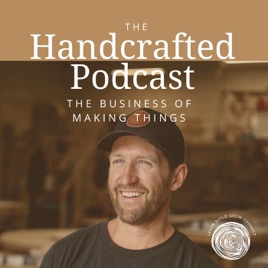
Advertise on podcast: The Handcrafted Podcast: The Business of making things
Rating
4.3from
This podcast has
79 episodes
Language
EnglishPublisher
Paul MencelExplicit
No
Date created
2025/03/14
Latest episode
2026/10/05
Average duration
16 min.
Release period
7 days
Description
The Handcrafted Podcast: The Business of Making Things" is where craftsmanship meets business strategy. Hosted by Paul, founder of Philadelphia Table Co. and The Handcrafted Network, this podcast dives into the mindset, pricing, marketing, and systems that help makers turn their craft into a thriving business. Whether you're a woodworker, artisan, or creative entrepreneur, you’ll learn the strategies to build a profitable, sustainable business—because great craftsmanship deserves great business strategy.
Unlock The Handcrafted Podcast: The Business of making things podcast Email contact info,
Listeners & Audience details
Email contact information
Direct podcast contact details

Listeners
Audience numbers & engagement insights

Audience details
Podcast Insights

Podcast episodes
Check latest episodes from The Handcrafted Podcast: The Business of making things podcast
Weathering the Storm: The Stockdale Paradox for Makers
2026/10/05
Join the network.
After reflecting on the Texas Woodworking Festival and the supportive community within the Handcrafted Network, Paul shares a lesson for navigating difficult seasons in business and life.
The Stockdale Paradox teaches us to confront the harsh reality of our circumstances while maintaining unwavering faith that we will ultimately prevail. Using the metaphor of captaining a ship through turbulent seas, Paul explains that we cannot control the storm—but we can prepare, choose our direction, and keep moving forward.
This honest episode is a reminder that struggling does not mean failing, you are not alone, and the only way through a difficult season is to face it with realism, hope, and perseverance.
Join the Network
4 Hills I’ll Die On as a Maker & Business Owner
2026/09/29
Summary
In this episode of The Handcrafted Podcast, Paul shares four business beliefs that recently sparked conversation on social media—and explains why he stands behind each one. He also opens with a personal reflection on getting through difficult periods by focusing on one problem, one hour, and one day at a time rather than trying to solve everything at once.
The four “hills” are:
Capture your work properly. If you spend hundreds of hours creating a piece, don’t spend ten minutes documenting it. Great photography and video are part of the business, not an afterthought.Follow-up is one of the easiest ways to make more money. Paul shares a real example of reconnecting with a lead after two weeks and potentially turning it into a table-and-chairs order.Sometimes you need to turn down work to build the business you actually want. Saying no to an interesting but off-brand banjo display case freed up time to pursue work that fits PTC’s strengths. At the same time, newer makers shouldn’t necessarily niche too early—experimentation can help reveal what the business should become.If your content only shows how you make something, you’re attracting makers—not buyers. Tutorial content often appeals to other craftspeople. Instead, makers should think about who they actually want as customers and create content that makes those people want the product, appreciate the craftsmanship, and trust the business.Join the Network
RERUN: Going Beyond Expectations: The Power of Unreasonable Hospitality
2026/09/21
Unfortunately, one of my dogs was hit and killed by a car unexpectedly. As you can imagine it's hard to muster the strength and poise needed to record a new podcast episode. Here is one of my favs that seems to have been overlooked.
In this RERUN episode, Paul explores how makers and creative business owners can transform their client experience by going above and beyond what’s expected — a concept inspired by Will Guidara’s book Unreasonable Hospitality. Drawing lessons from world-class hospitality, he shares how simple, thoughtful gestures can turn ordinary interactions into unforgettable moments that clients rave about. Paul breaks down how this philosophy applies directly to custom furniture and creative businesses, and how delivering “legendary” experiences can become your most powerful sales tool.
Key Takeaways:
Bare minimum isn’t enough. Exceptional product quality and good service are simply the baseline. The real magic happens when you exceed expectations in ways that surprise and delight.Three levels of experience:One-size-fits-all — Small touches every client receives (e.g., elevating delivery or sample interactions).One-size-fits-some — Experiences tailored to certain groups (e.g., custom gestures for pet owners or retirees).One-size-fits-one — Hyper-personalized moments that show you’re truly listening (e.g., picking up on a client’s passing comment and acting on it).It’s about thought, not money. High-impact gestures don’t have to be expensive — they need to feel intentional, personal, and memorable.Experiences drive word-of-mouth. Memorable interactions turn clients into storytellers and brand advocates, amplifying your reputation without traditional marketing.Empower your team to create “legends.” Encourage them to notice details, act creatively, and share wins so these moments become part of your culture.For questions or to share your own “legendary” client stories, reach out to [email protected]
Join the Network
Join the Network
Who Are You Really Doing It For?
2026/09/14
Join the network.
Summary:
As makers, we often assume customers value the same things we do. But the details we obsess over—perfect grain matching, a single-maker process, sustainability, or endless customization—may not be the reasons customers choose us.
In this episode, Paul explores the importance of understanding who your work is actually for and what those customers truly value. He challenges makers to separate customer needs from personal preferences and ego—and to question whether the “moat” protecting their business might also be keeping them trapped.
Key Takeaways
Not every product, service, or creative choice is meant for every audience.Ask customers why they chose you instead of assuming you already know.The details you value most may not be the details your customers value.Great craftsmanship should serve the customer—not just the maker’s ego.What helped build your business may not be what takes it to the next level.A competitive moat can protect your business, but it can also limit its growth.When you encounter a reason you “can’t” grow, examine whether that limitation is real or self-imposed.Ask yourself: Who am I doing this for, and what are they actually coming to me for?Join the Network
The Difference Between Craftsmanship and Perfectionism
2026/09/07
The Handcrafted Network
Summary:
Perfectionism can feel like craftsmanship, but often it’s just procrastination in disguise. In this episode, Paul talks about finding the line between maintaining a high standard and wasting time on details your customer doesn’t notice or value. He explores wabi-sabi, the beauty of imperfection, and why handmade work doesn’t need to look machine-made to be excellent. The goal isn’t to lower your standards—it’s to define your standard, know where perfection actually matters, and get the work out the door.
Key Takeaways:
Perfectionism and craftsmanship aren’t the same thing.Extra effort doesn't always translate into extra value for the customer.Figure out where precision truly matters versus where “great” is enough.Handmade work inherently contains human variation—and that can be part of its value.Your company's standard should evolve as your skills, customers, and business evolve.Finish it. Ship it. Learn from it. Get better on the next one.Join the Network
B2B vs. D2C: The Two Ways to Grow Your Business
2026/08/31
Join the network
Most makers think about selling directly to customers, but there’s another powerful path: selling to other businesses. In this episode, Paul breaks down the strengths and weaknesses of direct-to-consumer (D2C) and business-to-business (B2B) sales—and why the strongest businesses often use both.
Key Takeaways:
D2C is easier to start, harder to scale. You can begin through markets, Etsy, Facebook Marketplace, your website, and word of mouth—but eventually growth requires serious investment in branding and marketing.B2B is harder to establish, but easier to pursue proactively. Instead of waiting for customers to find you, you can directly approach designers, contractors, showrooms, restaurants, hotels, and other businesses.Recurring B2B clients can fill your pipeline, but relying too heavily on one customer creates major risk.B2B can become a race to the bottom if you're viewed simply as a vendor or commodity.Diversification is the goal. Philadelphia Table Company now operates roughly in thirds: D2C, interior designer/showroom resale, and direct B2B.COVID proved the value of diversification. When hospitality disappeared almost overnight, PTC's D2C business helped keep the company moving.Homework: Write out your potential D2C channels and B2B channels. Identify specific ways you could actively grow each side of the business.Core idea: Use B2B to proactively generate revenue while you slowly build the brand and audience that make D2C scalable.
Join the Network
Are You Solving the Right Problem?
2026/08/24
Explore the Network.
Summary
Business owners often jump straight into fixing whatever problem seems most obvious—but that may not be the problem actually holding the business back.
In this episode, Paul shares how he thought Philadelphia Table Company needed a salesperson, only to realize that sales weren’t the bottleneck at all. The real issue was production capacity and an increasingly long queue.
Before hiring, changing your product, chasing more leads, or making a major pivot, trace the problem back to its actual source. More leads won’t help if you can’t close them. Better products won’t fix bad customer service. New employees won’t solve a broken system.
Key takeaways:
Don’t confuse the symptom with the actual problem.Identify where the bottleneck really exists: leads, sales, production, delivery, service, systems, etc.Don’t default to the easiest or most obvious solution.Give big decisions time—sleep on them and revisit them with a clear head.Business is a constant game of Whac-A-Mole. Solve the right problem, then move on to the next one.Join the Network
Office Hours: The Problems That Show Up When Your Business Starts Growing
2026/08/17
Join the Network
Summary:
In this Office Hours episode, Paul answers five real-world questions about the growing pains makers face as their businesses expand. He covers why being busy doesn’t necessarily mean being profitable, when it makes sense to start turning down work, how to build a quality-control culture with employees, whether to raise prices when leads are slow, and how to stop yourself from becoming the bottleneck in your own company.
Topics Covered:
Busy but not profitable: Use cost analysis to determine whether the problem is pricing, efficiency, or overhead—and aim for roughly $150K in revenue per employee as a benchmark.When to say no: Early in your business, saying yes to diverse projects can help build your portfolio. Niche down as demand and experience grow.Quality control: Create a repeatable QC checklist and a clear shop standard so quality isn’t dependent on the owner inspecting every detail.Raising prices when leads are slow: Separate a lead problem from a closing problem. If leads simply aren't coming in, price probably isn't the reason.Getting yourself out of everything: Break the business into clear buckets—marketing, sales, design, operations, production, delivery—and assign ownership so everything doesn’t automatically flow back to you.Core takeaway: Growth creates a new set of problems. The solution isn’t simply working harder; it’s understanding your numbers, creating standards, defining responsibilities, and gradually building a business that doesn’t require you to personally touch everything.
Join the Network
5 Ways to Get Better at Sales
2026/08/10
Learn about the Network
Paul shares five practical sales habits that help makers turn more inquiries into paying clients—without relying on pushy scripts or gimmicky closing techniques.
Reply quickly, even if it is only to acknowledge the inquiry and set expectations.Track every lead and record project details, timing, preferences, and past conversations.Tell the story behind the product instead of responding with only a price.Treat sales like improvisation by adapting to how each customer prefers to communicate.Follow up consistently, using personal details and relevant questions instead of generic “just checking in” messages.The biggest takeaway: there is no universal closing formula. Great sales come from being responsive, organized, curious, and willing to stay engaged. Paul estimates that 50–60% of his sales come from follow-up rather than the initial conversation.
Join the Network
How to Be Better Than Everyone Else
2026/08/03
Learn about the Network (Free Trial)
This episode challenges the assumption that the way to beat your competition is simply by making a better product. While great craftsmanship is the price of admission, the businesses that truly stand out focus on improving everything surrounding the product—the customer experience, communication, delivery, and the countless small details competitors overlook. Drawing on examples from Unreasonable Hospitality, Uber, and Philadelphia Table Company's own delivery challenges, Paul argues that lasting competitive advantages often come from solving problems outside the core product itself.
Key Takeaways
A great product is the baseline—not the competitive advantage.Study where competitors create frustration instead of only copying what they do well.The biggest opportunities often exist outside your core craft.Small improvements to the customer experience can create a much larger competitive advantage than marginal product improvements.Every step of the customer journey—from the first inquiry to final delivery—shapes your reputation.Ask yourself: What are my competitors unwilling to do that would create an unforgettable experience for my customers?Join the Network
Craft Every Step of the Way
2026/07/27
Join the Network.
Summary:
Your craftsmanship shouldn’t start and end with the product. Every touchpoint—from your website and social media to sales conversations, design presentations, samples, communication, and delivery—should reflect the same level of care as the thing you’re making.
If you want to charge a premium for a 10/10 product, the entire experience needs to feel 10/10. Customers judge your quality long before they ever see the finished piece, and that perceived quality builds the trust that ultimately wins the job.
Key Takeaways
Your website and social media are part of your craft.Every customer touchpoint should match the quality of your finished product.Premium pricing requires a premium experience.Audit your business: Where does the craft fall through?Your current customers can become your best salespeople when the entire experience is worth talking about.Join the Network
Talk Story: Why Storytelling Makes Your Business More Valuable
2026/07/20
Free Trial
Summary:
Storytelling is one of the most powerful tools you can use in business. Whether you're selling a product, explaining a design decision, marketing your work, or motivating your team, people connect with and remember stories far more than facts. Instead of simply telling customers what something costs or what you do, build a narrative around why it exists and how it was created. A strong story builds trust, increases perceived value, and gives customers something memorable they can share with others.
Key Points:
Tell the why, not just the what.Use stories throughout the entire sales process.Build narratives around your products, materials, processes, and design decisions.A compelling brand story helps customers understand what makes you different.Storytelling also helps employees believe in and rally around the company's larger vision.The best stories are simple and memorable enough that customers naturally repeat them to others.Join the Network
The Invisible Ceiling: Pricing, Systems, Creativity & Knowing What to Say No To
2026/07/13
Free Trial
In this Office Hours episode, Paul answers four listener questions about pricing, hiring, social media, and taking on projects outside your niche. He explains why raising prices never feels comfortable, how to know when you've built a real business instead of just another job, why you shouldn't create for Instagram instead of yourself, and how to decide when an opportunity is worth pursuing. The episode is a reminder that growth often comes from embracing discomfort and making intentional long-term decisions.
Key Takeaways
Raise your prices if you're consistently booked out—discomfort is normal.A real business can operate without you being involved in every decision.Hire to replace your weaknesses, not necessarily your craft.Create work you love instead of chasing social media trends.Evaluate projects outside your niche based on long-term potential, not just immediate revenue.Join the Network
Don't Niche Too Soon: Let Your Customers Build Your Business
2026/07/06
Free Trial
In this episode, Paul challenges one of the most common pieces of business advice: "Find your niche." While niching down is important eventually, he argues that many makers do it far too early—before they've collected enough real-world data about what customers actually want.
Drawing from his own experience building Philadelphia Table Company, Paul explains how saying "yes" to a wide variety of projects in the early years allowed the business to discover its true specialty naturally. Rather than forcing a niche based on assumptions, successful businesses often evolve toward the products and services customers repeatedly request.
Paul also discusses the value of building a team that allows you to step away from the shop, the importance of community and mentorship, and why flexibility—not stubbornness—is often what separates thriving businesses from struggling ones.
Key Takeaways
Don't niche before your customers tell you what your niche is.Early in business, say "yes" more often to discover where true demand exists.Your geographic location and local market heavily influence what products will succeed.Many iconic furniture brands began as custom job shops before launching product collections.Build collections around proven customer demand—not personal assumptions.Stay adaptable. The market changes, and your business should evolve with it.Hiring employees isn't just about growth—it's about creating freedom and sustainability.Surround yourself with a community of other makers who openly share knowledge and hold you accountable.Every business owner should create their own "recipe" rather than blindly following someone else's advice. Memorable Quote
"Don't niche too soon. Let your customers tell you what your business should become."
Join the Network
Own Your Audience: Why Makers Need an Email List
2026/06/29
Summer Special ! Start your free trial.
Summary:
This episode argues that makers should stop relying only on social media or handing out business cards, and instead start collecting emails so they can “own” their audience. The main idea is to use email marketing in a luxury, story-driven way—less “buy now,” more behind-the-build narratives, project highlights, inspiration, and client/project stories.
Key points:
Social media audiences belong to the platform, not you.Ask for emails at markets, galleries, shows, and client interactions.Send narrative-based emails, not discount-style marketing.Use project stories, photos, process, and inspiration.Monthly or quarterly emails may feel more premium than weekly blasts.Segment your list: residential clients, interior designers, commercial/design clients.Join the Network
Podcast reviews
Read The Handcrafted Podcast: The Business of making things podcast reviews
Pete Deeble 2026/09/01
I think I need this
I just started listening to this podcast and it’s definitely right up my alley. I can tell that there is a ton for me to learn here and I look forward...
Robyneckersley 2026/08/13
Instrumental in Crafting My Business Approach
Been woodworking for about a year and a half now, and discovered The Handcrafted Podcast a few months ago. I started this business with a “no pressure...
MPBlacky 2025/07/14
Great insights
Great stuff Paul! Really enjoy everything you’re sharing. Very helpful, and a great reminder to focus on marketing and sales!
Podcast sponsorship advertising
Start advertising on The Handcrafted Podcast: The Business of making things relevant audience podcasts
You may also like to advertise on these Podcasts

4.639655
Only Murders in the Building Podcast
Straw Hut Media
4.7828515
The Home Service Expert Podcast
Tommy Mello: $200 Million Founder|Forbes, Inc., Entrepreneur Columnist

4.443361346
Something You Should Know
Mike Carruthers | OmniCast Media

4.7906254
Everything is Fine
Jennifer Romolini and Kim France

4.610766567
Serialously with Annie Elise
Annie Elise & Audioboom Studios

4.41171483
The Outlier Health Podcast
Matt Frazier, Matt Tullman, Isabelle Caputo, and Doug Hay

4.616081354
Giggly Squad
Hannah Berner & Paige DeSorbo

4.8219787
Imperfect Action
Steph Taylor
4.727420586
This Past Weekend w/ Theo Von
Theo Von

4.712993373
The Tim Dillon Show
The Tim Dillon Show