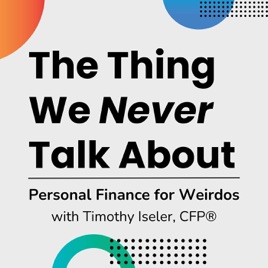
Advertise on podcast: The Thing We Never Talk About
Rating
4.8from
This podcast has
75 episodes
Language
EnglishPublisher
Timothy IselerExplicit
Yes
Date created
2025/03/20
Latest episode
2026/10/05
Average duration
38 min.
Release period
10 days
Description
The Thing We Never Talk About is an educational podcast about personal finance for creatives and other weirdos. We'll discuss managing cash flow with a lumpy income, when to save & when to invest, and how to reduce stress & build confidence when it comes to your money. No hot stock tips, no complicated strategies, and no finance bro jargon. We'll hear from artists, musicians, creative professionals, and other weirdos about how they navigate these questions for themselves. The Thing We Never Talk About is hosted by Timothy Iseler, CFP®, a former recording & touring audio engineer with 18 years experience in the music industry.
Unlock The Thing We Never Talk About podcast Email contact info,
Listeners & Audience details
Email contact information
Direct podcast contact details

Listeners
Audience numbers & engagement insights

Audience details
Podcast Insights

Podcast episodes
Check latest episodes from The Thing We Never Talk About podcast
Paul Dalen – Tour Manager & Tour Accountant
2026/10/05
In this episode, Tim sits down with tour manager & tour accountant Paul Dalen for a candid conversation about money, career, and what it actually takes to make retirement a real possibility after decades on the road. Paul traces a career that has taken him from front of house audio engineering to production management to artist management and back to touring, including a period about 15 years ago when he found himself broke and starting over from scratch in his mid-50s. He talks openly about what that reset taught him, how a combination of fiscal discipline and good fortune in the markets turned things around, and why he thinks the touring industry's culture of financial avoidance does real damage to the people in it.
Paul's question for Tim: When might an S corp or any other corporate entity be worth considering for freelancers?
Key Takeaways:
Paul has spent his entire adult life in the music industry, moving across roles from front of house engineer to production manager to artist manager to tour manager — a career arc shaped more by relationships and opportunity than by deliberate planning.His approach to underpaid gigs early in his career was to say yes for a short run while making clear it wasn't his normal rate, a move that consistently led to better opportunities.After his artist management business failed around 15 years ago, Paul found himself broke in his mid-50s and returned to touring with his tail between his legs. His path back to financial stability was built on basic principles — budgeting, fiscal discipline, and consistent investing.He advises people new to investing to just start somewhere, even imperfectly, rather than waiting until they fully understand how to optimize.Paul's approach to spending is experiential rather than material: theater, travel, good meals occasionally, and tickets to shows he wants to see. He also notes that not eating out regularly has been one of the quieter contributors to financial stability over the years.Links: Send me a question to be answered on a future episode. Sign up for the Keep It Easy newsletter.
Saving Money vs. Building Wealth
2026/09/28
Money has different jobs depending on when you need it — and confusing what works for one timeline with what works for another is one of the most common financial mistakes. In this solo episode, Tim walks through the difference between saving money and building wealth, using this definition of wealth as a guide: the ability to do what you want, when you want, with whom you want, for as long as you want. From cash savings for short-term needs, to CDs and Treasury bills for medium-term goals, to stock market investing for long-term goals like retirement, Tim lays out a simple framework for how matching your money to its purpose builds wealth both now and later.
One Key Takeaway: Saving money and building wealth are not the same thing. Match your money to its timeline: cash for the short term, stable interest-bearing accounts or investments for the medium term, and stock market investing for the long term.
Links:Send me a question to be answered on a future episode. Sign up for the Keep It Easy newsletter.
Serena Lander - Tattoo Artist
2026/09/21
In this episode, Tim sits down with Serena Lander — self-employed artist, tattoo artist, and owner of a multi-unit property — for a conversation about building a creative life on your own terms. Serena traces her path from tattooing as a teenager in British Columbia, when she was one of only a handful of women in the craft in North America, through nearly four decades of working entirely for herself. She talks openly about her ambivalent feelings towards money and the practical decisions that have shaped her financial life like keeping overhead low and investing in things she actually believes in. It's a conversation about finding your own version of financial stability without abandoning the values that drew you to a creative life in the first place.
Serena's question for Tim: Can you share some ideas about setting goals in life and trying to engage more enthusiastically with your finances? I wish there was a way to make it more sparkly for myself so that I would do it.
Key Takeaways:
Serena started tattooing at 19 in British Columbia at a time when there were only a handful of women doing it in all of North America.She has spent her entire career working for herself, supported early on by keeping her overhead extremely low.Buying a house at the bottom of the market in 2011 and gradually subdividing it into four rental units has turned into a financial foundation she didn't originally plan for, with rental income now covering her mortgage.Serena reflects on the punk rock and alternative music community's cultural aversion to money, and how that narrative — money as part of the system, financial participation as selling out — has made it harder for people in those communities to build long-term stability.She finds it easier to engage with financial decisions when they are tangible and values-aligned, like adding solar panels to her house.Links:Send me a question to be answered on a future episode. Sign up for the Keep It Easy newsletter. Serena Lander on Instagram Serena Lander's website
Case Study: Paying Off Mortgage vs Investing
2026/09/14
Should you pay off your mortgage early or invest the money instead? In this solo episode, Tim walks through a real case study involving a couple who received a significant one-time windfall and want to know how to use it wisely. He compares three options — investing the full amount right away, paying off the mortgage entirely, or splitting the difference — across a twenty-year time line, and shares what the numbers actually revealed. The results might surprise you, and one of the most important factors turns out to be one that doesn't show up in any spreadsheet.
One Key Takeaway: When comparing paying off debt versus investing, the math usually favors investing — but only if you can actually stick to your investment plan over many years and decades.
Links:Send me a question to be answered on a future episode.Sign up for the Keep It Easy newsletter.
Richard Dansky - Game Narrative Expert
2026/09/07
In this episode, Tim sits down with Richard Dansky — game narrative expert, fiction writer, and tabletop role-playing game designer — for a wide-ranging conversation about building a creative career across multiple formats and revenue streams. Richard traces his path from tabletop games starting in the '90s through nearly three decades of video game work, including a long tenure as the central narrative resource for Ubisoft's Tom Clancy franchise, while continuing to write fiction, contribute to tabletop games, and co-author a graphic novel along the way. He talks candidly about the economics of that kind of career: how he thinks about rates across different formats, why he has always lived well below his means, and why he wishes more writers understood their own professional value. He also shares hard-won wisdom about navigating rejection and knowing when to walk away from a bad deal.
Richard's question for Tim: How do you think about melding various revenue streams, as these days every author's got to have a Patreon/Substack/YouTube channel/podcast/newsletter/online store/convention presence etc.
Key Takeaways:
Richard describes his entry into both tabletop and video games as largely relationship-driven — a reminder that in creative industries, showing up, being reliable, and knowing the right people often matters as much as talent.He has maintained a remarkable ability to work across multiple formats simultaneously: video games by day, tabletop and fiction by night — treating each as a distinct creative sandbox with its own rules and rewards.Richard's fiction acceptance rate is around 3.7%, which he notes is listed as above average. It's a useful reminder that rejection is the norm in creative work, not a signal of failure.Richard describes the best financial habit of his career as consistently spending well below his means, and how knowing he can afford his lifestyle frees up mental and creative energy.He argues that writers and narrative designers are frequently underpaid because the value of their work is hard to quantify, and that the industry actively works to make creative professionals feel their contributions are worth less than they are.Links:Send me a question to be answered on a future episode.Sign up for the Keep It Easy newsletter.Richard's websiteRichard's LinkedIn profile, where he shares insight on game narrative designThe issue of Dark Yonder in which I first learned about Richard
What Happens to Your Money When You Do Nothing?
2026/08/31
Doing nothing with your money feels safe — but it comes with real costs, both financial and emotional. In this episode, Tim explains why cash is essential for short-term stability but loses value over time to inflation, and why investing anything beyond your cash reserve is one of the most important financial moves you can make. He also explores two emotional patterns that keep people stuck: "the leaky bucket", where money slowly disappears without intention, and the "but what comes next" mindset, where fear of making the wrong decision leads to making no decision at all. The solution to both, it turns out, is the same: define how much cash you actually need, stick to that number, and put everything above it to work for you through investing.
One Key Takeaway: Making no decision for what to do with your money is itself a decision — and it usually costs you.
Links:Send me a question to be answered on a future episode.Sign up for the Keep It Easy newsletter.
Angela Hugghins - Esthetician & Owner of Cult of Reason
2026/08/24
In this episode, Tim sits down with Angela Hugghins, esthetician & founder of Cult of Reason skincare, for a wide-ranging conversation about what it looks like to build multiple businesses on your own terms. Angela shares how she structured her solo practice to protect her hands, her energy, and her lifestyle after nearly 30 years in the industry, why she made a significant price jump despite fears of losing clients, and how she thinks about the break-even math before introducing any new product or equipment. She also talks candidly about the origins of Cult of Reason, the unexpected challenges of running a product business, and the recent purchase of a commercial building to house her businesses and generate rental income.
Angela's question for Tim: Now that we're landlords, what are the tax advantages of owning commercial real estate, how do we maximize rental income, and what other ways can we benefit from this new structure?
Key Takeaways:
Angela capped her working days at four per week after years of overworking, a deliberate lifestyle decision driven by the physical demands of her craft.She hired a virtual assistant who spends just 30 minutes a day managing her emails and client communications — a small investment that she says has paid off in stress reduction far beyond its dollar cost.After building a wait list of over 200 clients, Angela made a significant price increase, gave clients three months of advance notice without disclosing the exact amount, and lost only three or four people as a result.Angela launched Cult of Reason to recreate a discontinued product she had relied on, starting with a single formula developed over two years through a custom cosmetics lab, funded entirely out of pocket.She describes Cult of Reason as a passion project that is now self-funding, and identifies supply chain disruptions and tariffs on imported ingredients as challenges she hadn't anticipated when she started.Links: Send me a question to be answered on a future episode. Sign up for the Keep It Easy newsletter. Cult of Reason Skincare Cult of Reason on YouTube
Is This About The Money?
2026/07/06
A surprising amount of what looks like a money problem is actually something else wearing a money costume. Tim shares a story from his early touring days, when a tour manager's blunt question — "Is this about the money, or is it something else?" — cut through a negotiation in under a minute. He applies that same question to financial planning, using the common example of someone wondering if they're saving enough for retirement: the real issue often isn't the math, it's an unresolved question about priorities. Tim walks through a framework for looking past the numbers to identify what you actually want, then reframing that priority as a matter of identity rather than obligation — a shift that makes it far easier to stick with a plan.
One Key Takeaway: Before assuming a financial question is just a matter of getting the numbers right, ask whether there's a deeper question hiding underneath it.
Links:Send me a question to be answered on a future episode.Sign up for the Keep It Easy newsletter.
Katie Cunningham - Producer & Writer-Director
2026/06/29
In this episode, Tim sits down with Katie Cunningham, a freelance producer and writer-director, for a conversation about risk, identity, and how she built a creative life on your own terms. Katie shares the story of leaving a corporate marketing job in 2022 to write and direct a self-funded short film (even though her finances weren't necessarily ready for the leap), and how that decision led to later creative success. She talks candidly about what it took to rewire a long-held identity as someone who was "bad with money," the practical systems that changed her relationship with her finances, and Produce Your Life, a project she launched to apply a production mindset to everyday life. It's a conversation about building financial confidence step by step and trusting yourself enough to take the leap before everything feels perfectly ready.
Katie's question for Tim: Can we talk about rewiring my internal story to look directly at and take responsibility for money instead of remaining in a state of chaos?
Key Takeaways:
Katie left her corporate marketing job in 2022 to pursue writing and directing, despite knowing that it was a financial risk.Before making the leap, she spent months consolidating scattered retirement accounts and reviewing her spending to trim unnecessary expenses — unglamorous groundwork that gave her a clearer picture of where she actually stood financially.As a new freelancer, Katie embraced a period of deliberate "unmooredness," traveling and taking on flexible freelance production work without a fixed home base, which matched the freedom she identified as a core value.Katie's rules for deciding which jobs to take are built around how a project sustains her lifestyle costs, or whether it's an opportunity to learn from someone she admires (even at a lower rate).Katie's biggest piece of advice for freelancers is to know exactly what their lifestyle costs every month, since that number changes everything about which gigs make sense to take and removes a huge amount of background financial stress.Links:Send me a question to be answered on a future episode.Sign up for the Keep It Easy newsletter.Katie's website
You Can't Out Earn Your Spending
2026/06/22
When people feel financially stretched, it can be hard to decide where to cut back. What if you just focused on earning more instead? It seems like the logical solution — but there's a problem with that logic: almost everyone increases their spending when their income goes up. The result is that you find yourself right back where you started, just at a higher level. In this episode, Tim shares a real example of a household earning over $400,000 a year that still had nothing left over, why trying to out earn your spending rarely works, and a practical framework for building a gap between what you earn and what you spend — and keeping it.
One Key Takeaway: Earning more won't solve a spending problem. Instead you need to spend below your means, save the rest, and widen that gap every time your income goes up.
Links:Send me a question to be answered on a future episode.Sign up for the Keep It Easy newsletter.
Rob Mazurek – Abstractivist
2026/06/15
In this episode, Tim sits down with Rob Mazurek — composer, painter, and self-proclaimed abstractivist — for a wide-ranging conversation about what it looks like to build a life entirely around creative vision. Rob traces his path from Chicago's boundary-pushing music scene of the '90s through his current life in Marfa, Texas, where he and his wife have built a low-overhead, high-quality existence that allows him to keep making exactly the work he wants to make. He talks candidly about the financial realities of that life — the relationships with festival directors and venue operators that have allowed him to command respectable fees over decades, the deliberate choice to keep expenses low, and the honest admission that at 60, he has neither investments nor life insurance and knows it's time to change that. Throughout the conversation, Rob brings the same openness and curiosity he applies to his art to questions about money, and what emerges is a portrait of someone who has always prioritized creative integrity, and is ready to think seriously about what comes next.
Rob's question for Tim: What should I do concerning investment strategies and life insurance? I have neither.
Key Takeaways:
Rob describes himself as an abstractivist, a term he coined in the ‘90s to capture the holistic nature of his work across music, art, and performance.His move to Marfa came almost by accident, and what started as a getaway trip turned into a life decision when his wife suggested they consider staying, drawn by the low cost of living, the beauty of the landscape, and the manageable access to El Paso's airport.Rob's ability to keep touring economically viable comes from decades of fostering direct relationships with festival directors and venue operators in Europe, combined with a deliberate decision to streamline his setup so he can travel with everything as carry-on luggage.He describes his financial philosophy as doing the work because he loves it and being grateful that it also pays, rather than doing it for money — a distinction he holds with genuine pride, even as he acknowledges the life it produces is a modest one.Rob has kept his overhead deliberately low in Marfa, prioritizing spending on quality food, a reliable car for the long drive to the airport, and little else — a conscious trade-off that has allowed him to sustain a creative life without significant financial stress.Links:Send me a question to be answered on a future episode.Sign up for the Keep It Easy newsletter.Rob's websiteRob's label
When Your Bank Account Stops Making Sense
2026/06/08
Most people with unconventional careers started out with a simple financial dashboard: one look at the bank account told them everything they needed to know. But over time, as careers grow and income gets real in a new way, that single number stops telling the whole story. Tim walks through what happens when the bank account stops making sense: why leaving too much money sitting in cash trades short-term security for long-term growth, and how to think about matching your money to its actual purpose, whether that's immediate spending, a stability cushion, or longer-term investments in stocks and bonds. It's a practical framework for the moment when you've stopped just surviving and started building something real.
One Key Takeaway: When your bank account stops making sense, that's not a problem — it's a signal. It means your financial life has grown beyond what a single number can capture, and it's time to start thinking differently.
Links:Send me a question to be answered on a future episode.Sign up for the Keep It Easy newsletter.
Mary Lattimore — Musician
2026/06/01
In this episode, Tim sits down with Mary Lattimore — classically trained harpist, solo recording artist, and film composer — for a candid conversation about building an unconventional life in music. Mary traces her path from growing up around the harp in Asheville, through years of juggling multiple part-time jobs in Philadelphia, to the Pew Fellowship that gave her the financial breathing room to focus on music full time. She talks openly about her complicated relationship with money: the anxiety that came with her first large sum, the difficulty of saving when income ebbs and flows, and the game-changing decision to hire a business manager who helped her get her finances under control. Mary also shares the story of co-purchasing an apartment in a tiny village in Tuscany, what it felt like to sign those papers, and why owning a little piece of the world somewhere beautiful felt like a dream she barely knew she was allowed to have.
Mary's question for Tim: What's your advice for someone whose money ebbs and flows and who is bad about saving?
Key Takeaways:
Mary describes herself as both a freelance musician and a small business owner — that distinction matters, since thinking of her work as a business has shaped how she manages income, taxes, and team-building.The Pew Fellowship she received in 2014 was the turning point that allowed her to stop working multiple part-time jobs and focus on music full time, though she recalls that seeing her bank account full for the first time actually triggered anxiety rather than relief.Her path out of classical music into her own solo work was gradual and social — friends in Philadelphia asking her to add harp to their records, followed by touring with Thurston Moore, whose mastery of free improvisation pushed her to trust her own musical instincts.Mary co-purchased an apartment in a village of 200 people in Tuscany — splitting the cost and the schedule with a friend — and describes it as a dream she barely believed was possible, especially given that homeownership in the U.S. feels out of reach.Her business manager helped her set up LLCs for both her business and her Tuscany apartment, put her on a regular payroll through her S corp, and helped her make sense of the complex label statements she had previously found overwhelming.Links:Send me a question to be answered on a future episode.Sign up for the Keep It Easy newsletter.Mary's websiteMary's IG
What Money Can’t Buy You
2026/05/25
You know what they say about money & happiness — but we all still want to try a little bit, right? In this solo episode, Tim shares a personal story from his touring career: the year he made the most money he'd ever made as an audio engineer, stayed in nice hotels, and ended up feeling ... deeply unhappy. What was missing was human connection, the sense of being part of a team, the feeling that the work actually mattered — and money is a poor substitute. That realization didn't just change how Tim thought about money; it directly led to the career he has now, built around helping people with unconventional careers use their money to support the lives they actually want to live.
One Key Takeaway: More money is swell, but it's not really the goal. The goal is a fulfilling life, and money is just one tool for building it.
Links:Send me a question to be answered on a future episode.Sign up for the Keep It Easy newsletter.
Cheetie Kumar - Chef & Owner (Ajja & Big Cat)
2026/05/18
In this episode, Tim sits down with Cheetie Kumar — chef, owner of Ajja and Big Cat in Raleigh, NC, and two-time James Beard Award nominee — for a wide-ranging conversation about what it looks like to build a life and a business from scratch with more passion than experience. Cheetie traces her path from immigrating to the US as a child, through punk rock and bartending, to opening a music venue and eventually a restaurant with no formal training. She speaks candidly about the financial blind spots that nearly derailed her early restaurant — underpricing her menu, not understanding cost of goods, and spending years without a real grasp of finances. She also reflects on the emotional weight of growing up with financial insecurity and how that shaped her relationship with money through the present day. Throughout the conversation, Cheetie brings the same thoughtful, collaborative ethos she applies in the kitchen to questions about entrepreneurship, financial literacy, and what it means to build something that reflects your values.
Cheetie's question for Tim: What are five essential financial literacy elements for a first-time small business owner?
Key Takeaways:
Cheetie describes herself first as someone who fixes problems: the reality of running multiple restaurants is that the job is mostly about solving whatever is in front of you.Her path to being a chef was indirect: she was bartending to support her touring life when a lease on a real restaurant space presented the opportunity to start her own restaurant, and she learned how to do that entirely on the job.The DIY ethos of punk rock deeply shaped how she approached opening her first venue and restaurant — not waiting for permission or credentials, but simply identifying what was missing and building it herself.Cheetie shares how not taking on outside investors meant keeping full ownership so that no one else had a claim on what she built, even when that made things harder in the short term.She now approaches finances with diligence and rigor — tracking expenses, reconciling regularly, and understanding that there is no substitute for staying on top of the numbers, because looking away even briefly can put you in the red.Links:Send me a question to be answered on a future episode.Sign up for the Keep It Easy newsletter.Cheeti's IG accountAjjaBig Cat on Brookside
Podcast reviews
Read The Thing We Never Talk About podcast reviews
This is Patrick D. 2025/08/02
Financial advise & indy rock lore
Tim’s our financial advisor and does great work! His podcasts are either short-form finance nuggets of wisdom or long-form interviews with folks in th...
JeremyLemos 2025/04/25
I love this podcast
Especially the fifth episode
Jim Jammy 69 2025/04/21
I love this podcast!
I’ve been looking for something exactly like this for years and here it is!
Podcast sponsorship advertising
Start advertising on The Thing We Never Talk About relevant audience podcasts
You may also like to advertise on these Podcasts
4.92001922
The Wright Report
Bryan Dean Wright

4.98391800
The Adam Mockler Show
MeidasTouch Network

4.813842000
Daily Tech News Show
Tom Merritt

4.858221911
Sara Gonzales Unfiltered
Blaze Podcast Network

4.810941750
Warchant Podcasts featuring Seminole Headlines
Warchant.com
4.824761865
Deck The Hallmark
Bramble Jam Podcast Network
4.8104492000
Steve Deace Show
Blaze Podcast Network
4.75881745
Ruthless Podcast
Josh Holmes, Comfortably Smug, Michael Duncan and John Ashbrook

4.920641171
Toni and Ryan
Toni Lodge and Ryan Jon
4.847032000
Pat Gray Unleashed
Blaze Podcast Network