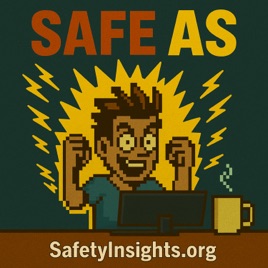
Advertise on podcast: Safe As Podcast
Rating
4.8from
This podcast has
108 episodes
Language
EnglishPublisher
Ben HutchinsonExplicit
No
Date created
2025/06/10
Latest episode
2026/10/18
Average duration
13 min.
Release period
4 days
Description
A podcast dedicated to the thrifty analysis of safety science, risk, systems, and performance research. Jump onto SafetyInsights.Org for more research. Intro/Output "Dark Synth Wave" by ElephantGreen (PixaBay.com)
Unlock Safe As Podcast podcast Email contact info,
Listeners & Audience details
Email contact information
Direct podcast contact details

Listeners
Audience numbers & engagement insights

Audience details
Podcast Insights

Podcast episodes
Check latest episodes from Safe As Podcast podcast
108: Professor Robin Dillon-Merrill Part 2: Resilient Vs Vulnerable Near misses
2026/10/18
Can AI help us identify critical safety blind-spots before disaster?Part 2 interview with Professor Robin Dillon-Merrill (Georgetown University, McDonough School of Business), who unpacks her 20+ years of research on decision-making under risk, outcome bias, and how organizations misinterpret near misses.We discuss:a) why near-miss biases shape human decision-making & how we can build robust systems to counter them catch them b) why technical experts are uniquely positioned to simulate counterfactuals ('what could have happened, but didn't')c) how well-intended safety messaging becomes background noise without institutional actiond) how cutting-edge AI & machine learning can triage gigantic incident datasets before catastrophe.Plus, Robin discusses real-world safety challenges with autonomous vehicles, such as Waymo vehicles illegally passing school buses in Texas.Resources & Links:Website & Articles: https://safetyinsights.orgSupport the channel: https://buymeacoffee.com/benhutchinson
E107: Skip-Order-Action Framework: Measuring Work-As-Done in the Field (HOP / Safety-II)
2026/10/14
Today we unpack a study tracking 1,422 procedural steps across 40 petrochemical operations. Using their Skip-Order-Action (SOA) Framework, they explored how frontline personnel navigate written instructions in practice: revealing that roughly 1/3 of steps depart from prescribed methods even when tasks are completed successfully. We explore how: a. the SOA framework functions b. how workers using paper instructions followed fewer steps as the task progressed (e.g. dropping from ~75% adherence to 55%)c. what these findings mean for safety professionals advancing a Safety-II / HOP approachReference: Ashraf, A. M., Peres, S. C., & Sasangohar, F. (2025). Beyond Compliance: Investigating Work-as-Done in Procedural Work with the Systematic Skip-Order-Action (SOA) Framework. Resources & Links:Website & Articles: https://safetyinsights.orgSupport the channel: https://buymeacoffee.com/benhutchinson
E106: Boeing 737 MAX Disaster: When High-Authority Systems Go "Strong, Silent, and Wrong"
2026/10/11
What happens when a high-authority automated system operate with an incorrect model of reality?This question is explored via Dekker & Woods’ (2024) article on automated systems that are Strong, Silent, and Wrong.We explore the breakdown of human-automation coordination, mode confusion, and automation surprises, using the Boeing 737 MAX MCAS accidents as a central example. Learn how complex system design must prioritize observability, redirectability, and graceful failure.Ref: Dekker, S. W., & Woods, D. D. (2024). Wrong, strong, and silent: What happens when automated systems with high autonomy and high authority misbehave? Journal of Cognitive Engineering and Decision Making, 18(4), 339–347.Resources & Links:Website & Articles: https://safetyinsights.orgSupport the channel: https://buymeacoffee.com/benhutchinson
E105: Does Fatigue Cause Attentional Blindness? (Quickisode)
2026/10/07
Can fatigue cause visual blindness in plant operators and drivers?In this video, I review a 2019 study from Li et al. (Automation in Construction) who used wearable eye-tracking tech to measure how prolonged excavator operation / time-on-task fatigue impacts hazard detection and visual attention.Namely, whether the operators notice workers walking behind the excavator over a shift.Key findings:a. Hazard miss rates increased over 40% after 60 mins. Overall detection rates dropped to 70% at 36 minutes and down to 60% by the 60-minute mark.b. Operators took significantly longer to recognize peripheral hazards as fatigue increased.c. Visual attention on the excavator side mirrors and rearview mirrors decreased over the task. Operators stopped scanning peripheral blind spots and focused almost exclusively on the central display directly in front of them.
Resources & Links:Website & Articles: https://safetyinsights.orgSupport the channel: https://buymeacoffee.com/benhutchinson
E104: Professor Robin Dillon-Merrill Part 1: Near Misses & Confusing Luck with Resilience
2026/10/04
Do we routinely mistake good luck with systemic resilience – until something blows up?
Today I speak with Professor Robin Dillon-Merrill (Georgetown University, McDonough School of Business), who breaks down her 20+ years of research on decision-making under risk, outcome bias, and how organizations misinterpret near misses.
We discuss:
• The differences between resilient vs vulnerable near misses: How the perceived ‘margin of safety’ desensitizes organizations to risk when luck is the primary reason failure was averted.
• Managing outcome bias: Why leaders who experience lucky successes are possibly judged as more competent and promotable than those who face bad luck, even when their underlying decision quality is identical.
• Counterfactual thinking: How processes used by NASA facilitate teams to evaluate alternative outcomes and decouple decision quality from outcomes.
• Gathering info: Why decision makers consistently stop searching for critical warning signs long before they have sufficient data.
• Why ‘speaking up’ campaigns fail: Safety reporting programs may be ineffective for recognising an issue since the issue isn’t recognised as danger in the first place.
Resources & Links:Website & Articles: https://safetyinsights.orgSupport the channel: https://buymeacoffee.com/benhutchinson
E103: Does HOP Actually Work? Real Data From a 5-Year Study (Quickisode)
2026/09/30
Does a Human & Organizational Performance (HOP) initiative improve learning and the quality of actions? And what happens when the initiative stops?This quickisode unpacks Christopher Mastrangelo’s 2026 Master’s thesis examining a multi-year HOP implementation at a large biopharmaceutical company. His project tracked operational data from 2020 through July 2025 across key metrics: a. deviation initiation ratesb. root cause classification practicesc. CAPA types, andd. cultural persistence after formal support was removed. The HOP initiative seemingly resulted in:a. A drop in quality deviationsb. A shift away from findings of 'human error' towards organisational improvementsc. Fixing systems rather than retraining peopleAnd what happens when the HOP initiative and key stakeholders are dissolved? After the dedicated HOP team was dissolved in mid-2024, formal training scores dropped, and 'human factors' classifications (e.g. focusing on people rather than the system) crept back in. But, frontline work execution and proactive learning mindsets persisted. Resources & Links:Website & Articles: https://safetyinsights.orgSupport the channel: https://buymeacoffee.com/benhutchinson
E102: Writing Better Safety Procedures Part 2: Rules vs Reality, WAI/WAD, Safety-II & Workarounds
2026/09/27
In a 5-year petrochemical study examining over 1,400 work steps, 1/3 were performed differently from what was written in the procedure, but every task was completed successfully.Is this non-compliance or a display of worker aptitude and resilient skill?
In Part 2 of our series on procedures, we look beyond the "100% compliance" rhetoric and unpack the gap between work-as-imagined (WAI) and work-as-done (WAD).
We explore why workers adapt rules, how to categorise workarounds, and how to redesign safety procedures as resources for action rather than as tools for worker control.
We cover:
a. why procedures assume work is linear, predictable and controllable - and why real-world conditions constantly force adaptation
b. The RES framework which explores three drivers of procedural adaptation: Routine, Efficiency, and Safety
c. The difference between viewing procedures as top-down mandates (Model 1) vs localised, situated tools (Model 2)
d. The limits of compliance checks, and how 'pencil whipping' procedures fails to assure adequate rule following, and why procedure quality and safety climate may matter more
e. How airline pilots handle complex emergencies by drawing on fragments from checklists and SOPs rather than following linear scripts
f. The challenges of over-specification vs under-specification, and why cramming in more details forces workers into a 'damned if you do, damned if you don't' trap
g. Using Scenario-Based Training (SBT) & Gary Klein’s ShadowBox approaches, and HPOG’s Walk-Through Talk-Through to build expertise & redesign work systems
Resources & Links:Website & Articles: https://safetyinsights.orgSupport the channel: https://buymeacoffee.com/benhutchinson
E101: From Blame to Restorative Justice: A Just Culture Tool (HOP / Safety-II / New View)
2026/09/23
Do traditional approaches unintentionally blame front-line workers instead of fixing broken organisational systems?This Quickisode unpacks how an international energy company redesigned its Just Culture (JC) framework to shift focus from individual culpability to systemic weaknesses.This company found that traditional approaches relied on judgement terminology, like violation or negligence, and frequently misapplied as disciplinary tools.Their redesigned JC tried to address these limitations, including:a. decoupling the analysis from disciplineb. separating the evaluation of system conditions from HR disciplinary actionsc. neutral language by removing terms like violationd. evaluating supervisory influence and management decisions alongside worker actionsBased on this case study, they found that 90% of non-conformances stemmed from underlying system weaknesses, like from unclear procedures, resource constraints, or task complexity.The revised tool led to 55% of corrective actions being tied to system improvements, whereas disciplinary action occurred in only 5% of cases.Resources & Links:Website & Articles: https://safetyinsights.orgSupport the channel: https://buymeacoffee.com/benhutchinson
E100: Dr Linda Bellamy Part 2: Fatal vs Minor hazards, SIFs & Barrier Failures
2026/09/20
Part 2 discussion with Dr Linda Bellamy on SIFs, fatal accidents, and barrier failures.
Resources & Links:Website & Articles: https://safetyinsights.orgSupport the channel: https://buymeacoffee.com/benhutchinson
E99: 25 Questions for Better Incident Investigations | Safety-II / HOP
2026/09/16
Do your investigations often conclude when you've identified 'human error', or a pesky person not following rules?Do you want to improve the quality and depth of your learning opportunities?One way is via local rationality: understanding why decisions & actions made sense to people at the time. It's a core feature in human factors / safety-II / and Human and Organizational Performance (HOP).This episode unpacks Louise Roe's Local Rationality Question Tool in her article presented at the Chartered Institute of Ergonomics & Human Factors (CIEHF) 2025 conference.The tool covers things like: - workload, time pressure & environmental cues; goals, assumptions & information available- training, policies & useable job aids- team dynamics & information flow- Expectations & imagined outcomes/'what ifs'Ref: Roe, L. (2025). Local rationality question tool: understanding why it made sense at the time. In Golightly, D., Balfe, N., & Charles, R. (Eds.), Contemporary Ergonomics and Human Factors 2025: Proceedings of the Chartered Institute of Ergonomics and Human Factors Annual Conference (pp. 360-362). CIEHF. Resources & Links:Website & Articles: https://safetyinsights.orgSupport the channel: https://buymeacoffee.com/benhutchinson
E98: Writing better procedures part 1: Action verbs, human factors & more
2026/09/13
Why are so many procedures technically accurate, but barely workable in practice?In Part 1 of this two part series on procedural systems, we unpack the technical side of writing better, more useable procedures: exploring how to reduce safety clutter, choosing the right type of rule, and structure instructions so they support work.We unpack:• Types of rules: performance goal vs. process vs. action rules & how they limit or enable discretion• Formatting: Action-verb steps, concrete language & single-action steps• Critical steps: Highlighting actions where mistakes cause immediate or unrecoverable harm• Warnings & alerts: What guidelines and research suggests about effective warning placementAnd more.In Part 2, we go beyond technical writing and structure to unpack procedures from a Resilience Engineering and Safety-II perspective – procedures as resources for action.Resources & Links:Website & Articles: https://safetyinsights.orgSupport the channel: https://buymeacoffee.com/benhutchinson
E97: Investigating when 'Nothing' Failed: a Safety-II/HOP debrief tool (Quickisode)
2026/09/09
This quickisode races through a Safety-II / HOP inspired debrief tool which can help unearth 'hidden' insights about work that doesn't rely on incidents for learning.Resources & Links:Website & Articles: https://safetyinsights.orgSupport the channel: https://buymeacoffee.com/benhutchinson
E96: Dr Linda Bellamy Part 1: Fatal vs Minor hazards, SIFs & Barrier Failures
2026/09/06
Is there a relationship between fatal and minor hazard exposures? Recent SIF research & movements suggest 'NO' - what kills people aren't the same as what hurts them.
But is that scientifically accurate?
Part 1 discussion with Dr Linda Bellamy, who undertook perhaps the largest study of this kind exploring the connection - and, there ** is ** a connection.
We discuss barrier/control systems & how they fail and succeed, weak signals, indicators and more.
Resources & Links:Website & Articles: https://safetyinsights.orgSupport the channel: https://buymeacoffee.com/benhutchinson
E95: Critical Controls & Barriers - Part 4: What do barrier models leave out? A Safety-II critique
2026/08/30
A bowtie or critical control register may be useful tools, but they aren't the work.In Part 4 of this series, I unpack what control / barrier models can leave out: e.g. changing conditions, competing goals, control dependencies, unintended consequences and the adaptations people make to keep work functioning.I also explore how controls can change the systems they are introduced into, why more barriers don't always mean greater risk control, and why successful work may conceal degraded controls and poor design.We should specify, support and verify barriers but also ask: "What do the people using the control know that the bowtie doesn’t show?"Part 1: https://youtu.be/qQfORHGC4BsPart 2: https://youtu.be/7sPqw5NAyiEPart 3: https://youtu.be/Ly1mEn_KCLQResources & Links:Website & Articles: https://safetyinsights.orgSupport the channel: https://buymeacoffee.com/benhutchinson
E94: Dr Marcin Nazaruk Part 2: HOP, New View, Learning from Daily Work
2026/08/23
Today I interview Dr Marcin Nazaruk, who shares his practical experience and research on learning from normal work / daily work, HOP / New View / Safety-II, to improve learning and risk management.The discussion also explores themes around risk controls, work constraints, risk assessments, and error traps.Support the channel: https://buymeacoffee.com/benhutchinson
Podcast sponsorship advertising
Start advertising on Safe As Podcast relevant audience podcasts
You may also like to advertise on these Podcasts
4.727499587
This Past Weekend w/ Theo Von
Theo Von

4.713009375
The Tim Dillon Show
The Tim Dillon Show

4.115956456
The Tucker Carlson Show
Tucker Carlson Network

4.828036451
Huberman Lab
Scicomm Media

4.240683
To Be The Man
Podcast Heat | Cumulus Podcast Network
4.41511292000
The Ben Shapiro Show
The Daily Wire

4.2155648
TENNIS.com Podcast
TENNIS.com Podcast/Tennis Channel Podcast Network
4.510846771
The Joe Budden Podcast
The Joe Budden Network
4.611626506
The Bulwark Podcast
The Bulwark
4.711480389
Matt and Shane's Secret Podcast
Matt McCusker & Shane Gillis