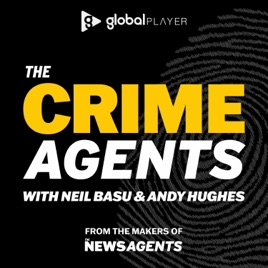
Advertise on podcast: The Crime Agents
Rating
4.8from
This podcast has
123 episodes
Language
EnglishPublisher
GlobalExplicit
Yes
Date created
2025/06/16
Latest episode
2026/10/08
Average duration
38 min.
Release period
4 days
Description
If you want to understand what’s really happening on Britain’s streets, you need to hear this. The Crime Agents, the new podcast from the makers of The News Agents, goes beyond the headlines to uncover the truth behind crime that affects all of us. Why is violence rising? Why is public trust in the police collapsing? And what’s really driving young people to kill each other? Hosted by two insiders who have spent their lives chasing the answers, this is your front-row seat to the realities of crime today. Neil Basu, the former Head of UK Counter-Terrorism Policing, brings unparalleled experience from the front lines of law enforcement. Andy Hughes, LBC’s Crime Correspondent, has spent two decades exposing the criminal underworld as an award-winning investigative journalist. Each week, The Crime Agents dives deep into the stories you think you know - from foiled terror plots and unsolved murders, to gang culture, far-right extremism, and the tactics police use to crack the toughest cases. With over 50 years of combined experience, Neil and Andy don’t just report on crime - they’ve lived it. For advertising opportunities on this podcast email: [email protected]
Unlock The Crime Agents podcast Email contact info,
Listeners & Audience details
Email contact information
Direct podcast contact details

Listeners
Audience numbers & engagement insights

Audience details
Podcast Insights

Podcast episodes
Check latest episodes from The Crime Agents podcast
Q&A: Putney Pusher ID potential after 9 years, off-duty cops & can prevention stop violence?
2026/10/08
The ‘Putney Pusher’ case has resurfaced in recent months after an inquest into a suspect's death was opened… but after 9 years, we are still no closer to an ID on the suspect.
So what are the processes of the police in identification and could there be new clues uncovered after all this time? Andy and Neil answer your questions
Then: what it really takes to make a film like Andy's recent ‘London gangs special report’. What goes on behind the scenes and how many months of build up does it take to complete?
Plus, what is a serving officer obliged to do off duty? And how much of the law do you take into your personal life? Neil explains all on why the badge is a 24/7 responsibility.
And the case for prevention: Glasgow's decade-long experiment, youth workers waiting at hospital bedsides, and the chicken shop moment that explains what policing is really about.
Have a question for a future Q&A? Send it via email to [email protected] or follow us on social media: @thecrimeagents
The Crime Agents is a Global production, available every Monday and Thursday on Global Player, YouTube or wherever you get your shows. Make sure you subscribe so you never miss an episode.
Chris Kaba: the shooting that divided Britain
2026/10/05
In September 2022, a Met firearms officer shot and killed Chris Kaba. What followed divided the country: protests and grief on one side, a mass walkout of armed officers on the other, and in the middle, a murder trial almost unprecedented in British policing.
In this episode, Andy and Neil go back through what happened that night and what happened in court. Should the officer ever have been put on trial? Should jurors have known about Kaba's criminal history earlier? And can a split-second decision taken behind a gun ever be fairly judged months later in a courtroom?
With Neil's experience of signing off firearms operations at the highest level, and Andy's extensive contacts within the Met's firearms unit, this is the full story behind one of the most controversial police incidents of recent years - and how it has changed British policing forever.
Follow us on social media: @thecrimeagents
The Crime Agents is a Global production, available every Monday and Thursday on Global Player, YouTube or wherever you get your shows. Make sure you subscribe so you never miss an episode.
Q&A: Why were the RAF Fairford terror suspects bailed?
2026/10/01
Arrests at an RAF base on suspicion of terrorist offences, then bail. For many people - including President Trump - this didn't add up. Andy and Neil start this Q&A by explaining what police bail actually is and why the five suspects weren't held on remand for longer. Plus, they examine the likelihood of a hostile state - such as Iran - being involved in whatever happened in Gloucestershire in the early hours of Sunday morning.
They also discuss whether the police can and should be doing any more to crack down on the activities of individuals such as Danny Tommo, who was recently charged with criminal damage after an incident in the Channel. And can any more be done to protect the RNLI, who are coming under increasing hostility from far-right activists?
Andy & Neil also respond to the news that Scotland Yard is re-examining CCTV in the Jill Dando case. How much can enhancement technology realistically pull out of such old tape — and 27 years on, what would detectives genuinely need to turn a blurred figure on a screen into a named suspect?
And Mick asks about the Parole Board's decision to hear Jon Venables' latest review in private, despite James Bulger's mother Denise Fergus asking for it to be held in public. She says secrecy fuels misinformation, so who is a private hearing really protecting? And should victims' families have a say in that call?
Have a question for a future Q&A? Send it via email to [email protected] or follow us on social media: @thecrimeagents
The Crime Agents is a Global production, available every Monday and Thursday on Global Player, YouTube or wherever you get your shows. Make sure you subscribe so you never miss an episode.
Tommy Robinson’s donations: Where does the money go?
2026/09/28
Thousands of people hand Tommy Robinson their money. But very few of them know where it ends up.
In this episode, Andy is joined by investigative journalist Matt Shea, who has spent months following the money around Stephen Yaxley-Lennon - the man better known as Tommy Robinson.
Matt explains why he focused on the finances rather than the politics: the donation buckets, the fundraising appeals, the crypto promotions and the companies that handled the money but never filed accounts.
He describes meeting a Telford grooming gang survivor who says her story was used in Robinson's own film, and that she never received a penny. And he tells Andy why Sir Max Hill, the former Director of Public Prosecutions, believes there's a case for a perjury investigation.
Robinson denies perjury, denies any financial wrongdoing, and his full response is read out in the episode.
Follow us on social media: @thecrimeagents
The Crime Agents is a Global production, available every Monday and Thursday on Global Player, YouTube or wherever you get your shows. Make sure you subscribe so you never miss an episode.
Q&A: Why is the 'Putney Pusher' case still unsolved?
2026/09/24
Why has the 'Putney Pusher' proved so difficult to identify? And is this another investigation that will be remembered for police failings? Andy and Neil are asked why, 9 years on, the suspect has still never been officially identified. Neil explains what a case like this really looks like from inside the incident room, and why some suspects stay out of reach even when police have CCTV and eyewitnesses.
Then: should frontline UK officers routinely carry firearms? In an increasingly violent world, would police and the public be safer if they were armed, rather than having to wait for a specialist unit to arrive? Andy and Neil debate the pros and cons of more police officers carrying guns on Britain's streets.
Also this week, the security headache of a Prime Minister who wants to take part in the Great North Run. How do protection officers keep him safe at such a crowded event? And finally, the question every journalist wrestles with: how do you know when a story is finished? Andy reflects on his investigation into London's gang war, and whether there's one single cause behind it at all.
Have a question for a future Q&A? Send it via email to [email protected] or follow us on social media: @thecrimeagents
The Crime Agents is a Global production, available every Monday and Thursday on Global Player, YouTube or wherever you get your shows. Make sure you subscribe so you never miss an episode.
Special report: Inside London's gang war
2026/09/22
The recent fatal shooting of an innocent bus driver in Clapham has put London's biggest gang war onto the front pages.
In this special report, Andy is given exclusive access to an undercover Met Police unit working to tackle the tensions behind this South London turf war. He learns about the shocking social media 'scoreboard' system gangs are using, effectively turning violence into a game. Andy also speaks to gang members and local residents who have lost friends and family to the violence, and he hears from the community activists trying to pull young people away from it.
Then Andy and Neil sit down to unpick what he discovered. How did this war escalate to the point where an innocent man is shot dead outside a popular pub? Why is violent crime seen as a game to so many youngsters? What role does policing play in tackling this problem, and where does it make things worse? And after years of crackdowns, task forces and initiatives, can anything actually stop the killing?
Follow us on social media: @thecrimeagents
The Crime Agents is a Global production, available every Monday and Thursday on Global Player, YouTube or wherever you get your shows. Make sure you subscribe so you never miss an episode.
Q&A: would the Suffragettes be labelled 'terrorists' under today's laws?
2026/09/17
If the Suffragettes were campaigning today, would the law treat them as terrorists? It's a question that goes to the heart of how Britain defines political violence, and Neil - the former head of UK Counter-Terrorism Policing - takes on the uncomfortable comparison: where exactly is the line between direct action, criminality and terrorism?
Andy and Neil also tackle the judge's controversial decision to declare a mistrial in the Lindsay Clancy case. How do investigators and prosecutors actually go about establishing intent when the central question is what was happening inside someone's mind? And if reports of an 11-1 jury split in favour of acquittal are accurate, was the judge right to declare a mistrial? That leads them into another listener challenge, prompted by a recent episode: should individual police officers have ignored the orders they were given at the Sarah Everard vigil in 2021?
Plus, Neil has argued it's healthy that senior officers are pushing back publicly against political criticism, so should judges be allowed to do the same, explaining their decisions and answering their critics? Would that strengthen public trust in the justice system, or wreck it? And to finish, the pair pick their favourite fictional detectives - and the ones they wouldn't want covering their back on a real job.
Have a question for a future Q&A? Send it via email to [email protected] or follow us on social media: @thecrimeagents
The Crime Agents is a Global production, available every Monday and Thursday on Global Player, YouTube or wherever you get your shows. Make sure you subscribe so you never miss an episode.
Cracking an 'unsolvable' double murder
2026/09/14
A crime scene with nothing in it. A community that wouldn't talk. A suspect who turned out to be the wrong man. And a seven-year-old girl lying dead beside her father.
The murders of Tony Byfield and his daughter Toni-Ann were Neil's first case as a Senior Investigating Officer. More than two decades on, he still describes it as the most famous of his career. In this episode, he takes Andy through it from the moment the phone rang: what he walked into, why the early breakthrough collapsed, and what it felt like to lead an investigation that a lot of people had quietly written off.
Neil also reveals the parts of this story that never made the headlines. Why Crimewatch turned the appeal down. What a serious case review later concluded about the state's failure to protect Toni-Ann. And the moment the silence finally broke: a march through Kensal Rise, an anniversary appeal, and a single phone call that changed everything.
Then Andy and Neil turn to Operation Trident, the unit this investigation fell under. What was Trident actually set up to do? Why did the killing of a child become so important to it? And if community trust is what cracked this case, what could the police still learn from it today?
Follow us on social media: @thecrimeagents
The Crime Agents is a Global production, available every Monday and Thursday on Global Player, YouTube or wherever you get your shows. Make sure you subscribe so you never miss an episode.
Q&A: Were police too soft on masked mobs in Dover & Portsmouth?
2026/09/10
Why did a few hundred masked men appear to be treated more leniently than protesters from groups such as Palestine Action and Just Stop Oil? Were the police scared of the mobs in Dover & Portsmouth? Or was their 'light touch' approach justifiable given the lack of notice for law enforcement? Andy & Neil debate whether this was a case of 'two-tier' policing.
They also explain why arrests at public order events often come later rather than on the day, and what officers can and can't do when protesters cover their faces. Is there already a power that could be used to stop it, or does the law need to change? They also look at whether the intelligence services will be assessing the threat from groups run by far-right agitators such as Tommy Robinson and Danny Tommo; where is the line between public disorder and a national security concern?
Plus Andy & Neil give their reactions to yet another heist in France after millions of pounds of Renoir paintings were stolen from a gallery. Why does this keep happening?
Have a question for a future Q&A? Send it via email to [email protected] or follow us on social media: @thecrimeagents
The Crime Agents is a Global production, available every Monday and Thursday on Global Player, YouTube or wherever you get your shows. Make sure you subscribe so you never miss an episode.
Hillsborough: the cover-up that shamed British policing
2026/09/07
Within hours of 97 Liverpool fans being crushed to death at an FA Cup semi-final at Hillsborough, a story was already circulating: that the fans had done it to themselves. Four days later, The Sun printed an infamous front page - "The Truth" - and a lie that would last 27 years was set in stone. So where did that story come from, and how did it survive decade after decade of official scrutiny?
Andy and Neil are joined by LBC presenter Shelagh Fogarty, who was a journalistic apprentice in Liverpool in April 1989. She describes the day itself: the hundreds of Liverpool families who set off across the Pennines with no way of knowing whether the people they loved were alive or dead, and the furious supporters who made it home and went on the airwaves in an attempt to stop the smear campaign against them.
Together they unpick how the cover-up began almost immediately, who gained from it, and the role the media played in carrying it. They examine the case of David Duckenfield, the newly promoted Chief Superintendent commanding his first big match, and why families believe the system failed to hold anyone to account. They also ask what the disaster changed in football, in policing, and in how the British state behaves when it's caught in a lie. Ninety-seven people were unlawfully killed. Nobody has ever been convicted. Was this the biggest police cover-up in British history?
Follow us on social media: @thecrimeagents
The Crime Agents is a Global production, available every Monday and Thursday on Global Player, YouTube or wherever you get your shows. Make sure you subscribe so you never miss an episode.
Q&A: Digital ID mission creep, scrapping the 43 forces & are the CPS friend or foe?
2026/09/03
When MPs talk about the death threats they face online, are they making a genuine plea for protection or building the case for something bigger? Andy and Neil take on the question of whether the abuse politicians face is being used to push the digital ID agenda, and where that leaves free speech. Would digital ID actually stop the threats? And what does Neil - a former head of UK Counter-Terrorism Policing - make of the idea that online anonymity is the real problem?
Then to something that decides whether justice gets done at all: the relationship between the police and the Crown Prosecution Service. How closely do the two work during an investigation, when does the CPS actually get involved, and what happens when detectives are convinced they have enough to charge and the CPS disagrees? Are the CPS a friend to the police - or a foe?
Plus: Sir Mark Rowley wants the 43 police forces of England and Wales merged into fewer, larger regional ones. Is that a serious fix, or asking turkeys to vote for Christmas when Chief Constables would be voting themselves out of a job? And last but not least: is 30 too old to become a police officer? And can a career as a detective ever fit around raising a family?
Have a question for a future Q&A? Send it via email to [email protected] or follow us on social media: @thecrimeagents
The Crime Agents is a Global production, available every Monday and Thursday on Global Player, YouTube or wherever you get your shows. Make sure you subscribe so you never miss an episode.
David Carrick: why did nobody stop the rapist police officer?
2026/08/31
PC David Carrick was one of the most prolific sex offenders in British history and for nearly two decades, he abused women while carrying a warrant card and a gun. Complaints were made about him before he joined the police, and again and again during his career, but he was only stopped after he had assaulted dozens of victims. So how did a man like this pass vetting and then stay on the police payroll for so long?
Neil - who for several years ran the firearms command that both Carrick and Wayne Couzens served in - reveals the cultural problems in a unit described as a 'dark corner' of the Met. He and Andy explain the vetting failures that allowed Carrick into the police in the first place, and the subsequent failings which meant his crimes were never properly investigated until it was far too late.
Andy also tells the story of his exclusive interview with one of Carrick's victims, who described the reality of his abuse: being locked inside the house, cameras installed to monitor her, being denied food, and being told she wasn't allowed to speak on one of the rare occasions he let her meet his fellow officers socially.
They explain how Carrick was finally caught and debate whether policing is doing enough to address the cultural issues laid bare by this case and the murder of Sarah Everard.
Follow us on social media: @thecrimeagents
The Crime Agents is a Global production, available every Monday and Thursday on Global Player, YouTube or wherever you get your shows. Make sure you subscribe so you never miss an episode.
Q&A: Harry & Meghan's security row, Middlesbrough crash arrests & the Lindsay Clancy trial
2026/08/27
Prince Harry and Meghan Markle believe their family isn't safe in the UK. So who decides if that's true? And who should pay if the decision is made to give them police protection? Neil ran the Met's Royal Protection unit for several years and in that role was responsible for Harry & Meghan's security before they left Britain for America. Here, Neil reveals how the system really works and details the nature of the threats the Duke & Duchess are likely to face now they're back in Britain.
Then the fatal crash in Middlesbrough. What does justice look like in this case? And is this evidence that dangerous driving has become commonplace on our roads? Andy and Neil also tackle the pace of the investigation: 17 arrests within a few days. Neil explains whether police really do pull out all the stops when their colleagues are killed in the line of duty.
Plus they look at the Lindsay Clancy trial: do American and British justice systems need to deal with cases potentially involving severe post-partum mental illness more sensitively?
Have a question for a future Q&A? Send it via email to [email protected] or follow us on social media: @thecrimeagents
The Crime Agents is a Global production, available every Monday and Thursday on Global Player, YouTube or wherever you get your shows. Make sure you subscribe so you never miss an episode.
Sarah Everard: the murder that broke trust in the police
2026/08/24
In March 2021, Sarah Everard walked home from a friend's flat in Clapham. She never arrived. Her face went up on lampposts across south London, her name spread across the country, and within a week police had arrested a suspect: a serving Metropolitan Police officer.
Neil reveals how he felt in the moment that he learned the suspect was an officer serving under his command. Andy was living locally and watched a local missing person appeal become a national story. Drawing on conversations with detectives who worked the case, they explain how investigators identified Wayne Couzens, and what it was like for officers to build a murder case against one of their own.
Together they discuss what it says about police culture that a man nicknamed 'the rapist' by his colleagues had been allowed to stay in uniform, and whether this was the biggest crisis the Met's leadership has ever faced. They examine the Clapham Common vigil and whether the force's handling of it was defensible, why Dame Cressida Dick lost her job, and whether women and girls will ever feel like they can trust the police again.
Follow us on social media: @thecrimeagents
The Crime Agents is a Global production, available every Monday and Thursday on Global Player, YouTube or wherever you get your shows. Make sure you subscribe so you never miss an episode.
Q&A: Farage vs Essex Police, the Mushroom Murderer's appeal & London Falling
2026/08/20
Nigel Farage says Essex Police warned him to stay away from the Clacton by-election count. Essex Police say that never happened. So who's lying? And why are politicians increasingly dragging the police into their political battles? In this week's Q&A, Andy and Neil tackle Farage's claim head-on and ask what it means for public trust when policing becomes a prop in politicians' narratives.
They also discuss the Mushroom Murderer's appeal. Erin Patterson was convicted of poisoning her former in-laws with a death cap mushroom lunch, and from the moment she appeared on camera claiming to be "devastated," most people felt she was guilty. But how often do detectives get an instinctive feeling that someone did it? And can that gut instinct help or hinder an investigation?
Plus: has CCTV revolutionised crime-solving in the same way DNA once did? And do the benefits of Ring doorbells on every street outweigh 'Big Brother' concerns? Andy and Neil also dig into the unsolved death of Zac Brettler, the case at the heart of Patrick Radden Keefe's London Falling, and whether the Met's investigation was as flawed as the reporting suggests.
Have a question for a future Q&A? Send it via email to [email protected] or follow us on social media: @thecrimeagents
The Crime Agents is a Global production, available every Monday and Thursday on Global Player, YouTube or wherever you get your shows. Make sure you subscribe so you never miss an episode.
Podcast sponsorship advertising
Start advertising on The Crime Agents relevant audience podcasts
You may also like to advertise on these Podcasts

4.689331209
Get Sleepy: Sleep meditation and stories
Slumber Studios

4.79026375
Life is Short with Justin Long
Audible

4.714107348
Bad Friends
Bobby Lee & Andrew Santino

4.7126170
10 to Life
Annie Elise

4.76755462
Criminology
Emash Digital & Mike Ferguson, Mike Morford

4.87501973
The Dr. John Delony Show
Ramsey Network

4.512577662
RedHanded
RedHanded
4.959762000
Legal AF by MeidasTouch
MeidasTouch Network
4.9247711442
Unashamed with the Robertson Family
Tread Lively
4.8224751791
The Andrew Klavan Show
The Daily Wire