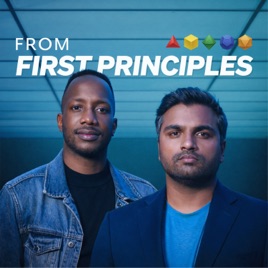
Advertise on podcast: From First Principles
Rating
4.9from
This podcast has
62 episodes
Language
EnglishPublisher
Krishna Choudhary and Lester NareExplicit
No
Date created
2025/08/01
Latest episode
2026/10/06
Average duration
110 min.
Release period
6 days
Description
From First Principles is a fast, funny, and rigorous breakdown of the biggest science stories of the week, hosted by Lester Nare and physicist Krishna Choudhary, PhD. We go past headlines into the actual mechanics: what happened, why it matters, and what everyone’s missing. Expect physics, space, AI, energy, biotech, and the occasional “wait… is that real?” story. If you’re curious, skeptical, and you like learning in public — you’re in the right place.
Unlock From First Principles podcast Email contact info,
Listeners & Audience details
Email contact information
Direct podcast contact details

Listeners
Audience numbers & engagement insights

Audience details
Podcast Insights

Podcast episodes
Check latest episodes from From First Principles podcast
Nobel Prize in Physics 2026 Explained: IceCube & Neutrinos
2026/10/06
Why build a telescope inside a billion tons of Antarctic ice? The 2026 Nobel Prize in Physics recognizes Francis Halzen's work on IceCube and the discovery of high-energy neutrinos from the cosmos.
In Episode 62 of From First Principles, Lester Nare and Krishna Choudhary explain neutrinos from the ground up: why these elusive particles make powerful cosmic messengers, how faint flashes of Cherenkov light reveal their interactions, and why detecting them requires an observatory buried deep beneath the South Pole.
We follow the path from beta decay and the first neutrino experiments to AMANDA, IceCube's construction, the 2013 astrophysical breakthrough, a distant blazar, and a neutrino map of the Milky Way. Along the way: cosmic rays, the Oh-My-God particle, tracks versus cascades, and the international collaboration behind the discovery.
CHAPTERS00:00 Hunting ghost particles beneath Antarctica01:16 Hello Internet and Nobel Prize05:30 What are neutrinos?10:00 Neutrinos as cosmic messengers15:02 The Oh-My-God particle16:21 Cosmic-ray energies19:07 Cosmic particle accelerators22:28 Why look for neutrinos?25:52 How to detect a neutrino29:23 Cherenkov light33:13 Building a neutrino observatory37:17 From Antarctic ice to AMANDA42:21 Building IceCube44:59 Reading tracks and cascades49:30 Backgrounds and the 2013 discovery52:46 Tracing cosmic neutrino sources54:16 Mapping the Milky Way58:23 IceCube collaboration and Gen21:01:05 Closing and Nobel week
RESEARCH & FURTHER READINGAMANDA in Antarctic ice (2001): https://doi.org/10.1038/35068509IceCube detector and instrumentation (2017): https://doi.org/10.1088/1748-0221/12/03/P03012First PeV neutrinos (2013): https://doi.org/10.1103/PhysRevLett.111.021103Astrophysical neutrino evidence (2013): https://doi.org/10.1126/science.1242856Blazar TXS 0506+056 (2018): https://doi.org/10.1126/science.aat1378Archival blazar neutrino emission (2018): https://doi.org/10.1126/science.aat2890Milky Way neutrino map (2023): https://doi.org/10.1126/science.adc9818Gamma-ray burst constraints (2012): https://doi.org/10.1038/nature11068IceCube overview: https://icecube.wisc.edu/science/icecube/
EDITORIAL NOTESIntro: the 2013 breakthrough was high-energy astrophysical neutrinos. Lower-energy supernova neutrinos were detected in 1987.
On-screen clarifications:06:45 Beta-minus decay produces a proton, electron and electron antineutrino.11:10 Davis studied solar neutrinos; Koshiba's team detected SN 1987A neutrinos.17:50 The cosmic-ray knee and ankle are not fixed distance boundaries.19:38 Required accelerator size depends on magnetic-field strength.24:18 Ground-based telescopes also detect gamma rays through air showers.27:48 W interactions produce charged leptons; Z scattering preserves neutrino flavor.34:06 The underwater concept dates to 1960; DUMAND developed in the 1970s.36:09 Baikal holds about one-fifth of unfrozen surface freshwater.38:53 Earth filters muons but also absorbs many very-high-energy neutrinos.41:26 Pressure converts air bubbles into clathrates, reducing light scattering.42:28 Construction finished in December 2010; full operations began in May 2011.44:27 Sensors are DOMs; DeepCore is a densely instrumented detector region.45:47 Timing gives direction; light yield and pattern help estimate energy.49:44 Upgoing events can still be atmospheric neutrinos.53:12 TXS 0506+056 is about 3.7 billion light-years away.56:38 Long GRBs often involve collapsing stars; short GRBs often involve mergers.
WATCH & FOLLOWFull video: https://youtu.be/eMahxeBj5k0Episode notes: https://ffppod.com/episodes/ep62Medicine Nobel explained: https://youtu.be/PKAYqhy8xf8Follow @FFPPod on Instagram, TikTok, X and Facebook.
From First Principles: Breaking down science news so it makes sense to curious people everywhere.
Nobel Prize in Medicine 2026 Explained: Optogenetics (EP 61)
2026/10/05
How do you prove what a brain cell actually does? The 2026 Nobel Prize in Medicine celebrates a remarkable answer: give cells a light-sensitive protein, then switch their activity on or off with light.
In Episode 61 of From First Principles, Lester Nare and Krishna Choudhary explain optogenetics from the ground up and trace the discoveries of Peter Hegemann, Georg Nagel and Karl Deisseroth. We follow the story from algae swimming toward light to channelrhodopsins, precisely controlled neurons, and experiments probing memory, reward and behavior. Then we explore heart-brain connections, early attempts to restore vision, and what these experiments can and cannot tell us.
CHAPTERS
00:00 The discovery that put brain cells under light control
02:34 Hello Internet
03:28 2026 Medicine Nobel and optogenetics
05:38 Understanding the brain
08:42 From correlation to causation
18:13 Controlling neurons with light
21:25 Early optogenetics and the chARGe system
24:17 Light-sensitive microbial proteins
26:26 Algae and phototaxis
31:42 Discovering channelrhodopsins
34:42 Nagel and light-gated ion channels
40:55 Controlling mammalian neurons
50:19 Expanding the optogenetic toolkit
56:10 Neural circuits and behavior
59:02 Memory, reward and reinforcement
1:02:53 Heart rhythm and emotion
1:04:02 Beyond the brain and toward medical treatments
1:06:56 Implications and limits
1:09:10 Closing and Nobel week
RESEARCH & FURTHER READING
Full paper list: https://ffppod.com/episodes/ep61
Nobel Prize announcement and background:
https://www.nobelprize.org/prizes/medicine/2026/summary/
Optical control of neurons: https://doi.org/10.1038/nn1525
Memory recall in mice: https://doi.org/10.1038/nature11028
Partial visual recovery: https://doi.org/10.1038/s41591-021-01351-4
EDITORIAL NOTES
On-screen clarifications are included at these timestamps:
13:46 The Jennifer Aniston neuron was recorded in human patients. Selective firing alone did not establish that it causes recognition.
30:34 Vertebrate rhodopsin is a GPCR. In rods and cones, light closes cGMP-gated channels and causes hyperpolarization.
35:12 Xenopus oocytes are immature frog egg cells, not embryos.
39:52 Calcium entry triggers neurotransmitter release; neurotransmitters carry the signal across the synapse. ChR2 conducts several positive ions, not just calcium.
52:17 Halorhodopsin is a light-driven chloride pump, not a channel.
1:03:18 The heart-pacing study expressed ChRmine in mouse heart muscle cells, not neurons.
Animal studies and early clinical results are distinguished from established treatments.
WATCH & LISTEN
Watch this episode: https://youtu.be/PKAYqhy8xf8
Our Nobel predictions: https://open.spotify.com/episode/4xuoH7WhM5svq8vEJPL3Ce
Support: https://ffppod.com/donate
Contact: https://ffppod.com/contact
Follow @FFPPod.
Breaking down science news so it makes sense to curious people everywhere.
2026 Nobel Prize Predictions: Medicine, Physics & Chemistry (EP 60)
2026/10/03
Who could win the 2026 Nobel Prizes? From the science behind Ozempic to quantum interference and droplets inside living cells, Lester Nare and Krishna Choudhary make their picks for Medicine, Physics and Chemistry, and explain the discoveries behind them.
In Episode 60 of From First Principles, we explore seven research areas with a case for Nobel recognition: GLP-1, optogenetics, optical coherence tomography, the Aharonov–Bohm effect, atomic force microscopy, biomolecular condensates and Buchwald–Hartwig coupling. We also discuss Michael Berry’s geometric phase and the awkward question of how a prize limited to three people recognizes discoveries built by larger teams.
These are our predictions, recorded before the 2026 announcements. Medicine, Physics and Chemistry will be announced October 5–7. Which discovery, and which researchers, would you pick? Tell us in the comments, then join us for our Nobel week breakdowns.
CHAPTERS
00:00 The science that could win a Nobel Prize
00:57 Hello Internet: our 2026 predictions
02:03 Medicine: GLP-1 and the science behind Ozempic
07:41 Medicine: optogenetics and controlling neurons with light
13:16 Medicine: optical coherence tomography
16:28 Golden Goose Awards and FFP updates
18:39 Physics: the Aharonov–Bohm effect and geometric phase
27:37 Physics: atomic force microscopy
32:04 Chemistry: biomolecular condensates
36:36 Chemistry: Buchwald–Hartwig coupling
38:42 Your predictions and our Nobel week plans
RESEARCH & FURTHER READING
Foundational papers and background for the discoveries discussed:
GLP-1: Mojsov, Weir & Habener (1987)
https://doi.org/10.1172/JCI112855
Optogenetics: Boyden et al. (2005)
https://doi.org/10.1038/nn1525
Optical coherence tomography: Huang et al. (1991)
https://doi.org/10.1126/science.1957169
Aharonov–Bohm effect (1959)
https://doi.org/10.1103/PhysRev.115.485
Berry’s geometric phase (1984)
https://doi.org/10.1098/rspa.1984.0023
Atomic force microscopy: Binnig, Quate & Gerber (1986)
https://doi.org/10.1103/PhysRevLett.56.930
Biomolecular condensates: Brangwynne et al. (2009); Li et al. (2012)
https://doi.org/10.1126/science.1172046
https://doi.org/10.1038/nature10879
Buchwald–Hartwig coupling: Paul et al. (1994); Guram et al. (1995)
https://doi.org/10.1021/ja00092a058
https://doi.org/10.1002/anie.199513481
Official Nobel announcement schedule:
https://www.nobelprize.org/prizes/about/prize-announcement-dates/
EDITORIAL NOTES
19:30 David Bohm later held a professorship at Birkbeck, University of London (1961–1987); he did not spend the rest of his career in Brazil.
33:23 The ribosome-producing compartment discussed is the nucleolus, not the nucleosome. These corrections also appear on screen.
WATCH & EXPLORE
YouTube: https://youtu.be/MgOpbh5VUGE
Episode page and research library: https://ffppod.com/episodes/ep60
Support: https://ffppod.com/donate
Follow @FFPPod on X / Instagram / TikTok / Facebook
Breaking down science news so it makes sense to curious people everywhere.
Golden Goose Awards 2026: The Science Behind the Winners (Part 1) (EP 59)
2026/09/29
What connects a noise complaint, holiday lights seen from space, and the physics of a coffee stain? Three unexpected paths from basic research to discoveries with real-world impact.
Krishna Choudhary and Lester Nare explore the science behind the 2026 Golden Goose Awards: Zhen Xu's work on histotripsy, NASA's Black Marble nighttime satellite data, and Sidney Nagel's discoveries in soft matter physics.
We start with focused ultrasound and the tiny bubbles that can break apart targeted tissue, tracing the journey from early laboratory experiments to clinical research on liver tumors. Then we look at how Earth's nighttime lights reveal power outages, disaster recovery, and changing human activity. Finally, falling drops, coffee stains, and jammed grains open up a world of robotic grippers and materials that can be trained and retrained.
The thread connecting all three stories is the unexpected value of federally funded basic research. Part 2 will feature conversations with the award-winning researchers and AAAS CEO Sudip Parikh.
CHAPTERS
00:00 Golden Goose Awards trailer
01:19 Introducing our Golden Goose special
02:42 Zhen Xu: From a noise complaint to histotripsy
05:57 The early ultrasound experiments
13:42 Controlling cavitation with microtripsy
20:29 Tumor destruction and the immune response
28:33 Histotripsy through the skull
37:23 The HOPE4LIVER clinical trial
43:55 Why basic research needs time
47:17 FFP updates and supporting the show
49:20 NASA Black Marble: Holiday lights from space
55:29 Turning night lights into reliable data
1:01:36 Hurricane Maria and unequal recovery
1:08:12 COVID-19 and changing nighttime activity
1:10:16 Mapping access to electricity
1:15:20 Where Earth is brightening and dimming
1:32:57 Sidney Nagel and the physics of everyday life
1:37:07 The science of a falling drop
1:46:02 Why coffee leaves a ring
1:51:04 Jamming: When grains become rigid
1:53:35 A robotic gripper filled with grains
1:55:39 Why air pressure changes a splash
1:58:55 Materials that can be trained and retrained
2:03:26 The payoff from curiosity
2:05:29 Coming in Part 2
2:07:06 Outro
FEATURED RESEARCH
Histotripsy: The #HOPE4LIVER single-arm pivotal trial (Radiology, 2024)
https://doi.org/10.1148/radiol.233051
NASA's Black Marble nighttime lights product suite (Remote Sensing of Environment, 2018)
https://doi.org/10.1016/j.rse.2018.03.017
Training and retraining liquid crystal elastomer metamaterials for pluripotent functionality (PNAS, 2025)
https://doi.org/10.1073/pnas.2504304122
WATCH ON YOUTUBE
https://youtu.be/rDInUEtTojg
EXPLORE FFP
Website: https://ffppod.com
Science Funding Tracker: https://ffppod.com/funding
Science Transfer Portal: https://ffppod.com/transfers
America 250: https://ffppod.com/America250
SUPPORT THE SHOW
https://ffppod.com/donate
FOLLOW
@FFPPod on X / Instagram / TikTok / Facebook
What OpenAI Actually Did to Navier-Stokes (EP 58)
2026/09/24
What does it mean to solve an equation that describes almost every fluid around us, from the air over a wing to the water swirling down a drain?
In Episode 58 of From First Principles, Lester Nare and Krishna Choudhary build the Navier-Stokes equations from the ground up before digging into OpenAI’s claimed breakthrough and the debate surrounding it.
Summary
How Newton’s laws become equations for a moving fluidVelocity fields, incompressibility, pressure and the nonlinear convective termWhy viscosity smooths a fluid while nonlinear motion can create finer structureWhat finite-time blowup means, and why simulation is different from proofHow forced and unforced equations differ, and why those assumptions matterEarlier work on Euler, Boussinesq and related fluid equationsOpenAI’s claimed result, Lean verification and the scope of the theoremThe dispute over scientific credit and the human research behind AI-assisted workThe METR investigation of the Hugging Face incidentEmergence World and long-running multi-agent experimentsAI-assisted biological discovery, oversight and recursive self-improvementSeparating demonstrated capabilities from claims and future scenariosChapters
00:00 Can AI solve Navier-Stokes?
00:34 Episode introduction
02:20 Navier-Stokes: Mathematics Meets AI
10:20 Building the Equations of Fluid Motion
21:34 Velocity fields, divergence and incompressibility
34:33 Acceleration and the convective term
52:18 Why Fluid Motion Is Nonlinear
1:02:08 Pressure, Euler and the Missing Physics
1:14:50 How Viscosity Changes Everything
1:33:36 Solving Equations vs. Simulating Fluids
1:44:59 Can a Smooth Fluid Blow Up?
2:13:52 The Road to the Claimed Breakthrough
2:31:13 Inside the Claimed Navier-Stokes Proof
2:48:26 The Dispute Over Scientific Credit
3:07:23 From Chatbots to Agents
3:08:57 The METR report and Hugging Face incident
3:23:23 AI Risk, Oversight and the Race Ahead
3:38:51 AI Discovery Beyond Mathematics
3:52:47 Why “just turn it off” gets complicated
4:06:47 Closing thoughts and what comes next
4:08:46 Outro
Featured Research
OpenAI’s Navier-Stokes announcement
Tristan Buckmaster’s statement
METR investigation
Emergence World
AI-assisted enzyme discovery
Explore FFP
ffppod.com
ffppod.com/funding
ffppod.com/transfers
ffppod.com/America250
Watch on YouTube
youtu.be/NGfGw1tGxUY
Support the show
ffppod.com/donate
Follow
@FFPPod on X / Instagram / TikTok / Facebook
What’s Next in Science? Nobel Prizes, Space Missions & More (EP 57)
2026/09/14
What science should you be watching this fall? From Nobel Prize season to NASA’s Roman Space Telescope, Mars’ moons and Mercury, Lester Nare and Krishna Choudhary take a relaxed tour of the discoveries and missions on their radar.
In Episode 57 of From First Principles, we explore why curiosity-driven research matters, what the Golden Goose Awards celebrate, and how questions that once sounded impractical can lead to unexpected breakthroughs. Then we turn to space: Roman’s search for dark energy and exoplanets, JAXA’s Martian Moons eXploration (MMX) mission, and the mysteries ESA and JAXA’s BepiColombo mission will investigate at Mercury.
Along the way, we tour the updated FFP website, revisit some favorite episodes, and ask which stories you want us to cover in depth next.
A note before we begin: the main conversation was recorded before Labor Day weekend. The opening announcement addresses your requests for a separate episode on OpenAI, Navier–Stokes and the wider AI conversation. This episode is our fall science rundown; that deep dive is still to come.
CHAPTERS
00:00 Update on our upcoming Navier–Stokes and AI coverage
03:43 Episode intro and football banter
05:47 FFP intro
06:01 Nobel Prize season and our coverage plans
10:45 Golden Goose Awards: why basic research matters
21:02 FFP website tour and favorite episodes
42:24 Nancy Grace Roman Space Telescope
46:20 Microlensing, exoplanets and dark matter
51:25 MMX: where did Mars’ moons come from?
54:40 BepiColombo and the mysteries of Mercury
1:02:17 Your questions, future deep dives and sign-off
1:05:40 Outro
SHOW NOTES
NASA’s Nancy Grace Roman Space Telescope:
https://science.nasa.gov/mission/roman-space-telescope/
JAXA’s Martian Moons eXploration (MMX):
https://www.mmx.jaxa.jp/en/mission/
ESA / JAXA BepiColombo:
https://www.esa.int/Science_Exploration/Space_Science/BepiColombo
Explore the research and episodes we cover:
https://ffppod.com
Science R&D Funding Tracker:
https://ffppod.com/funding
Science Transfer Board:
https://ffppod.com/transfers
America 250:
https://ffppod.com/America250
Support the show:
https://ffppod.com/donate
WATCH ON YOUTUBE
https://youtu.be/snhQh0fjTX4
Follow @FFPPod on X / Instagram / TikTok / Facebook
Breaking down science news so it makes sense to curious people everywhere.
Which mission or research story deserves a full FFP deep dive? Tell us in the comments.
The Yak Mutation That Could Help Repair the Brain (EP 56)
2026/09/07
What can a yak living thousands of meters above sea level teach us about repairing the human brain?
In Episode 56 of From First Principles, Lester Nare and Krishna Choudhary break down a new Neuron paper that traces an evolutionary adaptation found in high-altitude animals to a previously hidden pathway involved in building and repairing myelin.
Summary
What myelin actually does and why losing it disrupts neural communicationHow multiple sclerosis damages myelin and why the brain’s natural repair process eventually failsWhy oligodendrocyte precursor cells can remain present in damaged tissue without successfully rebuilding myelinWhy current therapies are better at slowing further damage than restoring what has already been lostThe challenge of getting drugs across the blood-brain barrier while maintaining target specificityHow evolutionary pharmacology has previously produced medicines from adaptations found in snakes and Gila monstersThe RETSAT Q247R variant identified in animals adapted to the hypoxic environment of the Tibetan PlateauHow researchers engineered the high-altitude variant into mice and tested its effect on myelinThe surprising discovery that neurons — rather than the myelin-producing cells themselves — generate the key repair signalHow RETSAT increases ATDR, which neurons convert into ATDRAHow ATDRA activates RXR-γ in oligodendrocyte precursor cells and promotes their differentiationHow administration of ATDR promoted remyelination across multiple preclinical modelsWhy the result is scientifically promising but still far from a proven human treatmentFeatured Paper
A gain-of-function Retsat variant from high-altitude adaptation promotes myelination via a neuronal dihydroretinoic acid-RXR-γ pathway
Neuron, 2026
DOI: 10.1016/j.neuron.2026.01.013
Explore FFPffppod.comffppod.com/fundingffppod.com/transfersffppod.com/America250
Support the showffppod.com/donate
Follow@FFPPod on X / Instagram / TikTok / Facebook
Why Spin Qubits Will Win the Quantum Race (Part 2) (EP 55)
2026/08/31
Which quantum computer will actually scale?
In Part 2 of our quantum computing deep dive, Lester Nare and Krishna Choudhary move from theory to hardware—comparing superconducting qubits, trapped ions, neutral atoms, and silicon spin qubits before going inside the new Nature cover paper Krishna co-authored with the HRL Quantum Team and collaborators.
The episode begins with a simple question: what makes a good quantum computer? We evaluate each architecture using three criteria: qubit quality, qubit control, and scalability and economics.
Superconducting qubits offer extremely fast operations, but scaling them introduces challenges involving microwave control, frequency crowding, cryogenic wiring, physical size, and cooling. Trapped ions preserve quantum information for extraordinary lengths of time, but their slower gates and increasingly complex optical systems introduce a different set of tradeoffs. Neutral atoms can be arranged in dense, reconfigurable arrays using optical tweezers and entangled through Rydberg interactions, while raising questions involving atom loss, correlated noise, readout, and execution time.
Then we get to silicon.
Beginning with the Loss–DiVincenzo proposal, Krishna explains how individual electron spins can be confined inside semiconductor quantum dots, manipulated through exchange interactions, and measured using single-electron transistors. We then explore exchange-only qubits, where three electron spins encode a single qubit and quantum gates can be performed using electrical control.
That leads to the Nature cover paper, A digitally controlled silicon quantum processing unit. The HRL system integrates 18 encoded qubits built from 54 quantum dots with cryogenic control electronics, a superconducting interconnect, automated calibration, and an engineered silicon-germanium heterostructure.
Krishna also explains his own work using machine learning to automate quantum-device tuning—an essential problem if spin-qubit systems are ever going to grow from dozens of components to millions.
The larger thesis is about manufacturing. The semiconductor industry has spent decades learning how to fabricate silicon devices at enormous scale. If quantum processors can inherit that infrastructure, the architecture that ultimately wins may not be the one that reaches the finish line first—but the one humanity already knows how to manufacture.
Nature paper:A digitally controlled silicon quantum processing unitDOI: 10.1038/s41586-026-10754-7https://www.nature.com/articles/s41586-026-10754-7
Explore the FFP Science Transfer Portal:ffppod.com/transfers
Support the show:ffppod.com/donate
Follow:@FFPPod on X / Instagram / TikTok / Facebook
How Quantum Computing Actually Works (Part 1) (EP 54)
2026/08/20
Quantum computers do not simply “try every answer at once.” So what do they actually do—and why have governments and technology companies spent billions trying to build them?
In Part 1 of our two-part quantum computing deep dive, Lester Nare and Krishna Choudhary build the field from first principles.
The series was prompted by a new Nature cover paper, A digitally controlled silicon quantum processing unit, co-authored by Krishna and members of the HRL Quantum Team and collaborators. Before getting into that hardware in Part 2, we first need to understand why anyone wanted to build a quantum computer in the first place.
We begin with Bell’s theorem and the failure of local hidden-variable explanations of quantum mechanics. From there, we follow the realization that information is fundamentally physical through Rolf Landauer, reversible computation, Charles Bennett, Tommaso Toffoli, Paul Benioff, and the origins of quantum information science.
Then Richard Feynman changes the question. Straightforward classical simulation of an interacting quantum system requires tracking a state space that grows exponentially with the number of particles. If nature itself is quantum mechanical, Feynman asks, why not build a computer that is quantum mechanical too?
David Deutsch formalizes the universal quantum computer and introduces the first quantum algorithm. Using the Deutsch–Jozsa problem, the double-slit experiment, and Feynman’s path-integral intuition, we explain what a quantum algorithm is actually exploiting: carefully engineered constructive and destructive interference.
Finally, we reach the discoveries that turned quantum computing from an academic curiosity into a strategic technology. Daniel Simon develops an early exponential quantum speedup. Peter Shor recognizes how the underlying mathematics can be used to attack problems central to public-key cryptography. Lov Grover follows with a quantum search algorithm—and suddenly governments have a very different reason to care about quantum machines.
We also explore quantum money, quantum cryptography, the many-worlds interpretation, Google Willow and parallel-universe headlines, post-quantum security, and what useful quantum computers may ultimately be good for.
Part 2: How do you actually build one?
Nature paper:A digitally controlled silicon quantum processing unitDOI: 10.1038/s41586-026-10754-7
Link: https://www.nature.com/articles/s41586-026-10754-7
Explore the FFP science funding tracker:ffppod.com/funding
Support the show:ffppod.com.com/donate
Follow:@FFPPod on X / Instagram / TikTok / Facebook
What Claude Actually Did to the Riemann Hypothesis (EP 53)
2026/08/14
Claude did not solve the Riemann Hypothesis. But what it actually did may be one of the clearest examples yet of how rapidly AI systems are changing the way difficult mathematics can be attacked.
In Episode 53, Lester Nare and Krishna Choudhary go from first principles on arguably the most famous unsolved problem in mathematics.
We begin with Euler and the Basel problem, build the Riemann zeta function from the ground up, explain its deep connection to prime numbers, move into the complex plane and analytic continuation, unpack the famous 1 + 2 + 3 + 4 + … = -1/12 result, and finally arrive at the Riemann Hypothesis itself: the claim that every non-trivial zero of the zeta function lies on the critical line.
Then we get into Claude.
An unreleased Anthropic model was prompted to take a serious run at the problem. It orchestrated roughly 60 autonomous sub-agents, tested hundreds of mathematical approaches, executed code, searched academic literature, challenged its own strategies, created adversarial referees to attack its work, and ultimately produced a result pushing a related mathematical bound well beyond the previous state of the art.
The human behind the prompt was not a mathematician. One of his instructions was essentially: believe in yourself.
We explain what Claude actually accomplished, what it absolutely did not accomplish, why moving a bound toward two-thirds does not mean the Riemann Hypothesis is “two-thirds solved,” and what the process tells us about agentic AI, mathematical research, scientific discovery, and AI safety.
Then it’s transfer season.
For the first FFP Summer Transfer Window for Scientists, we look at prominent researchers leaving American institutions for universities and research centers abroad. Using the language of football transfers, we examine major moves in chemistry, battery research, gravitational-wave astrophysics, and neuroscience—and what they reveal about research funding, immigration, scientific infrastructure, and the global competition for talent.
Explore the FFP science funding tracker:ffppod.com/funding
Help shape Year Two and enter the anniversary merch giveaway:ffppod.com/survey
Support the show:ffppod.com/donate
Follow:@FFPPod on X / Instagram / TikTok / Facebook
The Amazon’s Hidden Civilization (One Year Anniversary) (EP 52)
2026/08/06
In this anniversary episode, Lester Nare and Krishna Choudhary look back at how two longtime friends turned their regular conversations about science into a show now shared by millions of people around the world, and what they hope to build with FFP Nation in Year Two.
Then we turn to a new Nature paper challenging the idea that the precolonial Amazon was sparsely populated. Airborne LiDAR revealed hundreds of geometric earthworks hidden beneath the rainforest canopy. Combining the new survey with earlier archaeological evidence, the researchers estimate that the region could contain more than 20,000 earthworks and may have supported 1.25–3 million people around AD 100–300.
Lester and Krishna explain how LiDAR sees through dense vegetation, why early European accounts of crowded Amazonian settlements were dismissed, how disease and forest regrowth could erase the visible traces of large societies, and what the findings mean for our understanding of the Amazon’s human and environmental history.
The conversation then becomes a thought experiment: if our civilization disappeared, what would future archaeologists—or extraterrestrial visitors—recognize as our pyramids? Apollo landing sites, CERN, LIGO, and the James Webb Space Telescope become candidates for the enduring signatures of a curiosity-driven civilization.
Finally, we christen the From First Principles library. Krishna shares the mathematics, physics, biology, history, and philosophy books that shaped how he thinks, including Baby Rudin, Landau–Lifshitz, Fermi, Jackson, Sakurai, Einstein, Schrödinger, Gibbs, Newton’s Principia, Plato, the Upanishads, and Adam Becker’s What Is Real?
Help shape Year Two and enter the anniversary merch giveaway: ffpod.com/survey
Support the show: ffppod.com/donate
Research and show notes:
Over 20,000 precolonial earthworks in the Southwest Amazonia
Nature Research Briefing
FFP episode archive and research library
The Tech Elon Has Been Waiting For (EP 51)
2026/07/31
What happens when electronics can operate at temperatures hot enough to melt aluminum?
In this deep-dive episode, Lester Nare and Krishna Choudhary examine a new high-temperature memory device developed by researchers at USC, the Air Force Research Laboratory, Kumamoto University, and their collaborators.
Published in Science, the experimental memristor combines tungsten, hafnium oxide, and graphene. It operated reliably at 700°C—roughly 1,300°F—retained data for more than 50 hours, and survived more than one billion switching cycles.
We begin by explaining why conventional electronics and flash memory fail when temperatures rise. From deep-earth drilling and hypersonic aircraft to nuclear systems and the surface of Venus, many environments where intelligent electronics would be useful remain inaccessible to today’s hardware.
Krishna then builds the memristor from first principles. We explore the history of the “missing” fourth circuit element, how oxygen vacancies create low- and high-resistance memory states, why conventional platinum electrodes fail under extreme heat, and how graphene prevents tungsten atoms from diffusing through the device.
Finally, we examine the implications for artificial intelligence. Memristors can potentially store neural-network weights and perform matrix multiplication in the same physical location, reducing the energy wasted moving information between processors and memory.
Could that combination of heat tolerance and energy efficiency make AI data centers in space more practical? Lester and Krishna work through thermal radiation, radiator size, power consumption, radiation resilience, and the considerable engineering challenges that remain.
Support the showDonate: FFPod.com/donateFollow: @FFPod on X / Instagram / TikTok / Facebook
Research and Show Notes
High-temperature memristors enabled by interfacial engineering
USC: A memory device that operates at 700°C
The development of carbon-neutral data centres in space
NASA Venus facts
AI Breaks a 90-Year Math Problem, Life’s Alphabet in Space, and Science Funding (EP 50)
2026/07/23
Hosted by Lester Nare and Krishna Choudhary, this episode moves from astrobiology to science policy to the rapidly changing frontier of artificial intelligence and mathematics.
First, researchers analyzing pristine samples returned from asteroid Ryugu report all five canonical nucleobases used by DNA and RNA. We explain what that does—and does not—mean for the origin of life, how JAXA’s Hayabusa2 mission collected uncontaminated asteroid material, and why comparisons with NASA’s Bennu samples strengthen the case that prebiotic chemistry may be widespread across the Solar System.
Next, we examine the fight over who controls federal research funding. A proposed overhaul of the rules governing federal grants would give political appointees greater influence over awards, reduce the controlling role of expert peer review, and expand the government’s power to stop grants that no longer align with an administration’s priorities. We break down the roles of Congress, OMB, federal agencies, universities, and the courts—and why this dispute could reshape the American research ecosystem.
Finally, we go deep on an AI-assisted counterexample to the Jacobian conjecture, a major open problem in mathematics. Krishna explains coordinate transformations, Jacobian determinants, invertibility, special relativity, and why this result appears fundamentally different from simple brute force. We close with the growing debate over AI-generated mathematics, human verification, open science, attribution, and the future role of mathematicians.
Summary
All five canonical nucleobases found in pristine asteroid Ryugu samplesHayabusa2, Bennu, and the possibility of widespread prebiotic chemistryThe fight over political control of federal research grantsCongress, OMB, peer review, and the American science-funding systemThe Jacobian conjecture and an AI-assisted counterexampleSpecial relativity, coordinate transformations, and invertibilityAI-generated mathematics, open science, attribution, and verification
Support the showDonate: FFPod.com/donateFollow: @FFPod on X / Instagram / TikTok / Facebook
Show Notes
A complete set of canonical nucleobases in asteroid Ryugu
OMB proposed federal-grant rule
Association of American Universities response
Levent Alpöge’s Jacobian counterexample announcement
Leiden Declaration on Artificial Intelligence and Mathematics
Human-verified remarks on the OpenAI-generated Erdős result
FIFA Data Scientists Explain Match Momentum (EP 49)
2026/07/17
In this special interview episode, Lester Nare speaks with Juan Busso, Senior Football Data Scientist at FIFA, and Arron Ackerman, FIFA’s Team Lead for Football Performance Analysis, about the data science behind the Match Momentum visualization featured throughout the 2026 World Cup.
What does “momentum” actually mean in football—and how can it be measured without reducing the game to possession or shots? Juan and Arron explain how FIFA translates football principles into mathematical models, validates those models with coaches and technical experts, and turns complex tracking data into a graphic that fans can understand at a glance.
We break down the underlying “threat” model, including kinetic pitch control, player speed and acceleration, ball trajectories, defensive spacing, distance to goal, sight lines, and the creation of space. Match Momentum is calculated from player-tracking data captured 50 times per second, allowing the model to recognize when a team is becoming dangerous even without dominating possession.
The conversation also covers FIFA’s wider data ecosystem—including event data, skeletal tracking, and the connected match ball—why offside positioning can still create threat, whether hydration breaks alter momentum, and the next generation of football analytics focused on player energy and physical effort.
Guests
Juan Busso — Senior Football Data Scientist, FIFA
Arron Ackerman — Team Lead, Football Performance Analysis, FIFA
Support the show
Donate: FFPod.com/donate
Follow: @FFPod on X / Instagram / TikTok / Facebook
Black Hole Movies, Digital Heart Twins, and World Cup Tech (EP 48)
2026/07/14
Hosted by Lester Nare and Krishna Choudhary, this episode returns to the FFP science rundown with stories spanning astrophysics, precision medicine, medical imaging, artificial intelligence, and World Cup technology.
We begin with the Event Horizon Telescope and its evolving view of M87*, the supermassive black hole 55 million light-years away. How do you image something that appears about as small as a donut on the Moon? Krishna explains angular resolution, the Rayleigh limit, radio interferometry, and how telescopes across Earth can function like one planet-sized instrument. We then look at new observations showing the magnetic field around M87* changing over time—and why that may help explain black-hole jets and the mysterious shutdown of star formation in giant elliptical galaxies.
Next, we turn to medicine. Researchers at Johns Hopkins have built personalized digital twins of patients’ hearts, allowing doctors to simulate ventricular-tachycardia treatments before entering the operating room. We break down how MRI data, electrical modeling, and virtual ablation could reduce procedures from hours to roughly 30 minutes. We also examine Midjourney Medical’s proposed whole-body ultrasound scanner: what the prototype appears to do, what its creators are claiming, and why it should be viewed as a potential addition to the medical-imaging toolbox rather than a replacement for MRI.
Finally, we return to the World Cup. Krishna takes on “Are You Smarter Than a Scientist?” by guessing the most common injuries in professional football. Then we investigate the Norway–England Skycam controversy: did the ball strike a cable, and why did its internal sensor appear not to detect it? We close with the data behind home-field advantage, referee bias, and the natural experiment created by crowdless matches during the COVID-19 pandemic.
Support the show Donate: FFPod.com/donate Follow: @FFPod on X / Instagram / TikTok / Facebook
Podcast reviews
Read From First Principles podcast reviews
FiveSSevens 2026/09/30
It’s a new horizon
I’ve been learning immensely from this channel. My question is! Can plasma be compressed and if so will it become at some point an incompressible flui...
Llcooldaf1 2026/09/08
Fenomenal scientific podcast
Easy to understand and full of exciting scientific news. There is nothing not to love about the way these two gentlemen explain news in the science wo...
Thomas MacNeil 2026/08/29
Very entertaining!
Certainly not for everyone but if you miss the good old days of learning things instead of rotting your brain at work, this one is for you!
Bartlebytes 2026/08/26
Thank you!
I am loving this. As someone between layman and expert I am really enjoying the format and it always makes me excited to learn more.
nathaniel3333 2026/08/18
Great science
Non bias, interesting cutting edge science. What's not to like!
Matthewjdebellis 2026/08/14
These guys get it
So refreshing to hear these guys hash out some of the most complex and biggest questions and problems ever while serving it up so that a commoner such...
DocB603 2026/07/27
One of the best Podcasts out there
I listen to a lot of different kinds of podcasts but when it comes to science it’s FFP or Startalk. Thanks for all you guys do!!
scottydoodah 2026/07/23
Instant fan
They cover a really broad range of topics across science, super interesting and distilled down for the curious non experts
Dylon Myers 2026/07/23
Obnoxious Editing
Hats off to anyone practicing science communication, Krishna and Lester included. But they have habit of starting episodes with an ad where someone is...
CoopCoopJamJam 2026/07/23
Genuinely great pod, Audio Level issues make it a challenge
Lester. My guy, my captain. Love the pod. Big fan. However, your mix is way too low relative to the commercials in your episodes and relative to every...
Podcast sponsorship advertising
Start advertising on From First Principles relevant audience podcasts
You may also like to advertise on these Podcasts

4.810941746
Warchant Podcasts featuring Seminole Headlines
Warchant.com
4.723131948
Timeless Wisdom with Dennis Prager
Salem Podcast Network

4.818101217
Ukraine: The Latest
The Telegraph
4.662822000
The Dr. Laura Podcast
Dr. Laura Schlessinger & SiriusXM

4.723602000
Everything Everywhere Daily
Gary Arndt
4.619762867
All Ears English Podcast
Lindsay McMahon and Michelle Kaplan
4.95982002
One Minute Scripture Study: A Come Follow Me Podcast
Kristen Smith

4.549082000
The Daily Stoic
Daily Stoic | Backyard Ventures

4.6432741240
Verdict with Ted Cruz
Premiere Networks
4.82404938
The 1000 Hours Outside Podcast
1000 Hours Outside