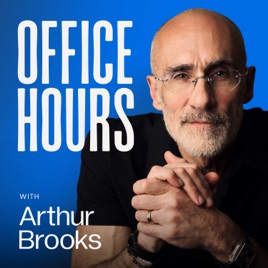
Advertise on podcast: Office Hours with Arthur Brooks
Rating
4.9from
This podcast has
61 episodes
Language
EnglishPublisher
Arthur BrooksExplicit
No
Date created
2025/08/09
Latest episode
2026/09/28
Average duration
52 min.
Release period
7 days
Description
Hi Friends, I’m Arthur Brooks, a social scientist, professor at the Harvard Kennedy School and Harvard Business School, and columnist at The Atlantic. I write, speak, and teach about the science of human happiness, blending neuroscience, behavioral science, philosophy, and religion for insights on how to live better, and be happier. Each week on Office Hours, you’ll get a glimpse into the cutting edge research on happiness, and explore how you can use it to improve your life—and share what you learn with those you love. Join me in the movement to build a happier world–starting with you.
Unlock Office Hours with Arthur Brooks podcast Email contact info,
Listeners & Audience details
Email contact information
Direct podcast contact details

Listeners
Audience numbers & engagement insights

Audience details
Podcast Insights

Podcast episodes
Check latest episodes from Office Hours with Arthur Brooks podcast
4 Ways to Avoid Your Professional Decline
2026/09/28
What happens when the abilities that brought you professional success start to decline?
In this episode of Office Hours, I explore how our strengths change with age and how to be happier as they do. Drawing on my book From Strength to Strength, I explain fluid and crystallized intelligence and contrast how Darwin and Bach responded to professional decline.
As always, I leave you with practical steps to help you navigate this transition and find more happiness, meaning, and fulfillment as you age.
—
Brought to you by:
• LMNT—A science-backed electrolyte drink mix that helps you feel and perform your best, without sugar, artificial ingredients, or gimmicks. Get a free sample pack at DrinkLMNT.com/Arthur
• Helix Sleep—A mattress designed for every body. Go to helixsleep.com/brooks for 27% off sitewide for their Labor Day Sale—an exclusive offer for listeners of Office Hours.
—
Where to find Arthur Brooks:
• Website: https://arthurbrooks.com/
• In-person Retreats: https://retreats.arthurbrooks.com/
• Newsletter: https://www.arthurbrooks.com/newsletter
• X: https://x.com/arthurbrooks
• Instagram: https://www.instagram.com/arthurcbrooks/
• Facebook: https://www.facebook.com/ArthurBrooks/
• YouTube: https://www.youtube.com/channel/UCGuyFRjJQFGCKzfHTBvWM6A
• LinkedIn: https://www.linkedin.com/in/arthur-c-brooks/
• Email: [email protected]
—
Timestamps:
(00:00) Intro
(10:40) How happiness changes with age
(15:09) Who is happiest after 70
(17:40) The inevitability of age-related decline in our abilities
(21:49) Lessons on aging from the lives of Darwin and Bach
(32:05) Why our abilities decline with age
(39:01) #1. Jump to the new curve
(40:51) #2. Serve other people
(42:15) #3. Develop your life philosophy
(43:40) #4. Connect more deeply with others
(46:28) Q&A: Navigating relationships with adult children
(47:51) Q&A: Finding meaningful ways to spend retirement
(49:01) Q&A: How to handle “deal” friends
—
Referenced:
• The Meaning of Your Life: Finding Purpose in an Age of Emptiness: https://www.arthurbrooks.com/the-meaning-of-your-life
• Arthur’s newsletter: https://www.arthurbrooks.com/newsletter
• The Happiness Scale: https://learn.arthurbrooks.com/the-happiness-scale
• The Pursuit of Happiness with Arthur Brooks: https://www.thefp.com/s/the-pursuit-of-happiness-with-arthur
• From Strength to Strength: Finding Success, Happiness, and Deep Purpose in the Second Half of Life: https://www.amazon.com/Strength-Finding-Success-Happiness-Purpose/dp/059319148X
• Your Professional Decline Is Coming (Much) Sooner Than You Think: https://www.theatlantic.com/magazine/archive/2019/07/work-peak-professional-decline/590650/
• Is happiness U-shaped everywhere? Age and subjective well-being in 145 countries: https://pmc.ncbi.nlm.nih.gov/articles/PMC7480662
• Creative productivity: A predictive and explanatory model of career trajectories and landmarks: https://psycnet.apa.org/record/1997-02113-002
• Charles Darwin: https://en.wikipedia.org/wiki/Charles_Darwin
• Johann Sebastian Bach: https://en.wikipedia.org/wiki/Johann_Sebastian_Bach
• ...References continued at: https://www.arthurbrooks.com/office-hours
How to Be More Optimistic with Simon Sinek
2026/09/21
Simon Sinek is an optimist, bestselling author of Start with Why, and founder of The Optimism Company.
In this special episode of Office Hours, part of the Be Hope podcast takeover during the United Nations General Assembly, Simon joins me to explore what optimism really requires. We discuss how optimism differs from hope, why relationships help us sustain a belief in a better future, how our expectations shape others, and why pessimism has become so powerful. We also explain how leaders can turn optimism into action through a clear vision, and how each of us can become more optimistic by creating space to imagine a better future and finding a vision worth pursuing.
—
Brought to you by:
• Noble Mobile—With Noble, there is only one plan: The No-Bull Plan. It’s simple. It’s transparent. And if you use less data, you get cash back. Get an exclusive offer at: https://noblemobile.com/arthurbrooks.
• Magic Mind—Magic Mind is a mental performance shot with vitamins and clinically-backed ingredients like Ashwagandha and Lion’s Mane for a sharper mind and sustained energy. Get 50% off your first order at magicmind.com. —
Where to find Simon Sinek:
• X: https://x.com/simonsinek
• LinkedIn: https://www.linkedin.com/in/simonsinek
• Instagram: https://www.instagram.com/simonsinek
• YouTube: https://www.youtube.com/simonsinek
• Podcast: https://simonsinek.com/podcast
• Website: https://simonsinek.com
Where to find Arthur Brooks:
• Website: https://arthurbrooks.com/
• In-person Retreats: https://retreats.arthurbrooks.com/
• Newsletter: https://www.arthurbrooks.com/newsletter
• X: https://x.com/arthurbrooks
• Instagram: https://www.instagram.com/arthurcbrooks/
• Facebook: https://www.facebook.com/ArthurBrooks/
• YouTube: https://www.youtube.com/channel/UCGuyFRjJQFGCKzfHTBvWM6A
• LinkedIn: https://www.linkedin.com/in/arthur-c-brooks/
• Email: [email protected]
—
Timestamps:
(00:00) Intro
(06:10) How Arthur and Simon met
(07:24) Why Simon defines himself as an optimist
(13:10) The difference between optimism and hope
(19:15) How expectations shape relationships and behavior
(28:31) Why optimism is on the decline
(30:39) Why we need leaders with vision
(34:48) How to be more optimistic
(42:42) Optimism in politics
(50:11) Four lessons for becoming more optimistic
(53:55) Advice for leaders
—
Referenced:
• The Meaning of Your Life: Finding Purpose in an Age of Emptiness: https://www.arthurbrooks.com/the-meaning-of-your-life
• Arthur’s newsletter: https://www.arthurbrooks.com/newsletter
• The Happiness Scale: https://learn.arthurbrooks.com/the-happiness-scale
• The Pursuit of Happiness with Arthur Brooks: https://www.thefp.com/s/the-pursuit-of-happiness-with-arthur
• Be Hope Podcast Takeover: https://globalgoals.org/behope/
• The U.N. General Assembly 2026: https://www.un.org/en/high-level-week-2026
• The Power of Why | Simon Sinek: https://www.youtube.com/watch?v=i0rOB91WEOk
• ...References continued at: https://www.arthurbrooks.com/office-hours
5 Ways to Kill Your Envy and Get Happier
2026/09/14
Dante had a particularly gruesome punishment for the envious: their eyes were wired shut. In this episode of Office Hours, I explore why envy is such a powerful happiness killer—and how to stop feeding it in your own life.
—
Brought to you by:
• Noble Mobile—With Noble, there is only one plan: The No-Bull Plan. It’s simple. It’s transparent. And if you use less data, you get cash back. Get an exclusive offer at: https://noblemobile.com/arthurbrooks
—
Where to find Arthur Brooks:
• Website: https://arthurbrooks.com/
• In-person Retreats: https://retreats.arthurbrooks.com/
• Newsletter: https://www.arthurbrooks.com/newsletter
• X: https://x.com/arthurbrooks
• Instagram: https://www.instagram.com/arthurcbrooks/
• Facebook: https://www.facebook.com/ArthurBrooks/
• YouTube: https://www.youtube.com/channel/UCGuyFRjJQFGCKzfHTBvWM6A
• LinkedIn: https://www.linkedin.com/in/arthur-c-brooks/
• Email: [email protected]
—
Timestamps:
00:00 Intro
7:15 Dante’s Divine Comedy
11:56 Definition of envy and its purpose
18:46 Benign and malicious envy
24:13 The effects on the brain when you’re feeling envy
28:30 What people envy
33:25 5 ways to be less envious and much happier
45:06 Q&A: Four classic temperaments
46:34 Q&A: Developing your PhD research question
48:40 Q&A: Romantic love: addiction or happiness?
—
Referenced:
• The Meaning of Your Life: Finding Purpose in an Age of Emptiness: https://www.arthurbrooks.com/the-meaning-of-your-life
• Arthur’s newsletter: https://www.arthurbrooks.com/newsletter
• The Happiness Scale: https://learn.arthurbrooks.com/the-happiness-scale
• Dante’s Purgatorio, Canto 13: http://dantelab.dartmouth.edu/reader?reader%5Bcantica%5D=2&reader%5Bcanto%5D=13
• Josef Epstein. Envy: https://www.amazon.com/dp/B00VQVKUPC?lv=shuf&channelId=500&plpRedirect=mhFallback
•Envy: An Adversarial Review and Comparison of Two Competing Views: https://journals.sagepub.com/doi/abs/10.1177/1754073919873131
•The Role of Subjective and Objective Social Status in the Generation of Envy: https://www.frontiersin.org/journals/psychology/articles/10.3389/fpsyg.2020.513495/full
•When your gain is my pain and your pain is my gain: https://pubmed.ncbi.nlm.nih.gov/19213918/
•Is envy harmful to a society's psychological health and wellbeing?: https://pubmed.ncbi.nlm.nih.gov/29316510/
•Envy: Functional specificity and sex-differentiated design features: https://psycnet.apa.org/record/2012-11291-001
•What to Do When Social Media Inspires Envy: https://daily.jstor.org/what-to-do-when-social-media-inspires-envy/
•Mitigating malicious envy: Why successful individuals should reveal their failures: https://psycnet.apa.org/record/2019-11196-001
•How gratitude inhibits envy: From the perspective of positive psychology: https://pubmed.ncbi.nlm.nih.gov/33300284/
•Bragging and humblebragging in online reviews: https://www.sciencedirect.com/science/article/pii/S0160738319302063?casa_token=2WdCSNbKzdQAAAAA:2PlvLLvja-2c9_454Rnb8h9GB55Kt0Rg3A1pY7XpBxksabWaNZBsbdjbnay4DhKlrJXhk-aEow
• ...References continued at: https://www.arthurbrooks.com/office-hours
—
Production and marketing by https://penname.co/.
What Is the Happiest Personality? (It Actually Might Be Yours)
2026/09/07
If you’re an introvert, you might not like what the research has to say: Extroverts tend to be happier. But before you start striking up conversations with strangers in the elevator, there’s more to the story.
In this episode of Office Hours, I explore how your personality might shape your happiness, what introverts and extroverts can learn from each other, and why understanding your natural tendencies can help you cultivate habits towards a more connected and, therefore, happier life.
—
Brought to you by:
• Noble Mobile—With Noble, there is only one plan: The No-Bull Plan. It’s simple. It’s transparent. And if you use less data, you get cash back. Get an exclusive offer at: https://noblemobile.com/arthurbrooks
• LMNT—A science-backed electrolyte drink mix that helps you feel and perform your best, without sugar, artificial ingredients, or gimmicks. Get a free sample pack at DrinkLMNT.com/Arthur—
Where to find Arthur Brooks:
• Website: https://arthurbrooks.com/
• In-person Retreats: https://retreats.arthurbrooks.com/
• Newsletter: https://www.arthurbrooks.com/newsletter
• X: https://x.com/arthurbrooks
• Instagram: https://www.instagram.com/arthurcbrooks/
• Facebook: https://www.facebook.com/ArthurBrooks/
• YouTube: https://www.youtube.com/channel/UCGuyFRjJQFGCKzfHTBvWM6A
• LinkedIn: https://www.linkedin.com/in/arthur-c-brooks/
• Email: [email protected]
—
Timestamps:
(00:00) Intro
(09:00) Personality traits and genetics
(10:47) Jung’s work on personality
(12:54) The Big Five personality traits (OCEAN)
(20:55) Eysenck’s theories on introversion and extroversion
(23:26) Why extroverts tend to have a happiness advantage
(32:02) What introverts can learn from extroverts
(38:44) What extroverts can learn from introverts
(43:04) Happiness homework for introverts and extroverts
(45:01) Q&A: Budgeting, vacations, and happiness
(47:02) Q&A: Dealing with romantic failure
—
Referenced:
• The Meaning of Your Life: Finding Purpose in an Age of Emptiness: themeaningofyourlife.com
• Meaning Membership: https://hub.arthurbrooks.com/the-meaning-membership
• Arthur’s newsletter: https://www.arthurbrooks.com/newsletter
• The Happiness Scale: https://learn.arthurbrooks.com/the-happiness-scale
• The development of markers for the Big-Five factor structure: https://psycnet.apa.org/record/1992-25730-001
• Carl Jung: https://www.thesap.org.uk/articles-on-jungian-psychology-2/carl-gustav-jung/
• Extraversion and happiness: https://psycnet.apa.org/record/1991-12567-001
• Intelligence assessment: a theoretical and experimental approach: https://pubmed.ncbi.nlm.nih.gov/5341403
• Happiness, introversion-extraversion and happy introverts: https://www.researchgate.net/publication/232553189_Happiness_introversion-extraversion_and_happy_introverts
• Hans Eysenck's interface between the brain and personality: Modern evidence on the cognitive neuroscience of personality: https://www.sciencedirect.com/science/article/pii/S0191886916302628
• ...References continued at: https://www.arthurbrooks.com/office-hours
—
Production and marketing by https://penname.co/.
5 Ways to Find Your Faith
2026/08/31
Why do so many people drift from faith in early adulthood, only to feel drawn back to it later in life?
In this episode of Office Hours, I explore the Hindu concept of Ashramas and the parallels with what modern science tells us about how our priorities change with age.
As we get older, the worldly rewards we once chased can start to feel less satisfying. We begin asking deeper questions about wisdom, meaning, and transcendence. That’s what happens when you enter Vanaprastha—the stage of life when we turn our attention inward.
I also share five practical steps for beginning (or rebeginning) your own spiritual journey.
—
Brought to you by:
• Noble Mobile—With Noble, there is only one plan: The No-Bull Plan. It’s simple. It’s transparent. And if you use less data, you get cash back. Get an exclusive offer at: https://noblemobile.com/arthurbrooks
—
Where to find Arthur Brooks:
• Website: https://arthurbrooks.com/
• In-person Retreats: https://retreats.arthurbrooks.com/
• Newsletter: https://www.arthurbrooks.com/newsletter
• X: https://x.com/arthurbrooks
• Instagram: https://www.instagram.com/arthurcbrooks/
• Facebook: https://www.facebook.com/ArthurBrooks/
• YouTube: https://www.youtube.com/channel/UCGuyFRjJQFGCKzfHTBvWM6A
• LinkedIn: https://www.linkedin.com/in/arthur-c-brooks/
• Email: [email protected]
—
Timestamps:
(00:00) Intro
(07:10) Lessons from Hinduism
(16:50) Ashramas: The four stages of life
Brahmacharya
Grihastha
Vanaprastha
Sannyasa
(30:05) The link between spirituality and midlife
(35:30) #1: Loosen your commitments to not believing
(38:47) #2. Spirituality as an entrepreneurial endeavor
(40:09) #3: Walk towards what you seek
(42:27) #4. Get a buddy
(44:14) #5. Find a teacher
(46:03) Q&A: The evolutionary purpose of dark triads
(48:35) Q&A: Having a two-way relationship with god
—
Referenced:
• The Meaning of Your Life: Finding Purpose in an Age of Emptiness: https://www.arthurbrooks.com/the-meaning-of-your-life
• Arthur’s newsletter: https://www.arthurbrooks.com/newsletter
• The Happiness Scale: https://learn.arthurbrooks.com/the-happiness-scale
• The Autobiography of a Yogi: https://www.amazon.com/dp/1785991663
• From Strength to Strength: Finding Success, Happiness, and Deep Purpose in the Second Half of Life:
https://www.amazon.com/Strength-Finding-Success-Happiness-Purpose/dp/059319148X
• Why do levels of religious observance vary by age and country: https://www.pewresearch.org/religion/2018/06/13/why-do-levels-of-religious-observance-vary-by-age-and-country
• Stages of Faith: The Psychology of Human Development and the Quest for Meaning: https://www.amazon.com/dp/0060628405
• More Americans say they’re spiritual, but not religious: https://www.pewresearch.org/short-reads/2017/09/06/more-americans-now-say-theyre-spiritual-but-not-religious/
• The sociopaths among us: How to spot (and avoid) a Dark Triad: https://www.arthurbrooks.com/podcast/the-sociopaths-among-us-how-to-spot-and-avoid-a-dark-triad
• ...References continued at: https://www.arthurbrooks.com/office-hours
—
Production and marketing by https://penname.co/.
The Three Secrets to Raising Great Kids
2026/08/24
Being a parent is one of the most meaningful things you can do with your life, and one of the easiest things to worry about getting wrong. Most of us ultimately want the same things for our children: for them to grow up to be good people and have a good life. But how much influence do parents actually have over those outcomes?
In this episode of Office Hours, I explore what the research can teach us about raising happy, well-adjusted kids, including how much of our children’s personalities are inherited, where we as parents really can make a difference, and why what we model often matters more than what we say.
—
Brought to you by:
• Noble Mobile—With Noble, there is only one plan: The No-Bull Plan. It’s simple. It’s transparent. And if you use less data, you get cash back. Get an exclusive offer at https://noblemobile.com/arthurbrooks
• LMNT—A science-backed electrolyte drink mix that helps you feel and perform your best, without sugar, artificial ingredients, or gimmicks. Get a free sample pack at DrinkLMNT.com/Arthur
—
Where to find Arthur Brooks:
• Website: https://arthurbrooks.com/
• In-person Retreats: https://retreats.arthurbrooks.com/
• Newsletter: https://www.arthurbrooks.com/newsletter
• X: https://x.com/arthurbrooks
• Instagram: https://www.instagram.com/arthurcbrooks/
• Facebook: https://www.facebook.com/ArthurBrooks/
• YouTube: https://www.youtube.com/channel/UCGuyFRjJQFGCKzfHTBvWM6A
• LinkedIn: https://www.linkedin.com/in/arthur-c-brooks/
• Email: [email protected]
—
Timestamps:
(00:00) Intro
(05:04) What most parents want for their kids
(09:29) What the research has revealed about nature vs. nurture
(17:00) How parenting impacts personality
(29:12) Parenting principle #1: Even a hot mess can be a great parent
(32:52) Parenting principle #2: Be warm and loving
(34:29) Parenting principle #3: Be an actor
(38:42) Q&A: Overcoming bad habits learned from your parents
(40:50) Q&A: How to support a child with a toxic partner
(42:49) Q&A: Teaching children the discipline of happiness
—
Referenced:
• The Meaning of Your Life: Finding Purpose in an Age of Emptiness: https://www.arthurbrooks.com/the-meaning-of-your-life
• Meaning Membership: https://hub.arthurbrooks.com/the-meaning-membership
• Arthur’s newsletter: https://www.arthurbrooks.com/newsletter
• The Happiness Scale: https://learn.arthurbrooks.com/the-happiness-scale
• The Pursuit of Happiness with Arthur Brooks: https://www.thefp.com/s/the-pursuit-of-happiness-with-arthur
• Parenting in America Today: https://www.pewresearch.org/social-trends/2023/01/24/parenting-in-america-today
• OCEAN: https://pubmed.ncbi.nlm.nih.gov/1635039/
• Heritability of the big five personality dimensions and their facets: a twin study: https://pubmed.ncbi.nlm.nih.gov/8776880
• Longitudinal associations between parenting and child Big Five personality traits: https://psycnet.apa.org/record/2022-24205-001
• ...References continued at: https://www.arthurbrooks.com/office-hours
—
Production and marketing by https://penname.co/.
Success Secret: Finding People Who Disagree With You
2026/08/17
Most of us prefer spending time with people who are like us. They think like us, share our values, and make us feel comfortable. But while similarity may be easy, it isn't always what helps us grow.
In this episode of Office Hours, I explain why some of the greatest benefits in life come from building relationships with people who think, believe, and live differently from us. I explore the science behind why diversity of thought can make us wiser and more successful, and share three practical ways to bring more variety of opinions and values into your life.
And if you want to get better at disagreeing better, check out one of my earlier episodes on loving your “enemies.”
—
Brought to you by:
• LMNT—A science-backed electrolyte drink mix that helps you feel and perform your best, without sugar, artificial ingredients, or gimmicks. Get a free sample pack at DrinkLMNT.com/Arthur
• Magic Mind—Magic Mind is a mental performance shot with vitamins and clinically backed ingredients like Ashwagandha and Lion’s Mane for a sharper mind and sustained energy. Get 50% off your first order at magicmind.com
—
Where to find Arthur Brooks:
• Website: https://arthurbrooks.com/
• In-person Retreats: https://retreats.arthurbrooks.com/
• Newsletter: https://www.arthurbrooks.com/newsletter
• X: https://x.com/arthurbrooks
• Instagram: https://www.instagram.com/arthurcbrooks/
• Facebook: https://www.facebook.com/ArthurBrooks/
• YouTube: https://www.youtube.com/channel/UCGuyFRjJQFGCKzfHTBvWM6A
• LinkedIn: https://www.linkedin.com/in/arthur-c-brooks/
• Email: [email protected]
—
Timestamps:
(00:00) Intro
(06:48) Bonding vs. bridging social capital
(14:04) Why we prefer people who are like us
(20:17) Why diversity makes us happier
(21:44) Demographic diversity vs. diversity of ideas
(29:20) How disagreement can improve your thinking
(32:36) Step 1: Talk to strangers
(36:07) Step 2: Become a social scientist
(38:40) Step 3: Celebrate heresy
(43:48) Q&A: How video games affect happiness
(44:56) Q&A: What happens when positivity goes too far
(46:26) Q&A: How to avoid being ruled by pleasure
—
Referenced:
• The Meaning of Your Life: Finding Purpose in an Age of Emptiness: https://www.arthurbrooks.com/the-meaning-of-your-life
• Meaning Membership: https://hub.arthurbrooks.com/the-meaning-membership
• Arthur’s newsletter: https://www.arthurbrooks.com/newsletter
• The Happiness Scale: https://learn.arthurbrooks.com/the-happiness-scale
• The Pursuit of Happiness with Arthur Brooks: https://www.thefp.com/s/the-pursuit-of-happiness-with-arthur
• The Meaning of Your Life Retreats: https://retreats.arthurbrooks.com
• World Day for Cultural Diversity for Dialogue and Development, 21 May: https://www.un.org/en/observances/cultural-diversity-day
• ...References continued at: https://www.arthurbrooks.com/office-hours
—
Production and marketing by https://penname.co/.
One Year of Office Hours: Lessons on Love and Friendship
2026/08/10
In this special one-year anniversary episode of Office Hours, I'm joined by six young adults to discuss the modern crisis of meaning and why so many people feel disconnected despite having more ways to connect than ever. Together, we explore why friendship and romantic love seem harder to find and maintain, what gets in the way of deep connection, and what young adults are actually looking for in relationships, community, and life. Along the way, the participants share their experiences navigating friendship, dating, marriage, graduate school, and major life transitions.
If there's one hope I have for this episode—and for this podcast—it's that it helps us all build lives that are richer in meaning, connection, and love.
Whether you've been with us all year or this is your first episode, thank you for listening. I'm grateful you're joining me in the mission to lift people up and bring us together in bonds of happiness and love.
—
Where to find Arthur Brooks:
• Website: https://arthurbrooks.com/
• In-person Retreats: https://retreats.arthurbrooks.com/
• Newsletter: https://www.arthurbrooks.com/newsletter
• X: https://x.com/arthurbrooks
• Instagram: https://www.instagram.com/arthurcbrooks/
• Facebook: https://www.facebook.com/ArthurBrooks/
• YouTube: https://www.youtube.com/channel/UCGuyFRjJQFGCKzfHTBvWM6A
• LinkedIn: https://www.linkedin.com/in/arthur-c-brooks/
• Email: [email protected]
—
Timestamps:
(00:00) Intro
(04:10) Introducing the young participants
(06:48) The three macronutrients of happiness, and the crisis of loss of meaning
(09:59) The three parts of meaning
(14:43) The decline in friendship and romantic love
(17:30) The challenges of making friends in adulthood
(24:28) Friendship after marriage
(27:44) Making friends in graduate school
(33:20) Best friends
(38:33) Going deeper in a friendship
(44:05) The seven lessons of friendship
(46:52) Why falling in love seems harder today
(58:21) Dating off the apps
(1:02:00) The limitations of dating apps
(1:06:06) What the participants want out of a relationship
(1:12:05) Why deep friendship is the key and what's getting in the way
(1:15:02) The rules for successful love and dating
—
Production and marketing by https://penname.co/.
Why You Should Let People Help You More
2026/08/03
We usually think generosity means helping other people. But what if accepting help is generous, too?
In this episode of Office Hours, I explore why letting others help us can be a gift. We’ll look at the science of why helping makes people happier, why others enjoy doing us favors more than we expect, the four rules for asking well, and how receiving with grace creates a virtuous cycle of generosity.
—
Brought to you by:
• Noble Mobile—With Noble, there is only one plan: The No-Bull Plan. It’s simple. It’s transparent. And if you use less data, you get cash back. Get an exclusive offer at: https://noblemobile.com/arthurbrooks.
• Helix Sleep—A mattress designed for every body. Go to helixsleep.com/brooks for 20% off sitewide, 25% off Luxe Mattresses, and 30% off Elite Mattresses for their Fourth of July Sale—Extended!
—
Where to find Arthur Brooks:
• Website: https://arthurbrooks.com/
• In-person Retreats: https://retreats.arthurbrooks.com/
• Newsletter: https://www.arthurbrooks.com/newsletter
• X: https://x.com/arthurbrooks
• Instagram: https://www.instagram.com/arthurcbrooks/
• Facebook: https://www.facebook.com/ArthurBrooks/
• YouTube: https://www.youtube.com/channel/UCGuyFRjJQFGCKzfHTBvWM6A
• LinkedIn: https://www.linkedin.com/in/arthur-c-brooks/
• Email: [email protected]
—
Timestamps:
(00:00) Intro
(07:02) The benefits of giving to others
(14:10) Why asking for help is an act of generosity
(19:25) Rule #1: How much is too much
(21:19) Rule #2: Asking is not demanding
(23:27) Rule #3: Don’t wreck it
(26:46) Rule #4: Being generous requires nothing
(30:38) Q&A: Resources for aporia
(33:06) Q&A: Marrying outside your faith
—
Referenced:
• The Meaning of Your Life: Finding Purpose in an Age of Emptiness: https://www.arthurbrooks.com/the-meaning-of-your-life
• Meaning Membership: https://hub.arthurbrooks.com/the-meaning-membership
• Arthur’s newsletter: https://www.arthurbrooks.com/newsletter
• The Happiness Scale: https://learn.arthurbrooks.com/the-happiness-scale
• The Pursuit of Happiness with Arthur Brooks: https://www.thefp.com/s/the-pursuit-of-happiness-with-arthur
• The Meaning of Your Life Retreats: https://retreats.arthurbrooks.com/
• It’s good to do good and receive good: The impact of a ‘pay it forward’ style kindness intervention on giver and receiver well-being: https://psycnet.apa.org/record/2015-21350-001
• Who Really Cares: The Surprising Truth About Compassionate Conservatism: https://www.amazon.com/dp/0465008216
• Happy People Become Happier Through Kindness: A Counting Kindnesses Intervention: https://pmc.ncbi.nlm.nih.gov/articles/PMC1820947/
• ...References continued at: https://www.arthurbrooks.com/office-hours
—
Production and marketing by https://penname.co/.
The Power of Sunlight: Protocols for Better Mood, Sleep & Happiness
2026/07/27
It's easy to assume that we'd be happier if we lived somewhere with more sunshine. But how much does sunlight actually matter?
In this episode of Office Hours, I examine what the research says about the relationship between sunlight and happiness, why some people benefit more than others, and how much sunlight you really need. I also share three practical ways to build healthier light habits.
—
Brought to you by:
• Noble Mobile—With Noble, there is only one plan: The No-Bull Plan. It’s simple. It’s transparent. And if you use less data, you get cash back. Get an exclusive offer at: https://noblemobile.com/arthurbrooks
• Helix Sleep—A mattress designed for every body. Go to helixsleep.com/brooks for 20% off sitewide, 25% off Luxe Mattresses, and 30% off Elite Mattresses for their Fourth of July Sale—Extended!
—
Where to find Arthur Brooks:
• Website: https://arthurbrooks.com/
• In-person Retreats: https://retreats.arthurbrooks.com/
• Newsletter: https://www.arthurbrooks.com/newsletter
• X: https://x.com/arthurbrooks
• Instagram: https://www.instagram.com/arthurcbrooks/
• Facebook: https://www.facebook.com/ArthurBrooks/
• YouTube: https://www.youtube.com/channel/UCGuyFRjJQFGCKzfHTBvWM6A
• LinkedIn: https://www.linkedin.com/in/arthur-c-brooks/
• Email: [email protected]
—
Timestamps:
(00:00) Intro
(06:40) What the research shows about the effects of sunlight
(07:57) What Seasonal Affective Disorder (SAD) is
(11:40) The small percentage of people who react negatively to sunlight
(13:17) How sunlight affects mood and the role of vitamin D
(16:48) How much sunlight you need to get the benefits
(19:34) Why some people overdo it with sunlight
(27:25) Make sunshine a daily routine
(32:35) Get your morning light even without the sun
(34:23) When to avoid the light
(35:25) Why you probably don’t need to move to be by the sun
(39:38) Q&A: Finding meaning after a life change
(41:34) Q&A: Relating to friends with different tolerance for conflict
—
Referenced:
• The Meaning of Your Life: Finding Purpose in an Age of Emptiness: https://www.arthurbrooks.com/the-meaning-of-your-life
• Meaning Membership: https://hub.arthurbrooks.com/the-meaning-membership
• Arthur’s newsletter: https://www.arthurbrooks.com/newsletter
• The Happiness Scale: https://learn.arthurbrooks.com/the-happiness-scale
• The Pursuit of Happiness with Arthur Brooks: https://www.thefp.com/s/the-pursuit-of-happiness-with-arthur
• The Meaning of Your Life Retreats: https://retreats.arthurbrooks.com
• Outdoor daylight exposure and longer sleep promote wellbeing under COVID‐19 mandated restrictions: https://pmc.ncbi.nlm.nih.gov/articles/PMC8646753
• What is seasonal affective disorder?: https://www.nimh.nih.gov/health/publications/seasonal-affective-disorder
• ...References continued at: https://www.arthurbrooks.com/office-hours
—
Production and marketing by https://penname.co/.
How Lying Sabotages Your Happiness
2026/07/20
Most people don't start with huge lies. They start with little white lies meant to avoid conflict, spare someone's feelings, or make life a little easier. But what if those small compromises are quietly making us less happy?
In this episode of Office Hours, I make the case that honesty is one of the deepest expressions of love. I explore why we're afraid to say what we really think, why even well-intentioned lies can undermine trust and happiness, and how practicing radical honesty—with compassion—can strengthen our relationships and help us live more authentically. I also share three practical ways to become more honest without becoming hurtful.
—
Brought to you by:
• Noble Mobile—With Noble, there is only one plan: The No-Bull Plan. It’s simple. It’s transparent. And if you use less data, you get cash back. Get an exclusive offer at: https://noblemobile.com/arthurbrooks
• LMNT—A science-backed electrolyte drink mix that helps you feel and perform your best, without sugar, artificial ingredients, or gimmicks. Get a free sample pack at DrinkLMNT.com/Arthur—
Where to find Arthur Brooks:
• Website: https://arthurbrooks.com/
• In-person Retreats: https://retreats.arthurbrooks.com/
• Newsletter: https://www.arthurbrooks.com/newsletter
• X: https://x.com/arthurbrooks
• Instagram: https://www.instagram.com/arthurcbrooks/
• Facebook: https://www.facebook.com/ArthurBrooks/
• YouTube: https://www.youtube.com/channel/UCGuyFRjJQFGCKzfHTBvWM6A
• LinkedIn: https://www.linkedin.com/in/arthur-c-brooks/
• Email: [email protected]
—
Timestamps:
(00:00) Intro
(05:00) Why we don’t share what we think
(10:06) Honesty as an act of love
(12:01) Transcendentalism and radical honesty
(18:11) The types of lies and how often we lie
(24:27) Why lying undermines happiness
(33:25) Seek and accept honesty from others
(36:03) Offer truth to heal, not harm
(40:11) Make the truth appealing
(42:48) Q&A: Making the most of summer
(44:56) Q&A: The hardest part of my protocols
(46:34) Q&A: The pros and cons of napping
—
Referenced:
• The Meaning of Your Life: Finding Purpose in an Age of Emptiness: https://www.arthurbrooks.com/the-meaning-of-your-life
• Meaning Membership: https://hub.arthurbrooks.com/the-meaning-membership
• Arthur’s newsletter: https://www.arthurbrooks.com/newsletter
• The Happiness Scale: https://learn.arthurbrooks.com/the-happiness-scale
• The Pursuit of Happiness with Arthur Brooks: https://www.thefp.com/s/the-pursuit-of-happiness-with-arthur
• The Meaning of Your Life Retreats: https://retreats.arthurbrooks.com
• Poll: 62% of Americans Say They Have Political Views They’re Afraid to Share: https://www.cato.org/survey-reports/poll-62-americans-say-they-have-political-views-theyre-afraid-share
• The “Spiral of Silence” Revisited: A Meta-Analysis on the Relationship Between Perceptions of Opinion Support and Political Opinion Expression: https://journals.sagepub.com/doi/abs/10.1177/009365021774542
• Self-Reliance: https://www.amazon.com/dp/0500024472
• ...References continued at: https://www.arthurbrooks.com/office-hours
—
Production and marketing by https://penname.co/.
Use Music to Change Your Brain and Get Happier
2026/07/13
There's a reason music has mattered to people for thousands of years. Across cultures and generations, we’ve treated it as more than entertainment—as a kind of language that can express what words can’t and help us connect with the meaning and mystery on the right side of our brain.
In this episode of Office Hours, I explore why that idea has endured and what modern science has to say about it. I also share two simple ways to amplify music’s positive effects, plus four practical strategies for building a music practice that fits your goals—so you can get more out of the music you already love.
And if you want to dive deeper into the music I love and listen to, go to: https://www.arthurbrooks.com/playlist
—
Brought to you by:
• LMNT—A science-backed electrolyte drink mix that helps you feel and perform your best, without sugar, artificial ingredients, or gimmicks. Get a free sample pack at DrinkLMNT.com/Arthur
• Magic Mind—Magic Mind is a mental performance shot with vitamins and clinically backed ingredients like Ashwagandha and Lion’s Mane for a sharper mind and sustained energy. Get 50% off your first order at magicmind.com
—
Where to find Arthur Brooks:
• Website: https://arthurbrooks.com/
• In-person Retreats: https://retreats.arthurbrooks.com/
• Newsletter: https://www.arthurbrooks.com/newsletter
• X: https://x.com/arthurbrooks
• Instagram: https://www.instagram.com/arthurcbrooks/
• Facebook: https://www.facebook.com/ArthurBrooks/
• YouTube: https://www.youtube.com/channel/UCGuyFRjJQFGCKzfHTBvWM6A
• LinkedIn: https://www.linkedin.com/in/arthur-c-brooks/
• Email: [email protected]
—
Timestamps:
(00:00) Intro
(05:40) Schopenhauer’s theory
(09:38) Why I believe music reveals deeper truths
(13:20) The science of music and the brain
(19:41) The emotional impact of music
(23:32) Which type of music is linked with happiness
(25:28) The worst kind of music for happiness
(26:54) The benefits of listening to sad music
(29:35) Two ways to amplify music’s positive effects
(30:50) #1: Decide what you want from your music
(31:55) #2: Create a catalog of songs
(33:15) #3: Learn and grow
(36:04) #4: Play music yourself
(39:22) Q&A: Learning about classical music
(40:24) Q&A: Listening to music while working out
(42:06) Q&A: Friendship on the autism spectrum
—
Referenced:
• The Meaning of Your Life: Finding Purpose in an Age of Emptiness: https://www.arthurbrooks.com/the-meaning-of-your-life
• Meaning Membership: https://hub.arthurbrooks.com/the-meaning-membership
• Arthur’s newsletter: https://www.arthurbrooks.com/newsletter
• The Happiness Scale: https://learn.arthurbrooks.com/the-happiness-scale
• The Pursuit of Happiness with Arthur Brooks: https://www.thefp.com/s/the-pursuit-of-happiness-with-arthur
• The Meaning of Your Life Retreats: https://retreats.arthurbrooks.com
• Schopenhauer on music as the embodiment of Will: https://www.cambridge.org/core/books/abs/schopenhauer-philosophy-and-the-arts/schopenhauer-on-music-as-the-embodiment-of-will/19892B6A1001BACD7093CFBA2D59BF38
• Three Philosophies of Life: Ecclesiastes, Job, and Song of Songs, Peter Kreeft: https://www.amazon.com/dp/0898702623
• ...References continued at: https://www.arthurbrooks.com/office-hours
—
Production and marketing by https://penname.co/.
How to Stay in Love with Your Soul Mate, with Special Guest Ester Brooks
2026/07/06
Thirty-five years ago, I somehow convinced an extraordinary woman to marry me. Our relationship began like any other—attraction, a leap of faith, and eventually the decision to embark on the unknown journey ahead of us together.
In this episode of Office Hours, my wife, Ester Munt-Brooks, and I reflect on what we’ve learned over 35 years of choosing each other—from the risks we took early on, to why love is much more than a feeling. Drawing on the wisdom of Thomas Aquinas, we explore what it truly means to love—and how that understanding can transform every relationship.
—
Brought to you by:
• Noble Mobile—With Noble, there is only one plan: The No-Bull Plan. It’s simple. It’s transparent. And if you use less data, you get cash back. Get an exclusive offer at: https://noblemobile.com/arthurbrooks
—
Where to find Ester Munt-Brooks:
• Website: https://www.fevaloryalegria.org/
• YouTube: https://www.youtube.com/user/estermunt
• Instagram: https://www.instagram.com/FAITHWITHJOYTALKS/
Where to find Arthur Brooks:
• Website: https://arthurbrooks.com/
• In-person Retreats: https://retreats.arthurbrooks.com/
• Newsletter: https://www.arthurbrooks.com/newsletter
• X: https://x.com/arthurbrooks
• Instagram: https://www.instagram.com/arthurcbrooks/
• Facebook: https://www.facebook.com/ArthurBrooks/
• YouTube: https://www.youtube.com/channel/UCGuyFRjJQFGCKzfHTBvWM6A
• LinkedIn: https://www.linkedin.com/in/arthur-c-brooks/
• Email: [email protected]
—
Timestamps:
(00:00) Intro
(08:55) Arthur and Ester’s love story
(14:02) The risks they took to give it a shot
(19:30) How Ester came to embrace marriage
(24:36) The next stage: Marriage and children
(28:05) St. Thomas Aquinas’s definition of love
(45:20) What’s coming up in future episodes on love
(46:04) The three big love lessons
(49:26) Q&A: Personalizing a morning routine for your needs
(55:06) Q&A: How to think about faith while dating
(57:54) Q&A: How having children impacts happiness
(1:02:30) Q&A: How to meet people in person
—
Referenced:
• The Meaning of Your Life: Finding Purpose in an Age of Emptiness: https://www.arthurbrooks.com/the-meaning-of-your-life
• Meaning Membership: https://hub.arthurbrooks.com/the-meaning-membership
• Arthur’s newsletter: https://www.arthurbrooks.com/newsletter
• The Happiness Scale: https://learn.arthurbrooks.com/the-happiness-scale
• The Pursuit of Happiness with Arthur Brooks: https://www.thefp.com/s/the-pursuit-of-happiness-with-arthur
• The Meaning of Your Life Retreats: https://retreats.arthurbrooks.com
• ...References continued at: https://www.arthurbrooks.com/office-hours
—
Production and marketing by https://penname.co/.
Why Success Never Feels Like Enough
2026/06/29
Do you find yourself chasing success, working long hours, doing far more than is required, and thinking about work all the time? Congratulations—you might be a workaholic. (There’s no trophy for this, by the way. I checked.)
In this episode of Office Hours, I dig into what workaholism is, where it comes from, and why it can be so damaging to your happiness and relationships. We discuss the connection between work addiction and the belief that love has to be earned (which turns out to be a surprisingly ineffective strategy). There’s good news: I also share three practical steps you can take to break the cycle, become more present for your loved ones, and find the deeper sources of happiness, meaning, and connection that no promotion will ever give you.
—
Brought to you by:
• Noble Mobile—With Noble, there is only one plan: The No-Bull Plan. It’s simple. It’s transparent. And if you use less data, you get cash back. Get an exclusive offer at: https://noblemobile.com/arthurbrooks
• Magic Mind—Magic Mind is a mental performance shot with vitamins and clinically-backed ingredients like Ashwagandha and Lion’s Mane for a sharper mind and sustained energy. Get 50% off your first order at magicmind.com
—
Where to find Arthur Brooks:
• Website: https://arthurbrooks.com/
• In-person Retreats: https://retreats.arthurbrooks.com/
• Newsletter: https://www.arthurbrooks.com/newsletter
• X: https://x.com/arthurbrooks
• Instagram: https://www.instagram.com/arthurcbrooks/
• Facebook: https://www.facebook.com/ArthurBrooks/
• YouTube: https://www.youtube.com/channel/UCGuyFRjJQFGCKzfHTBvWM6A
• LinkedIn: https://www.linkedin.com/in/arthur-c-brooks/
• Email: [email protected]
—
Timestamps:
(00:00) Intro
(05:58) Why workaholism is so destructive
(09:31) Work culture in Spain vs. the U.S.
(11:11) The three classic signs of workaholism
(12:26) Why people become workaholics
(13:42) Four more signs of work addiction
(15:01) Intrinsic rewards vs. extrinsic rewards
(24:59) A thought experiment about intrinsic and extrinsic rewards
(27:52) Where workaholism comes from
(33:04) How to break your work addiction—Step 1: Face the truth
(34:39) Step 2: Give what you most want to receive
(36:02) Step 3: Make plans to change
(38:12) Summary of the three steps
(39:20) Q&A: The grief of divorce vs. death
(40:35) Q&A: Coping with betrayal
—
Referenced:
• The Meaning of Your Life: Finding Purpose in an Age of Emptiness: http://themeaningofyourlife.com
• Meaning Membership: https://hub.arthurbrooks.com/the-meaning-membership
• Arthur’s newsletter: https://www.arthurbrooks.com/newsletter
• The Happiness Scale: https://learn.arthurbrooks.com/the-happiness-scale
• The Pursuit of Happiness with Arthur Brooks: https://www.thefp.com/s/the-pursuit-of-happiness-with-arthur
• Workaholism: definition, measurement, and preliminary results: https://pubmed.ncbi.nlm.nih.gov/16370875
• Workload, Workaholism, and Job Performance: Uncovering Their Complex Relationship: https://pmc.ncbi.nlm.nih.gov/articles/PMC7557789
• PANAS quiz: https://www.arthurbrooks.com/quiz/panas
• 3 Steps to Managing Your Emotions: https://www.arthurbrooks.com/podcast/3-steps-to-managing-your-emotions
• ...References continued at: https://www.arthurbrooks.com/office-hours
—
Production and marketing by https://penname.co/.
How to Beat Burnout
2026/06/22
If you feel emotionally exhausted, cynical about your work, or like you’re no longer enjoying parts of the job you used to, you may be experiencing burnout.
In this episode of Office Hours, I explain what burnout is, how psychologists define it, and what the research shows about its effects on the brain and body. We discuss the workplace conditions most likely to cause burnout, why some occupations experience it more than others, and the self-reinforcing cycle that makes even meaningful work feel draining.
I also share five things employers can do to protect their employees from burnout and three practical ways individuals can create healthier boundaries between work and life so that each supports, rather than undermines, the other.
—
Brought to you by:
• LMNT—A science-backed electrolyte drink mix that helps you feel and perform your best, without sugar, artificial ingredients, or gimmicks. Get a free sample pack at DrinkLMNT.com/Arthur.
• Helix Sleep—A mattress designed for every body. Go to helixsleep.com/brooks for 20% off sitewide, 25% off Luxe Mattresses, and 30% off Elite Mattresses for their Fourth of July Sale.
—
Where to find Arthur Brooks:
• Website: https://arthurbrooks.com/
• In-person Retreats: https://retreats.arthurbrooks.com/
• Newsletter: https://www.arthurbrooks.com/newsletter
• X: https://x.com/arthurbrooks
• Instagram: https://www.instagram.com/arthurcbrooks/
• Facebook: https://www.facebook.com/ArthurBrooks/
• YouTube: https://www.youtube.com/channel/UCGuyFRjJQFGCKzfHTBvWM6A
• LinkedIn: https://www.linkedin.com/in/arthur-c-brooks/
• Email: [email protected]
—
Timestamps:
(00:00) Intro
(04:45) The origins of burnout
(06:44) Herbert Freudenberger’s definition of burnout
(07:25) What the research shows about burnout today
(10:59) The three signs of burnout and Arthur’s experience
(16:40) The physiology of burnout
(20:14) The 7 causes of burnout
(30:29) The occupations with the most burnout
(35:10) Five things employers can do to safeguard against burnout
(38:10) #1 way to fight burnout: Create space
(40:54) #2 way to fight burnout: Work only in defined hours
(42:23) #3 way to fight burnout: Work on your spiritual/philosophical life
(44:15) Why remote work is not the answer to burnout
(45:35) Recap: 3 ways to fight burnout
(47:58) Q&A: Coping with being a full-time caregiver
(50:01) Q&A: Adapting protocols to your life
—
Referenced:
• The Meaning of Your Life: Finding Purpose in an Age of Emptiness: themeaningofyourlife.com
• Meaning Membership: https://hub.arthurbrooks.com/the-meaning-membership
• Arthur’s newsletter: https://www.arthurbrooks.com/newsletter
• The Happiness Scale: https://learn.arthurbrooks.com/the-happiness-scale
• The Pursuit of Happiness with Arthur Brooks: https://www.thefp.com/s/the-pursuit-of-happiness-with-arthur
• The Brothers Karamazov: https://www.amazon.com/Brothers-Karamazov-Fyodor-Dostoevsky/dp/0374528373
• Poor mental health costs UK employers £51 billion a year for employees: https://www.deloitte.com/uk/en/about/press-room/poor-mental-health-costs-uk-employers-51-billion-a-year-for-employees.html
• Beyond Burnout: https://hbsp.harvard.edu/product/H0669W-PDF-ENG
• Burnout Test: https://www.psychologytoday.com/us/tests/career/burnout-at-work
• ...References continued at: https://www.arthurbrooks.com/office-hours
—
Production and marketing by https://penname.co/.
Podcast reviews
Read Office Hours with Arthur Brooks podcast reviews
Son of Lester Bangs 2026/09/28
Highs and lows
I have loved Brooks’s writing since the early Atlantic days. Show is superb. I think the “man on the plane” was Buzz Aldrin who had plenty of highs an...
StudentofPolitics 2026/09/26
Public Service
Thank you to Arthur for spreading the science of happiness and helping all of us become happiness teachers. It is truly a public service.
Marceteran 2026/09/07
The Science of Happiness, Beautifully Explained
Prof Arthur Brooks has a remarkable ability to
make the science of happiness feel deeply personal, practical and intellectually compelling!
AndiPack 2026/09/03
Insightful and actionable
I’ve been following Arthur Brooks for a while now and have been a listener since close to the launch of his podcast. I always find the information and...
xirogoh 2026/08/30
Great listen.
Great brain thought and practices
alohaeac 2026/08/28
Helpful insights undermined by the monetizing choices
Taking advice from this podcast has truly increased my happiness in daily life. Dr Brooks presents practical, research-based strategies for living and...
LauraFierceMomma 2026/08/27
Solid advice with life transitions
It took me a while to find you, Arthur Brooks, but maybe the timing is perfect. Recently retired after 40 years as a nurse, and recently marrying off ...
Schlossie 79 2026/08/18
So good
I have been following this podcast for about a year now and it truly helped me navigate very stressful situations. We forget to stay close to nature, ...
Leibach123 2026/07/17
Attention seeking
Hey Arthur! In a recent podcast, you mentioned, those who desire to be loved should give love.
I’m wondering if this idea would apply to those wh...
Tsquared8 2026/07/12
Episodes with Esther
I really like the episode with Esther about love and marriage. I’m looking forward to the future ones you mentioned!
Podcast sponsorship advertising
Start advertising on Office Hours with Arthur Brooks relevant audience podcasts
You may also like to advertise on these Podcasts

4.4503509
Warfare
History Hit

4.8296511978
Fantasy Footballers - Fantasy Football Podcast
Fantasy Football

4.712826544
True Crime All The Time
Emash Digital

4.8159981996
Watch What Crappens
Ben Mandelker & Ronnie Karam
4.638701156
Modern Wisdom
Chris Williamson

4.66171305
True Crime with Kendall Rae
Mile Higher Media & Audioboom Studios
4.73400776
The Ancients
History Hit

4.89077308
The Why Files: Operation Podcast
The Why Files: Operation Podcast

51088171
Middle Children
Jessie Jolles and Chris Burns

4.9264952000
Morning Wire
The Daily Wire