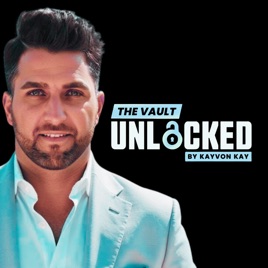
Vault Unlocked is for founders who don't want to learn the hard way.
If you're building something real and you care about growing revenue faster, cleaner, and with fewer blind spots, this podcast is your unfair advantage.
Hosted by Kayvon Kay, Vault Unlocked brings elite founders and operators into conversations they normally keep private. Not the public story. The real one.
The fumbles that cost them millions.
The decision they almost didn't make.
The strategy they only understood after it finally worked.
Every episode is built around one question founders actually care about:
"What do you know now that would have saved you time, money, and pain if you learned it earlier?"
Kayvon goes deep on purpose.
The guests don't hide.
Because surface-level answers don't grow companies.
This is where you learn what not to do, what actually moved the needle, and how the best founders think when things are on the line.
No motivation.
No recycled playbooks.
Just inside access to hard-earned lessons that help you grow faster by learning from other people's mistakes, missteps, and breakthroughs.
If you want to shortcut the learning curve without gambling your own business, Vault Unlocked is for you.
Listen like a founder who plans to win.
Advertise on The Vault Unlocked
Advertise on The Vault Unlocked to promote your brand to thousands of podcast listeners
Check latest episodes from The Vault Unlocked podcast
How AI is Raising the Bar at Every Job (Most People Haven't Felt It Yet)
2026/10/08
Your team is already being measured against a standard you didn't set. AI raised the bar, and the founders who haven't noticed are about to miss opportunities because of it.
Kayvon sits down with Sean Campbell, who has spent three decades watching how people adopt technology, who embraces it and who stalls. Sean sees the pattern in his classroom, in boardrooms and in the companies he helps rebuild around AI. He gives Kayvon the one question he would ask to predict who wins with it, and it has nothing to do with how technical you are. It comes down to how you manage people.
Sean is the CEO of Cascade Insights, and author of The Art of Asking: Collaborating Effectively with AI. He helps leaders redesign work with AI and understand how it is changing their market.
Sean gave a room of future sales reps 30 minutes to pitch a university on a new cafeteria supplier. Within five minutes, some teams wanted to hand in a finished email. Others used AI to attack their own work, found the holes and ended up better prepared than reps who started before AI existed. Same tool, same clock. Completely different outcome. Sean breaks down why that split shows up inside every company, including yours.
From there Kayvon and Sean go after the questions most leaders avoid. Why a great-looking deck or email no longer sets anyone apart. Why this round of job disruption plays out in about a year when the last ones took generations. Why knowing what great work looks like is starting to matter more than having done every step by hand. And what happens to your sales process when a meeting ends with the proposal already written. Kayvon adds his own experience building with AI with zero development background, and the two get into why AI can be your best intern or your worst one depending on you.
This episode is for founders, operators and executives who are responsible for how a team performs over the next five years. If AI is still a search bar in your business, you are leaving growth on the table and your competitors know it.
The conversation also covers how AI is reshaping business growth and sales performance. Sean explains why business owners often see the upside before their employees do, and why delegation and clear context have become core leadership skills in an AI-driven company. They talk about deciding each morning what to give AI and what to keep, how AI slop raises the value of real creative talent, how to keep up when something new launches daily, and why building software for an audience of one is turning into a real edge. Sean closes with what to watch next, and it is robotics.
Questions Answered
How is AI raising the bar at every job?
What skill predicts whether someone will succeed with AI at work?
Why do good delegators get better results from AI?
How should leaders decide what to give AI and what to keep for humans?
Will AI replace jobs faster than past technology shifts?
How is AI changing sales roles and proposals?
Should schools and universities ban AI?
Does learning a craft by hand still matter when AI can do the work?
How can leaders keep up when AI changes every day?
What is "software of one," and why does it matter for business owners?
Why should founders watch robotics alongside AI?
Looking to dive deeper into these conversations and connect with our host and guest?
Follow Sean Campbell:
Instagram
Facebook
LinkedIn
Website
Follow Kayvon:
Instagram
Facebook
LinkedIn
TikTok
Want to go deeper with Kayvon?
Subscribe to the newsletter
Book a discovery call
Get your Revenue Engine Scorecard™️
Hire the right salespeople
How Nike Built the Stories Behind Kobe and LeBron (And What Every Brand Can Learn From It)
2026/10/01
Most people who stall out in their careers never find out why. They did the work and hit the numbers, then watched someone else get the room, the budget, and the title. The rules that decided it were never written down, and nobody was going to hand them over.
Arturo Nunez is the former VP of Marketing for Nike Basketball, where he shaped the public stories of Kobe Bryant and LeBron James. He ran Latin America for the NBA, spent four and a half years at Apple, and served as CMO of the largest digital bank in the world. He grew up in 1970s Harlem with no one in his family who had ever worked inside a corporation. His new book is the manual he wishes he'd been handed on day one.
Kayvon and Arturo start inside the locker room. Arturo explains how his personal friendship with Kobe produced better stories than any title could, and shares the question Kobe asked everyone around him: are you curious or are you committed? Then comes the LeBron problem. After The Decision, young players called him the best in the league, yet none called him their favorite. Arturo walks through how his team borrowed from Muhammad Ali in Zaire to build the "Training Day" campaign and flip the public story.
The second half turns to the unwritten rules: the difference between a mentor and a sponsor, why a win that costs you the relationship is a pyrrhic victory, and the rule he calls the meeting before the meeting.
Founders, executives, marketers, and operators who already have the skill and can't figure out why the next level isn't opening up. First-generation professionals without a family roadmap. Leaders building diverse teams. If you believe good work speaks for itself, this conversation will be uncomfortable, and it should be.
At its core, this episode is about influence inside organizations and how career growth happens once talent stops being the differentiator. Arturo makes the case that storytelling is the most powerful skill in marketing and leadership, and connects it to navigating a matrix organization, where results depend on relationship capital with people who don't report to you. The discussion covers stakeholder alignment before high-stakes presentations, the role of sponsorship in reaching the C-suite, and why diversity is a revenue decision for any business entering new markets.
QUESTIONS ANSWERED
How did Nike build authentic brand stories around Kobe Bryant and LeBron James?
What is the difference between a mentor and a sponsor?
How do you get buy-in before a high-stakes executive meeting?
Why do talented people get passed over for promotion?
How do you build win-win relationships in a matrix organization?
Why is diversity a business advantage?
How do first-generation professionals navigate corporate America?
Looking to dive deeper into these conversations and connect with our host and guest?
Follow Arturo Nunez:
Instagram
LinkedIn
Buy Arturo's Book
Website
Follow Kayvon:
Instagram
Facebook
LinkedIn
TikTok
Want to go deeper with Kayvon?
Subscribe to the newsletter
Book a discovery call
Get your Revenue Engine Scorecard™️
Hire the right salespeople
Why Emotional Energy Is the Real X-Factor in Scaling a Business (Not Strategy)
2026/09/23
Most founders think strategy is what separates the businesses that scale from the ones that stall. It isn't. Lee Benson built an aerospace maintenance company from zero to over 100 million dollars with no outside investors and sold it for a 21.6x EBITDA multiple, in an industry where an 8x is considered a strong exit. He says the real driver wasn't the strategy. It was something almost nobody tracks.
Lee Benson is the founder of ETW, where he runs CEO mastermind groups and coaches roughly thirty CEOs at a time, and the founder of Dinner Table, a family value creation platform now serving over 40,000 parents. He has started eight companies from scratch, currently runs two as CEO, and wrote the book Your Most Important Number. His biggest exit, Able Aerospace Services, went from zero to a hundred million dollars in the aviation aftermarket business, repairing and overhauling aircraft parts, and sold in 2016 for a multiple most private equity buyers would never approach.
In this episode, Lee breaks down what he calls holistic value creation, a framework built on three inputs: material value, emotional energy, and spiritual value, which he defines as connectedness. He argues emotional energy is the scarcest resource in business because it supercharges everything a leader touches, and it is contagious inside a team whether a leader wants it to be or not. He walks through the specific habits, self-talk patterns, and recovery routines he uses to keep his own energy at a nine or ten instead of a three or four, and why he believes nobody actually knows the ceiling on what they are capable of building.
The conversation goes deep into how Lee structured Able Aerospace around a strict integrity model. Every team member had a clearly defined role, results were tracked without exception, and roughly 22 percent of pre-tax profit was distributed back to the team every month, proportionate to income, starting on day one of employment. No waiting period, no tiered eligibility. Lee explains why that structure outperformed traditional bonus models and how it turned frontline employees into people as invested in outcomes as leadership.
Lee also unpacks why he and his late business partner, former GE CEO Jack Welch, believed 80 to 90 percent of the 166 billion dollars spent annually on leadership development in the United States is wasted. He explains what most companies get wrong when they measure the wrong things, why he refuses to accept the idea that anyone is a victim of their own circumstances inside a business they lead, and the leadership traits he coaches into every CEO in his mastermind groups.
This episode is for founders, CEOs, and operators who are scaling past the point where hustle alone gets results. It is for leaders who have hit a ceiling they cannot explain with numbers and are starting to suspect the missing variable is not tactical. It is not for anyone looking for a motivational pep talk. Lee does not deal in that currency.
Throughout the conversation, Lee connects emotional energy to sales leadership, team performance, and long-term business growth, and explains why founders who ignore this input plateau no matter how strong their systems or strategy look on paper. He talks about building intentional culture, why productive engagement drives value creation at every level of an organization, and how leaders can diagnose whether their own energy is quietly lowering the output of everyone around them. The discussion also covers what it actually takes to scale a company without outside capital, why equity should be earned rather than granted, and why most leadership development spend never gets measured against real results.
Questions answered in this episode:
Why is emotional energy considered the real X-factor in scaling a business
How did Lee Benson scale Able Aerospace from zero to 100 million dollars with no outside investors
What is the holistic value creation framework
Why do most leadership development programs fail to change actual results
How should profit-sharing and bonus structures be built to actually drive performance
What leadership traits predict whether a leader can scale a team
How does self-talk and personal recovery affect a leader's decision-making under pressure
What did Lee Benson learn building his leadership philosophy alongside Jack Welch
Looking to dive deeper into these conversations and connect with our host and guest?
Follow Lee Benson:
Instagram
Facebook
LinkedIn
YouTube
Work with ETW
Work with Dinner Table
Follow Kayvon:
Instagram
Facebook
LinkedIn
TikTok
Want to go deeper with Kayvon?
Subscribe to the newsletter
Book a discovery call
Get your Revenue Engine Scorecard™️
Hire the right salespeople
How to Increase Your Website Conversion Rate (3 Free Fixes Anyone Can Make)
2026/09/16
Most businesses run their websites off of a feeling, pure gut instinct. A stock photo here, a red button there, a template because it "looked good." Sahil names that for what it is, then shows exactly what replaces it.
Sahil Patel CEO of Spiralyze, built his career two SaaS companies deep, and by the time he became a customer of Spiralyze, he had already sat through enough failed website redesigns to know the truth nobody wants to hear. Your best guess about what converts is still just a guess. Four years later he now owns the company, and what he found by analyzing other people's live A/B tests changes how you should think about every page on your site.
In this conversation, Sahil breaks down why A/B testing is the same double blind logic that proves a drug works, why B2B websites need bigger, bolder test variations than e-commerce sites pulling in millions of visitors, and why copying a single "winning" test from a competitor is a trap he calls the winner's curse. He explains what predictive CRO actually means: pulling winners and losers from hundreds of similar companies' public tests instead of betting on one anecdote.
Then he hands over three things anyone listening can fix today, for free, before hiring an agency or a data scientist. He names the exact mistake quietly killing conversions on most B2B homepages right now (stock photos of happy people with nothing to do with the product), the fastest way to find out if your imagery is actually working (a translation trick that takes five minutes), and the rule that decides whether your headline is a hook or noise. He closes with a bonus test that shows in about sixty seconds whether your homepage sounds like every competitor you have.
This episode is for founders and operators running B2B SaaS or service businesses who are making website and messaging decisions based on instinct, internal opinion, or "what worked at my last company." It is for marketing leads tired of hearing "best practice" as a justification and looking for an actual method instead. It matters most if your business does over fifty million in revenue and generates leads through your website, because that is exactly where this conversation lives. If your site gets under a hundred form fills a month, Sahil is direct about why testing is not your next move yet, and what is.
The conversation covers conversion rate optimization, A/B testing methodology, homepage design, lead generation, B2B SaaS growth strategy, sales funnel psychology, and the copywriting principles that turn a website into an actual salesperson instead of a digital brochure. Sahil also breaks down the difference between testing for direct to consumer traffic versus B2B traffic, how statistical significance actually works, and why the agency or in house team you already pay still has a data problem you may not know about.
Questions Answered:
What is A/B testing and how does it actually work
How much website traffic do you need before A/B testing is worth it
What is predictive conversion rate optimization and how is it different from standard CRO
Why do stock photos hurt website conversions
How can you tell if your website's imagery is doing its job
What makes a strong homepage headline versus a weak one
How do you know if your website messaging is actually different from your competitors
Looking to dive deeper into these conversations and connect with our host and guest?
Follow Sahil Patel:
LinkedIn
Website
Watch CRO Crimes
Follow Kayvon:
Instagram
Facebook
LinkedIn
TikTok
Want to go deeper with Kayvon?
Subscribe to the newsletter
Book a discovery call
Get your Revenue Engine Scorecard™️
Hire the right salespeople
Why Agency Owners Get Stuck Between $1M and $10M (And Never Get Out)
2026/09/09
Most agency owners hit seven figures and assume the hard part is behind them, but it isn't. Somewhere between one million and ten million dollars in revenue, growth stalls, hours multiply, and the business that was supposed to set you free starts running you into the ground instead. Nick Avaria has bought and sold seven agencies and watched this exact pattern repeat without exception. If your revenue has plateaued and you can't explain why, this conversation names the reason.
Nick Avaria is the founder of Agency Acquisitions, where he works exclusively with agency owners caught in this stretch. In this conversation with Kayvon Kay, he maps out what he calls the swamp: the zone between one and ten million dollars in revenue where founders get stuck longer than anywhere else in the business lifecycle, and where up to 65% of middle managers add negative value instead of freeing up the owner's time.
Nick breaks down why the jump from founder to CEO has nothing to do with revenue and everything to do with whether the people around you are smarter than you. He explains the single hiring mistake responsible for most broken management layers: promoting the best individual contributor into a role that requires a completely different skill set. And he lays out the triple net win framework his clients use to align employee performance, business results, and client outcomes into one measurable system.
The conversation also covers lifetime value as the first number Nick checks in any business, why some agencies can profitably spend $40,000 to acquire a single client, and how smaller agencies use service and retention to compete against holding companies spending millions a month on ads.
This episode is built for agency owners and founders generating between one and ten million dollars in annual revenue who feel busier now than when they started. It's for operators who have hired managers and still find themselves doing the work anyway, and for anyone deciding whether to stay the technical expert in their business or build the systems required to actually leave the day to day. If the business runs fine without you in the room, this isn't for you. If it doesn't, listen closely.
This conversation covers the operational and leadership systems required to scale an agency past the seven-figure ceiling, including middle management structure, KPI design, customer acquisition cost, and lifetime value benchmarking. Nick and Kayvon also unpack the mindset shift between founder-led sales and CEO-level leadership, what separates a strategic partner from a vendor in B2B service relationships, and how the right behavior-change systems replace founder dependency with sustainable growth.
Questions Answered
Why do agency owners get stuck between $1 million and $10 million in revenue?
What's the actual difference between a founder and a CEO?
Why do most middle managers fail to add value to a business?
What's the biggest mistake owners make when promoting employees into management?
How do you calculate customer lifetime value for an agency?
Why can some agencies afford a higher customer acquisition cost than their competitors?
What are triple net wins and how do they improve team performance?
How do you build a management layer without losing control of the business?
Looking to dive deeper into these conversations and connect with our host and guest?
Follow Nick Avaria:
Instagram
LinkedIn
Website
Follow Kayvon:
Instagram
Facebook
LinkedIn
TikTok
Want to go deeper with Kayvon?
Subscribe to the newsletter
Book a discovery call
Get your Revenue Engine Scorecard™️
Hire the right salespeople
Why Most E-Commerce Brands Are Measuring the Wrong Metrics (And Paying for It)
2026/09/02
Most e-commerce brands are not losing because their product is bad or their ads are off. They are losing because they are measuring the wrong things and making decisions based on data that was never designed to tell the whole story.
Mark Young is the founder of RYZE Agency, a PhD in functional medicine, a career educator, and one of the sharper strategic minds operating in direct-to-consumer and health and wellness e-commerce today. His five-book series, the E-Commerce Guide to the Galaxy, is built for founders who refuse to be taken advantage of by agencies again.
ROAS is not a health metric. It is a signal. And the business owners who treat it as a target are handing their agencies a blueprint for smoke and mirrors. Mark Young, PhD has spent over a decade watching this play out in real time, walking into client relationships already contaminated by bad metrics, bad incentives, and the kind of blind trust that costs brands their momentum. He wrote five books on it because the problem is not a tactic problem, it's a literacy problem.
In this conversation, Mark breaks down the specific metrics that actually drive e-commerce growth and explains why the ones most brands obsess over are actively working against them. Kayvon and Mark go deep on the Holy Trinity of Metrics: lifetime value, average order value, and new customer acquisition cost. They walk through how a business can rationally spend $300 to acquire a $100 customer, why blended MER matters more than account-level ROAS, how cross-channel attribution is being double-counted across Meta, Google, and email simultaneously, and how the "ready, fire, aim" wiring of most entrepreneurs is exactly what makes them vulnerable to the metrics game agencies play.
They also cover AI, hiring, and the structural shift happening inside lean agencies: fewer people running more sophisticated operations, with intellectual curiosity replacing credentials as the primary hiring filter.
This conversation is for founders, operators, and marketers managing e-commerce brands or working inside them. It is for people who want to understand how to read a marketing dashboard like a business owner, not a media buyer. If you are running paid ads, managing agency relationships, or trying to understand why your numbers look fine but growth feels stuck, this one will reframe how you see the whole game.
Topics covered include e-commerce marketing strategy, return on ad spend, customer acquisition cost, new customer acquisition cost, direct-to-consumer marketing, lifetime value optimization, average order value, media efficiency ratio, cross-channel attribution, marketing analytics, agency accountability, e-commerce brand building, AI in marketing operations, digital marketing metrics, and health and wellness brand growth.
Questions Answered:
Why is ROAS a bad metric for most e-commerce brands?
What is the Holy Trinity of Metrics for e-commerce growth?
What is the difference between CAC, NCAC, and CPA?
How do you calculate how much to spend acquiring a new customer?
What is blended MER and why does it matter more than account-level ROAS?
How do agencies use metrics to hide underperformance?
How does cross-channel attribution work, and why is double-counting so common?
When is it rational to lose money on the first sale?
How is AI changing the structure of lean marketing agencies?
What should founders look for when evaluating an agency relationship?
Looking to dive deeper into these conversations and connect with our host and guest?
Follow Mark Young:
Instagram
Facebook
LinkedIn
Website
Shop Mark's Books
Ryze Agency
Follow Kayvon:
Instagram
Facebook
LinkedIn
TikTok
Want to go deeper with Kayvon?
Subscribe to the newsletter
Book a discovery call
Get your Revenue Engine Scorecard™️
Hire the right salespeople
How Military Technology Became a Pain Relief Patch (The Accidental Breakthrough Nobody Expected)
2026/08/26
Most breakthrough products start with a problem. Signal Relief started with Navy SEALs, an 80-pound backpack, and a five-foot antenna. Mike Hammond had already built and sold one of the largest Dish Network retailers in the United States when he was pulled into a very different world: advanced antenna technology being developed to help reduce the weight soldiers carried into the field.
The goal was straightforward. Shrink the antenna, reduce the power, make the signal travel farther. Then something happened that nobody on the team was looking for. Before the antennas were even connected to a radio, they started picking up what the engineers thought was electrical noise. The noise wasn't coming from the building. It was coming from the human body.
In this episode, Mike walks through exactly how that discovery led to Signal Relief, a wearable wellness patch that redirects pain signals out of the body rather than masking them. No chemicals. No medication. No side effects across 800,000 units sold. He breaks down the science in plain terms, the five clinical trials that keep landing at 85 percent efficacy, the White House cabinet member whose foot pain vanished in two days, the horse that was going to be put down and stood up walking two hours after the patch was applied, and the mother's email that is posted on the wall of Signal Relief's corporate office because it says everything the company cannot say in an ad.
This is also a story about what happens when an entrepreneur from the satellite industry stumbles into health and wellness and refuses to let regulatory friction stop him from getting something real into people's hands.
This episode is for founders who want to understand what a hardware-based health innovation actually looks like to build, for operators who study how a product with military origins crosses into consumer markets, and for anyone who has watched someone they care about manage chronic pain without real relief.
The conversation covers how pain works at an electrical level and why that matters for non-pharmaceutical solutions, the growing landscape of stacked wellness modalities and where wearable technology fits inside it, what FDA clearance requires versus what a health and wellness designation allows right now, and how Signal Relief is being studied at the Georgetown clinical level following its debut at a MAHA event in Washington D.C.
It also gets into what the product does not do, which matters as much as what it does, and how Mike thinks about building trust in a market that has been burned by inflated claims too many times.
Questions Answered in This Episode
How does the Signal Relief patch actually work?
What is the science behind electrical pain signals and neural pathways?
Can a wearable patch replace pain medication for chronic pain?
What did five clinical trials show about Signal Relief's efficacy?
How did military antenna technology lead to a consumer wellness product?
What is phantom limb pain and can Signal Relief help?
How is Signal Relief different from a TENS unit?
What conditions has Signal Relief been tested on?
What does FDA clearance for a pain patch require?
Is Signal Relief a legitimate product or an MLM?
Looking to dive deeper into these conversations and connect with our host and guest?
Follow Mike Hammond and Signal Relief:
Instagram
Facebook
Youtube
Website
For a discount code on Signal Relief patches, reach out to Mike Hammond.
Follow Kayvon:
Instagram
Facebook
LinkedIn
TikTok
Want to go deeper with Kayvon?
Subscribe to the newsletter
Book a discovery call
Get your Revenue Engine Scorecard™️
Hire the right salespeople
How a Near-Fatal Car Accident Made Guinness World Record Holder Jenn Drummond Stop Living for Everyone Else
2026/08/19
Jenn Drummond had no mountaineering experience, no tolerance for sleeping in tents, and a fear of heights she did not discover until she was ten feet off an indoor climbing wall during her first training session. Three years later, she became the first woman in history to complete the Seven Second Summits, standing on the second-highest peak on every continent and earning her place in the Guinness World Records as one of the most unlikely and most documented athletic achievements in modern history.
Jenn Drummond is a Guinness World Record holder, entrepreneur, speaker, and mother of seven. She built and scaled a white-label investment platform for institutional clients, walked away to raise her family, and nearly died in a car accident in 2018 that forced her to stop performing a version of herself and start building from the real one. What followed was nine mountains, seven continents, a teammate lost in an avalanche on K2, and a record no woman had ever completed.
The episode opens on the car accident. Not as backstory. As the diagnostic. The universe gives you cues, Jenn says. If you do not hear them, they get louder. The crash was loud enough. From there, the conversation moves into what it actually looked like to pursue a world record in a discipline she had no business attempting, hire the wrong guides and learn from it, develop a fear of heights mid-training and build a thirty-day protocol to climb through it, and turn back on K2 after a teammate died in an avalanche rather than summit without him.
They also get into what Guinness told her after she submitted seven mountains' worth of documentation and believed she had finished. Two more mountains. Different continent interpretation. Different geopolitical boundary. Jenn's response was not a fight. It was a calendar invite for the next climb.
The conversation closes on what she is building now, a project built around the someday lists people carry but never act on, and why she believes the founders most at risk of living on autopilot are the ones who have optimized everything except the life underneath the business.
If close rate is still your primary metric for a life well lived, this episode will change how you run the numbers.
Questions Answered
What does it actually take to pursue a world record with zero relevant experience?
How do you rebuild your identity after a near-fatal accident?
How do you respond when the finish line moves after you believe you already crossed it?
What is the difference between external validation and internal authority?
Why do the most optimized founders often have the least examined lives?
How do you model resilience for your children without performing it?
What does it mean to stop deferring and start building the life you keep postponing?
What is the real cost of waiting for outside permission to pursue the life you already know you want?
How do high-achieving people know when to stop optimizing and start experiencing?
What happens to your sense of purpose when the goal you built your identity around is finally finished?
Looking to dive deeper into these conversations and connect with our host and guest?
Follow Jenn Drummond
Instagram
Facebook
Linkedin
X
TikTok
YouTube
Website
Follow Kayvon:
Instagram
Facebook
LinkedIn
TikTok
Want to go deeper with Kayvon?
Subscribe to the newsletter
Book a discovery call
Get your Revenue Engine Scorecard™️
Hire the right salespeople
Why the Setter-Closer Model Still Wins (And How to Build One That Actually Scales)
2026/08/12
Josh Troy, co-founder of Curvion Blue and 12-year high-ticket sales operator, joins Kayvon Kay on to break down what a real sales operation looks like from the inside, and why most founders have never actually built one.
Most sales problems are not sales problems. They are infrastructure problems dressed up as performance problems. You hired the wrong person, handed them the wrong metrics, and wondered why nothing scaled. Josh has seen it hundreds of times. So has Kayvon. This conversation is two operators comparing notes without cleaning it up for the audience.
The episode opens on the setter-closer model. Why it still wins, and why it has nothing to do with preference and everything to do with leverage. From there, Josh introduces the golden formula: lead flow multiplied by sales performance equals revenue. Two variables. Two sides of the table. A feedback loop most businesses have never actually built.
The conversation moves into the validation sequence, a diagnostic framework that identifies exactly where a revenue operation is breaking down before anyone blames the wrong variable. Lead quality first. Rep performance second. Pitch design third. Offer design last. Run it in order, document it in a validation matrix, and you stop having the marketing-versus-sales argument and start having a data conversation.
They also cover why close rate is the wrong primary metric, what collected dollars per booked call actually measures, how the funding waterfall increases average sales price without burning the deal, and what a technical close is and why tracking it separately protects your reps and your client relationships.
The episode closes on conviction. A rep with modest skill and full conviction will outsell a rep with all the right skills and zero belief every time.
If close rate is still your primary rep metric, this episode will change how you run the numbers.
Questions Answered
Why does the setter/closer model outperform the full-cycle rep model at scale?
What is the validation sequence and how does it replace "lead quality" as a diagnostic?
What is the golden formula and how do you use it to find where revenue is leaking?
What is a SIP and how does it differ from a PIP?
What is the funding waterfall and how does it protect average sales price?
What is a technical close and why should it be tracked separately?
Why does a good rep with great systems beat a great rep with bad systems?
What is CDPBC and why is close rate the wrong primary metric?
Looking to dive deeper into these conversations and connect with our host and guest?
Follow Josh Troy:
Instagram
LinkedIn
TikTok
YouTube
Learn more about Curvion Blue
Follow Kayvon:
Instagram
Facebook
LinkedIn
TikTok
Want to go deeper with Kayvon?
Subscribe to the newsletter
Book a discovery call
Get your Revenue Engine Scorecard™️
Hire the right salespeople
Inner Empire: Why Unfinished Tasks Are Quietly Draining Your Income
2026/08/05
Meir Ezra, entrepreneur, speaker, and founder of Guaranteed Prosperity, sits down with Kayvon Kay for part two of a three-part series called Inner Empire.
Every task you have not finished is still running in the background of your mind. It is pulling your attention, your energy, and your money without you noticing. Meir names exactly what is happening inside your head when you stall, freeze, or half finish something, and exactly what it is costing you. This is not a mindset conversation. It is a mechanism, and once you see it, you cannot unsee it.
The episode opens with a distinction most people have never made: the difference between operating as cause and operating as effect. Meir breaks down what the mind actually is, a rapid series of pictures running in the background, not a personality trait or a mindset setting, and why trying to fix your mindset is often solving the wrong problem entirely.
From there the conversation moves into a full reframe of insanity. Not the definition everyone repeats, but a sharper one: attention stuck in the past. Meir ties this directly to why smart, capable founders stay stuck long after they already have the knowledge to move forward.
The middle of the episode gets uncomfortable in the right way. Meir tells two real stories, one involving a physical ailment tied to unresolved grief, another about a man whose career stalled for decades over a decision made at seven years old, to show how unclosed emotional loops physically show up in the body and in the business. He also shares his own story of closing a hundred million dollar deal in South Africa with no money, no English, and no track record, to prove the difference between believing something is possible and knowing it.
The episode closes with the most practical section of the conversation, a three step method, start, change, stop, for identifying and closing every open loop currently draining your attention. Meir makes the case, directly and without hedging, that control equals income, and that every task left unfinished is a leak in both.
Who this is for: Founders and operators who already have the knowledge and still cannot execute. Anyone running a business who has noticed the same pattern repeating, the same procrastination, the same unfinished task, the same excuse, and suspects it is not a discipline problem. This is not for anyone looking for a quick affirmation or a surface level productivity hack. This is a mechanism, not a pep talk.
The conversation touches directly on business growth and why so many founders plateau despite having the right strategy, the right offer, and the right market. Meir connects personal control to income and leadership capacity, arguing that the systems most entrepreneurs build to scale a business are secondary to the internal system running their own decision making. He also addresses the difference between mindset work and actual behavioral change, a distinction that matters for anyone trying to lead a team, close high ticket sales, or build sustainable business systems without burning out in the process. For operators who understand the mechanics of growth but keep hitting an invisible ceiling, this conversation names the ceiling directly.
Questions Answered:
What is the real definition of insanity, according to Meir Ezra?
Why do unfinished tasks and open loops drain your income and focus?
What is the difference between the mind, the spirit, and the body?
Why does knowing something feel different from believing it?
How did Meir Ezra close a $100 million deal with no money and no English?
What is the Start, Change, Stop method for closing open loops?
How does unresolved emotional pain show up as physical or business limitation?
Why does control equal income?
Looking to dive deeper into these conversations and connect with our host and guest?
Follow Meir Ezra:
Instagram
Facebook
LinkedIn
X
TikTok
Website
Follow Kayvon:
Instagram
Facebook
LinkedIn
TikTok
Want to go deeper with Kayvon?
Subscribe to the newsletter
Book a discovery call
Get your Revenue Engine Scorecard™️
Hire the right salespeople
Why Building With AI Got Easy and Maintaining It Got Brutal with Fathom CEO Richard White
2026/07/29
Building software has never been easier. Keeping it alive has never been harder. Most founders adopting AI right now have only priced in the first half of that sentence.
Richard White is the founder and CEO of Fathom, the top rated AI note taker on G2. He started the company just before 2020 on two bets almost nobody agreed with: transcription costs would fall to zero, and AI would get good enough to do something useful with what it heard. Both were right. He breaks down what actually changed, what didn't, and why the maintenance cycle is the part nobody warns you about.
A new frontier model lands every three to six months. The other side of that coin is that a model gets deprecated every three to six months too. Build on one version and you have about six months before you rebuild on the next.
Richard explains why Fathom is moving workloads off frontier models and onto open source, not to save money, but because the upgrade cycle is unsustainable for anything you intend to maintain. He walks through why a purpose-built pipeline running five or six models still beats a single general purpose call, what happens to accuracy when you're searching for something that appears in one percent of your meetings, and why the GPT-5 release that landed flat commercially mattered enormously to anyone solving retrieval problems.
Then he flips it. Fathom operates like a Formula One team because it competes at the frontier and throws away the engine after every race. A normal business isn't in that race. Move your build from one model version to the next and it'll be slightly worse and close enough that you won't care. The maintenance cost is real. It is not a reason to wait.
This is for founders and operators making real decisions about AI inside a business that already generates revenue, and for domain experts sitting on knowledge they've never been able to productize. Software markets that were never worth raising against are now buildable in a weekend by the person who already understands the customer.
Questions Answered
Why has building with AI become easier while maintaining it has become harder?
Why is Fathom moving from frontier models to open source?
How should a business owner adopt AI without it becoming a full time job?
What replaces the meeting when AI captures and routes the information for you?
Why doesn't dumping all your transcripts into a chatbot work?
What does managing AI agents have in common with managing people?
How does model capability map to what you can safely delegate?
Can a domain expert now build profitable software without funding or a team?
Is headcount still a useful proxy for company size?
Looking to dive deeper into these conversations and connect with our host and guest?
Follow Richard White:
LinkedIn
X
Learn more about Fathom
Follow Kayvon:
Instagram
Facebook
LinkedIn
TikTok
Want to go deeper with Kayvon?
Subscribe to the newsletter
Book a discovery call
Get your Revenue Engine Scorecard™️
Hire the right salespeople
How Real Brands Build Trust and Consistency (Most Companies Miss This Entirely)
2026/07/22
Most businesses think branding is marketing. It's not. And that single confusion costs them millions in lost trust, positioning, and growth.
Howard Lim has spent his career helping companies to build and rebuild their brands. He breaks down exactly where businesses get branding wrong, why consistency matters more than creativity, and how the brands people actually want to buy are built on systems, not slogans.
If your business isn't printing the value you know it's worth, this is likely why. Branding isn't about what you say. It's about what people think about you. The gap between those two things is where most companies fail.
Howard lays out the three core components of real branding and which one most companies skip entirely. He walks through the difference between branding and marketing, why your designer might be killing your brand without knowing it, and how McDonald's and Apple's consistency builds trust the same way every major scaled brand does. You'll learn why aspiration in branding actually increases customer loyalty rather than chasing away local buyers, and the one rule that breaks a brand overnight.
The framework here applies whether you're a personal brand scaling a service business, a product company expanding into new markets, or an operator building a brand that compounds over time.
Questions Answered
What are the three parts of branding, and why do most companies skip one entirely?
What's the real difference between branding and marketing?
How do positioning and customer experience create equilibrium and build trust?
What's the one consistency rule that turns a brand into a real asset?
Why does aspirational design actually outsell relatable design?
Why is brand identity different across media? (And why your social post isn't your billboard)
What's the cost of designer freedom versus brand discipline?
How do trust and repetition actually build brand loyalty?
Looking to dive deeper into these conversations and connect with our host and guest?
Follow Howard Lim:
YouTube
LinkedIn
X
Website
Work with Howard: Email - [email protected]
Follow Kayvon:
Instagram
Facebook
LinkedIn
TikTok
Want to go deeper with Kayvon?
Subscribe to the newsletter
Book a discovery call
Get your Revenue Engine Scorecard™️
Hire the right salespeople
Why Talented People Fail and Tenacious People Don't (The U2 Roadie Who Proved It)
2026/07/15
A psychologist told Scott Scovill it would be easier for him to grab a red-hot stove and hang on than to try at anything. His fear of failure was that severe. It flunked him out of college and left him waiting tables at a roadside Howard Johnson's.
Then a tour bus rolled in one day, and everything he believed about talent, fear, and what it takes to make it got dismantled.
In this conversation, Kayvon pulls apart how a college dropout with a clinical fear of failure snuck into U2 shows for five weeks with a homemade laminate, lived in his car, worked for free, and landed on the biggest Rolling Stones tour in the world within three years. Scott breaks down the pattern he found when interviewing household names for his book, including Brad Paisley, Alan Jackson, Peter Frampton, and Olympic champion Scott Hamilton. He also spoke to NASA astronauts, athletes, CEOs, a Navy SEAL, and many more. None of them credit talent. Every one of them credits refusing to quit. He explains why the most talented people you've never heard of gave up, why fear operates through small deflections more than big walls, and why one step forward instantly changes who you are.
This episode is for founders, operators, and sales professionals who have been hiding behind preparation, credentials, or perfectionism instead of moving. If you believe talent is the reason others are winning, this conversation will take that excuse away from you.
The episode covers overcoming fear of failure, building a business from nothing, the mindset behind long-term success, how top performers in music and entertainment think about risk, and why tenacity is the only success factor that is one hundred percent developable. Scott's story maps directly onto sales, leadership, and entrepreneurship, where the gap between knowing what to do and doing it decides everything.
Topics covered:
The clinical fear of failure that froze Scott's early life
Sneaking into U2 shows for five weeks
Landing the Rolling Stones tour within three years
Imposter syndrome at the top and how identity catches up
Why household names credit tenacity, never talent
Learning to sing in his forties and opening for Brad Paisley
The Tim Ferriss conversation that changed how Scott lives
Fear as deflection: the small avoidances that cost you your dream
The one-step rule that turns "someday" into momentum
Looking to dive deeper into these conversations and connect with our host and guest?
Follow @scottscovillcreative
Instagram
Facebook
Spotify
Apple Music
X
TikTok
Website
Get your copy of 'Tenacious' by Scott Scoville
Follow Kayvon:
Instagram
Facebook
LinkedIn
TikTok
Want to go deeper with Kayvon?
Subscribe to the newsletter
Book a discovery call
Get your Revenue Engine Scorecard™️
Hire the right salespeople
How to Get Your Business Recommended by ChatGPT, Claude and Other AI Search Tools
2026/07/08
Your customers stopped Googling. They ask ChatGPT now.
And when ChatGPT answers, it recommends someone. If that someone is not you, this episode explains exactly why, and exactly what to do about it. One founder already cracked it: 10 million impressions from ChatGPT, zero dollars in ad spend, and an American Marketing Association campaign of the year award to prove it was not luck.
Anya Cheng spent her career building products and marketing at Meta, eBay, Target, and McDonald's tech headquarters before founding Taelor, an AI-powered menswear rental company in Silicon Valley. She is a Northwestern lecturer, TEDx speaker, bestselling author, and mentor at 500 Startups. In this conversation, she opens the playbook most agencies are still guessing at.
The episode starts with the business itself: an AI stylist backed by human experts that dresses busy operators for the outcome they need. A deal to close. A courtroom to win. A first date that earns a second one. Then Kayvon does what he does on every episode and reverse engineers the real gold. The conversation turns to how Taelor actually acquires customers, and the answer is not ads. It is AI search. Anya breaks down why sentiment now outranks keywords, why Reddit threads and review platforms feed the machines, why AI can analyze your video and podcast content beyond the keywords Google Search relied on, and how a human-AI content flywheel turns proprietary data into a moat no competitor can copy.
This one is for founders, operators, and marketing leaders who feel the ground shifting under their acquisition strategy. If your growth plan still assumes people find you through a search bar, you are optimizing for a behavior that is disappearing.
The conversation covers answer engine optimization, AI SEO, generative engine optimization (GEO), and the practical mechanics of getting cited by the likes of ChatGPT, Claude and Gemini. It digs into proprietary data as a competitive advantage, building content flywheels that combine human expertise with AI scale, customer acquisition without paid ads, subscription business models, and what it takes to become an AI-native company instead of a company that merely uses AI.
Topics covered:
How Taelor's AI plus human stylist model works
Why fashion companies were built for the wrong customer
The shift from Google search to AI recommendations
Sentiment, reviews, and context: the new ranking signals
The exact content system behind 10 million ChatGPT impressions
Why proprietary data is the only real moat in the AI era
The 40 percent problem: fashion's unsold inventory crisis
Dressing for outcomes: deals, courtrooms, and second dates
Looking to dive deeper into these conversations and connect with our host and guest?
Follow Anya Cheng:
Instagram
Facebook
LinkedIn
Learn more about Taelor.style
Use code PODCAST25 for 25% off your first month with Taelor
Use code PODCASTGIFT for 10% off a Taelor gift card
Follow Kayvon:
Instagram
Facebook
LinkedIn
TikTok
Want to go deeper with Kayvon?
Subscribe to the newsletter
Book a discovery call
Get your Revenue Engine Scorecard™️
Hire the right salespeople
Why Presence Beats Performance in Leadership (Most Founders Get This Backwards)
2026/07/01
Most leaders think the problem is that they are not doing enough, but that's usually not it.
The people you are trying to reach, your kids, your team, your clients, do not need more from you. They need you to actually be present, and almost nobody is.
This episode is about the gap between performing leadership and being present in it, and why closing that gap changes everything downstream.
Renée Marino, actress, author and speaker joins the show to break down what presence actually looks like in practice, not as a feeling but as a discipline. She talks about catching herself in the trap of constant doing, the cost of treating attention as something you can fake, and a 10 year old video that reminded her what people actually remember.
Renée walks through the morning practice she uses to lead from a grounded place: phone out of the room, pen to paper, one question asked and answered before the day starts pulling at you. The argument is simple. You connect with the most important person first, yourself, and every other connection that day runs cleaner because of it.
This one is for founders and operators who have built the business but feel scattered inside it. For leaders who are present on paper and absent in the room. For anyone who has confused activity with attention and is starting to feel the difference.
The conversation moves through authentic communication, the discipline of slowing down internal noise, and why presence is a leadership skill rather than a soft one. It connects personal alignment to how you show up with a team, how you build trust without performing, and why the founders who scale sustainably tend to be the ones who learned to be before they learned to do more.
Topics covered:
Why doing more is often a substitute for being present
The real cost of distracted, performative attention
The 10 minute morning practice for clarity and alignment
Why writing by hand changes how you start the day
How personal presence shapes the way you lead a team
Looking to dive deeper into these conversations and connect with our host and guest?
Follow Renée Marino
Instagram
Facebook
LinkedIn
TikTok
Website
Follow Kayvon:
Instagram
Facebook
LinkedIn
TikTok
Want to go deeper with Kayvon?
Subscribe to the newsletter
Book a discovery call
Get your Revenue Engine Scorecard™️
Hire the right salespeople
Podcast reviews
Read The Vault Unlocked podcast reviews
4.2 out of 5
174 reviews
★★★★★
jeff1949 2025/12/18
How does he get the guests?
Great guests who really know what they are talking about.
★★★★★
SalesGuru_Marcus26 2025/12/12
Brutal Honesty Works
Kayvon says the things nobody else will and that's exactly why it works. I've been in sales for 15 years and this is the first time I've heard feedbac...
★☆☆☆☆
Polkypot1 2025/12/11
Why is this charting?
No one is listening. Something weird happening here
★★★★★
Ben Albert 2025/12/04
Killer
Killer host that for real cares about adding value.
★★★☆☆
1159314 2025/10/31
Interrupted
Wow can the host Kayvon interrupt his guest any more. Too much for me and that was the HR podcast. I am a first-timer here and that was enough.
★★★★★
Ñíŕøb Kháñ 2025/10/04
Great Entrepreneurs on the Go
As a startup founder, I don’t have much time. But this podcast is perfect for my daily commute. Each episode gives one golden takeaway I can apply imm...
★★★★★
Shamim mix 2025/09/29
Motivational, but Action-Oriented
What I like most is that you don’t just feel inspired you get a to-do list. After listening, I often walk away with one or two tactics I can test imm...