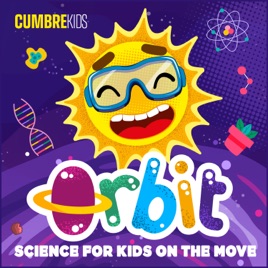
Advertise on podcast: Orbit: Science for kids on the move!
Rating
5from
This podcast has
32 episodes
Language
EnglishPublisher
Cumbre KidsExplicit
No
Date created
2025/09/15
Latest episode
2026/09/22
Average duration
26 min.
Release period
8 days
Description
Kids ask + scientists answer! Featuring scientists from leading museums, universities, zoos, and more! Perfect for families with children ages 3-10 🌟 Submit your kids' questions: www.cumbrekids.org/questions A podcast by Cumbre Kids. Episodes in Spanish on: 🧬 Cráneo: Ciencia para niños curiosos 🦎 Camaleón: Animales para niños curiosos
Unlock Orbit: Science for kids on the move! podcast Email contact info,
Listeners & Audience details
Email contact information
Direct podcast contact details

Listeners
Audience numbers & engagement insights

Audience details
Podcast Insights

Podcast episodes
Check latest episodes from Orbit: Science for kids on the move! podcast
Sea otters: Superheroes of kelp forests!
2026/09/22
Sea otters aren't just adorable! They're a critically important keystone species for a fascinating underwater ecosystem - kelp forests!
In this episode of the Wild Critters series, we're joined by marine biologist and sea otter expert Leilani Konrad from the Monterey Bay Aquarium, who teaches us about sea otters, the relationship with kelp and sea urchins, how they are on the of the few animals to use tools, and the incredible role of foster moms in raising orphaned pups!
Part of the Wild Critters series with PBS Nature and the National Wildlife Federation.
➡️ Ranger Rick Magazine: https://www.rangerrick.org
➡️ Monterey Bay Aquarium: https://www.montereybayaquarium.org/
➡️ The book that Sam mentioned: "Odder: An Otter's story": link
Orbit links
💬 Submit your kids' questions! Click here to get started 💛 Support this podcast by joining The Curious Club 🖍️ Episode coloring pages 🎧 Cumbre Kids website 👨👩👧👦 A message for parents about our values: Read more
The race to save 3 mountain lion cubs!
2026/09/16
Three mountain lion cubs were left orphaned in the California wilderness, and a team of scientists raced to find them before it was too late!
In this episode of the Wild Critters USA series on Orbit, families meet wildlife ambassador Marco Wendt from the San Diego Zoo Wildlife Alliance. We learn about the incredibly versatile mountain lion - which can be found from Canada all the way down to Argentina - including what makes it a stealthy hunter and how it adapts to an incredible variety of environments!
Part of the Wild Critters series with PBS Nature and the National Wildlife Federation.
Ranger Rick Magazine: https://www.rangerrick.org San Diego Zoo Wildlife Explorers: https://sdzwildlifeexplorers.org/ San Diego Zoo Wildlife Alliance: https://sandiegozoowildlifealliance.org/ Orbit links
💬 Submit your kids' questions! Click here to get started 💛 Support this podcast by joining The Curious Club 🖍️ Episode coloring pages 🎧 Cumbre Kids website 👨👩👧👦 A message for parents about our values: Read more
How tiny corals build underwater cities!
2026/09/02
Did you know a coral reef, one of the largest structures ever built by a living creature, is made by an animal smaller than a grain of rice!? And that corals aren't plants or rocks at all, but tiny animals related to jellyfish and sea anemones!?
In this episode, marine scientist Dr. Mike Henley from the Smithsonian's National Zoo and Conservation Biology Institute joins Orbit to explore the underwater world of coral reefs! Learn how thousands of tiny coral polyps build a single reef, how corals make babies during massive "spawning" events that look like an underwater snowstorm, why reefs support a quarter of all ocean life, and what coral bleaching really means for a reef's health. We also hear from David Mizejewski of Ranger Rick Magazine about which animals actually eat coral!
➡️ Part of the Wild Critters series, created with PBS Nature and the National Wildlife Federation
➡️ Learn more about wildlife with Ranger Rick Magazine: https://rangerrick.org/
➡️ Explore ocean science with the Smithsonian: https://ocean.si.edu/
➡️ Coral reef resources from NOAA: https://coralreef.noaa.gov/
Orbit Family Conversation Starters: Would you ever want to go snorkeling or scuba diving to see a real coral reef? Which reef in the world would you want to visit?
Continue learning as a family: Play "Build a Coral Reef Neighborhood" together, just like Milam did in this episode! Pick five sea creatures to be your reef neighbors, and talk about why you chose each one.
Orbit links
💬 Submit your kids' questions! Click here to get started 💛 Support this podcast by joining The Curious Club 🖍️ Episode coloring pages 🎧 Cumbre Kids website 👨👩👧👦 A message for parents about our values: Read more
A monarch butterfly's 3,000-mile journey!
2026/08/26
Ever heard of the SUPER GENERATION of the monarch butterfly!? This little insect goes on one of the most incredible journeys in the whole animal kingdom!
To learn more, we're joined in this episode by Dr. Dorothy Borowy, an ecologist with the U.S. National Park Service! We also have a new friend! Margaret joins Orbit to cohost and help us bring a chrysalis to life for families!
➡️ Part of the Wild Critters series, created with PBS Nature and the National Wildlife Federation
➡️ Learn more about wildlife with Ranger Rick Magazine: https://rangerrick.org/
➡️ Milkweed and Monarch resources from the National Wildlife Federation: https://bit.ly/4qxUsO5
Orbit Family Conversation Starters: If you could make a migration like a monarch butterfly, where would you go and why?
Continue learning as a family: Continue learning about milkweed and monarch butterflies! Plant milkweed in your garden or another species of native plant to help local pollinators!
Orbit links
💬 Submit your kids' questions! Click here to get started 💛 Support this podcast by joining The Curious Club 🖍️ Episode coloring pages 🎧 Cumbre Kids website 👨👩👧👦 A message for parents about our values: Read more
The turtle that dances for worms!
2026/08/19
Ever wonder how a turtle can trick worms into coming out of the ground just by dancing?! Or how scientists can tell a turtle's age just by looking at its shell?!
We're continuing the Wild Critters series to learn all about wood turtles with turtle biologist Chris Polinski from the Smithsonian's National Zoo and Conservation Biology Institute! Along the way, learn why mama wood turtles travel for miles to lay their eggs, and exactly what to do if you're lucky enough to spot one in the wild!
➡️ Part of the Wild Critters series, created with PBS Nature and the National Wildlife Federation
➡️ Learn more about wildlife with Ranger Rick Magazine: https://rangerrick.org/
➡️ Learn more about the Smithsonian's National Zoo and Conservation Biology Institute: https://nationalzoo.si.edu/
Orbit Family Conversation Starters: Why do you think stomping on the ground to imitate rain tricks worms into coming to the surface?
Continue learning as a family: Go to a local park as a family and close your eyes and listen. What sounds do you hear that are "nature sounds" and what sounds are "people sounds?" Talk about what turtles like Wanda must think!
Orbit links
💬 Submit your kids' questions! Click here to get started 💛 Support this podcast by joining The Curious Club 🖍️ Episode coloring pages 🎧 Cumbre Kids website 👨👩👧👦 A message for parents about our values: Read more
How do baby bald eagles learn to fly?
2026/08/05
Ever wonder how a fluffy baby bald eagle grows into the majestic bald eagles that soar through the sky!? Or why bald eagles build giant nests that can weigh as a pickup truck!?
We're continuing the Wild Critters series to learn all about bald eagles with eagle biologist Ulgonda Dunlevy from the U.S. Fish and Wildlife Service! Along the way, learn why bald eagles almost disappeared in the 1960s, and how people worked together to help their population recover!
➡️ Part of the Wild Critters series, created with PBS Nature and the National Wildlife Federation
➡️ Learn more about endangered species with Ranger Rick Magazine: https://rangerrick.org/
➡️ Learn more about the U.S. Fish and Wildlife Service: https://www.fws.gov/
Orbit Family Conversation Starters: What do you think it would feel like to be a fledgling learning to fly for the very first time?
Continue learning as a family! See how many details you can spot on something four feet away versus twenty feet away, like an eagle would!
Orbit links
💬 Submit your kids' questions! Click here to get started 💛 Support this podcast by joining The Curious Club 🖍️ Episode coloring pages 🎧 Cumbre Kids website 👨👩👧👦 A message for parents about our values: Read more
Ice Age clues frozen in mammoth poo!
2026/07/29
Did you know a giant, dried-out pile of mammoth poop can survive for over 20,000 years!? And still hold the seeds, pollen, and even parasite eggs trapped inside it! Scientists call it "mummified," and it might be the ultimate Ice Age time capsule!
This week, we travel to Waco Mammoth National Monument in Texas with Justin Tweet, paleontologist with the U.S. National Park Service!
➡️ Part of the Wild Critters USA series, created with PBS Nature and the National Wildlife Federation
➡️ Learn more about Waco Mammoth National Monument: https://www.nps.gov/waco/index.htm
➡️ Ranger Rick magazine from the National Wildlife Federation: https://rangerrick.org
Orbit Family Conversation Starters! If you found footprints, bones, hair, and poop in a cave, which one would you want to investigate first, and why?
Continue Learning as a Family! Look up what kind of Ice Age animals once lived in your own area or country! Many places around the world had their own giant mammoths, sloths, or saber-toothed cats.
Orbit links
💬 Submit your kids' questions! Click here to get started 💛 Support this podcast by joining The Curious Club 🖍️ Episode coloring pages 🎧 Cumbre Kids website 👨👩👧👦 A message for parents about our values: Read more
Why does welding create sparks? ⚡
2026/07/21
Did you know the welding arc can get even hotter than the surface of the Sun? 🔥
This week, we meet Rudy Rodriguez, a welding instructor at Weimar High School in Weimar, Texas. Together, we discover how welders use heat to join metal together, why they wear special helmets, what causes those bright sparks, and how welding helps build everything from playgrounds and roller coasters to bridges, airplanes, and even rockets!
➡️ Part of the Cool Jobs for Curious Kids series, made possible by Level Up Texas and the Texas A&M Office for Youth Engagement https://tx.ag/cooljobs
➡️ Explore Cool Jobs in the classroom! K-5 classroom resources: https://bit.ly/cooljobs_resources
Orbit Family Conversation Starters!
If you could build anything out of metal, what would you create?What is something in your home or neighborhood that was probably welded together?Continue learning as a family!
Look for welded objects around your home, school, or playground. Can you spot where pieces of metal were joined together?Visit a construction site from a safe distance and see what materials are being used to build.
Orbit links
💬 Submit your kids' questions! Click here to get started 💛 Support this podcast by joining The Curious Club 🖍️ Episode coloring pages 🎧 Cumbre Kids website 👨👩👧👦 A message for parents about our values: Read more
How do tiny mussels clean our rivers?
2026/07/15
Who cleans a river? It turns out some of the hardest workers are animals you may have never heard of: freshwater mussels.
Join Tyler Hern from the U.S. Fish and Wildlife Service as we discover how these amazing animals help keep rivers healthy, how baby mussels hitch rides on fish, and why scientists are working hard to protect them.
➡️ Part of the Wild Critters USA series, created with PBS Nature and the National Wildlife Federation
➡️ Learn more about freshwater ecosystems with Ranger Rick Magazine: https://rangerrick.org/
➡️ Learn more about the U.S. Fish and Wildlife Service: https://www.fws.gov/
Orbit Family Conversation Starters!
If you were a baby mussel, what do you think it would be like to hitch a ride on a fish? What are some ways our family can help keep rivers, streams, and lakes clean? Continue Learning as a Family!
Visit a local stream, pond, or river and look for signs of wildlife that depend on clean water! Explore a National Fish Hatchery or wildlife refuge near you: https://www.fws.gov/program/national-fish-hatchery-systemA cool video from PBS showing mussel mimicry and glochidia: https://www.youtube.com/watch?v=m7p_w4zE3s4 Orbit links
💬 Submit your kids' questions! Click here to get started 💛 Support this podcast by joining The Curious Club 🖍️ Episode coloring pages 🎧 Cumbre Kids website 👨👩👧👦 A message for parents about our values: Read more
Why are alligator moms so awesome?
2026/07/08
Did you know that American alligator moms build nests, guard their eggs, carry their babies to the water, and come running when their little ones call for help? They might just be contenders for Wild Critter Mom of the Year!
This week, we travel to Florida's Everglades National Park with Yvette Cano, director of education at Everglades National Park!
➡️ Part of the Wild Critters USA series, created with PBS Nature and the National Wildlife Federation
➡️ Learn more about Everglades National Park: https://www.nps.gov/ever
➡️ Ranger Rick magazine from the National Wildlife Federation: https://rangerrick.org
Orbit Family Conversation Starters!
What's your favorite wetland animal mentioned in today's episode?How can one animal help many other animals survive in an ecosystem?Continue learning as a family!
Draw your own "gator hole" and imagine what animals might visit it during the dry season.Look at a map and find the Everglades in Florida. How is it different from where you live? Orbit links
💬 Submit your kids' questions! Click here to get started 💛 Support this podcast by joining The Curious Club 🖍️ Episode coloring pages 🎧 Cumbre Kids website 👨👩👧👦 A message for parents about our values: Read more
Why do bison body-slam trees?
2026/07/01
Did you know that American bison help prevent grasslands from turning into forests by body-slamming young trees? And that they once lived in herds so enormous they stretched all the way to the horizon?
This week, we travel to the grasslands of Montana with Dr. Andy Boyce, a research ecologist at the Smithsonian's National Zoo and Conservation Biology Institute. Discover why bison live in herds, how they defend themselves from predators, and why scientists call them a keystone species. Along the way, you'll learn how these giant mammals help shape entire grassland ecosystems simply by grazing, digging, dust bathing, and being itchy!
➡️ Part of the Wild Critters USA series, created with PBS Nature and the National Wildlife Federation https://linktr.ee/wildcritters
➡️ Learn more about American bison from the Smithsonian National Zoo: https://nationalzoo.si.edu/animals/american-bison
Orbit Family Conversation Starters!
If you could have one bison superpower, which would you choose and why?Why do you think animals like bison choose to live in groups instead of by themselves?Continue learning as a family!
Think about a prairie ecosystem compared to a forest ecosystem. What plants and animals might live in each? What are some examples of predators and prey that live in the wild - similar to grizzly bears and bison! ➡️ Explore the Smithsonian's Great Plains Science Program: https://nationalzoo.si.edu/conservation/great-plains-science
➡️ Visit the Smithsonian's "Bison: Standing Strong" exhibit: https://naturalhistory.si.edu/exhibits/bison-standing-strong
➡️ Learn more about American Prairie and bison conservation: https://americanprairie.org/
Orbit links
💬 Submit your kids' questions! Click here to get started 💛 Support this podcast by joining The Curious Club 🖍️ Episode coloring pages 🎧 Cumbre Kids website 👨👩👧👦 A message for parents about our values: Read more
The tortoise that saved the rabbit!
2026/06/24
Did you know a single Mojave Desert tortoise burrow can become a shelter for rattlesnakes, owls, kangaroo rats, and many other desert animals?
This week, we explore the Mojave Desert with wildlife biologist Brianna Fogel from the U.S. Fish and Wildlife Service. Learn how desert tortoises survive in one of North America's harshest environments, why they spend so much time underground, and why scientists call them a keystone species that helps support an entire desert community.
➡️ Part of the Wild Critters USA series, created with PBS Nature and the National Wildlife Federation
➡️ Learn more about desert wildlife with Ranger Rick Magazine: https://rangerrick.org/
➡️ Learn more about the U.S. Fish and Wildlife Service: https://www.fws.gov/
Orbit Family Conversation Starters!
If you could design the perfect desert burrow, what would it be like and which animals would you invite to share it? Why do you think some animals can survive in places that seem too hot, too cold, or too dry for people? Continue learning as a family!
Draw your own desert tortoise burrow and decide which animals might use it for shelter. Look for other examples of keystone species and the important roles they play in ecosystems. Orbit links
💬 Submit your kids' questions! Click here to get started 💛 Support this podcast by joining The Curious Club 🖍️ Episode coloring pages 🎧 Cumbre Kids website 👨👩👧👦 A message for parents about our values: Read more
Get ready for Wild Critters USA!
2026/06/24
Discover the wild side of America with Orbit’s brand-new Wild Critters USA series!
Join us as wildlife experts from the National Park Service, U.S. Fish and Wildlife Service, and Smithsonian's National Zoo and Conservation Biology Institute answer real questions from curious kids about alligators, bald eagles, desert tortoises, bison, and more.
Perfect for summer road trips, family adventures, and screen-free learning for kids ages 3–11.
➡️ A special summer series celebrating America’s wildlife in partnership with PBS Nature and the National Wildlife Federation
➡️ Explore more with National Wildlife Federation's Ranger Rick Magazine: https://rangerrick.org/
➡️ Learn more about PBS Nature: https://www.pbs.org/wnet/nature/
Orbit links
💬 Submit your kids' questions! Click here to get started 💛 Support this podcast by joining The Curious Club 🖍️ Episode coloring pages 🎧 Cumbre Kids website 👨👩👧👦 A message for parents about our values: Read more
How does AC lower the temperature?
2026/06/16
❄️ Do air conditioners actually make cold air? How was air conditioning invented? And what does an HVAC technician do all day?
In this episode, HVAC instructor John Vernon helps Orbiters discover the surprising science behind air conditioning. Learn how refrigerant carries heat, why compressors are so important, and how air conditioning changed homes, schools, hospitals, and cities around the world.
This episode is part of our Cool Jobs series with Level Up Texas and Texas A&M University's Office for Youth Engagement.
➡️Level-Up Texas: https://tx.ag/cooljobs
➡️ Explore Cool Jobs in the classroom! K-5 classroom resources: https://bit.ly/cooljobs_resources
➡️ Skillpoint Alliance (https://skillpointalliance.org/), a nonprofit organization that helps adults prepare for skilled trades careers through hands-on training programs.
Orbit Family Conversation Starter: If you could invent something to make life more comfortable, what would it do?
Continue learning as a family!
Find every vent, thermostat, fan, refrigerator, freezer, and cooling system in your home.Watch a family-friendly video about how air conditioners work. Orbit links
💬 Submit your kids' questions! Click here to get started 💛 Support this podcast by joining The Curious Club 🖍️ Episode coloring pages 🎧 Cumbre Kids website 👨👩👧👦 A message for parents about our values: Read more
What's in the eye of a hurricane?
2026/06/03
Ever wonder how hurricanes form, why they spin, or why some storms get names? Join Rob, Hank, and cohost Milam as we explore the wild science of hurricanes with meteorologist Steve LaVoie from the National Weather Service!
Special Middle School episode extra: YouTube
Family conversation starter:
What did you learn about hurricanes?Steve was very interested in weather when he was a kid. Do you have one favorite topic, like Steve, or do you enjoy learning about many topics?Keep learning! Activities based in this episode:
Create your severe weather plan! https://www.weather.gov/ama/severesafetyplan See if your name is on the Hurricane rotation! https://www.nhc.noaa.gov/aboutnames.shtmlPrint a Hurricane Tracking chart: https://www.nhc.noaa.gov/tracking_charts.shtml NOAA Jetstream, an online school for weather: https://www.noaa.gov/jetstream Hurricane hazards video series: https://www.youtube.com/watch?v=VwcHGAEiieU&list=PLGSuh25eUsgFsswOq3DVrhg3lzBylEMSt Learn about the Coriolis effect: https://www.youtube.com/watch?v=HIyBpi7B-dE This work was funded by the National Academies of Sciences, Engineering, and Medicine (NASEM)-Gulf Research Program, Grant # SCON-10001601 (PI: Ayça K. Fackler, Co-PI: Lourdes Cardozo-Gaibisso). Any opinions, findings, and conclusions or recommendations expressed in this material are those of the authors and guests, and do not necessarily reflect the views of NASEM.
Orbit links
💬 Submit your kids' questions! Click here to get started 💛 Support this podcast by joining The Curious Club 🖍️ Episode coloring pages 🎧 Cumbre Kids website 👨👩👧👦 A message for parents about our values: Read more
Podcast reviews
Read Orbit: Science for kids on the move! podcast reviews
c_haworth 2026/09/29
Science-loving-kid-approved
This is the perfect podcast for the science-loving-kid in your life! Our kids anxiously await the new episode released each week. They love learning a...
LinaDMckellar 2026/06/13
We love to learn with Orbit!
We love all cumbre kids’ podcast. In a one parent one language household, it’s nice to have Craneo for me and Orbit for my spouse to share with the ki...
nugat.2 2026/06/05
Great for Kids
Kids learn a lot with you!
RC_x1992 2025/09/15
Love Orbit!
Big fan of Cumbre Kids. So excited to see the new podcast out! (And Milam is awesome!)
Webs713 2025/09/15
Educational and Fun!
We are so excited for this new show. Can’t wait for future episodes!
Podcast sponsorship advertising
Start advertising on Orbit: Science for kids on the move! relevant audience podcasts
You may also like to advertise on these Podcasts

4.8583398
Didn't I Just Feed You
Stacie Billis and Meghan Splawn

4.4503509
Warfare
History Hit

4.8296521975
Fantasy Footballers - Fantasy Football Podcast
Fantasy Football

4.712826544
True Crime All The Time
Emash Digital

4.8159981996
Watch What Crappens
Ben Mandelker & Ronnie Karam

4.638681155
Modern Wisdom
Chris Williamson

4.66166304
True Crime with Kendall Rae
Mile Higher Media & Audioboom Studios
4.73397774
The Ancients
History Hit
4.89073308
The Why Files: Operation Podcast
The Why Files: Operation Podcast
51088171
Middle Children
Jessie Jolles and Chris Burns