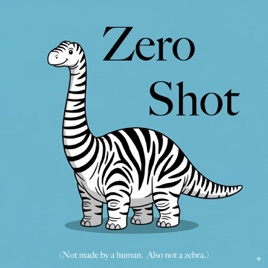
Advertise on podcast: Zero Shot
Rating
5from
This podcast has
49 episodes
Language
EnglishPublisher
The KenExplicit
No
Date created
2025/09/23
Latest episode
2026/08/19
Average duration
20 min.
Release period
7 days
Description
Join Brady Ng, Praveen Gopal Krishnan, and Rohin Dharmakumar of The Ken as they discuss the big ideas in artificial intelligence. You’ll get the macro view, explore their experiments in practical applications, go deeper than the news coverage you’ve seen, and hear about the implications of the latest developments. Nothing is off the table.
Unlock Zero Shot podcast Email contact info,
Listeners & Audience details
Email contact information
Direct podcast contact details

Listeners
Audience numbers & engagement insights

Audience details
Podcast Insights

Podcast episodes
Check latest episodes from Zero Shot podcast
The last episode
2026/08/19
Brady, Praveen and Rohin are back for the last and final episode of Zero Shot. They discuss the arc of how the podcast evolved over the last year, and what comes next.
A big thanks to everyone who followed Zero Shot for the last year.
The Ken is building a sharper, more usable successor to Zero Shot called Intelligence Independence, and they want you to tell them what you'd actually want from it. Take 2 minutes and share your thoughts here: https://form.typeform.com/to/JbBPfcVp
China trains more AI researchers and workers than anyone. It needs 5 million more
2026/08/12
China produces more top AI researchers than any country in the world. A large share of them work in Silicon Valley.
A few figures showcase what’s going on with the country’s AI tech talent. ManpowerGroup puts China among the lowest talent shortages on Earth, at 48%, below the global average for AI vacancies per qualified candidate. McKinsey says China will be short 5 million AI workers by 2030, a figure it revised up from 4 million. ByteDance's offer to top fresh hires went from 1.5 million yuan in 2024 to 3–5 million yuan in 2025, then to 6 million yuan this year. That’s doubling annually to hit the current $900,000.
Tianchen Xu, senior economist at the Economist Intelligence Unit in Beijing, explains this phenomenon. His argument is that China has two separate labour markets that are often viewed as one. There is the frontier—people who can train models, improve algorithms, and design large-scale systems—where the pool is tiny and the pay is a superstar auction. Below that, there is the diffusion layer, which is formed by millions of engineers who deploy and integrate AI across manufacturing, finance, healthcare, logistics, and other sectors. The second group is where there is a shortfall of 5 million, while the land grab for talent is entirely in the first.
Tianchen also shows us what one of China’s AI academies actually looks like from the inside, why Tencent handed its chief AI scientist role to a 27-year-old, why 500 Chinese universities launching AI majors is mostly not a good sign, why Tencent is running camps for high schoolers, and more.
Tianchen was ranked the most accurate forecaster on China in the world at the FocusEconomics 2026 Accuracy Awards.
—
This episode was hosted and produced by Brady Ng.
—
Zeus, the mascot of Zero Shot, was generated using AI. Everything else is made by humans, just like all articles, columns, newsletters, and other podcasts created by The Ken.
—
Write to us at [email protected].
India's AI dependence is the symptom, not the disease
2026/08/05
India uses more AI than almost anyone and builds almost none of it. Before this live event, we surveyed 501 of our readers. In the past week, 93 percent of them had used a model from OpenAI or Anthropic. Two percent had used an Indian one. The biggest gap they named was that India has no credible model of its own.
Last week I put three people who see this differently on a stage in Bangalore and we started from the question: is AI a fighter jet, or a power grid? A scarce thing you hoard, or an abundant one you let spread. Paras Chopra builds AI and runs his own lab, Lossfunk. Venugopal Garre reads the whole industry through markets, as head of India research at Bernstein. Pranay Kotasthane thinks about it the way a country's strategists have to, at Takshashila.
What came out of it was that dependence is not the same as vulnerability, what your "alpha" is once models can copy everything else you do, why nobody in India has built a DeepSeek, the strange case of a sovereign model almost nobody uses, and whether India should rewrite copyright law the way it once rewrote drug patents. This is the sharp forty-five minutes of a three-hour argument.
Guests
Paras Chopra, founder of Lossfunk; earlier bootstrapped Wingify.
Venugopal Garre, MD and head of India research, Bernstein.
Pranay Kotasthane, deputy director, Takshashila Institution; writes "Anticipating the Unintended."
Read and hear more
Zero Shot: "The best time to think about Intelligence Independence was 4 years ago. The next best time is now." [link]
Zero Shot: "Is India the subject or the object of its AI story?" [link]
The event page and its living record of the votes: [link]
Credits
Recorded live at the Bangalore International Centre on 1 August 2026, the sixth event in The Ken's live series. Hosted by Rohin Dharmakumar. Event co-sponsor: Neysa. Produced by The Ken. Audio by Rajiv CN.
AI Psychosis, a 30-Day Sprint, and Killing Slack with Tanmai Gopal, PromptQL (Hasura)
2026/07/31
Tanmai Gopal built Hasura into infrastructure most founders dream about - an open-source engine with 600 million downloads, running underneath half the Fortune 500. Then ChatGPT made him decide his own company was an existential risk. If AI can write the code, what's the point of a tool that helps you write it faster? So he ran the same company through three lives in eighteen months: Hasura the GraphQL engine, then PromptQL the enterprise "AI analyst" that raised a $25M Series B and a $100M Series C on the way to a billion-dollar-plus valuation, and now after moving his own team off Slack in February and living through what he calls three weeks of "AI psychosis" — a multiplayer AI workspace pitched as the thing that kills Slack.
In this episode, Praveen and Brady talk to Tanmai about why there isn’t an analytics agent yet. And according to Tanmai, code is portable but data isn't. The moment you point AI at a company's real numbers, you hit two problems that took him years to appreciate: Context i.e nobody in a big company actually knows everything, and definitions rot faster than you can capture them, to the point where Instacart had six different, all-correct definitions of a single metric and leadership didn't know who knew. And security : the instant you make AI multiplayer, every person you pull into a thread becomes a new way to leak data.
Hasura had spent years solving exactly that access-and-permissions layer, which is Tanmai's case for why now, finally, he thinks he’s found the right product market fit.
Tanmai walks us through the 30-day "tournament sprint" that produced the current product and what it feels like on the other side, when ninety percent of your DMs vanish and no word you say goes unacted-upon. He believes that we are at the precipice of a fast takeoff and predicts layoffs "the size of which we've never seen" within six to nine months, with only the people who own context surviving.
Along the way Tanmai also makes the case for why the form factor you launch with is the one you're stuck with, why Cursor struggled to become a coding agent, and why Slack, even if it wanted to, can't simply become PromptQL.
As always, like most episodes of Zero Shot, there’s a lot of disagreements, and challenges, but that’s that makes this a must-listen.
If this episode resonated with you, we’d love to hear from you and also see you at our sixth live event on how professionals, companies, and India keep their edge as AI gets more powerful.
It's on August 1 at the Bangalore International Centre in Indiranagar. Livestream tickets are available if you can't make it in person and prices go up soon. Here are all the details: https://the-ken.com/events/intelligence-independence/
—
This episode was produced by Praveen Gopal Krishnan and edited by Rajiv CN.
—
Zeus, the mascot of Zero Shot, was generated using AI. Everything else is made by humans, just like all articles, columns, newsletters, and other podcasts created by The Ken.
—
Write to us at [email protected]. We are all ears.
What's your AI vocabulary?
2026/07/22
On July 12, Satya Nadella published a blog post in which he argued that you pay for AI twice. Once with money, and once with proprietary knowledge you have to feed it. His recommendation to every company: create your private evals.
But wait, do you know what an eval is? Could you define it in simple terms?
Most people can't. And that’s the thing with the AI vocabulary that has seeped into our lives.
On today’s episode of Zero Shot, hosts Rohin Dharmakumar, Praveen Gopal Krishnan and Brady Ng put some common AI concepts and words to test in their own lives. They pick from the following options:
A. Never heard of it
B. Heard of it, can't define it
C. Can define it
D. It changed how I work
Here are the words they unpack: Frontier models · Open weights · Tokens · Context window · Fine-tuning · Distillation · RAG · Prompt/context engineering · Context store · Prompt library · Context rot · Voice & style · Harness · Loops · Evals
Along the way, they discuss Fable, distillation, the hype around prompt engineering, the current push around taste, and the one AI leader missing from all of the action.
If this episode resonated with you, we’d love to hear from you and also see you at our sixth live event on how professionals, companies, and India keep their edge as AI gets more powerful.
It's on August 1 at the Bangalore International Centre in Indiranagar. Livestream tickets are available if you can't make it in person and prices go up soon. Here are all the details: https://the-ken.com/events/intelligence-independence/
—
This episode was produced by Vidhatri Rao and edited by Rajiv CN.
—
Zeus, the mascot of Zero Shot, was generated using AI. Everything else is made by humans, just like all articles, columns, newsletters, and other podcasts created by The Ken.
—
Write to us at [email protected]. We are all ears.
—
Additional material:
https://snscratchpad.com/posts/looking-ahead-2026/
https://snscratchpad.com/posts/reverse-information-paradox/
https://the-ken.com/podcasts/two-by-two/indias-ai-edge-is-that-it-has-no-ai-of-its-own/
China let its AI industry run wild to build the best models. Now, it wants control
2026/07/15
The US-China AI race typically gets looked at through three lenses: models, chips, and talent pool. But there's a little-known government document that might reveal more about China's AI boom than any of those. It’s a registry that companies building with AI must deal with to legally operate in the country. And the result is a public list of thousands of algorithms. This document answers a few important questions. Which tools are being built? Who's building them? Which sectors are gaining prominence?
Kendra Schaefer is our guest on today’s episode of Zero Shot. She's the head of tech policy research at Trivium China, a strategic advisory firm, and leads Trivium Tech Daily, a brief read by global investors, companies and policymakers. She's spent close to 20 years living and working in China's tech sector and among her recent areas of focus is the registry.
When we ask Kendra about the registry though, she first takes through the history of the tech industry's relationship with the Chinese government. Kendra's biggest point is a macro one: Chinese tech almost invites over regulation. "They will find any crack in the cement whatsoever and they will dive through it with such gusto," she says, describing how companies race regulators to every loophole before rules can close them. It's a pattern that predates AI.
That's where the registry comes in. It was introduced as a website-registration system and has been repurposed for the AI boom.
There is this data. Chinese LLMs are being deployed. They are hitting all benchmarks and are among the best in the world.
But here is the catch. As Kendra says: "The state always prioritizes security.” "It will put security first no matter what the ramifications are to competition, " she adds. What does that mean in the near future?
Tune in!
—
This episode was produced by Vidhatri Rao and edited by Rajiv CN.
—
Zeus, the mascot of Zero Shot, was generated using AI. Everything else is made by humans, just like all articles, columns, newsletters, and other podcasts created by The Ken.
—
Write to us at [email protected]. We are all ears.
Razorpay CEO Harshil Mathur on how agentic commerce will unfold in India
2026/07/08
If you've bought anything online in India in the last ten years, you've seen the checkout page. You search, scroll, filter, add to cart, and eventually pay.
UPI simplified the payment part. But you still had to do everything else yourself.
That's about to change with agentic commerce, says Harshil Mathur, the CEO of Razorpay.
Not just change but disappear entirely.
Imagine this. Let’s say you want to make cake one evening. An agent figures out the ingredients you need for the recipe, builds the cart, checks the pantry, and finishes the purchase. Without you ever opening an app.
This is the future two years from now, according to Harshil.
And Razorpay is at the forefront of this transformation. In the last eight months alone, the company has built a UPI-OpenAI-Razorpay pilot for ordering groceries in chat, launched agentic payments across Zomato, Swiggy, and Zepto, rolled out a UPI Reserve Pay flow that practically kills the PIN, and built an agent studio on Claude for merchants to automate disputes, recoveries, and reconciliation.
As this future unfolds, there are some questions. What does agentic commerce actually look like end to end? Can India make a mark here like it did with UPI? Can the habits of consumers actually shift? If they do, who loses and who wins? Does this genuinely level the playing field for small businesses, or does it just entrench the platforms that already have scale? And what does any of this mean for the tens of millions of people who haven't touched e-commerce yet?
Harshil answers all of these questions on this episode of Zero Shot. Tune in!
—
This episode was produced by Vidhatri Rao and edited by Rajiv CN.
—
Zeus, the mascot of Zero Shot, was generated using AI. Everything else is made by humans, just like all articles, columns, newsletters, and other podcasts created by The Ken.
—
Write to us at [email protected]. We are all ears.
We audited our AI use. We are now making a case for 'intelligence independence'
2026/07/01
How many AI models can you name? Not how many you use… but how many you can actually name.
That question sets the ball rolling for this episode. In the next hour, Rohin puts Brady and Praveen—two people who use AI every single day for a living—through a cold read. There is no prep or script.
What they couldn't answer is the whole point. Over the course of an hour, three daily AI users discover their stances on where their data goes, on the tools they default to, and their strategy with AI use.
The questions they had to answer:
What did you use AI for in the last 24 hours? Be specific.On a scale of one to ten, how AI proficient are you?Have you ever thought about where your conversations and data actually go?If you lost access tomorrow, what would you actually lose?Have you taught the AIs you use about yourself? Could you take that to a different tool?Does your company have an AI strategy, or does it just have AI users?Do you think using AI is making you sharper or duller?A year from now, do you want to be more valuable because of AI—or more replaceable?These questions around "intelligence independence" form the basis of The Ken's next live event on Saturday, 1 August, at the Bangalore International Centre.
Unlike prior waves of technology, the AI wave doesn't just impact all of us—be it as a country, a company, or a professional—it also extracts what is most valuable from us. Our knowledge. Our intelligence. It's the part of the AI equation we talk about the least. And we want to change that.
You can find the tickets here: https://the-ken.com/columns/zero-shot/the-best-time-to-think-about-intelligence-independence-was-four-years-ago-the-next-best-time-is-now/
---
This episode was produced by Vidhatri Rao and edited by Rajiv CN.
---Zeus, the mascot of Zero Shot, was generated using AI. Everything else is made by humans, just like all articles, columns, newsletters, and other podcasts created by The Ken.---
Write to us at [email protected]. We are all ears.
Shakun Batra and ad director Kobayashi on AI in films, the importance of craft
2026/06/24
First came hesitation. Naturally, given both guests are filmmakers.
But once the threshold was crossed, there was no looking back. For Shakun Batra — director of Kapoor & Sons, Gehraiyaan, and Ek Main Aur Ekk Tu — the tipping point was a traffic jam shot that cost one-tenth of what they'd built on set. For Kobayashi, it was a car commercial that he hadn’t attempted before.
Shakun went on to build an AI division at his production house Jouska Films and collaborate with Google to make a small film using Veo 3. Kobayashi built Bait Society, an AI-native production company, from scratch.
One augmented an existing practice. One rebuilt entirely. We assumed these were diverging paths. But at the core, both are simply people who love using technology to make things they'd love to see.
In this episode of Zero Shot, we get into who gets credit when AI is in the pipeline, what happens to the crews and guilds being left behind, and why craft and voice still matter. We also go into the writing process in the AI age, the limits of the tools, and what it actually takes to make a feature film with AI today.
Both agree on one thing: production is getting easier. The bar for storytelling is going higher.
Tune in!
____
This episode was produced by Vidhatri Rao and edited by Rajiv CN.
____
Zeus, the mascot of Zero Shot, was generated using AI. Everything else is made by humans, just like all articles, columns, newsletters, and other podcasts created by The Ken.
Write to us at [email protected]. We are all ears!
____
Additional material:
https://www.imdb.com/name/nm2439708/
https://www.baitsociety.ai/kobayashi-reel
Uber and Meta have said no to toxenmaxxing. Make way for 'yieldmaxxing'
2026/06/17
If you have been paying attention, something has been happening within tech companies. And it has to do with tokens. But not what you think.
After killing its AI leaderboard, Meta announced a new platform to track AI usage and spending. Microsoft has started cancelling the Claude Code licenses of its employees. Uber said it ran out of its token budget for 2026. And then came the latest news of Anthropic disabling Fable 5's access following the US government's directive.
These four developments signal a shift underway. For the past year, the game was tokenmaxxing: use as much AI as possible, as often as possible, on everything. Enterprises are now asking whether this obsession was worth it. We are giving that question a name: "yieldmaxxing". Our thesis is simple. The big challenge now is this: how we will use AI safely and reliably without lock-ins and exploding bills, while remaining strategically nimble?
To figure out what the token burn and its aftermath looks like, we have Gaurav Mishra on this episode of Zero Shot. Gaurav worked across many companies we are talking about. He was at Yahoo, Meta, and headed product for Uber AI. He is now the CEO of Proshort, an AI-powered contextual sales platform.
Tune in!
____
This episode was produced by Vidhatri Rao and edited by Rajiv CN.____
Zeus, the mascot of Zero Shot, was generated using AI. Everything else is made by humans, just like all articles, columns, newsletters, and other podcasts created by The Ken.
Write to us at [email protected]. We are all ears!
____
Recommended Reading:
https://finance.yahoo.com/markets/stocks/articles/meta-ai-costs-spike-company-225410935.html
https://www.projectflux.ai/p/blown-by-april-why-uber-s-3-4-billion-r-d-budget-could-not-hold-the-line-on-ai-coding-spend
https://www.thestreet.com/technology/microsoft-ceo-sends-shocking-message-to-employees
Physical AI is a Mexican standoff. Who walks away as the winner?
2026/06/10
Think of an action or crime film. At some point, when all of the different threads and plots converge, you witness a high-stakes scene. Three characters are locked in a fight. You don’t know who emerges a winner. This is what is loosely called a Mexican standoff.
Apply this analogy to physical AI. There are currently three players in the game. America has BigTech and big models that only seem to be getting bigger. China has actual manufacturing capabilities and a sharp-minded executional focus on hardware. And then there are places like India and Nigeria that provide the data for some of these robots, especially “humanoids”.
In this episode of Zero Shot, host Praveen Gopal Krishnan talks to The Ken reporter Sakshi Sadashiv who wrote about the mushrooming gig economy around data collection to create robots that perform human tasks. We are also joined by Pramod Ghadge, the co-founder of Unbox Robotics, an Indian company that has deployed 700 robots across nine countries for a specific use-case: warehouses.
Each has a take on who wins. But more importantly, this episode takes you inside the growing Physical AI market. Tune in!
Additional Material:
AI product differentiation, living with robots, world models, and extreme leverage
Tesla and Figure AI are building robots to act like humans. Indian workers are teaching them how
The GPT Moment for Robotics Is Here
https://unboxrobotics.com/
Lossfunk is the third space for Indian AI, beyond industry and academia
2026/06/03
After 15 years of building Wingify, Paras Chopra spent some time deliberating about his next stint.
For years, he had chased the 0 to 1 journey of building something from the ground up and watching it grow. He wanted that again.
But he knew it had to be different.
There would be no product. Forget that, he decided the next project would barely have any commercial inclination. Instead, he chased his curiosity as a child passionate about science.
That’s how Lossfunk, a “cosy home” for “independent researchers” was born.
Paras describes Lossfunk as the place where everyone — from undergrads to PHDs to just inquisitive people— ask foundational questions on AI away from the pressures that burden academia and labs attached to big tech companies.
In this episode of Zero Shot, Paras gets into the journey of Lossfunk and talks about its motivations and principles.
Now, a lot of the questions Lossfunk is asking might not result in a flashy new product that changes consumer behaviour. They might just become a research paper. Or two. For Paras, that's completeley alright because building a “research attitude” may fully be the point.____
This episode was produced by Vidhatri Rao and edited by Rajiv CN.____
Zeus, the mascot of Zero Shot, was generated using AI. Everything else is made by humans, just like all articles, columns, newsletters, and other podcasts created by The Ken.Write to us at [email protected]. We are all ears!
____
Additional ResourcesLossfunkhttps://lossfunk.com
Inverted Passionhttps://invertedpassion.com
Esoteric programming languageshttps://spectrum.ieee.org/esoteric-programming-languages-daniel-temkin
Manifesto for doing good science in AIhttps://letters.lossfunk.com/p/manifesto-for-doing-good-science
Particle Feverhttps://particlefever.com/
HCL invests in Sarvam and goes down the 5-layer AI cake
2026/05/27
For decades, Indian IT grew and grew some more based on the labor arbitrage model: deploy engineers from Bangalore at one-sixth the cost of an American engineer, bill, repeat. The industry perfected the art of selling "services" instead of building and owning technology. But AI has quickly made the engineer a commodity. The big question now is how IT services will pivot and reinvent.
A step in that direction was seen recently, when news spread that HCLTech looks all set to invest $150M into Sarvam and lead its latest funding round.
But what exactly is HCL buying and what is Sarvam selling? That's the crux of this episode of Zero Shot. Host Rohin Dharmakumar is joined by Abhishek Pathak, the lead IT analyst at Motilal Oswal and Kashyap Kompella, the founder of RPA2AI Research, who has spent 25 years across AI strategy, M&A advisory, and industry analysis.
While both agree the investment signals a shift from applications, they debate the core tensions and questions surrounding this deal.
Tune in and hear them unpack the move that could define the shape IT services will take going forward. ____
Additional material:
https://x.com/nathanclark_/status/2056947354654355849?s=20 ( https://x.com/nathanclark_/status/2056947354654355849?s=20 )https://the-ken.com/story/google-meta-are-building-huge-data-centres-in-vizag-nobody-told-the-power-grid ( https://the-ken.com/story/google-meta-are-building-huge-data-centres-in-vizag-nobody-told-the-power-grid )https://www.moneycontrol.com/news/business/startup/hcltech-to-lead-300-million-sarvam-ai-round-with-150-million-bet-at-1-5-billion-valuation-13918719.html ( https://www.moneycontrol.com/news/business/startup/hcltech-to-lead-300-million-sarvam-ai-round-with-150-million-bet-at-1-5-billion-valuation-13918719.html )
https://rpa2ai.com/about/team/ ( https://rpa2ai.com/about/team/ )https://www.linkedin.com/in/abhishek-pathak-841a3494 ( https://www.linkedin.com/in/abhishek-pathak-841a3494/ )https://blogs.nvidia.com/blog/ai-5-layer-cake/ ( https://blogs.nvidia.com/blog/ai-5-layer-cake/ )____
This episode was produced by Vidhatri Rao and edited by Rajiv CN.
____
Zeus, the mascot of Zero Shot, was generated using AI. Everything else is made by humans, just like all articles, columns, newsletters, and other podcasts created by The Ken.
Write to us at [email protected]. We are all ears!
'The application layer is dead': SpotDraft's Shashank Bijapur on why System of Record is the real moat
2026/05/20
Another day and another Anthropic announcement has spurred conversation.
This time, it is Claude for Legal services. On May 12, Anthropic unveiled 20+ new "MCP connectors that link Claude to the software the legal industry runs on". Think Westlaw, LexisNexis, DocuSign. Alongside this, it announced 12 "new plugins tailored to specific legal work".
With every new Anthropic announcement, we typically ask two questions on Zero Shot. Are actual workflows impacted? And what does this do to companies building in similar spaces?
In our latest episode, we sat down with Shashank Bijapur, the co-founder and CEO of SpotDraft, to find out more. SpotDraft works on contracts, a crucial component of a lawyer's workflow that Anthropic wants to augment.
But Shashank is not worried.
He calls Claude the UPI layer. What you build on top of it is "heavily defensible," he adds.
But what exactly is SpotDraft building that enables it to work with Claude as opposed to being pressured by its entry into the legal tech stack?
Tune in!
____
Additional material:
An AI System Built by Litigators, for Litigators
https://law-disrupted.fm/ai-system-built-by-litigators/
( https://law-disrupted.fm/ai-system-built-by-litigators/ )
Claude for the legal industry
https://claude.com/blog/claude-for-the-legal-industry
( https://claude.com/blog/claude-for-the-legal-industry )
Mike OSS
https://mikeoss.com/
( https://mikeoss.com/ )
____
This episode was produced by Vidhatri Rao and edited by Rajiv CN.
____
Zeus, the mascot of Zero Shot, was generated using AI. Everything else is made by humans, just like all articles, columns, newsletters, and other podcasts created by The Ken.
Write to us at [email protected]. We are all ears!
Anthropic's agents are your new finance professionals. They don’t offer investment advice
2026/05/13
On May 5, Anthropic released 10 financial services agents. The company said they "pair best" with Claude Opus 4.7, a "state-of-the-art" model that leads the industry on financial agent benchmarks. And the hype followed. The media called the agents a threat to Wall Street.
The reality is more complicated.
In today’s episode of Zero Shot, hosts Brady Ng and Praveen Gopal Krishnan are joined by Musheer Ahmed, founder of FinStep Asia and ex-trader, and Sharath Chandra, founder of EmpowerEdge Ventures, to make sense of what actually changed.
The conversation covers why financial services keeps attracting AI investment, why the 10 agents are more useful to junior analysts than to the industry at large, and why trust remains the real bottleneck in finance. They also get into data residency, the regulatory moat protecting incumbent banks, and what happens to a service like the Bloomberg terminal.
Tune in!
____
This episode was produced by Vidhatri Rao and edited by Rajiv CN.
____
Zeus, the mascot of Zero Shot, was generated using AI. Everything else is made by humans, just like all articles, columns, newsletters, and other podcasts created by The Ken.
Write to us at [email protected]. We are all ears!____
Additional Resources
Who watches the AI watching your money?https://the-ken.com/kaching/who-watches-the-ai-watching-your-money/ ( https://the-ken.com/kaching/who-watches-the-ai-watching-your-money/ )
Anthropic releases new AI agents for financial services firmshttps://www.wsj.com/tech/ai/anthropic-releases-new-ai-agents-for-financial-services-firms-e2829b37 ( https://www.wsj.com/tech/ai/anthropic-releases-new-ai-agents-for-financial-services-firms-e2829b37 )
Anthropic unveils AI agents for financial services taskshttps://www.youtube.com/watch?v=W3RLgeUiUXY ( https://www.youtube.com/watch?v=W3RLgeUiUXY )
AI for financial serviceshttps://www.anthropic.com/news/finance-agents ( https://www.anthropic.com/news/finance-agents )
Podcast sponsorship advertising
Start advertising on Zero Shot relevant audience podcasts
You may also like to advertise on these Podcasts

4.6432771245
Verdict with Ted Cruz
Premiere Networks

4.619772871
All Ears English Podcast
Lindsay McMahon and Michelle Kaplan

4.814621637
The Big Honker Podcast
Andy Shaver & Jeff Stanfield

4.813262012
The Jeff Cameron Show ~ Warchant.com
Jeff Cameron Show

4.834901999
Conservative Review with Daniel Horowitz
Blaze Podcast Network

4.662832000
The Dr. Laura Podcast
Dr. Laura Schlessinger & SiriusXM
4.98401800
The Adam Mockler Show
MeidasTouch Network

4.723662000
Everything Everywhere Daily
Gary Arndt
4.824771870
Deck The Hallmark
Bramble Jam Podcast Network
4.721651382
Motivation Daily by Motiversity
Motiversity