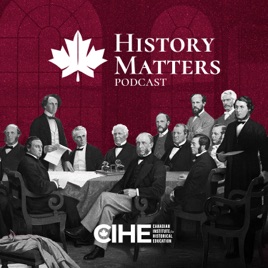
Advertise on podcast: History Matters by Canadian Institute for Historical Education
This podcast has
35 episodes
Language
EnglishExplicit
No
Date created
2025/10/02
Latest episode
2026/09/24
Average duration
41 min.
Release period
13 days
Description
Canada’s history is full of triumphs, tensions, and turning points. Yet too often, it’s reduced to headlines or overshadowed by present-day debates. History Matters was created to give space for deeper conversations — ones that connect the past to the present, and help us see why context matters more than ever.
Unlock History Matters by Canadian Institute for Historical Education podcast Email contact info,
Listeners & Audience details
Email contact information
Direct podcast contact details

Listeners
Audience numbers & engagement insights

Audience details
Podcast Insights

Podcast episodes
Check latest episodes from History Matters by Canadian Institute for Historical Education podcast
Barbara Messamore on the King-Byng Affair
2026/09/24
Allan welcomes back Barbara Messamore, Emeritus Professor of History at the University of the Fraser Valley, to discuss the 1925 Canadian federal election, the subsequent King-Byng affair, and the 1926 election. Messamore addresses common misconceptions regarding Governor General Julian Byng’s refusal of Prime Minister William Lyon Mackenzie King’s request for a dissolution of Parliament, examining how the crisis unfolded amidst the Customs Department scandal and Arthur Meighen’s short-lived government. She also reflects on the political dynamics between King and Meighen, the evolving constitutional role of the Crown in Canada, and how similar parliamentary situations have played out in Canadian political history.
Barbara Messamore on Canada's 1921 General Election
2026/09/17
Allan welcomes historian Barbara Messamore, Emeritus Professor of History at the University of the Fraser Valley, to discuss her book Times of Transformation: The 1921 Canadian General Election and the broader political landscape of post-WWI Canada. Messamore, who also serves as president of the Institute for the Study of the Crown in Canada, explores the rise of the Progressive Party, the political fortunes of leaders like Arthur Meighen and Mackenzie King and the historic election of Canada's first female MP Agnes MacPhail.
John English on writing about Canada’s prime ministers.
2026/09/10
Allan welcomes historian John English, Distinguished Professor Emeritus at the University of Waterloo, to discuss his long career of teaching and writing about Canadian history, and his significant contributions to public service. English edited two volumes of essays about Mackenzie King, published 25 years apart, and wrote critically acclaimed, two-volume biographies of both Lester Pearson and Pierre Trudeau. He also sat in the House of Commons himself from 1993 to 1997, wrote a report on the state of Canada’s national archives for then Heritage Minister Sheila Copps, and continues to serve as chair of the Canadian International Council.
Shannon Kyles on The Story on Ontario Architecture
2026/07/30
Allan talks with architectural historian Shannon Kyles about her book, The Story of Ontario Architecture: What We Built and Why We Built It. They discuss how architecture provides one lens for looking at the history of Ontario communities. From Gothic Revival churches and Greek Revival court houses and town halls to the Italianate commercial buildings along the main streets of most Ontario small towns, Shannon explains how different architectural styles reflect the values, economics, and aspirations of the people who built them.
Neville Thompson on Mackenzie King, Churchill and Roosevelt
2026/07/23
Allan talks with Neville Thompson, emeritus professor of History at Western University, about Mackenzie King and his relationships with Winston Churchill and Franklin Roosevelt. In his book, The Third Man, based largely on King’s incredibly detailed personal diary, Thompson argues that King’s friendships with the two leaders – he knew both of them better than they knew each other – made him a vital intermediary, and consequently a more important player in the story of World War Two than has generally been acknowledged. Thompson also talks about his friend Lynton "Red" Wilson, whom he knew since their undergraduate days together at McMaster University, and who died in February 2026, and his significant philanthropic contributions to the study of Canadian history.
www.cihe.ca
Greg Koabel on his "Nations of Canada" Podcast
2026/07/16
In this episode, Allan talks with Greg Koabel, creator and host of the Nations of Canada podcast, to discuss his mission of bringing Canadian history to life through long-form storytelling. Koabel shares his journey from studying European history to producing over 300 episodes, emphasizing the importance of diverse perspectives and context—rather than mere chronology—in understanding the past. The conversation covers key historical topics, including the First World War, the Halifax Explosion, and Indigenous diplomacy. Additionally, Koabel discusses his new book, The Making of Canada: An Epic History in 20 Extraordinary Lives, offering a behind-the-scenes look at his research process. This episode serves as an engaging deep dive into one of Canada's most ambitious history projects, providing valuable insights for educators, students, and podcast enthusiasts interested in a more comprehensive understanding of the Canadian story.
Alan Sears and Carla Peck on How History Education can Help Save Democracy
2026/07/09
In this episode Allan speaks with Carla Peck and Alan Sears about their 2026 book, Rescuing Reason: How History Education Can Help Save Democracy. The conversation explores their paths into history education, influenced by the late Peter Seixas, and examines the purpose of education: Sears and Peck argue that history is essential for fostering civic reasoning, empathy, and navigating complexity.
www.cihe.ca
John Boyko on Sir Sandford Fleming
2026/07/02
In this episode Allan talks with historian and author John Boyko about his latest book, In Pursuit of Tomorrow: The Inventive Life of Sandford Fleming. While Fleming is best known for coming up with the idea of standard time and time zones used around the world today, that was just one of a long list of significant achievements. By his mid-twenties, Fleming had already surveyed and mapped half a dozen Ontario cities, redesigned Toronto’s waterfront, created Canada’s first postage stamp featuring the beaver, founded the Canadian Institute, and established a reputation as one of the country's leading engineers.
Fleming’s contributions shaped projects that helped define modern Canada, including the Intercolonial Railway, the Canadian Pacific Railway, Queen’s University, scientific institutions, and communications networks that connected the country to the wider world.
www.cihe.ca
Donald Wright on the Canadian Historical Association and Donald Creighton
2026/06/25
In Episode 26, recorded at the annual meeting of the Canadian Historical Association in Charlottetown, Allan talks with Professor Donald Wright, past president of the Canadian Historical Association and professor at the University of New Brunswick, about his biography Donald Creighton: A Life in History.
The conversation opens with a look at the CHA itself—its bilingual mandate, its annual conference, and the role of the presidential address, before turning to Wright's own presidential address on historian Ramsay Cook and Cook's complicated relationship with his thesis supervisor, Donald Creighton. From there, Wright traces Creighton's life: his Toronto upbringing and devotion to literary storytelling, his Laurentian thesis of Canadian history, and his celebrated two-volume biography of Sir John A. Macdonald, a work Wright calls brilliant but deeply flawed in its hero-worship and silence on Indigenous policy.
The episode closes with Creighton's bitter later years, his widely panned book on Mackenzie King, and Wright's reflections on writing a biography with the cooperation of Creighton's family.
www.cihe.ca
Patrice Dutil on Mackenzie King and Conscription
2026/05/07
In this episode Allan talks with Patrice Dutil, professor of Politics and Public Administration at Toronto Metropolitan University, about his edited volume The Enduring Riddle of Mackenzie King and what it reveals about one of Canada’s most puzzling political figures: how did someone with no obvious charm or charisma remain in office so long?
The conversation focuses on the issue of conscription as a way into understanding King’s leadership, especially during the Second World War, the tension King had to manage between English and French Canada, and how carefully he navigated that divide. Dutil argues that King made little effort to understand French Canada, instead relying on Quebec lieutenants, first Ernest Lapointe and later Louis St. Laurent, who became his successor as Prime Minister.
www.cihe.ca
Duncan McDowall on the Life and Legacy of Sir John A Macdonald
2026/04/30
In this episode Allan talks with Professor Duncan McDowall, University Historian Emeritus at Queen’s University, about the life and legacy of Sir John A. Macdonald. McDowall suggests that Macdonald’s early years in Kingston were critical in shaping his appreciation for the importance of building ties between Protestant and Catholic, English and French, and with the thousands of immigrants, particularly the Irish, who passed through Kingston en route to destinations beyond.
The conversation explores Macdonald’s political rise, his essential role in achieving Confederation, and his accomplishments as Canada’s first Prime Minister, including building the CPR and bringing Manitoba, British Columbia, and Prince Edward Island into Confederation. It also looks at relations with Indigenous Peoples and provides context on how Macdonald operated within the realities of 19th-century society while shaping a nation.
www.cihe.ca
Ty Seidule on the ‘Myth of the Lost Cause”
2026/04/23
In this episode of History Matters, host Allan Williams speaks with historian and former U.S. Army officer Ty Seidule about how history is remembered, interpreted, and debated in the United States.
The conversation begins with recent controversies over the renaming of U.S. military bases previously associated with Confederate figures, including the work of the Naming Commission. From there, Seidule reflects on his upbringing in the American South and the beliefs that shaped his early understanding of the past—an experience he examines in Robert E. Lee and Me.
The discussion explores the origins and influence of the “Lost Cause” narrative, how it has been sustained through education and popular culture, and how historical evidence can challenge deeply held assumptions. Drawing on his time teaching at West Point, Seidule explains how institutions and commemorative practices reflect broader social and political dynamics.
The episode also considers how societies decide whom to honour, the differences between historical figures such as Robert E. Lee, George Washington, and Thomas Jefferson, and why their legacies are evaluated differently. While focused on the United States, the conversation raises wider questions about public memory and the challenges of engaging with difficult histories.
www.cihe.ca
Joanne Archibald on Business History
2026/04/16
In this episode, Allan speaks with Joanne Archibald, Executive Director of the Canadian Business History Association, about the role of business history in shaping Canada’s past. The discussion begins with a business and logistical perspective on the Battle of Vimy Ridge, highlighting the contribution of Canadian industry and railways to the war effort. Archibald then outlines how business history connects with political, military, and social history, and why it remains an important but often overlooked field of study. The conversation also explores how business records are preserved, the challenges facing archives, and the importance of collaboration between historians and the business community. Drawing on her work with Livy Consulting, Archibald discusses how organizations can use their history to better understand and communicate their identity.
www.cihe.ca
Eric McGeer on Vimy Ridge: the Battle and the Memory
2026/04/09
In this episode, posted on the April 9th anniversary of the Battle of Vimy Ridge in 1917, Allan talks with military historian Dr. Eric McGeer about the battle and its place in Canadian memory.
The conversation covers the battle itself and its significance in the Arras Offensive and in the course of the First World War, the men who led the planning and preparations in the months leading up to April 9th primarily Sir Julian Byng and Arthur Currie, under Sir Douglas Haig, the Commander in Chief of the British Expeditionary Force, how Vimy came to be the focus of
Canada’s memorialisation of the Great War, and how the meaning of Vimy has shifted over time. In the process Eric and Allan discuss books about Vimy by Pierre Berton, Ted Barris,
Jonathan Vance and Tim Cook.
https://cihe.ca/
Pictures from the podcast: https://cihe.ca/2026/04/09/episode-21-eric-mcgeer-on-vimy-ridge-the-battle-and-the-memory/
Jerry Amernic on his book Sleepwoking
2026/04/02
In this episode, Allan talks with journalist Jerry Amernic about his book Sleepwoking, published in November 2025.
The conversation opens with an anecdote about the founding of the Baseball Hall of Fame in Cooperstown, New York in 1939, ostensibly because the first ever baseball game had been played there in 1839, an origin story subsequently debunked by the Hall of Fame itself. Sleepwoking, in a similar vein, considers the accusations that Sir John A. Macdonald “starved the Indigenous Peoples,” Egerton Ryerson was the “architect” of residential schools, Henry Dundas “delayed” the abolition of the slave trade, Edward Cornwallis put a bounty on the scalps of Mi’kmaq “men, women and children,” and Matthew Begbie sentenced six innocent “Chilcotin Chiefs” to death by hanging. “None of this is true,” says Amernic. It is history shaped by ideology rather than evidence. But the vilification of these six follows a common pattern: an initial charge amplified by activists, then quoted by deferential media and politicians until it becomes orthodoxy. Historians who present evidence to the contrary do so at the risk of their careers. All of this is possible, says Amernic, because “people do not know the history of their country.
https://www.jerryamernic.com/sleep-wokinghttps://
cihe.ca/
Podcast reviews
Read History Matters by Canadian Institute for Historical Education podcast reviews
Podcast sponsorship advertising
Start advertising on History Matters by Canadian Institute for Historical Education relevant audience podcasts
You may also like to advertise on these Podcasts
4.7906254
Everything is Fine
Jennifer Romolini and Kim France

4.610742564
Serialously with Annie Elise
Annie Elise & Audioboom Studios

4.41171483
The Outlier Health Podcast
Matt Frazier, Matt Tullman, Isabelle Caputo, and Doug Hay

4.8219787
Imperfect Action
Steph Taylor
4.727388583
This Past Weekend w/ Theo Von
Theo Von

4.712974372
The Tim Dillon Show
The Tim Dillon Show

4.827973446
Huberman Lab
Scicomm Media

4.240683
To Be The Man
Podcast Heat | Cumulus Podcast Network
4.41511132000
The Ben Shapiro Show
The Daily Wire

4.2155648
TENNIS.com Podcast
TENNIS.com Podcast/Tennis Channel Podcast Network