1844730386
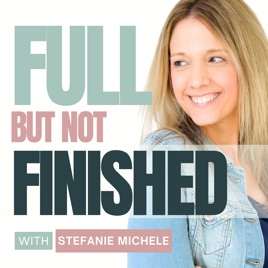
Full But Not Finished

Advertise on podcast: Full But Not Finished

Rating
★★★★★
5
from
41 reviews
This podcast has
49 episodes
Language
English
Explicit
No
Date created
2025/10/07
Latest episode
2026/09/30
Average duration
40 min.
Release period
8 days

Description

Full But Not Finished is for anyone who's tried to "just stop eating when you're full" and realized it's never that simple. Hosted by Somatic and Intuitive Eating counselor and coach Stefanie Michele, this podcast dives into the ongoing work of recovery -- where fullness doesn't always mean satisfaction, and where food, body image, and nervous system work is never finished. Each episode unpacks the psychology, nervous system patterns, and cultural conditioning that shape eating behaviors, showing why willpower alone doesn't work and what real regulation looks like. If you've lived the binge–restrict cycle, felt trapped in body image spirals, or wondered why "normal eating" feels out of reach, this is where we make sense of it — not with rules, but with integration, somatic tools, and a more human way forward.

Unlock Full But Not Finished podcast Email contact info,
Listeners & Audience details

Email contact information

Direct podcast contact details

Listeners

Audience numbers & engagement insights

Audience details

Podcast Insights

Podcast episodes

Check latest episodes from Full But Not Finished podcast


49. When Fullness Feels Unsafe: Sexual Trauma and Binge Restrict Cycles with Becca Robinson
2026/09/30
Therapist and binge eating recovery coach Becca Robinson joins me to talk about the ways sexual trauma changed her relationship with food, her body, and herself. For Becca, bingeing, purging, and restriction became much more intense after her assault. Fullness could feel physically overwhelming and bring her back into sensations she wanted to escape, while restriction created a sense of distance from her body and a feeling of agency she was struggling to find elsewhere. We also talk about how trauma shaped the way she saw her body, including the shift toward seeing herself as a sexual object, and why behaviors that looked confusing or self-destructive made more sense once she understood what they were doing for her. Becca shares how trauma education, therapy, and somatic work eventually changed both her eating disorder recovery and her relationship with her body, and what it has meant to move from feeling disconnected from her body to experiencing it as her own. Content note: This episode discusses sexual assault, binge eating, purging, restriction, and trauma responses. There are no graphic descriptions of sexual violence.
48. Can Hypnotherapy Help You Stop Binge Eating?
2026/09/16
If you've ever thought, I know why I binge. I know what triggers it. I know what I'm supposed to do instead. So why am I still doing it? I wanted to talk with clinical hypnotherapist Emelia Armstrong-Crews about this. Can hypnosis be useful when talking and insight have only gotten you so far? We ended up having a much bigger conversation about how people change. Emelia talks about what it means to stop trusting your own instincts, which felt especially relevant to eating disorders, and how hypnosis may help someone have a different experience without needing it to make logical sense. I share some of my own experience with this too, including how hard it used to be for me to relax enough to feel anything during embodiment work, and how different that is now. So can hypnosis help with binge eating? What becomes possible when we stop assuming that understanding the problem is the same thing as changing it? CONNECT WITH EMELIA ARMSTRONG-CREWS Clinical Hypnotherapist Institute of Applied Psychology Australia Website: https://hypnotherapywithemelia.com Email: [email protected] MORE FROM STEFANIE MICHELE Somatic Experiencing Practitioner & Binge Recovery Coach Website: https://www.iamstefaniemichele.com Instagram: https://www.instagram.com/iamstefaniemichele Contact: [email protected]
47. Eckhart Tolle on Body Image: Do We Pay Too Much Attention to How We Look?
2026/09/09
Eckhart Tolle says a dog doesn't have body image issues because a dog doesn't have an image of itself. My first reaction was basically: okay, but we're not dogs. We know what we look like. Other people see us. Our bodies exist in a world that assigns meaning to appearance. We can't just opt out of all of that. But there is something useful in what he's saying. How much of our body image distress is intensified by the amount of attention we give our image? In this episode I talk about mirrors, photos, technology, aging, body checking. There is a difference between avoidance and choosing not to always look at yourself, and why moving your attention away from your body can actually feel unsafe. I also share how I use non-attention when I get pulled into that tunnel myself, and a simple practice for getting better at moving attention between threat and the rest of your life. MORE FROM STEFANIE MICHELE Stefanie Michele is a certified coach and Somatic Experiencing Practitioner who helps people understand the deeper psychological, emotional, and nervous-system patterns shaping their relationships with food, body image, and themselves. Instagram : @iamstefaniemichele Substack : @iamstefaniemichele 1:1 Coaching with Stefanie (apply for January 2027) Full But Not Finished on YouTube https://www.youtube.com/@iamstefaniemichele
46. Why Diet Talk Makes You Want to Eat More: The Rebel Response
2026/09/02
A listener wrote in about something I know a lot of people experience in recovery: hearing someone talk about cutting sugar, seeing a weight-loss commercial, or coming across an article demonizing certain foods, and then feeling almost compelled to do the opposite. Not because you suddenly want the food more, exactly. Because something in you is saying, absolutely not. You will not take this away from me again. That rebel response makes sense, especially if restriction has hurt you before. But it can also become its own kind of trap if someone else talking about their diet ends up changing what you eat. This week on Full But Not Finished, I'm talking about how to stay with yourself in those moments, without complying with the message and without having to prove anything to yourself (or the universe at large). MORE FROM STEFANIE MICHELE Stefanie Michele is a certified coach and Somatic Experiencing Practitioner who helps people understand the deeper psychological, emotional, and nervous-system patterns shaping their relationships with food, body image, and themselves. Instagram : @iamstefaniemichele Substack : @iamstefaniemichele 1:1 Coaching with Stefanie (apply for January 2027) Full But Not Finished on YouTube https://www.youtube.com/@iamstefaniemichele
45. Binge Recovery, "Healthy Eating," and a Kidney Cancer Diagnosis: Suanne's story
2026/08/27
In this episode, I'm joined by Suanne to talk about a recovery story that began in a fairly textbook way: regular meals, consistency, and learning to stop bingeing. But stopping the binges didn't automatically resolve everything underneath them. Food choices could still be shaped by ideas about weight, volume, and what counted as "healthy." Years later, a kidney cancer diagnosis complicated those ideas even further, forcing Suanne to reconsider some of the rules she had relied on and what taking care of herself actually meant. We talk about the difference between behavioral recovery and a freer relationship with food, how health concerns can intersect with restriction, and what recovery can continue to ask of us long after the most obvious symptoms are gone. Learn more about Suanne: @suannebd on Instagram MORE FROM STEFANIE MICHELE Stefanie Michele is a certified coach and Somatic Experiencing Practitioner who helps people understand the deeper psychological, emotional, and nervous-system patterns shaping their relationships with food, body image, and themselves. 1:1 Coaching with Stefanie https://www.iamstefaniemichele.com/coaching Full But Not Finished on YouTube https://www.youtube.com/@iamstefaniemichele Website https://www.iamstefaniemichele.com Instagram https://www.instagram.com/iamstefaniemichele
44. The Cookie Paradox: Mental Restriction in Reverse
2026/08/20
Still having food noise even though you've stopped dieting? Mental restriction can keep binge eating and overeating going long after you've stopped counting calories or labeling foods "good" and "bad." In this episode, I share a client story that explains mental restriction a little differently than we usually talk about it. She wasn't afraid of cookies, worried about calories, or judging herself for wanting dessert. But underneath was still an expectation that, if she were fully recovered, she should eventually stop needing cookies emotionally. We talk about this subtle form of mental restriction that can remain after dieting and how even recovery or intuitive eating ideals can accidentally become another standard to live up to. If you've ever thought, I'm not restricting anymore, so why can't I stop overeating? this episode may help explain what might still happening. MORE FROM STEFANIE MICHELE Stefanie Michele is a certified coach and Somatic Experiencing Practitioner who helps people understand the deeper psychological, emotional, and nervous-system patterns shaping their relationships with food, body image, and themselves. 1:1 Coaching with Stefanie https://www.iamstefaniemichele.com/coaching Full But Not Finished on YouTube https://www.youtube.com/@iamstefaniemichele Website https://www.iamstefaniemichele.com Instagram https://www.instagram.com/iamstefaniemichele
43. Why Travel Days and Transitions Can Trigger Binge Urges
2026/08/12
Why does a travel day, a Sunday night, or the first day back after being away sometimes make you want to graze, overeat, or binge? Transitions can do strange things to our relationship with food, especially in the hours when one routine has ended and the next one hasn't quite begun. More free content in weekly emails Instagram too
42. I Wanted My Roommate's Diet to Fail: and other stories I was too ashamed to tell anyone.
2026/08/05
In this episode of Full But Not Satisfied, Stefanie shares four hidden behaviors from her 25 years with disordered eating and an eating disorder — things she assumed were evidence of bad character, but were actually nervous system threat responses. From neglecting hygiene and hoping for a hospital stay, to feeling jealous of other people's diets, to stealing and lying about food, these are the parts of eating disorder recovery that rarely get talked about. Using nervous system regulation, polyvagal theory, and parts work, Stefanie unpacks why these behaviors happen — and why shame, not the behavior itself, is often the thing that keeps people stuck. This episode is for anyone in eating disorder recovery, disordered eating recovery, or body image healing who has ever done something they didn't want to admit out loud. Stefanie's Mailing List >> Topics covered: eating disorder recovery, disordered eating behaviors, binge eating shame, nervous system regulation, polyvagal theory, parts work, body image healing, jealousy in eating disorder recovery, food and shame. 00:01 Shame, Shame 02:33 Hygiene And Not Wanting to Care Care of Myself 09:58 My Routines Now 13:02 Feeling Resentful Of Friends Who Lost Weight 17:18 GLP-1 Comparison Triggers 21:55 Anything For A Reset! Even that. 28:36 Stealing And Lying For Food 35:37 Safety And Recovery 36:58 Closing Thoughts   More From Stefanie Instagram Website
41. Why Listening to Your Body Is So Confusing
2026/07/29
Why is listening to your body so confusing? You might be trying to follow your hunger and fullness cues but still have no idea whether you're feeling hunger, anxiety, habit, adrenaline, an emotion, or the pressure of paying far too much attention. In this episode, I talk through five reasons body cues can be difficult to interpret, especially after disordered eating or years of overriding them. Cues may still be inconsistent or extreme. Several sensations may be happening at the same time. Anxiety can interrupt interoception, emotions can become wired together with food urges, and the cue you notice first may simply be the one you are most accustomed to following. Even trying very hard to eat intuitively can turn hunger and fullness into another system to monitor and get right. Listening to your body becomes more useful when a cue is treated as information rather than an automatic instruction. By the end of this episode, you'll have a clearer way to think about what your body is communicating without assuming every sensation is telling you exactly what to do. MORE FROM STEFANIE MICHELE Stefanie Michele is a certified coach and Somatic Experiencing Practitioner who helps people understand the deeper psychological, emotional, and nervous-system patterns shaping their relationships with food, body image, and themselves. 1:1 Coaching with Stefanie https://www.iamstefaniemichele.com/coaching Full But Not Finished on YouTube https://www.youtube.com/@iamstefaniemichele Website https://www.iamstefaniemichele.com Instagram https://www.instagram.com/iamstefaniemichele
40. Bored, Restless, and Looking for Food: Emotional Eating and the Nervous System
2026/07/22
Why do we eat when we're bored, even when we know we aren't hungry?  In this episode, I look at boredom eating through a nervous system lens and question the assumption that boredom simply means we cannot tolerate being alone with ourselves. Stillness can leave us with a mind that is anything but still, especially when the brain shifts into the default mode network and begins revisiting everything we were too occupied to notice before. Food can give shape to unstructured time and offer a "gear shift" of energy that the nervous system may really be asking for. I also talk about the difference between needing rest, seeking stimulation, and sliding into a lower-energy state that we may be calling boredom. Understanding which one is happening can change the way we respond to emotional eating, grazing, or the urge to eat when there is nothing else to do. ABOUT STEFANIE MICHELE Stefanie Michele is a certified coach and Somatic Experiencing Practitioner who helps people understand the deeper psychological, emotional, and nervous-system patterns shaping their relationships with food, body image, and themselves. 1:1 Coaching with Stefanie https://www.iamstefaniemichele.com/coaching Full But Not Finished on YouTube https://www.youtube.com/@iamstefaniemichele Website https://www.iamstefaniemichele.com Instagram https://www.instagram.com/iamstefaniemichele
39. GLP-1s, Body Acceptance, and the Pressure to Choose
2026/07/17
Can you work toward body acceptance while considering a GLP-1 medication? In this unscripted collaboration, body image coaches Kristina Bruce of Unlearning Beautiful and Stefanie Michele of Full But Not Finished talk about what happens when you have spent years stepping away from dieting while the culture around you appears to be moving toward weight loss again. We discuss the pressure on both sides of the GLP-1 conversation, the limits of turning dieting or anti-diet thinking into a fixed belief system, and why body trust cannot be reduced to one universally correct decision. The conversation moves beneath the choice itself into the life, body, identity, or future we may still be attached to—and the difficulty of knowing what self-care means after years of confusing it with self-control. Choosing relief does not necessarily mean abandoning yourself, and choosing not to pursue weight loss does not automatically make you freer. The work is learning to recognize what is true inside your own life without turning today's decision into another rule you must follow tomorrow. This conversation is educational and is not medical advice. Decisions about GLP-1 medications should be made with a qualified medical professional who understands your individual health history, including any history of disordered eating or eating disorders. ABOUT KRISTINA BRUCE Kristina Bruce is a body image coach and the founder of Unlearning Beautiful. She helps people stop obsessing about their bodies and develop greater peace, trust, and freedom. Free Guide to Body Peace https://www.kristinabruce.com/guide 1:1 Body Peace Coaching https://www.kristinabruce.com/private-coaching Instagram https://www.instagram.com/kristinabrucecoach ABOUT STEFANIE MICHELE Stefanie Michele is a certified coach and somatic practitioner who helps people understand the psychological, emotional, and nervous-system patterns underneath binge eating, food control, body image anxiety, and feeling trapped in the relationship with their bodies. 1:1 Coaching with Stefanie https://www.iamstefaniemichele.com/coaching Full But Not Finished on YouTube https://www.youtube.com/@iamstefaniemichele Website https://www.iamstefaniemichele.com Instagram https://www.instagram.com/iamstefaniemichele
38. I Lost Decades to my ED and I'm Okay With That — and Is Body Image Just A First World Problem?
2026/07/11
In this Q&A episode, I'm answering two questions about eating disorder recovery. The first is about how to make peace with the years an eating disorder took — the grief of looking back and realizing how much of life was shaped by food, body image, fear, and survival, without blaming yourself for not recovering sooner. The second question is about why body image can still matter, even when part of you feels embarrassed by that or tells yourself it is a "first world problem." I talk about lost time, self-blame, body shame, and the very human wish to feel okay in your body without turning any of it into another reason to shame yourself. More from Stef: Binge Eating to Intuitive Eating (BE2IE) Self-Study Course iamstefaniemichele.com/iamstefaniemichelecourse.com Substack (essays on body image, appetite, and the nervous system) iamstefaniemichele.substack.com Instagram instagram.com/iamstefaniemichele
37. A Different Way to Be Strong: with Guest Marcus Kain
2026/07/01
In this episode, I'm joined by Marcus Kain Murray of Strong Not Starving for a conversation about strength training that goes beyond reps, programming, and pushing harder. We talk about what changes when training becomes something you practice instead of something you perform for approval. Marcus gets into why a workout can feel hard and still be the wrong kind of hard, how the fitness industry sells exhaustion as progress, and why pulling back is sometimes what actually helps you get stronger. We also talk about effort, intensity, rest periods, and what it means to challenge yourself without turning exercise into another place where you have to override yourself. If you tend to either overdo it or avoid it, this conversation gives a different way to think about strength, recovery, and consistency. This is a strength-based episode, but the lens is bigger than fitness. It's about building strength without making training the boss of your life. Marcus is the founder of Strong Not Starving. He is a trainer, StrongFirst certified instructor, and coach with 20 years of experience in the fitness industry. His work brings together strength training, nutrition coaching, disordered eating informed fitness, stress management and recovery, sleep, and relationship coaching. Find Marcus here: https://strongnotstarving.com/ More from Stef: Binge Eating to Intuitive Eating (BE2IE) Self-Study Course iamstefaniemichele.com/iamstefaniemichelecourse.com Substack (essays on body image, appetite, and the nervous system) iamstefaniemichele.substack.com Instagram (daily thoughts + short-form content) instagram.com/iamstefaniemichele
36. Can You Have Food Freedom With Food Restrictions? A listener goes gluten-free for health reasons
2026/06/24
More from Stef: Binge Eating to Intuitive Eating (BE2IE) Self-Study Course iamstefaniemichele.com/iamstefaniemichelecourse.com What happens when a food restriction is not coming from diet culture, but from an actual health need? In this episode of Full But Not Finished, I'm answering a listener question about giving up gluten for an autoimmune condition, feeling better physically, and then suddenly feeling the old psychological pull of restriction, scarcity, rebellion, and white-knuckling come back. We talk about the difference between a true health accommodation and a food rule, why even medically appropriate restrictions can still register as scarcity, and what gets in the way of staying connected to food freedom when your body genuinely needs something different. I also get into food morality, perfectionism, satisfaction, autonomy, and why your psychology may rebel against a protocol that starts to feel like obedience, even when your health matters. This episode is for anyone trying to care for their body without falling back into old binge/restrict cycles, orthorexic thinking, or the belief that food freedom means never having boundaries around food. Topics covered: medical food restriction, gluten, autoimmune conditions, intuitive eating, food freedom, food morality, orthorexia, binge restrict cycle, scarcity mindset, health accommodations, and restriction recovery. Substack (essays on body image, appetite, and the nervous system) iamstefaniemichele.substack.com Instagram (daily thoughts + short-form content) instagram.com/iamstefaniemichele
35. Not Recovered, But Not Ashamed: a listener's story
2026/06/17
In this episode, I'm joined by Minea for a conversation about food recovery, body image, control, and what happens when you understand the concepts but still don't feel safe enough to let go. This is not a neat success story, and that is exactly why I wanted to share it. Minea talks about growing up as a child who loved food, the moment her body began to feel like something other people could judge, the early pull toward control, and the confusing shift into feeling out of control around food after years of trying to stay in control. We also talk about shame, identity, perfectionism, productivity, attachment, fear of weight change, and the hard-to-name place where someone can have deep self-awareness and still feel caught between what they understand and what they feel able to do. This conversation may not be right for everyone, especially if you are currently feeling pulled toward control or struggling to feel steady in your own food and body work. Please take care of yourself while listening. For the person who has ever thought, "I understand all of this, so why am I still here?" — this episode is for you. More from Stef: Binge Eating to Intuitive Eating (BE2IE) Self-Study Course iamstefaniemichele.com/iamstefaniemichelecourse.com Substack (essays on body image, appetite, and the nervous system) iamstefaniemichele.substack.com Instagram (daily thoughts + short-form content) instagram.com/iamstefaniemichele Topics include binge eating after restriction, eating disorder recovery, body image, weight gain fear, perfectionism, shame, compulsive exercise, nervous system regulation, intuitive eating, attachment, resistance, and the reality of being in the middle of healing

Podcast reviews

Read Full But Not Finished podcast reviews


5 out of 5
41 reviews
★★★★★
M10🌺 2026/05/13
Helpful podcast!
I really enjoy listening to Stefanie and I appreciate her sharing her vulnerability and wisdom.
★★★★★
haley.raymer805 2026/04/07
It’s everything…
Stephanie is just such a JOY to listen to, when topics and feelings can be very heavy. She brings such a thoughtful dialogue, with scientific explanat...
★★★★★
Suannebd 2026/03/31
So relatable….
I think I found Stephanie during the pandemic, doing videos from her closet. Then I found her podcast with Sarah - which I LOVED! Now, still follow...
★★★★★
StabithaL 2026/02/27
A Major Part of My Continued Recovery
Stefanie’s podcast (both with Sarah and now solo) has been such an important part of my recovery journey. Now that I’m recovered for four years, I lis...
★★★★★
SproutPete 2026/01/20
My favorite podcast
I’ve always enjoyed listening to Steph as I feel like she really gets to the core issues when it comes to EDs. I’ve had so much growth in feeling con...
★★★★★
reneehardy9 2026/01/19
When you're close don't fit
This is the best podcast I think you've ever done. I completely resonated with it and I appreciate all that you taught. I think you are much better si...
★★★★★
Avelavalamp 2025/11/13
Wonderfully needed
I’m grateful for your thoughtful, embodied approach to both ED recovery and food in general. Please keep the somatic suggestions coming!
★★★★★
Joshuac311 2025/10/30
Awesome
Stefanie is a wonderful host and makes so many abstract ideas simple enough to understand while maintaining the dignity of the listener. She paints a ...
★★★★★
Fedelza 2025/10/28
Definitely worth a listen!
Great job Stephanie! Always love your content and relate to everything you say. Thank you for your wisdom!
★★★★★
Hanni🍃 2025/10/16
Stefanie is the best!
So so thankful that Stefanie has continued to speak to “ life after” diets… after “Life After Diets”! Her insights, relatability and understanding aro...
check all reviews on apple podcasts

Podcast sponsorship advertising

Start advertising on Full But Not Finished relevant audience podcasts


What do you want to promote?