508376907
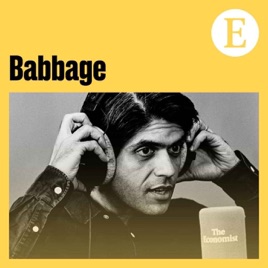
Babbage from The Economist

Advertise on podcast: Babbage from The Economist

Rating
★★★★★
4.8
from
588 reviews
This podcast has
581 episodes
Language
English
Publisher
The Economist
Explicit
No
Date created
2012/03/06
Latest episode
2026/04/21
Average duration
-
Release period
7 days

Description

Babbage is The Economist’s weekly podcast on science and technology—named after Charles Babbage, the grandfather of computing. Explore the science changing the way we live from AI to genetics, particle physics and space travel with Alok Jha. This award-winning podcast features in-depth interviews with top scientists and special episodes investigating wellness trends. Published every Wednesday. If you’re already a subscriber to The Economist, you’ll have full access to all our shows as part of your subscription. For more information about Economist Podcasts+, including how to get access, please visit our FAQs page here https://myaccount.economist.com/s/article/What-is-Economist-Podcasts Hosted on Acast. See acast.com/privacy for more information.

Unlock Babbage from The Economist podcast Email contact info,
Listeners & Audience details

Email contact information

Direct podcast contact details

Listeners

Audience numbers & engagement insights

Audience details

Podcast Insights

Social media

Check Babbage from The Economist social media presence


Podcast episodes

Check latest episodes from Babbage from The Economist podcast


Chernobyl: a laboratory like no other
2026/04/21
In the popular imagination, the Chernobyl nuclear-power plant sits in an abandoned, post-apocalyptic wasteland. In reality, the site of the world’s worst nuclear-energy disaster is a thriving experimentation ground for scientists studying the long-term impacts of radiation. This week, 40 years after the meltdown, we investigate what that laboratory has found so far. Guests and hosts: - Jason Palmer, host of “The Intelligence” podcast - Olena Pareniuk of the Institute for Safety Problems of Nuclear Power Plants - Jim Smith of the University of Portsmouth - Alok Jha, The Economist’s science and technology editor Topics covered: - Chernobyl nuclear disaster - Nuclear safety - Radiation physics Transcripts of our podcasts are available via economist.com/podcasts. Listen to what matters most, from global politics and business to science and technology—subscribe to Economist Podcasts+. For more information about how to access Economist Podcasts+, please visit our FAQs page or watch our video explaining how to link your account.
An antimatter road trip
2026/04/15
The universe—and everything inside it—shouldn’t exist. The big bang should have produced equal amounts of matter and antimatter, and their mutual annihilation should have resulted in nothing more than a sprawling ball of energy. But, in fact, the universe is dominated by matter, while antimatter is vanishingly rare. To try to understand why, physicists have taken antimatter on a road trip—for the first time in history. Guests and hosts: - Sam Wikeley, The Economist’s science correspondent - April Cridland of CERN’s antimatter factory - Stefan Ulmer of HHU Düsseldorf and CERN’s BASE experiment - Host: Alok Jha, The Economist’s science and technology editor Topics covered: - Antimatter - The European Organisation for Nuclear Research (CERN) - Particle physics Transcripts of our podcasts are available via economist.com/podcasts. Listen to what matters most, from global politics and business to science and technology—subscribe to Economist Podcasts+. For more information about how to access Economist Podcasts+, please visit our FAQs page or watch our video explaining how to link your account.
Inside the mind of Demis Hassabis
2026/04/07
The AI race is intensifying. It wasn’t supposed to be this way, according to Demis Hassabis, the boss of Google DeepMind. Journalist and biographer Sebastian Mallaby has had unprecedented access to Mr Hassabis over the past three years. In this episode, he tells us how the AI pioneer was swept into a commercial and geopolitical contest that he never expected. Can Mr Hassabis’s aim of safely building artificial superintelligence still be achieved? Guests and hosts: - Sebastian Mallaby, author of “The Infinity Machine” - Host: Alok Jha, The Economist’s science and technology editor Topics covered: - Demis Hassabis and Google DeepMind - AI safety and regulation - China’s open-source AI industry Watch Inside Tech's recent interview with Demis Hassabis on The Economist's app. Transcripts of our podcasts are available via economist.com/podcasts. Listen to what matters most, from global politics and business to science and technology—subscribe to Economist Podcasts+. For more information about how to access Economist Podcasts+, please visit our FAQs page or watch our video explaining how to link your account.
A vaccine for everything
2026/03/31
Imagine if a single vaccine could protect against a vast array of pathogenic threats. Recent research suggests that a universal vaccine to fend off respiratory viruses, bacterial infections—even allergens—might become a reality. Such jabs would be vital for blunting the impact of the next pandemic. Guests and hosts: - Ainslie Johnstone, The Economist’s data and science correspondent - Mihai Netea of Radboud University Nijmegen - Pamela Bjorkman of the California Institute of Technology - Bali Pulendran of Stanford University - Host: Alok Jha, The Economist’s science and technology editor Topics covered: - Broad-spectrum vaccines - Immunology - mRNA technology Listen to Ainslie’s related reporting on dementia and infections by scrolling back to our March 2025 episode, “Going viral: could infections cause Alzheimer's?” Transcripts of our podcasts are available via economist.com/podcasts. Listen to what matters most, from global politics and business to science and technology—subscribe to Economist Podcasts+. For more information about how to access Economist Podcasts+, please visit our FAQs page or watch our video explaining how to link your account.
How AI is really being used in war
2026/03/25
The conflict in Iran has been described as the “first AI war”. But how is artificial intelligence actually being deployed? We examine the conflicts in Iran and Ukraine, which raise some thorny questions about the mechanics and ethics of the future of war. Guests and hosts: - Shashank Joshi, defence editor at The Economist - James Lawson, a director at Helsing - Host: Alok Jha, The Economist’s science and technology editor Topics covered: - Military technology - Autonomous weapons - Artificial intelligence Transcripts of our podcasts are available via economist.com/podcasts. Listen to what matters most, from global politics and business to science and technology—subscribe to Economist Podcasts+. For more information about how to access Economist Podcasts+, please visit our FAQs page or watch our video explaining how to link your account.
The dangers of obsessing over metrics
2026/03/18
The mechanisms of games are often used to motivate people—from tracking health to scrolling social media feeds and even the way school is graded. But C. Thi Nguyen is worried we’re over-obsessing about keeping score. He wants us to focus more on the things we enjoy doing, rather than letting metrics hijack our lives. Guests and hosts: - C. Thi Nguyen, a philosopher at the University of Utah and author of “The Score” - Host: Alok Jha, The Economist’s science and technology editor Topics covered: - Games - Metrics - Social media Transcripts of our podcasts are available via economist.com/podcasts. Listen to what matters most, from global politics and business to science and technology—subscribe to Economist Podcasts+. For more information about how to access Economist Podcasts+, please visit our FAQs page or watch our video explaining how to link your account.
AI catastrophe could be around the corner
2026/03/11
The spat between America’s government and Anthropic has some alarming implications. In AI development, it appears speed is being prioritised over safety. Artificial intelligence could not only give bad actors the capabilities to unleash destruction, evidence is building that the models themselves are becoming more capable of deceit. Is a catastrophe imminent? Guests and hosts: - Alex Hern, The Economist’s AI writer - Adam Beaumont, director of Britain’s AI Security Institute (AISI) - Jade Leung, Chief Technology Officer at AISI - Alok Jha, host of “Babbage” Watch Zanny Minton Beddoes, The Economist’s editor-in-chief, interview Dario Amodei, Anthropic’s boss, on “The Insider”. Topics covered: - Anthropic vs America's government - AI safety - Cyber security Transcripts of our podcasts are available via economist.com/podcasts. Listen to what matters most, from global politics and business to science and technology—subscribe to Economist Podcasts+. For more information about how to access Economist Podcasts+, please visit our FAQs page or watch our video explaining how to link your account.
Why better chips will need more extreme physics
2026/03/04
Making computer chips is not easy. The machines that etch patterns onto silicon wafers already use some astonishing engineering. To make the next generation of computer chips, though, engineers will need to get even more radical. Guests and hosts: - Shailesh Chitnis, The Economist’s global business correspondent - Bruno La Fontaine, a physicist at the Lawrence Berkeley National Laboratory - Nicholas Kelez, CEO and CTO of xLight - Alok Jha, host of “Babbage” Topics covered: - Extreme ultraviolet lithography - Chipmaking - ASML Transcripts of our podcasts are available via economist.com/podcasts. Listen to what matters most, from global politics and business to science and technology—subscribe to Economist Podcasts+. For more information about how to access Economist Podcasts+, please visit our FAQs page or watch our video explaining how to link your account.
Science is winning the war on cancer
2026/02/25
The rates of deaths from cancer have fallen dramatically in recent decades. And the good news doesn’t stop there. By teasing out the reasons why some cancers take hold, while others don’t, scientists are opening up new ways to prevent even more cases of the disease. Guests and hosts: - Slavea Chankova, The Economist’s health-care correspondent - Joanna Fowler, senior staff scientist at the Wellcome Sanger Institute - Phil Jones, an oncologist at the University of Cambridge and the Wellcome Sanger Institute - Alok Jha, host of “Babbage” Topics covered: - Cancer research - Tumour prevention - Carcinogens Transcripts of our podcasts are available via economist.com/podcasts. Listen to what matters most, from global politics and business to science and technology—subscribe to Economist Podcasts+. For more information about how to access Economist Podcasts+, please visit our FAQs page or watch our video explaining how to link your account.
How to think like a chess pro
2026/02/18
How do the world’s best chess players operate? What does the game itself reveal about thinking and memory? In this episode, Jennifer Shahade explains how thinking like a chess champion can help you make better decisions in life. Guests and hosts: - Jennifer Shahade, woman chess grandmaster and author of “Thinking Sideways” - Alok Jha, host of “Babbage” You can watch Alok and Jennifer play their chess game on The Economist's YouTube channel. Topics covered: - Chess - Cognitive science - Artificial intelligence Transcripts of our podcasts are available via economist.com/podcasts. Listen to what matters most, from global politics and business to science and technology—subscribe to Economist Podcasts+. For more information about how to access Economist Podcasts+, please visit our FAQs page or watch our video explaining how to link your account.
Can “world models” fix AI’s blind spots?
2026/02/11
Modern artificial intelligence is seemingly unstoppable. But large language models have an undeniable blind spot: an incomplete understanding of physical reality and the laws of physics. Could “world models” be the solution—and how are AI labs building them? Guests and hosts: - Alex Hern, AI writer at The Economist - Yann LeCun, AI pioneer and executive chairman at AMI Labs - Shlomi Fruchter, research director at Google DeepMind - Cristóbal Valenzuela, CEO at Runway AI - Alok Jha, host of “Babbage” Topics covered: - Large language models - World models - Google's Project Genie Transcripts of our podcasts are available via economist.com/podcasts. Listen to what matters most, from global politics and business to science and technology—subscribe to Economist Podcasts+. For more information about how to access Economist Podcasts+, please visit our FAQs page or watch our video explaining how to link your account.
NASA’s Artemis: humans are returning to the Moon
2026/02/04
NASA’s much-delayed Artemis II mission is set to launch in early March. For the first time since 1972, astronauts will fly around the moon—if all goes well, that means humans could walk on the lunar surface once again in a subsequent mission.  But, if China succeeds in its own ambitions, those astronauts might not be alone. A new Moon race has begun. Host: Alok Jha, The Economist’s science and technology editor. Guests: The Economist’s Tim Cross and Oliver Morton; and Teasel Muir-Harmony of the Smithsonian's National Air and Space Museum. For more on America’s Moon programme, listen to our podcast on the inception of NASA’s giant (and pointless) SLS rocket. Transcripts of our podcasts are available via economist.com/podcasts. Listen to what matters most, from global politics and business to science and technology—subscribe to Economist Podcasts+. For more information about how to access Economist Podcasts+, please visit our FAQs page or watch our video explaining how to link your account.
Jimmy Wales: Wikipedia’s founder on surviving AI
2026/01/28
Wikipedia, a volunteer-written encyclopedia, has defied the odds to become one of the world's most popular—and trusted—websites. Today, the project is under threat from divisive politics and the rise of generative AI. But Jimmy Wales, Wikipedia’s resilient founder, argues that the encyclopedia—and the human values which underpin it—are more relevant than ever. Host: Alok Jha, The Economist’s science and technology editor. Guests: Andrew Palmer, host of The Economist’s “Boss Class” podcast; and Jimmy Wales, founder of Wikipedia and the author of “The Seven Rules of Trust: Why It Is Today's Most Essential Superpower”. Andrew’s new series of “Boss Class”, which explores how to master management in the age of AI, is out on January 29th. Transcripts of our podcasts are available via economist.com/podcasts. Listen to what matters most, from global politics and business to science and technology—subscribe to Economist Podcasts+. For more information about how to access Economist Podcasts+, please visit our FAQs page or watch our video explaining how to link your account.
Custom cures: tailor-made drugs for rare diseases
2026/01/21
A teenage girl in Britain recently received a custom-made drug to fix a fault in her genetic code. Doctors hope that it will treat her ultra-rare neurodegenerative condition. It is also part of a medical trial that could transform the way that customised medicines are made available to people who otherwise have no alternatives. Host: Alok Jha, The Economist’s science and technology editor. Guests: Natasha Loder, The Economist's health editor; Julia Vitarello of EveryONE medicines; Paul Gissen of UCL Great Ormond Street Institute of Child Health. Transcripts of our podcasts are available via economist.com/podcasts. Listen to what matters most, from global politics and business to science and technology—subscribe to Economist Podcasts+. For more information about how to access Economist Podcasts+, please visit our FAQs page or watch our video explaining how to link your account.
Lone dangers: the physical toll of social isolation
2026/01/14
Loneliness and social isolation are connected to around 100 deaths every hour, according to the World Health Organisation. Feeling lonely has been linked to cardiovascular disease, neurological conditions and problems with the immune system. Developing better social connections could improve millions of peoples’ health, but doing so is not as simple as it sounds. Host: Alok Jha, The Economist’s science and technology editor. Guests: The Economist’s Ainslie Johnstone; Julianne Holt-Lunstad of Brigham Young University. Thanks to Patrick Abrahams, Helen Kingston and Caroline Blake in Frome, England. Transcripts of our podcasts are available via economist.com/podcasts. Listen to what matters most, from global politics and business to science and technology—subscribe to Economist Podcasts+. For more information about how to access Economist Podcasts+, please visit our FAQs page or watch our video explaining how to link your account.

Podcast reviews

Read Babbage from The Economist podcast reviews


4.8 out of 5
588 reviews
★★★★★
Cpatel05 2026/03/18
Excellent!
Very well-researched and presented. I always come out with a better understanding of topics after listening to it.
★★★★★
PatNLeyla 2025/08/04
Perfect Science Journslism~~~~
Allow more archives.
★★★★★
Ray Bod 2023/04/05
Intelligent Content
Babbage from Economist is great intelligent podcast for geeks to listen to.
★★☆☆☆
Gilbert Coyle 2023/12/04
Paywall
I loved this podcast with its intelligent interviews and fascinating subjects but it all changed. They have now locked all future episodes behind thei...
★★★★★
Jared Herbert 2022/05/13
Another solid podcast
Another solid podcast offered by The Economist
★☆☆☆☆
-Real-Reviews 2022/06/23
Amazing content. TOO MANY ADS AND PADDING
Please remove some or all of the ads and the padding at the beginning and end of each episode. It’s so excessive for regular listeners!
★★★★☆
Dr. Strangelove! 2022/06/21
Weekly Tech Deep Dive
Often a great source of information and interviews with experts. A lot of it goes over my head, but I appreciate being able to listening in to such le...
★★★★★
BeijingJim 2022/01/10
Excellent podcast for anyone who appreciates science and technology!
The Economist produces many fine podcasts that complement their world-class magazine, and this is the finest of those! I like Babbage above their oth...
★★★☆☆
garrekds 2022/02/12
New changes feel a bit overproduced
There have been some changes to Babbage and Money Talks, adding more sound effects and focusing on a single theme in each show. I like the focus; befo...
★★★☆☆
Dave Pomerantz 2022/01/06
Enjoy everything except the narrator's voice
Good podcast, well put together, well-researched with excellent interviews. Just personally I find Kenneth Cukier's delivery annoying and hard to lis...
check all reviews on apple podcasts

Podcast sponsorship advertising

Start advertising on Babbage from The Economist relevant audience podcasts


What do you want to promote?