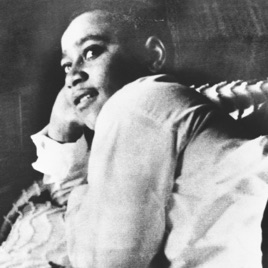
Advertise on podcast: Witness History: Black history
Rating
4.6from
This podcast has
93 episodes
Language
EnglishPublisher
BBC World ServiceExplicit
No
Date created
2013/10/05
Latest episode
2026/09/04
Average duration
10 min.
Release period
68 days
Description
Listen to and download our programmes
Unlock Witness History: Black history podcast Email contact info,
Listeners & Audience details
Email contact information
Direct podcast contact details

Listeners
Audience numbers & engagement insights

Audience details
Podcast Insights


Podcast episodes
Check latest episodes from Witness History: Black history podcast
Star Trek: America's first interracial TV kiss
2026/09/04
In 1968, American television boldly went where it had never gone before, broadcasting what's claimed to be the country's first interracial kiss in a TV programme.
The moment of passion was between Captain Kirk of the starship USS Enterprise and communications officer Lieutenant Uhura, in Star Trek.
Nichelle Nichols played Uhura in the cult series, and she was one of the first black women to be featured on American TV in a non-subservient role.
Through archive BBC interviews, Nichelle explains the story behind that famous scene. Produced and presented by Reena Stanton-Sharma.
Witness History is a short BBC World Service podcast about history that takes you inside big moments from the past through first-hand testimony and archive. Each weekday, in around nine minutes, we revisit one moment that helped shape the world and hear it through the voice of someone who was there. Scientists, artists, campaigners, soldiers, leaders and everyday people tell their true stories.
When you subscribe to Witness History, you’ll be taken inside turning points in world affairs from West Africa’s fight back against Boko Haram in 2015 to the behind-closed-doors talks that led to the US-Cuba “thaw” and the surprise announcement of restored relations.
You’ll discover what it was like to experience disasters and how people recovered from them, including the Tabasco floods in Mexico, Portugal's worst train disaster, and the huge clean-up after the Chernobyl nuclear disaster.
You’ll explore culture and ideas too: Sweden’s Expedition Robinson, often credited as the first modern reality TV game show; the friendship between The Beatles’ George Harrison and Indian sitarist Ravi Shankar; and the night a tiger attack brought Las Vegas superstars Siegfried and Roy’s show to a sudden end.
And if you’re curious about inventions, we’ll tell you how air fryers, BlackBerry, YouTube, Alexa, GPS, superglue, the shopping cart (shopping trolley) and bubble tea were created.
If you’re new to Witness History, the appeal is simple: real voices, one strong true story, and a fresh way to understand today through events from history – all in the time it takes to enjoy a cup of tea or a walk around the block. Join millions of BBC World Service podcast listeners around the globe and enjoy the insight, context and detail Witness History will bring you.
(Photo: Nichelle Nichols as Lieutenant Uhura in Star Trek in 1967. Credit: CBS via Getty Images)
The last of the Mau Mau fighters
2026/08/12
In 1963, as Kenya celebrated independence from British rule, one of the last Mau Mau fighters came out of hiding and laid down her arms.
Muthoni Kirima was the first and only woman to be appointed field marshall in the Kenya Land and Freedom Army - better known as the Mau Mau.
She had been living in the Kenyan forest for 11 years, fighting with other armed rebels to reclaim land taken by European settlers.
Thousands died or were imprisoned as Britain tried to crush the uprising. But the rebellion was later seen as paving the way to independence.
Jane Wilkinson has found out more through Muthoni Kirima's interview with the Mau Mau Chronicles oral history project.
Eye-witness accounts brought to life by archive. Witness History is for those fascinated by and curious about the past. We take you to the events that have shaped our world through the eyes of the people who were there.
For nine minutes every day, we take you back in time and all over the world, to examine wars, coups, scientific discoveries, cultural moments and much more.
Recent episodes explore everything from how the Excel spreadsheet was developed, the creation of cartoon rabbit Miffy and how the sound barrier was broken.
We look at the lives of some of the most famous leaders, artists, scientists and personalities in history, including: the moment Reagan and Gorbachev met in Geneva, Haitian singer Emerante de Pradines’ life and Omar Sharif’s legendary movie entrance in Lawrence of Arabia.
You can learn all about fascinating and surprising stories, like the invention of a stent which has saved lives around the world; the birth of the G7; and the meeting of Maldives’ ministers underwater. We cover everything from World War Two and Cold War stories to Black History Month and our journeys into space.
(Photo: Field Marshall Muthoni Kirima, 1963. Credit: Smith Archive/Alamy)
Ashley Kriel: South Africa's anti-apartheid 'Che Guevara'
2026/08/05
In the 1980s, townships in the Cape Flats area of Cape Town became an unexpected hotbed of activity against South Africa's apartheid government.
One charismatic young activist emerged as a leader of the struggle against white minority rule, becoming known as the Che Guevara of the Cape Flats.
Former anti-apartheid activist Adiel 'Gorie' November tells Sumaya Bakhsh about his memories of his friend and fellow resistance fighter, Ashley Kriel.
Eye-witness accounts brought to life by archive. Witness History is for those fascinated by and curious about the past. We take you to the events that have shaped our world through the eyes of the people who were there.
For nine minutes every day, we take you back in time and all over the world, to examine wars, coups, scientific discoveries, cultural moments and much more.
Recent episodes explore everything from how the Excel spreadsheet was developed, the creation of cartoon rabbit Miffy and how the sound barrier was broken.
We look at the lives of some of the most famous leaders, artists, scientists and personalities in history, including: the moment Reagan and Gorbachev met in Geneva, Haitian singer Emerante de Pradines’ life and Omar Sharif’s legendary movie entrance in Lawrence of Arabia.
You can learn all about fascinating and surprising stories, like the invention of a stent which has saved lives around the world; the birth of the G7; and the meeting of Maldives’ ministers underwater. We cover everything from World War Two and Cold War stories to Black History Month and our journeys into space.
(Photo: Ashley Kriel. Credit: Rashid Lombard Archive)
Nelson Mandela's incarceration at Robben Island
2026/06/08
On 13 June 1964, Nelson Mandela, who later became South Africa's president, was taken to the maximum security prison on Robben Island off the coast of South Africa.
Mandela had led the military wing of the African National Congress party which was banned by the apartheid government.
He was sentenced to life imprisonment and spent 18 years on the island before being transferred to prison on the mainland.
He was freed on 11 February 1990 after serving 27 years behind bars.
Jen Dale uses BBC archive to tell this period of Mandela's life.
Eye-witness accounts brought to life by archive. Witness History is for those fascinated by and curious about the past. We take you to the events that have shaped our world through the eyes of the people who were there.
For nine minutes every day, we take you back in time and all over the world, to examine wars, coups, scientific discoveries, cultural moments and much more.
Recent episodes explore everything from how the Excel spreadsheet was developed, the creation of cartoon rabbit Miffy and how the sound barrier was broken.
We look at the lives of some of the most famous leaders, artists, scientists and personalities in history, including: the moment Reagan and Gorbachev met in Geneva, Haitian singer Emerante de Pradines’ life and Omar Sharif’s legendary movie entrance in Lawrence of Arabia.
You can learn all about fascinating and surprising stories, like the invention of a stent which has saved lives around the world; the birth of the G7; and the meeting of Maldives’ ministers underwater. We cover everything from World War Two and Cold War stories to Black History Month and our journeys into space.
(Picture: Nelson Mandela's cell on Robben Island, Credit: Getty/Dave Hogan)
Uncovering a lost burial ground in Rio
2026/05/13
In 1996, the bricklayer renovating Merced dos Anjos’ home in Rio de Janeiro told her something strange had happened. Bones appeared as he was breaking ground. As she inspected the site, she found they were human. But why so many bones? Was it the work of a serial killer?
The answer was more macabre. They had unearthed an ancient cemetery. The discovery shed light on the brutal history of Brazil’s slavery past – and Rio’s role as the biggest slavery port in the Americas.
The neighbouring Valongo Wharf, today a World Heritage Site, received roughly one million African captives by 1831. Many were too weak after the transatlantic crossing and died soon after arriving. They were buried in the so-called New Blacks Cemetery.
Merced dos Anjos tells Julia Carneiro how the discovery upended her life and led her to create a research centre to shed light on Rio's painful past.
An Overcoat Media production.
Eye-witness accounts brought to life by archive. Witness History is for those fascinated by and curious about the past. We take you to the events that have shaped our world through the eyes of the people who were there.
For nine minutes every day, we take you back in time and all over the world, to examine wars, coups, scientific discoveries, cultural moments and much more.
Recent episodes explore everything from how the Excel spreadsheet was developed, the creation of cartoon rabbit Miffy and how the sound barrier was broken.
We look at the lives of some of the most famous leaders, artists, scientists and personalities in history, including: the moment Reagan and Gorbachev met in Geneva, Haitian singer Emerante de Pradines’ life and Omar Sharif’s legendary movie entrance in Lawrence of Arabia.
You can learn all about fascinating and surprising stories, like the invention of a stent which has saved lives around the world; the birth of the G7; and the meeting of Maldives’ ministers underwater. We cover everything from World War Two and Cold War stories to Black History Month and our journeys into space.
(Photo: Merced Guimarães dos Anjos. Credit: Julia Dias Carneiro)
Civil rights swim-in
2025/06/18
On 18 June 1964, black and white protesters jumped into a ‘whites only’ swimming pool at a motel in St Augustine, in Florida.
Photos of the Monson Motor Lodge manager, James Brock, pouring cleaning acid into the pool to get them out, made global headlines.
The following day, the Civil Rights Act - a landmark bill to end discrimination which had been stalling in the Senate – was finally passed.
Using archive interviews with two of the swimming activists, JT Johnson and Mimi Jones, Vicky Farncombe looks back at this crucial moment in the civil rights movement.
This programme includes outdated and offensive language.
Eye-witness accounts brought to life by archive. Witness History is for those fascinated by the past. We take you to the events that have shaped our world through the eyes of the people who were there. For nine minutes every day, we take you back in time and all over the world, to examine wars, coups, scientific discoveries, cultural moments and much more.
Recent episodes explore everything from football in Brazil, the history of the ‘Indian Titanic’ and the invention of air fryers, to Public Enemy’s Fight The Power, subway art and the political crisis in Georgia. We look at the lives of some of the most famous leaders, artists, scientists and personalities in history, including: visionary architect Antoni Gaudi and the design of the Sagrada Familia; Michael Jordan and his bespoke Nike trainers; Princess Diana at the Taj Mahal; and Görel Hanser, manager of legendary Swedish pop band Abba on the influence they’ve had on the music industry. You can learn all about fascinating and surprising stories, such as the time an Iraqi journalist hurled his shoes at the President of the United States in protest of America’s occupation of Iraq; the creation of the Hollywood commercial that changed advertising forever; and the ascent of the first Aboriginal MP.
(Photo: Monson Motor Lodge manager, James Brock, pouring cleaning acid into the pool. Credit: Getty Images)
Charleston church shooting
2025/06/17
On 17 June 2015, white supremacist Dylann Roof attended a bible group at Emanuel African Methodist Episcopal Church in Charleston, South Carolina, in the United States. As it was ending, the 21-year-old started shooting and killed nine people.
Polly Sheppard was one of the survivors. She called 911 whilst hiding from Roof. The shootings at the historic African-American church shocked a nation already too used to gun violence. President Barack Obama delivered the eulogy at one of the victim’s funerals and spontaneously started singing Amazing Grace. Ten years on since that day, Polly now 80, tells her harrowing story to Uma Doraiswamy.
Eye-witness accounts brought to life by archive. Witness History is for those fascinated by the past. We take you to the events that have shaped our world through the eyes of the people who were there. For nine minutes every day, we take you back in time and all over the world, to examine wars, coups, scientific discoveries, cultural moments and much more.
Recent episodes explore everything from football in Brazil, the history of the ‘Indian Titanic’ and the invention of air fryers, to Public Enemy’s Fight The Power, subway art and the political crisis in Georgia. We look at the lives of some of the most famous leaders, artists, scientists and personalities in history, including: visionary architect Antoni Gaudi and the design of the Sagrada Familia; Michael Jordan and his bespoke Nike trainers; Princess Diana at the Taj Mahal; and Görel Hanser, manager of legendary Swedish pop band Abba on the influence they’ve had on the music industry. You can learn all about fascinating and surprising stories, such as the time an Iraqi journalist hurled his shoes at the President of the United States in protest of America’s occupation of Iraq; the creation of the Hollywood commercial that changed advertising forever; and the ascent of the first Aboriginal MP.
(Photo: A memorial outside the Emanuel AME Church. Credit: Brendan Smialowski/AFP via Getty Images)
King Kong: South Africa's first all-black musical
2025/03/11
In 1959, Todd Matshikiza composed the score for King Kong, it was South Africa’s first musical with an all-black cast and it opened to critical acclaim.
About the rise and fall of the heavyweight boxer Ezekiel Dlamini, it defied apartheid with the collaboration between black and white artists.
Starring Miriam Makebe, it launched the singer's international career and went on to tour, arriving in London’s West End in February 1961. Todd’s daughter Marian was eight when the family moved to London for the run. She speaks to Reena Stanton-Sharma about her father’s music and what King Kong meant to him.
Eye-witness accounts brought to life by archive. Witness History is for those fascinated by the past. We take you to the events that have shaped our world through the eyes of the people who were there. For nine minutes every day, we take you back in time and all over the world, to examine wars, coups, scientific discoveries, cultural moments and much more.
Recent episodes explore everything from football in Brazil, the history of the ‘Indian Titanic’ and the invention of air fryers, to Public Enemy’s Fight The Power, subway art and the political crisis in Georgia. We look at the lives of some of the most famous leaders, artists, scientists and personalities in history, including: visionary architect Antoni Gaudi and the design of the Sagrada Familia; Michael Jordan and his bespoke Nike trainers; Princess Diana at the Taj Mahal; and Görel Hanser, manager of legendary Swedish pop band Abba on the influence they’ve had on the music industry. You can learn all about fascinating and surprising stories, such as the time an Iraqi journalist hurled his shoes at the President of the United States in protest of America’s occupation of Iraq; the creation of the Hollywood commercial that changed advertising forever; and the ascent of the first Aboriginal MP.
(Photo: Todd Matshikiza. Credit: Jurgen Schadeberg via The Schadeberg Collection)
How bloodshed in Selma led to the US Voting Rights Act 1965
2025/03/07
In March 1965, hundreds of peaceful civil rights protesters in Selma were brutally beaten by Alabama state troops.
They had been marching to demonstrate against the denial of voting rights to Black Americans.
The bloodshed in Selma prompted President Lyndon B Johnson to push for the Voting Rights Act of 1965, one of the most significant pieces of legislation ever passed by Congress.
The landmark Act was brought in to tackle racial discrimination during elections and to guarantee the rights of African Americans to vote.
Farhana Haider has been listening to the archive.
A version of this programme was first broadcast in 2020.
Eye-witness accounts brought to life by archive. Witness History is for those fascinated by the past. We take you to the events that have shaped our world through the eyes of the people who were there. For nine minutes every day, we take you back in time and all over the world, to examine wars, coups, scientific discoveries, cultural moments and much more.
Recent episodes explore everything from football in Brazil, the history of the ‘Indian Titanic’ and the invention of air fryers, to Public Enemy’s Fight The Power, subway art and the political crisis in Georgia. We look at the lives of some of the most famous leaders, artists, scientists and personalities in history, including: visionary architect Antoni Gaudi and the design of the Sagrada Familia; Michael Jordan and his bespoke Nike trainers; Princess Diana at the Taj Mahal; and Görel Hanser, manager of legendary Swedish pop band Abba on the influence they’ve had on the music industry. You can learn all about fascinating and surprising stories, such as the time an Iraqi journalist hurled his shoes at the President of the United States in protest of America’s occupation of Iraq; the creation of the Hollywood commercial that changed advertising forever; and the ascent of the first Aboriginal MP.
(Photo: Civil rights leader Dr Martin Luther King at the Selma to Montgomery march. Credit: Getty Images)
Emperor Haile Selassie in Bath
2024/09/10
In 1936, Haile Selassie came to Bath in the west of England to escape Mussolini and the fascists who had invaded Ethiopia.
He bought a property – Fairfield House - and moved his entire family and staff there. He quickly became the talk of the town.
The local paper ran daily updates on the Emperor’s schedule and dispelled rumours such as the Emperor’s beard "having turned white with anguish" or that he was keeping lions in the basement.
Haile Selassie also made a point of indulging in local amusements and even took a trip to the Tropicana outdoor swimming pool in the seaside town of Weston-super-Mare.
Selassie returned to Ethiopia in 1940 after the British helped remove Mussolini. He never forgot his time in Bath and renamed one of his palaces Fairfield in tribute to the British city.
Eye-witness accounts brought to life by archive. Witness History is for those fascinated by the past. We take you to the events that have shaped our world through the eyes of the people who were there. For nine minutes every day, we take you back in time and all over the world, to examine wars, coups, scientific discoveries, cultural moments and much more.
Recent episodes explore everything from football in Brazil, the history of the ‘Indian Titanic’ and the invention of air fryers, to Public Enemy’s Fight The Power, subway art and the political crisis in Georgia. We look at the lives of some of the most famous leaders, artists, scientists and personalities in history, including: visionary architect Antoni Gaudi and the design of the Sagrada Familia; Michael Jordan and his bespoke Nike trainers; Princess Diana at the Taj Mahal; and Görel Hanser, manager of legendary Swedish pop band Abba on the influence they’ve had on the music industry. You can learn all about fascinating and surprising stories, such as the time an Iraqi journalist hurled his shoes at the President of the United States in protest of America’s occupation of Iraq; the creation of the Hollywood commercial that changed advertising forever; and the ascent of the first Aboriginal MP.
(Photo: Haile Selassie during his coronation. Credit: Getty Images)
Waris Dirie
2024/08/28
In 1987, an unknown 18 year-old Somalian model called Waris Dirie walked into the studio of renowned British photographer Terence Donovan.
She had never had her picture taken before but after striking her first pose it was clear belonged in front of the lens.
Although she says modelling was "easy-peasy” it was not an obvious career path for Waris.
She was born in the Somalian desert to a nomadic family.
When she was young she was forced to undergo female genital mutilation after which her family arranged a marriage for her.
Waris tells Anoushka Mutanda-Dougherty how she walked barefoot across the Somalian desert to escape child marriage and how she became an international supermodel sensation.
Recent episodes explore everything from football in Brazil, the history of the ‘Indian Titanic’ and the invention of air fryers, to Public Enemy’s Fight The Power, subway art and the political crisis in Georgia. We look at the lives of some of the most famous leaders, artists, scientists and personalities in history, including: visionary architect Antoni Gaudi and the design of the Sagrada Familia; Michael Jordan and his bespoke Nike trainers; Princess Diana at the Taj Mahal; and Görel Hanser, manager of legendary Swedish pop band Abba on the influence they’ve had on the music industry. You can learn all about fascinating and surprising stories, such as the time an Iraqi journalist hurled his shoes at the President of the United States in protest of America’s occupation of Iraq; the creation of the Hollywood commercial that changed advertising forever; and the ascent of the first Aboriginal MP.
(Photo: Waris Dirie. Credit: Waris Dirie)
Sarah Baartman's 200-year journey back home
2024/04/24
In August 2002, the remains of an indigenous South African woman called Sarah Baartman were returned to South Africa after almost 200 years away. Sarah died in Paris in 1815 after being forced to perform in European 'freak shows' where people considered to be biological rarities were paraded for entertainment. She had been subjected to racist and degrading treatment and her remains were exhibited at a French museum until 1976.
When Nelson Mandela became the president of South Africa in 1994, he requested that Sarah's remains be returned to her homeland. However, by 1998 that had not happened. Poet Diana Ferrus decided to write about Sarah’s limbo. Her poem became so popular that it was noticed by politicians in France. Diana shares her memories of that time with Matt Pintus.
This programme contains discriminatory language.
(Photo: Sarah Baartman likeness at French museum. Credit: Getty Images)
Major Charity Adams and the Six-Triple-Eight
2024/04/19
Major Charity Adams was the first African-American woman to lead a World War Two battalion. It was known as the Six-Triple-Eight (6888).
The 6888 was a majority African-American women’s unit, the women sorted through mountains of post across Europe, using the motto: 'No Mail, Low Morale'.
Charity went on to become lieutenant colonel, the highest possible rank for women in her unit. She died in 2002.
Her son, Stanley Earley, speaks to Marverine Cole.
This was a Soundtruism production for the BBC World Service.
(Photo: American Women's Army Corps Captain Mary Kearney and American Commanding Officer Major Charity Adams inspect the first arrivals to the 6888th Central Postal Directory Battalion Credit. Archive Photos/Getty Images)
The Battle of Versailles: Catwalk clash of American and French fashion
2024/02/09
In 1973, a fashion show was held in France which became known as the Battle of Versailles, a duel between designs from modern America and the capital of couture, Paris.
Five American designers, including Oscar de la Renta and Halston, were invited to show their work alongside five of France’s biggest names, including Yves Saint Laurent and Hubert de Givenchy.
The aim was to raise money to help restore Versailles, a 17th Century palace built by King Louis XIV, but the media billed it as a competition between the two countries.
By the end, the Americans were declared the winners. The show also highlighted their industry’s racial diversity on an international stage, with 10 women of colour modelling work by US designers. Bethann Hardison, one of the models, talks to Jane Wilkinson about the lasting impact of the astonishing show.
(Photo: Bethann Hardison at Versailles in 1973. Credit: Jean-Luce Hure/Bridgeman Images)
How Rosa Parks took a stand against racism
2024/02/08
Rosa Parks was brought up in Alabama during the Jim Crow era, when state laws enforced segregation in practically all aspects of daily life.
Public schools, water fountains, trains and buses all had to have separate facilities for white people and black people.
As a passionate civil rights activist, Rosa was determined to change this.
In December 1955, she was travelling home from the department store where she worked as a seamstress.
When a white passenger boarded the bus, Rosa was told to give up her seat.
Her refusal to do so and subsequent arrest sparked a bus boycott in the city of Montgomery, led by Dr Martin Luther King.
Using BBC interviews with Rosa and Dr King, Vicky Farncombe tells how Rosa’s story changed civil rights history and led to the end of segregation.
This programme includes outdated and offensive language.
(Photo: Rosa Parks sitting on a bus. Credit: Getty Images)
Podcast reviews
Read Witness History: Black history podcast reviews
Apalindromea 2022/02/03
Excellent
A wonderful introduction into important events. Always with an eyewitness account.
Contraryan 2018/10/18
Excellent coverage
Excellent coverage of events that deserve more attention than they get. At 10 minutes or so, a good length.
JAZZZ LOVER 2017/08/18
Wow!!!
Please keep them coming! Absolutely love the content and delivery.
rebeccaPool 2017/08/05
AWESOME
thank you so so much for making this podcast. It is so important to learn more detailed history about black America that we are just not taught in sch...
modinatt 2014/06/20
Good History--Knowledge
This is A very good synopsis of history, lots of knowledge by just listening... Actually makes you want to go to a library and read more on the inform...
t v h 2013/11/21
Phenomenal!
Excellent source for a quick brain pick-up on the go. You learn about an event, experience and or person from Black history in 9 minutes or less. Ever...
Podcast sponsorship advertising
Start advertising on Witness History: Black history relevant audience podcasts
You may also like to advertise on these Podcasts

4.922672003
First15 Devotional
First15

4.838332000
Entrepreneurs on Fire
John Lee Dumas of EOFire

4.890611563
Fearless with Jason Whitlock
Blaze Podcast Network
4.827601703
Earn Your Happy
Lori Harder | YAP Media

4.8121051000
Mind Pump: Raw Fitness Truth
Sal Di Stefano, Adam Schafer, Justin Andrews, Doug Egge

4.8104512000
Steve Deace Show
Blaze Podcast Network

4.853532000
Men In Blazers
Men In Blazers

4.917101554
DarrenDaily On-Demand
Darren Hardy LLC

4.861411101
The David Pakman Show
David Pakman

4.732641948
The President's Daily Brief
The First TV