73330895
In Our Time

Advertise on podcast: In Our Time

Rating
★★★★★
4.6
from
5233 reviews
Categories
Country
United Kingdom
This podcast has
1175 episodes
Language
English
Publisher
BBC Radio 4
Explicit
No
Date created
2005/06/23
Latest episode
2026/11/05
Average duration
45 min.
Release period
6 days

Description

Spanning history, religion, culture, science and philosophy, In Our Time from BBC Radio 4 is essential listening for the intellectually curious. In each episode, host Misha Glenny and expert guests explore the characters, events and discoveries that have shaped our world. History fans can learn about pivotal wars and societal upheavals, such as the rise and fall of Napoleon, the Sack of Rome in 1527, and the political intrigue of the Russian Revolution. Those fascinated by the lives of kings and queens can journey to Versailles to meet Marie Antoinette and Louis XIV the Sun King, or to Ancient Egypt to meet Cleopatra and Nefertiti. Or perhaps you're looking to explore the history of religion, from Buddhism's early teachings to the Protestant Reformation. If you're interested in the stories behind iconic works of art, music and literature, dive in to discussions on the artistic genius of Michelangelo's Sistine Chapel and Van Gogh's famous Sunflowers. From Gothic architecture to the works of Shakespeare, each episode of In Our Time offers new insight into humanity's cultural achievements. Those looking to enrich their scientific knowledge can hear episodes on black holes, the Periodic Table, and classical theories of gravity, motion, evolution and relativity. Learn how the discovery of penicillin revolutionised medicine, and how the death of stars can lead to the formation of new planets. Lovers of philosophy will find episodes on the big issues that define existence, from free will and ethics, to liberty and justice. In what ways did celebrated philosophers such as Mary Wollstonecraft and Karl Marx push forward radical new ideas? How has the concept of karma evolved from the ancient Sanskrit texts of Hinduism to today? What was Plato's concept of an ideal republic, and how did he explore this through the legend of the lost city of Atlantis? In Our Time celebrates the pursuit of knowledge and the enduring power of ideas.

Unlock In Our Time podcast Email contact info,
Listeners & Audience details

Email contact information

Direct podcast contact details

Listeners

Audience numbers & engagement insights

Audience details

Podcast Insights

Social media

Check In Our Time social media presence


Podcast episodes

Check latest episodes from In Our Time podcast


Megalosaurus: the first dinosaur to ever be scientifically named
2026/11/05
The first dinosaur to ever be scientifically named, almost 20 years before we even had the word ‘dinosaur’. In 1824, the geologist and priest William Buckland (1784-1856) stood before the Geological Society of London and announced something that would kickstart two centuries of dinosaur science. He’d been studying large, fossilised bones which didn’t resemble those of any living animal - and, as he told his rapt audience at that meeting, he had a new name for this mysterious and unusual creature: Megalosaurus. Misha Glenny and his guests discuss why the 19th century was such profound period of theological and scientific change, and how our understanding of mid Jurassic dinosaurs has changed since. This In Our Time episode examines the story of a dinosaur that led to palaeontology as we know it today. The discussion explores the influential roles of William and Mary Buckland, how we learn about animals from over 160 million years ago, and why you’d never have seen a Megalosaurus and a Tyrannosaurus Rex together. With Emily Rayfield Professor of Palaeobiology at the University of Bristol Emma Nicholls Vertebrate Palaeontologist and Collections Manager at Oxford University Museum of Natural History And Steve Brusatte Professor of Palaeontology and Evolution at the University of Edinburgh Producer: Martha Owen Reading list: Deborah Cadbury, Terrible Lizard: The First Dinosaur Hunters and the Birth of a New Science (Owl Books, 2002) Michael Taylor, Impossible Monsters: How the Discovery of Dinosaurs Changed the World (Bodley Head, 2024) Roger B. J. Benson, ‘A description of Megalosaurus bucklandii (Dinosauria: Theropoda) from the Bathonian of the UK and the relationships of Middle Jurassic theropods’ (Zoological Journal of the Linnean Society, 158, 2010) William Buckland, ‘XXI.—Notice on the Megalosaurus or great Fossil Lizard of Stonesfield’ (Transactions of the Geological Society of London, 2:1, 1824) P. Wilson et al, ‘Utilizing X-ray computed tomography for heritage conservation: The case of Megalosaurus bucklandii’ (2017 IEEE International Instrumentation and Measurement Technology Conference 12MTC, Torino, 2017) In Our Time is a BBC Studios production A world-class seminar every week. Spanning history, religion, culture, science and philosophy, In Our Time celebrates the pursuit of knowledge and the enduring power of ideas. In each episode, host Misha Glenny and expert guests explore the characters, events and discoveries that have shaped our world.
Casablanca
2026/10/29
Recorded at the Crossed Wires Festival in Sheffield, Misha Glenny and guests discuss Casablanca, one of the greatest films from Hollywood’s Golden Era. The film stars Humphrey Bogart and Ingrid Bergman and features the unforgettable song As Time Goes By. Casablanca opened in November 1942 when Europe had been at war for three years and the USA for one. It was among Hollywood’s first major films to explain to US audiences why the war was worth fighting, and alongside this became a huge box office hit. It was created by a cast and crew full of emigres and refugees from lands under Nazi control. They produced a movie that has authenticity as well as astonishing emotional power that continues to this day. With Ian Christie Emeritus Professor of Film and Media History at Birkbeck University of London Pamela Hutchinson Film historian and critic Sheldon Hall Emeritus Fellow at Sheffield Hallam University. Producers: Simon Tillotson & Sam Peach Reading List: Rudy Behlmer, Inside Warner Bros. (1935-1951) (Weidenfeld & Nicolson, 1986) Thomas Doherty, Hollywood and Hitler, 1933-1939 (Columbia University Press, 2013) David Gerstner and Janet Staiger (eds.), Authorship and Film (Routledge, 2003), especially 'The Auteur theory: Michael Curtiz and Casablanca' by Peter Wollen Aljean Harmetz, The Making of Casablanca: Bogart, Bergman, and World War II (Hyperion, 2002) Noah Isenberg, We’ll Always Have Casablanca: The Life, Legend, and Afterlife of Hollywood`s Most Beloved Movie (Faber & Faber, 2020) Colin McArthur, The Casablanca File (Half Brick Images, 1992) Thomas Schatz, The Genius of the System: Hollywood Filmmaking in the Studio Era (Pantheon Books, 1988) David Thomson, Warner Bros: The Making of an American Movie Studio (Yale University Press, 2017) In Our Time is a BBC Studios production A world-class seminar every week. Spanning history, religion, culture, science and philosophy, In Our Time celebrates the pursuit of knowledge and the enduring power of ideas. In each episode, host Misha Glenny and expert guests explore the characters, events and discoveries that have shaped our world.
Particle Accelerators
2026/10/22
Misha Glenny and guests discuss the machines that are described as the world’s largest experiments: Particle Accelerators. A famous example of a Particle Accelerator is the Large Hadron Collider, a device which stretches for nearly 30km, deep beneath the ground in a tunnel between France and Switzerland. This enormous scale enables the particles within to be propelled to incredible speeds, reaching almost the speed of light before they smash together. The resulting debris offers insights into the fundamental building blocks of our universe, such as the Higgs Boson Particle. These Colliders are international scientific projects costing billions of pounds, but thousands of other particle accelerators exist around the world. The process has remarkable applications in medicine, archaeology and technology. With Harry Cliff, Particle Physicist at the University of Cambridge Victoria Martin Professor of Collider Physics at the University of Edinburgh Joseph Martin Professor of the History of Science and Technology at Durham University. Producer: Sam Peach Reading list: Jon Butterworth, A Map of the Invisible: Journeys into Particle Physics (William Heinemann Ltd, 2017) Jon Butterworth, Smashing Physics: Inside the World’s Biggest Experiment (John Murray, 2014) Brian Cathcart, The Fly in the Cathedral: How a Small Group of Cambridge Scientists Won the Race to Split the Atom (Viking, 2004) Panagiotis Charitos, Theodore Arabatzis, Harry Cliff, Günther Dissertori, Juliette Forneris, and Jason Li-Ying (eds.), Big Science in the 21st Century: Economic and Societal Impacts (IOP Publishing, 2023) Harry Cliff, Space Oddities: The Mysterious Anomalies Challenging Our Understanding of the Universe (Picador, 2024) Harry Cliff, How to Make an Apple Pie from Scratch: In Search of the Recipe for Our Universe (Picador, 2021) Frank Close, Elusive: How Peter Higgs Solved the Mystery of Mass (Allen Lane, 2022) Allan Franklin, Shifting Standards: Experiments in Particle Physics in the Twentieth Century (University of Pittsburgh Press, 2013) John L. Heilbron, Ernest Rutherford and the Explosion of Atoms (Oxford University Press, 2003) John L. Heilbron and Robert W. Seidel, Lawrence and His Laboratory: A History of the Lawrence Berkeley Laboratory (University of California Press, 2023) Lillian Hoddeson, Adrienne W. Kolb, and Catherine Westfall, Fermilab: Physics, the Frontier, and Megascience (University of Chicago Press, 2011) Joseph D. Martin, Solid State Insurrection: How the Science of Substance Made American Physics Matter (University of Pittsburgh Press, 2019) Michael Riordan, The Hunting of the Quark: A True Story of Modern Physics (Touchstone Books, 1987) Michael Riordan, Lillian Hoddeson, and Adrienne W. Kolb, Tunnel Visions: The Rise and Fall of the Superconducting Super Collider (University of Chicago Press, 2018) Suzie Sheehy, The Matter of Everything: A History of Discovery (Bloomsbury Publishing, 2023) Sharon Traweek, Beamtimes and Lifetimes: The World of High Energy Physicists (Harvard University Press, 1992) A world-class seminar every week. Spanning history, religion, culture, science and philosophy, In Our Time celebrates the pursuit of knowledge and the enduring power of ideas. In each episode, host Misha Glenny and expert guests explore the characters, events and discoveries that have shaped our world. In Our Time is a BBC Studios production
Thomas More's Utopia
2026/10/15
In 1516, the publication of one small book would coin a new word and give rise to centuries of literature, theory, and thought. In his most influential work, the lawyer and Tudor politician Thomas More (1478-1535) described a seemingly perfect – but entirely fictional – island called Utopia. In 1535, less than two decades after writing the book, More was executed for refusing to accept King Henry VIII as supreme head of the church of England. Misha Glenny and his guests discuss why More’s exploration of service and the ideal state has been read as a blueprint for society, a scathing satire, and as a timeless warning. This In Our Time episode examines the 16th-century origin and legacy of one of most influential works of political philosophy. The discussion explores Utopia’s roots in Renaissance Humanism, what the book has to say about tyranny and governance, and why utopias can so often seem dystopian. With Laura Ashe Professor of English Literature at Worcester College, University of Oxford Cathy Shrank Professor of Tudor and Renaissance Literature at the University of Sheffield And Joanne Paul Honorary Associate Professor in Intellectual History at the University of Sussex Producer: Martha Owen Reading list: Terence Cave (ed.), Thomas More’s ‘Utopia’ in Early Modern Europe: Paratexts and Contexts (Manchester University Press, 2008) J. H. Hexter, More’s Utopia: The Biography of an Idea (Princeton University Press, 1952) Richard Marius, Thomas More: A Biography (Harvard University Press, 1999) Thomas More (ed. Joanne Paul), Utopia (Oxford University Press, 2025) Thomas More (ed. George M. Logan), Utopia (Cambridge University Press, 2016) Thomas More (ed. Gerard B. Wegemer and Stephen W. Smith), The Essential Works of Thomas More (Yale University Press, 2020) Joanne Paul, Thomas More: A Life and Death in Tudor England (Michael Joseph, 2025) Joanne Paul, Thomas More: Classic Thinkers (Polity, 2016) Howard P. Segal, Utopias: A Brief History from Ancient Writings to Virtual Communities (Wiley-Blackwell, 2012) Cathy Shrank and Phil Withington (eds.), The Oxford Handbook of Thomas More's Utopia (Oxford University Press, 2023) Quentin Skinner, The Foundations of Modern Political Thought, vol. 1: The Renaissance (Cambridge University Press, 1979) In Our Time is a BBC Studios production A world-class seminar every week. Spanning history, religion, culture, science and philosophy, In Our Time celebrates the pursuit of knowledge and the enduring power of ideas. In each episode, host Misha Glenny and expert guests explore the characters, events and discoveries that have shaped our world.
Archive: The Measurement of Time
2026/10/12
Misha Glenny chooses the first of his archive picks - bringing back classic conversations from the In Our Time archive, every Monday. Humans have tried to calculate, regulate, and measure time for thousands of years: from systems based on tracking sunrise and sunset, to the invention of increasingly precise mechanical alarm clocks and astrolabes. In this archive episode, first released in March 2012, Melvyn Bragg and guests discuss the methods used to measure time throughout human history. Early civilisations used the movements of heavenly bodies to tell the time, but in the ancient world there were also sophisticated timekeeping devices such as water clocks. The development of mechanical clocks in Europe emerged in the medieval period, when monks used such devices to sound an alarm to signal it was the hour to pray, although these clocks did not tell them the time. For hundreds of years clocks were inaccurate and it proved hard to remedy the problems, let alone settle on a standard time that a whole country should follow. It was the advent of the railways that meant time finally became standardised in Britain during the mid-19th century, and in 1884 Greenwich became the prime meridian of the world. Atomic clocks now mark the passing of the days, hours, and minutes and they are capable of keeping time to a second in 15 million years. With Kristen Lippincott Former Director of the Royal Observatory, Greenwich Jim Bennett Director of the Museum of the History of Science at the University of Oxford Jonathan Betts Senior Curator of Horology at the Royal Observatory, Greenwich Producer: Natalia Fernandez In Our Time is a BBC Studios production A world-class seminar every week. Spanning history, religion, culture, science and philosophy, In Our Time celebrates the pursuit of knowledge and the enduring power of ideas. In each episode, host Misha Glenny and expert guests explore the characters, events and discoveries that have shaped our world. On Thursdays, hear brand-new episodes hosted by Misha Glenny and leading academics. On Mondays, discover Misha's Archive Picks: classic conversations from the In Our Time archive, originally presented by Melvyn Bragg.
Archive: Trinity
2026/10/08
Misha Glenny delves in to the In Our Time archive to select ten episodes for listeners to revisit. His final choice is the Trinity, an episode first released in March 2014. The idea that God is a single entity, but one known in three distinct forms - Father, Son and Holy Spirit - has been a central belief for most Christians since the earliest years of the religion. The doctrine was often controversial in the early years of the Church, until clarified by the Council of Nicaea in the late 4th century. Later thinkers including St Augustine and Thomas Aquinas recognised that this religious mystery posed profound theological questions, such as whether the three persons of the Trinity always acted together, and whether they were of equal status. The Trinity's influence on Christian thought and practice is considerable, although it is interpreted in different ways by different Christian traditions. With: Janet Soskice Professor of Philosophical Theology at the University of Cambridge and a Fellow of Jesus College Martin Palmer Director of the International Consultancy on Religion, Education, and Culture The Reverend Graham Ward Regius Professor of Divinity at the University of Oxford and a Canon of Christ Church. Producer: Thomas Morris Reading list: Susan Ashbrook Harvey and David G. Hunter (eds.), The Oxford Handbook of Early Christian Studies (Oxford University Press, 2010), especially chapter ‘The Doctrine of God’ Lewis Ayres and Andrew Radde-Gallwitz Lewis Ayres, Nicaea and Its Legacy: An Approach to Fourth-Century Trinitarian Theology (Oxford University Press, 2006) John Behre, The Way to Nicaea: Formation of Christian Theology Vol 1 (St Vladimir's Seminary Press, 2001) Gilles Emery and Matthew Levering (eds.), The Oxford Handbook of the Trinity (Oxford University Press, 2011) Susan Frank Parsons (ed.), The Cambridge Companion to Feminist Theology (Cambridge University Press, 2002), especially chapter ‘Trinity and Feminism’ by Janet Soskice George Herbert, The Complete English Poems (Penguin Classics, 2004) Julian of Norwich, Revelations of Divine Love (Penguin Classics, 1998) Ben Quash and Michael Ward (eds.), Heresies and How to Avoid Them: Why It Matters What Christians Believe (SPCK, 2007), especially essay on ‘Biblical Trinitarianism’ by Janet Soskice Pierre Teilhard de Chardin, Hymn of the Universe (HarperPerennial, 1976) Miroslav Volf, After Our Likeness: The Church as the Image of the Trinity (William B. Eerdmans Publishing Co, 1998) Graham Ward, Christ and Culture (Wiley-Blackwell, 2005) In Our Time is a BBC Studios production Spanning history, religion, culture, science and philosophy, In Our Time from BBC Radio 4 is essential listening for the intellectually curious. In each episode, host Misha Glenny and expert guests explore the characters, events and discoveries that have shaped our world.
Archive: Emma
2026/10/01
Misha Glenny delves in to the In Our Time archive to select ten episodes for listeners to revisit. His ninth choice is the episode on Jane Austen’s novel Emma, first released in November 2015. Austen described her leading character as "a heroine whom no-one but myself will much like." Emma is one of Austen’s most popular novels and arguably her masterpiece, a brilliantly sparkling comedy of manners published in December 1815 by John Murray, the last to be published in Austen's lifetime. This followed Sense and Sensibility (1811), Pride and Prejudice (1813) and Mansfield Park (1814), with her brother Henry handling publication of Northanger Abbey and Persuasion (1817). With Janet Todd Professor Emerita of Literature, University of Aberdeen and Honorary Fellow of Newnham College, Cambridge John Mullan Professor of English at University College, London And Emma Clery Professor of English at the University of Southampton. Producer: Simon Tillotson Reading list: Marilyn Butler, Jane Austen and the War of Ideas (first published 1975; Oxford University Press, 1988) Edward Copeland and Juliet McMaster (eds.), The Cambridge Companion to Jane Austen (Cambridge University Press, 2010) Richard Jenkyns, A Fine Brush on Ivory: An Appreciation of Jane Austen (Oxford University Press, 2004) Claudia Johnson, Jane Austen: Women, Politics and the Novel (University of Chicago Press, 1988) Peter Knox-Shaw, Jane Austen and the Enlightenment (Cambridge University Press, 2004) David Monaghan (ed.), Emma (New Casebook Series, Palgrave Macmillan, 1992) Anthony Mandal, Jane Austen and the Popular Novel (Palgrave Macmillan, 2007) John Mullan, What Matters in Jane Austen?: Twenty Crucial Puzzles Solved (Bloomsbury, 2012) Bharat Tandon, Jane Austen and the Morality of Conversation (Anthem, 2003) Tony Tanner, Jane Austen (first published 1986; Palgrave Macmillan, 2007) Janet Todd, The Cambridge Introduction to Jane Austen (Cambridge University Press, 2015) John Wiltshire, The Hidden Jane Austen (Cambridge University Press, 2014) John Wiltshire, Jane Austen and the Body (Cambridge University Press, 1992) In Our Time is a BBC Studios production Spanning history, religion, culture, science and philosophy, In Our Time from BBC Radio 4 is essential listening for the intellectually curious. In each episode, host Misha Glenny and expert guests explore the characters, events and discoveries that have shaped our world.
Archive: The War of 1812
2026/09/24
Misha Glenny delves in to the In Our Time archive to select ten episodes for listeners to revisit. His eighth choice is The War of 1812, which was first released in January 2013. Melvyn Bragg and his guests discussed the conflict between America and the British Empire sometimes referred to as the second American War of Independence. In June 1812, President James Madison declared war on Britain, angered by the restrictions Britain had imposed on American trade, the Royal Navy's capture of American sailors and British support for Native Americans. After three years of largely inconclusive fighting, the conflict finally came to an end with the Treaty of Ghent which, among other things, helped to hasten the abolition of the global slave trade. Although the War of 1812 is often overlooked, historians say it had a profound effect on the USA and Canada's sense of national identity, confirming the USA as an independent country. America's national anthem, The Star-Spangled Banner began life as a poem written after its author, Francis Scott Key, witnessed the British bombardment of Fort McHenry during the Battle of Baltimore. The war also led to Native Americans losing hundreds of thousands of acres of land in a programme of forced removal. With: Kathleen Burk Professor of Modern and Contemporary History at University College London Lawrence Goldman Fellow in Modern History at St Peter's College, University of Oxford Frank Cogliano Professor of American History at the University of Edinburgh Producer: Victoria Brignell Reading list: Carl Benn, The War of 1812 (Osprey, 2002) George Robert Gleig, A Narrative of the Campaigns of the British Army: at Washington, Baltimore, and New Orleans by an officer (John Murray, 1821) Donald R. Hickey, The War of 1812: A Forgotten Conflict (University of Illinois Press, 1989) Reginald Horsman, The Causes of the War of 1812 (Various publishers, 1962) Reginald Horsman, The Diplomacy of the New Republic, 1776-1815 (Harlan Davidson, 1985) Lawrence Kaplan, Entangling Alliances with None: American Foreign Policy in the Age of Jefferson (Kent State University Press, 1987) Andrew Lambert, The Challenge: Britain Against America in the Naval War of 1812 (Faber and Faber, 2012) Jon Latimer, 1812: War with America (Harvard University Press, 2007) Bradford Perkins, The Creation of a Republican Empire, 1776-1865 (Cambridge University Press, 1993) Leonard Sadosky, Revolutionary Negotiations: Indians, Empires, and Diplomats in the Founding of America (University of Virginia Press, 2009) J. C. A. Stagg, The War of 1812: Conflict for a Continent (Cambridge University Press, 2012) Alan Taylor, The Civil War of 1812: American Citizens, British Subjects, Irish Rebels and Indian Allies (Knopf, 2010) In Our Time is a BBC Studios production Spanning history, religion, culture, science and philosophy, In Our Time from BBC Radio 4 is essential listening for the intellectually curious. In each episode, host Misha Glenny and expert guests explore the characters, events and discoveries that have shaped our world.
Archive: Rosalind Franklin
2026/09/17
Misha Glenny delves in to the In Our Time archive to select ten episodes for listeners to revisit. His seventh choice is the pioneering scientist Rosalind Franklin (1920 - 1958), first released in February 2018. During her distinguished career, Franklin carried out ground-breaking research into coal and viruses but she is perhaps best remembered for her investigations in the field of DNA. In 1952 her research generated a famous image that became known as Photograph 51. When the Cambridge scientists Francis Crick and James Watson saw this image, it enabled them the following year to work out that DNA has a double-helix structure, one of the most important discoveries of modern science. Watson, Crick and Franklin's colleague Maurice Wilkins received a Nobel Prize in 1962 for this achievement but Franklin did not and today many people believe that Franklin has not received enough recognition for her work. With: Patricia Fara President of the British Society for the History of Science Jim Naismith Interim lead of the Rosalind Franklin Institute, Director of the Research Complex at Harwell and Professor at the University of Oxford Judith Howard Professor of Chemistry at Durham University Producer: Victoria Brignell. Reading list: Jenifer Glynn, My Sister Rosalind Franklin (Oxford University Press, 2012) Kersten T. Hall, The Man in the Monkeynut Coat: William Astbury and the Forgotten Road to the Double-Helix (Oxford University Press, 2014) Brenda Maddox, Rosalind Franklin: The Dark Lady of DNA (HarperCollins, 2002) Anne Sayre, Rosalind Franklin and DNA (first published 1975; W. W. Norton, 2000) James D. Watson, The Double Helix: A Personal Account of the Discovery of the Structure of DNA (first published 1968; W&N, 2010) In Our Time is a BBC Studios production Spanning history, religion, culture, science and philosophy, In Our Time from BBC Radio 4 is essential listening for the intellectually curious. In each episode, host Misha Glenny and expert guests explore the characters, events and discoveries that have shaped our world.
Archive: Plato's Republic
2026/09/10
Misha Glenny delves in to the In Our Time archive to select ten episodes for listeners to revisit. His sixth choice is Plato's Republic, an episode first released in June 2017. Is it always better to be just than unjust? That is the central question of Plato's Republic, written in c380BC. Plato applied this question both to the individual and the city-state, considering earlier and current forms of government in Athens and potential forms, in which the ideal city might be ruled by philosophers. The Republic is arguably Plato's best known and greatest work, a dialogue between Socrates and his companions, featuring the allegory of the cave and ideas about immortality of the soul, the value of poetry to society, and democracy's vulnerability to a clever demagogue seeking tyranny. With Angie Hobbs Professor of the Public Understanding of Philosophy at the University of Sheffield MM McCabe Professor of Ancient Philosophy Emerita at King's College London and James Warren Fellow of Corpus Christi College and a Reader in Ancient Philosophy at the University of Cambridge Producer: Simon Tillotson Reading list: Julia Annas, An Introduction to Plato's Republic (Oxford University Press, 1998) Rachel Barney, Tad Brennan and Charles Brittain, Plato and the Divided Self (Cambridge University Press, 2012) G. R. F. Ferrari (ed.), The Cambridge Companion to Plato's Republic (Cambridge University Press, 2007) Angela Hobbs, Plato and the Hero: Courage, Manliness and the Impersonal Good (Cambridge University Press, 2000) Angela Hobbs, Plato's Republic (Ladybird Expert Book, to be published 2018) Thomas More (trans. Dominic Baker-Smith), Utopia 1516 (Penguin, 2012) Grethe B. Peterson (ed.), The Tanner Lectures on Human Values: 18 (University of Utah Press, 1997), especially ‘Culture and Society in Plato’s Republic’ by Myles Burnyeat Gerald A. Press (ed.), The Continuum Companion to Plato (Bloomsbury, 2012) Gerasimos Santas (ed.), The Blackwell Guide to Plato's Republic (Wiley-Blackwell, 2006) Malcolm Schofield, Plato (Oxford University Press, 2006) In Our Time is a BBC Studios production Spanning history, religion, culture, science and philosophy, In Our Time from BBC Radio 4 is essential listening for the intellectually curious. In each episode, host Misha Glenny and expert guests explore the characters, events and discoveries that have shaped our world.
In Our Time Returns for a New Series
2026/09/07
In Our Time returns for a new series with host Misha Glenny. A world class seminar, every week. In Our Time explores the ideas, people and discoveries that have shaped our world, spanning history, philosophy, religion, science, literature, art and culture. On Thursdays, hear brand-new episodes with Misha Glenny and leading academics. On Mondays, discover Misha's Archive Picks: classic conversations from the In Our Time archive, originally presented by Melvyn Bragg. Recent episodes have featured topics as wide-ranging as the Roman Arena, Handel's Messiah, John Keats, On Liberty and the Mariana Trench, bringing expert insight to pivotal events, influential thinkers and remarkable discoveries. Throughout the archive, you can hear discussions on historical figures such as Marie Antoinette, Nefertiti, Mary Wollstonecraft, Karl Marx and Albert Einstein; explore great works of literature such as Shakespeare’s Hamlet, Nineteen Eighty-Four, Alice's Adventures in Wonderland and the poetry of John Donne; uncover the stories behind cultural masterpieces including Van Gogh's Sunflowers and Michelangelo's Sistine Chapel; or journey from Jupiter and the death of stars, to the theories of Plato and Aristotle. In Our Time celebrates the pursuit of knowledge and the enduring power of ideas. A BBC Studios Production.
Archive: Empress Dowager Cixi
2026/09/03
Misha Glenny delves in to the In Our Time archive to select ten episodes for listeners to revisit. His fifth choice, first released in May 2024, is the Empress Dowager Cixi, the woman who, for almost fifty years, was the most powerful figure in the Chinese court. Cixi (1835-1908) started out at court as one of the Emperor's many concubines, yet was the only one who gave him a son to succeed him and who also possessed great political skill and ambition. When their son became emperor he was still a young child and Cixi ruled first through him and then, following his death, through another child emperor. This was a time of rapid change in China, when western powers and Japan humiliated the forces of the Qing empire time after time, and Cixi had the chance to push forward the modernising reforms the country needed to thrive. However, when she found those reforms conflicted with her own interests or those of the Qing dynasty, she was arguably obstructive or too slow to act and she has been personally blamed for some of those many humiliations even when the fault lay elsewhere. With Yangwen Zheng Professor of Chinese History at the University of Manchester Rana Mitter The S.T. Lee Professor of US-Asia Relations at the Harvard Kennedy School And Ronald Po Associate Professor in the Department of International History at London School of Economics and Visiting Professor at Leiden University Producer: Simon Tillotson In Our Time is a BBC Studios Audio Production Reading list: Pearl S. Buck, Imperial Woman: The Story of the Last Empress of China (first published 1956; Open Road Media, 2013) Katharine A. Carl, With the Empress Dowager (first published 1906; General Books LLC, 2009) Jung Chang, Empress Dowager Cixi: The Concubine Who Launched Modern China (Jonathan Cape, 2013) Princess Der Ling, Old Buddha (first published 1929; Kessinger Publishing, 2007) Joseph W. Esherick, The Origins of the Boxer Uprising (University of California Press, 1987) John K. Fairbank and Merle Goldman, China: A New History (Harvard University Press, 2006) Peter Gue Zarrow and Rebecca Karl (eds.), Rethinking the 1898 Reform Period: Political and Cultural Change in Late Qing China (Harvard University Press, 2002) Grant Hayter-Menzies, Imperial Masquerade: The Legend of Princess Der Ling (Hong Kong University Press, 2008) Keith Laidler, The Last Empress: The She-Dragon of China (Wiley, 2003) Keith McMahon, Celestial Women: Imperial Wives and Concubines in China from Song to Qing (Rowman & Littlefield, 2020) Anchee Min, The Last Empress (Bloomsbury, 2011) Ying-Chen Peng, Artful Subversion: Empress Dowager Cixi’s Image Making (Yale University Press, 2023). Sarah Pike Conger, Letters from China: with Particular Reference to the Empress Dowager and the Women of China (first published 1910; Forgotten Books, 2024) Stephen Platt, Imperial Twilight: The Opium War and the End of China's Last Golden Age (Atlantic Books, 2019) Liang Qichao (trans. Peter Zarrow), Thoughts From the Ice-Drinker's Studio: Essays on China and the World (Penguin Classics, 2023) Sterling Seagrave, Dragon Lady: The Life and Legend of the Last Empress of China (Vintage, 1993) Jonathan D. Spence, The Search for Modern China (first published 1991; W. W. Norton & Company, 2001) X. L. Woo, Empress Dowager Cixi: China's Last Dynasty and the Long Reign of a Formidable Concubine (Algora Publishing, 2003)
Archive: Plate Tectonics
2026/08/27
Misha Glenny delves in to the In Our Time archive to select ten episodes for listeners to revisit. His fourth choice, first released in January 2008, explores how the science of plate tectonics revolutionised our understanding of the planet on which we live. America is getting further away from Europe. This is not a political statement but a geological fact. Just as the Pacific is getting smaller, the Red Sea bigger, the Himalayas are still going up and one day the Horn of Africa will be a large island. This is the theory of plate tectonics, a revolutionary idea in 20th century geology that claimed the continents of Earth were dancing to the music of deep time. A dance of incredible slowness, yet powerful enough to throw up the mountains and pour away the oceans. Plate tectonics, the idea that the earth’s surface moved on a carpet of molten magma, constituted a genuine scientific revolution in geology. It explained why mountains appeared and why earthquakes occurred; it explained the curious distribution of fossils across the globe and finally solved the age old conundrum of why continents such as Africa and South America appeared to fit together like a giant jigsaw puzzle. Plate tectonics has made geologists, and many more besides, profoundly re-think what the Earth was, how it worked and how it related to all the things in it. With: Richard Corfield Visiting Senior Lecturer in Earth Sciences at the Open University Joe Cann Senior Fellow in the School of Earth and Environment at the University of Leeds Lynne Frostick Director of the Hull Environment Research Institute and Professor of Physical Geography at the University of Hull In Our Time is a BBC Studios production Spanning history, religion, culture, science and philosophy, In Our Time from BBC Radio 4 is essential listening for the intellectually curious. In each episode, host Misha Glenny and expert guests explore the characters, events and discoveries that have shaped our world.
Archive: Hatshepsut
2026/08/20
Misha Glenny delves in to the In Our Time archive to select ten episodes for listeners to revisit. His third choice, first released in November 2014, is the Egyptian pharaoh Hatshepsut, whose name means 'foremost of noble ladies'. She ruled Egypt from about 1479 - 1458 BC and some scholars argue that she was one of the most successful and influential pharaohs. When she came to the throne, Egypt was still recovering from a period of turbulence known as the Second Intermediate Period a few generations earlier. Hatshepsut reasserted Egyptian power by building up international trade and commissioned buildings considered masterpieces of Egyptian architecture. She also made significant changes to the ideology surrounding the pharaoh and the gods. However, following her death, her name was erased from the records and left out of ancient lists of Egyptian kings. With: Elizabeth Frood Associate Professor of Egyptology at the University of Oxford Kate Spence Lecturer in Egyptian Archaeology at the University of Cambridge Campbell Price Curator of Egypt and Sudan at The Manchester Museum Producer: Victoria Brignell Reading list: Elizabeth Blyth, Karnak: Evolution of a Temple (Routledge, 2006) Kara Cooney, The Woman Who Would Be King (Crown, 2014) José M. Galán, Betsy M. Bryan and Peter F. Dorman (eds.), Creativity and Innovation in the Reign of Hatshepsut (Oriental Institute of the University of Chicago, 2014) Marc Van De Mieroop, A History of Ancient Egypt (Wiley-Blackwell, 2011) Catharine H. Roehrig, Renée Dreyfus and Cathleen A. Keller, Hatshepsut: From Queen to Pharaoh (Yale University Press, 2005) Catharine Roehrig (ed.), Hatshepsut: From Queen to Pharaoh (Metropolitan Museum of Art, 2005) Joyce Tyldesley, Hatshepsut: The Female Pharaoh (Penguin, 1998) Willeke Wendrich (ed.), UCLA Encyclopedia of Egyptology (University of California, 2010) particularly Peter Brand’s essay, ‘Usurpation of Monuments’ In Our Time is a BBC Studios production Spanning history, religion, culture, science and philosophy, In Our Time from BBC Radio 4 is essential listening for the intellectually curious. In each episode, host Misha Glenny and expert guests explore the characters, events and discoveries that have shaped our world.
Archive: Coffee
2026/08/13
Misha Glenny delves in to the In Our Time archive to select ten episodes for listeners to revisit. His second choice, first released in December 2019, is the history and social impact of coffee. From its origins in Ethiopia, coffea arabica spread through the Ottoman Empire before reaching Western Europe where, in the 17th century, coffee houses were becoming established. There, caffeinated customers stayed awake for longer and were more animated, and this helped to spread ideas and influence culture. Coffee became a colonial product, grown by slaves or indentured labour, with coffea robusta replacing arabica where disease had struck, and was traded extensively by the Dutch and French empires; by the 19th century, Brazil had developed into a major coffee producer, meeting demand in the USA that had grown on the waggon trails. With Judith Hawley Professor of 18th Century Literature at Royal Holloway, University of London Markman Ellis Professor of 18th Century Studies at Queen Mary University of London And Jonathan Morris Professor in Modern History at the University of Hertfordshire Producer: Simon Tillotson Reading list: Brian Cowan, The Social Life of Coffee: The Emergence of the British Coffeehouse (Yale University Press, 2005) Benoit Daviron and Stefano Ponte, The Coffee Paradox: Global Markets, Commodity Trade and the Elusive Promise of Development (Zed Books, 2005) Markman Ellis, The Coffee House: A Cultural History (Orion, 2004) Ralph Hattox, Coffee and Coffeehouses: The Origins of a Social Beverage in the Medieval Near East (University of Washington Press, 1985) Jonathan Morris, Coffee: A Global History (Reaktion, 2018) Mark Prendergast Uncommon Grounds: The History of Coffee and How It Transformed our World (Basic Books, 2010) Claudia Roden, Coffee (Faber, 1977) William Clarence Smith and Steven Topik (eds.), The Global Coffee Economy in Africa, Asia, and Latin America, 1500-1989 (Cambridge University Press, 2003) William H. Ukers, All About Coffee (first published 1935; Martino Fine Books, 2011) Anthony Wild, Black Gold: The Dark History of Coffee (Harper Perennial, 2010) In Our Time is a BBC Studios production Spanning history, religion, culture, science and philosophy, In Our Time from BBC Radio 4 is essential listening for the intellectually curious. In each episode, host Misha Glenny and expert guests explore the characters, events and discoveries that have shaped our world.

Podcast reviews

Read In Our Time podcast reviews


4.6 out of 5
5233 reviews
★★☆☆☆
charlottejlk 2026/10/06
Great concept, Rude Host
I remember why I stopped listening before. Melvyn speaks over people so often. Some episodes are unbearable because of it.
★★★☆☆
BM00111 2026/10/01
Rude Host, Great Guests
Host is rude, but the guests are Fantastic
★★☆☆☆
Nijo150 2026/09/25
Excellent but…
Excellent show. No complaints on the content. But the snow is randomly interrupted by ads that are two times the volume of the program. I know they ne...
★★★☆☆
Noveria79 2026/09/09
The tile change is appalling
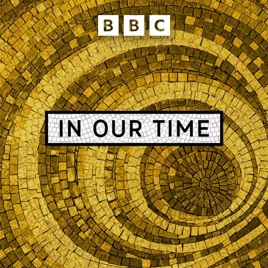
Used to show beautiful mosaic in golden colors, now with model change is just a black spiral of doom
★★★★★
WilderLander 2026/08/29
Gaia Theory
Can you review this topic based off of the great archival episode from 2008? Amazing insights, especially in light of escalating environmental degrada...
★★★★★
Appjbjbapp 2026/08/07
Don’t litter the feed
Please don’t be another podcast that litters and dilutes the feed with other pods. If we want to, we can subscribe to “here for the history.” You can ...
★★★★★
sew2sew 2026/08/02
Wonderful
Finally, a smart podcast. Thank you so much!!
★★★★★
Tim_MN 2026/07/30
My Number One Podcast!
Lots of good topics, super guest experts, and excellent production. And Misha Glenny is superb as the new host!
★★★☆☆
Insomniac 64 2026/07/17
Secular timeline confusion and distraction
For the regular listener who is not a member of academia or the scientific community I.e. your target audience, please, please, go back to using BC an...
★★★★★
Mokeyt3/35 2026/05/30
The industrial revolution episode
I really like the podcast show and this episode in particular. Except for the liberal woman who is insufferable. Not only is she rude and condescendin...
check all reviews on apple podcasts

Podcast sponsorship advertising

Start advertising on In Our Time relevant audience podcasts


What do you want to promote?