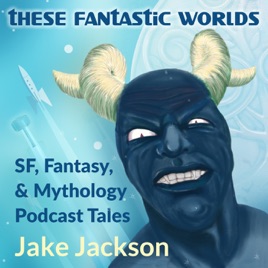
Advertise on podcast: Podcasts | These Fantastic Worlds
This podcast has
100 episodes
Language
EnglishPublisher
Jake JacksonExplicit
No
Date created
2014/09/11
Latest episode
2022/01/11
Average duration
13 min.
Release period
8 days
Description
Quick journey? Need a short respite from the everyday? Take a listen to stories from the far future to the distant past, with gothic landscapes, dystopia, dark fantasy, myths and space opera, pure science fiction and fantasy. These Fantastic Worlds features new weekly short stories by Jake Jackson.
Unlock Podcasts | These Fantastic Worlds podcast Email contact info,
Listeners & Audience details
Email contact information
Direct podcast contact details

Listeners
Audience numbers & engagement insights

Audience details
Podcast Insights

Social media
Check Podcasts | These Fantastic Worlds social media presence


Podcast episodes
Check latest episodes from Podcasts | These Fantastic Worlds podcast
110 - Norse Myths 10 - Ragnarok
2022/01/11
The tenth of Ten Norse Myths. Ragnarok, the Twilight of the Gods, the destruction of the worlds, the dramatic death duel of light and dark...
Ragnarok. The end of the world had been prophesied from its beginning, and everyone across the world knew what to expect when Ragnarok fell upon them. For Ragnarok was the twilight of the gods, an end to the golden years of Asgard, an end to the palaces of delight, an end to the timeless world where nothing could interfere. It was the death of Balder that set the stage for the end of the world, and it was Loki’s crimes which laid in place the main characters. And when the events had begun, there was no stopping it.
When evil entered Asgard, it tainted all nine worlds. Sol and Mani, high in the sky, paled with fright, and their chariots slowed as they moved with effort across the sky. They knew that the fierce, dark wolves, Hati and Skull would be soon upon them and that it would be only a matter of time before eternal darkness would fall once again. Sol and Mani were indeed devoured by their dread pursuers, there was no light to shine on the earth, and the terrible cold crept into the warm reaches of summer and drew from the soil all that was growing there. Snow began to drift down upon the freezing land, and soon it snowed a little faster, and a little harder, until the earth was covered once again in a dark layer of ice.
Winter was upon them, and it did not cease. For three long, frozen seasons, it was winter, and then, after a thaw that melted only one single layer of ice, it was back for three more. With the cold and the darkness came evil, which rooted itself in the hearts of humankind. Soon crime was rampant, and all shreds of kindness disappeared with the spring. At last, the stars were flung from the skies, causing the earth to tremble and shake. Loki and Fenris were freed from their manacles, and together they moved forward to wreak their revenge on the gods and men who had bound them so cruelly.
At the bottom of Yggdrasill, there was a groan that emanated the entire length of the tree, for at that moment, Nithog had gnawed through the root of the world tree, which quivered and shook from bottom to top. Fialar, the red cock who made his home above Valhalla shrieked out his cry, and then flew away from the tree as his call was echoed by Gullinkambi, the rooster in Midgard.
Heimdall knew at once what was upon them, and raising his mighty horn to his lips he blew the call that filled the hearts of all gods and humankind with terror.
"Ragnarok."
"Ragnarok."
"Ragnarok."
The gods sprang from their beds, and thrust aside the finery that hung in their chambers. They armed themselves and mounted their horses, ready for the war that had been expected since the beginning of time. They moved quickly over the rainbow bridge and then they reached the field of Vigrid, where the last battle would be fought.
The turmoil on earth caused the seas to toss and twist with waves, and soon the world serpent Jormungander was woken from his deep sleep. The movement of the seas yanked his tail from his mouth, and it lashed around, sending waves crashing in every direction. And as he crawled out upon land for the first time, a tidal wave swelled across the earth, and set afloat Nagilfar, the ship of the dead, constructed as it was from the nails of the dead. Such nails came from those whose relatives had failed in their sacred duties, and neglected to pare the nails of the deceased when they were laid to rest. As the wind caught the blackened sail, Loki leapt aboard, and took her wheel – the ship of the undead captained by the personification of all evil. Loki called upon the fire-gods from Muspell, and they arrived in a conflagration of terrible glory.
Another ship had set out for Vigrid, and this was steered by Hrym and crewed by the frost-giants who had waited through the millennia for this battle. Across the raging sea, both vessels made for the battlefield.
As they travelle
109 - Norse Myths 09 - The Death of Baldur
2022/01/04
The ninth Norse Myth of ten, brings us to the death of Baldur, one of the most famous laments of Viking legend...
The Death of Baldur. To Odin and Frigga were born twin sons as dissimilar in character and physical appearance as it was possible for two children to be. Hodur, god of darkness, was sombre, taciturn, and blind, like the obscurity of sin, which he was supposed to symbolise, while his brother Baldur, the beautiful, was worshipped as the pure and radiant god of innocence and light. From his snowy brow and golden locks seemed to radiate beams of sunshine which gladdened the hearts of gods and men, by whom he was equally beloved. Each life that he touched glowed with goodness, and he was loved by all who knew him. Baldur tended to his twin brother Hodur with every kindness and consideration. Hodur worshipped Baldur, and would do nothing in his power to harm him.
The youthful Baldur attained his full growth with marvellous rapidity, and was early admitted to the council of the gods. He took up his abode in the palace of Breidablik, whose silver roof rested upon golden pillars, and whose purity was such that nothing common or unclean was ever allowed within its precincts, and here he lived in perfect unity with his young wife Nanna (blossom), the daughter of Nip (bud), a beautiful and charming goddess.
The god of light was well versed in the science of runes, which were carved on his tongue; he knew the various virtues of simples, one of which, the camomile, was called “Baldur’s brow,” because its flower was as immaculately pure as his forehead. The only thing hidden from Baldur’s radiant eyes was the perception of his own ultimate fate.
There came a morning when Baldur woke with the dawn, his face tightened with fear and foresight. He had dreamed of his own death and he lay there petrified, aware, somehow, that the strength of this dream forecasted sinister things to come. So Baldur travelled to see Odin, who listened carefully, and knew at once that the fears of his son were justified – for in his shining eyes there was no longer simply innocence; there was knowledge as well. Odin went at once to his throne at the top of Yggdrasill, and he prayed there for a vision to come to him. At once he saw the head of Vala the Seer come to him, and he knew he must travel to Hel’s kingdom, to visit Vala’s grave. Only then would he learn the truth of his favourite son’s fate.
It was many long days before Odin reached the innermost graves on Hel’s estate. He moved quietly so that Hel would not know of his coming, and he was disregarded by most of the workers in her lands, for they were intent on some celebrations, and were preparing the hall for the arrival of an esteemed guest. At last the mound of Vala’s grave appeared, and he sat there on it, keeping his head low so that the prophetess would not catch a glimpse of his face. Vala was a seer of all things future, and all things past; there was nothing that escaped her bright eyes, and she could be called upon only by the magic of the runes to tell of her knowledge.
The grave was wreathed in shadows, and a mist hung uneasily over the tombstone. There was silence as Odin whispered to Vala to come forth, and then, at once, there was a grating and steaming that poured forth an odour that caused even the all-powerful Odin to gag and spit.
‘Who disturbs me from my sleep,’ said Vala with venom. Odin thought carefully before replying. He did not wish her to know that he was Odin, king of gods and men, for she may not wish to tell him of a future that would touch on his own. And so he responded:
‘I am Vegtam, son of Valtam, and I wish to learn of the fate of Baldur.’
‘Baldur’s brother will slay him,’ said Vala, and with that she withdrew into her grave.
Odin leapt up and cried out, ‘With the power of the runes, you must tell me more. Tell me, Vala, which esteemed guest does Hel prepare for?’
‘Baldur,’ she muttered from the depths o
108 - Norse Myths 08 - The Story of the Volsungs
2021/12/28
This eighth Norse Myth of ten, tells of the dynasty of the Volsungs, the heroes of the North, the family of Sigurd, Sigmund and Sigi, born of Odin...
The Heroes of the Volsungs. The story of the Volsungs begins with Sigi, a son of Odin, a powerful man, and generally respected, until he killed another man out of jealousy, the latter having slain more game when they were out hunting together. In consequence of this crime, Sigi was driven from his own land and declared an outlaw. But it seems that he had not entirely forfeited Odin’s favour, for the god now provided him with a well-equipped vessel, together with a number of brave followers, and promised that victory should ever attend him.
Thus aided by Odin, the raids of Sigi became a terror to his foes, and in the end he won the glorious empire of the Huns and for many years reigned as a powerful monarch. But in extreme old age his fortune changed, Odin forsook him, his wife’s kindred fell upon him, and he was slain in a treacherous encounter.
His death was soon avenged, however, for Rerir, his son, returning from an expedition upon which he had been absent from the land at the time, put the murderers to death as his first act upon mounting the throne. The rule of Rerir was marked by every sign of prosperity, but his dearest wish, a son to succeed him, remained unfulfilled for many a year. Finally, however, Frigga decided to grant his constant prayer, and to vouchsafe the heir he longed for. She accordingly despatched her swift messenger Gna, or Liod, with a miraculous apple, which she dropped into his lap as he was sitting alone on the hillside. Glancing upward, Rerir recognised the emissary of the goddess, and joyfully hastened home to partake of the apple with his wife. The child who in due time was born under these favourable auspices was a handsome little lad. His parents called him Volsung, and while he was still a mere infant they both died, and the child became ruler of the land.
Years passed and Volsung’s wealth and power ever increased. He was the boldest leader, and rallied many brave warriors around him. Often they drank his mead underneath the Branstock, a mighty oak, which, rising in the middle of his hall, pierced the roof and overshadowed the whole house.
Ten stalwart sons were born to Volsung, and one daughter, Signy, came to brighten his home. So lovely was this maiden that when she reached marriageable age many suitors asked for her hand, among whom was Siggeir, King of the Goths, who finally obtained Volsung’s consent, although Signy had never seen him.
When the wedding-day came, and the bride beheld her destined husband she shrank in dismay, for his puny form and lowering glances contrasted sadly with her brothers’ sturdy frames and open faces. But it was too late to withdraw—the family honour was at stake—and Signy so successfully concealed her dislike that none save her twin brother Sigmund suspected with what reluctance she became Siggeir’s wife.
While the wedding feast was in progress, and when the merry-making was at its height, the entrance to the hall was suddenly darkened by the tall form of a one-eyed man, closely enveloped in a mantle of cloudy blue. Without vouchsafing word or glance to any in the assembly, the stranger strode to the Branstock and thrust a glittering sword up to the hilt in its great bole. Then, turning slowly round, he faced the awe-struck and silent assembly, and declared that the weapon would be for the warrior who could pull it out of its oaken sheath, and that it would assure him victory in every battle. The words ended, he then passed out as he had entered, and disappeared, leaving a conviction in the minds of all that Odin, king of the gods, had been in their midst.
Volsung was the first to recover the power of speech, and, waiving his own right first to essay the feat, he invited Siggeir to make the first attempt to draw the divine weapon out of the tree-trunk. The bridegroom anxiously tugg
107 - Norse Myths 07 - The Sword of Tyr
2021/12/21
In this, the seventh Norse Myth of ten, the mighty sword of the Viking God Tyr grants victory and death in equal measure across great empires...
Tyr’s Sword Carves Destiny and Victory. Tyr, Tiu, or Ziu was the son of Odin, and, according to different storytellers, his mother was Frigga, queen of the gods, or a beautiful giantess whose name is unknown, but who was a personification of the raging sea. He is the god of martial honour, and one of the twelve principal deities of Asgard. Although he appears to have had no special dwelling there, he was always welcome to Vingolf or Valhalla, and occupied one of the twelve thrones in the great council hall of Glads-heim.
Tyr, whose name was synonymous with bravery and wisdom, was also considered by the ancient Northern folk to have the white-armed Valkyrs, Odin’s attendants, at his command, and they thought that he it was who designated the warriors whom they should be transferred to Valhalla to aid the gods on the last day, the end of the world, Ragnarök.
***
As the God of courage and of war, Tyr was frequently invoked by the various nations of the North, who cried to him, as well as to Odin, to obtain victory. That he ranked next to Odin and Thor is proved by his name, Tiu, having been given to one of the days of the week, Tiu’s day, which in modern English has become Tuesday. Under the name of Ziu, Tyr was the principal divinity of the Suabians in the first century region of the Upper Rhine and Danube, who originally called their capital, the modern Augsburg in Bavaria, Ziusburg. These people, venerating the god as they did, worshipped him under the emblem of a sword, his distinctive attribute, and in his honour held great sword dances, where various figures were performed. Sometimes the participants forming two long lines, crossed their swords, point upward, and challenged the boldest among their number to take a flying leap over them. At other times the warriors joined their sword points closely together in the shape of a rose or wheel, and when this figure was complete invited their chief to stand on the navel thus formed of flat, shining steel blades, and then they bore him upon it through the camp in triumph. The sword point was further considered so sacred that it became customary to register oaths upon it.
A distinctive feature of the worship of this god among the Franks and some other Northern nations was that the priests called Druids or Godi offered up human sacrifices upon his altars, these sacrifices were made upon rude stone altars called dolmens, which can still be seen in Northern Europe and parts of the British Isle. As Tyr was considered the patron god of the sword, it was deemed indispensable to engrave the sign or rune representing him upon the blade of every sword—an observance of which was said to be essential to those who were destined to be victorious.
Tyr was identical with the Saxon god Saxnot (from sax, a sword), and with Er, Heru, or Cheru, the chief divinity of the Cheruski one of the early Germanic tribes, who also considered him to be a god of the sun, and deemed his shining sword blade an emblem of its rays.
According to an ancient legend, Cheru’s sword, which had been fashioned by the same dwarfs, sons of Ivald, who had also made Odin’s spear, was held sacred by his people, to whose care he had entrusted it, declaring that those who possessed it were sure to have the victory over their foes. But although carefully guarded in the temple, where it was hung so that it reflected the first beams of the morning sun, it suddenly and mysteriously disappeared one night. A Vala, druidess, or prophetess, consulted by the priests, revealed that the Norns had decreed that whoever wielded it would conquer the world and come to his death by it; but in spite of all entreaties she refused to tell who had taken it or where it might be found. Some time after this, a tall and dignified stranger came to Cologne, where Vitellius, the Roman pref
106 - Norse Myths 06 - Heimdall
2021/12/14
This sixth Norse Myth is the tale of Heimdall, the Guardian of the Rainbow Bridge, his adventures with the people of Midgard, and his battle with Loki...
Heimdall in Midgard. Heimdall was called the watchman of the gods, and he was distinguished by his role at the Bifrost bridge, which he had constructed from fire, air and water, which glowed as a rainbow in the sky. The Bifrost bridge was also called the Rainbow bridge, and it connected heaven with earth, ending just under the great tree Yggdrasill.
***
The golden age of Asgard was one of such happiness that there was never any threat to the peace of the land, and so it was that its watchman became bored. Heimdall was easily spotted, so he could not travel far without being recognized and commended for his fine work. He carried over his shoulder a great bugle, Giallarhorn, the blasts of which could summon help from all nine worlds. One fine day, Odin noticed that Heimdall had been hard at work without any respite for many many years. Odin himself would occasionally slip into a disguise in order to go out into the worlds beneath them, and he decided then that Heimdall should have the same opportunity – after all, Asgard was hardly in need of defence when all was quiet.
Heimdall was delighted, for he had been longing to visit Midgard and to get to know the people there. He carefully laid his bugle and his sword to one side, and dressed in the garb of the people of Midgard, he slipped across the bridge and reached a deserted shore. The first people he clapped eyes upon were Edda and Ai, a poor couple who lived on the bare beaches of Midgard, eking a meagre living from the sands. They lived in a tumble-down shack and had little in their possession, but what they did have they offered gladly to Heimdall. Their shack was sparsely furnished, with only a seaweed bed on which to lay, but it was agreed that Heimdall could sleep there with them, and at night he laid himself between the couple and slept well.
After three nights, Heimdall summoned Ai and Edda as they gathered snails and cockles from the seashore. He had put together several pieces of driftwood, and as they watched, he fashioned a pointed stick from one, and cut out a hole in another. The pointed stick was placed inside the hole, and he turned it quickly, so that sparks, and then a slender stream of smoke was produced. And then there was fire. Ai and Edda flew back against the walls of the shack, astonished by this magical feat. Heimdall smiled, thanked them for their hospitality and took his leave.
Ai and Edda’s lives were transformed by fire. Their water was heated; the most inedible nuggets from the beach were softened into tender morsels of food. And most of all, they had warmth. Nine months later a second gift appeared to Edda, for she gave birth to a son who she called Thrall. Thrall was an ugly, wretched-looking boy, with a knotted body and a twisted back, but he was kind and he worked hard. When he came of age, he married one like him – a deformed young woman called Serf. Together they had many children, all of whom worked about the house or on the land with the same diligence as their father and mother. These were the ancestors of the thralls.
Heimdall had left the home of Ai and Edda and travelled on. Soon enough he came to a lovely little house occupied by an older couple Amma and Afi. As he arrived, Afi was hard at work, whittling away at beams with which to improve their house. Heimdall set down his belongings and began to work with Afi. Soon they had built together a wonderful loom, which they presented to Amma, who was seated happily by the fire with her spinning wheel. Heimdall ate well that evening, and when the time came for sleep, he was offered a place between them in the only bed. For three nights Heimdall stayed with Afi and Amma, and then he left them. Sure enough, nine months later, and to the astonishment of the elderly couple, Amma gave birth to a son, who they called Karl the
105 - Norse Myths 05 - Loki
2021/12/07
This fifth Norse Myth is the last tale of Loki, not the charming, trickster of the Marvel Universe, but the dark God of the Vikings Age...
The Legends of Loki. Besides the hideous giant Utgard-Loki, the personification of mischief and evil, whom Thor and his companions visited in Jötunheim, the ancient Northern nations had another type of sin, whom they called Loki also.
In the beginning, Loki was merely the epitome of the hearth fire and of the spirit of life. At first a god, he gradually becomes “god and devil combined,” and ends in being held in general detestation as an exact counterpart of the mediaeval Lucifer, the prince of lies, “the originator of deceit, and the back-biter” of the Aesir.
By some authorities Loki was said to be the brother of Odin, but others assert that the two were not related, but had merely gone through the form of swearing blood brotherhood common in the North.r
Loki’s Last Crime Loki’s last crime, and the one which filled his measure of iniquity, was to induce Hodur to throw the fatal mistletoe at Balder, whom he hated merely on account of his immaculate purity. Perhaps even this crime might have been condoned had it not been for his obduracy when, in the disguise of the old woman Thok, he was called upon to shed a tear for Balder. His action on this occasion convinced the gods that nothing but evil remained within him, and they pronounced unanimously upon him the sentence of perpetual banishment from Asgard.
***
To divert the gods’ sadness and make them, for a short time, forget the treachery of Loki and the loss of Balder, Aegir, god of the sea, invited them to partake of a banquet in his coral caves at the bottom of the sea.
The gods gladly accepted the invitation, and clad in their richest garb, and with festive smiles, they appeared in the coral caves at the appointed time. None were absent save the radiant Balder, for whom many a regretful sigh was heaved, and the evil Loki, whom none could regret. In the course of the feast, however, this last-named god appeared in their midst like a dark shadow, and when bidden to depart, he gave vent to his evil passions in a torrent of invective against the gods.
Then, jealous of the praises which Funfeng, Aegir’s servant, had won for the dexterity with which he waited upon his master’s guests, Loki suddenly turned upon him and slew him. At this wanton crime, the gods in fierce wrath drove Loki away once more, threatening him with dire punishment should he ever appear before them again.
Scarcely had the Aesir recovered from this disagreeable interruption to their feast, and resumed their places at the board, when Loki came creeping in once more, resuming his slanders with venomous tongue, and taunting the gods with their weaknesses or shortcomings, dwelling maliciously upon their physical imperfections, and deriding them for their mistakes. In vain the gods tried to stem his abuse; his voice rose louder and louder, and he was just giving utterance to some base slander about Sif, when he was suddenly cut short by the sight of Thor’s hammer, angrily brandished by an arm whose power he knew full well, and he fled incontinently.
Knowing that he could now have no hope of being admitted into Asgard again, and that sooner or later the gods, seeing the effect of his evil deeds, would regret having permitted him to roam the world, and would try either to bind or slay him, Loki withdrew to the mountains, where he built himself a hut, with four doors which he always left wide open to permit of a hasty escape. Carefully laying his plans, he decided that if the gods should come in search of him he would rush down to the neighbouring cataract, according to tradition the Fraananger force or stream, and, changing himself into a salmon, would thus evade his pursuers. He reasoned, however, that although he could easily avoid any hook, it might be difficult for him to effect his escape if the gods should fashion a net like that of th
104 - Norse Myths 04 - Thor
2021/11/30
The fourth of ten Norse myths tells of the story of the Thor and how he gained his hammer through the wicked machinations of the mischievous Loki.
The Legend of Thor. Thor was one of the twelve principal deities of Asgard, and he lived in the splendid realm of Thrudvang, where he built a palace called Bilskirnir. Here he lived as god of thunder, and his name was invoked more than any other in the age of the Vikings. For Thor was the protector of the land, a fine figure of a man with glowing eyes, firm muscles, and a red beard that made him instantly recognizable. He became known across the worlds for his great hammer, Miolnir (the crusher), which had been forged by the dark elves. This hammer, together with Thor’s strength and his terrible temper, made him the fiercest god of Asgard, and the personification of brute force. Thor was also god of might and war, and because of his popularity, he soon grew to embody the forces of agriculture, and became a symbol of the earth itself. He is remembered throughout the world on the fourth day of every week – Thursday, or Thor’s day.
How Thor Gained His Hammer Thor was married to Sif, whose long golden hair was one of her great prides. It fell to her feet like a ray of sunlight, and it was the colour of ripe cornsilk in the summer fields. As she brushed it, it glinted in the light and became a symbol of great beauty across Asgard. One day, the glistening cascade of hair caught the eye of Loki, and he wondered then how he ever could have imagined living without it. He thought about that hair all day, and all through the night. And then, just as the moon reached her pinnacle in the midnight sky, Loki leapt to his feet and made for Sif’s bedchamber, where he knew he would find her sleeping. The moon cast long shadows into the sleeping goddess’s delicately furnished room, and it was easy for the fleet-footed Loki to steal in and set to work.
***
Loki crept to the side of Sif’s bed and very gently, so that he did not disturb her, he withdrew a pair of great shears from his cloak and cut her long veil of hair from her head. Winding the tresses around his arm, he darted from the room once again, and there was silence. Until, that is, Sif awoke to discover the travesty that had occurred.
Her shrieks brought everyone in the kingdom running to her side, and Thor howled with such outrage that the entire kingdom of Asgard shook. It was not long before Loki was ferreted out and brought before the irate god. Thunder boomed in the sky as the shaking trickster fell to his knees before Thor.
‘I beg you, Thor,’ he cried, ‘let me free and I will find a new head of hair for Sif – one that is even more beautiful than the one she has now. I’ll go to the dark elves. They’ll fashion one!’ Loki’s head bobbed up and down with fright and eventually Thor gave in.
‘You have twenty hours to come forward with the tresses, and if you fail, Loki, you will be removed from Asgard forever.’ Thor banged down a thunderbolt at Loki’s feet, and the traitor scampered hastily away, hardly daring to breathe at his good fortune.
Loki travelled at once to the centre of the earth, down into the Svart-alfa-heim, where the wily dwarf Dvalin had his home. He threw himself on the mercy of the dwarf, and requested as well two gifts with which he could win the favour of Odin and Frey, who were bound to hear of the news and wish to punish him themselves.
Dvalin worked over the heat of his forge for many hours, and as he worked he chanted the words which would make all he forged the finest there was – for there are no arms as powerful nor as invincible as those fashioned by dwarfs. First he finished the spear Gungnir, which would always hit its mark. Next, he formed the ship Skiblanir, which would always find wind, on even the most silent of seas, and which could sail through the air as well as on water. The ship was folded carefully and placed in a tiny compass. Loki’s eyes shone at it
103 - Norse Myths 03 - Tale of the Valkyrie
2021/11/23
The third of ten Norse myths tells of the story of the Valkyrie, Odin's shield maidens who bring the fallen heroes of battle to the everlasting rewards of Valhalla.
The Valkyrs. Odin’s special attendants, the Valkyrs, or battle maidens, were either his daughters, like Brunhild, or the offspring of mortal kings, maidens who were privileged to remain immortal and invulnerable as long as they implicitly obeyed the god and remained virgins. They and their steeds were the personification of the clouds, their glittering weapons being the lightning flashes. The ancients imagined that they swept down to earth at Valfather’s command, to choose among the slain in battle heroes worthy to taste the joys of Valhalla, and brave enough to lend aid to the gods when the great battle would be fought.
***
These maidens were pictured as young and beautiful, with dazzling white arms and flowing golden hair. They wore helmets of silver or gold, and blood-red corselets, and with spears and shields glittering, they charged boldly through the fray on their mettlesome white steeds. These horses galloped through the realms of air and over the quivering Bifrost, bearing not only their fair riders, but the heroes slain, who after having received the Valkyrs’ kiss of death, were thus immediately transported to Valhalla.
As the Valkyrs’ steeds were personifications of the clouds, it was natural to fancy that the hoar frost and dew dropped down upon earth from their glittering manes as they rapidly dashed to and fro through the air. They were therefore held in high honour and regard, for the people ascribed to their beneficent influence much of the fruitfulness of the earth, the sweetness of dale and mountain-slope, the glory of the pines, and the nourishment of the meadow-land.
The mission of the Valkyrs was not only to battlefields upon earth, but they often rode over the sea, snatching the dying Vikings from their sinking dragon-ships. Sometimes they stood upon the strand to beckon them thither, an infallible warning that the coming struggle would be their last, and one which every Northland hero received with joy.
The numbers of the Valkyrs differ greatly according to various storytellers, ranging from three to sixteen, most authorities, however, naming only nine. The Valkyrs were considered as divinities of the air. It was said that Freyia and Skuld led them on to the fray.
The Valkyrs had important duties in Valhalla, when, their bloody weapons laid aside, they poured out the heavenly mead for the Einheriar. This beverage delighted the souls of the new-comers, and they welcomed the fair maidens as warmly as when they had first seen them on the battlefield and realised that they had come to transport them to their honour in Valhalla.
Völund and the Valkyrs The Valkyrs were supposed to take frequent flights to earth in swan plumage, which they would throw off when they came to a secluded stream, that they might indulge in a bath. Any mortal surprising them thus, and securing their plumage, could prevent them from leaving the earth, and could even force these proud maidens to mate with him if such were his pleasure.
It is related that three of the Valkyrs, Olrun, Alvit, and Svanhvit, were once sporting in the waters, when suddenly the three brothers Egil, Slagfinn, and Völund, or Wayland the smith, came upon them, and securing their swan plumage, the young men forced them to remain upon earth and become their wives. The Valkyrs, thus detained, remained with their husbands nine years, but at the end of that time, recovering their plumage, or the spell being broken in some other way, they effected their escape.
The brothers felt the loss of their wives extremely, and two of them, Egil and Slagfinn, putting on their snow shoes, went in search of their loved ones, disappearing in the cold and foggy regions of the North. The third brother, Völund, however, remained at home, knowing all search would be of no avail, and he found sola
102 - Norse Myths 02 - Odin and Frigga
2021/11/16
The second of ten Norse myths tells of Odin and Frigga in Valhalla in Asgard, and their sons Thor, Balder and the first gods of the Vikings...
Odin and Frigga in Asgard. Odin was the son of Bor, and the brother of Vili and Ve. He was the most supreme god of the Northern races and he brought great wisdom to his place at the helm of all gods. He was called Allfather, for all gods were said to have descended from him, and his esteemed seat was Asgard itself. He held a throne there, one in an exalted and prestigious position, and it served as a fine watchtower from which he could look over men on earth, and the other gods in Asgard as they went about their daily business.
***
Odin was a tall, mighty warrior. While not having the brawn of many excellent men, he had wisdom which counted for much more. On his shoulders he carried two ravens, Hugin (thought) and Munin (Memory), and they perched there, as he sat on his throne, and recounted to him the activities in the great wide world. Hugin and Munin were Odin’s eyes and his ears when he was in Asgard and he depended on their bright eyes and alert ears for news of everything that transpired down below. In his hand Odin carried a great spear, Gungnir, which had been forged by dwarfs, and which was so sacred that it could never be broken. On his finger Odin wore a ring, Draupnir, which represented fertility and fruitfulness and which was more valuable to him, and to his land, than anything in any other god’s possession. At the foot of Odin’s throne sat two wolves or hunting hounds, Geri and Freki, and these animals were sacred. If one happened upon them while hunting, success was assured.
Odin belonged to a mysterious region, somewhere between life and death. He was more subtle and more dangerous than any of the other gods, and his name in some dialects means ‘wind’, for he could be both forceful and gentle, and then elusive or absent. On the battlefield, Odin would dress as an old man – indeed, Odin had many disguises, for when things changed in Asgard, and became bad, he had reason to travel on the earth to uncover many secrets – attended by ravens, wolves and the Valkyrs, who were the ‘choosers of the slain’, the maidens who took the souls of fallen warriors to Valhalla.
Valhalla was Odin’s palace at Asgard, and its grandeur was breathtaking. Valhalla means ‘hall of the chosen slain’, and it had five hundred great wooden doors, which were wide enough to allow eight hundred warriors to pass, breastplate to breastplate. The walls were made of glittering spears, polished until they gleamed like silver, and the roof was a sea of golden shields which shone like the sun itself. In Odin’s great hall were huge banqueting tables, where the Einheriar, or warriors favoured by Odin, were served. The tables were laden with the finest horns of mead, and platters of roast boar. Like everything else in Asgard, Valhalla was enchanted. Even the boar was divine and Saehrimnir, as he was called, was slain daily by the cook, boiled and roasted and served each night in tender, succulent morsels, and then brought back to life again the following day, for the procedure to take place once again. After the meal, the warriors would retire to the palace forecourt where they would engage in unmatched feats of arms for all to see. Those who were injured would be healed instantly by the enchantment of Valhalla, and those who watched became even finer warriors.
Odin lived in Asgard with Frigga, who was the mother-goddess and his wife. Frigga was daughter of Fiogyn and sister of Jord, and she was greatly beloved on earth and in Asgard. She was goddess of the atmosphere and the clouds, and she wore garments that were as white as the snow-laden mountains that gently touched the land of Asgard. As mother of all, Frigga carried about her a heady scent of the earth – blossoming flowers, ripened fruit, and luscious greenery. There are many stories told about Frigga, as we will
101 - Norse Myths 01 - Creation
2021/11/09
The first of ten Norse myths that cover Odin, Loki, Thor and more, we begin, fittingly, with the creation of the universe as seen through the eyes of the Vikings...
The Creation of the Universe. In the beginning, before there was anything at all, there was a nothingness that stretched as far as there was space. There was no sand, nor sea, no waves nor earth nor heavens. And that space was a void that called to be filled, for its emptiness echoed with a deep and frozen silence. So it was that a land sprung up within that silence, and it took the place of half the universe. It was a land called Filheim, or land of fog, and where it ended sprung another land, where the air burned and blazed. This land was called Muspell. Where the regions met lay a great and profound void, called Ginnungagap, and here a peaceful river flowed, softly spreading into the frosty depths of the void where it froze, layer upon layer, until it formed a fundament. And it was here the heat from Muspell licked at the cold of Filheim until the energy they created spawned the great frost-giant Ymir. Ymir was the greatest and the first of all frost-giants, and his part in the creation of the universe led the frost-giants to believe that they should reign supreme on what he had made.
Filheim had existed for many ages, long before our own earth was created. In the centre was a mighty fountain and it was called Vergelmir, and from that great fountain all the rivers of the universe bubbled and stormed. There was another fountain called Elivagar (although some believe that it is the same fountain with a different name), and from this bubbled up a poisonous mass, which hardened into black ice. Elivagar is the beginning of evil, for goodness can never be black.
Muspell burned with eternal light and her heat was guarded by the flame giant, Surtr, who lashed at the air with his great sabre, filling it with glittering sparks of pure heat. Surtr was the fiercest of the fire giants who would one day make Muspell their home. The word Muspell means ‘home of the destroyers of the world’ and that description is both frightening and accurate because the fire giants were the most terrifying there were.
On the other side of the slowly filling chasm, Filheim lay in perpetual darkness, bathed in mists which circled and spun until all was masked. Here, between these stark contrasts, Ymir grew, the personification of the frozen ocean, the product of chaos. Fire and ice met here, and it was these profound contrasts that created a phenomenon like no other, and this was life itself. In the chasm another form was created by the frozen river, where the sparks of the Surtr’s sabre caused the ice to drip, and to thaw, and then, when they rested, allowed it to freeze once again. This form was Audhumla, a cow who became known as the nourisher. Her udders were swollen with rich, pure milk, and Ymir drank greedily from the four rivers which formed from them.
Audhumla was a vast creature, spreading across the space where the fire met the ice. Her legs were columns, and they held up the corners of space.
Audhumla, the cow, also needed sustenance, and so she licked at the rime-stones which had formed from the crusted ice, and from these stones she drew salt from the depths of the earth. Audhumla licked continuously, and soon there appeared, under her thirsty tongue, the form of a god. On the first day there appeared hair, and on the second, a head. On the third day the whole god was freed from the ice and he stepped forth as Buri, also called the Producer. Buri was beautiful. He had taken the golden flames of the fire, which gave him a warm, gilded glow, and from the frost and ice he had drawn a purity, a freshness that could never be matched.
While Audhumla licked, Ymir slept, sated by the warmth of her milk. Under his arms the perspiration formed a son and a daughter, and his feet produced a giant called Thrudgemir, an evil frost-giant with six heads who went on to bear h
Micro-fiction 100 – Machines Discarded II (Post-Apocalypse series)
2021/11/02
Continuing from Machines Discarded Part One. Past and present churn together as the dark tale of discarded machines opens out to the future of humankind and the long shadow of primordial dread…
Machines Discarded. Part Two. The day she discovered a discarded metal creature.
In the melee, with the light streaming from the head of the fallen robot, casting its visions of the past, Karima swerved backwards, her hands raised to protect herself from the lunging lawman, her right elbow knocked the electric screwdriver off the chest of the robot, and the light show fell. The lawman halted, his frenzied eyes staring hard at the now empty wall, his pistol hanging.
“What the Hell are you doing!?” Karima’s fury stoked her defiance.
“You don’t understand, those things, they’re death to us all.” The Lawman shouted back, just a few inches from the feet of the inert robot.
“Is that why you followed me?”
“Of course, what else would make you so special?” The Lawman’s voice dropped a little, his whole body shook as he folded his gun arm to his chest, trying to steady himself.
The two of them looked at each other, he was now hunched over, almost retching, she was ready to lunge. They stood like that for a few moments.
“You’d better go.” She murmured. “Let me get on with my work.”
“Yes.” His wary eyes flickered across to the robot, “you should break it up, that’s what you were going to do, wasn’t it?
“Not that it’s any of your business, but yes.”
“Ok. I’ll go. I’ll let myself out.” He retreated. Keeping his eyes both on Karima and the fallen robot he stepped backwards to the door, just out of sight, reaching the shadows that swallowed him up.
Karima nodded and looked down at her toolkit, just by her foot. She heard the door click open, followed by its soft closure. When she looked up her imagination conjured the impression of the grin in the dark, sitting back in the formlessness of night.
“By the Gods, what was that all about?” She leaned against the kitchen table and closed her eyes.
The day she discovered a discarded metal creature.
“So, I can’t just take you apart, not without investigating further.” She shook her head and lingered on the missing face of the creature before her. “That lawman was definitely frightened of you.” She saw the electric screwdriver on the wooden floor, picked it up, and returned it to the wall charger. She pulled a chair across to the table and folded herself into its ancient simplicity. It was a chair she used to bury herself in her mothers arms, the memory of her tiny, dangling feet still present in her adult legs, with the single bulb above them in the kitchen.
She fell asleep.
At first it was a deep slumber, but she was disturbed by flickering dreams of people fighting, robots in cages, sledgehammers and slaughterhouses, eyes that stared, and grins that lingered in the shadows. She felt the darkness deepen, denying the day, as if the destruction of each metal creature brought endless night ever closer. And then she felt hunted. She felt watched.
“Oh!” She lurched awake with a thud. The house was completely dark. The generator must have stopped. She stood up and listened to the sounds of the night, wondering how long she’d been asleep, inactive, like the robot she knew to be on the table but could not see.
She blinked, allowed her eyes to adjust. She felt the same sensation she had when she’d turned on the generator earlier: there was a different quality in the air, this time inside.
Her breathing became shallow as she stilled herself.
There was nothing to hear. The usual night sounds of screeching foxes, distant owls, foraging and ferreting creatures, all silent.
She opened her mouth to speak, but found no words.
She relaxed her eyes to suppress her rising panic, and looked around. She could see the vague outlines of the table next to her, and the form of the robot, but where she knew the window
Micro-fiction 099 – Machines Discarded I (Post-Apocalypse series)
2021/10/26
In a world that’s turned against itself, and destroyed all thinking machines Karima stumbles across a robot, and is followed in the dark…
Machines Discarded. Part One.
Today she discovered a discarded metal creature.
It was a safe time to walk along the twilight lane, relatively, at least. As she stepped silently to fetch water from the pump in the next farm Karima watched for signs of movement along the edge of the fields. She was strong, encouraged by her now absent parents to look after herself, to know when to fight, to run, to hide. She knew how to cook without leaving a trace in the air, to clean her clothes in the river, to be wary of the people she met. Those parents had left when she was young, taking her sister with them, on a trip to the city from which they had never returned.
The golden sunset would herald a peaceful night in more joyful times, but in her short life she had seen everything descend, with the destruction of the robots, then all machines as the economy collapsed, swiftly followed by society. She knew she was too young to understand what had happened so she sat in the old parks, the benches on the roadside, and leaned against the corners of the streets in the nearest town. She didn’t invite discussion, kept her eyes down, smoothed her hair and dressed in neutral hues, but she listened to everyone, tried to piece together what had happened and learn how others survived. She’d heard so many stories of the rebellion of people against the machines, destroying what had been created to help them, when it was discovered the machines were a threat after all.
But today she discovered a discarded metal creature.
She tripped over something in the gathering shadows of the lane. A copse of trees, bent with the effort of age distracted her with their branches silhouetted like arms, their twigs crooked like old fingers. She stopped herself falling and sprang back up, holding her breath still, checking for other sounds.
“Just the myna birds.” She muttered to herself. “But what’s this?” She kicked gently in front of her and felt the unyielding resistance of some sort of metal.
“Maybe I can make something with that, or sell it.” She knelt down and tugged at the solid form. She found herself hauling a long, straggling bundle of metal parts, limbs, a torso, and final a broken head. It was one of the old service robots, left to rust in the vegetation, cast aside or dumped, who knows.
“Great for parts though.” She smiled for the first time in days. She had a few friends, or associates as she called them, and they all looked out for spare metal to sell or make useful. Some had even tried to jack them into life.
In dire need of the water she contemplated covering it up and leaving it, but sighed, “I’ll have to bring it with me to the farm, I don’t want to lose it.” She shifted her water can into the crook of her arm and lifted the dented, scratched carcass. It was surprisingly light.
“Well I don’t fancy dragging it.” So she shuffled the abandoned creature onto her back like a rucksack, its legs dangling down, its shattered head lolling to the side.
But today she discovered a discarded metal creature.
With the sun now disappeared she reached the farm and felt strangely comforted by the presence of her broken companion. She strode up the winding path to the farm, quietly opening the cap from her can. Everyone from the local area used this well, the only one for miles guaranteed not to be poisoned, for now. Often she had to wait, noting others hesitating by the corners of the farm buildings, or peering out from the depths of haylofts. But tonight there seemed to be no-one else.
She shrugged her companion further up on her back and headed for the well. It took only a few moments to fill the can from the noisy tap, its old plumbing complaining noisily throughout. Usually this was when she was most anxious, for the noise could be heard from all around,
Podcast reviews
Read Podcasts | These Fantastic Worlds podcast reviews
Podcast sponsorship advertising
Start advertising on Podcasts | These Fantastic Worlds relevant audience podcasts
You may also like to advertise on these Podcasts

4.4371061566
The Megyn Kelly Show
SiriusXM

4.888901269
Fearless with Jason Whitlock
Blaze Podcast Network

4.8118931000
Mind Pump: Raw Fitness Truth
Sal Di Stefano, Adam Schafer, Justin Andrews, Doug Egge

4.8102131585
Tara Brach
Tara Brach

4.541561215
Something You Should Know
Mike Carruthers | OmniCast Media

4.513841343
Strictly Anonymous Confessions
Kathy Kay

4.8292781897
Fantasy Footballers - Fantasy Football Podcast
Fantasy Football

4.62382612
Football Weekly
The Guardian

4.45387666
Two Judgey Girls
Two Judgey Girls

3.8258501152
The Viall Files
Nick Viall