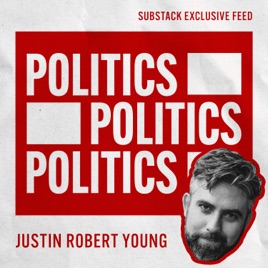
Advertise on podcast: Politics Politics Politics
Rating
4.6from
This podcast has
411 episodes
Language
EnglishPublisher
Justin Robert YoungExplicit
No
Date created
2015/10/22
Latest episode
2026/10/13
Average duration
76 min.
Release period
4 days
Description
Unbiased political analysis the way you wish still existed. Justin Robert Young isn't here to tell you what to think, he's here to tell you who is going to win and why. www.politicspoliticspolitics.com
Unlock Politics Politics Politics podcast Email contact info,
Listeners & Audience details
Email contact information
Direct podcast contact details

Listeners
Audience numbers & engagement insights

Audience details
Podcast Insights

Podcast episodes
Check latest episodes from Politics Politics Politics podcast
What the Hell Is Happening in Kansas? Where the Iran War Goes Next (with Ryan McBeth)
2026/10/13
A race that should’ve barely garnered any attention outside its home state is turning into one of the hottest of the midterms, as Republican Senator Roger Marshall is in the fight of his life against Democrat Adam Hamilton. Six months ago, Democratic hopes for the Senate were centered on Maine, Ohio, and Michigan, maybe even Florida at the outer edges. Nobody was talking about Kansas. Now Emerson has Hamilton ahead 45–43, the New York Times/Siena poll has the race tied at 45, and YouGov has Hamilton leading 48–45. These are consistent, margin-of-error leads for a Democrat.
Marshall is a throwback religious conservative from the pre-Trump era who’s plugged himself into the MAGA universe through faith-and-family politics. He has the votes you’d expect, including a controversial one involving January 6. Hamilton is a centrist Democrat who founded his own church in 1990 with four people in a borrowed space. He’s using that religious background and his charisma as a leader of men to say, “I’m not asking you to vote for a Democrat. I’m asking you to vote for common sense.”
Politics Politics Politics is a reader-supported publication. To receive new posts and support my work, consider becoming a free or paid subscriber.
Hamilton wants congressional approval for tariffs, more agricultural export promotion, and year-round guest-worker visas. Those positions push directly against Trump’s tariffs and hard-line immigration policies. Marshall, meanwhile, has to defend Trump during what’s being called “Farmageddon.” Diesel prices can only stay this high for so long. Restrictions on selling crops can only remain this punitive before farmers go crazy.
Marshall’s medical career has also become a liability. An investigation found that he sued more than 700 patients over unpaid medical debt, and court records showed 81 arrests after people missed court appearances connected to those cases. His side says the collections were necessary to sustain medical care and that nobody was criminally convicted simply for being unable to pay. But Hamilton has an effective ad featuring a woman who says she was arrested while eight months pregnant after missing a payment. “I’m a doctor” is usually a good political pitch. Marshall found a way to make it a negative.
This isn’t simply the national environment. Republicans face similar problems with farmers, diesel, and tariffs in Iowa, but Ashley Hinson is still leading her Democratic opponent and running ahead of the Republican gubernatorial candidate. Kansas is the combination of a bad environment and an incumbent who’s never been tested suddenly finding himself in the race of his life. The cavalry is arriving: Marshall has hired Chris Grant of Big Dog Strategies, and the Senate Leadership Fund is bringing in nearly $8.2 million, possibly redirected from Georgia and North Carolina. My gut says Kansas is much closer than it should be but doesn’t tip. Raw political gravity and the Republican registration advantage probably carry Marshall through. Maybe.
The broader Republican strategy is now triage. Two Republican super PACs are withdrawing support from Tom Kean Jr. and Mariannette Miller-Meeks, leaving both incumbents without the air cover they expected. Republicans aren’t trying to flip Democratic seats anymore; they’re defending their own and attempting to minimize the losses. Trump is even heading to Wasilla to campaign for Alaska Senator Dan Sullivan against Mary Peltola. Second-term presidents aren’t usually eager to do a full-court press, let alone fly to Alaska. Trump deserves credit for doing the work, but the fact that he’s campaigning in red states tells you where Republican priorities are. They’re no longer on offense.
Chapters
00:00:00 - Intro
00:02:45 - James Talarico
00:13:09 - Kimberly Guilfoyle
00:14:24 - Kansas Senate Race
00:25:30 - Update
00:26:22 - Republican Super PACs
00:27:25 - Trump Heads to Alaska
00:29:58 - DOGE
00:31:02 - Interview with Ryan McBeth
This is a public episode. If you'd like to discuss this with other subscribers or get access to bonus episodes, visit www.politicspoliticspolitics.com/subscribe
Are These Senate Races Widening or Tightening? The Most Expensive Midterms Ever (with Dave Levinthal)
2026/10/08
We’re less than a month from Election Day, which means this is when polls should begin to move. The money has been spent, the persuasion is out there, and the surrogates have said what they’re going to say. A race sitting at five or six points needs to move toward three or two if it’s going to become competitive. Otherwise, it starts widening to the point where we can call it done.
Michigan is essentially tied. Four recent polls have Abdul El-Sayed leading Mike Rogers by one or two points, while a smaller survey put El-Sayed ahead by five. I’m inclined to throw that smaller poll out. El-Sayed also appears to be distancing himself from Hasan Piker after campaigning with him during the primary. If he’s trying to get away from that association now, somebody internally is showing him scary numbers. My verdict: Michigan is tightening — like two hands coming together on a first date.
Politics Politics Politics is a reader-supported publication. To receive new posts and support my work, consider becoming a free or paid subscriber.
Georgia and North Carolina are going the other way. Jon Ossoff leads by eight to 10 points in three recent Georgia polls. That race is wider than the Grand Canyon and only getting wider. In North Carolina, Roy Cooper leads by five to 12 points, and Michael Whatley has temporarily pulled his television ads. His campaign says it’s merely adjusting whom it targets before making a late push. I say: liar, liar, pants on fire. That race is wider than a waistband on Thanksgiving, with more green-bean casserole still coming.
Texas is telling two different stories. Large polls have James Talarico ahead by six, while others show him leading by only one or two. My gut, living here, is that this race isn’t as tight as Beto O’Rourke versus Ted Cruz. Talarico is popular, but he isn’t a cult figure, and winning statewide as a Democrat would be historic. On the other hand, Ken Paxton is a lump of dirty clothes with the charisma of a wooden spoon. So is Texas tightening or widening? I don’t know. It might be staying the same while being pulled equally in opposite directions.
Kansas is unquestionably tightening. Recent polls range from Democrat Hamilton leading by three to Republican Roger Marshall leading by one, with another showing a tie. An earlier poll had Marshall ahead by five. If you start at Marshall plus five and end at Hamilton plus three, there’s only one way to describe that: tighter than new underwear. It’s all bunching up in there.
The big picture is ugly for Republicans. They’re effectively giving up on Georgia and North Carolina while betting their hopes on Michigan. Candidate quality matters — Ossoff has become a feared candidate, Cooper has won statewide, and Rogers is strong enough that he might lead in a better environment. But the environment isn’t better. Republicans have very few bright spots: races are tightening where they shouldn’t be, and they’re widening in places where Republicans desperately need them to stop stretching.
Chapters
00:00:00 - Intro
00:04:18 - Widening and Tightening
00:20:55 - Update/Marco Rubio in Greece
00:25:58 - Microsoft H1B
00:28:36 - Iran
00:32:13 - Interview with Dave Levinthal
01:10:52 - Wrap-up
This is a public episode. If you'd like to discuss this with other subscribers or get access to bonus episodes, visit www.politicspoliticspolitics.com/subscribe
Can You Trust Senate Midterm Polling? A Tale of Two Economies (with J.D. Durkin)
2026/10/06
This wasn’t supposed to be a good Senate year for Democrats. They’re competing in states Trump won, sometimes by double digits, and Maine looked like their best pickup opportunity. But if you believe the RealClearPolitics averages, we’re going to see a blue Senate. Democrats currently lead by 0.7 points in Iowa and Maine, 1.6 in Minnesota, and 1.8 in Alaska, while Kansas Republican Roger Marshall leads by only one. Recent polling is even worse for Republicans: Marist has Troy Jackson up four in Maine and Josh Turek up eight in Iowa, while a New York Times/Siena poll has Mary Peltola up seven in Alaska and Kansas tied.
My hypothesis is that polling is simply getting worse. It’s harder to reach people, fewer people are willing to participate, and the public averages are increasingly flooded with internal polling or something that looks like it. An interest group aligned with a candidate releases a poll, it enters the bloodstream, and it shifts the aggregate. At the same time, reputable pollsters may be overcorrecting based on whom they missed in the previous presidential election.
Politics Politics Politics is a reader-supported publication. To receive new posts and support my work, consider becoming a free or paid subscriber.
I took five of the most competitive Senate races from 2014, 2018, and 2022 and compared the final RealClearPolitics averages with the actual results. In 2014, the average error across those races was 2.31 points. North Carolina polling had Democrat Kay Hagan ahead of Thom Tillis by 0.7, but Tillis won by roughly 1.5. The biggest miss came in Iowa, where Joni Ernst was expected to win by 2.3 and instead won by six.
The misses got worse in 2018, when the average error reached about 4.5 points. Polling had Rick Scott losing in Florida, Martha McSally beating Kyrsten Sinema in Arizona, Claire McCaskill and Josh Hawley essentially tied in Missouri, and a Democrat winning in Indiana. Hawley and the Indiana Republican both won by nearly six points, while Democrat Jacky Rosen won Nevada by five. When those polls missed, they missed horrendously.
In 2022, the average error across the five races was 3.92 points. Polling had Pennsylvania essentially tied, with Mehmet Oz slightly ahead, before John Fetterman won by about five. It had Herschel Walker beating Raphael Warnock, who ultimately won the race, and Adam Laxalt leading Catherine Cortez Masto by 3.5 points in Nevada before Cortez Masto won by nearly one. These weren’t all misses in the same partisan direction.
The polling right now unquestionably shows a blue wave. To believe otherwise, you have to convince yourself that unreachable rural Republicans will come home even though they don’t want to talk to pollsters. I’m skeptical of rosy Democratic numbers in deep-red states like Iowa and Kansas, but in Ohio, Michigan, and perhaps Pennsylvania, the polls may actually be undercounting Democratic support. A three- or four-point miss is entirely plausible and would change many of these races. The problem for anyone relying on that possibility is that there’s no guarantee which way the miss goes.
Chapters
00:00:00 - Intro
00:02:48 - Polling
00:15:11 - Update
00:16:00 - Trump Ads
00:18:28 - Midterm Spending
00:20:31 - Supreme Court Climate Change
00:22:57 - Interview with JD Durkin
00:57:45 - Wrap-up
This is a public episode. If you'd like to discuss this with other subscribers or get access to bonus episodes, visit www.politicspoliticspolitics.com/subscribe
Are Data Centers Going to Flip Ohio Blue? Checking in on the Midterms One Month Out (with Kirk Bado)
2026/10/02
A Democratic outside group called Defend the Vote has launched a $7 million statewide television campaign attacking Senator John Husted’s ties to data-center developers and making him the face of AI data centers in Ohio. Husted knows he’s vulnerable on this. That’s why he attached his name to the Ratepayer Protection Act, which was designed to prevent regular citizens from paying higher electricity costs because of data centers. The bill passed the House but failed procedurally in the Senate, 57–43, because it needed 60 votes.
Most people don’t really know why data centers are supposed to be bad beyond the fact that big tech wants them and nobody knows what that means for their community. There’s plenty of misinformation, but the issue has still become a galvanizing cross-party force. The strongest Democratic argument is to frame data centers as corruption — payback, kickbacks, graft, and politicians acting as supplicants to big tech. Otherwise, it’s mostly a NIMBY concern. But if that concern reaches the exurbs, Democrats will gladly take those votes because they don’t normally get them.
Politics Politics Politics is a reader-supported publication. To receive new posts and support my work, consider becoming a free or paid subscriber.
Ohio used to be one of the swingiest swing states before moving firmly into the Republican column during the Trump era. Now it’s close again. One poll has Sherrod Brown leading Husted by nearly four points, another has him up eight, another has him up 2.6, and the latest has him ahead by one. The race appears to be narrowing, but this is still a state Trump won comfortably in 2024 and one where nobody spent much time, money, or effort trying to elect Kamala Harris.
Democrats may have an even better opportunity in the governor’s race. Amy Acton leads Vivek Ramaswamy by six points in one poll and nine in another, and she’s above 50 percent in both. Another poll has Ramaswamy ahead by one, so this isn’t universal, but we may be seeing the degradation of the Trump coalition — voters who believed in Trump’s brand of populism and now feel disillusioned or betrayed. Acton is also the more charismatic candidate. Ramaswamy is compelling when he’s on the attack, but when he isn’t tearing somebody down, he’s odd. He’s in this position because Trump was popular in Ohio. Now he may have to eat a gigantic sandwich full of excrement.
Democrats also appear to be addressing their money problem in the House. Their two main outside groups raised a combined $230 million during the third quarter, the best quarter they’ve ever had, bringing their cycle total to $514 million. House Majority PAC plans to spend more than $291 million on advertising before Election Day. Democrats were hurting, and now they’ll be able to play on the air. The question is where they can still buy space, because many of those slots were reserved months ago.
Trump, meanwhile, is using investment announcements and campaign visits to help vulnerable Republicans. He announced a $54 billion Alaska gas project with Senator Dan Sullivan and promoted a proposed $15 billion steel plant in Iowa alongside Ashley Hinson. I don’t think anyone will be able to say Trump was lazy during these midterms. The Republican fear was that he’d sense things were going badly, pull back, stop spending money, and start trashing his own candidates. Instead, he understands this is the last time he’ll be on the ballot, even by proxy, and he’s getting off his ass. Whether it’ll matter is another question.
Chapters
00:00:00 - Intro
00:01:57 - Ohio
00:09:06 - Update
00:09:40 - Dem Fundraising
00:11:35 - Reflecting Pool
00:12:46 - Trump’s Midterm Push
00:15:50 - Interview with Kirk Bado
00:55:05 - Emails and Wrap-up
This is a public episode. If you'd like to discuss this with other subscribers or get access to bonus episodes, visit www.politicspoliticspolitics.com/subscribe
Does James Talarico Really Have a Shot in Texas? The Changing Political Winds in DC (with Juliegrace Brufke)
2026/09/29
Right now, the prediction markets have James Talarico at about 60–40, and the polling shows either a tied race or one where he’s slightly ahead of Ken Paxton. But I live in the most liberal enclave of Texas, and this doesn’t feel like Beto mania. You see Talarico signs around Austin, but you don’t see the same cultural energy. Maybe that’s by design. Talarico is trying to appeal more to the middle, and Beto lost in a favorable environment during Trump’s first midterm.
The biggest wind at Talarico’s back is the environment. Trump is historically unpopular, gas prices are high, inflation is persistent, and people are paying more to get the same or less. That’s a recipe for killing presidential and party momentum. It would help Republicans if they had a dynamic candidate, but Paxton is a big fat bullfrog who mostly sits on a log and puffs his neck. Mr. Saturday Night he isn’t, and his lack of charisma may be the least of his problems. He’s rife with scandal, including a divorce from his very loyal wife on biblical grounds.
Politics Politics Politics is a reader-supported publication. To receive new posts and support my work, consider becoming a free or paid subscriber.
My crystallized view is that these are two weak candidates. Talarico is weak because of who he is: a slight guy from the most progressive place in a state that isn’t progressive, with years of statements from the legislature that can and will be used against him. He took progressive positions during a progressive age that are no longer fashionable. That would normally be enough to sink a candidate, but it hasn’t because I think he’s running a good campaign. The upside comparison is Brock Purdy — undersized, underqualified, carrying baggage from his past, but succeeding when he finally gets his shot.
Talarico’s campaign still seems unsure how to sell him. One ad puts him in a rocking chair on a front porch somewhere outside Austin, trying to reassure religious voters that he’s just like everyday Texans. But the chair’s back towers over his head, making an already slight candidate look even smaller. Paxton’s campaign, meanwhile, stinks on ice. Until MAGA Inc. and the Senate Leadership Fund arrived, he barely had a pitch. He doesn’t talk to the camera, doesn’t appear in his own ads, and hasn’t offered a basic argument about what he accomplished as attorney general. The outside groups are now doing that work for him.
The coalition problem cuts both ways. Talarico needs the Democratic city centers, Black voters around Houston, and Hispanics along the border who moved toward Trump in 2024. But Jasmine Crockett still hasn’t bridged the gap between Talarico and Black voters after losing the primary. She released an endorsement list without his name on it. Paxton needs the suburbs, rural Texas, and as many Trump-voting Hispanics as possible, but John Cornyn seems perfectly happy to watch him crash and burn after losing the Republican primary. Cornyn and Crockett should form the Sore Losers Guild.
So, does Talarico have a shot? Yes, but everything has to go right. He got the opponent, environment, and campaigns he wanted, but it’s like needing a coin to land tails 10 times — getting nine doesn’t matter if the last flip is heads. Texas remains highly polarized, voters still dislike the Democratic Party, the Republican advantage may improve if gas prices fall, and Democrats are being badly outspent. I don’t think backing Talarico is ridiculous, but with plus money available on a Republican in Texas, I’d feel like a real horse’s ass on election night if I passed it up.
Chapters
00:00:00 - Intro
00:02:45 - Texas
00:23:07 - Update
00:24:18 - America.gov
00:27:39 - Iran
00:32:32 - AI
00:34:28 - Interview with Juliegrace Brufke
01:15:34 - Wrap-up
This is a public episode. If you'd like to discuss this with other subscribers or get access to bonus episodes, visit www.politicspoliticspolitics.com/subscribe
Mary Peltola’s Real-Life Veep Moment! Examining the Modern Cultural Moment (with Kevin Ryan)
2026/09/25
For my money, the most accurate television depiction of politics isn’t House of Cards — villainous, murky, lethal — or The West Wing — quippy, nerdy, idealistic. It’s Veep: mistake-prone, profane egos slapping lewdly against each other while supplicants protect the fragile facade of elected officials. When a story reinforces that idea, we’ve got to talk about it.
Mary Peltola is running as a strong Democratic candidate for Senate in Alaska. She’s well-liked statewide, has cross-party appeal, and doesn’t talk or act like a normal Democrat. The polling bears out the idea that she could win. But a new New York Times story, based on interviews with nine former staffers, says she isn’t the easiest person to work for.
Politics Politics Politics is a reader-supported publication. To receive new posts and support my work, consider becoming a free or paid subscriber.
Former aides described angry and profane outbursts, slurs, firings, and one incident in which Peltola allegedly shoved a male employee in the chest. Four said they heard her use a homophobic slur, which her campaign denies. Former aides and text messages also show her using “retarded.” In one message about Planned Parenthood, she wrote, “I hope Planned Parenthood knows that if we don’t win, it’s more their loss than ours. F**k those b*****s.” In another, she wrote of a local Planned Parenthood board member, “I hope she dies of a botched abortion.”
Staffers said Peltola sometimes jumped up and down, stomped her feet, and swept stacks of papers from her desk in frustration — something two people independently compared to a scene from Veep. They also said she would “nothing” people she believed had wronged her. One text read, “F**k that retard. Honestly, I nothing him.” Her campaign said she regrets using that word but denied that she used the homophobic slur.
Nearly every Republican political operative I spoke with had the same reaction: She’s going to win now. Democrats desperately want to sweep this under the rug, while Republicans seem to think she sounds kind of cool and not uptight. Some Democrats have even criticized the staffers, which isn’t something you’ve seen much over the last decade. My assumption is that this is revenge for the campaign shakeup, when Peltola fired staffers after a fight over her signage operation.
Some of the allegations also feel padded. Peltola asked aides to feed her family’s chameleon, Meatball, live crickets and eventually brought Meatball into the office to make that easier. I’d be shocked if members of Congress with dogs or cats had never relied on aides to feed them. Politics is a stressful business filled with ambitious members, colorful characters, and offices that are easier or harder to work in. Does any of this mean Peltola is a good person or a good boss? That’s up to you. All I’ll say is this: I’ve heard worse.
Chapters
00:00:00 - Intro
00:03:12 - Mary Peltola (uncensored segment)
00:20:13 - Kevin Ryan on Culture
01:01:17 - Update
01:01:35 - WH Press Pool
01:02:49 - War Powers
01:05:27 - US-China Trade Truce
01:08:01 - Kevin Ryan on Culture, con’t
01:55:44 - Wrap-up
This is a public episode. If you'd like to discuss this with other subscribers or get access to bonus episodes, visit www.politicspoliticspolitics.com/subscribe
Is Trump Out of Ideas? How Election Fundamentals Will Impact the Midterms (with Gabe Fleisher)
2026/09/22
I’m struggling to find anything that dissuades me from a position I think is probably too aggressive: Democrats are going to ransack. They’re going to pillage. They’re going to take things that aren’t usually theirs. The polling, the energy, and the environment all point in that direction, and I haven’t seen the midair maneuvering Republicans would need to put together a coherent message. Their argument is basically, “You’re really going to turn the keys back over to those guys? They’re lunatics and they’ve learned no lessons.” That’ll work with some of the base, but I don’t think it’ll be enough.
I took a random sampling of 15 polls and looked at the five issues Americans say they care about most. Number five is foreign affairs and war. Number four is democracy and democratic values. Number three is healthcare. Number two is immigration. Number one, of course, is the economy. Foreign affairs and war aren’t showing up because people are pumped about the war in Iran. Democracy is an almost entirely Democratic-signifying issue, and voters nearly always trust Democrats more on healthcare.
Politics Politics Politics is a reader-supported publication. To receive new posts and support my work, consider becoming a free or paid subscriber.
Immigration is the first good news for Republicans because nobody trusts Democrats on immigration. Some Democratic voters are worried about overenforcement, and even a Republican congresswoman from Miami has told Trump that he’s listening to the wrong advisers and going too far. But by and large, Republicans can argue that they’re correcting something that’s been wrong for a long time. Then you get to the economy, which is normally sewn into the DNA of the Republican Party. The problem is that when voters say “economy” right now, they mean inflation and gas prices — two areas where things have come in hotter than Trump swore they would.
The rest of the top issues include crime, Social Security, housing affordability, government ethics and reform, the SAVE America Act, Trump himself, and abortion. I don’t see many things there that Republicans want to discuss. I see plenty that Democrats would like to discuss because Republicans have taken a position and now have to defend their solutions. It’s easier to run against a problem than defend a solution, and Trump is very good at doing things. He explores every legal option to do a thing, which creates a lot of surface area for Democrats to run against.
Across the last 10 midterms, the five most common issues were crime and drugs, immigration, foreign affairs and war, healthcare, and the economy. The economy appeared in every one. But some issues that used to matter have disappeared. Morals and family values were major concerns in 1994, 1998, and 2006, but they’ve completely fallen off the political radar. If anything, shedding the morals-and-family-values label helped make the Republican Party more potent. Gun policy was important in 2018 and 2022 but didn’t make the current top 10. The federal budget deficit made the list only in 1986. Nobody cares about it now, which is why nobody is particularly interested in changing it.
In 2018, the top issue was healthcare, followed by immigration, the economy, and gun policy. In 2022, it was inflation, followed by abortion, crime, gun policy, and immigration. This year looks a little more like the Bush era, with foreign wars and foreign policy returning to the center. But the biggest difference is enthusiasm. Democrats are doing jumping jacks, keeping their heart rates up, ready to run through the door like the Kool-Aid Man to vote. I don’t see that same enthusiasm among Republicans, and I don’t see a message telling voters what Republicans will do about the things they care about most — at least not yet.
Chapters
00:00:00 - Intro
00:02:40 - Midterm Issues
00:18:04 - Update
00:19:55 - Paramount Settlement
00:23:09 - Trump and Mamdani
00:27:17 - Trump TV and the Press Pool
00:31:50 - Interview with Gabe Fleisher
01:16:09 - Wrap-up
This is a public episode. If you'd like to discuss this with other subscribers or get access to bonus episodes, visit www.politicspoliticspolitics.com/subscribe
Is Iran Making Trump Into Jimmy Carter? Making Sense of Talarico’s Texas Pivots (with Michael Cohen)
2026/09/17
When it comes to the war in Iran, my supposition is that the economic negativity driving the country — and creating an environment where Democrats could do very well in the midterms — is entirely about one thing: the price of gas. The war is incredibly unpopular, but it’s different from the war in Iraq. Both were very expensive, but Iraq brought coffins back at a scale we haven’t seen here. The biggest difference is what Americans are paying at the pump.
According to AAA’s live average, gas is at $4.44 nationally. It’s higher in states like California and New York, but even here in Texas, where we have relatively low gas prices, it’s edging toward $4. During the memorandum of understanding, that son of a b***h kissed the twos. Before the war in Iran, it was sitting around the twos. It’s not good right now.
The question is whether this is Iran’s play. Iran is extraordinarily sophisticated in its understanding of the American electorate and the American democratic system. Are they timing their greatest chaos in the region to spike the price of oil as high as possible during election season? The United States appeared to have established a flow of tanker traffic through the Strait of Hormuz, but now we’ve seen missiles and drones fired at American vessels and major damage to Saudi Arabia’s 745-mile east-west pipeline.
Politics Politics Politics is a reader-supported publication. To receive new posts and support my work, consider becoming a free or paid subscriber.
That pipeline can move four to five million barrels a day — roughly 4 to 5 percent of the global supply. Saudi Aramco has already told three European refiners they won’t receive their full September allotments, forcing them to buy emergency stock on the open market. Because oil is a globally traded commodity, that drives up the price. Chevron CEO Mike Wirth has warned that stockpile releases and access to previously restricted oil stored abroad had constrained prices, but those buffers are now played out. Iran has been warning about $200-a-barrel oil since the beginning of the conflict.
The obvious historical comparison is Jimmy Carter. But this isn’t 1979. Headline inflation was 11.8 percent then, compared with 3.4 percent now, and unemployment was 6 percent instead of 4.1 percent. We’re doing better by those measures, but will any of it matter? Gas was 98 cents a gallon in August 1979. In August 2026, it was $4.20, and it’s even higher now.
The sunniest version of Trump’s tariff policy was that he’d become the greatest energy president of all time and drive gas prices low enough to give him room to negotiate better trade deals. All of that went out the window with the rush into Iran. Even if you don’t totally hate the war from a foreign-policy standpoint, you can understand that this is political poison. It’s strychnine for the average voter. Electing Trump was, in part, a cry for economic relief from people who didn’t trust Joe Biden to provide it. The numbers currently suggest Democrats will receive that same benefit of the doubt. Whether it holds when people vote is the question.
Chapters
00:00:00 - Intro
00:03:25 - Gas Prices
00:16:34 - Update
00:16:59 - Data Centers
00:18:20 - ICE
00:19:34 - Kennedy Center
00:21:46 - Interview with Michael Cohen
01:00:02 - Wrap-up
This is a public episode. If you'd like to discuss this with other subscribers or get access to bonus episodes, visit www.politicspoliticspolitics.com/subscribe
Ohio Governor Ads Get Spicy! Crypto, Congress, and Campaigning for President (with Tim Ryan)
2026/09/15
The Republican Governors Association is already throwing downfield in Ohio. During the Ohio State–Texas game, it aired an ad attacking Amy Acton over a 2019 family dispute in which Acton’s daughter called 911, both adults acknowledged drinking, and Acton said she’d taken prescription migraine medication. The ad also called Acton a coward for refusing to debate Vivek Ramaswamy.
This is earwly to throw out a smear like “you’re an alcoholic.” If the only thing Acton needs to do to beat that charge is not act like an alcoholic in public, she’ll likely be able to beat it. Acton is further ahead in this race than Republicans would like to see in a state Donald Trump won by the amount he did, so they’re trying to change the math of the game. I don’t think this is going to be enough.
What Vivek really wants is a debate. The thing that put him on the map wasn’t his campaign ads or gigantic crowds — I was at the pizza places where he held events in Iowa, and they weren’t packed to the rafters. He built his reputation by fricasseeing Nikki Haley. He ent there, as the kids say. Now he desperately wants Acton onstage so he can drag the race into the mud, throw Republican red meat at her, and relitigate COVID. If Acton believes she’s ahead, her answer is simple: You can keep that debate spirit to yourself, Vivek.
Politics Politics Politics is a reader-supported publication. To receive new posts and support my work, consider becoming a free or paid subscriber.
Meanwhile, the Supreme Court has kept the Trump administration’s new mail-in-ballot restrictions from taking effect for the midterms. The existing block remains in place, allowing election officials to continue their current procedures. This is about where I thought things would land. We won’t have to worry about it for the midterms, but the broader fight will continue afterward. If Trump loses control of the House and enters the back half of his lame-duck term, his attention is going to turn toward executive orders like this.
Texas Democrat Al Green is also forcing the House to address another effort to impeach Donald Trump. The real political tension isn’t on the Republican side. Democrats have to decide how much they want to tell voters that regaining the House means going back to 2018 through 2020 — impeachment, impeachment, impeachment. Did that really move the needle? Did it get anybody the political wins they wanted? Not really. Republicans would love to remind voters that Democrats just want power again.
Finally, Mitch McConnell is back in the Senate after months away. Exactly how much Mitch is in the McConnell, I don’t know. Even in the worst video I saw, he seemed north of Dianne Feinstein — not a high bar, but nothing involving age in the Senate is. He doesn’t appear to be in fighting shape, but he’s a warm body, and Republicans need that vote on a lot of business between now and January.
Chapters
00:00 - Intro
02:41 - Anti-Amy Acton Ads
07:18 - Tim Ryan on Crypto and Clarity Act
24:39 - Update
25:40 - Mail-in Ballots
27:20 - Al Green
29:02 - Mitch McConnell
31:58 - Tim Ryan on Political Careers and Running for President
53:04 - Wrap-up
This is a public episode. If you'd like to discuss this with other subscribers or get access to bonus episodes, visit www.politicspoliticspolitics.com/subscribe
Why Trump’s $5,000 Check Won’t Happen. How the Internet Mixed Politics with Fandom (with Katherine Dee)
2026/09/10
Trump says he’ll give every American $5,000 if Republicans retain the House and Senate. That’s about $1.3 trillion, and the country is already $40 trillion in the hole. Is it a bribe? No — well, yes. Is it a political bribe? It’s unconventional, but I have a hard time separating it from politicians promising government services and warning that those services will disappear if you vote for the other party. The more important point is that even if Republicans keep Congress, this ain’t happening. There’s no political will for it, and I highly doubt the votes exist.
So why are we talking about it? Because Trump would rather have a conversation about whether a $1.3 trillion gift is feasible than talk about $4 gas, high diesel prices, inflation, or the state of the economy. Promising $5,000 reframes him as somebody who understands that people need cash. After a brief improvement in economic sentiment, things look dour again, and Trump now says the Iran war will end shortly after the midterms. Even through his rose-colored glasses that sometimes turn BS brown, he’s admitting this won’t be over before November.
Politics Politics Politics is a reader-supported publication. To receive new posts and support my work, consider becoming a free or paid subscriber.
Republicans are heading into a massive fight. New polling has Sherrod Brown in Ohio and James Talarico in Texas ahead by four or five points, while Lindsey Graham’s sister leads by only two in South Carolina. I’d still bet on Ken Paxton over Talarico, but Talarico is moving toward the center. He says he opposes trans athletes competing where fairness and safety are at stake and would sign a law banning sex changes for minors. Not long ago, that would’ve been called an attack on trans children. Now a more liberal candidate is saying it because he believes the issue is an exhaust port on his Death Star. I’m ending this week more inclined toward My Blue Heaven than I was on Labor Day.
The White House is also promising $500 rebates to roughly one million Obamacare customers in 30 states who were allegedly overcharged. That’s separate from Trump’s $5,000 promise, and neither announcement means money has reached anybody. This looks like an answer to Democrats’ warnings about the expiration of Obamacare subsidies — one of the issues that drove the earlier government shutdown. Is it really going to happen? I have no idea. But it puts the administration where it wants to be: talking about what it’ll do for voters who are hurting for money.
Meanwhile, the Supreme Court has interrupted Republicans’ effort to use a new congressional map in Missouri, clearing the way for the older map approved by the state Supreme Court. Republicans wanted one more House seat from the redraw, but election officials need usable instructions before ballots go out. The broader redistricting push was hot and heavy a few months ago, but it was also slapdash. That’s the Trump administration: Somebody has an idea, everybody says it’s great, they start doing it, and they figure out whether it’s possible about halfway through.
John Fetterman also appeared by recorded video at the Republican midterm convention to introduce fellow Pennsylvania senator Dave McCormick. Fetterman called himself a Democrat, praised McCormick, and discussed working with Trump to protect steel jobs. If you think that means he’s switching parties, he poured cold water on it. He remains a proud Democrat and says he votes with the party 80 to 90 percent of the time. But imagine Democrats reach 50 Senate seats and Fetterman becomes vote 51. I’d love to ask Abdul El-Sayed which he’d prefer: a Democratic majority that depends on Fetterman, or Fetterman revealing his “true colors” and becoming a Republican.
Chapters
00:00:00 - Intro
00:02:11 - Trump’s $5,000 Promise
00:06:30 - Polling
00:09:42 - Interview with Katherine Dee
00:31:29 - Trump’s $500 Refunds
00:33:09 - Supreme Court
00:34:29 - John Fetterman
00:36:29 - Interview with Katherine Dee, con’t
00:58:42 - Wrap-up
This is a public episode. If you'd like to discuss this with other subscribers or get access to bonus episodes, visit www.politicspoliticspolitics.com/subscribe
Why It’s So Hard to Make Sense of These Midterms (with Chris Cillizza)
2026/09/08
Trump’s threat to ban Bombardier aircraft sales has put Kansas Republicans in a bind. Senators Jerry Moran and Roger Marshall contacted the administration because the Canadian company supports American jobs, including more than 1,000 at its Wichita headquarters. Marshall is defending those jobs while still endorsing Trump’s goal of bringing more manufacturing home. That’s the political tension: A trade fight sold as protecting American workers is now threatening American workers who are already here.
A deal with Canada was allegedly close before it fell apart at the eleventh hour. Neither country really wants this. They both want to talk tough, and Donald Trump is definitely throwing his weight around, while Mark Carney is trying to squeeze as much political juice as possible out of standing up to him. But the Quebec by-election has come and gone, and there’s still no agreement. You’ve got to wonder how long this can continue.
Politics Politics Politics is a reader-supported publication. To receive new posts and support my work, consider becoming a free or paid subscriber.
Carney is also making a more credible threat of moving Canada closer to China. At the end of the day, there aren’t really middle powers operating in independent silos. You’ve got to stand next to one of the big players, and Carney is smart enough to understand that. He needs to show Canada has another path that the United States doesn’t want, because otherwise Canada is effectively an American vassal state. Put aside what’s right or good — that’s the reality. I still suspect this gets resolved, but that’s just me.
Meanwhile, Illinois Governor J.B. Pritzker is launching a political action committee that plans to invest at least $20 million in Democratic House races, including overlooked Republican-held districts in Ohio and Texas. The obvious question is how much helping other Democrats helps Pritzker, who is very much rumored to be considering a presidential run in 2028. His greatest advantage is money, and he’ll need to start making friends. But Democrats traditionally like their billionaires to keep cutting checks rather than seeking power themselves. Ask Tom Steyer or Michael Bloomberg how that works out.
The first two disclosed targets are Max Miller in Ohio’s 7th District and Brandon Herrera in Texas’ 23rd. Both seats are held by Republicans, and both campaigns give Pritzker a chance to demonstrate that he can expand the map. It’ll be interesting to see who else receives help and whether those candidates remember it later. Pritzker isn’t wet behind the ears — he’s already a governor — but spending money on other Democrats and converting that spending into national support are two different things.
Finally, Saudi Arabia says Houthi attacks have wounded 73 civilians and caused fires and temporary shutdowns at energy facilities. Iran is trying to create another edge that could force the United States toward negotiations on more favorable terms. Its inability to stop oil moving through the Strait of Hormuz has weakened its leverage, so we’re seeing more tough talk and more activity from the network of resistance. But the Houthis exist in a parallel world and aren’t completely beholden to Tehran. How loyal are any of Iran’s proxies to an Iran that’s increasingly broke? I don’t know what to make of it yet.
Chapters
00:00:00 - Intro
00:05:15 - Chris Cillizza on the Midterms and Beyond
00:37:37 - Update
00:39:23 - Trade War
00:43:25 - Pritzker
00:46:08 - Iran
00:48:27 - Chris Cillizza’s Midterm Prediction
01:08:51 - Wrap-up
This is a public episode. If you'd like to discuss this with other subscribers or get access to bonus episodes, visit www.politicspoliticspolitics.com/subscribe
Could Hasan Piker Cost El-Sayed the Michigan Senate Race? (with Bill Scher)
2026/09/03
I’m in Atlanta for Dragon Con, and normally that would give me a chance to see what the campaigns are putting on television. But I don’t expect to see many political ads while I’m in the Peach State, because Georgia’s Senate race wasn’t supposed to look like this. It was supposed to be Brian Kemp against Jon Ossoff — a heavyweight fight if there ever was one. But Kemp didn’t run; Mike Collins won the Republican primary, and plenty of Georgia Republicans really, really hate him. Ossoff has made himself more palatable and taken enough tough votes to argue that he’ll side with Georgia when his party doesn’t. I’ve been an Ossoff skeptic, but right now you can’t argue with it. I think this race is a wrap.
Republicans have two exceptionally weak Senate challengers in states where they should perform well: Collins in Georgia and Michael Whatley in North Carolina. I’ll eat the L on Whatley because I thought he’d do better. I expected the environment to be bad for Republicans, but we’ve reached the point where nobody not named Donald Trump feels comfortable telling voters how awesome everything is. Trump’s secret is that you always say it’s awesome. Sometimes people believe you, sometimes they don’t, but you can’t have a parade unless somebody leads it. In Georgia, I think this race is wrapped. Ossoff will remain a senator.
Politics Politics Politics is a reader-supported publication. To receive new posts and support my work, consider becoming a free or paid subscriber.
Meanwhile, a federal judge has blocked Trump’s latest attempt to narrow birthright citizenship. The revised order targeted alleged birth tourism, certain foreign-government employees, and people designated as alien enemies, but Judge Deborah Boardman said those categories barely resembled the exceptions previously recognized by the Supreme Court and found the order almost certainly unconstitutional. This is the Trump 2.0 philosophy: Get shots up. Push, push, push. Make judges knock it down, take it to the Supreme Court, and make the justices rule.
I’ve tried to interrogate why I don’t get as angry or worried about every one of these moves as other people do. Part of it is that there are so many of them, and I need to see how they rattle around before developing an emotional opinion. I’m willing to accept the criticism that I’m whistling while Rome burns, or while an arsonist fiddles with a matchbook. But the alternative is becoming a herky-jerky psychopath whose emotions are entirely controlled by the Trump administration. They decide when you’re mad, sad, or happy because everything depends on their latest action. I don’t want that, either.
Finally, Hakeem Jeffries also got another preview of life with a narrow Democratic majority after Jared Golden and Marie Gluesenkamp Perez rescued a Republican procedural vote without warning him. Jeffries and Democratic leaders called it a serious breach of trust and sent the matter to a caucus committee, triggering backlash from progressives and centrists worried about uneven punishment and loyalty rules. If Democrats win a WINO majority — fewer than 15 seats — this will be Jeffries’ life. Be careful what you wish for, Speaker Jeffries.
Chapters
00:00:00 - Intro
00:01:45 - Georgia
00:06:27 - Midterms with Bill Scher
00:32:07 - Update
00:34:33 - House of Representatives
00:36:06 - Birthright Citizenship
00:39:18 - Hakeem Jeffries
00:40:46 - Midterms with Bill Scher, con’t
01:03:44 - Wrap-up
This is a public episode. If you'd like to discuss this with other subscribers or get access to bonus episodes, visit www.politicspoliticspolitics.com/subscribe
Will the GOP Leave DC Already? What You Should Be Watching For in Iran (with Riley Blanton)
2026/09/01
House Republicans just returned from five weeks in their districts, and there’s already a rumor that they’re about to pull an “Abe Simpson” — walk into Washington, turn around, and leave again. They’ll vote on a Senate-approved stopgap funding bill to keep the government open through December, probably with Democratic support, and pass a few messaging bills about how they don’t like socialism. Beyond that, expectations are low. They want to leave until November 9, after the midterms.
The reasoning is simple: If they’re not going to accomplish anything in this divided, fractious Congress, why stay? Republicans have such a thin majority that they can’t agree on much or put Democrats on defense beyond the broadest, most useless bills. Their members would rather go home, campaign, press the flesh, shake hands, and kiss babies because they believe they’re fighting for their political lives.
The mood inside the Republican conference is bleak, bleak, bleak. One member holds a district Trump won by 10 points and the Republican candidate previously carried by 16. Their internal polling now has that Republican ahead by one point. Uno. These are the seats nobody treats as toss-ups until a wave turns them into toss-ups. Republicans are comparing their internal numbers in the hallways, and they don’t like what they see.
Politics Politics Politics is a reader-supported publication. To receive new posts and support my work, consider becoming a free or paid subscriber.
In 2022, Republican leaders told members they’d win the House by 20 seats; they won by five. The rule of thumb for some members now is to take whatever leadership says and subtract 20. Leadership says Republicans will hold by five, so members are preparing for Democrats to win a 15-seat majority. If Trump-plus-10 districts are already looking like toss-ups, they want to be home doing everything possible to eke out a victory.
They probably won’t leave immediately. Going home would be a gigantic red flag from leadership, and fundraisers are already scheduled throughout Washington. Members might need time in their districts, but they also need money for television and streaming ads. That means showing up and giving face time to the people attending those fundraisers.
The wild card is Big Chungus. If Trump says Congress should go home, Mike Johnson will face enormous pressure to disperse everybody. If Trump says members should remain in Washington, they’ll stay. From everything I’m hearing, there isn’t much good news on the Republican side. My personal barometer between WINO and My Blue Heaven is swinging left.
Chapters
00:00:00 - Intro
00:04:29 - House Republicans
00:12:53 - Update
00:14:25 - Mail-in Ballots
00:19:15 - Bonds
00:21:51 - Ballroom
00:25:46 - Interview with Riley Blanton
01:12:43 - Wrap-up
This is a public episode. If you'd like to discuss this with other subscribers or get access to bonus episodes, visit www.politicspoliticspolitics.com/subscribe
Trade War with Canada, Explained! (with Evan Scrimshaw)
2026/08/28
The Iran war has reached the six-month mark, far beyond the quick victory Trump once promised. Pakistan says it’s still working on diplomacy to reopen the Strait of Hormuz, while Trump says he has no timetable for ending the conflict and insists the United States is winning. The big story is that there now appears to be free passage through the American-controlled corridor off Oman’s coast. About half of the prewar oil traffic is reportedly getting through. That would represent a significant loss of Iranian leverage — but only if crude prices begin to fall.
Brent crude remains just under $90 a barrel. That’s the low end of high, not the meaningful decline we saw during the memorandum-of-understanding period. Iran is at an impasse. Regime leaders have reportedly been doxxed, people aren’t getting paid because the country can’t move oil, and there are rumors that the supreme leader may be dead. If Iran’s leverage since the revolution was “Don’t interact with us or we’ll derail the world economy and set the region on fire,” that doesn’t appear to have happened. Its proxies haven’t ignited the region, its oil isn’t moving normally, and it may now be operating without a supreme leader.
Politically, though, this has been an absolute disaster for Trump. It fractured his right flank and gave independent voters permission to say, “No, this guy sucks. He lied.” He called himself the president of peace, and now we’ve been at war with Iran for six months. Iran’s goal is to make Trump pay in the midterms, and Trump is doing a lot to help. He doesn’t have tremendous instincts for winning races when he isn’t on the ballot.
Politics Politics Politics is a reader-supported publication. To receive new posts and support my work, consider becoming a free or paid subscriber.
The administration may be looking to Venezuela for relief. It’s negotiating with the interim government for American ownership stakes in more than a dozen productive oil fields holding about 90 billion barrels of proven reserves. Venezuela would receive investment and additional revenue while American and other private firms rebuilt production. Is this energy security or an extraordinary American claim on another country’s resources? To quote the Stephen A. Smith meme: We don’t care. At least not when it comes to the one thing that matters in American politics — gas prices.
So go gas prices, so goes the economy, inflation, and probably the midterms. Trump’s original pitch was that tariffs might create instability and make foreign goods more expensive, but Americans could count on cheaper energy. A funny thing happened on the way to Tehran, and that got screwed up. More Venezuelan oil could push prices down and make it easier to refill the Strategic Petroleum Reserve without buying expensive crude. It would also almost certainly benefit the oil companies that remain furious about Hugo Chávez taking their equipment.
Chapters
00:00:00 - Intro
00:02:14 - Trade War with Canada
00:34:44 - Update
00:36:49 - Iran
00:42:19 - Venezuelan Oil
00:45:13 - 9/11 Trial
00:47:25 - Evan Scrimshaw’s Midterm Picks
01:25:03 - NFL
01:48:34 - Wrap-up
This is a public episode. If you'd like to discuss this with other subscribers or get access to bonus episodes, visit www.politicspoliticspolitics.com/subscribe
Is Darlene Graham Already Done in South Carolina? US Hackers vs. Foreign Gangs (with Eric Geller)
2026/08/25
I’ve got a bad feeling about the South Carolina runoff for Darlene Graham. Lindsey Graham’s sister led the first round with roughly 32 percent but now faces Representative Ralph Norman. Trump encouraged her to run, endorsed her before she formally entered, campaigned with her in Myrtle Beach, and held a runoff-eve tele-rally. MAGA Inc. spent $827,000 on last-day calls and texts supporting her. Norman is a longtime officeholder with a hardline conservative record who backed Trump but committed the unforgivable sin of endorsing Nikki Haley in 2024.
The problem is that Darlene has run an objectively bad campaign, even though the campaign she needed wasn’t difficult. Make it all about Lindsey. South Carolina Republicans had already chosen him, and nobody knew him like his sister. She could’ve presented herself as a caretaker working with his staff to finish the agenda he spent his life building. Every sentence should’ve begun or ended with “Lindsey told me” or “This is what Lindsey would’ve wanted.” Erase the Darlene.
Instead, she’s tried to establish the Darlene show. She’s drawn distinctions between Lindsey’s foreign-policy focus and her domestic priorities, but if she’s going to be anything other than Lindsey’s caretaker, voters don’t know her. That choice also makes every piece of her own record fair game. Then she delivered one of the biggest gaffes of the midterms when Greta Van Susteren gave her a question about China and she absolutely gagged on it. You’ve got to know “China bad.” It’s a two-word answer. She hasn’t done good; she’s done bad.
Politics Politics Politics is a reader-supported publication. To receive new posts and support my work, consider becoming a free or paid subscriber.
This is also a low, low, low, low, low-turnout runoff. Dozens of people are going to vote, and the people who show up in elections like this are usually the most energized. The most energized South Carolina Republicans aren’t necessarily Lindsey Graham voters. Many of them are the people who hated Lindsey Graham and wanted a more purebred MAGA senator. Darlene has the Graham name, but the name was already controversial within the party. Her hedge is Trump. The question is whether Trump can still get those voters out.
Trump’s average approval is 39.5 percent, with 57.2 percent disapproving. Stinky, bad, awful. If you’re in the low 40s, it’s bad. If you’re in the high 30s, it’s terrible. Darlene says she’s focused on domestic policy, the economy, and kitchen-table issues, but Trump’s economic numbers are even worse: 35.9 percent approve and 60.9 percent disapprove. That’s a 25-point spread. Donald Trump has been the wind beneath her wings, but I don’t know what kind of draft that endorsement creates anymore, even in deep-red South Carolina.
MAGA Inc. has $404 million on hand but spent only $2.3 million through July before dumping nearly $1 million into this runoff at the last minute. A huge cash advantage works best when you define people early, not when you wait until the final days. The energy and the issues are with Democrats, while two supposed Republican advantages — money and redistricting — don’t look like advantages right now. If Trump’s endorsement and a last-minute MAGA Inc. spending spree can’t save Lindsey Graham’s sister in South Carolina, that’s a bad sign for Republicans far beyond this runoff.
Chapters
00:00:00 - Intro
00:04:17 - College Sports Bill
00:08:01 - Darlene Graham
00:25:20 - Canada
00:30:45 - Iran
00:34:18 - Mail-in Voting
00:37:57 - Interview with Eric Geller
01:09:00 - Wrap-up
This is a public episode. If you'd like to discuss this with other subscribers or get access to bonus episodes, visit www.politicspoliticspolitics.com/subscribe
Podcast reviews
Read Politics Politics Politics podcast reviews
Andcbii 2026/05/06
Don’t listen
Worst podcast ever 5/5 stars. I wish I had a 6th star
ks ducnwn 2026/02/25
Disingenuous with Audience
Repeatedly bends the truth to defend Repub corruption and scandal. Has the gall to declare himself “non-partisan”, it’s hella gross. Enjoy him, MAGA ...
pilcrow 2026/01/14
Wow.
You really just said that “at a minimum” it was Renee Good’s fault for getting shot in the face.
Nauseating.
EricVonRoyer 2025/10/28
Conservative show pretending to be non-bipartisan
It’s been a year and the cover art still has Kamala on it. All he wants to do is strawman the left while steelmanning the right. Unbiased is just a li...
Rexqesdr 2025/10/10
5 stars for one reason.
No Jen.
brooklynhistorianLars 2025/07/18
Love the show
One note though:in a recent episode you say we need 2 or 3 people primary debates,that was actually tried by republicans in 2012 with a newt Gingrich ...
Sad Sad radio listener 2025/07/16
Hoverfly
He downplayed the Epstein scandal.
sktspring 2025/02/28
Great Work
Great interviews with Anne Applebaum and Sean Harris.
john3847650 2024/08/02
Follow the money
Latest episode with Dave Leventhal really is insightful.
wintersarrival 2024/06/13
Disappointing devolution
Center right content masquerading as neutral. Scan the topics and guests to see for yourself. I used to respect JRY but have realized that his experie...
Podcast sponsorship advertising
Start advertising on Politics Politics Politics relevant audience podcasts
You may also like to advertise on these Podcasts
4.8224751791
The Andrew Klavan Show
The Daily Wire

4.858201918
Sara Gonzales Unfiltered
Blaze Podcast Network

4.942031993
Chente Ydrach
Chente Ydrach

4.7106592000
FantasyPros - Fantasy Football Podcast
iHeartPodcasts
4.7278232000
The Matt Walsh Show
The Daily Wire

4.922672003
First15 Devotional
First15

4.838332000
Entrepreneurs on Fire
John Lee Dumas of EOFire
4.890611563
Fearless with Jason Whitlock
Blaze Podcast Network

4.827601703
Earn Your Happy
Lori Harder | YAP Media
4.8121051000
Mind Pump: Raw Fitness Truth
Sal Di Stefano, Adam Schafer, Justin Andrews, Doug Egge